2002 Quarter Error List with Pictures

Indiana’s racecar fits surprisingly well on a dime-sized piece of metal. The surrounding quarter lettering does not.
One such 2002-P quarter sold for $17,400 in August 2023, despite its date falling outside the small blank. This 2002 State Quarter error guide spans estimated values of $2–$20,000 across Tennessee, Ohio, Louisiana, Indiana, and Mississippi.
Read on to see which small marks deserve a closer look, and how to separate them from the larger minting mistakes.
1. 2002 Washington State Quarter An Unevenly Centered Design
A wide border on one side can make the Ohio design look pushed sideways. The reported 2002-D example has a broad front border and a shifted back design.
A die is the steel tool that stamps a coin. When one tool sits off its proper center, its design can move without the other face moving equally.
That differs from a blank lying partly outside both tools. The Ohio report alone does not establish that both faces lost design beyond the edge.
Check the whole coin, not just its widest border.
Estimated Value
A genuine modest one-sided shift is estimated at $5–$75. The lower end suits a small rim difference, while stronger displacement with clear original surfaces can bring more.
The design should visibly sit in the wrong place without evidence of later edge damage. Slightly uneven borders on otherwise ordinary coins often draw little interest.
Before paying the upper end, compare both faces. A wide rim alone does not establish a major off-center strike or justify that larger premium.
How to Identify
Place front and back photographs beside a normal Ohio quarter, keeping the images at the same size. Mark the center of each design and compare how much border surrounds it.
Use a 10× magnifier to inspect the widest rim for grinding or flattening. A damaged edge can imitate the uneven border without moving the design during minting.
A scale and calipers should put an ordinary clad coin near 5.67 grams and 24.26 millimeters; clad means bonded metal layers. Check the grooves around its edge, then turn the coin over: one shifted face opposite a normally centered face points toward a misaligned tool.
2. 2002 Washington State Quarter Doubled Design Details
A second rounded edge below Washington’s earlobe is the clearest starting point for several 2002 varieties. Cataloged reports include Ohio D, Tennessee P and D, and Louisiana D coins.
The extra outline was already present on the stamping tool. This is called a doubled die, and it does not mean the coin received two separate blows.
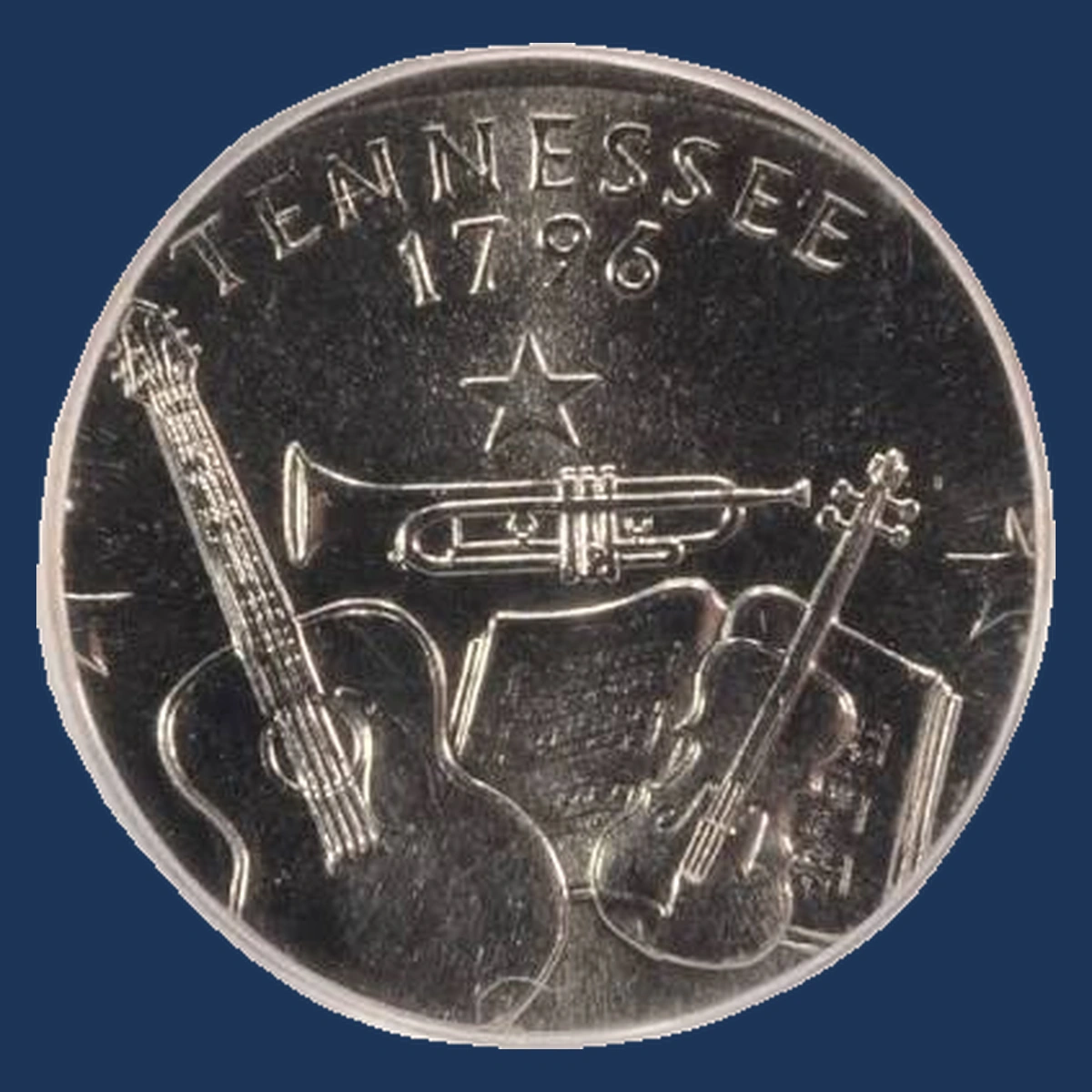
Tennessee also has a reported back-side doubling type involving lettering, instruments, or the ribbon. Indiana P and Mississippi front-side reports need their own matching examples.
An ear pattern from one state cannot identify all the others.
Estimated Value
Allow an estimated $10–$150 for a clearly matched doubled design on an ordinary coin. Subtle examples generally need magnification, while a strong rounded extra outline is easier to sell.
Recognized ear varieties are easier to compare than an unexplained thick letter. Wear can hide the small feature that makes a particular coin collectible.
Condition still matters, even when the doubling remains visible. Flat mechanical doubling should not receive the same premium as a documented doubled design.
How to Identify
Read the state name and mintmark first. The Ohio doubled-die catalog concerns Ohio examples, not every quarter bearing Washington’s portrait.
Ordinary clad coins should retain their grooved edge and measure near 5.67 grams and 24.26 millimeters on a scale and calipers. Those checks will not identify an ear variety.
Magnify Washington’s lower earlobe 10× and compare its extra contour with the matching state and mint. A flat shelf cutting into a letter is a different warning sign.
For Tennessee back-side reports, inspect the instruments and lettering instead of the front ear. Indiana and Mississippi also need their own photographs.
Match the rounded extra detail itself, rather than accepting a thick-looking letter as proof.
3. 2002 Washington State Quarter Peeling Metal on Mississippi
A thin flap or rough shallow cavity can appear when metal splits within the coin. Collectors call this lamination, meaning a layer of metal has separated.
Mississippi reports include this kind of local peeling. The affected side and exact location must be taken from the individual coin, rather than assumed to be a particular flower.
The split may leave metal attached, or a fragment may have fallen away. Neither appearance automatically means an entire copper-nickel face is missing.
A tool used after minting can also lift metal, leaving a deceptive flap.
Estimated Value
Genuine local peeling is estimated at $15–$175 on an ordinary Mississippi quarter. A small stable split lies toward the lower end, while a broad flap can attract more interest.
A 1911 Liberty nickel with front-side lamination sold for $51 in January 2023. That different-year, different-metal example offers a modest comparison for peeling errors.
A gouged or deliberately pried surface belongs outside this range. Remaining design and original surfaces affect the price.
How to Identify
Leave any flap untouched and first check where it remains attached. A loose clad quarter normally weighs 5.67 grams and measures 24.26 millimeters, but avoid pressing calipers against lifted metal.
Under a 10× magnifier, follow the opening from its attached end toward the loose edge. Look for a thin layered separation rather than a deep scoop with metal piled beside it.
Check whether nearby letters or flower details continue naturally across the split. Lighting from the side can make the layered structure easier to see.
Inspect the edge grooves for a tool entry point.
A flap surrounded by an undisturbed struck surface supports natural separation; a fresh pry mark beside the opening points toward later interference.
4. 2002 Washington State Quarter Raised Cracks and Metal Lumps
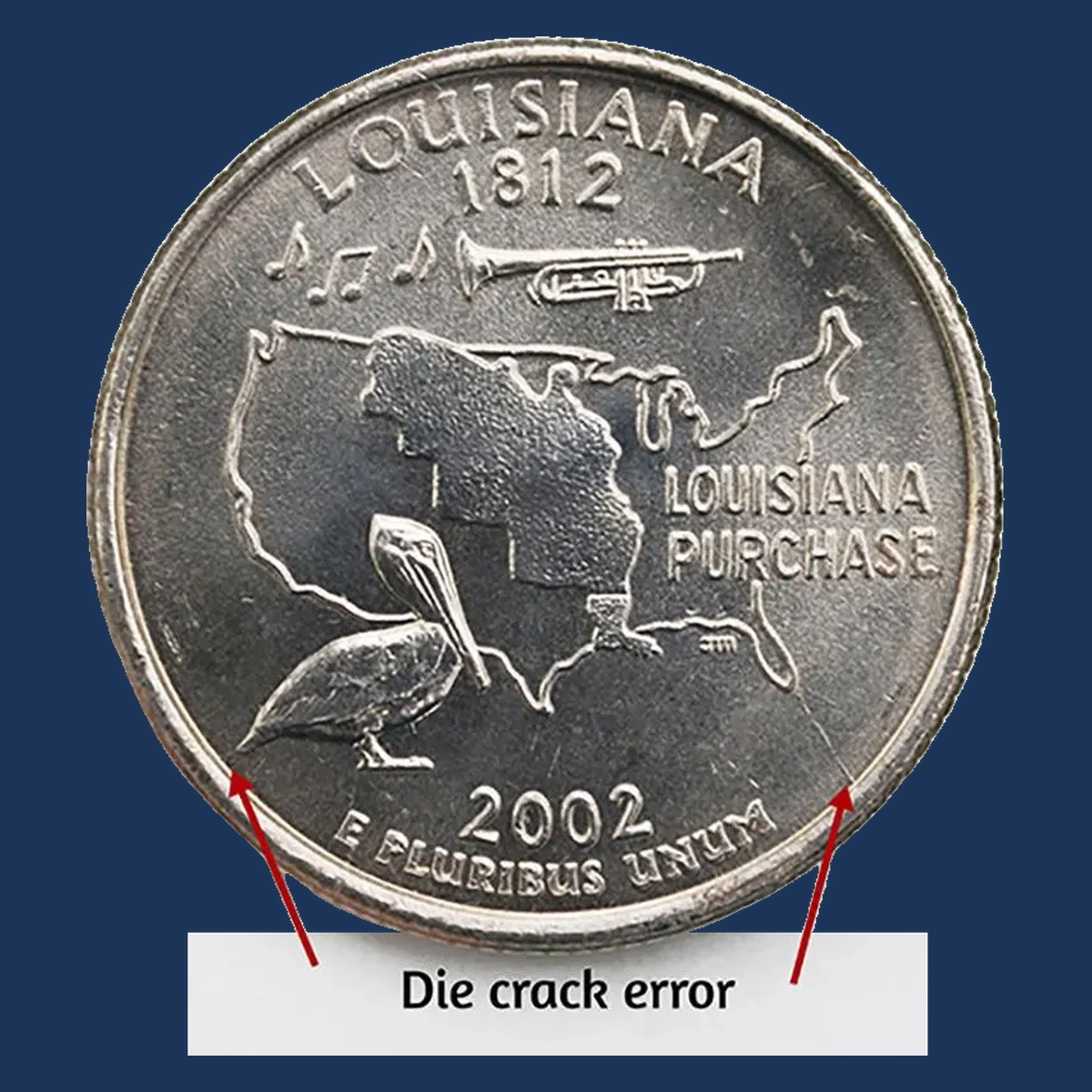
Fine raised lines near Tennessee’s instruments can come from cracks in the stamping tool. Metal enters the crack during striking and leaves a narrow ridge on the coin.
Ohio reports concern small lines or lumps around the astronaut and airplane. Louisiana reports include the map and a line near the pelican’s beak.
Mississippi has flower-edge crack reports and a separate claimed rim break. A broad raised patch connected to the rim is called a cud.
These are separate locations on different coins. Normal strings, feathers, and flower outlines remain part of the intended design.
Estimated Value
Small raised cracks and chips usually fit an estimated $2–$40 range. A genuine large rim-connected cud can be estimated around $40–$250, depending on its size and visibility.
A 1970-D nickel with two cuds sold for $63 in October 2022. It is a different-year comparison, rather than a sale of a Mississippi quarter.
The Mississippi cud range applies to a coin that actually has the required rim-connected break. A nickname or a small interior lump does not establish that feature.
How to Identify
Start with a normal quarter showing the same state. Compare Tennessee’s instrument strings, Ohio’s astronaut, Louisiana’s pelican, or Mississippi’s flower before calling a line extra metal.
A 10× magnifier helps show whether the line rises above the surface. Scratches usually cut down into it, sometimes pushing a narrow lip up beside the cut.
For a suspected cud, inspect the rim connection first and then the adjoining edge grooves. A loose clad coin normally remains near 5.67 grams and 24.26 millimeters on a scale and calipers, since tool damage does not add a separate piece of metal.
Trace the raised area into the design: a natural struck ridge differs from an impact crater or attached blob.
5. 2002 Washington State Quarter Unusual Heat-Treatment Color
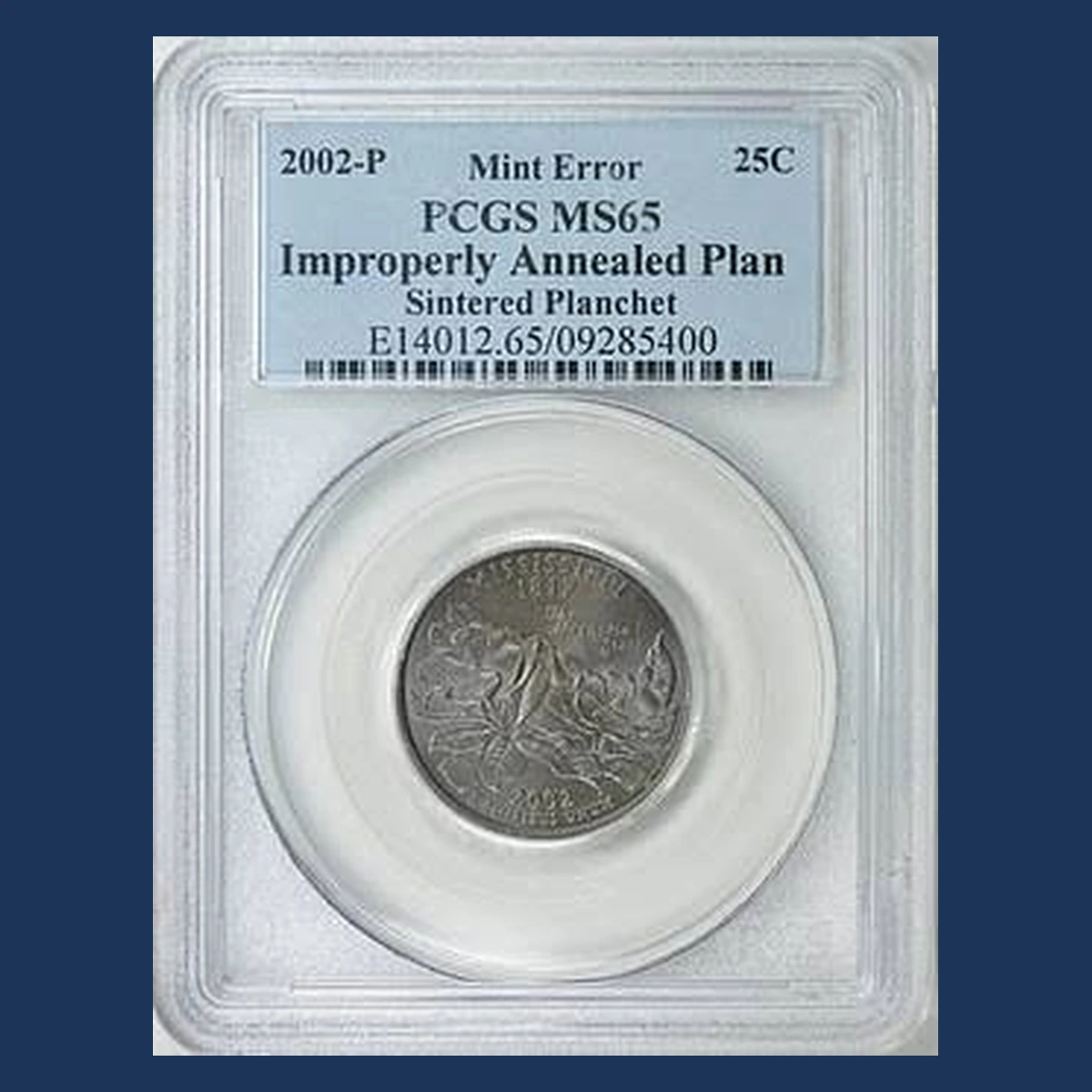
An unusual overall surface color can begin before a coin is struck. Coin blanks, the plain metal discs used to make coins, are heated during production.
Problems during that treatment may alter their surfaces. Auction descriptions sometimes call this an improperly annealed or sintered blank.
A 2002-P Tennessee example was listed with an ICG MS65 grade, describing an unworn coin with relatively clean surfaces. Its exact color should be judged from that coin itself.
Ordinary staining can produce similar colors later. Color is therefore a clue to examine, not proof of a minting error.
Estimated Value
Estimate $40–$250 for a genuine Tennessee heat-treatment error with appealing original surfaces. The change should be clear enough to see without unusual lighting or heavily edited photographs.
A 2005-P dime with an annealing error sold for $74 in April 2015. That different-year, different-denomination result supports a modest starting comparison rather than a special Tennessee auction claim.
Damage, corrosion, and added coatings can sharply reduce value. A professional opinion is especially useful when color is the main reason for the premium.
How to Identify
If the coin is loose, record its weight and diameter with a scale and calipers before examining color. The ordinary clad standards are 5.67 grams and 24.26 millimeters, and a color change alone should not alter them.
Place a normal Tennessee quarter beside it under white light, then turn both coins slowly. Inspect the suspected coin at 10× for corrosion pits, paint against letters, and differences between its faces and grooved edge.
Do not polish a dark patch to expose the metal below it. For a coin offered at a premium, compare the intact surface directly with an authenticated heat-treatment example rather than accepting darkness alone.
6. 2002 Washington State Quarter Faint Transferred Designs on Louisiana
A faint part of Washington’s design can sometimes appear where it does not belong on the back, or vice versa. This happens when the two stamping tools touch without a blank between them.
They can mark each other, then pass those marks to later coins. The effect is called a die clash.
Louisiana has a reported example, but no single trace location identifies every claimed coin. It should show recognizable pieces of the opposite design.
A random scratch or shallow stain does not become a clash merely because it crosses an open area.
Estimated Value
For a genuine Louisiana clash, an estimated $50–$300 covers modest through clearly visible transferred details. Original surfaces and a convincing match to the opposite design support the stronger end.
The finish and metal also matter. A specially made Proof coin, usually with reflective fields, should not be priced as an ordinary pocket-change coin.
A weak line visible only at one lighting angle has limited appeal. Several clear, matching traces make a much stronger case for paying a premium.
How to Identify
Photograph both faces squarely, then compare each faint trace with a reversed outline of the opposite design. A believable match should explain its shape and position together.
A 10× magnifier will help separate a struck trace from a fresh cut. Follow the mark through open space rather than relying on one vaguely similar bend.
Establish the coin’s finish before weighing it: clad examples use 5.67 grams, while a 90% silver Proof uses 6.25 grams. Both should measure about 24.26 millimeters with calipers and have grooves around the edge.
Tool contact normally leaves those measurements intact. A trace that fits an actual part of the opposite face offers the clearest practical confirmation.
7. 2002 Washington State Quarter A Stepped Edge on Mississippi
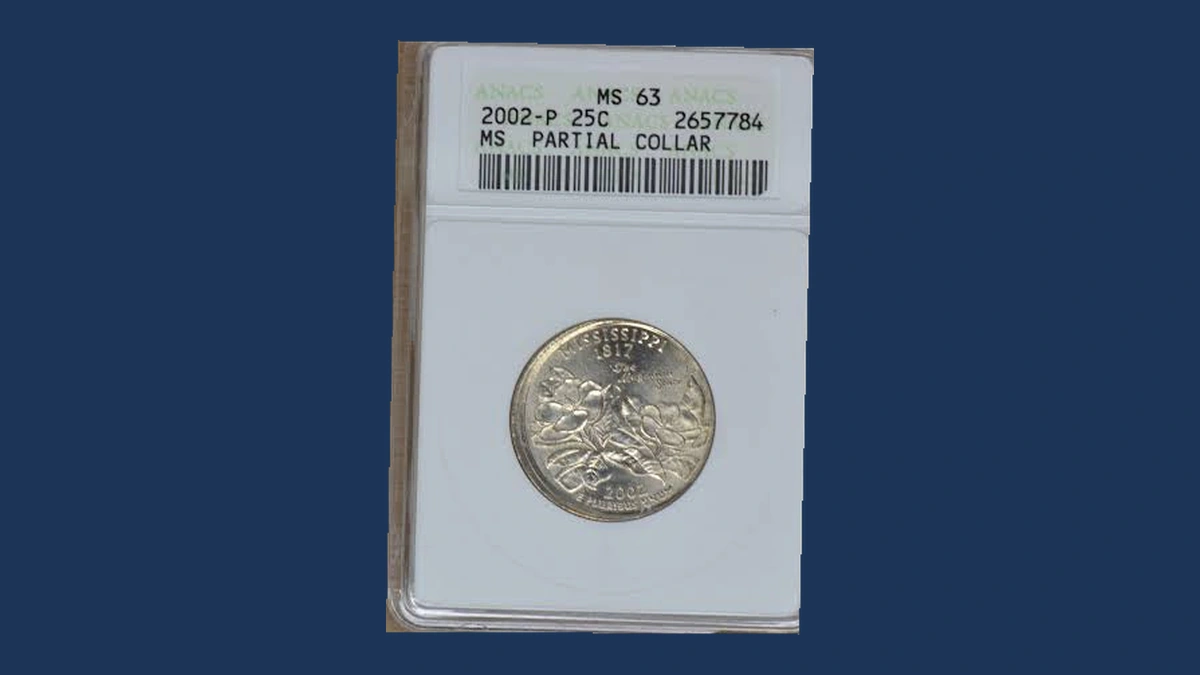
The side of the coin, rather than its picture, reveals this error. Part of the edge has normal grooves, while another part spreads outward into a smooth step.
The collar is the surrounding ring that normally holds the metal during striking. A partial-collar strike happens when the blank sits only partly within that ring.
A 2002-P Mississippi example appears in a specialist dealer’s error list. Its exact stepped section must be checked on the coin.
Two circles around the face alone are not enough. The difference in edge height is what matters.
Estimated Value
A clear ordinary Mississippi partial-collar strike is estimated at $30–$300. Small steps are less striking than a broad, easy-to-see change around the edge.
A 1990-P nickel with this error sold for $99 in June 2025. That sale is useful as a different-denomination comparison, while the state design and condition may alter demand for a quarter.
Original edge surfaces are essential. A coin squeezed in a vise or altered with a tool should not receive the same premium.
How to Identify
A face-on photograph can hide this error completely. View the coin from the side and locate the smooth expanded section beside the grooved section.
Measure across several directions with calipers, using 24.26 millimeters as the normal diameter. A scale should show roughly 5.67 grams for an ordinary clad coin because a partial collar moves metal rather than removing it.
Inspect the junction with a 10× magnifier while turning the coin slowly under low light. Fresh scrapes or crushed grooves suggest later alteration; a naturally struck rim leading into a clear step between smooth and grooved edge portions is the feature to find.
8. 2002 Washington State Quarter A Turned Back Design on Indiana
Turn an ordinary United States coin over from top to bottom and the other design should stand upright. A rotated-tool error leaves the back tilted after that same motion.
An Indiana 2002-D example has been reported in MS64 condition. The exact angle needs to come from the coin itself, not the angle of its holder.
This rotation occurs because one stamping tool was turned from its intended position. The coin can otherwise look normal.
A sideways flip gives a different result. It can make a perfectly ordinary quarter appear incorrectly aligned.
Estimated Value
Estimate $25–$400 for a genuine Indiana rotation, from a modest turn to a dramatic angle on an attractive coin. Very slight alignment differences usually draw much less interest.
As a later comparison, a 2015-D nickel rotated 90 degrees counterclockwise sold for $79 in October 2021. That angle and amount belong to the nickel, not the reported Indiana quarter.
The quarter’s measured rotation should guide the estimate. Wear, marks, and how easily the error can be demonstrated also affect demand.
How to Identify
Keep Washington upright and flip the coin from top to bottom without turning it sideways. Repeat with a normal quarter to check your hand movement.
Indiana’s back design should finish upright. Photograph a suspected rotation in one continuous sequence so the initial and final positions remain clear.
A holder’s tilt proves nothing about alignment.
Use a 10× magnifier to inspect the grooved edge for a join between altered pieces; a scale and calipers should show about 5.67 grams and 24.26 millimeters for clad. Stop if a seam or unnatural edge suggests an assembled coin.
Repeat the same top-to-bottom flip once more: a consistent difference from the normal quarter’s back position is the angle to measure.
9. 2002 Washington State Quarter Blocked or Indented Design Areas
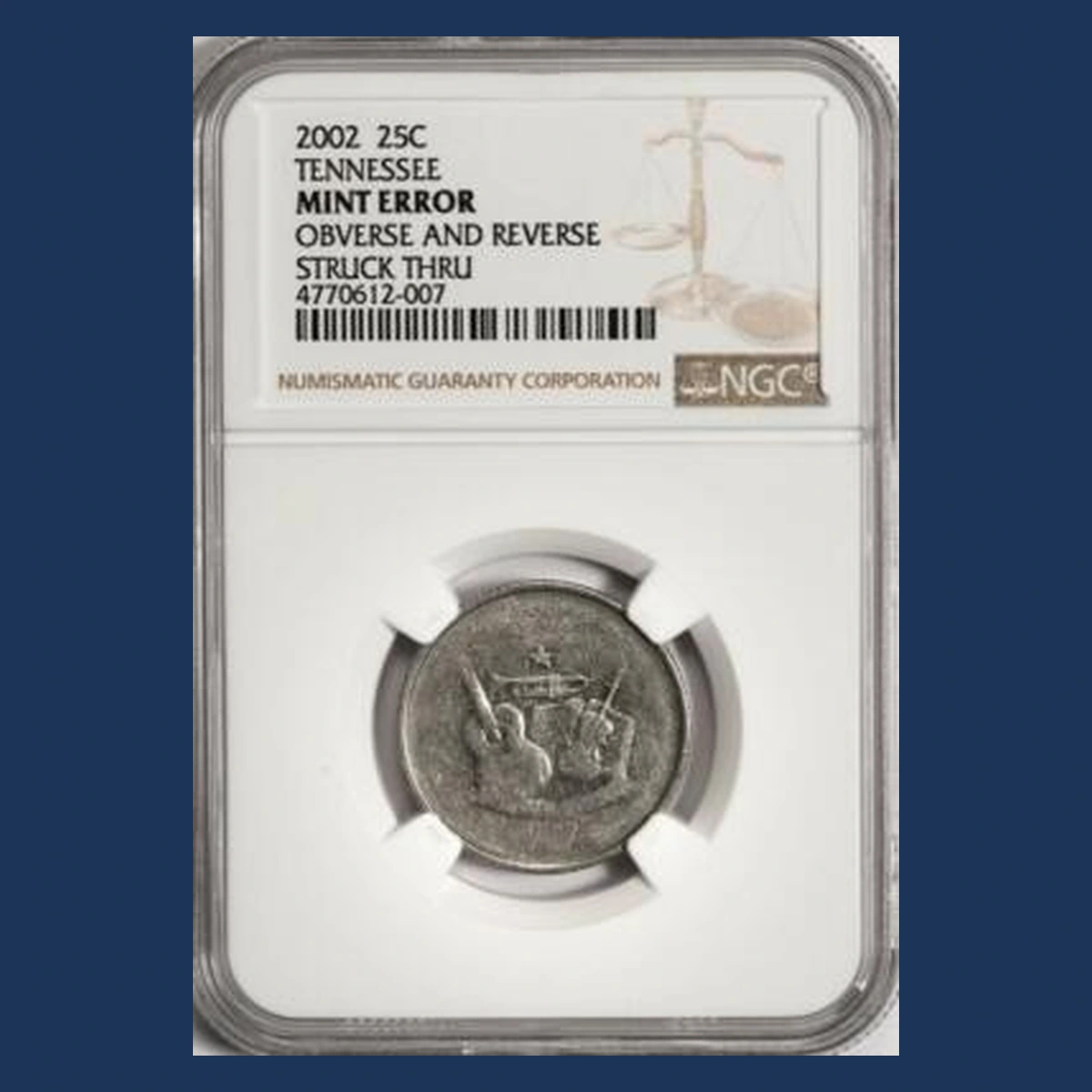
A missing patch of design can result when material gets between the blank and a stamping tool. The coin is struck through that material instead of receiving the full design.
Tennessee includes an NGC-labeled major struck-through example. Mississippi reports describe local depressions, while Indiana reports concern weak details caused by grease or similar buildup.
Louisiana also has a report of a depression near the pelican’s wing. Its exact coin and finish need an individual check.
These appearances need not share one cause or size. A later dent can remove detail too, but usually disturbs the surrounding metal.
Estimated Value
Small blocked details are estimated at $10–$75; large, clearly mint-made struck-through areas can reach roughly $100–$500. The shape and extent of the missing design matter more than a dramatic label.
A 1986-P nickel with a struck-through error sold for $204 in June 2023. That different-year sale helps compare a visible surface error but does not establish a Tennessee or Louisiana price.
Proof coins require separate finish comparisons. Scratches, corrosion, or dents acquired after minting do not earn this error premium.
How to Identify
For weak Indiana lettering, compare the nearby design first: wear generally affects exposed details together, while trapped material can block a smaller area. A 10× magnifier helps reveal that boundary.
On Tennessee or Mississippi, examine the depressed patch and the metal beside it. Later impacts often push metal outward, whereas a struck-through area can interrupt the design without that impact lip.
Louisiana’s wing-area report needs the same surface check plus identification of its finish. A normal clad coin weighs 5.67 grams, compared with 6.25 grams for a 90% silver Proof; calipers should show about 24.26 millimeters.
Inspect the edge grooves for broader damage. Follow the natural boundary between struck design and blocked area instead of judging the error by missing letters alone.
10. 2002 Washington State Quarter Missing Outer Metal Layers
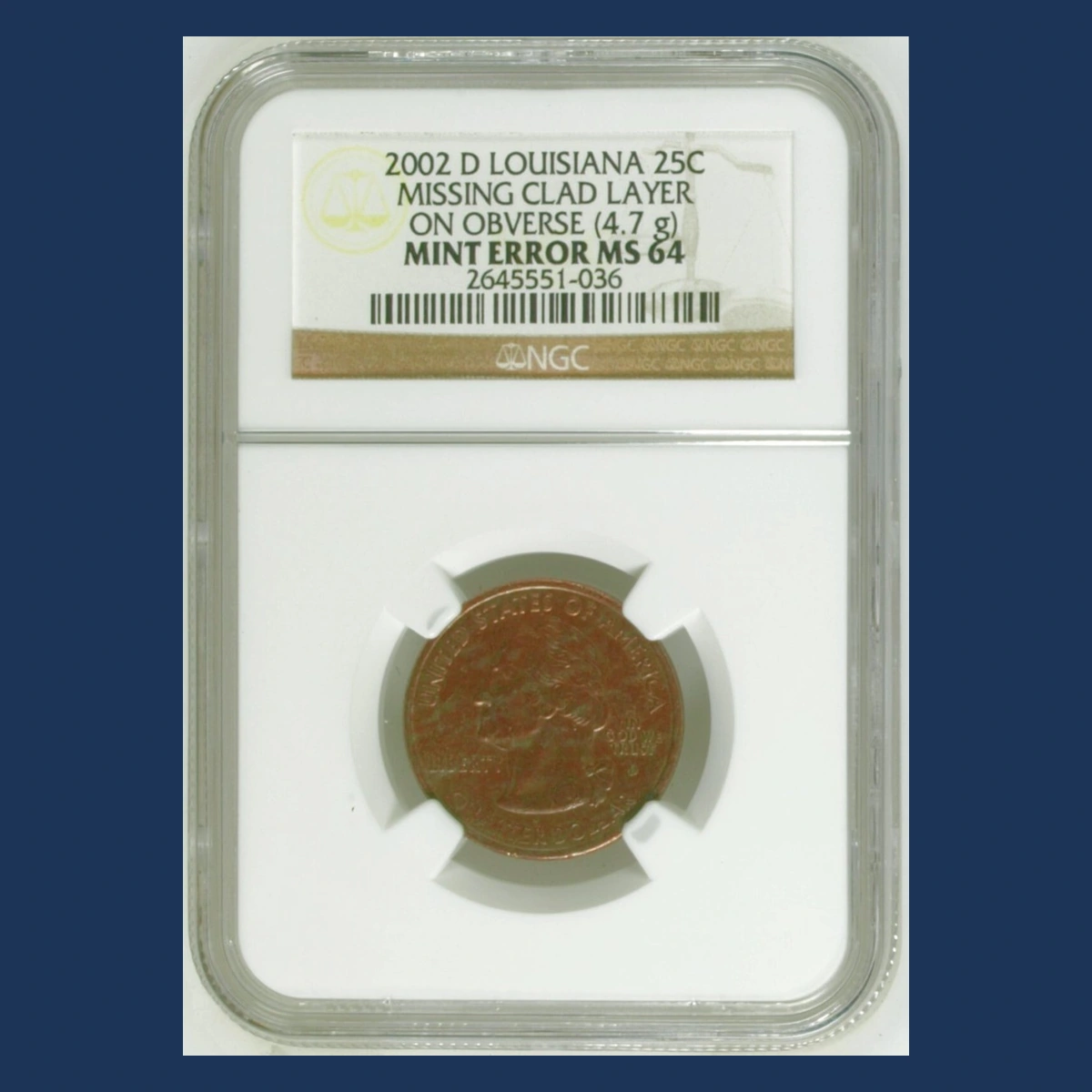
A missing outer layer exposes the copper inside an ordinary quarter. The exposed face can still carry a design, but its color and weight differ from a normal coin.
A reported Ohio P example lacks the back layer and also has later damage on the front. The damage is a separate condition issue.
Tennessee includes a PCGS MS64 back-layer example; Indiana has a separate PCGS MS65 front-layer example. Louisiana also has a missing-layer report.
Their sides, weights, and mintmarks must not be transferred from one coin to another. A copper-colored coating can imitate the appearance.
Estimated Value
A genuine full missing layer on an ordinary 2002 quarter is estimated at $100–$700. A clean, strongly struck exposed face should command more than one with heavy damage.
A 1999-D Connecticut quarter missing its back layer sold for $149 in December 2024. It provides a different-state, different-year comparison for the 2002 examples.
The damaged Ohio coin should not be priced like a problem-free example. Smaller local losses may fall below this range, while silver Proofs are a different construction altogether.
How to Identify
Weigh a loose suspected coin before relying on its copper color. A normal clad quarter starts at 5.67 grams, so an entire missing face should leave a meaningful weight reduction.
Through a 10× magnifier, inspect the boundary where the exposed copper meets the grooved edge. Added plating, chemical stripping, or grinding may leave evidence there.
Use calipers to compare the diameter with 24.26 millimeters, and examine whether the design was naturally struck into the exposed metal. On the Ohio example, separate the front damage from the missing back layer.
A correct weight loss together with an undisturbed layer boundary is much stronger evidence than a reddish face alone.
11. 2002 Washington State Quarter Clipped and Oval Blanks
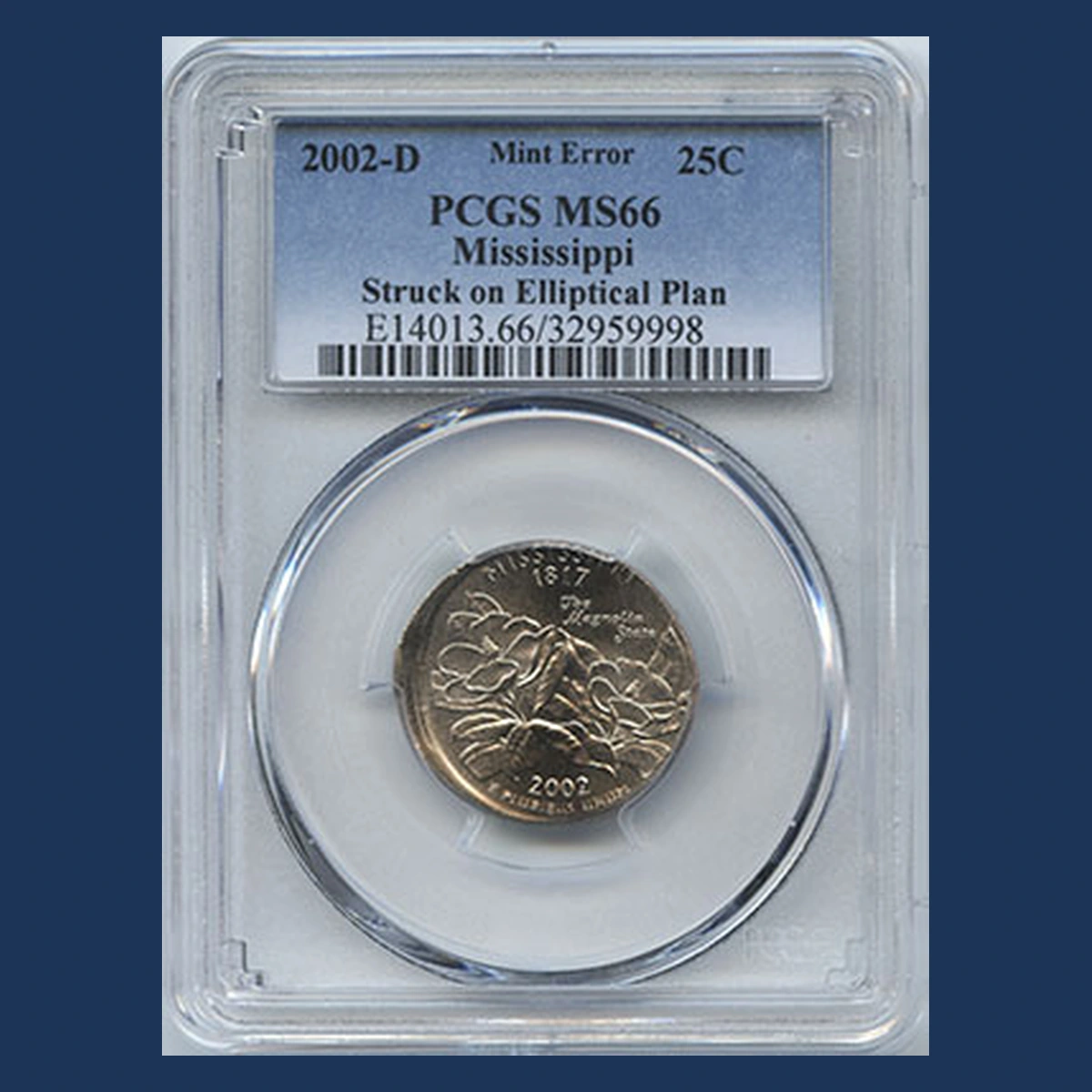
A quarter need not begin with a complete round blank. Missing metal can leave a curved bite or an oval shape that remains after striking.
The recorded 2002-D oval examples include Tennessee at 4.7 grams and Ohio at 5.0 grams. Indiana and Mississippi also have separate cataloged oval coins.
One Mississippi D example combines an oval blank with a 5% off-center strike. Both features belong to that one coin.
Another Mississippi P example has a reported 5% curved clip. A curved bite and an oval outline are different shapes of missing blank metal, not interchangeable photographs.
Estimated Value
Estimate $30–$200 for a small genuine curved clip and $150–$1,000 for a strong oval or combined error. These are whole-coin ranges, so the Mississippi combination should not receive two prices added together.
A 1999-D Pennsylvania quarter with overlapping clips sold for $74 in December 2024. Its different shape makes it a modest comparison, not an exact price for an oval blank.
A readable state design and natural missing boundary help. Heavy filing or an artificial cut removes the mint-error premium.
How to Identify
Compare the Tennessee and Ohio weights only with their own cataloged coins. For a new example, measure it yourself: an ordinary clad quarter begins at 5.67 grams and 24.26 millimeters.
Use calipers along the long and short directions of an oval coin. Under a 10× magnifier, inspect the remaining edge grooves and the missing boundary for saw marks or fresh filing.
The elliptical-blank collection separates the state examples, including Mississippi’s combined error. On that coin, distinguish absent metal from the blank area left by the displaced strike.
Follow the outline all the way around: a naturally formed incomplete blank should explain the shape without a later cut.
12. 2002 Washington State Quarter An Off-Center Silver Louisiana Proof
Part of the Louisiana design can fall outside the coin when its blank is not centered under the stamping tools. A plain crescent remains opposite the missing design.
This report concerns an S-mint silver Proof, a coin specially made for collectors with carefully prepared surfaces. Its metal differs from the ordinary layered quarter used in change.
The displacement must affect the coin as a whole, rather than just one shifted stamping tool. The report does not establish a particular percentage or grade.
A rubbed or damaged border should not be mistaken for a naturally unstruck crescent.
Estimated Value
For a genuine silver Proof off-center strike, use an estimated $300–$1,500, depending on displacement and surface quality. Clear date and state details make the error easier to collect.
A 1999-P Georgia ordinary clad quarter struck 40% off center sold for $192 in December 2024. Louisiana’s different metal and Proof production make that a lower-level comparison rather than an equivalent sale.
Reflective surfaces show contact marks readily. Cleaning or polishing can reduce value even when the underlying minting error is genuine.
How to Identify
Use a scale first: a normal 2002 silver Proof weighs 6.25 grams and contains 90% silver, whereas clad uses 5.67 grams. Confirm the finish as well, since a bright ordinary quarter is not automatically a Proof.
Place square photographs of both faces beside a normal Louisiana quarter. Determine whether missing design corresponds to the same unused part of the blank, then compare the outline with the normal 24.26-millimeter diameter using calipers.
At 10×, inspect the plain crescent and nearby edge grooves for sanding or fresh scratches. A naturally untouched crescent opposite design cut off on both faces identifies the off-center feature most directly.
13. 2002 Washington State Quarter Overlapping Strikes
More than one set of instruments or overlapping Ohio letters can show that a quarter was struck again after moving. The second image comes from another blow, not a doubled design on the tool.
A Tennessee P coin in a PCGS collector registry is described as struck four times. Its strike sequence should not automatically be called a flip-over error.
Separate Ohio examples include a D coin with the second strike 20% off center and a P coin with a 10% displacement. Those percentages belong to different coins.
Each extra impression must fit a possible movement of the same blank.
Estimated Value
Double-struck ordinary quarters are estimated at $150–$900, while a clear four-strike Tennessee example can be estimated around $500–$2,000. Strong, separated impressions are easier to appreciate than tiny overlaps.
A 2001-P dime with a second strike 75% off center sold for $114 in October 2021. Its different size and strike arrangement prevent a direct one-for-one comparison.
A four-strike coin receives one overall value. Do not multiply a single-strike price by four or add a separate premium for every repeated letter.
How to Identify
A second rim is a useful first clue. Look along the edge for two struck borders, then follow a repeated Ohio letter or Tennessee instrument inward from each one.
The two sets of details should explain a possible movement of the same blank. A doubled design on one tool does not create a separately displaced rim.
Use a 10× magnifier to compare stronger later details with shallow earlier impressions, and check the other face before deciding whether the coin flipped. On a loose clad example, compare weight with 5.67 grams and use calipers against 24.26 millimeters; extra blows may expand the outline and interrupt edge grooves.
Find a second naturally struck image whose position agrees with the second rim.
14. 2002 Washington State Quarter Expanded Strikes and a Cupped Ohio Proof
A broadstrike spreads outside the ring that normally holds a quarter’s edge. The full design may remain while extra metal extends beyond its usual border.
Ordinary examples include Ohio D, Tennessee P, and Mississippi D reports. A separate Ohio S Proof has a cup-shaped edge and clashed designs on both faces.
Clash marks form when the stamping tools touch without a blank between them, then carry faint opposing details to later coins. The cupped Proof combines these features on one coin.
Its unusual shape alone does not prove that the coin became stuck to a tool as a cap.
Estimated Value
Ordinary broadstrikes are estimated at $40–$350. Ohio’s cupped, clashed Proof calls for a separate estimated range of $500–$2,500, based on the combined appearance and preservation.
A 1990-P nickel with a partial-collar edge error sold for $99 in June 2025. That related edge error offers an ordinary-coin comparison, not a direct price for the Ohio Proof.
The Proof’s metal must be identified separately. Its cup shape and clash marks should be valued together, not priced as two independent coins.
How to Identify
For an ordinary broadstrike, first check that the complete design remains inside the expanded border. Missing design beyond one side suggests an additional off-center feature instead.
Calipers can compare the width with the normal 24.26 millimeters. A scale should show about 5.67 grams for clad or 6.25 grams for a 90% silver Proof, unless another error changes the weight.
On Ohio’s Proof, inspect the cup-shaped edge and any remaining grooves without trying to flatten it. Use a 10× magnifier to match faint clash traces to parts of the opposite design.
Check the whole rim for damage from squeezing or hammering. A full struck design inside naturally expanded metal is the strongest starting point for broadstrike identification.
15. 2002 Washington State Quarter Designs Struck on Smaller Blanks
Indiana’s racecar and Washington’s portrait survive on a documented dime-sized blank, while much of the surrounding text does not. The P mintmark remains near the edge, but the date lies outside the metal.
Tennessee also has separate P and D dime-blank examples. On the P example, the mintmark and date are outside the blank; its identification comes from the auction and holder.
These coins were made when a blank intended for another denomination entered a quarter press. A Tennessee nickel-blank report is a separate claim.
A smaller blank does not automatically mean an already-struck dime was used.
Estimated Value
Dime-blank state quarters can be estimated around $5,000–$20,000. The Indiana PCGS MS64 coin sold for $17,400 in August 2023.
A separate Tennessee D PCGS MS65 example is offered by Sullivan Numismatics for $8,000, an asking price. State rarity and visible design can outweigh a one-point grade difference.
For an authenticated Tennessee nickel-blank example, a separate estimated $500–$2,000 range is more suitable. Nickel blanks should not inherit the dime-blank auction price.
How to Identify
Begin with size and weight, not a missing date. Standard clad dime blanks weigh 2.268 grams and start around 17.91 millimeters; nickel blanks use 5 grams and about 21.2 millimeters.
Those are comparison standards, not measurements of the listed auction coins. Use a scale and calipers, remembering that striking can expand a smaller blank beyond its original size.
With a 10× magnifier, inspect the remaining edge and any grooves for grinding that reduced an ordinary 5.67-gram, 24.26-millimeter quarter. Check which parts of the state design naturally extend beyond the available metal.
For Indiana, the racecar and portrait survive while the date does not. Have a specialist confirm that the metal, measurements, and naturally truncated design fit the same smaller blank.
Conclusion
Estimated values stretch from $2–$20,000, with tiny raised cracks at one end and unusual wrong-blank strikes at the other. The five state designs offer different places to look, so compare the correct coin first.
Keep ordinary clad coins separate from specially made Proofs, including silver examples. Record any missing metal, displaced design, and edge change before judging the error, and leave original surfaces untouched.