2004 Quarter Error List with Pictures

The small curve above Wisconsin’s cheese wheel can matter a great deal. An Extra Leaf Low quarter graded MS67—unworn with very few marks—sold for $6,000 in January 2020.
That famous variety is only part of the 2004 quarter errors worth examining. Estimated values run from $2–$6,000 for the features below, including filled letters, broken blanks, and Florida quarters made on nickel blanks.
Follow the visible clues to separate these errors from everyday damage.
1. 2004 State Quarter Texas Clashed Design
Faint star or rope shapes around Washington can echo the Texas reverse. They are not supposed to be part of the front design.
A die clash can create this effect. The two dies, or stamping tools, strike each other with no blank between them, leaving marks that can appear on later coins.
Clashes are reported for Philadelphia and Denver Texas quarters, but a specific mark needs to match the opposite design. Random scratches and normal background lines do not become clash marks just because they surround the portrait.
Estimated Value
Estimate $15–$150 for a recognizable Texas clash, with stronger and cleaner examples toward the upper end. Several clearly related outlines usually create more interest than a single faint line.
The condition of the background matters because scratches can conceal the feature. An unworn coin with an obvious transferred shape may be easier to sell than a heavily marked piece, even when the latter appears to carry more stray lines around Washington.
How to Identify
Place photographs of the two faces side by side and compare the stray marks with the star and rope border. Flipping one image horizontally can help reveal the relationship between the opposing designs.
Do several nearby shapes match together? If every mark needs a different angle to resemble something on the back, the comparison is weak.
Use a magnifier on the coin itself to inspect the lines under moving light. Sharp trenches with displaced metal beside them suggest scratches or other damage.
The design match matters more than whether one isolated mark looks raised or sunken. Start with the star’s outline or a recognizable stretch of rope, then look for adjoining matching details.
2. 2004 State Quarter Doubled Details
An extra rounded detail below Washington’s earlobe identifies reported doubled-die examples on Philadelphia Florida quarters. The tool carried this doubled feature before striking the coins.
On Iowa quarters, doubling is reported around school windows and nearby building or tree outlines. Those reverse features belong to a different state design, even though the general cause is similar.
Texas reverse doubling remains a possibility to examine. Its star and map need a match to another Texas coin; extra lines on an Iowa school scene describe a different design and cannot identify the Texas pattern.
Estimated Value
Florida’s small earlobe doubling is estimated at $15–$100. For clear Iowa reverse doubling, use roughly $20–$200, depending on strength and the coin’s condition.
An unconfirmed Texas mark should not borrow the price of an identified Iowa variety. If it proves to be a genuine minor doubled design, $10–$100 is a reasonable starting estimate.
Worn-tool spreading and flat movement-related doubling do not deserve the premium of a clearly matched raised feature.
How to Identify
Look immediately below Washington’s earlobe on a P Florida quarter. A 10× magnifier should reveal the extra rounded detail more clearly than a distant photograph.
For Iowa, turn to the school scene instead. Compare window lines and nearby outlines with a normal coin under the same lighting.
A doubled die repeats part of the design because the stamping tool itself carries that extra feature. A flat shelf alongside a letter can instead result from movement during the strike.
Texas needs a fresh comparison with its own normal star and map, not an Iowa photograph.
Check that the suspected feature matches the correct state and exact position; a vaguely thicker outline alone is not enough.
3. 2004 State Quarter Filled Letters and Grease Strike-Throughs
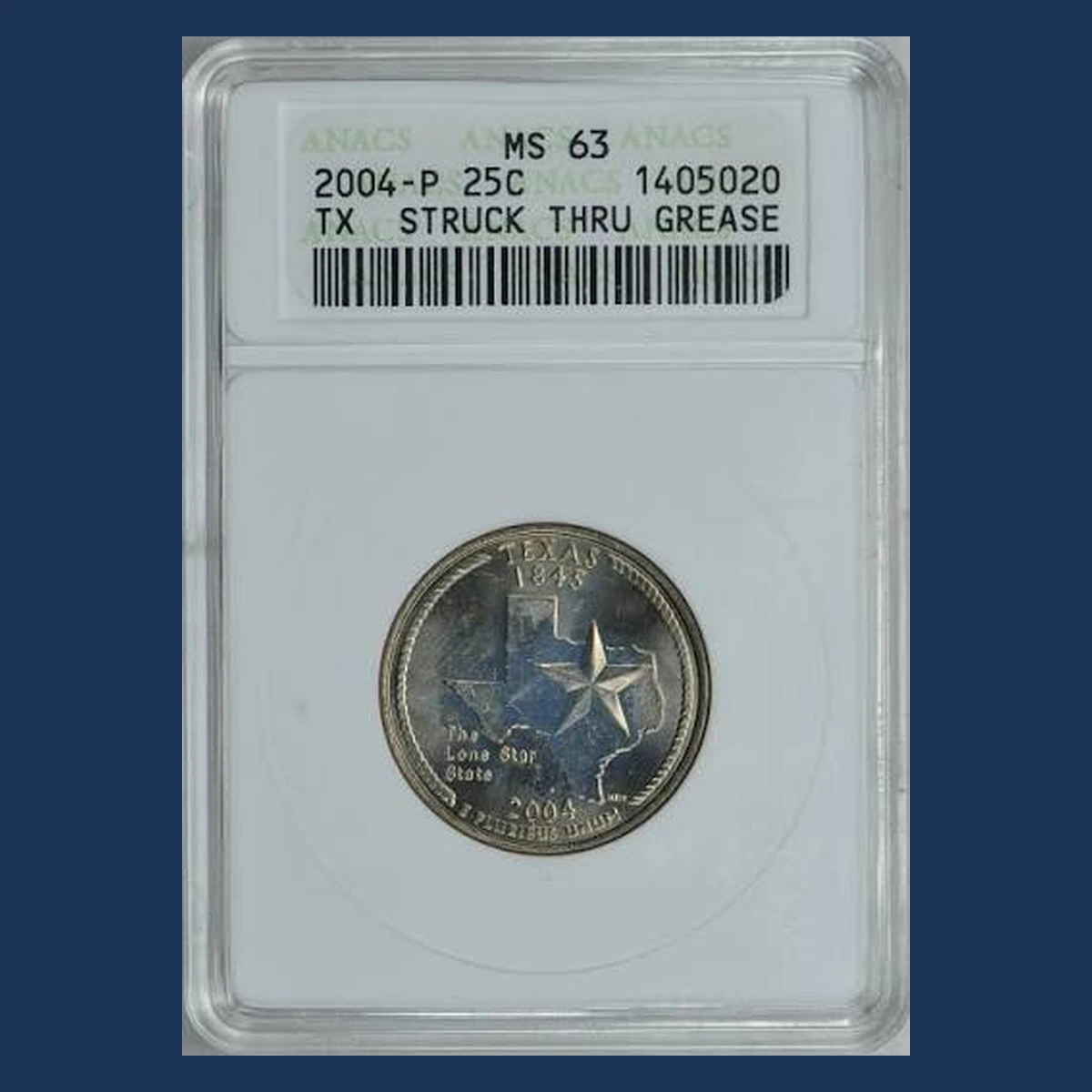
A missing T can make IN GOD WE TRUST look like IN GOD WE RUST on a Texas quarter. A Philadelphia example is described by a seller as struck through grease.
Packed material can fill a letter-shaped recess in the stamping tool. Metal cannot enter that blocked space, so the letter forms weakly or disappears.
Philadelphia Iowa quarters are also reported with grease affecting the school scene, and an AU58 example has an auction record. These features require care because circulation wear or deliberate rubbing can remove the same small details.
Estimated Value
Lightly filled letters are estimated at $5–$40, while a larger, clearly interrupted scene can reach about $40–$200. Buyers generally prefer a sharply struck surrounding design that makes the missing area obvious.
A 2004-P Iowa grease strike-through graded AU58, showing slight wear, sold for $35 in April 2022. That is a separate example from the reported MS65 reverse error, so its price illustrates the lower part of the market rather than fixing every Iowa coin’s value.
How to Identify
Compare the T in TRUST with the neighboring letters on a normal Texas quarter. If the whole word and Washington’s face are flattened, circulation wear may explain the missing detail.
Under a magnifier, look for rubbing scratches or a shallow scraped hollow where the T should stand. Those features can expose deliberate removal rather than a letter that never formed fully.
For Iowa, examine the school scene under a lamp moved from side to side. A real weak area should remain visible as the reflections change.
Keep the two examples separate: a missing Texas letter does not explain which part of an Iowa reverse is affected. Clear surrounding details beside one softly incomplete area provide the useful first check.
4. 2004 State Quarter Blank-Heating Errors
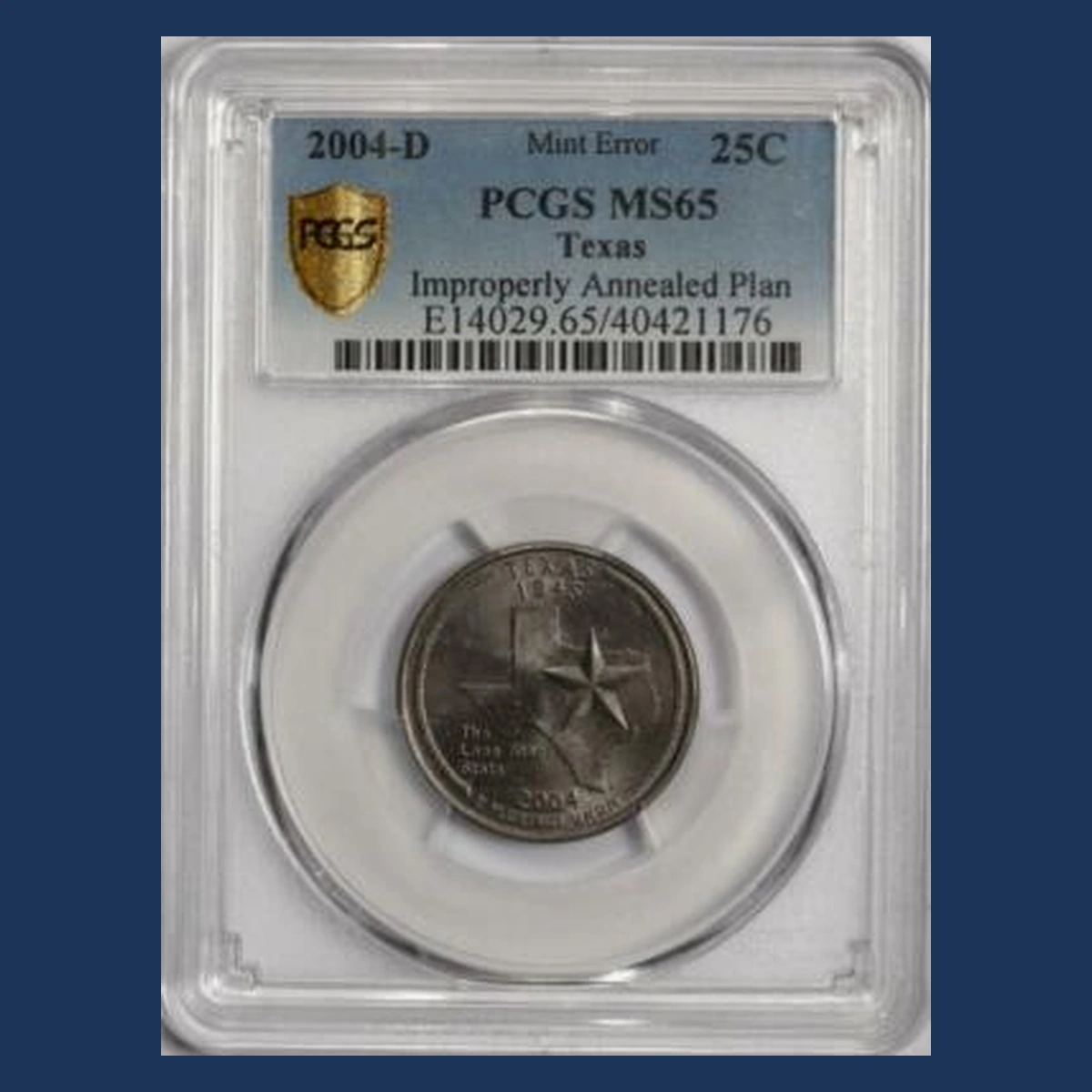
Michigan and Iowa quarters are known with unusual surfaces identified as improper annealing. Annealing means heating the blank to soften it before striking.
A Michigan example was graded PCGS MS65, while a separate Iowa coin was graded PCGS MS64. Both grades describe unworn coins, with the higher number generally indicating fewer distracting marks.
The unusual appearance comes from a problem during blank treatment, not from an intentionally different quarter alloy. Similar colors can develop after minting, so a brown or dull coin should not be identified from color alone.
Estimated Value
A 2004-P Iowa example brought $225.70 at Heritage in March 2026. Its certified MS64 condition gives a concrete comparison for an unworn coin with this error.
Estimated values are $40–$300, depending on surface quality and how clearly the cause is established. The Michigan MS65 listing records a sale but hides its final price, so its opening bid should not be treated as another realized result.
How to Identify
Before examining the coin’s color, read any grading-service description on its holder. A specific annealing-error label tells you more than an ordinary grade attached to a dark coin.
Inspect both faces under neutral lighting and use a magnifier to look for pits, crust, or chemical residue. Those signs may reveal later environmental damage.
On a loose clad quarter, check weight with a 0.01-gram scale against the normal 5.67 grams. A major loss of weight calls for other explanations, including missing metal.
Do not rub the surface to see whether the color comes off.
Preserved original details beneath the discoloration are useful to an examiner; uniform brown color by itself does not prove a Mint heating error.
5. 2004 State Quarter Iowa and Texas Clipped Blanks
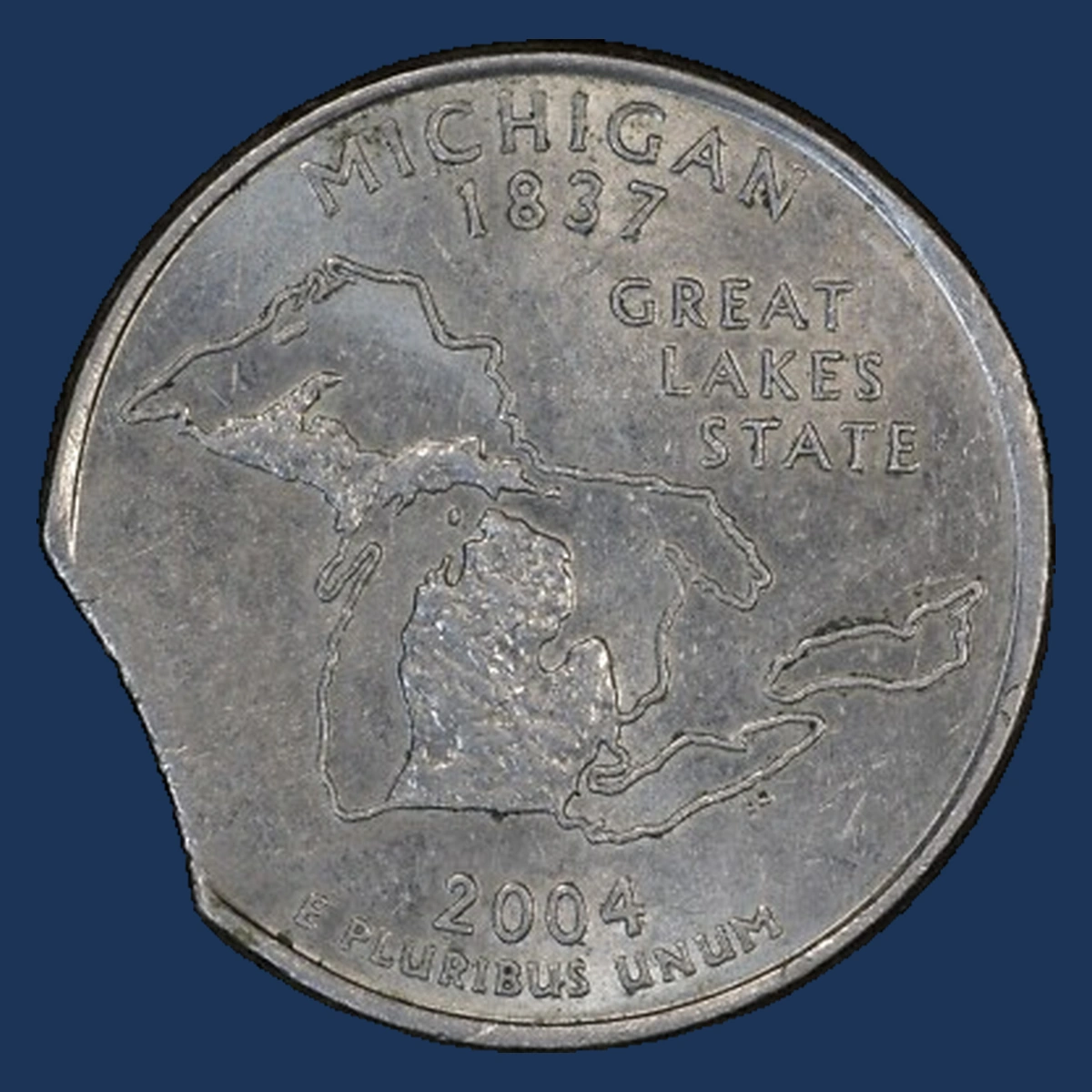
A missing edge segment can begin before the quarter is struck. The blanking press may cut an incomplete disk when it overlaps an earlier hole or reaches an edge of the metal strip.
A Denver Iowa quarter graded PCGS MS64 is cataloged with a 12% clip. That description gives the missing amount, not a clock position or a particular curved shape.
A separate Texas example is described as having a straight clip. Its flat boundary needs examination because cutting or grinding a finished quarter can create a superficially similar outline.
Estimated Value
Genuine examples are estimated at $30–$350. A small gap on a worn coin belongs lower, while a larger, cleanly formed missing area on an unworn coin can attract stronger bids.
A 2000-P New Hampshire elliptical blank error graded PCGS MS66 sold for $288 in September 2024. That different-year coin had a different shape, so it offers a broad market comparison rather than a sale price for either the Iowa or Texas example.
How to Identify
The Texas example calls for a close side view of its straight boundary. Under a magnifier, file marks or a sharp cut through fully formed lettering would suggest later alteration.
For either state, follow the rim as it approaches the missing segment. Tapered or stretched details can show how metal moved when the incomplete blank received its design.
A weak rim opposite the clip is helpful when present, but it is not a stand-alone proof. Weigh a loose coin on a 0.01-gram scale and compare with the normal 5.67 grams.
Less weight confirms metal is missing, not when it disappeared. Start with the way the original struck details meet the gap.
6. 2004 State Quarter Texas Tilted Partial Collar
An uneven step around the edge can reveal that a Texas quarter sat partly inside the collar during striking. The collar is the surrounding ring that controls size and forms the edge grooves.
When the blank is tilted, one section remains restrained while another can spread beyond the ring. The boundary between grooved and expanded metal may therefore slope around the edge.
A Denver Texas example is listed as a tilted partial-collar error. It differs from a fully broadstruck coin, which receives no normal collar restraint around the struck blank.
Estimated Value
An estimated $40–$350 suits a genuine tilted partial-collar Texas quarter. A clearly sloping edge step on an unworn example should be more appealing than a subtle height difference requiring careful enlargement.
The side view often determines buyer interest more than either face. Heavy rim knocks can make the feature difficult to judge, and a raised seam caused by later squeezing should not be priced as the original step produced during striking.
How to Identify
Set up a side view of the edge, using a magnifier or a close camera photograph to locate the step. Rotate the quarter through a full turn and watch how the boundary between grooved and expanded metal changes height.
Look closely where that boundary slopes, checking for crushed grooves or dents from a tool. A uniformly rolled seam or later edge damage should not be mistaken for the changing restraint of a tilted collar.
A loose clad coin normally weighs about 5.67 grams and measures roughly 24.3 millimeters, but part of this error may be wider. Use calipers gently to compare the spread portion with the section still held to normal size.
7. 2004 State Quarter Broadstrike
A broadstruck quarter spreads outward because the collar did not contain the blank during the strike. The coin becomes wider while still showing a complete design.
The surrounding collar normally controls the quarter’s diameter and puts grooves on its edge. Without that restraint, metal can flow farther outward and produce a broad rim or irregular expanded border.
A 2004 broadstrike is reported without a settled state or mint identity. That report should not be taken to mean all five state designs have matching examples, or that every oversized-looking quarter is a broadstrike.
Estimated Value
Estimated value is $50–$400 for a genuine 2004 State quarter broadstrike. Strong expansion with complete, readable details generally makes a more attractive error than slight spreading.
Identification of the state and mint matters when comparing similar coins. A wide quarter flattened outside the Mint is not equivalent, and scratches or bent edges can reduce a genuine example’s appeal.
The cleanly expanded shape should be visible in both full-face and side photographs.
How to Identify
Check the whole design before reaching for calipers: the scene and intended lettering should remain complete on a broadstrike. An unstruck arc beside a cut-off image instead points toward an off-center strike.
For a loose coin, measure the expanded outline against the normal diameter of roughly 24.3 millimeters and weigh it against 5.67 grams. Spreading alone changes shape rather than removing metal, so a major weight shortage needs another explanation.
Examine the edge with a magnifier for expanded metal, remaining grooves, or a sloping partial-collar step. Later flattening also enlarges a quarter, but crushed designs differ from a complete struck scene inside a naturally spread border.
8. 2004 State Quarter Wisconsin Cracked Blank
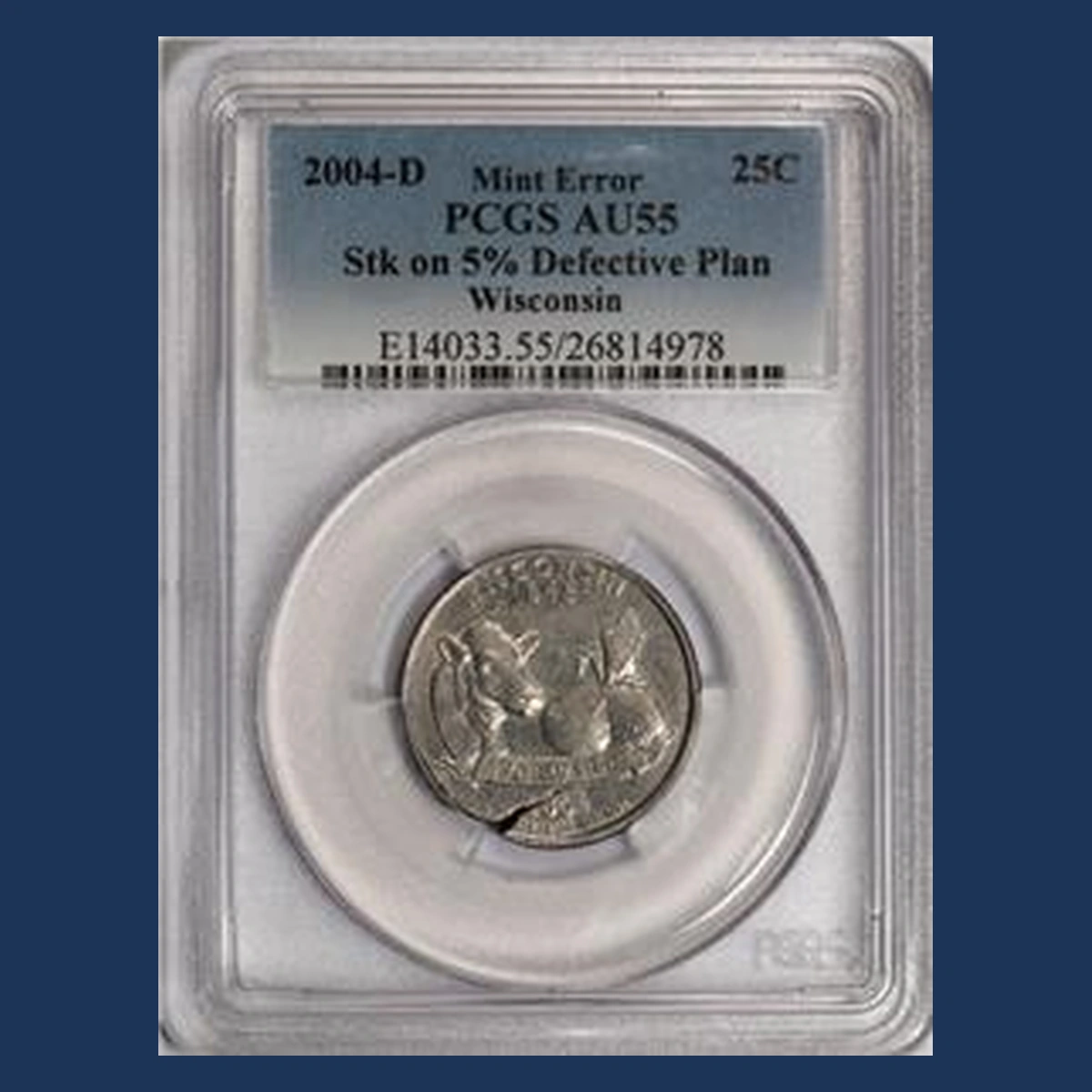
A crack in the coin’s metal is different from a raised line copied from a cracked stamping tool. A defective blank may already contain a split that opens or changes when the design is struck.
A Denver Wisconsin example was certified by PCGS as struck on a defective cracked blank. Its published description does not specify the path of the crack.
The visible feature to examine is an opening or recessed seam in the coin itself. A raised line alone would point toward a tool crack, while a fresh jagged break may be later damage.
Estimated Value
A genuine struck cracked blank is estimated at $50–$400. A clearly visible opening with undamaged surrounding designs should attract more attention than a tiny seam on a heavily worn piece.
The amount of separation and the coin’s overall appearance affect the price, but forcing the crack wider would only damage it. A sharp, newly broken edge should not be valued as a manufacturing defect without evidence that the split was present when the design formed.
How to Identify
Do not bend the coin to test the split. Put it on a padded surface and examine the opening with a 10× magnifier.
Follow it to the edge if it reaches that far. Photograph both faces and the side so a viewer can see whether the seam passes through the metal.
Look at details immediately beside the opening. Metal shaped by the original strike may taper or flow toward the gap, while a later break can cut through completed details sharply.
This ordinary clad coin normally starts at 5.67 grams; weighing it helps only if material has broken away.
A genuine crack is a separation in the coin’s body, so distinguish that opening from a simple raised line before judging its origin.
9. 2004 State Quarter Tool Cracks, Breaks, and Rim Cuds
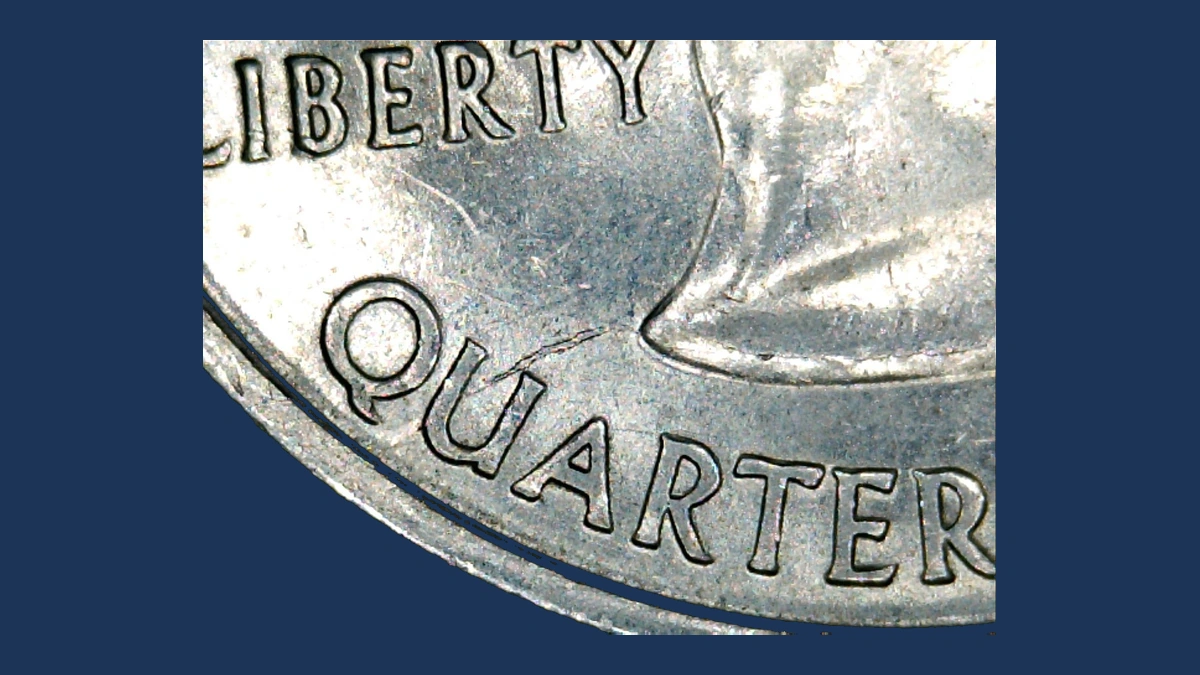
Raised lines or lumps can come from cracks and missing pieces in a stamping tool. A large front-side break is reported on a Philadelphia Texas quarter, although a rim-connected Texas cud remains a separate candidate.
Proofs, specially made collector coins, also show cracks. Reports include silver Wisconsin and Michigan pieces, clad Florida pieces, and both silver and clad Iowa pieces.
Their paths differ, so they are not one shared “spiked head” pattern. A tool crack makes a raised line, while a cud forms a larger raised patch that connects with the rim.
Estimated Value
For small raised cracks, estimate $2–$50 on ordinary coins and around $15–$100 for affected Proofs. These are whole-coin ranges, including the value of the collector coin itself.
A substantial Texas break can fall around $50–$300. For a large rim-connected cud, an estimate of $100–$500 is reasonable.
The reported large break should not automatically receive that cud price without a visible edge connection.
How to Identify
Use side lighting and a magnifier to establish that the line rises above the surface. An engraved scratch sinks into it.
On silver Wisconsin Proofs, inspect the front rim near four o’clock. Silver Michigan reports place a line from Washington’s head toward the E in STATES.
Iowa reverse cracks involve the teacher’s head and nearby tree, children, or rim. A separate clad Iowa front crack runs from the portrait base toward the D in DOLLAR and the edge.
Clad Florida Proofs have a reported front line from the portrait base toward the left side of that D and the rim.
For Texas, check the large front patch separately: only a continuous connection to the rim makes it a cud.
10. 2004 State Quarter Florida Missing Outer Layers
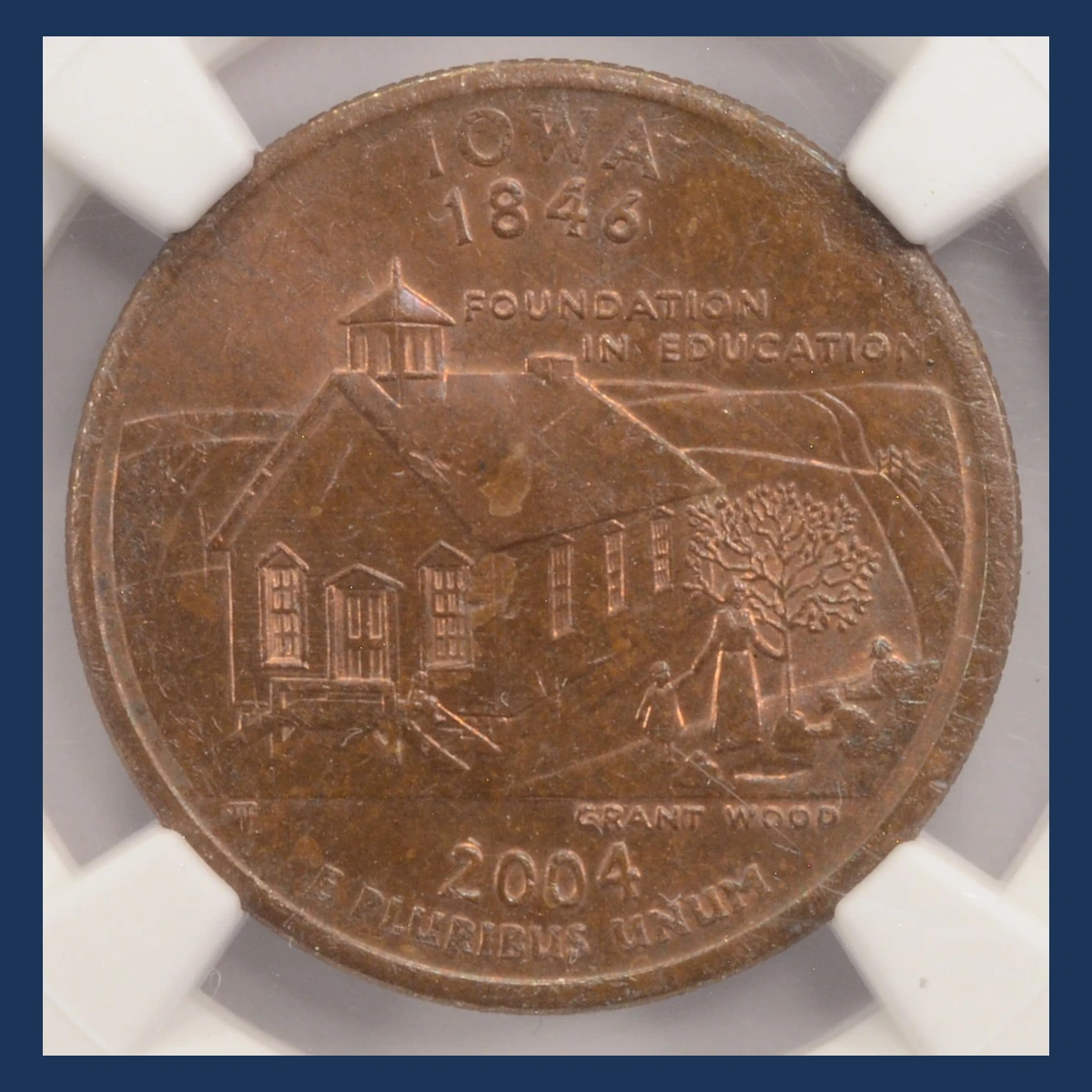
Patches of copper can appear when parts of a quarter’s outer layers are missing. A Denver Florida example is reported with partial loss on both faces.
Normal clad quarters have a copper center between two silver-colored copper-nickel layers. When part of an outer layer is absent before striking, the design can form directly on the exposed copper.
The size of the missing patches determines how much weight is lost. Brown color alone is not enough to identify this error, because staining, chemical treatment, or stripping a finished coin can also expose or imitate copper.
Estimated Value
For genuine partial layer loss, estimate $75–$700, depending on the size of the exposed areas and the coin’s condition. Two affected faces are still one coin, rather than two separately priced errors.
A different-year comparison is the 2008-D New Mexico quarter with its entire front layer missing, graded PCGS MS64, sold for $376 in January 2015. Its whole-face loss differs from the Florida patches, so the visible extent matters when applying that comparison.
How to Identify
Examine the boundary of each copper patch with a magnifier. A true change in layers should differ from a stain that simply changes the color of an otherwise continuous surface.
Check both faces and follow any missing area to the edge. Record the pattern rather than assuming the front and back lost equal amounts.
Weigh an unencapsulated candidate on a 0.01-gram scale against the normal clad standard of 5.67 grams. There is no single required reduced weight for every partially missing layer.
A separate 2004 silver Proof normally weighs 6.25 grams and should not be used as the clad standard. Smoothly struck copper details beside a real layer boundary provide a stronger clue than brown color alone.
11. 2004 State Quarter Iowa Double Strike
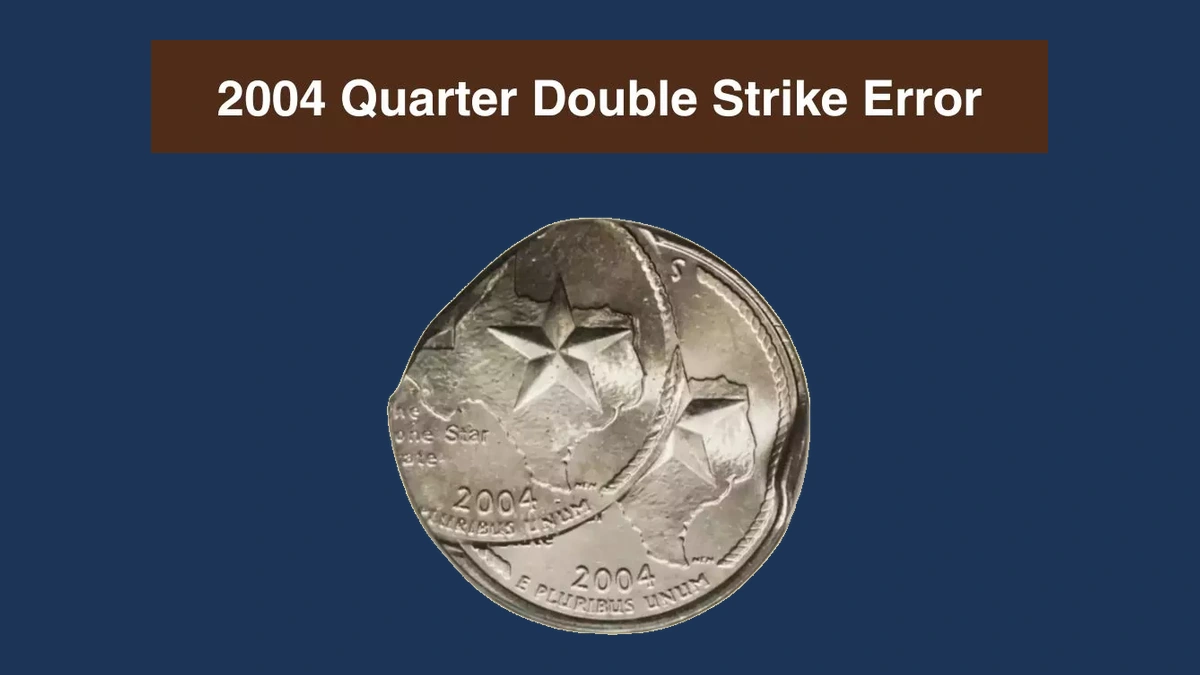
Two strikes can leave Washington or the lettering in more than one position on the same quarter. The second blow may partly flatten the first impression instead of leaving two equally sharp images.
A Denver Iowa example is reported with a double-struck front and an MS65 grade. The original auction has not been matched, so its precise overlap must be judged from the coin itself.
This differs from a doubled die, where the tool carries a repeated detail. A double strike involves another blow to the coin and can shift several design elements together.
Estimated Value
Estimated value is $150–$1,200 for a genuine double-struck Iowa quarter, depending on condition and the clarity of both impressions. Two easily understood design positions usually appeal more than a small, confusing overlap.
An MS65 grade describes an unworn coin with relatively few marks, but the error’s appearance still matters. A second strike that preserves readable dates or strong portrait outlines can add interest, while heavy later damage may obscure the very details buyers want to examine.
How to Identify
Follow two positions of the front lettering or Washington’s portrait, using a magnifier where the second impression flattened the first. Several details should shift together, rather than appearing as unrelated thick letters scattered across the face.
Inspect the reverse and edge for squeeze marks from finished coins pressed together after leaving the Mint. Two blows need not produce two equally clear reverse images, but a copied sunken image from later pressure is not a second Mint strike.
A loose clad example should stay near 5.67 grams on a scale because another strike alone removes no metal. Look for a consistent overlapping design group; a thin flat shelf alongside one letter can form during a single blow.
12. 2004 State Quarter Off-Center Strike
Most of the blank remains outside the design on a Florida quarter described as 70% off-center. The cataloged Philadelphia coin also has contact from a feeder part and a buckled blank.
Those features belong to one coin. The feeder contact and bending should not be treated as three separate quarter errors with three prices.
The basic off-center error occurs when the blank is partly outside the stamping area during the blow. Texas is also listed as a possible off-center find, but a specific Texas specimen has not been established by that general report.
Estimated Value
For a small genuine off-center strike, estimate $40–$200; a dramatic Florida example with readable identifying details can reach about $500–$1,500. Condition and the remaining design affect where it falls.
A historical Fred Weinberg list asked $1,300 for the Florida PCGS MS62 coin with feeder contact and bending. That was one asking price for the combined features, not an auction result; a Texas candidate needs its own identification before using any comparable range.
How to Identify
Find the remaining struck design before examining the bent area. On the Florida example, the catalog’s 70% figure describes the portion outside the strike, not an angle of rotation.
Check the surviving state name, issue date, and mintmark wherever they remain visible. A magnifier can help separate weakly struck details from scratches.
Compare both faces for an unstruck area beside the incomplete design. A design shifted on just one face may involve tool alignment instead.
For the Florida combination, obtain a side photograph showing the bend without trying to flatten it.
The coin’s identity comes from its surviving design and original unstruck metal; a later bend by itself cannot prove the off-center or feeder-contact error.
13. 2004 State Quarter Wrong Blank or Wrong Metal
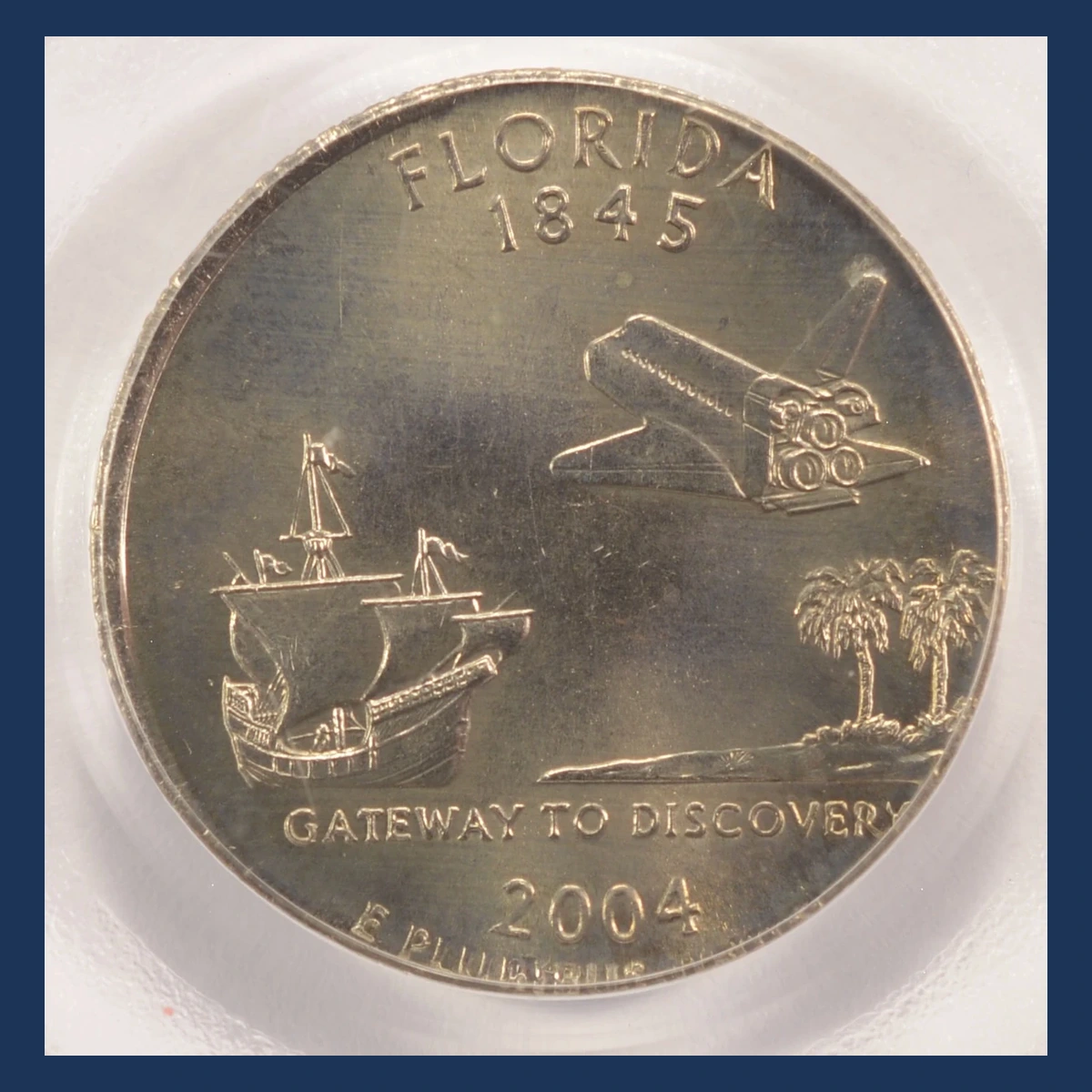
A quarter design can be squeezed onto a blank intended for another coin. The smaller blank may leave parts of the outer lettering missing even when the strike is centered.
Philadelphia Florida quarters are cataloged on nickel blanks. A normal nickel blank weighs 5 grams and uses a copper-nickel alloy throughout, unlike a quarter’s copper center and outer layers.
Off-metal examples are also reported for Michigan, Iowa, Texas, and Wisconsin, but their blank types are not established. Florida’s nickel composition therefore should not be assigned to those other state reports.
Estimated Value
Estimate $1,000–$3,500 for a genuine Florida quarter struck on a nickel blank. Historical dealer prices for PCGS MS65 through MS67 examples were $2,000–$2,750, which were asking prices rather than sales.
For the other reported states, $500–$3,500 is a conditional range until the actual blank and coin are identified. A well-preserved, clearly recognizable wrong-blank piece generally brings more interest than an indistinct or damaged example with only an unexplained color difference.
How to Identify
Weigh a loose candidate on a 0.01-gram scale, then inspect the edge with a magnifier. A normal clad quarter weighs 5.67 grams and usually shows its copper center at the edge.
A nickel blank starts at 5 grams and 21.21 millimeters, with 75% copper and 25% nickel throughout. Calipers may show that the later quarter strike expanded it beyond the blank’s original diameter.
Look for a centered quarter design cut short by the smaller disk, rather than letters removed by grinding. Color changes from plating or chemicals cannot establish a different original blank.
For an unusual Michigan or another state example, obtain professional composition testing. Matching weight, edge metal, and the struck design is stronger than any one measurement alone.
14. 2004 State Quarter Wisconsin Extra Leaf Low and High
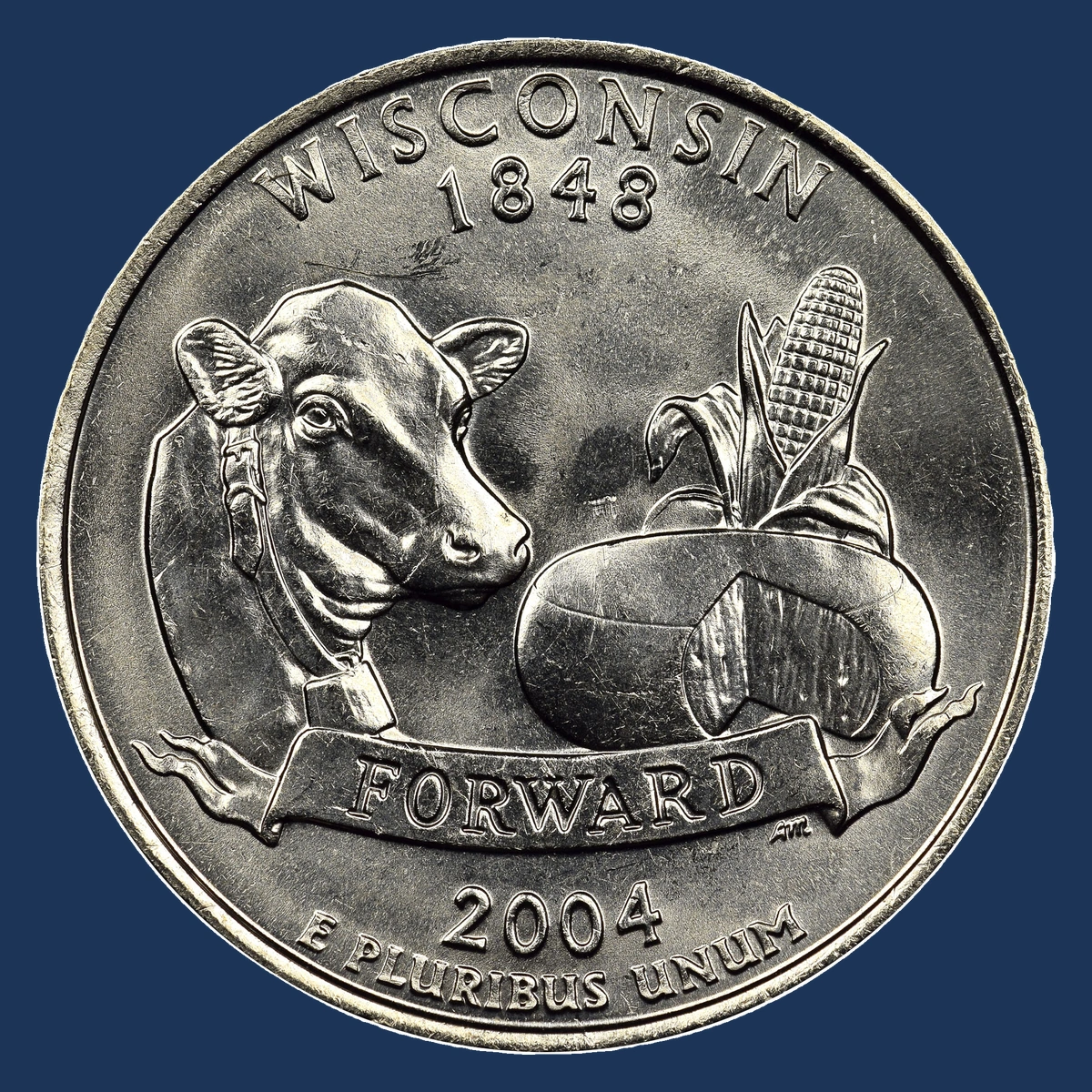
The extra Wisconsin leaf is a raised curve beside the corn, above the cheese wheel. It appears in two clearly different forms on Denver quarters.
The Low Leaf arches close to the top of the cheese wheel. The High Leaf rises farther upward beside the corn stalk, so the two names describe position rather than condition.
These are repeated features left by altered stamping tools, not two extra leaves on every affected coin. How the marks originated remains debated, but identifying the visible High and Low forms does not require deciding whether someone made them intentionally.
Estimated Value
Ordinary collectible examples are estimated around $50–$500, with exceptionally clean certified coins reaching much higher levels. For top pieces, allow roughly $500–$6,000, depending on variety and grade.
PCGS records an Extra Leaf Low graded MS67 at $6,000 in January 2020. A High Leaf graded MS67 brought $2,280 in January 2019; neither result means a worn pocket-change example should be priced like an exceptional unworn coin.
How to Identify
Find the corn and cheese on the reverse, using a 5× magnifier if the added line is hard to see unaided. Low Leaf arches close above the cheese, while High Leaf rises farther upward along the corn’s left side.
Compare the whole curve with a normal Wisconsin quarter so the intended corn leaves remain easy to distinguish. Then check Washington’s side for the D mintmark, since these recognized forms belong to the Denver issue.
Under changing light, the added line should stand smoothly above the surrounding surface and follow the known shape. A sunken cut or metal pushed up beside a scratch is damage, even if one short part resembles a leaf.
Conclusion
Wisconsin’s extra leaves are easy to remember, but the other 2004 designs deserve attention too. Florida’s smaller wrong-blank coins and Iowa’s incomplete edges tell very different manufacturing stories.
Estimates across these errors span $2–$6,000, with the top end reserved for exceptional pieces. Match the state, mint, finish, and actual feature before comparing prices.
Leave unusual surfaces untouched so their original details remain available for examination.