2008 Quarter Error List with Pictures

A copper-colored face helped one 2008-D New Mexico quarter bring $376 at auction in January 2015. Its outer metal layer was missing.
Other 2008 quarter errors need a closer look: extra metal between bear claws, faint doubled details, or letters where Washington’s neck should be. Estimated values span $2–$15,000, from small tool breaks to a rare reported quarter struck over a dime.
Explore the five state designs below to see how these mistakes differ.
1. 2008 State Quarter Reported Blank Defect
A rough patch, an opening in the surface, or metal that did not form properly can begin in the blank itself. The blank is the metal disk used to make a coin.
Such a flaw may survive the strike, leaving nearby parts of the design interrupted or uneven. It is different from losing a whole outer layer of a clad coin.
Minor blank defects have been mentioned for Alaska quarters, but no particular specimen or defect shape is established. A suspected example needs its own surface examination before receiving that label.
Estimated Value
A small, genuine defect in the original blank is estimated at $10–$100. The upper end would suit a clear, unusual flaw that interrupts the design without extensive later damage.
A shallow spot that could just as easily be corrosion offers much less appeal. This range applies only after the feature is identified as a manufacturing problem; a damaged Alaska quarter does not become valuable simply because a seller calls its surface “defective.”
How to Identify
Look at how the design meets the suspected flaw, using a magnifier and light from the side. Lettering or bear details formed beside an original opening may differ from details scraped away later.
Turn the coin over to check whether an impact on the opposite face could explain the mark. An ordinary dent can push or distort metal without involving any defective blank.
Do not lift a loose-looking edge or try to clean a dark cavity. Photograph the whole coin and the affected area while the original surface remains intact.
The important early test is whether the surrounding struck detail fits a preexisting flaw, rather than a fresh cut or corroded pit.
2. 2008 State Quarter Doubled Design
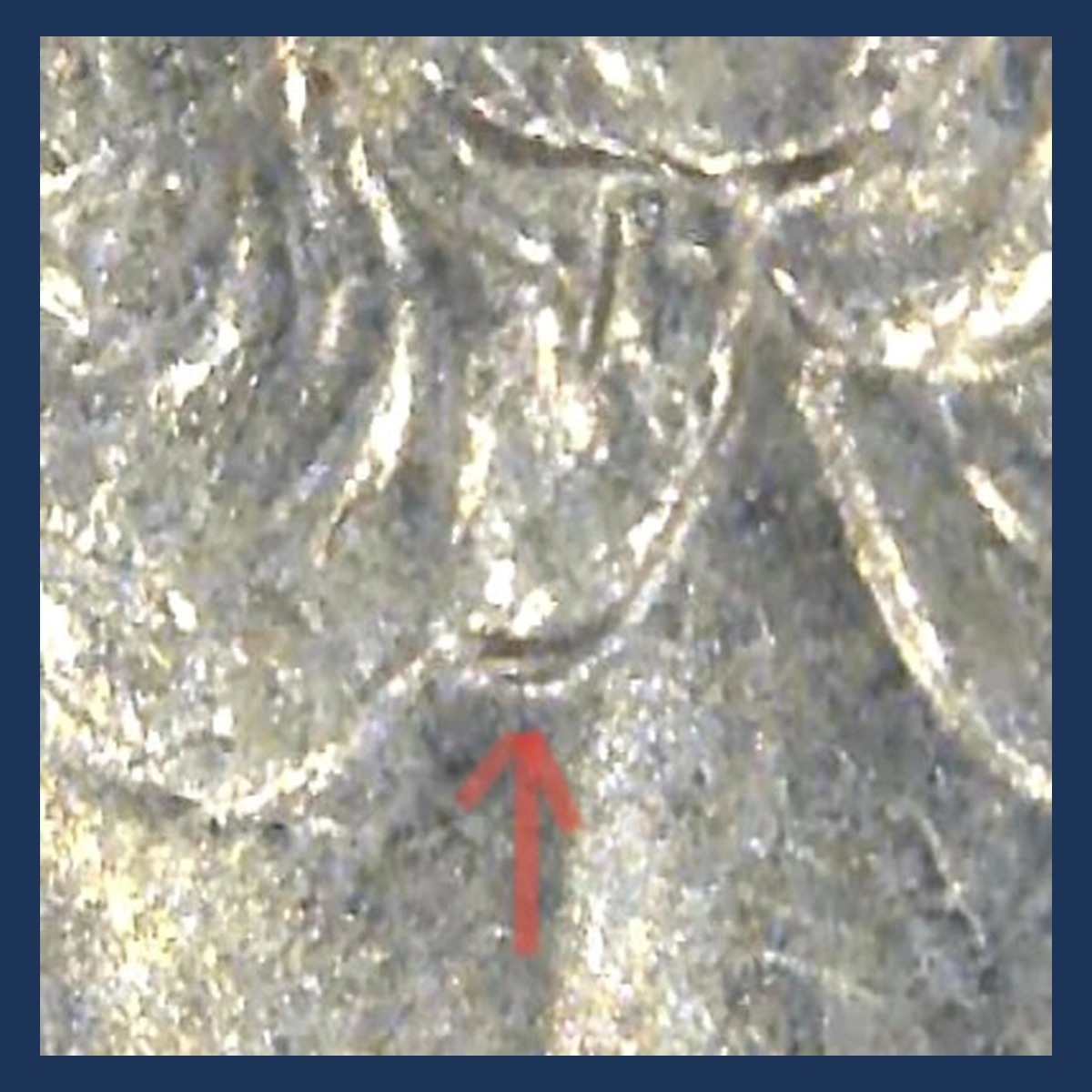
An extra curve below Washington’s earlobe is one place to look on a Philadelphia New Mexico quarter. On Philadelphia Alaska pieces, repeated lines are reported near the bear’s nose and the fur above the fish.
These are doubled-die features: part of the design was doubled on the stamping tool before it made the coin. They differ from two separate strikes on one coin.
Denver Oklahoma reports describe both front-side details and the bird’s wing or flowers on the back. Hawaii front-side doubling is also reported for Philadelphia and Denver coins.
Estimated Value
Estimated values for these mostly small doubled details run around $10–$150. A clear, easily matched extra outline on an unworn coin belongs above a faint feature hidden by wear.
An Oklahoma example showing genuine doubling on both sides is valued as one coin, rather than two separate premiums. Flat shelves beside letters and spreading from a worn tool are common lookalikes, so they should not receive the price of a true doubled design.
How to Identify
Find the state name, then choose the detail to enlarge. A 10× magnifier is useful for these small differences.
For New Mexico, look just below Washington’s earlobe. On Alaska, move to the bear’s nose and fur above the fish, rather than its separate extra-claw feature.
Oklahoma requires two comparisons: the reported front detail and the bird’s wing or flowers on the reverse.
The extra outline should belong to the raised design. Compare it with a clear photograph of the same variety, because ordinary fur and feather lines can look repeated.
A low flat shelf along a letter often results from movement during striking. Broad, stretched edges suggest a worn tool instead of a precisely doubled outline.
3. 2008 State Quarter Hawaii Clashed Design
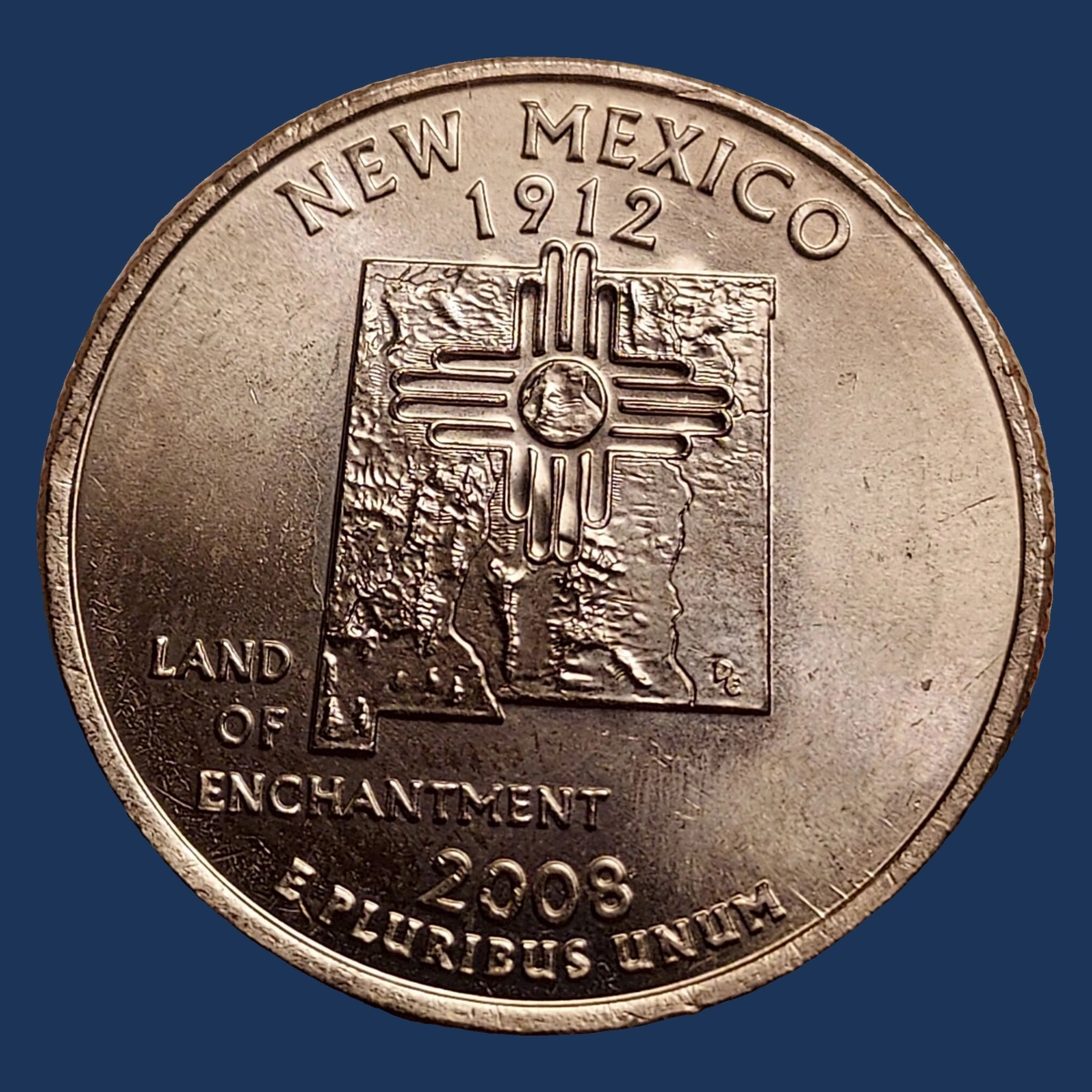
Washington’s side of a Hawaii quarter can carry faint shapes borrowed from the opposite design. A Denver example is reported with traces that may match the king or island chain.
The effect begins when the stamping tools collide without a blank between them. Their contact can damage the tools and leave those extra shapes on later coins.
This is called a die clash. It does not mean a second finished coin was pressed directly into the quarter, and the exact transferred outlines should be compared before treating stray lines as a clash.
Estimated Value
A recognizable Hawaii clash is estimated at $15–$150. Strong traces visible in ordinary light are more appealing than barely visible lines that need careful enlargement.
Surface quality can matter as much as the number of marks. A clean, unworn coin lets buyers compare the traces with the king or islands.
Heavy scratches hide that detail and add no clash premium, even when they happen to resemble part of the reverse.
How to Identify
Photograph the front and back at the same size, with the camera square to each face. Comparing the pictures is often easier than repeatedly turning the coin in your fingers.
Look for several neighboring shapes that fit the opposite design together, allowing for the mirror relationship between the two tools. One isolated arc can be misleading.
Inspect those marks on the coin with a magnifier and angled light. A sharp groove or a scraped boundary may reveal later damage rather than a trace from a clashed tool.
Do not assume every clash must appear as a sunken line. A group of shapes matching the same king or island details is the meaningful visible clue.
4. 2008 State Quarter Blank-Heating Color Error
Oklahoma quarters have been reported with abnormal color linked to the heating of their blanks. The process, called annealing, softens the metal before the design is struck.
If that treatment goes wrong, the finished surface can differ from the normal silver-gray color. A Denver example is included in the year’s error reports.
Color alone cannot establish this cause. Chemicals, soil, or heat after leaving the Mint can also turn a coin dark or brown.
Both even color and patchy color can have more than one explanation.
Estimated Value
For a confirmed heating-related Mint error, estimate $20–$200. Strongly different color on an otherwise attractive, unworn coin may appeal more than a faint discoloration.
Preserved original surfaces are important because harsh treatment can imitate the effect while reducing value. A brown quarter needs a supported manufacturing explanation before it belongs near the upper end.
Ordinary environmental staining generally adds nothing to the value of the coin beneath it.
How to Identify
Examine the color under a neutral lamp, then view the coin in daylight. Phone filters and warm lighting can make an ordinary silver-colored quarter look brown.
Use a 10× magnifier to search for crust, pits, residue, or cleaning scratches. These can explain the color without any problem at the Mint.
A loose clad Oklahoma quarter should weigh about 5.67 grams on a 0.01-gram scale, but normal weight does not prove an annealing error.
Check the edge for a normal copper stripe rather than treating that stripe as another defect.
Keep the coin uncleaned for an expert examination. An intact struck surface is the useful starting point; color by itself cannot establish when the change happened.
5. 2008 State Quarter Alaska Rotated Reverse
A bear that appears tilted after the quarter is flipped can signal a rotated stamping tool. The designs may each be centered normally, yet their upright directions no longer agree.
A Philadelphia Alaska quarter is reported with about 50 degrees of rotation. That is an angle between the two faces, not the percentage of design missing from an off-center strike.
The test depends on how the coin is turned. Two separately rotated photographs cannot establish a mint error, because a perfectly normal coin can appear misaligned when its pictures are positioned differently.
Estimated Value
An Alaska quarter with a genuine rotation near the reported 50 degrees is estimated at $40–$250. The stronger end of the range suits an unworn coin with the angle clearly demonstrated.
A small tilt attracts less interest than a substantial rotation, but condition still affects the price. Photographs that do not preserve the coin’s position leave buyers unable to judge the feature, so a controlled flip is more useful than a dramatic description.
How to Identify
Position the quarter upright beside a fixed vertical guide, with Washington facing you, and record a straight top-to-bottom flip. The bear should end upright too; turning sideways instead changes the test and can create a false impression.
Repeat the flip without twisting your wrist, using a transparent holder if that helps keep the coin steady. Consistent tilt on the bear’s side is worth measuring, whereas a different result each time suggests hand movement.
Use a protractor or an image overlay to measure from the bear design’s normal upright position, not from an already tilted photograph. About 50 degrees refers to this angle between the faces, rather than how far either design sits from the rim.
6. 2008 State Quarter Extra Claw, Extra Cactus, and Other Tool Breaks
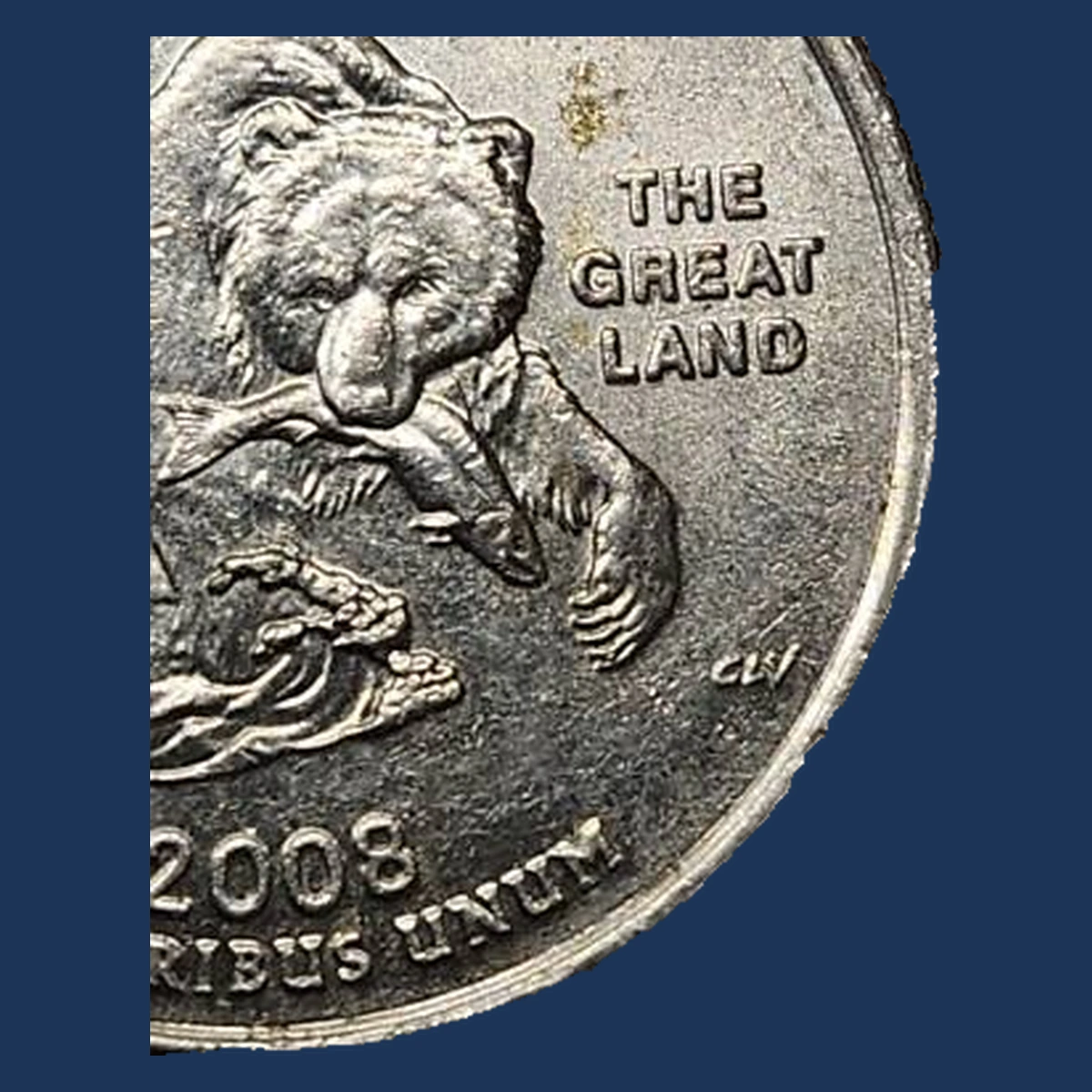
Extra metal between the Alaska bear’s claws can resemble a sixth claw. Arizona’s “extra cactus” similarly comes from broken areas of the stamping tool, rather than a newly engraved plant.
Longer raised cracks are reported on Arizona, while an Alaska rim-connected lump is a separate feature called a cud. An internal claw lump does not need to reach the rim.
On a Philadelphia New Mexico example, two raised patches sit along the state map’s northern edge beside the sun symbol. Faint clash marks accompany those breaks on the same coin.
Estimated Value
Small claw, cactus, or crack features are estimated at $2–$40. More prominent internal breaks can reach around $40–$100, and a substantial Alaska rim cud is estimated at $75–$350.
The New Mexico combination is priced as one coin with several features, not as separate clash and break sales. Size and clear visibility matter more than an exciting nickname, especially when ordinary lines in the design can resemble the claimed extra feature.
How to Identify
New Mexico’s useful starting points are two raised patches beside the sun symbol along the northern edge of the state outline. Compare that area with a normal quarter under a 5× magnifier.
On Alaska, move to the gap between the bear’s front claws. Extra metal there is an internal chip, even when its shape resembles another claw.
An Alaska cud needs a separate check: follow its raised patch all the way to the rim.
Arizona’s cactus and nearby banner should be compared for both short extra lumps and longer raised cracks.
Rotate the light to distinguish raised metal from a cut into the surface. A dark line that is actually sunken is a scratch, not a raised die crack.
7. 2008 State Quarter Hawaii Straight Clipped Blank
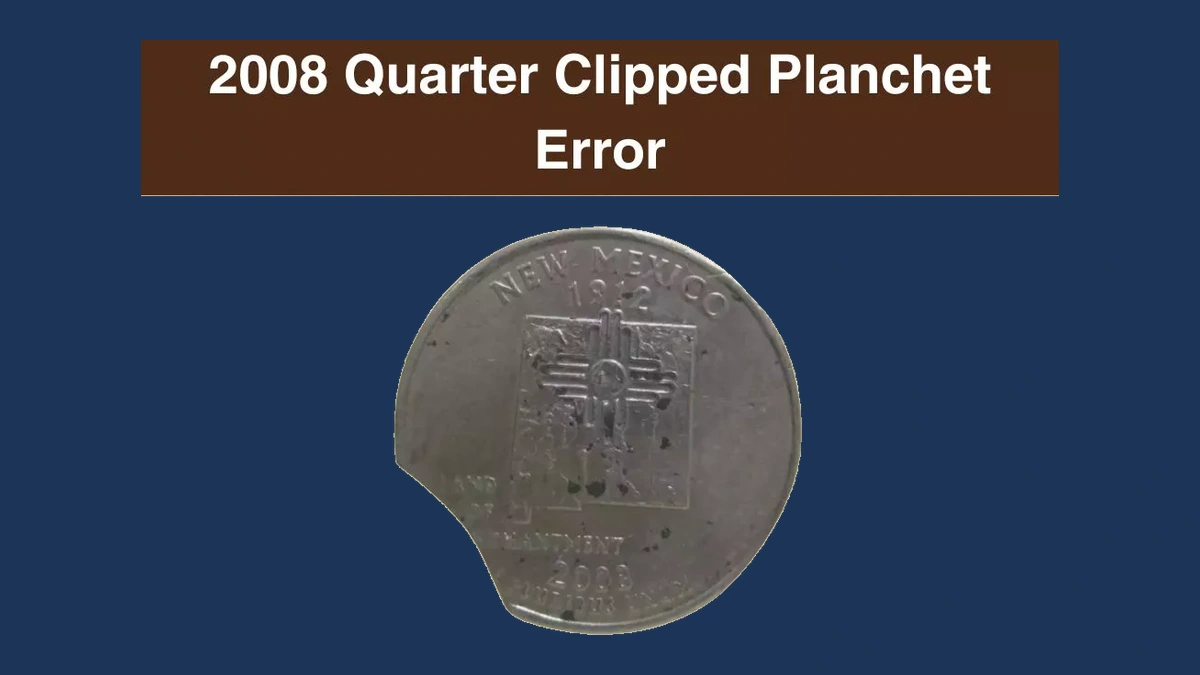
A Hawaii quarter is reported with a straight piece missing near King Kamehameha’s outstretched arm. Its outline differs from the familiar curved bite of some clipped coins.
A straight clip can form when the blanking press cuts a disk across the end or edge of the metal strip. The incomplete blank then receives the quarter design.
The reported example is a Philadelphia coin. A flat missing segment by itself is not enough to prove the error, because somebody can also cut or grind the edge of a finished quarter.
Estimated Value
Estimated value for a genuine Hawaii straight clip is $40–$500, with a large, attractive example toward the upper end. Small missing segments generally bring less.
For a recent different-year comparison, a 2000-P New Hampshire elliptical blank error graded PCGS MS66 sold for $288 in September 2024. Its shape is different, but it shows buyer interest in clearly incomplete State quarter blanks; the Hawaii coin’s own size and condition still control its estimate.
How to Identify
Look along the straight boundary from the side. Use a magnifier to search for saw lines, file marks, or a sharp burr that could reveal cutting after the coin was made.
Then examine the king’s nearby arm and the rim beside the gap. Details formed during striking may taper or stretch toward the missing area, unlike completed details abruptly sliced away later.
A weak rim opposite the clip can support identification, but it does not prove the cause on its own. Weigh a loose example on a 0.01-gram scale; missing metal lowers the normal clad weight of about 5.67 grams.
The most telling first view is the boundary where struck details meet the straight gap.
8. 2008 State Quarter Struck Through Debris or Grease
A deep diagonal hollow crosses Washington’s neck and LIBERTY on a studied Philadelphia New Mexico quarter. Fine parallel marks inside the hollow reflect the object struck into the surface.
This happened when material blocked the stamping tool, an error called a strike-through. Other scratches on the coin’s high points occurred after striking and are separate damage.
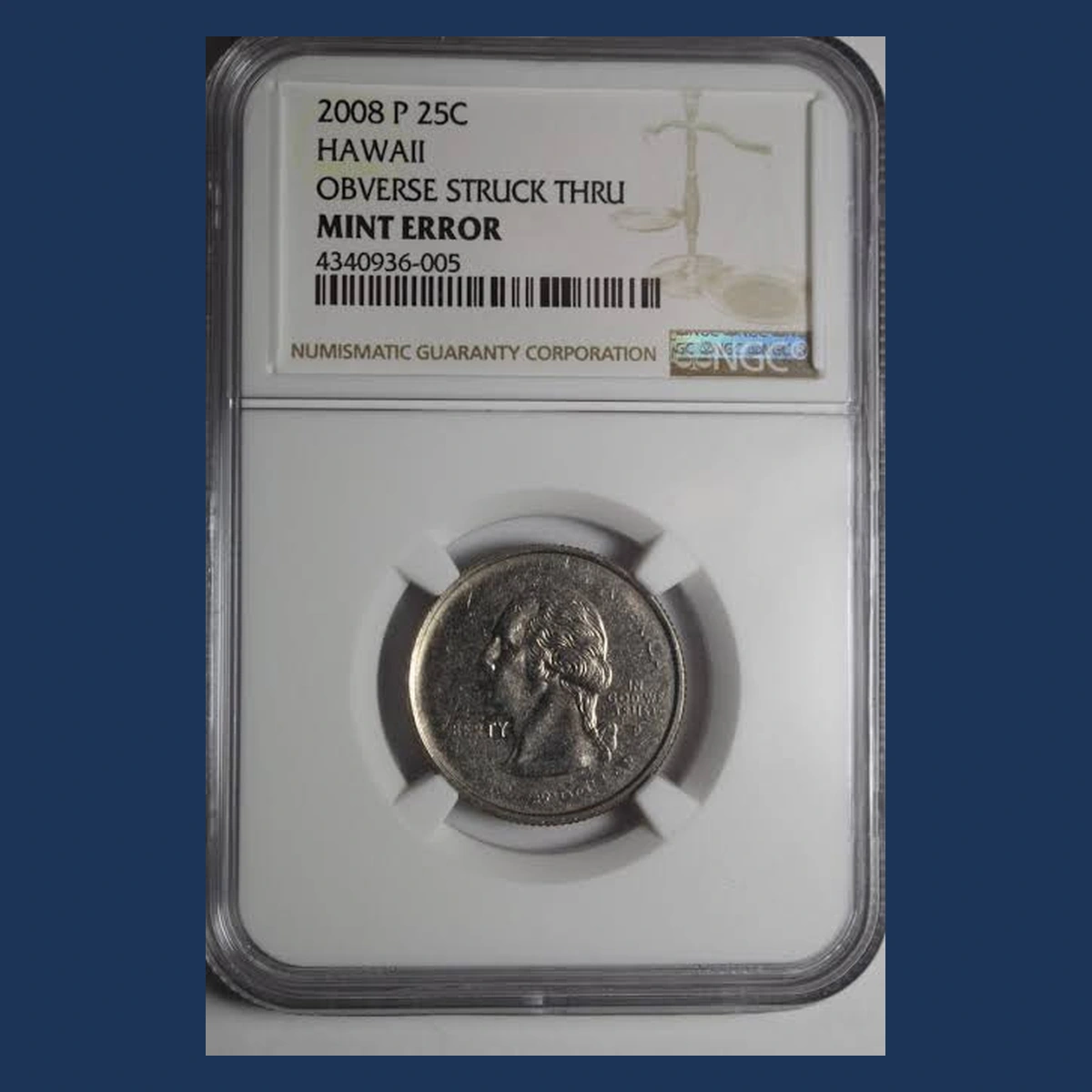
Philadelphia Hawaii examples include an NGC-labeled front-side strike-through and a different coin with weak letters attributed to grease. Grease can hide small design details, while a harder object may leave a more sharply bounded hollow.
Estimated Value
Light grease-filled details are estimated at $5–$50, while a deep, distinctive strike-through can fall around $75–$600. A large clear impression generally draws more attention than a few faint letters.
A 2020-P Samoa quarter with a reverse strike-through, graded AU58 with slight wear, sold for $104 in September 2024. It is a different design and year; the New Mexico trench and Hawaii examples must be valued according to their own size, surfaces, and clarity.
How to Identify
A scratch inside a hollow is not automatically proof of damage: the object pressed into a blank can carry its own lines. On the New Mexico example, use a magnifier and low-angle light to compare the recessed floor with the portrait’s higher areas.
Keep later scrapes across those high points separate from the diagonal strike-through running through the neck and LIBERTY. The original study proposed scraped-off material as the object, but did not establish its exact source.
For Hawaii’s weak-letter example, compare the front inscriptions and the reverse date and HA with an ordinary quarter. Soft, incomplete lettering can suggest grease, while flattened high points elsewhere may show that normal circulation wear removed the details.
9. 2008 State Quarter Missing Outer Metal Layer
Copper showing across a quarter’s face can mean an outer silver-colored layer was absent when the design was struck. A normal copper stripe along the edge is different: that stripe is supposed to be there.
A Denver New Mexico coin has its front layer missing, and other New Mexico examples affect the back. Denver Alaska examples include partial loss and a separately reported missing reverse layer.
Oklahoma and Arizona reports also list this error. The Oklahoma account does not consistently establish whether one face or both faces lost their outer layers.
Estimated Value
The 2008-D New Mexico front-layer error graded PCGS MS64 sold for $376 in January 2015. That grade describes an unworn coin with noticeable contact marks.
Estimated values are $75–$300 for partial layer loss and $200–$800 for a clear whole-face loss. Attractive original copper surfaces help, while corrosion or scratches reduce appeal; multiple affected areas on the same coin should not be priced as separate error coins.
How to Identify
Follow the exposed copper area to its boundary with the remaining silver-colored metal. A 10× magnifier can show whether there is a real layer change or merely a color stain.
Weigh a loose clad candidate on a 0.01-gram scale. A normal piece weighs about 5.67 grams, but the amount missing determines the reduction.
One separately cataloged Denver New Mexico example weighed 4.7 grams. That measurement belongs to that coin, not every missing-layer quarter.
Proofs, specially made collector coins, require the correct starting standard: 2008 silver Proofs weigh 6.25 grams and contain 90% silver.
For a clad piece, look for a struck copper surface and a matching absent edge layer rather than relying only on color.
10. 2008 State Quarter Hawaii Dropped-Letter Impression
A misplaced sunken letter can come from packed material that once filled a letter-shaped hole in a stamping tool. When the filling falls loose onto a blank, the next strike can press its shape into the coin.
Collectors call this a dropped filling or dropped-letter error. The result is an impression below the surface, rather than another raised letter added to the design.
A Denver Hawaii example is reported, although the particular letter and its position are not specified. That means an unrelated stamped or scratched letter should not be accepted automatically.
Estimated Value
An estimated $100–$1,000 covers a genuine, recognizable dropped-letter impression on a Hawaii quarter. A complete letter with clean edges generally attracts more interest than a fragment that is difficult to identify.
The premium depends on showing that the letter formed during manufacture. A hand-stamped character is damage, and a vague hollow deserves a lower assessment until its shape is explained.
A famous-looking nickname cannot replace a clear view of the impression itself.
How to Identify
Tilt the coin under a lamp to determine whether the unexpected letter is sunken. Raised doubling or a raised lump belongs to a different kind of feature.
Use a 10× magnifier to examine the shape, including its ends and enclosed spaces. Compare it with letters actually present on the quarter, allowing for the loose filling having turned before it was struck.
Look for a deeply punched center, an unnatural square boundary, or metal shoved upward around the letter. Those signs may point to a character added after manufacture.
A clear photograph of the whole face keeps the letter’s position understandable. Start with the sunken letter outline, then have a specialist assess whether it formed during the original strike.
11. 2008 State Quarter Off-Center Strike
An off-center quarter leaves part of the blank outside the area struck by the tools. The remaining image is incomplete, with a smooth unstruck arc beside it.
A Denver Arizona example is reported at about 30% off-center. A dealer also listed a New Mexico example graded PCGS MS65, meaning an unworn coin with relatively few marks.
Broader reports cover Oklahoma, Alaska, and Hawaii, but they do not establish a particular percentage for each state. Those reports should not be confused with the separate Hawaii coin that received two strikes, one of them off-center.
Estimated Value
Use an estimated $30–$1,000, ranging from a small visible displacement to a dramatic, attractive coin retaining its date. A date lost beyond the blank can make the year harder to establish.
A historical dealer list asked $275 for the New Mexico PCGS MS65 example; that was an asking price, not a sale. As a later comparison, a 2000-P Virginia quarter struck 20% off-center and graded NGC MS64 sold for $154 in September 2024.
How to Identify
Read 2008 near the bottom of the reverse first: the larger date near the state name records statehood, not the coin’s issue. Check the front mintmark separately before comparing a described example.
Now turn the coin over and find the unstruck arc on each face, using a magnifier to inspect its surface. If one face is centered normally, consider a shifted stamping tool instead of a blank struck off-center.
A loose clad quarter normally starts around 5.67 grams, so a scale can help detect metal removed after manufacture. A real off-center strike leaves both an incomplete design and original unstruck metal, rather than a design erased by filing.
12. 2008 State Quarter Hawaii Double Strike
Two different positions of the Hawaii design can survive when a quarter is struck again after moving. Parts of the first image remain outside, or underneath, the second impression.
Auction catalog 307 from Dutch Country Auctions describes a Hawaii quarter whose second strike was about 30% off-center. It does not identify the mint or a numerical grade.
This is more than a little doubling along one letter. The second blow places a larger portion of the design somewhere new, and it can flatten or partly replace details from the earlier strike.
Estimated Value
Estimated value is $135–$1,500, depending on condition and how clearly both strikes can be understood. Dramatic overlap with readable dates can appeal more than a second strike that hides most of the first.
The Dutch Country catalog gave its Hawaii example an estimate of $135–$170. That was a presale estimate, not a realized price; the broad present range also allows for better-preserved, more visually distinct examples.
How to Identify
Pick one visible part of the Hawaii design and follow it until you can separate its two positions. Use a magnifier to trace faint first-strike details where the later blow flattened or partly covered them.
Compare both faces, looking for other design parts that moved together rather than a thin shelf along one letter. Examine the edge too: copied details created by squeezing finished coins together are damage and can leave pressure marks.
If the coin is loose, check its weight on a scale against the normal clad standard of about 5.67 grams. Repeated striking alone does not remove metal, and recognizable overlapping design groups provide stronger evidence than one thick or doubled-looking letter.
13. 2008 State Quarter Arizona Extra Raised Motto on the Neck
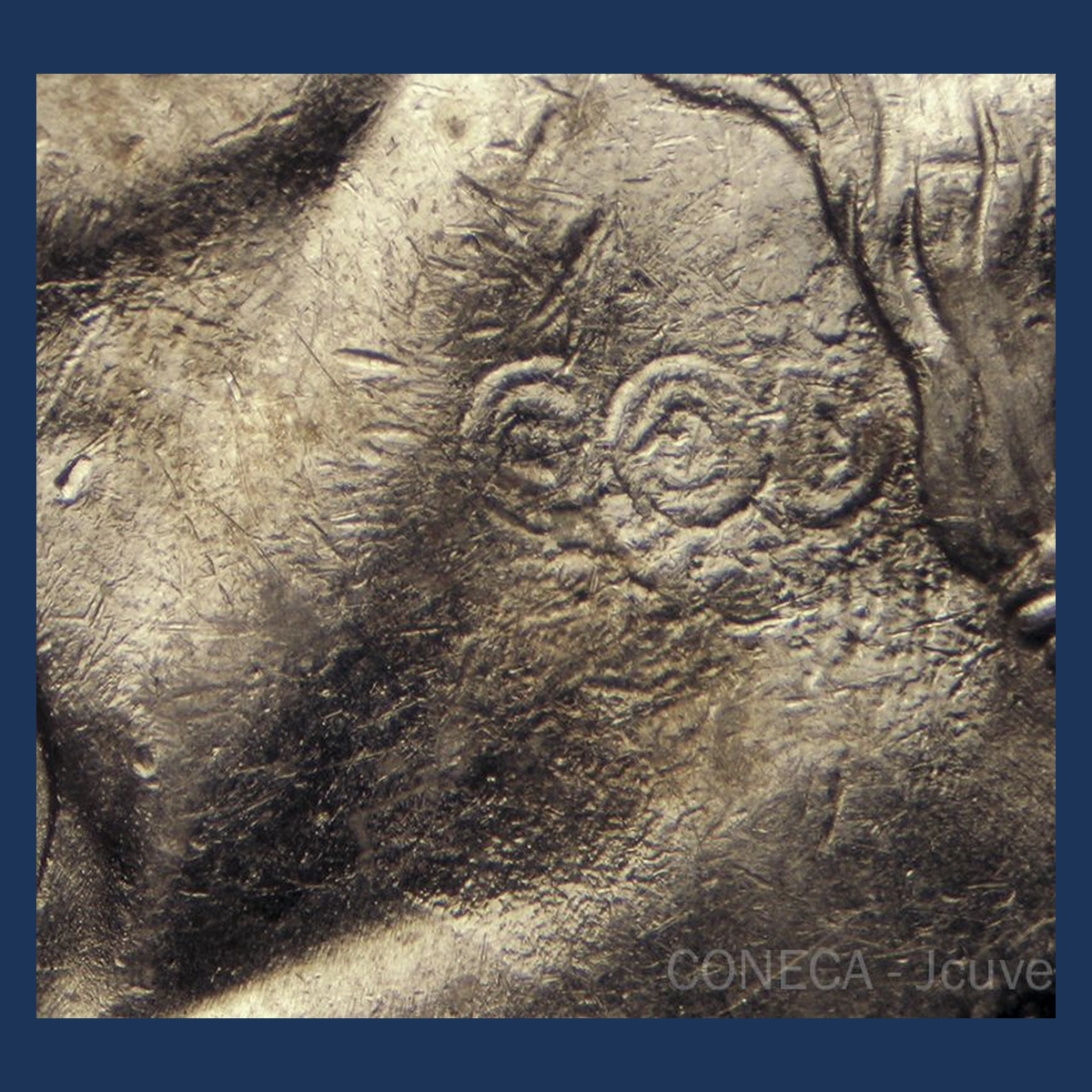
Washington’s neck carries letters where no motto belongs on a studied Philadelphia Arizona quarter. Two close groups include portions of IN GOD WE TRUST, and the letters read normally rather than backward.
Error-Ref’s explanation is that packed grease picked up lettering from earlier coins and then transferred it onto this one. Another specialist interpreted the same coin as a floating counterbrockage, a design copied back through an intermediate object.
The proposed cause differs, but the visible result is the same: raised lettering within an unusual neck patch.
Estimated Value
A striking example with recognizable extra motto letters is estimated at $500–$3,000. Clear lettering, an attractive surface, and expert agreement about the error would support the higher part of the range.
This is an estimate for the unusual transferred design, not a known auction result for the illustrated Arizona coin. Ordinary grease-filled letters that disappear from their correct location are much simpler effects and should not be priced like this extra raised motto.
How to Identify
Find Washington’s neck and examine the extra lettering under a 10× magnifier. The feature to establish is a raised, normally reading group of letters, not a sunken mirror image.
Photograph the entire neck patch under light from several directions so the letter edges remain visible. Avoid counting shadows or normal portrait lines as additional letters.
A letter punched into a finished coin usually sinks below the surface, while attached material can sit on top without belonging to the original strike. Neither should be confused with a transferred raised design.
Keep the surface untouched for expert inspection. The compact groups of readable raised motto letters within the neck patch provide the direct comparison with the studied example.
14. 2008 State Quarter Hawaii Design Struck Over a Dime
A Hawaii quarter design struck over a finished dime can preserve pieces of both denominations. The smaller coin already carried its dime design before it entered the quarter press.
This is called a double-denomination error. A quarter struck on an unused dime blank is different, because that blank would have no earlier dime lettering or portrait to preserve.
A Mint Error News sales table reports a 2008-P Hawaii example with a flipover second strike. The dime’s own date and a grading-service identity are not specified, so those details should not be assumed.
Estimated Value
Mint Error News issue 27 records a reported sale of $13,378 for the Hawaii quarter-over-dime described as BU, or unworn. It is a published sales report, without a numerical grade or certification details.
A working estimate is $5,000–$15,000 for a genuine, clearly identifiable example of this unusual combination. Surviving dime details, the visibility of the Hawaii design, and professional authentication would be central to any serious valuation.
How to Identify
Find recognizable dime details before judging the smaller size. Remaining Roosevelt features, dime lettering, or reverse elements would distinguish a previously struck dime from an unused dime blank.
The quarter design must also identify Hawaii and 2008, with the P mintmark assessed separately. Follow overlapping details on both faces rather than assuming every extra line is from the dime.
A modern clad dime starts at about 2.27 grams and 17.91 millimeters, compared with a quarter’s 5.67 grams and 24.26 millimeters. Use a scale and calipers for a loose candidate, allowing for expansion during the later strikes.
These standards are not measurements of the reported piece. Two recognizable denominations on the same struck metal are the essential first evidence.
Conclusion
An extra bear claw, a copper-colored face, and two overlapping designs each tell a different story. Start with the state name and the 2008 issue date, then examine the unusual feature.
The estimated $2–$15,000 range reflects very different errors, not the value of every marked quarter. Preserve original surfaces and get expert help for a suspected two-denomination coin before paying a major premium.