2020 Quarter Error List with Pictures

The bat design can hide both raised bumps and missing details, but those features have different causes. A 2020-P American Samoa quarter with a struck-through reverse sold for $104 in September 2024.
This 2020 quarter error list covers the five park designs, with estimated values from $2–$7,500. A Salt River Bay double strike is advertised at $7,500, an asking price rather than a sale.
Explore the visible clues below, from tiny extra branches to incomplete blanks.
1. 2020 America the Beautiful Quarter Sunken Branch from Tool-Making Debris
An extra branch can sink into the surface instead of rising from it. On some Marsh-Billings-Rockefeller quarters, this mark lies between the large tree’s two lowest branches on the right.
The variety catalog explains it as debris affecting a working hub, a tool used to create stamping tools. The flaw was then copied into coins.
Philadelphia and West Point examples are listed. This explanation differs from the raised extra-branch doubling described separately, and the catalog has revised some earlier doubled-die labels as the unusual sunken shapes were studied.
Estimated Value
A Philadelphia example with a clearly matched sunken branch fits an estimated $5–$50 range. For West Point, estimate $15–$100 for comparable modest examples, including the ordinary collector value of the W issue.
These ranges concern a recognizable copied tool flaw rather than a new major striking error on every coin. A small feature may add little, while sharp surfaces and a clear match make it easier for collectors to understand.
How to Identify
Look between the large tree’s two lowest right-hand branches, with a normal Marsh-Billings-Rockefeller quarter beside it. Keep the tree trunk visible so an unrelated line elsewhere is not mistaken for this feature.
Bring light from opposite sides while using a 10× magnifier. The extra shape should lie below the surrounding surface, unlike a raised doubled branch.
Check the P or W on Washington’s side before choosing a catalog photograph. Different listed examples should not be assumed to have exactly the same small details.
A scratch can also be sunken, but it may cut through completed design or leave sharp displaced metal. The cataloged branch shape and its fixed position are the important match.
2. 2020 America the Beautiful Quarter Clashed Designs
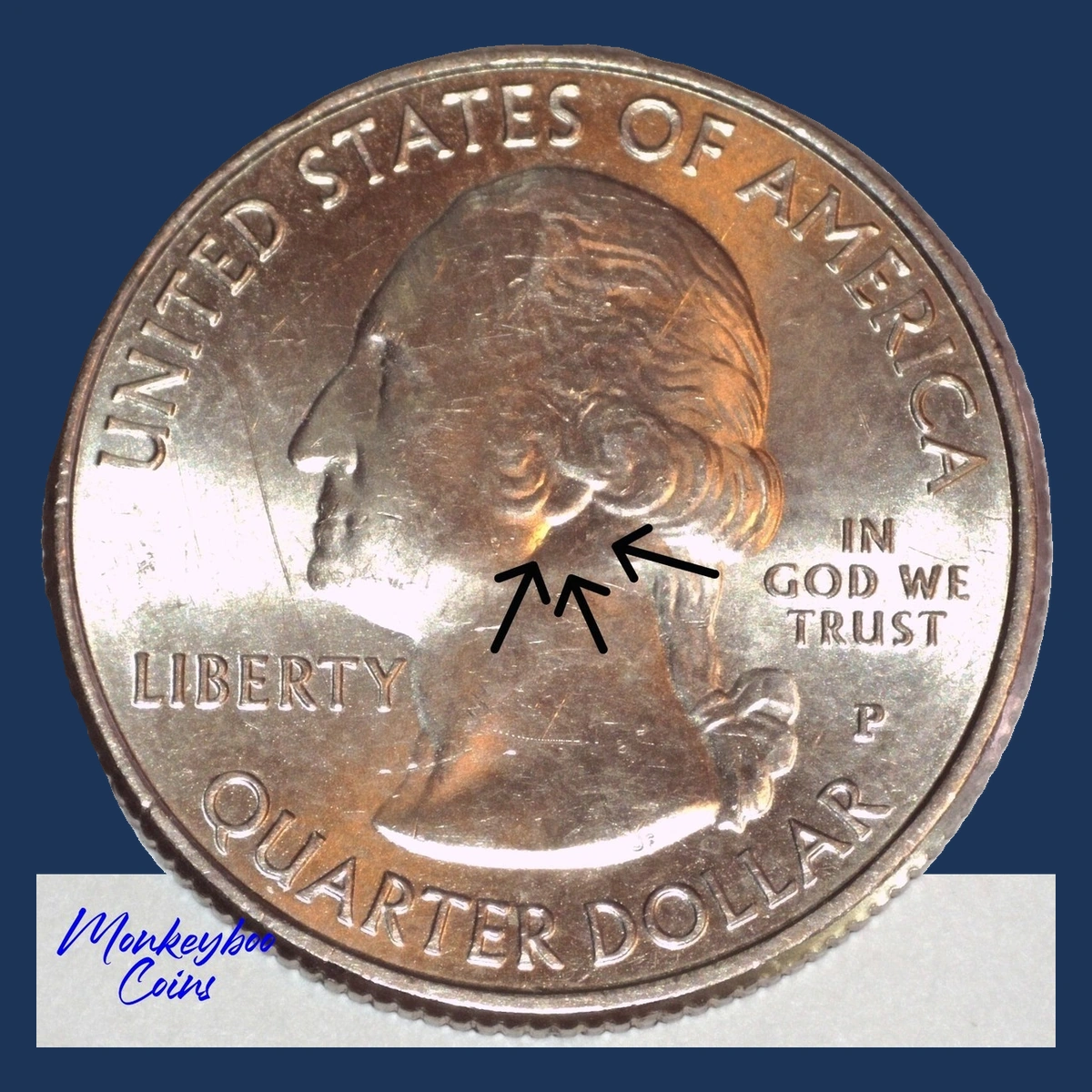
A faint piece of the reverse picture may appear where only Washington’s design belongs. The stamping tools can leave these traces after meeting each other without a blank between them.
Collectors call the result a die clash. A die is the steel tool that stamps one face of the coin.
The collector group CONECA’s 2020 publications report a Philadelphia Weir Farm clash and a separate American Samoa example. Their different reverse designs would leave different shapes, so a bat-related outline should not be used to identify a Weir Farm coin.
Estimated Value
For recognizable minor clashes on ordinary 2020 quarters, estimate $15–$150. Stronger opposing-design traces are easier to display than faint lines that disappear in normal room light.
The published examples establish the kinds of coins to compare, without providing a universal price for every clash. Wear or cleaning scratches can hide the pattern, and random tool lines carry a different meaning from an outline that clearly matches the other face.
How to Identify
Use full photographs of both faces to compare the suspected shape with the opposite design. A painter, a bat, and Washington’s portrait give you different outlines to test.
Enlarge the area with a magnifier and move the light slowly. Try to follow several connected parts of the transferred shape instead of selecting one convenient line.
Scratches often cross finished details without matching anything on the other side. Surface scratches may also have a hollow center with a sharp raised lip.
The Weir Farm report identifies Philadelphia, while the Samoa report does not settle its mint. Keep each coin’s actual mintmark and reverse picture in view when matching the faint transferred outline.
3. 2020 America the Beautiful Quarter Doubled Letters, Roots, or Branches
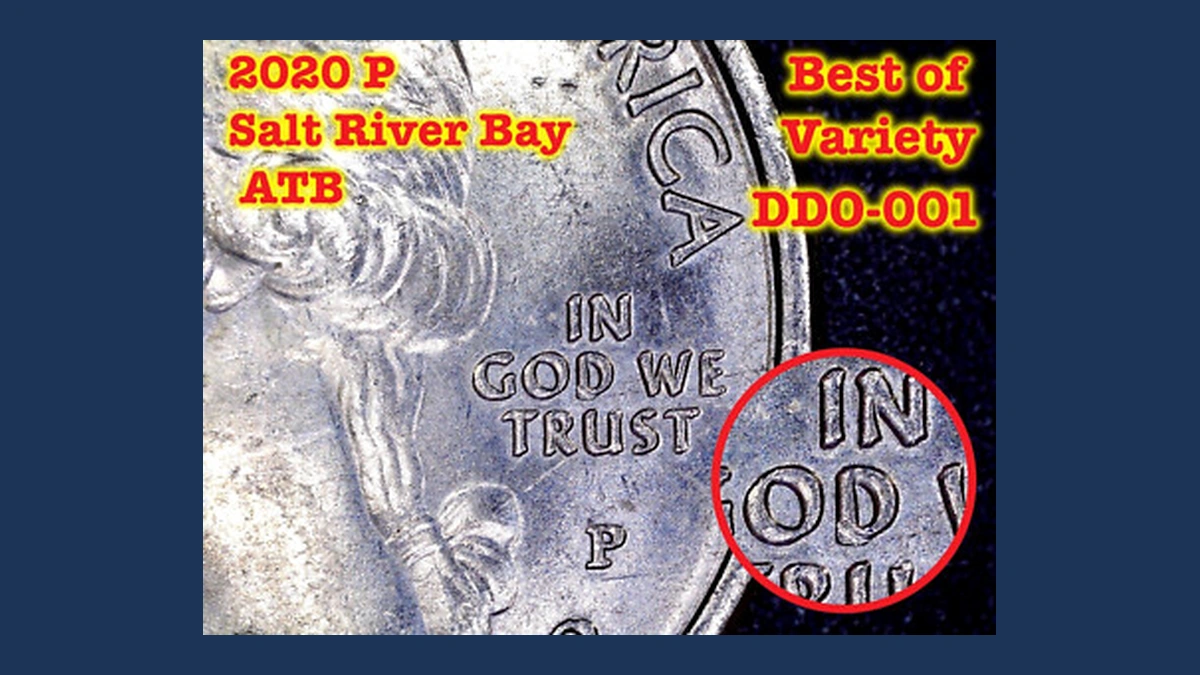
Extra roots or branches can come from a repeated detail already present in the stamping tool. One blow then transfers that doubled design to the quarter.
Salt River Bay Philadelphia examples include a notched Y in LIBERTY and added detail beside the upper knotted root. A Denver reverse example instead shows thickening and separation in JFM, the designer’s initials.
Marsh-Billings-Rockefeller Philadelphia quarters also have a listed raised branch between the large tree’s two lowest right branches. Its height distinguishes it from the separate sunken tool-making flaw, even though the positions are similar.
Estimated Value
Allow an estimated $5–$200 for matched minor doubled-design varieties with clear details and attractive surfaces. The visible separation matters more than an “extra root” or “extra branch” nickname.
Wear can hide a small notch, while a sharp example makes comparison easier. These are whole-coin estimates for the actual listed patterns; an ordinary thick letter, a flat movement-related shelf, or a different root shape should not automatically receive the same premium.
How to Identify
For Salt River Bay, identify the mint before choosing the detail to enlarge. Philadelphia and Denver do not share every listed pattern.
On the Philadelphia front, inspect the upper-left end of LIBERTY’s Y and compare the motto lettering. On its reverse, examine the left side of the upper knotted root.
A 10× magnifier can help show the Denver JFM initials and their repeated edges. Match the catalog photographs, rather than expecting the Philadelphia root feature there.
On Marsh-Billings-Rockefeller, direct side light between the lowest right branches. The extra branch in this doubled-design group rises above the surface; a sunken branch belongs to the separate tool-making explanation.
4. 2020 America the Beautiful Quarter Raised Chips, Cracks, and Rim Breaks
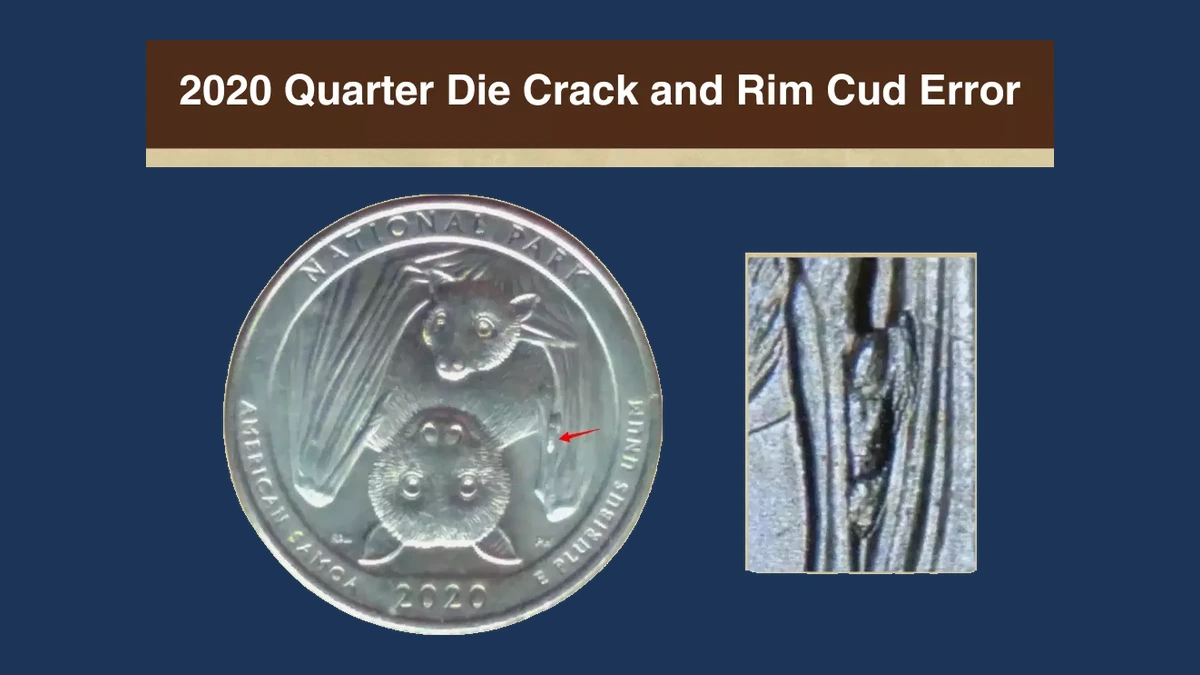
A broken spot in a stamping tool can leave a small raised lump on the coin. Narrow cracks produce raised lines, while a missing piece at the tool’s edge can create a rim-connected lump called a cud.
Reports describe Philadelphia bat-area chips, Denver Weir Farm smock or easel bumps, and Tallgrass Prairie butterfly-wing chips. West Point reports include a Weir Farm crack and a rim break on an unspecified design.
The W mintmark and V75 mark are normal. Neither mark alone proves that a nearby bump formed from a broken tool.
Estimated Value
For small P or D chips, estimate $2–$20. Clearer cracks or substantial original rim breaks can fit $20–$250, with the underlying W quarter’s collector value included when relevant.
A tiny butterfly-wing bump does not command a major-error price simply because it has a nickname. The size, natural shape, and visible rim connection matter, while heavy contact marks or glue can make a superficially similar coin unsuitable for that comparison.
How to Identify
The first distinction is height: a tool chip adds a raised shape, whereas the bat strike-through described below leaves interrupted detail. Use side lighting to see the surface clearly.
For Weir Farm, compare the reported smock or easel area with a normal painting scene. For Tallgrass Prairie, examine the butterfly wing and compare its outline with a normal coin before identifying a raised chip.
A magnifier helps trace a line into nearby sound metal and reveal the hollow beside an ordinary scratch. A cud must join the rim, so follow the suspected lump to the edge; an internal chip near W is not enough.
5. 2020 America the Beautiful Quarter Struck-Through Material or Filled Letters
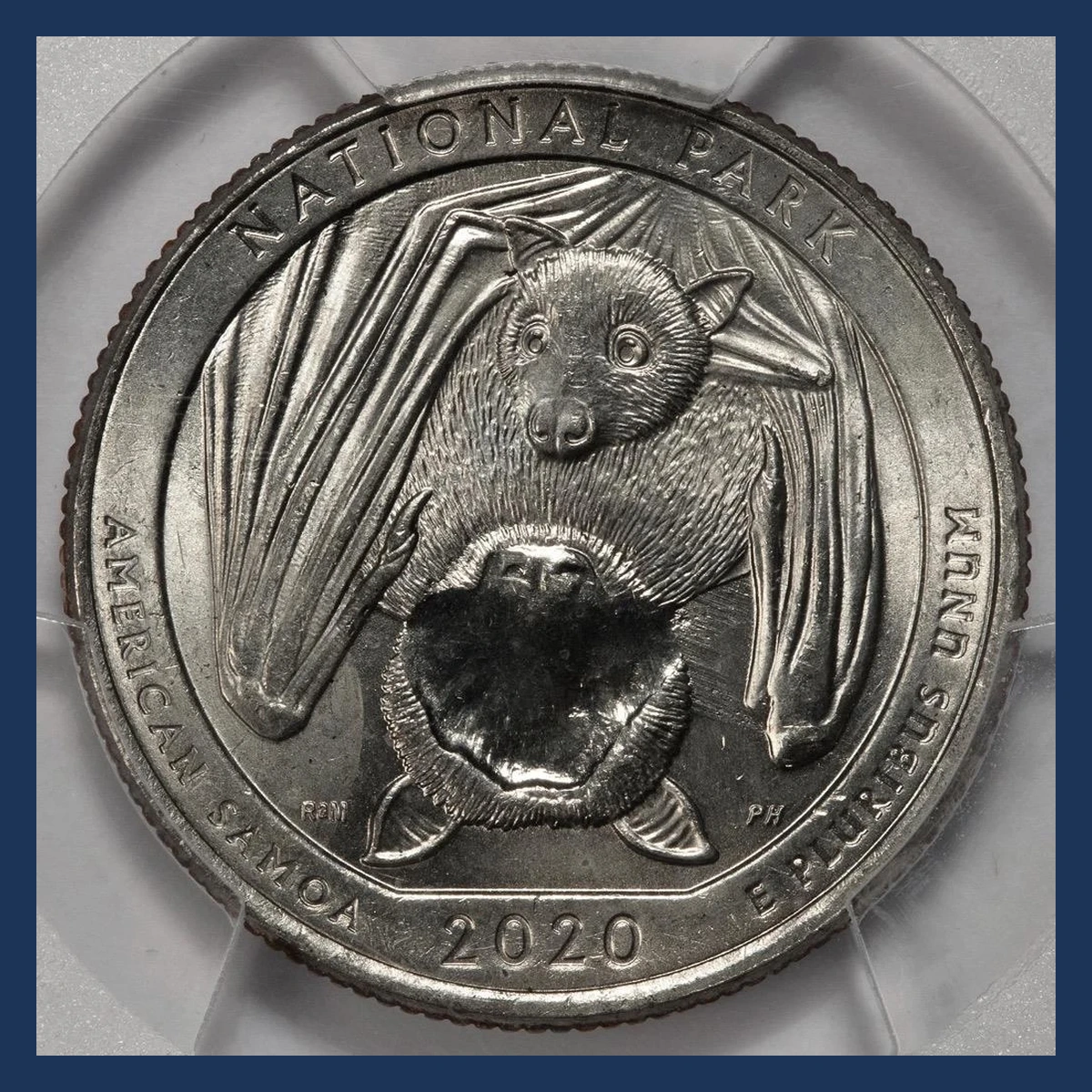
Material caught during striking can interrupt a bat’s face or another part of the design. Grease filling a tool’s small openings can leave weak or missing letters instead of a sharply defined hollow.
A Philadelphia Samoa quarter graded PCGS AU58 has a documented reverse strike-through. A separate PCGS MS64 Samoa example is illustrated with the bat affected.
West Point reports concern Tallgrass Prairie’s front and Weir Farm’s N in IN GOD WE TRUST. Their exact appearances differ, and the Samoa auction title does not prove that its bat lost both eyes.
Estimated Value
The Philadelphia Samoa AU58 example sold for $104 on September 16, 2024. AU58 means very light wear, and that price belongs to this specific reverse strike-through.
Estimate $10–$100 for modest filled-detail effects and $50–$500 for larger clear impressions on comparable 2020 quarters. West Point’s normal collector value also matters, while the separate unworn Samoa example should not automatically inherit the AU58 coin’s auction price.
How to Identify
Identify which part of the design is interrupted before deciding what caused it. An enlarged bat face can look strange from wear, glare, or a raised chip as well as blocked striking.
Use a magnifier at the boundary between normal detail and the affected patch. A natural impression should fit the surrounding strike, without scrape lines or a sharp lip from later impact.
For Weir Farm’s weak N, compare the adjacent letters and Washington’s other high points for wear. A missing letter alone does not identify grease with certainty.
Tallgrass Prairie’s reported W example needs its own front photograph. Keep the W and normal V75 mark visible so that a different park or mint is not substituted.
6. 2020 America the Beautiful Quarter Off-Center Strike
An empty crescent beside an incomplete picture can show that a blank sat away from the center of the press. Part of each design then missed the available metal.
A year guide reports a West Point Salt River Bay example as about 16% off center and graded MS66. That description still needs to be matched to the actual coin rather than borrowed for other examples.
A separate Marsh-Billings-Rockefeller report concerns ROCKEFELLER near the rim. An uneven border alone needs examination to distinguish a displaced blank from one misaligned stamping tool.
Estimated Value
For a genuine dated 2020 off-center quarter, estimate $75–$1,000, with mint, displacement, and condition affecting the total. A recognizable W example may include a stronger normal-coin premium than an ordinary P or D issue.
As a different-year comparison, a 2000-P Virginia quarter struck 20% off center, graded NGC MS64, sold for $154 in September 2024. That actual result is not a sale price for the reported 2020-W coin.
How to Identify
Place the full front and reverse photographs side by side. Locate where each design runs off the metal and where blank surface remains opposite it.
If only one face is shifted while the other is centered, investigate a misaligned tool instead. The Marsh-Billings-Rockefeller lettering near the rim cannot decide that question by itself.
Inspect the empty area through a magnifier for original texture, not scratches from removing design. The surviving 2020 date and mintmark should belong to the same pictured coin.
Read the shape before accepting a seller’s percentage. Both designs missing the blank in a compatible way provide stronger evidence than a single cramped word or uneven border.
7. 2020 America the Beautiful Quarter Clipped Blanks, Including a Combined Off-Center Strike
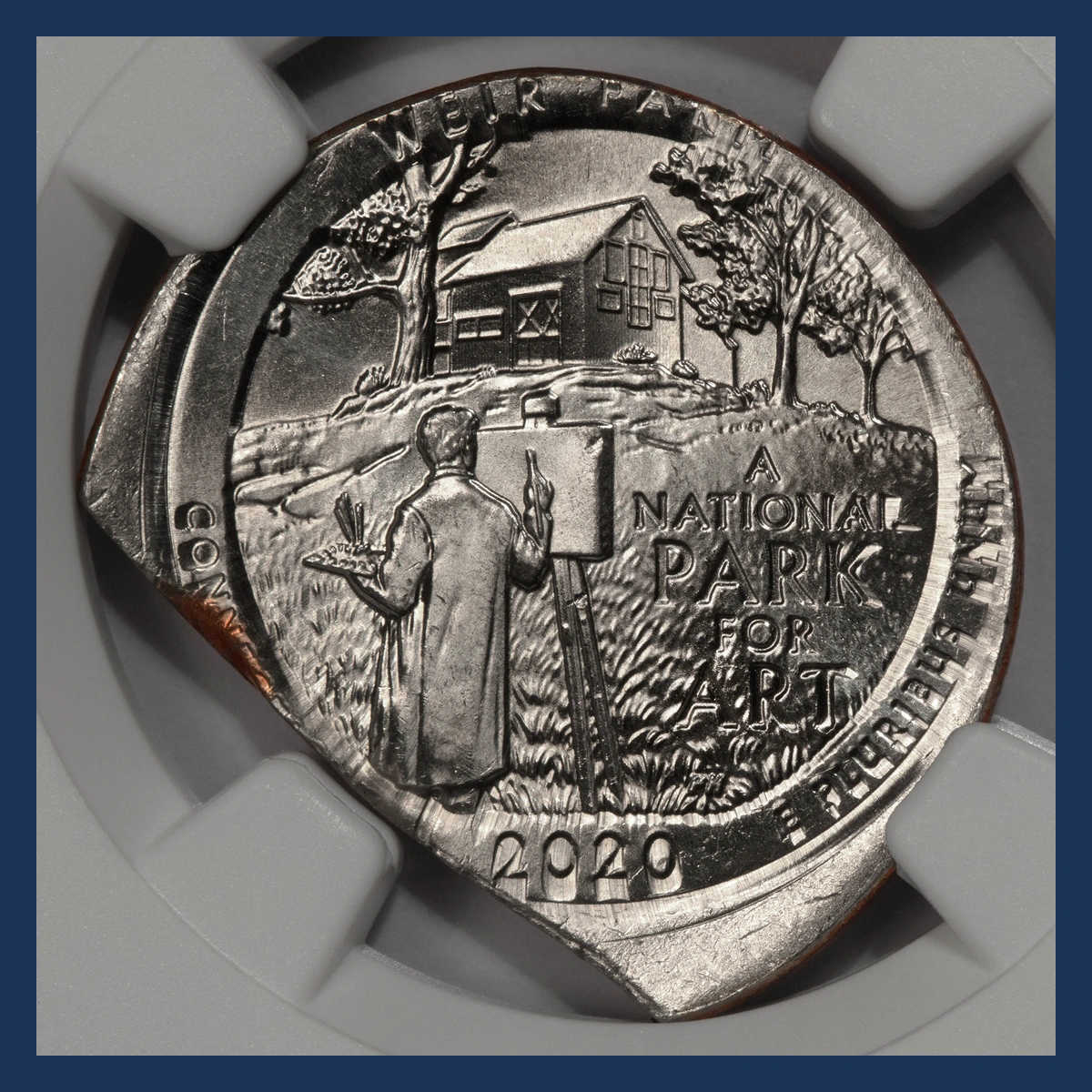
Three documented quarters show different incomplete-blank shapes. The American Samoa example has a 15% curved clip and an NGC MS61 grade, meaning unworn with noticeable marks.
The Weir Farm coin combines an off-center strike with a 20% straight clip and is graded NGC MS63. Here 20% describes the missing blank portion, not the amount of striking displacement.
A Salt River Bay example has an oval, or elliptical, clipped outline and weighs 4.3 g. These are separate coins, and the weight belongs only to the Salt River Bay example.
Estimated Value
Estimate $100–$2,500 across these recognizable clipped-blank errors, with the unusual Weir Farm combination requiring its own whole-coin comparison. Do not add two independent full prices for its clip and off-center strike.
For context, a different 2000-P New Hampshire quarter on an elliptical blank, graded PCGS MS66, sold for $288 in September 2024. The 2020 coins differ in design, grade, and shape, so that sale is a comparison rather than their individual price.
How to Identify
The Salt River Bay coin’s recorded 4.3 g is below the normal clad-quarter weight of 5.67 g. Consult the holder record, or use a scale for a loose candidate without removing a graded coin from its case.
With a magnifier, follow the clip boundary and its ends. Look for original struck metal meeting the incomplete edge rather than fresh cuts or grinding.
The illustrated 2020 examples give different outlines to compare.
For Weir Farm, inspect the plain unstruck area separately from the straight missing segment.
That distinction preserves both parts of the error: some metal was absent before striking, while the remaining blank also sat out of position.
8. 2020 America the Beautiful Quarter Missing Reverse Clad Layer
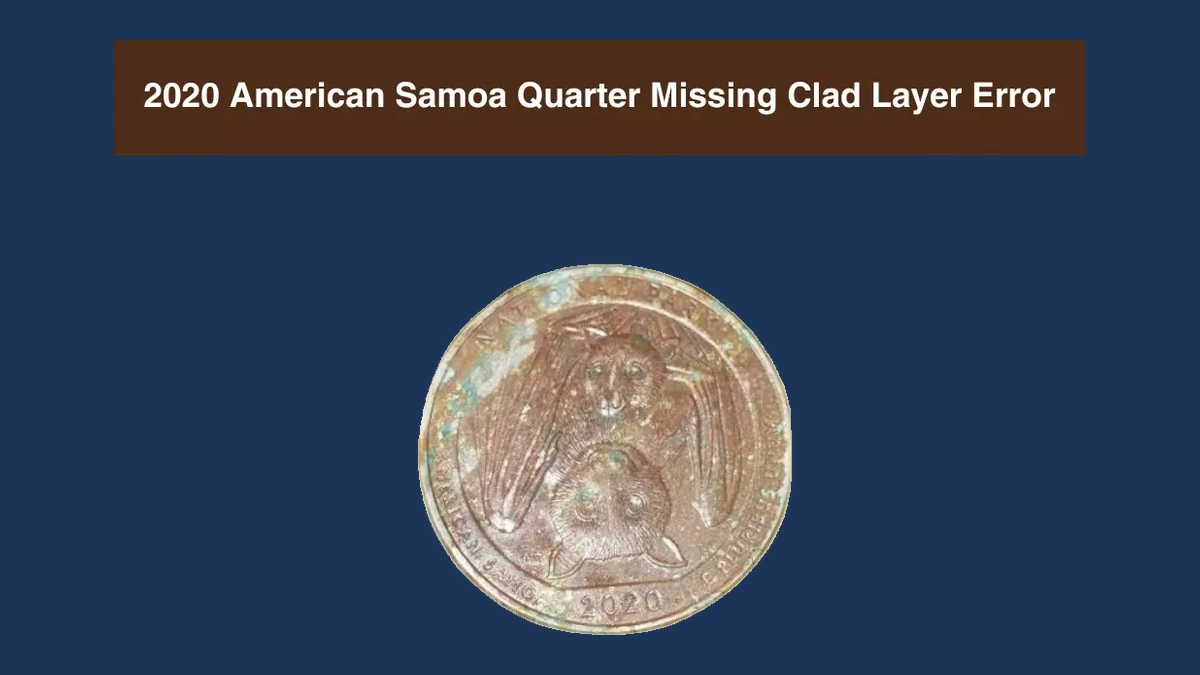
A copper-colored reverse can result when the outer copper-nickel layer is missing before the design is struck. The underlying copper core then takes the picture.
A year guide describes a Denver American Samoa example with about 98% of the reverse layer absent and a PCGS MS64 grade. The individual coin needs to match that reported identity.
Normal clad quarters can also turn brown from staining or chemical exposure. The missing-layer explanation requires physical loss and original struck detail, rather than treating color or a fixed low weight as proof by itself.
Estimated Value
A confirmed broad missing-layer error on a 2020 clad quarter has an estimated $250–$2,500 range. The extent of exposed original copper and the coin’s preservation affect the comparison.
A 2000-P South Carolina quarter missing its reverse layer, graded PCGS AU58 and weighing 4.64 g, sold for $336 in September 2024. That different-year sale provides a real comparison without treating the secondary report’s price for the 2020-D coin as independently confirmed.
How to Identify
Use the edge beside the copper-colored face to check how the layers meet. A remaining patch of outer metal should have a natural boundary, not a torn or ground edge made after striking.
Weigh a loose ordinary quarter on a scale against the normal 5.67 g. Do not copy the 4.64 g weight of the South Carolina comparison onto a Samoa coin.
Examine the bat design under a magnifier for original detail, pitting, or scrape lines. Chemical stripping can lower weight while damaging the surface.
The .999 silver Proof, a specially made collector coin, has no clad layer to lose. First establish the copper-nickel version, then judge exposed copper and missing metal together.
9. 2020 America the Beautiful Quarter Double Strike with Partly Covered First Design
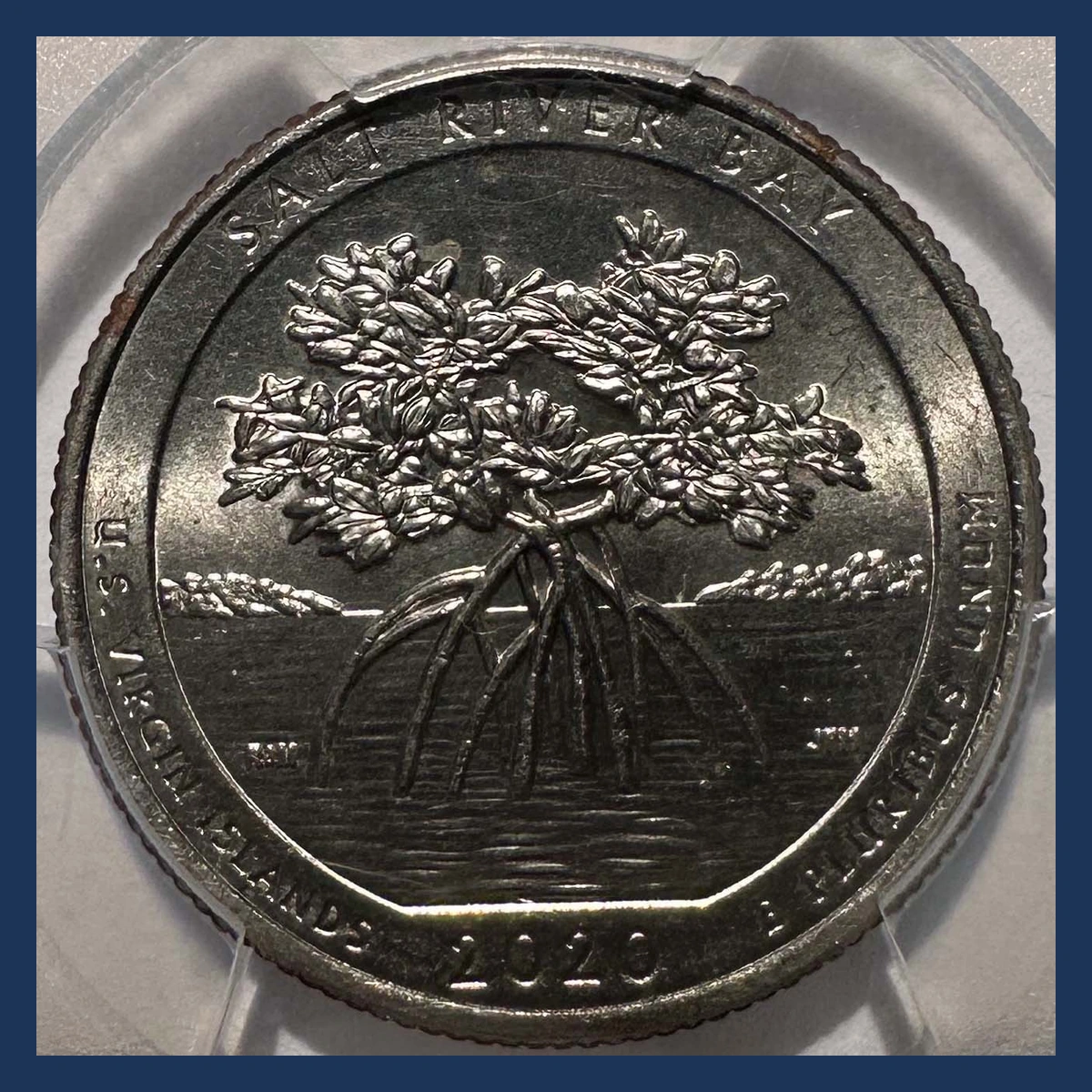
Two blows do not always leave two complete pictures. On the PCGS MS64 Salt River Bay quarter, the second strike covered almost all of the first.
The first blow occurred slightly off center and outside the collar, the ring that normally restrains the edge. The coin then sat properly for the second blow.
Parts of BAY and E PLURIBUS UNUM remain from the earlier impression on the reverse. Those surviving letters explain the sequence more directly than the tree roots, which can show unrelated small doubled-tool varieties on other Salt River Bay quarters.
Estimated Value
The PCGS MS64 Salt River Bay double strike is offered at $7,500. This is a dealer asking price, not an auction result.
An estimated $1,500–$7,500 allows for the distinctive surviving first-strike letters and the coin’s unworn condition.
Earlier modern-quarter double strikes can cost much less, so the upper estimate depends on this particular 2020 example’s appeal. A thick root or doubled-looking letter alone does not support the same price.
How to Identify
Enlarge BAY and E PLURIBUS UNUM on the reverse before concentrating on the mangrove roots. Find which portions belong to the main centered design and which remain from the earlier impression.
Follow those remnants with a magnifier under changing light. Their positions should fit a shifted first picture that was largely flattened by the later blow.
Compare the entire coin with the photographed PCGS MS64 example, including its date and P mintmark. A small extra root copied from a doubled tool does not create this same sequence of partly covered letters or prove that the blank received an accidental second strike.
Conclusion
Estimated values of $2–$7,500 cover very different coins, from small tool flaws to a distinctive double strike. The $104 Samoa auction result and $7,500 Salt River Bay asking price describe separate errors and different kinds of price evidence.
Match the park design first, then follow the unusual feature. Raised branches, sunken marks, missing layers, and incomplete blanks each need their own explanation.