2023 Quarter Error List with Pictures

A 2023 Edith Kanaka’ole quarter with a struck-through front sold for $99 in June 2026. Material caught during striking interrupted part of the design.
This 2023 quarter error list covers all five American Women designs, with estimated values from $2–$5,000. Some examples have grading records; other reported types need the individual coin examined.
Start with the woman on the reverse, then use the checks below to understand the unusual feature.
1. 2023 American Women Quarter Lamination or Peeling Metal
A thin flap can rise from a quarter’s surface when the metal contains a weak layer. If the flap breaks away, it leaves an irregular shallow patch.
This is called lamination. Reports include Maria Tallchief quarters and a broader 2023 listing that does not identify one of the five reverse designs.
A local peeling patch differs from an entire missing outer layer. The flaw can be small, so an enlarged view of its edge is more useful than assuming every rough or discolored area formed inside the Mint.
Estimated Value
Estimate $20–$150 for a genuine small lamination on an otherwise collectible 2023 quarter. This comparison covers localized peeling metal, rather than the larger missing-clad errors with an exposed copper face.
An attached flap that still carries part of the design can show the defect clearly. A shallow rough patch has less visual impact, and scratches or corrosion beside it can reduce interest even when an original metal weakness is present.
How to Identify
A shallow rough patch needs a close view of its boundary, not just a photograph of the whole coin. With a 10× magnifier and low side lighting, follow any separated layer into intact struck detail.
An attached flap may retain part of the original picture, so leave it in place and avoid probing underneath. Parallel cuts across the finished design or scraped metal at the boundary can instead point to later damage.
If metal has fallen away, a scale can compare a loose clad quarter with the usual 5.67 g. A small retained layer may barely change the weight, making its natural junction with the surrounding surface the more useful clue.
2. 2023 American Women Quarter Misaligned Front or Back Tool
One face may look pushed toward the edge while the other remains centered. This can happen when one die, the steel stamping tool, sits out of position.
The blank itself may still sit normally inside the press. That separates a misaligned-tool strike from an off-center coin whose two designs miss part of the blank.
Year guides report this feature on Edith Kanaka’ole and Maria Tallchief quarters. They do not establish one shared direction or amount of movement, so the border on each face needs its own straight-on view.
Estimated Value
A clear but modest one-sided shift has an estimated range of $10–$150. Tiny uneven borders often add little, especially when the design remains comfortably inside the rim.
The stronger examples show an obvious change on one face and a normal center on the other. These are comparison estimates for genuine misaligned modern quarters; a tilted photograph or a coin damaged around its edge does not justify the same premium.
How to Identify
Place the coin flat under the camera, rather than tilting it toward the light. Photograph both faces at the same distance.
Compare the gap between the outer lettering and rim around each face. A narrow gap at one side and a wide gap opposite it should belong mainly to the affected face.
Now examine the other face. If its whole design is displaced too, with an unstruck crescent, an off-center strike may explain the coin better.
Use a magnifier at the tightest border to check for impact flattening or grinding. The useful sign is a genuinely shifted design opposite a centered design, not a rim made uneven after striking.
3. 2023 American Women Quarter Clashed Opposing Designs
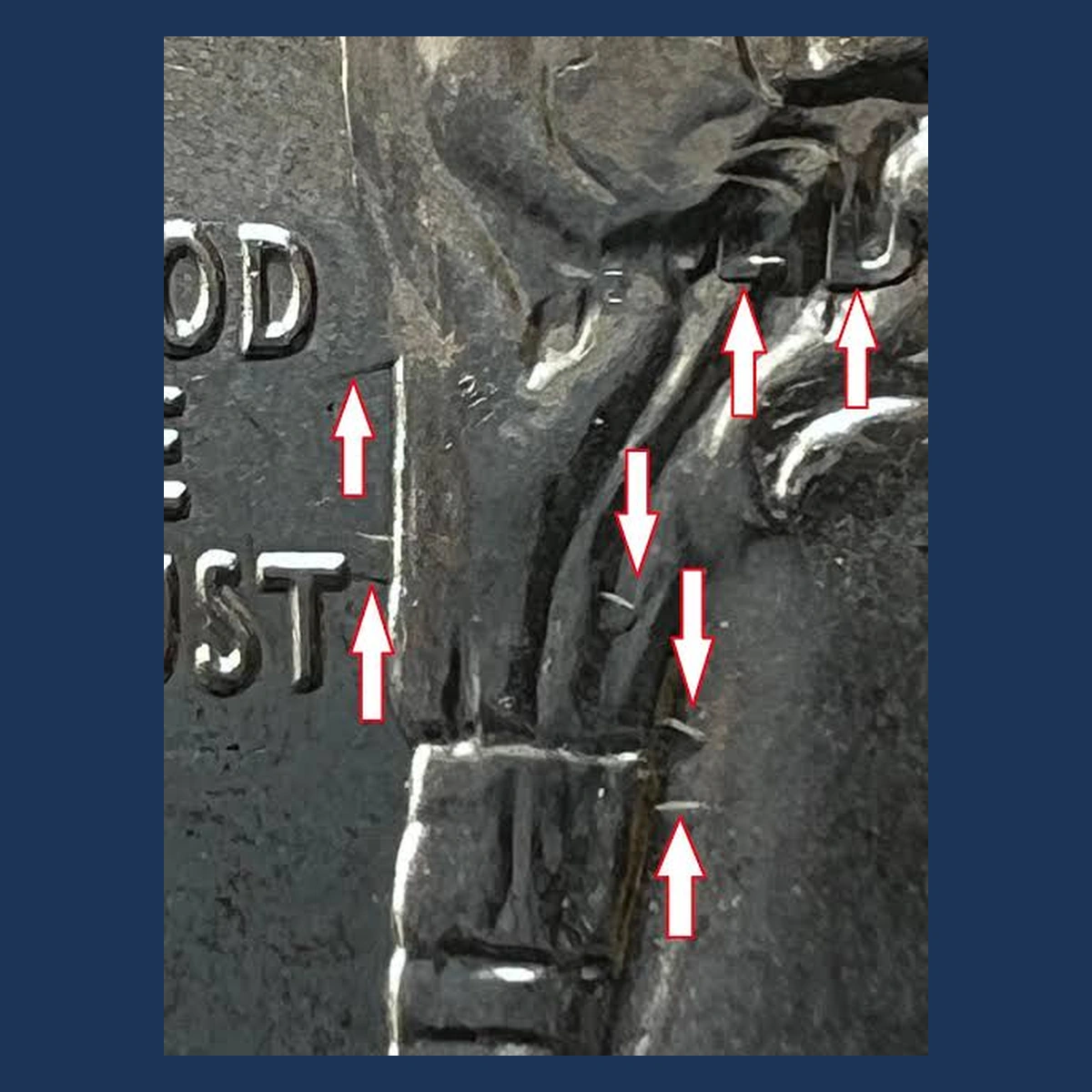
Parts of EDITH can appear near Washington’s ear on a 2023-P Kanaka’ole quarter. These faint transferred shapes belong to the opposite side’s design.
The two stamping tools can hit each other when no blank is between them. Later coins may carry traces left by that contact, which collectors call a die clash.
Collector photographs document the Kanaka’ole feature. Year guides also report light clashes on Coleman and Tallchief quarters, but their different reverse pictures would leave different traces rather than the same EDITH letters.
Estimated Value
Clashes that can be matched to the opposite design fit an estimated $10–$150 range for ordinary 2023 quarters. Faint traces generally sit lower than strong, easily photographed letters or shapes.
The Kanaka’ole example offers a useful visible comparison for how a clash looks, not a fixed price for every design. Surface scratches can obscure the pattern, while clear original surfaces make it easier for another collector to understand the feature.
How to Identify
Photograph both faces of the Kanaka’ole quarter with Washington upright in the front view. Enlarge the area near his ear and compare the faint shapes with EDITH on the reverse, allowing for reversed orientation.
The T offers a useful landmark for that comparison. Under low side lighting, a 10× magnifier helps separate the letter-shaped trace from a scratch that simply crosses the background.
Examine the corresponding reverse area for Washington-related outlines as well, since both tools could receive marks when they met. Coleman’s plane and Tallchief’s figure would create different traces, so their reported clashes require matching parts of those designs rather than borrowing the EDITH pattern.
4. 2023 American Women Quarter Doubled Designs and Lettering
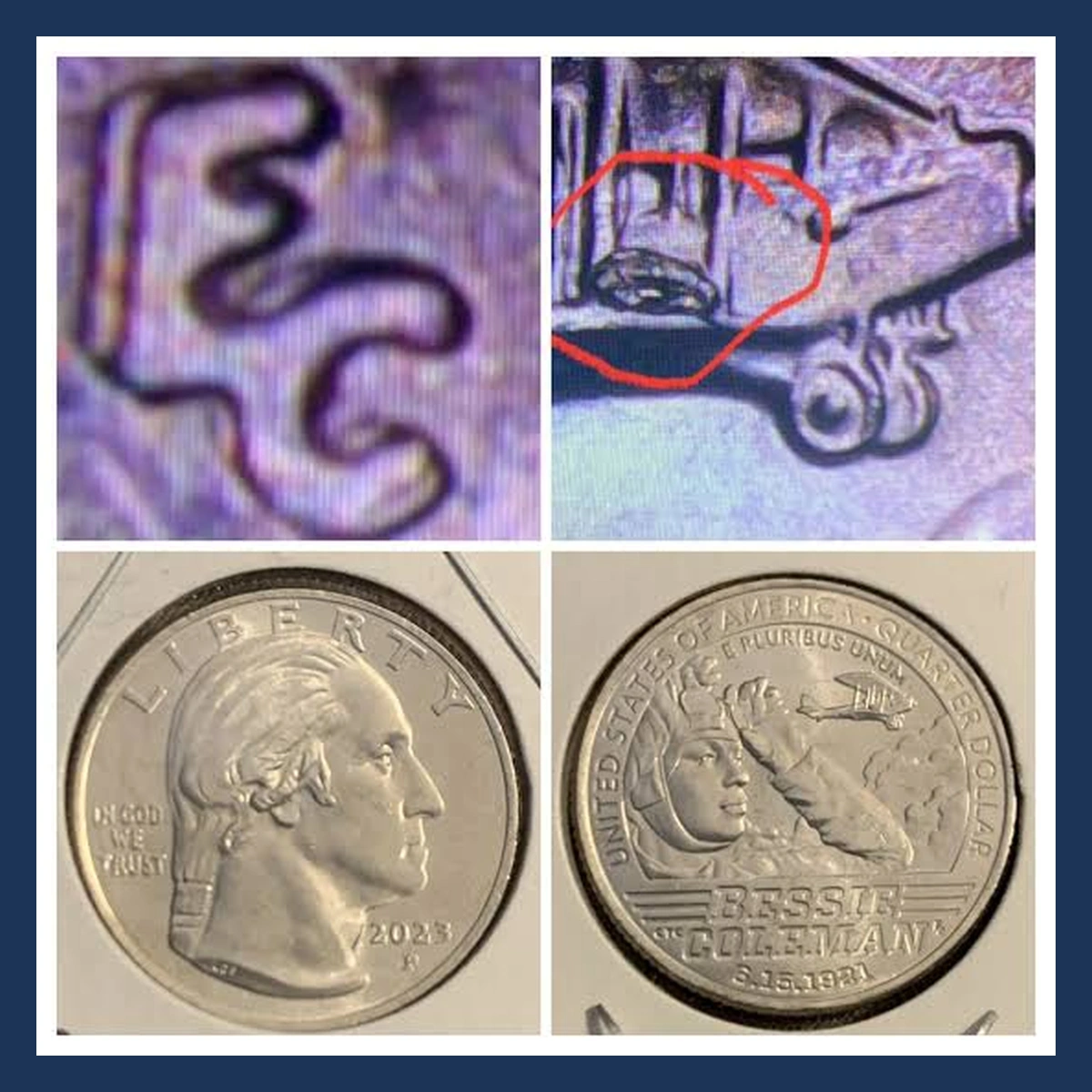
Extra rounded outlines can repeat on coins struck from a tool carrying a doubled design. Wexler lists 2023-P Coleman doubling on her nose and lips, toward the right.
For 2023-P Roosevelt, listed features include the scale pole, strings, and nearby name letters. A separate front variety repeats parts of GOD, TRUST, and Washington’s hair.
Idar reverse-letter doubling is reported without a firmly matched pattern. Coleman front doubling remains a candidate; the airplane and designer’s initials are on the back, so they cannot prove a doubled front.
Estimated Value
For a clearly matched minor doubled-design variety, estimate $5–$200. The strength and extent of the repeated outline matter more than simply finding a thick letter.
Some shared doubling came from an earlier tool used to make many working tools. Wexler notes widespread Roosevelt Denver scale doubling and shared Philadelphia eye features, so those alone do not show rarity; an ordinary example may remain worth only its normal coin value.
How to Identify
Choose the reverse design and mint first. A 10× magnifier can then show the specific details relevant to that combination.
For Philadelphia Coleman, compare the nose and lips with the Wexler photographs. Wider shared doubling can also affect her face, goggles, gloves, and airplane.
On Philadelphia Roosevelt, check OD in GOD, the last T in TRUST, and hair for the front variety. On the back, compare the scale pole and strings, EL in ELEANOR, and RO in ROOSEVELT.
Idar’s reverse lettering needs a matched repeated outline, not a flat shelf beside a digit. Tilt the light: genuine rounded separation stays part of the design, while glare changes or disappears.
5. 2023 American Women Quarter Clipped Blank or Small Rim Clip
A piece can be missing before a quarter receives its design. The blank-cutting process may overlap an earlier hole or the edge of the metal strip.
The resulting incomplete disc can leave the press with a curved or otherwise irregular gap. Collectors call this a clipped blank, even though nobody clipped a finished coin with scissors.
Tallchief clips appear in year reports, and small rim clips are reported on Philadelphia Idar quarters. The available descriptions do not fix their sizes or directions, so those details must come from each actual coin.
Estimated Value
For small, genuine rim clips, an estimated $15–$75 is a reasonable comparison range. A larger clearly formed clip with an attractive surviving design may fit $50–$250.
These estimates concern modern clipped quarters with identifiable dates and designs. Size alone does not decide value: original surfaces, the shape of the boundary, and readable details all matter, while a notch cut into a finished coin earns no mint-error premium.
How to Identify
First check whether the notch looks cut or naturally formed. Saw marks and sharp fresh cuts are warning signs under a 10× magnifier.
At each end of the gap, inspect the transition into the ordinary rim. Struck detail and metal flow should agree with a blank that was already incomplete.
Compare the rim directly opposite the gap for possible weakness.
A scale can record a loose clad quarter’s weight against the usual 5.67 g. The amount missing should make sense beside that reading, though a tiny rim clip may remove very little metal.
Keep the complete reverse in the photograph. That connects a Tallchief or Idar candidate with its own clip instead of assuming another design’s example proves the same location.
6. 2023 American Women Quarter Die Cracks, Chips, and Rim Breaks
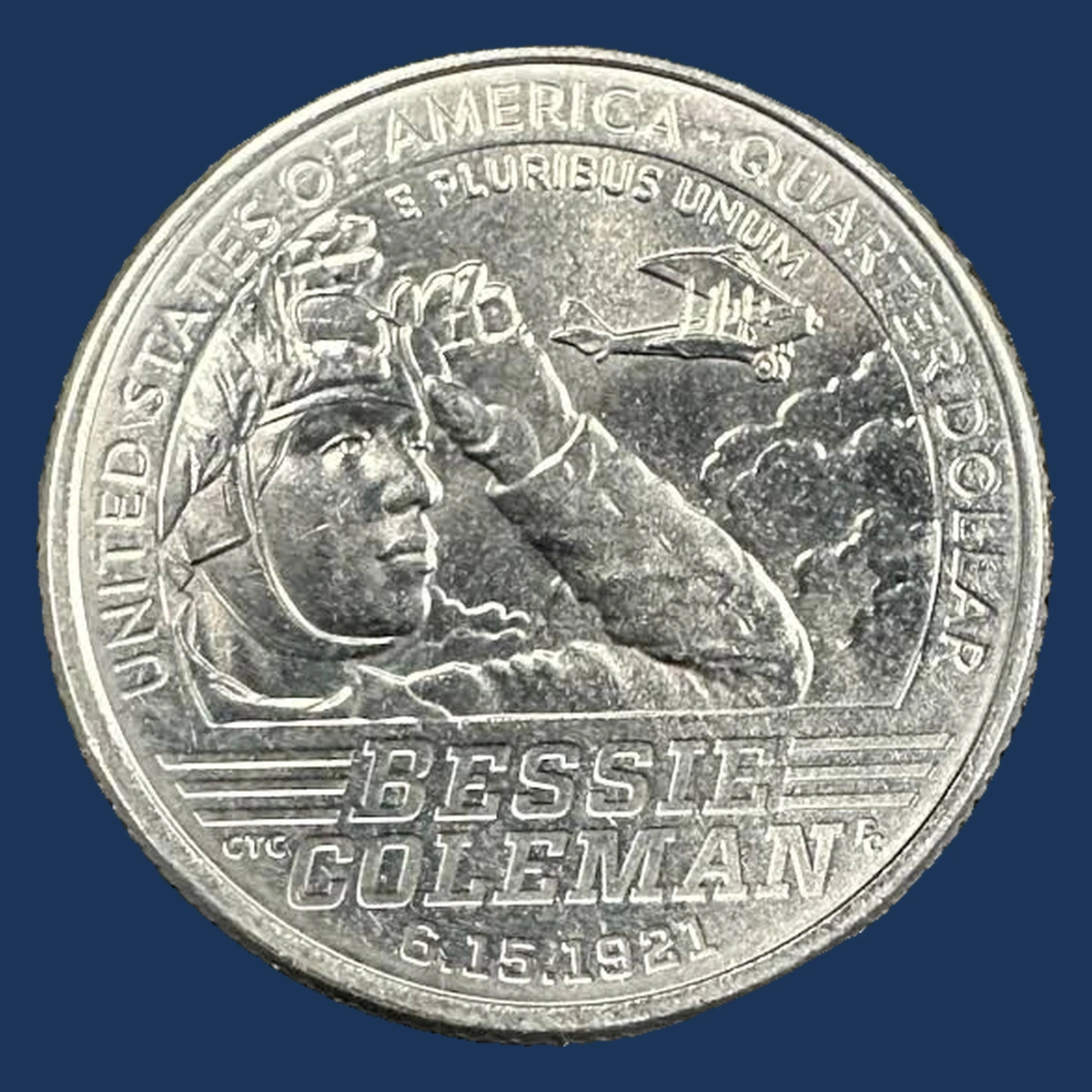
Raised lines and small lumps can form where a stamping tool cracks or loses a small piece. A larger break connected to the rim is called a cud.
Coleman reports include a plane-wing bump and letter cracks; Roosevelt examples include nose or cheek lines and a chip in ROOSEVELT’s V. Idar reports concern the forehead and clothing lettering.
Tallchief’s “extra feather” and “broken arm” names describe reported tool flaws, not changed artwork. Kanaka’ole cracks are also reported, while separate rim-break reports require an actual connection to the edge.
Estimated Value
Small recognizable cracks or chips generally fit an estimated $2–$40 range. Larger original rim-connected breaks can support an estimated $40–$300, depending on their size and the surviving design.
A colorful nickname does not set the price. The Roosevelt retained-break report near the globe needs a visible broken boundary.
A small bump on Washington’s nose should not be priced as a large missing portion of the stamping tool.
How to Identify
Use side lighting to decide whether the mark rises above the surface. A scratch can have a raised lip beside its hollow, so examine both sides of a suspected crack.
Through a 10× magnifier, follow Roosevelt’s nose or cheek line, Idar’s forehead feature, or Tallchief’s arm line into nearby undamaged detail. Match the actual reverse design before using a comparison picture.
For a suspected cud, follow the raised patch all the way to the rim. Coleman and Tallchief rim-break reports do not give a universal clock position.
The Roosevelt retained-break report points near the globe between 12 and 2 o’clock. A retained tool piece can leave some design inside the broken boundary; an isolated internal chip cannot prove that larger break.
7. 2023 American Women Quarter Struck-Through Material or Filled Detail
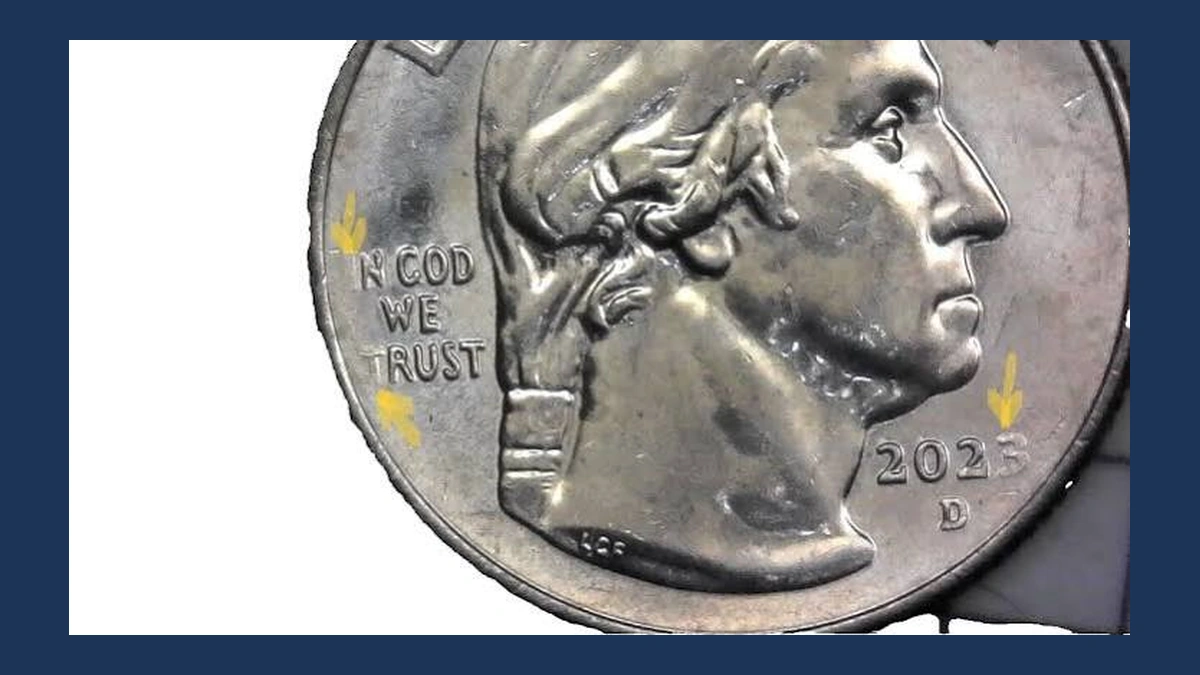
A hollow or missing patch of detail can form when material blocks part of the stamping tool. Solid debris may leave a clear impression; packed grease can soften small letters instead.
A graded Philadelphia Kanaka’ole quarter has a documented front struck-through error. Coleman reports describe a depressed line crossing LE in COLEMAN, without identifying the material.
Idar reports include interruptions on both faces and a seller’s proposed dropped-letter impression. That proposed material needs examination, and the normally open background around Idar’s letter-covered body is not missing design.
Estimated Value
An NGC-certified Kanaka’ole front struck-through quarter, described as having no circulation wear, sold for $99 in June 2026. It provides a same-year comparison for a recognizable interruption.
Estimate $10–$75 for modest filled-detail effects and $50–$350 for clear debris impressions. The visible size and shape matter; a weak T in TRUST does not automatically show the same process or value as a large impressed object.
How to Identify
The boundary of the affected patch helps distinguish the possibilities. Under a magnifier, compare any hollow with the sharp, undamaged details immediately beside it.
For Coleman, examine LE in her name. A line through those letters does not identify grease, wire, or another object by itself.
On Idar, compare the hair and clothing lettering with a normal coin. A dropped-letter claim needs an impressed letter-shaped object, rather than an ordinary letter already built into the design.
For a missing T or other weak letter, check nearby high points for wear and the background for grinding. Original detail interrupted locally, without fresh cuts or pushed-up impact edges, supports a struck-through explanation.
8. 2023 American Women Quarter Rotated Reverse
A reverse that tilts after a careful top-to-bottom flip may have been struck by a tool set at the wrong angle. The coin can still have a round outline and complete design.
A 2023 year report includes rotated tools but does not identify the particular woman, mint, or angle. Those details therefore belong to the candidate being examined.
Normal American coin alignment is easy to misunderstand. Turning a coin sideways instead of top to bottom can make a perfectly normal reverse appear upside down, creating a false error impression.
Estimated Value
For a genuine, clearly demonstrated rotation, estimate $25–$400 across modest through dramatic examples. This range compares ordinary modern quarters rather than assigning a sale price to an unidentified 2023 report.
A large angle is easier to display, but the actual coin still needs a consistent orientation check. Small departures may attract little interest, and two separately rotated photographs cannot establish either the error or an appropriate premium.
How to Identify
Keep Washington upright with the date level. Flip the coin from top to bottom while avoiding any twist to the left or right.
Identify the normal upright position of its particular reverse. Idar’s figure, Tallchief’s dancer, and the other designs provide different landmarks.
A transparent holder with reference lines can help preserve the orientation. Rotate the whole holder rather than opening a grading case.
Use a protractor over a straight photograph to record any angle and direction. Repeat the flip several times, because hand movement can create a misleading result.
The same reverse tilt must return each time while Washington starts in the same upright position.
9. 2023 American Women Quarter Broadstrike
A broadstruck quarter can spread outward beyond its normal diameter while keeping the main design complete. The restraining collar, a metal ring around the blank, did not contain the coin normally during the blow.
The outer margin may look unusually wide or uneven. The edge grooves may be incomplete or absent where the collar failed to form them.
Year guides report broadstrikes for Kanaka’ole and Tallchief quarters without establishing precise measurements. The widened shape must be examined alongside the full design, since later hammering can also flatten and enlarge a coin.
Estimated Value
An estimated $75–$500 covers genuine ordinary-strike broadstruck 2023 quarters with recognizable designs. Clear outward spread and attractive original surfaces make a stronger comparison than a barely unusual border.
The upper portion assumes a substantial, easily visible error rather than minor unevenness. A cut-off design may require an off-center comparison instead, and flattening after the coin left the Mint should not be valued as a failure of the press collar.
How to Identify
Measure a loose candidate in several directions with calipers and compare it with the normal 24.26 mm diameter. Photograph the measurements without pressing hard against the edge.
Next inspect the edge grooves through a magnifier. Their formation should agree with metal that expanded without normal collar restraint.
Look over the complete front and reverse pictures. A broadstrike retains the main design, even when the outer shape is uneven.
A scale can compare the normal copper-nickel weight of 5.67 g. Widespread flattening, damaged grooves, and compressed design details may instead point to later pressure; original spread surrounding a complete picture is the stronger combination.
10. 2023 American Women Quarter Off-Center Strike
A blank that sits away from the intended striking position can receive only part of both designs. The empty metal left beside the picture often forms a crescent.
Reports name Coleman, Kanaka’ole, Idar, and Tallchief quarters. They do not establish a single percentage, direction, or mint shared by all four designs.
The actual date is 2023 on Washington’s side. Coleman’s reverse also carries 6.15.1921, the date she earned her pilot’s license, so that inscription should not be mistaken for an old date left by another coin.
Estimated Value
Genuine 2023 off-center quarters with a readable date fit an estimated $50–$750 range. Small shifts generally sit lower than dramatic displacements that still preserve a clear identity.
These are comparison estimates for modern clad quarters, with wear and damage affecting the total. The named reports do not supply reliable measured percentages for every design, so a seller’s claim of a large shift should agree with the actual missing picture and blank area.
How to Identify
Look for two features together: design that runs beyond the blank and original empty metal on the opposite side. A magnifier can reveal grinding scratches if somebody removed the picture afterward.
Keep both faces in view. A shifted front beside a centered back may be a misaligned tool rather than an off-center blank.
The 2023 date and mintmark on Washington’s side identify the issue. Read the reverse design separately, especially on Coleman coins carrying the commemorative 1921 date.
An intact but misplaced blank can retain its normal weight. Follow the interrupted designs into the unstruck crescent on both faces before accepting the claimed amount of displacement.
11. 2023 American Women Quarter Missing Outer Clad Layer
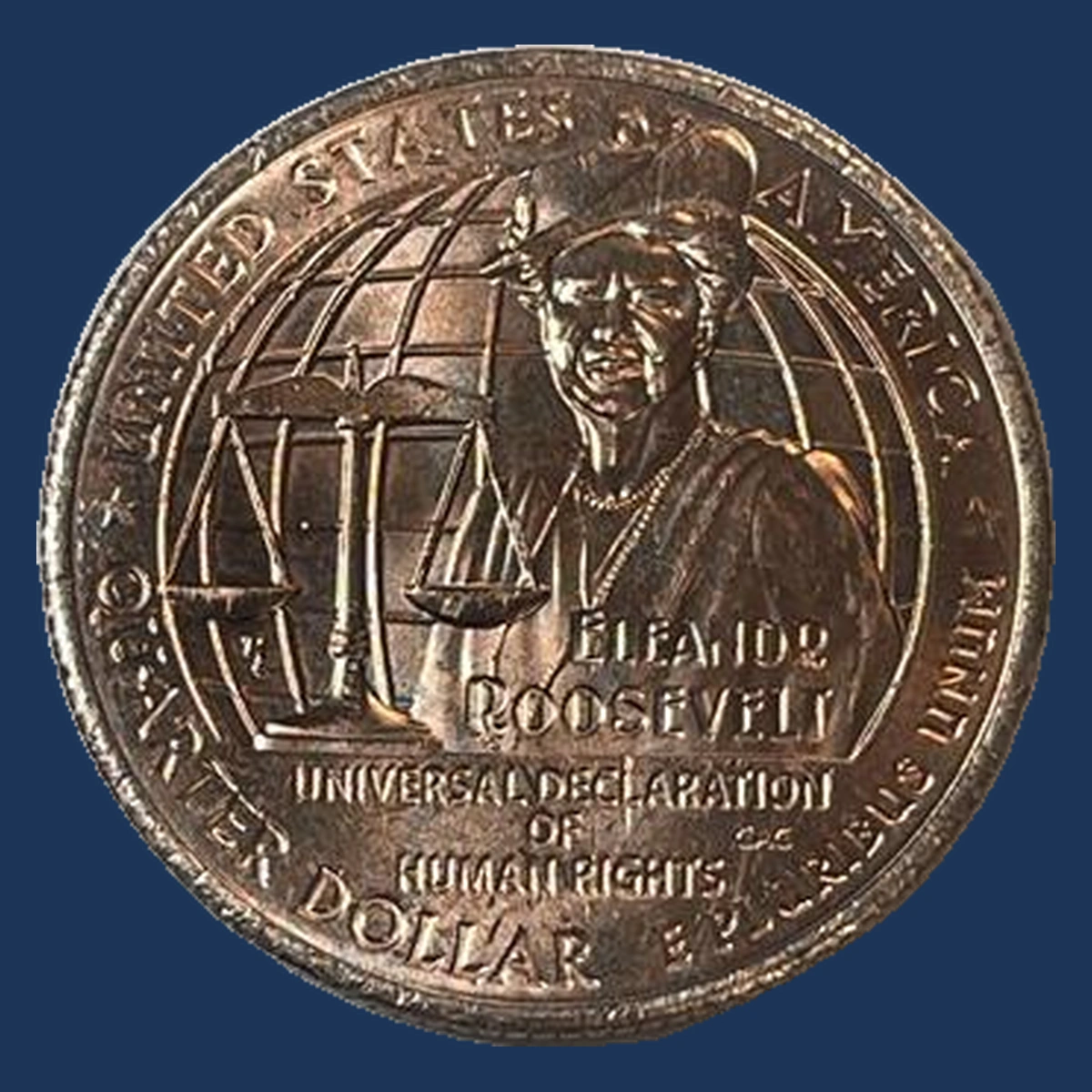
A copper-colored face can appear when a quarter loses its outer copper-nickel layer before striking. The exposed copper core then receives the design.
Graded Philadelphia examples include a Coleman quarter weighing 4.8 g and an Idar quarter weighing 4.7 g. Both are missing the reverse layer.
A Denver Coleman dealer example has about 95% of its reverse layer missing. Roosevelt and Tallchief missing-layer reports also exist, but their mint and affected face are not established; a brown surface alone does not prove this error.
Estimated Value
Estimate $300–$2,500 for a confirmed missing-layer 2023 clad quarter, with preservation and the extent of original exposed copper affecting the total. The graded Coleman and Idar coins demonstrate identifiable examples.
Their auction pages show starting bids of $1,760, while completed prices are hidden from public view. That figure is not a reported final sale, and partial loss, surface damage, or a merely copper-colored coin needs a different comparison.
How to Identify
For a loose ordinary quarter, use a scale accurate to 0.01 g. Compare the normal 5.67 g with the documented 4.8 g Coleman and 4.7 g Idar examples.
Examine the exposed face and edge together. Copper should form the original struck surface, with any remaining outer layer meeting it naturally.
The Coleman auction record identifies an NGC MS64 coin, meaning no circulation wear with some marks. Leave a graded coin in its holder and consult its recorded weight.
Silver Proofs, specially made collector coins containing .999 silver, have no clad layer to lose. Low weight plus original exposed copper is more meaningful than brown toning or added copper plating.
12. 2023 American Women Quarter Multiple Strikes
Two displaced sets of lettering or figures can show that a coin received another blow after moving. Parts of the first image may remain beneath the later strike.
A Tallchief year guide reports multiple strikes without specifying one coin’s mint, direction, or overlap. Those details must be visible on the candidate itself.
This process differs from a doubled design already present in a stamping tool. It also differs from normal Proof manufacture, where several properly aligned blows are intentional rather than an error that creates shifted overlapping pictures.
Estimated Value
A confirmed ordinary-strike Tallchief quarter with two clearly displaced impressions has an estimated range of $300–$3,000. The range compares modern multiple-struck quarters, not a recorded transaction for the year guide’s unspecified example.
Large visible overlap, a readable date, and an understandable sequence can increase collector interest. A small extra line on one letter cannot justify the same comparison, and damage made by pressing two finished coins together does not qualify.
How to Identify
Find a feature large enough to follow across the coin, such as a second portrait edge or part of Tallchief’s figure. Then trace nearby letters belonging to that same impression.
A close photograph should show a consistent second design, not isolated doubling on unrelated details. Use a magnifier where the two impressions overlap to see which one crosses the other.
Inspect both faces and the edge for evidence of later squeezing or flattening. A second blow may not affect both faces equally, so the actual overlap matters more than an assumed symmetrical pattern.
The decisive feature is a separate shifted picture with related details that move together, rather than a single thick letter.
13. 2023 American Women Quarter Brockage or Sunken Mirror Image
Reversed lettering pressed into the surface can form when a struck coin remains in the press and meets another blank. The stuck coin transfers its raised design as a sunken mirror image.
This error is called a brockage. A 2023 year report includes the category without naming a particular reverse design, mint, or affected face.
A candidate needs both the reversed image and its depth examined. A flipped photograph only reverses the picture on the screen, while coins squeezed together after minting can imitate part of the effect.
Estimated Value
For a genuine modern-quarter brockage, estimate $500–$5,000, from recognizable partial impressions to strong examples covering much of one face. This is a conditional comparison range for an examined 2023 candidate.
The completeness of the mirrored picture, surviving date, and surface condition affect the total. A vague dent with one possible letter belongs in a very different category from a clear sunken portrait or name created during the original strike.
How to Identify
Begin with a letter that has an obvious left-right direction. In a brockage, it should read backward and lie below the surrounding surface.
Low side lighting and a 10× magnifier help establish that depth. Check several connected letters or portrait details instead of relying on one ambiguous shape.
Turn the coin over to examine the normally struck face. Its date, mintmark, and design identify what was being produced.
Look along the edge and both faces for damage from later squeezing. A mirrored mark with crushed normal detail may need a different explanation.
A coherent sunken, reversed design is essential: a raised clash line or a digitally reversed image cannot supply that combination.
Conclusion
The estimated $2–$5,000 range runs from small raised tool flaws to dramatic mirrored or repeated strikes. The $99 Edith Kanaka’ole sale shows one documented price, rather than a promise for every weak-looking quarter.
Identify the reverse design and examine the feature itself. Original missing metal, displaced pictures, or consistent extra outlines matter more than a nickname, copper color, or an ambitious seller’s price.