1828 Dime Error List with Pictures

A backward Liberty helped a heavily worn 1828 dime sell for $5,750 in February 2009. The portrait was pressed into its back instead of the usual eagle.
The two 1828 dime errors below have estimated values from $100 to $8,000. One is a small raised break on the Small Date type; the other is the backward portrait on a larger Large Date coin.
Read on to compare their different shapes and sizes.
1828 Capped Bust Dime JR-1 Internal Die Break (Estimated Up to $1,200)
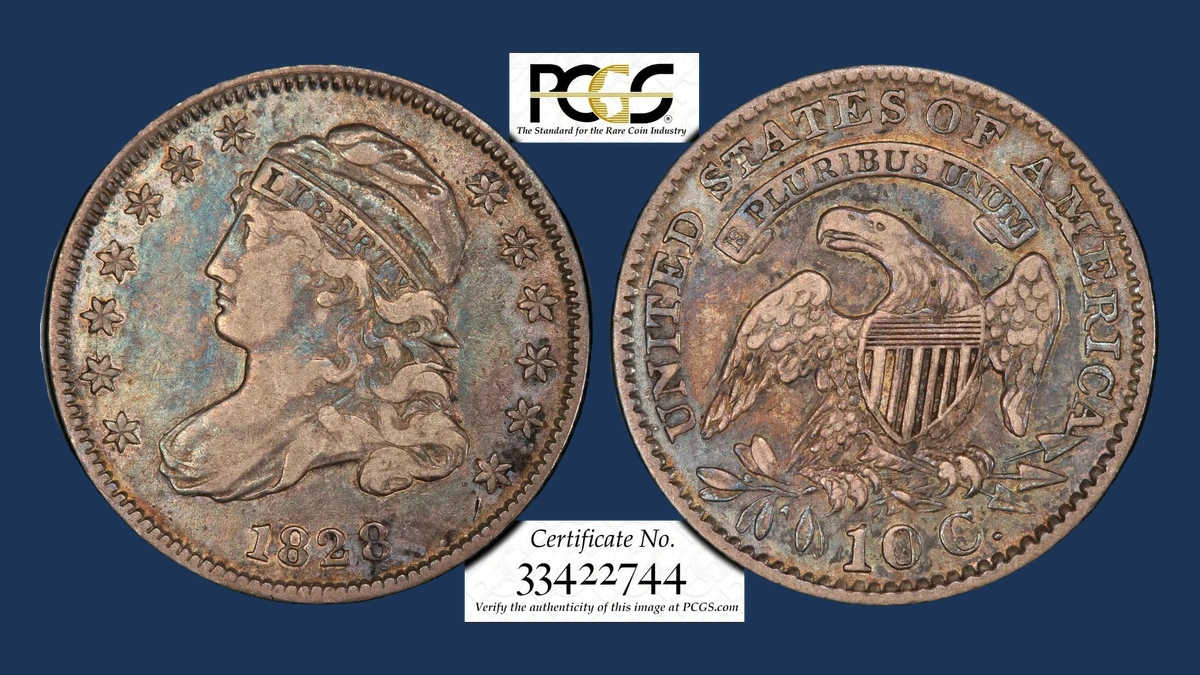
A small raised lump appears near M on an early Small Date JR-1 example. A guide describes a later, larger break from the letter labeled A2 toward the banner.
JR-1 identifies the pair of dies, the steel tools that stamp coins. Damage inside the back tool let coin metal enter the opening and form raised details.
The early chip photograph does not show every feature of the later stage. They should be compared separately.
This is an internal break, with no established connection to the rim. A random swelling or a rim-connected lump would need a different explanation.
Estimated Value
Estimate $100–$1,200 for circulated Small Date JR-1 dimes with clearly identified chips or internal breaks. Stronger remaining detail and a larger later break may support the upper end.
This is a whole-coin estimate, not a completed sale for the collector’s illustrated example. The JR-1 name alone does not promise the large break.
The early small chip needs a more modest comparison. Cleaning, corrosion, and other surface problems can reduce appeal even when the raised feature is visible.
How to Identify
Find the raised feature with a magnifier and check whether clear space separates it from the rim. The reported internal break should not be called a rim cud merely because it looks large.
Compare the early chip near M with the later A2-to-banner area in the collector discussion. The two stages have different amounts of damage.
A scale and calipers compare this Small Date type with about 2.70 grams and 18.50 mm. Its roughly 89.2% silver body has a grooved edge.
Look for added solder or gouging. Begin with original raised metal at the documented interior location, rather than an unrelated rim lump.
1828 Capped Bust Dime Large Date Reverse Brockage (Estimated Up to $8,000)
Liberty appears backward and sunk into the back of this Large Date dime. Another struck coin was caught against the blank and pressed its raised portrait into the metal.
Collectors call the result brockage. The receiving coin’s front still carries the normal design.
Heritage identified the example as JR-2 and graded it NGC AG3, meaning heavy wear with little remaining detail. The date and stars on the normal front are weak.
The protected sunken portrait retains stronger detail than that front. Its clearer appearance explains the error’s appeal, but it does not change the coin’s overall grade.
Estimated Value
The NGC AG3 sold for $5,750 on February 6, 2009. Estimate $3,000–$8,000 for genuine examples with a clear backward impression and a secure Large Date identification.
The historical sale shows that an unusual error can remain valuable despite heavy wear. It is not a current offer or a guaranteed price for another coin.
Remaining portrait detail, original surfaces, and reliable identification all affect the comparison. A plain depression does not qualify as the same error.
How to Identify
Tilt the back under a lamp and use a magnifier to check Liberty’s direction and height. The portrait and surviving lettering must be backward and sunk below the surface, not simply doubled or faint.
This older Large Date type starts near 2.70 grams and about 19 mm, with roughly 89.2% silver and a grooved edge. Use a scale and calipers, allowing for weight lost through heavy circulation.
Compare the weak date and full impression with the JR-2 photographs, checking for damage from later squeezing between coins. The quickest visible match is a normal front paired with a recessed, mirror-image Liberty occupying the back.
Conclusion
Estimated 1828 dime error values span $100 to $8,000. A small internal break and a backward portrait need different comparisons, even though both coins carry the same year.
Keep their sizes straight: the Small Date example is about 18.50 mm, while the Large Date brockage is about 19 mm. Both began near 2.70 grams.
Match the raised interior feature or sunken reversed portrait first, then compare condition and price.