1911 Dime Error List with Pictures

A 1911 Philadelphia dime struck 10% off center reportedly sold for $360 in February 2025. Smaller mistakes can be less obvious: a tiny missing edge or a second curve beside a mint letter.
This 1911 dime error list covers five types with estimated values of $25–$1,500. One listed San Francisco coin also has a step along its edge.
Read on to compare these shapes and understand what each price represents.
1. 1911-D Barber Dime Rim Clip (Estimated Up to $250)
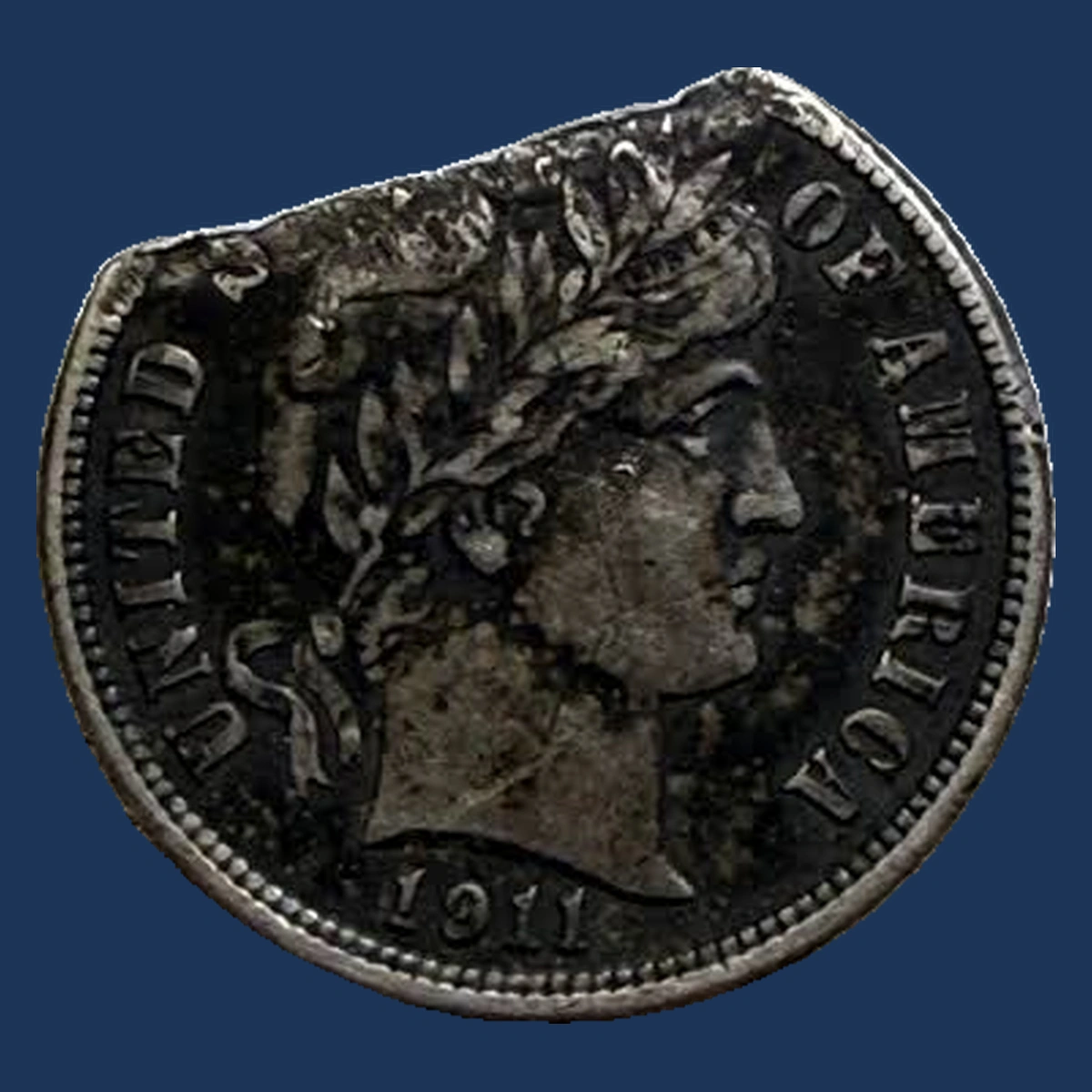
A tiny piece missing from the edge can be a rim clip. The 1911-D dime in the Rippere collection shows this small error, rather than a large crescent-shaped gap.
The blank was already incomplete when it entered the coin press. The design was then stamped onto the remaining metal.
GreatCollections listed this coin for its November 2025 sale as ANACS AU50 Details. AU50 indicates light wear; Details means a condition problem was also noted.
Because the missing area is small, its shape and surrounding metal are more useful than its size alone.
Estimated Value
A small rim clip on a circulated 1911-D dime has an estimated value of $25–$250. No sale price is established here for the Rippere example, and its condition problem matters.
A different silver dime blank with a clip sold for $59 at Heritage in March 2025. It was unstruck, undated, and graded PCGS MS60.
That lower-priced example shows the market for modest missing-metal errors. It is not a sale of a dated 1911 Barber dime.
How to Identify
The original grooves should end naturally where the small piece is missing. Look closely for saw marks, filing, or a fresh dent that might explain later damage.
Use a 10× magnifier to see how the stamped design and metal meet the gap. Weakness directly across the coin can support a genuine clip, but it is not a required finding.
Measure across undamaged portions with calipers, using 17.9 mm as the normal diameter. A scale reading can be compared with 2.50 g, though a tiny clip may remove no more metal than ordinary wear does.
Full photographs help preserve the shape of this small defect. Concentrate on the gap’s struck edges and absence of cutting marks, rather than assuming every missing sliver is a mint error.
2. 1911 Barber Dime Repunched Mintmark (Estimated Up to $400)
Above the D on some Denver dimes, part of another D remains visible. The earlier letter was punched slightly higher than the final one.
A die is the steel tool that stamps a coin’s design. Here, the worker punched the mint letter into that tool more than once.
The extra outline then appeared on coins made with it. The finished coin did not need a second strike.
An S/S variety is also reported for San Francisco. Its extra S must be checked separately, because the Denver letter’s position does not describe the San Francisco example.
Estimated Value
A year guide gives $25–$100 for circulated examples, while an estimated $25–$400 includes sharper, lightly worn coins. The range covers complete Denver and San Francisco dimes with recognizable extra letters.
An 1899-O dime with an O over another O sold for $115 in May 2023. That other-year coin had slight wear and a condition problem.
It is a useful Barber dime comparison. It does not establish a fixed amount to add to every 1911 mintmark variety.
How to Identify
First find D or S below the wreath bow on the back. For a Denver coin, Wexler’s photographs provide the comparison for the earlier D above the final letter.
Use a 10× magnifier and keep the whole letter in view. An extra rounded curve is more meaningful than a thick top or a small lump beside a nick.
For San Francisco, compare with a matching S/S photograph instead of assuming the extra piece must sit above the letter. Both mints used normal 2.50 g, 17.9 mm dimes with grooved edges.
A scale and calipers can check a loose coin without disturbing one sealed in a grading holder. On the Denver example, seek the small curve of the earlier D directly above the main D.
3. 1911 Barber Dime Doubled Die Obverse (Estimated Up to $600)
A doubled die can leave a small second outline beside part of the front design. The stamping tool itself carries the doubled image, so a single strike can pass it to a coin.
The annual 1911 guide reports this type without giving a confirmed mint letter or precise feature to match. It therefore does not establish that a particular letter or part of Liberty must be doubled.
Similar-looking shelves can form when a tool moves during striking. Those are a different effect.
A genuine example needs a consistent extra shape, not just a thick or blurry edge.
Estimated Value
Estimate $100–$600 for a clearly identified example from worn condition through coins with no circulation wear and some marks. The year guide’s circulated estimate is $100–$300.
The wider range allows for sharper coins with easy-to-see doubling. It is an estimate, not a recorded auction result for a 1911 doubled die.
Wear can hide a small extra outline. Flat shelves caused by movement during striking do not deserve the same price simply because they look doubled.
How to Identify
Move the lamp before accepting what looks like a second outline. Reflections can disappear or change position, while an actual raised feature stays on the coin.
Examine the front with a 10× magnifier, looking for rounded separation or small splits in the design. A flat shelf that seems to shave down the main shape suggests movement during striking instead.
The normal dime has a grooved edge, a 17.9 mm diameter, and an original weight of 2.50 g. Check those with calipers and a scale when the coin is loose.
Because the guide gives no exact matching feature, do not borrow one from another year. Confirm that the same extra raised shape remains visible as the light moves.
4. 1911-S Barber Dime Partial Collar Strike (Estimated Up to $700)
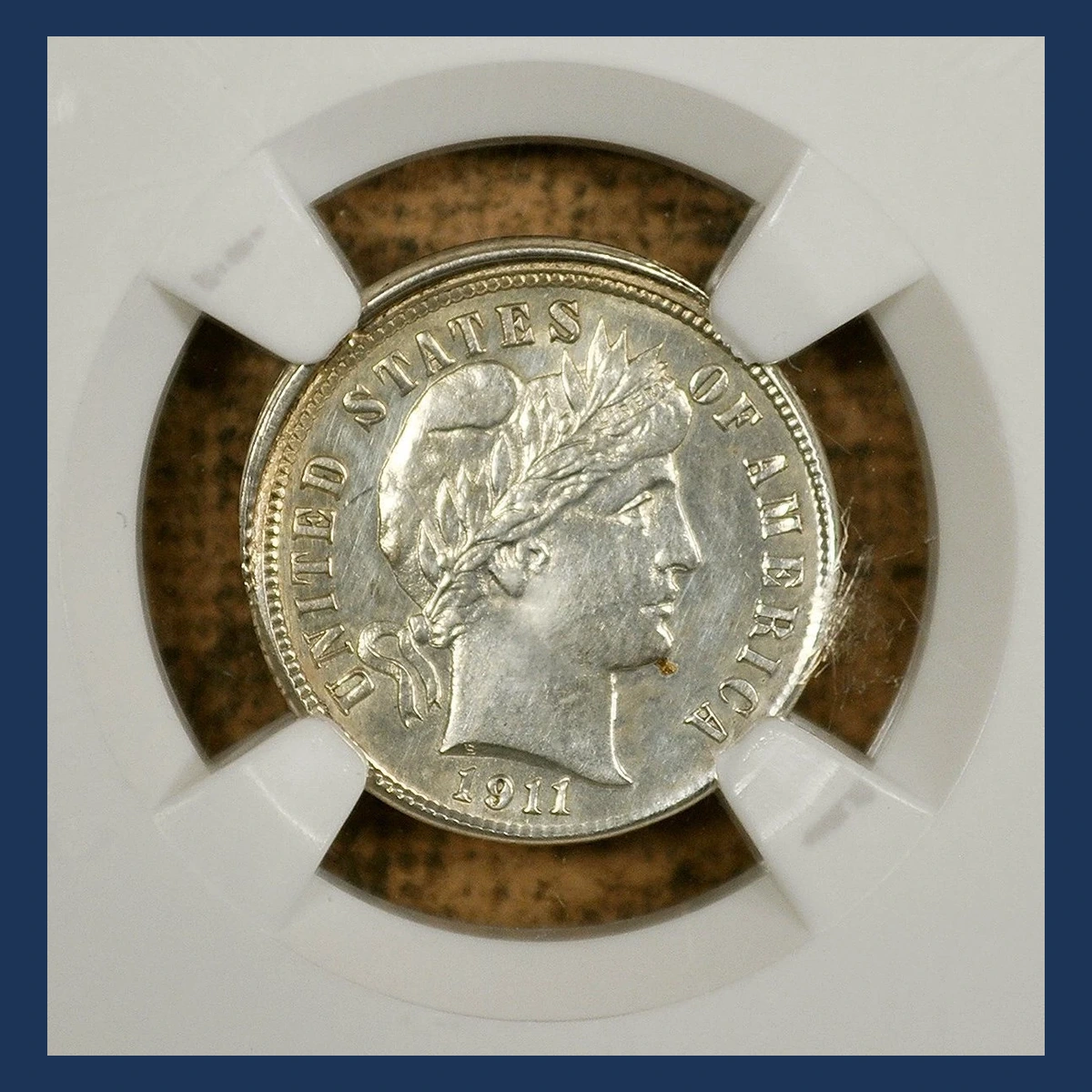
Viewed from the side, this error has two levels along the edge. One portion stays narrow while the other spreads farther outward.
The collar is the metal ring that controls a coin’s width during striking. If the blank only partly enters it, the exposed section can spread beyond the supported section.
Collectors sometimes call the resulting step a railroad rim. A dealer lists a 1911-S example graded NGC Uncirculated Details.
That means no circulation wear was found, but another condition problem was noted. The stepped edge is the error; the condition note describes a separate issue.
Estimated Value
The DJF Coins listing asks $289 for the NGC Uncirculated Details example, with offers accepted. An asking price is not a completed sale.
Estimate $150–$700 for recognizable examples from circulated condition through modest coins with no circulation wear. A clear edge step makes the mistake easier to appreciate.
Surface problems can lower the price even when the step is strong. The listed amount does not show what a buyer ultimately paid.
How to Identify
An ordinary face-on photograph can hide this error. View the edge directly, or use a holder photograph that shows its side.
Follow the step around the coin under a 10× magnifier. Compare the narrower band with the expanded metal beside it, noting where the edge grooves remain.
A loose coin normally starts near 2.50 g and 17.9 mm before wear or outward spread. A scale and calipers can document those measurements; there is no need to open a grading holder.
A dent changes one small spot, and later squeezing can leave compressed ridges. Look instead for two connected edge levels, with one band wider than the portion held by the collar.
5. 1911 Barber Dime Off-Center Strike (Estimated Up to $1,500)
Two 1911 dimes show how much the same mistake can vary. A Denver coin illustrated by Mint Error News is 20% off center, while a San Francisco example is only 5% off center.
The Denver coin was graded PCGS AU58, indicating slight wear. The San Francisco coin was ANACS VG8, with much heavier wear, and its strike shifted toward two o’clock.
Both began with a blank sitting off to one side between the stamping tools. The result leaves untouched metal beside the design and cuts off design at the opposite edge.
Estimated Value
The San Francisco VG8 example sold for $61 at Heritage in October 2017. A separate Philadelphia AU50 dime struck 10% off center reportedly brought $360 in February 2025.
Estimate $60–$1,500 from heavily worn, slightly shifted coins through better-preserved examples with larger shifts. A readable date also helps.
Neither sale belongs to the published Denver 20% example. Its price should not be assumed from another mint’s coin or from a different amount of displacement.
How to Identify
Can you read 1911 and the mint letter? Establish those first, since a strong shift may cut away the details needed to identify the year or mint.
The design should stop at a clear boundary beside untouched blank metal. Examine that boundary on both sides with a 10× magnifier; a shift on only one side can have another cause.
Use a scale and calipers to compare a loose coin with the normal 2.50 g and 17.9 mm. Check remaining edge grooves for cutting or grinding.
Do not use San Francisco’s two-o’clock direction to describe the Denver coin. The telltale combination is a blank margin and missing outer design produced together on both faces.
Conclusion
Estimated prices for these 1911 dimes range from $25 to $1,500. A small clip removes part of the original blank, a partial collar leaves an edge step, and an off-center strike shifts the design.
Mintmark and doubled-design varieties need closer views. Check their actual shapes rather than relying on a label, and remember that a seller’s asking price and an auction sale describe different things.