1999 Dime Error List with Pictures

A dime design on a cent blank created a wide, copper-colored 1999-D coin that brought $6,325 in April 2006. Other mistakes left two or three blanks joined together, or produced matching coins from one complicated strike.
This 1999 dime error list spans estimated values of $15–$15,000. Small doubled details occupy a different price level from the dramatic combinations.
Compare the designs and edges below, keeping each combined coin or matched pair together when judging its value.
1. 1999 Roosevelt Dime Doubled Front Design
A slight second outline near the date or LIBERTY can prompt a doubled-die check. A die is the steel stamping tool, and a true doubled die repeats its extra design on the coins it strikes.
The year guide mainly discusses Philadelphia examples and also mentions Denver reports. It does not establish one exact pattern or catalog number that identifies every candidate.
Thick letters alone are not enough. Movement during striking can leave a low, flat ledge beside a design, while reflections and wear can create other misleading outlines on a small coin.
Estimated Value
Use an estimated $15–$100 for clear, identifiable front doubling, with subtle examples nearer the lower end. The year guide’s usual comparison is roughly $15–$50 or more.
A stronger price needs a recognizable repeated pattern and an attractive surface. A seller’s close-up of one thick letter does not show enough to support the upper range.
Wear can hide second outlines, while scratches may interrupt the letters. Compare similarly clear doubling and surfaces rather than paying more simply for a higher grade.
How to Identify
Choose the feature that actually appears doubled and photograph it sharply before scanning unrelated letters. With a 10× magnifier, inspect the date and nearby lettering for rounded second edges rather than a flat ledge.
Move the light across the same feature to exclude a reflection. On a loose ordinary clad dime, a scale and calipers should show about 2.268 grams and 17.91 millimeters.
Those measurements identify the normal coin type but cannot establish how the extra outline formed. Compare the entire affected pattern with an identified example, since matching rounded separation is stronger evidence than isolated thickness or a shadow beside one letter.
2. 1999 Roosevelt Dime Broadstrike with a Wide Outer Border
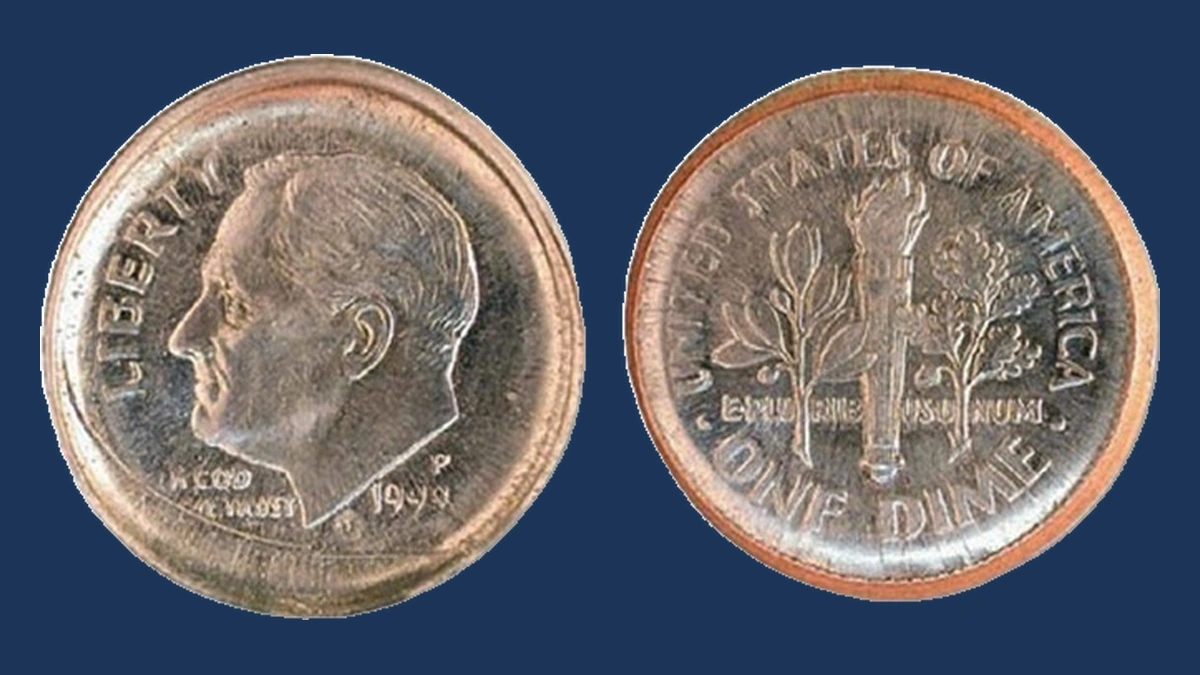
About a millimeter of extra border surrounds the auctioned Philadelphia example’s design. The metal spread because the collar, the ring that normally controls the coin’s width, did not contain the blank during striking.
Heritage described the coin as NGC MS66 Full Torch. MS66 means unworn with few marks, and Full Torch refers to sharply defined reverse details.
That sharpness is a condition feature, not another mint error. The complete design within the expanded border separates this broadstrike from a coin whose off-center strike leaves part of the design outside the metal.
Estimated Value
The MS66 Full Torch broadstrike sold for $49 at Heritage in April 2006. Another 1999-P broadstrike graded NGC MS66 brought $79 in March 2025.
An estimated $25–$200 covers ordinary attractive examples with varying amounts of expansion. The two sales show that an unworn broadstrike need not cost hundreds of dollars.
A clearly expanded, undamaged border is the feature to compare. Full Torch describes strike detail and should not be priced as a second independent error.
How to Identify
Inspect the border beyond the lettering before measuring the coin. The reported example has a visible band around the design, rather than a missing crescent cut from it.
Use calipers to compare the expanded outline with a normal 17.91-millimeter dime. A scale should place an intact clad example near 2.268 grams.
Under a 10× magnifier, follow the outer letters on both faces. They should belong to the original strike, without the crushing or scraping often left by later pressure.
Compare the edge with a normal grooved dime and check for free spreading. An enlarged outline carrying a complete design is the useful combination; a wide-looking photograph alone cannot establish a broadstrike.
3. 1999 Roosevelt Dime Straight, Curved, and Small Rim Clips
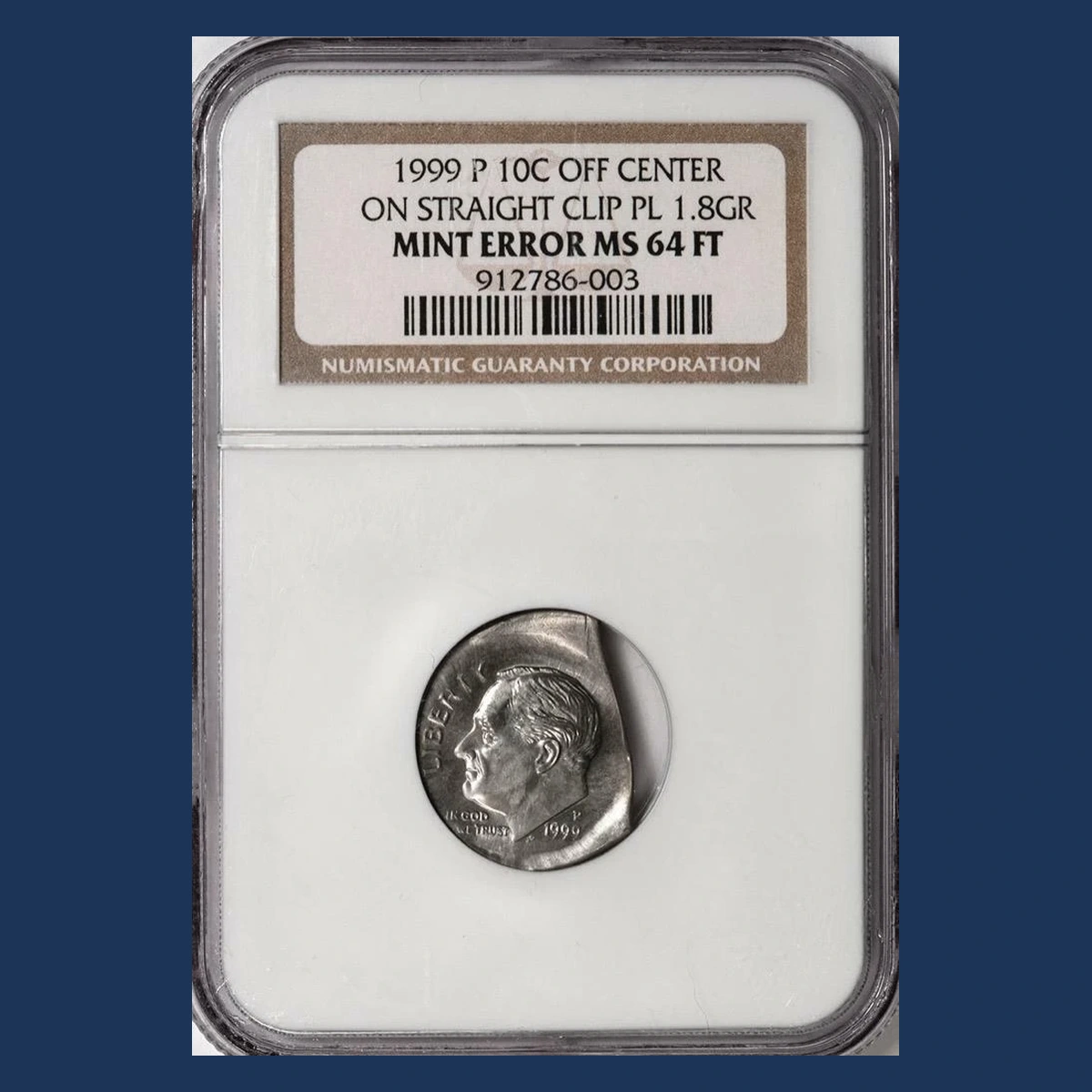
An incomplete blank can leave a straight missing section or a curved gap in the finished dime. The missing metal was absent before the design was stamped, rather than cut away afterward.
Heritage listed a 1999-P straight-edge clip graded NGC MS65, meaning unworn with relatively few marks. A separate PCGS MS66 coin has a twenty-percent curved clip and a smaller rim clip.
The two gaps on that second coin belong together. Their positions and sizes should not be borrowed for the straight-clip example, whose listing does not give those measurements.
Estimated Value
Estimate $30–$250 for genuine clips, with size, shape, and preservation affecting the result. A plainly original missing edge makes a stronger comparison than a coin with suspicious cutting marks.
The 1999-P twenty-percent curved clip with an additional rim clip sold for $69 in March 2025. That price covers the whole coin and both gaps.
A larger missing section does not guarantee a higher price if it removes the date or leaves a damaged, difficult-to-identify specimen.
How to Identify
Look at the two ends of the missing section with a 10× magnifier. Original design and metal flow near those ends should differ from a fresh cut through a finished rim.
On the curved example, locate the separate small rim gap as well. Do not assume that every curved clip carries that second feature.
A scale should register less than the normal 2.268 grams when metal is missing. Use calipers to compare unaffected spans with the ordinary 17.91-millimeter diameter.
Check opposite the larger gap for a weak rim, a useful clue that may vary in strength. Original edge texture and nearby struck detail are more important than the mere presence of a straight or curved bite.
4. 1999 Roosevelt Dime Broadstrike with a Front Indent
A broad, sunken area can interrupt the front while the surrounding coin spreads outward. Another blank overlapped the dime during striking, preventing the normal design from forming beneath the contact area.
Heritage listed this Philadelphia example as a broadstrike with an obverse indent. Obverse means the front, the face carrying Roosevelt’s portrait.
The coin was graded NGC MS64, an unworn grade with some visible marks. Its listing does not establish the exact position or percentage of the indent, so those details should come from the actual coin rather than a generic diagram.
Estimated Value
A working estimate of $75–$400 covers a clear front indent combined with a broadstrike. This prices the coin as one object rather than adding two complete error prices.
Plain 1999-P broadstrikes have recorded sales of $49 and $79, while an obvious original indent adds a different visual feature. Its size, depth, and placement would influence the comparison.
An original boundary and clean letters make the combined error easier to appreciate. Later dents or flattening should not receive the same premium.
How to Identify
Examine the bottom and boundary of the sunken area under a 10× magnifier. A blank overlap should block the strike in that area, rather than leave a sharp gouge through finished design.
Next trace the complete outer shape to identify the broadstrike component. Calipers can compare the spread outline with the ordinary 17.91-millimeter width.
An intact loose clad dime should remain near 2.268 grams on a scale. The overlapping object creates an impression; it does not necessarily cut material out of the dime.
Check for an original contact boundary and undamaged nearby letters. The indent and expanded border should show compatible metal flow, without the crushed surfaces typical of later squeezing.
5. 1999 Roosevelt Dime Missing Front Outer Layer
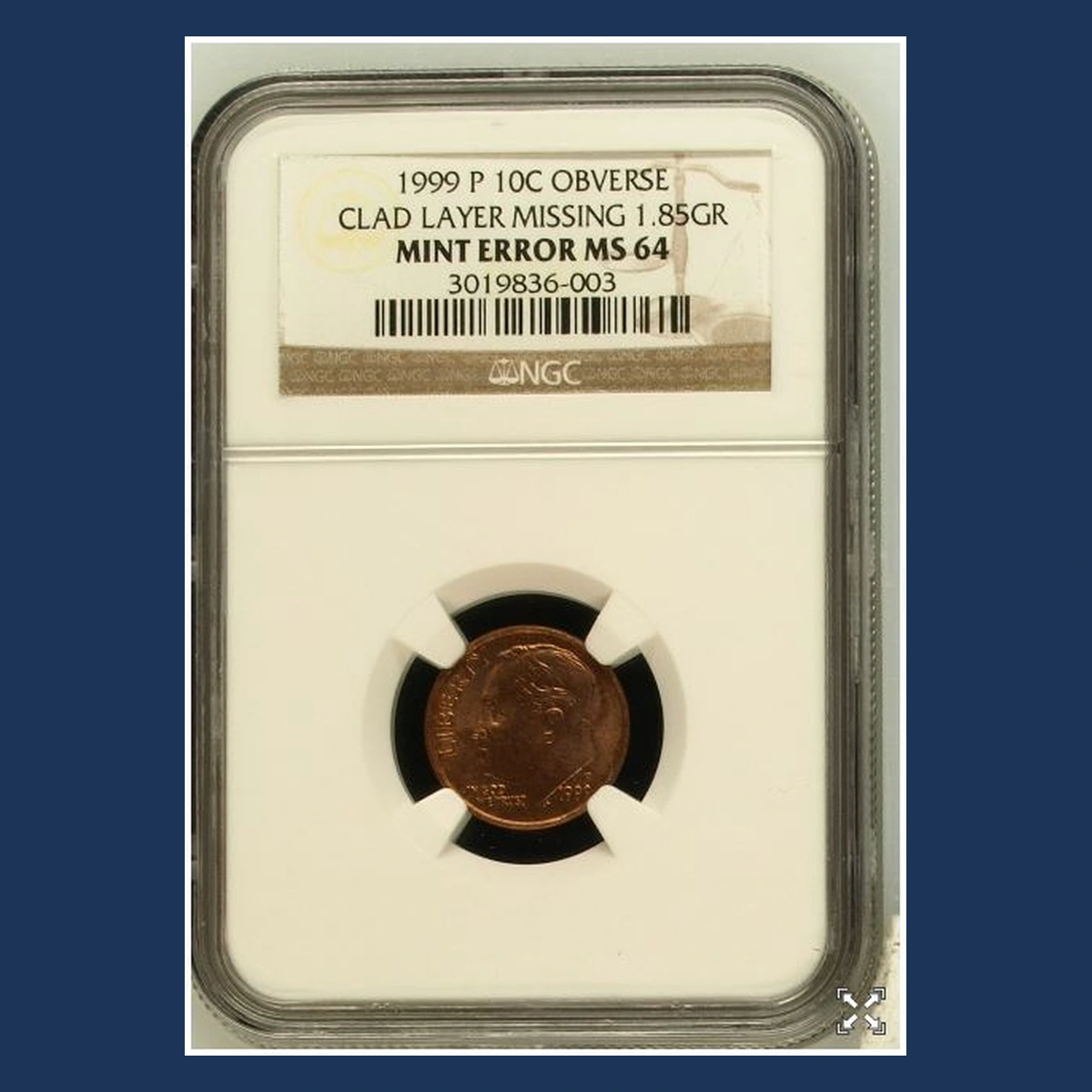
Roosevelt’s portrait can appear on copper-colored metal while the reverse retains its ordinary silver-colored face. The front outer layer is missing, exposing the copper core inside the clad dime.
A 1999-P example graded PCGS MS62 appears in Heritage’s auction records. MS62 describes an unworn coin with noticeable marks, so its condition should not be confused with a flawless specimen.
The metal loss should affect the edge and weight as well as color. A plated, stained, or chemically stripped dime may look similar, making a brown face only the beginning of the check.
Estimated Value
The recorded 1999-P MS62 example brought $139 in Heritage’s March 2025 sale. Use an estimated $100–$600 for genuine missing-front-layer examples of differing condition and appearance.
An original copper face with readable design provides a better comparison than a stained coin. Attractive higher-grade pieces may command more than the marked MS62 example.
Weight loss alone does not create the premium, because metal can also be removed after striking. The price depends on an original mint-made loss with its surface still recognizable.
How to Identify
Compare the front and reverse under neutral light, then examine the edge where the layers meet. Use a 10× magnifier to check that the front layer is actually absent.
Look closely at the portrait and letters for rough stripping, grinding lines, or rounded detail from chemical attack. Original copper-colored struck detail is more persuasive than a newly exposed damaged surface.
For a loose coin, compare weight on a precise scale with the normal 2.268 grams. A missing outer layer should reduce it, while calipers should show a width near 17.91 millimeters.
The normal 1999-S silver Proof, a specially made collector issue, weighs 2.50 grams. This error concerns the Philadelphia clad coin’s missing front layer, not intentionally different silver metal.
6. 1999 Roosevelt Dime Single Off-Center Strike
Part of the blank can remain untouched while the design reaches beyond the opposite edge. A single off-center strike occurs when the metal disk sits partly outside the stamping area.
The year guide reports ordinary Philadelphia and Denver examples. How far the coin shifted, and whether the date survived, must be checked on each actual piece.
Two separated design impressions indicate a different, multiple-strike event. Similarly, a complete design inside an unevenly wide border may be a broadstrike rather than a genuine off-center strike with part of its design lost.
Estimated Value
Estimate $15–$75 for a small, clearly original shift and $100–$600 for a more dramatic dated example. These are comparison ranges for ordinary clad dimes rather than a sale result for one guide illustration.
A large blank crescent can be impressive, but a readable year helps make the piece collectible. Wear, bends, and cuts reduce its appeal.
Do not add a separate off-center price when the same feature is already included in a double-struck or bonded combination.
How to Identify
Find the date first and read any surviving mintmark with a magnifier. A missing mark cannot establish Philadelphia if its normal position lies outside the struck metal.
Compare both faces for the same unstruck crescent and related missing design. A shift on only one face may come from a misplaced stamping tool.
Check whether there is one impression or several overlapping impressions. Extra portraits or dates belong in the multiple-strike comparison.
On a loose coin, use a scale against 2.268 grams and calipers against the normal 17.91-millimeter width. Spreading may change the outline without removing metal.
The visible match is one original blank crescent beside corresponding design loss, without a second separate strike.
7. 1999 Roosevelt Dime Double-Struck Pair with a Backward Impression
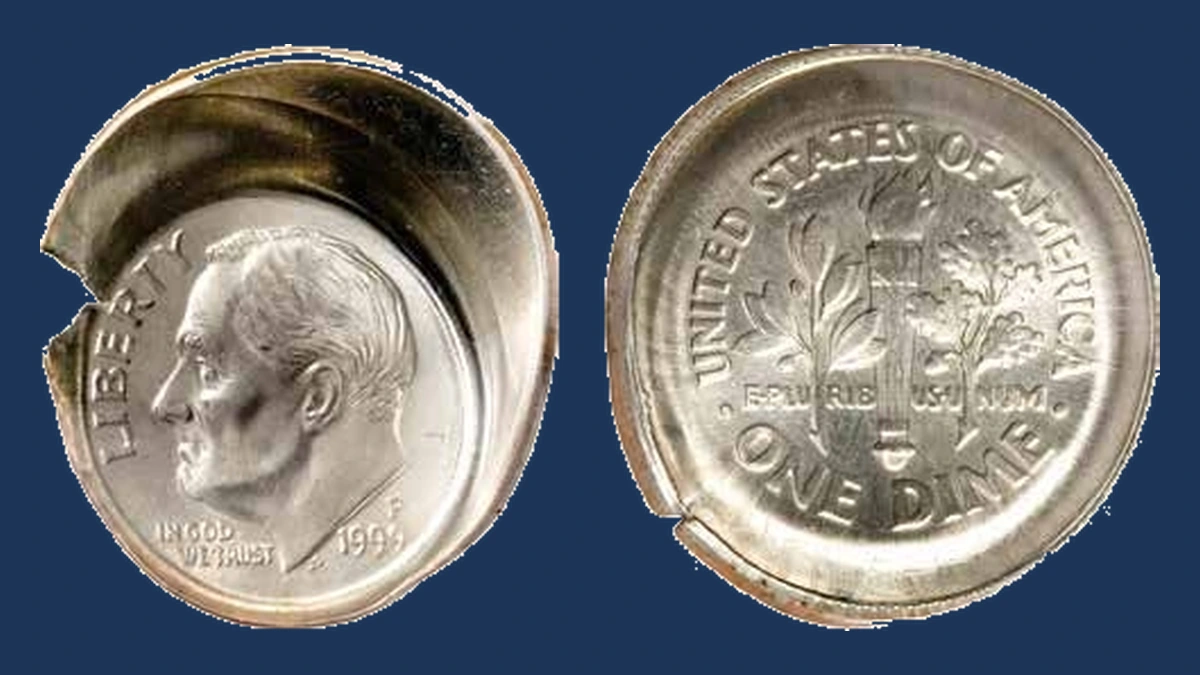
Two coins can preserve matching evidence of the moment they contacted each other inside the press. This Philadelphia pair includes a double-struck coin and another that is both double struck and brockaged.
Brockage means a sunken, backward design left by another struck coin. It differs from the normal raised image produced by the steel stamping tool.
The pair was graded ANACS MS62 and MS63, respectively, both unworn grades with visible marks. Its matching contact and design areas matter because two unrelated damaged dimes cannot recreate the same original striking relationship.
Estimated Value
The two-coin ANACS pair brought $552 at Heritage in July 2021. An estimated $350–$1,000 is a range for a complete, clearly matched pair of this kind.
The price covers both coins together. A buyer is paying for the connected evidence as well as the separate visible errors.
Missing one partner, heavy later damage, or an unclear match can reduce that appeal. The two grades and the extra backward impression should not be treated as three independent full-price error coins.
How to Identify
Place photographs of the two coins beside each other and locate the areas that could have contacted. Compare the shape of the overlap before studying individual letters.
With a 10× magnifier, check the second coin for a sunken backward design. The first coin’s relevant raised detail should explain the reversed impression, while both retain evidence of another strike.
Leave certified pieces sealed rather than pressing them together. For loose intact coins, each ordinarily begins near 2.268 grams and 17.91 millimeters, checked with a scale and calipers.
Striking can alter those outlines, so weight is not a substitute for the match. Related contact shapes and corresponding designs connect the pair more convincingly than similar dates alone.
8. 1999 Roosevelt Dime Die Caps and a Reported Capped-Die Strike
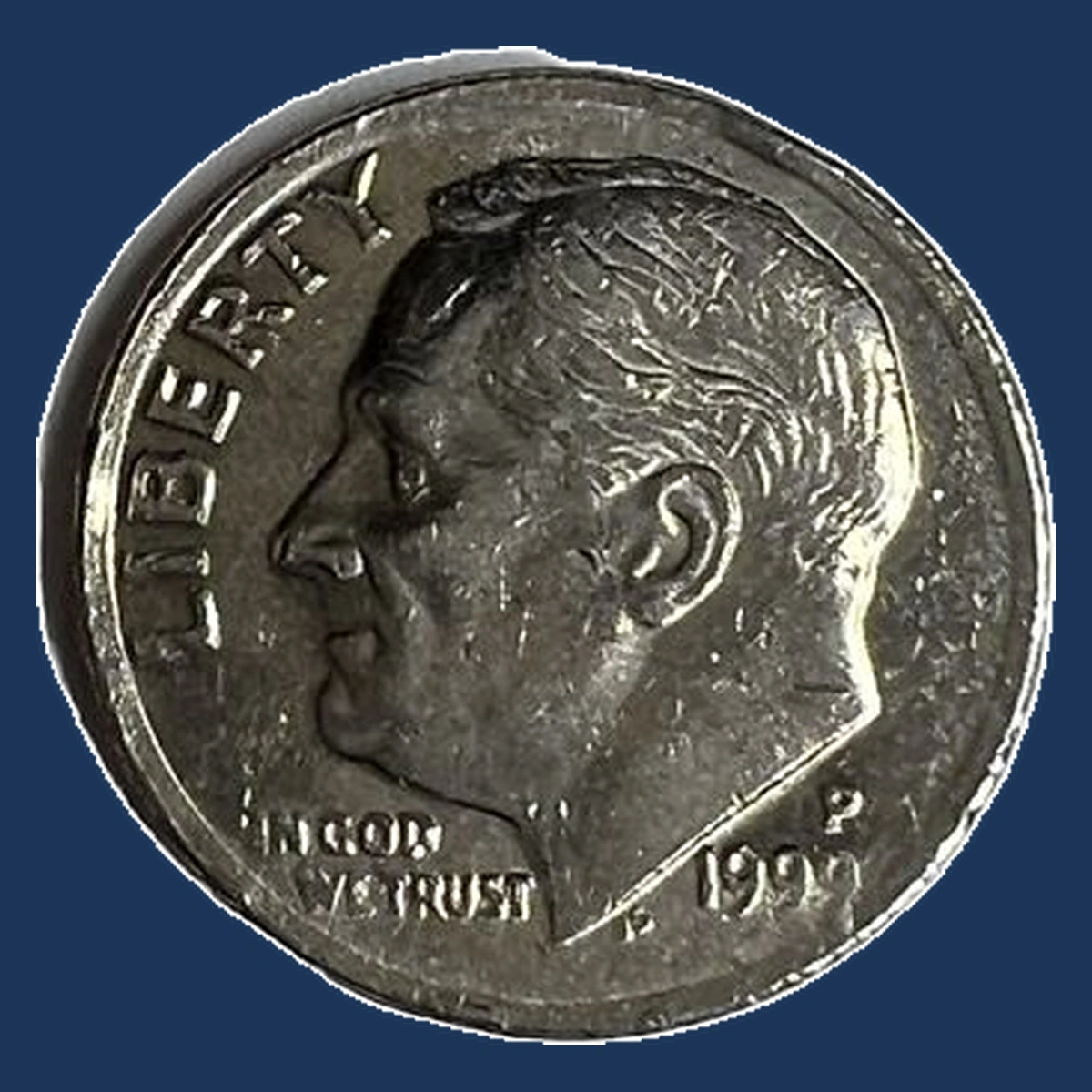
A dime that remains stuck to a stamping tool can curl around it as more blanks enter the press. The result is a die cap with a raised wall around its edge.
Known 1999 examples include a deep Philadelphia cap and a Denver front-side cap. A coin struck beneath such a cap is a different object, receiving an obstructed impression.
Another Philadelphia auction title uses Deep Capped Die Strike without enough description to settle that distinction. Its name should not turn a weak face into a proven separate type or identify the cap’s side.
Estimated Value
Use an estimated $300–$1,500 for clearly identified cap-related pieces, with shape and preservation driving comparisons. A Philadelphia MS64 deep cap sold for $546.25 in February 2010.
PCGS records $1,150 for the Denver MS64 front cap in April 2006. The separately titled MS67 capped-die strike brought $493.50 in January 2016.
These are different objects with different descriptions. Their prices cannot identify whether an unfamiliar coin is a cap or a coin struck beneath one.
How to Identify
View the edge from the side before studying a weak face. A genuine cap has metal rising around the tool, not just a flat area of missing design.
Use a 10× magnifier to inspect the raised wall and its connection with the struck surface. Later bending may leave sharp folds, tool marks, or crushed detail.
A cap-struck receiving coin instead needs an original obstructed impression. A sunken backward design can help when present, but is not required to remain clear on every late-stage strike.
For a loose piece, record weight and dimensions with a scale and calipers against the normal 2.268 grams and 17.91 millimeters. Do not flatten a cup to measure it.
Identify the actual wall or blocked impression separately from the auction title’s wording.
9. 1999 Roosevelt Dime Overlapping Pair with Stretching and a Folded Clip
One coin is stretched, while another incomplete blank folded beneath it and left an impression. Heritage described these two Philadelphia pieces as a linked combination involving overlapping blanks and several striking events.
The auction explanation also involves a third blank, with remnants left on a reverse. Only two main pieces were sold together, and neither was certified.
The clipped piece’s tail later received a flipped-over strike about ninety-five percent off center. That last impression belongs to the tail, not to the entire pair or to a separately available third complete coin.
Estimated Value
The two-piece combination sold for $603.75 at Heritage in August 2001. A working estimate of $400–$2,000 recognizes the complexity and the need for a convincing match between its parts.
The value covers the complete offered pair, including the evidence of overlapping and folding. It does not include an imaginary third intact dime.
Damage or lost fragments can make the striking sequence harder to explain. Clear original contact areas matter more than counting every error term as another premium.
How to Identify
Begin with separate photographs of both pieces, keeping their original orientation clear. Locate where the clipped piece folded beneath the stretched coin.
Under a 10× magnifier, compare the contact impression with the folded metal’s shape. Check the reverse for attached remnants and obstructed design without attempting to remove anything.
Find the tail’s flipped-over, largely off-center impression. Do not apply its ninety-five-percent description to the whole coin.
An ordinary dime begins at 2.268 grams and 17.91 millimeters. Use a scale and calipers to document the altered pieces, rather than expecting two standard weights from clipped and fragment-bearing objects.
The matching fold, contact hollow, and tail impression should explain the connected pair more clearly than a collection of unrelated bent coins.
10. 1999 Roosevelt Dime Multiple Strikes on an Irregular Scrap Blank
An irregular piece of metal can enter the press instead of a normal round blank. This Philadelphia example received multiple dime impressions on scrap and was graded PCGS MS65.
Its recorded weight is 1.46 grams, well below an ordinary clad dime. The outline and overlapping designs need to be considered together, because a normal coin can also become light after someone cuts it.
The listing does not map every strike or give an exact count. Extra design fragments therefore should not be assigned invented directions or used to construct a sequence beyond what the coin shows.
Estimated Value
A working estimate of $300–$2,500 suits an identified multiple-struck scrap piece, depending on visible design, size, and preservation. This is not a claimed auction result for the 1.46-gram specimen.
For context, a conventional 1999-D four-strike dime sold for $2,040 in March 2023. The scrap coin differs in both its blank and outline, so that sale only helps frame the comparison.
A lightweight fragment without original strike evidence should not receive the same value merely because its shape is unusual.
How to Identify
Weigh a loose candidate on a precise scale and record the result before trying to name the metal fragment. The cataloged piece weighs 1.46 grams, compared with 2.268 grams for an ordinary clad dime.
Use calipers to record its longest and shortest spans against a normal dime’s 17.91-millimeter width. With a 10× magnifier, follow the design impressions to the irregular edges and look for cuts through finished detail.
A genuine scrap strike needs original stamped design that fits the fragment’s pre-existing shape, not simply a normal dime cut smaller afterward. The overlapping impressions and untouched edge relationships are the useful evidence, rather than low weight by itself.
11. 1999 Roosevelt Dime Two or More Separate Strikes
An extra portrait, date, or section of lettering can show that a coin entered the stamping area more than once. Each new strike may partly erase an earlier impression or appear at another position.
NGC describes a 1999-D dime struck four times and graded MS66. A separate Philadelphia PCGS MS66 piece shows strikes twenty and seventy-five percent off center.
The Denver double-strike report instead places the second impression ninety-five percent off center. These percentages belong to different coins, and they should not be combined into a single imagined four-strike sequence.
Estimated Value
Estimate $250–$3,000 for clearly identified multiple strikes, with distinct, attractive impressions generally stronger than faint overlap. NGC reports $2,040 in March 2023 for the Denver four-strike MS66.
The Philadelphia twenty-and-seventy-five-percent double strike sold for $493.50 in January 2016. Its two impressions provide a different comparison from the four-strike coin.
How much recognizable design survives matters alongside the number of strikes. A second flat outline beside one letter is not equivalent to a second coin impression.
How to Identify
Find one clear repeated feature and trace the design around it with a 10× magnifier. Separate strikes should produce related groups of displaced detail, rather than only a shelf along one letter’s edge.
For the Philadelphia piece, compare the two off-center impressions separately; for the Denver four-strike coin, follow its own overlapping design. A loose ordinary dime starts near 2.268 grams and 17.91 millimeters, measured with a scale and calipers before allowing for distortion.
Check both faces for damage and for the way later impressions cut across earlier ones. Count only strikes supported by coherent design groups, keeping the reported ninety-five-percent second strike on its separate Denver specimen.
12. 1999 Roosevelt Dime Paired One-Sided Caps from Stacked Blanks
Two blanks entering the press together can block the designs from reaching their touching faces. This Philadelphia pair has the appearance of two one-sided caps, each with metal rising around its edge.
Heritage explained that the blanks apparently remained through several strikes before coming free. Both pieces were graded PCGS MS66, an unworn grade with few marks.
The plain contact faces and matching shapes are part of the same event. This differs from the separate pair with a backward coin impression, so the two groups should not borrow each other’s designs or prices.
Estimated Value
The two-coin PCGS MS66 pair sold for $2,185 at Heritage in May 2008. An estimated $1,000–$3,500 reflects the appeal of a complete matched combination with well-preserved original surfaces.
Keep the amount attached to the whole pair. One cap separated from its partner would no longer present the same complete evidence.
Raised walls, clear outer designs, and compatible contact faces all help support the comparison. Two unrelated cupped dimes do not become an equivalent matched pair simply because their dates agree.
How to Identify
Compare the contact faces before focusing on the high walls. The pair should show how two blanks blocked each other while their outward faces received the normal designs.
Use a 10× magnifier to inspect the meeting outlines and the bases of the walls. A backward design on a contact face would need a different explanation from an originally blank-to-blank contact.
Leave graded pieces sealed; do not force them together. For loose intact pieces, scale and caliper comparisons begin with 2.268 grams and 17.91 millimeters per ordinary dime, allowing for spreading.
Check for later folding or tooling around the cups. The compatible one-sided designs and original contact faces, rather than cupping alone, establish the relationship between the two pieces.
13. 1999 Roosevelt Dime Two or Three Blanks Bonded by Striking
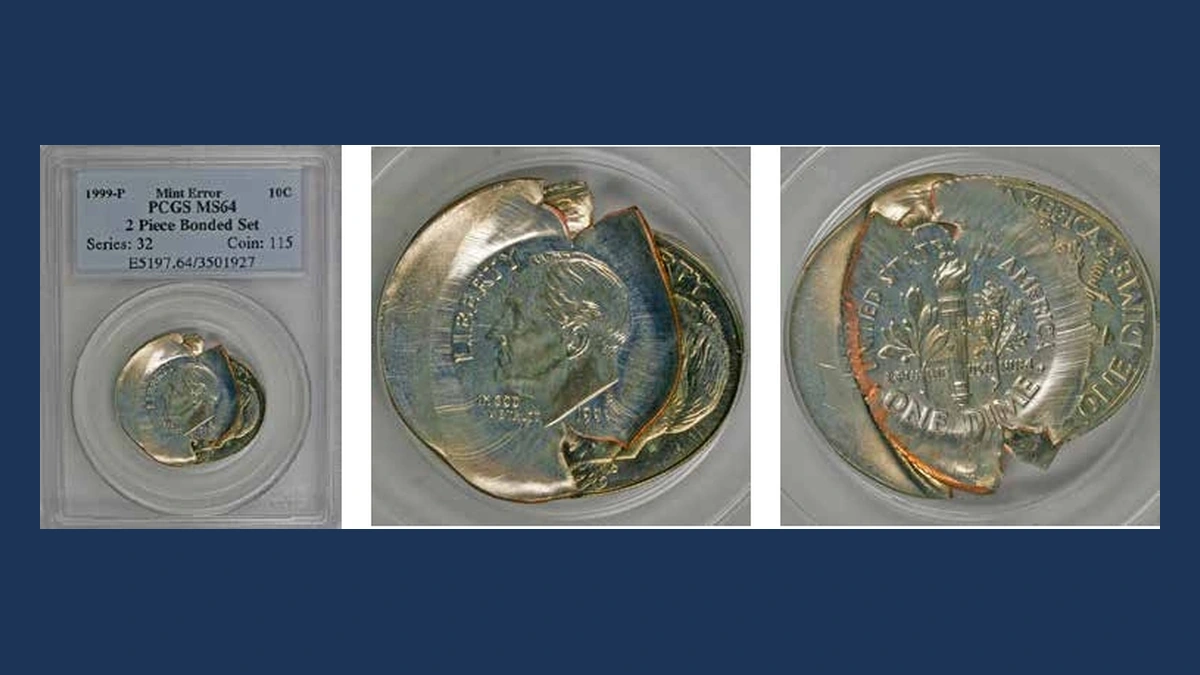
Striking pressure can join overlapping blanks into one connected object. The three-piece 1999-P example shows dime design across the joined metal and another partial impression on its lowest blank.
Heritage described that lower impression as about eighty percent off center. The whole combination received an NGC MS64 grade, meaning unworn with some marks.
A separate Philadelphia PCGS MS64 set contains two bonded pieces instead of three. These are different objects, and a small cut on the three-piece coin’s cheek is later damage rather than another feature created by the press.
Estimated Value
The three-piece NGC MS64 combination sold for $3,055 in January 2014. The two-piece PCGS MS64 set separately brought $3,360 in July 2021.
Estimate $1,500–$5,000 for a genuine, well-preserved bonded combination of this kind. The number of blanks alone does not determine the price, as these two results show.
Clear joined edges and connected original design make the error easier to understand. Loose coins glued together, or a genuine group broken apart after discovery, do not offer the same intact evidence.
How to Identify
Photograph the complete object before examining the joins. Count the visible blank outlines without trying to separate any pieces.
Use a 10× magnifier and side lighting to follow struck design into the overlap. Glue, solder, or a join interrupting finished detail may point to later assembly.
On the three-piece example, locate the additional impression on the lowest blank. Its roughly eighty-percent shift applies to that impression only.
A normal clad dime starts at 2.268 grams and 17.91 millimeters. A scale and calipers can document a loose bonded object, but no measured combined weight is given for these specimens.
Continuous original struck detail and metal joining across the overlaps provide stronger evidence than simply having several dimes stuck together.
14. 1999 Roosevelt Dime Broadstrike on a Copper-Plated Zinc Cent Blank
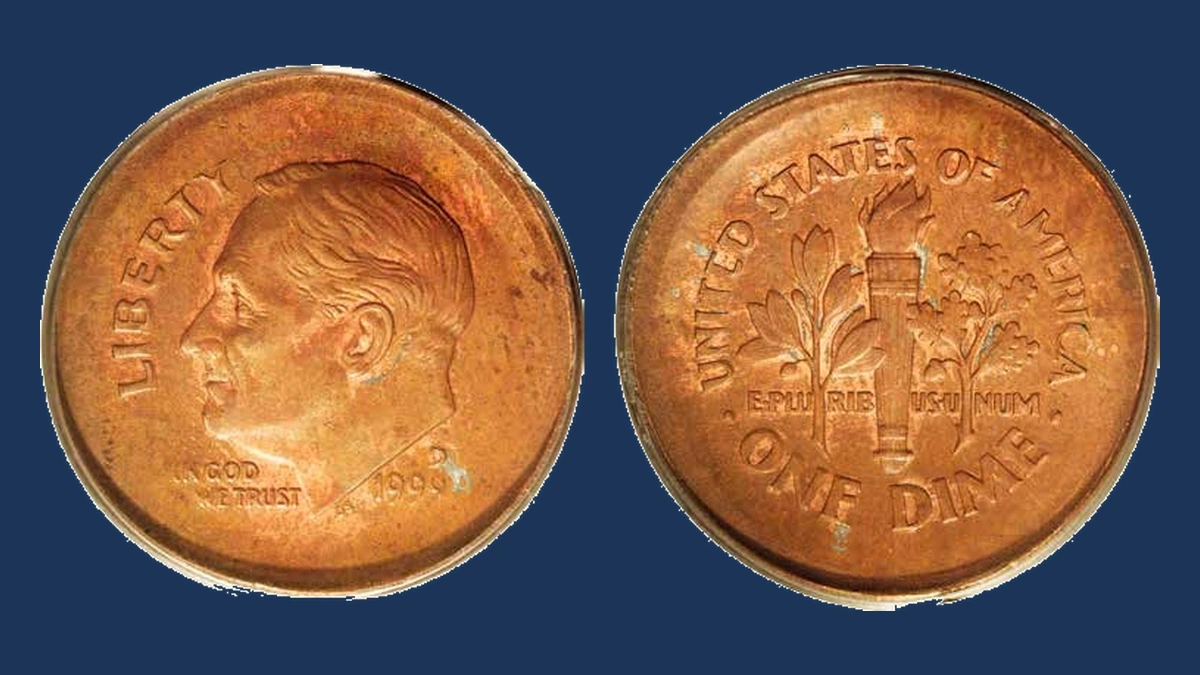
The Roosevelt design appears on a wider, copper-brown disk instead of the dime’s normal clad metal. Heritage identified the Denver example as broadstruck on a cent blank and graded it PCGS MS64 Brown.
A 1999 cent blank has copper plating over zinc, not zinc plating over copper. The catalog notes small exposed zinc areas on both faces and stretched lettering around the edge.
The wrong blank and expanded strike form one combination. This is not a dime overstruck on a finished Lincoln cent, which would need traces of an earlier cent design.
Estimated Value
The PCGS MS64 Brown example brought $6,325 at Heritage in April 2006. A working estimate of $3,000–$15,000 allows for differences in preservation and the strength of the wrong-blank identification.
Cleaner surfaces and clearer original plating support stronger prices within the range. The cent metal and broadstrike are valued together as one coin.
An ordinary dime colored copper after minting has neither feature. Original metal, recognizable dime design, and professional identification are essential to a comparable value.
How to Identify
Use a precise scale before deciding from color: a normal modern cent blank starts near 2.50 grams, while a clad dime starts at 2.268 grams. Calipers can compare the cent’s original 19.05-millimeter width with the dime’s 17.91 millimeters, allowing for further expansion during striking.
Under a 10× magnifier, inspect the reported zinc exposures and distorted outer lettering without scraping the metal. The auction’s generic dime specifications should not be treated as the measured weight of this unusual coin.
Check for added plating, removed outer layers, or an earlier Lincoln design before identifying the blank. A professionally established zinc core beneath original copper plating is stronger evidence than a brown color and a broad outline alone.
Conclusion
These 1999 dime errors have estimated values from $15 to $15,000. The $6,325 cent-blank broadstrike and the separate bonded sets show why the material and striking sequence matter.
Compare the complete object before naming individual features. A pair belongs with its partner, a bonded group keeps its original joins, and several strikes on one coin still receive one total price.
Clear matching evidence matters more than the number of error names in a listing.