2003 Dime Error List with Pictures

A football-shaped 2003-P dime sold for $172.50 at Heritage in February 2005. Its unusual outline came from an incomplete blank, not someone stretching a finished coin.
The 2003 dime errors below range from an estimated $5 to $8,500. The upper figure concerns a rare cent-stock error advertised for sale, while ordinary edge defects can cost far less.
Follow the differences in shape, metal, and design to see which description fits your dime.
1. 2003 Roosevelt Dime Stepped Edge from a Partial Collar
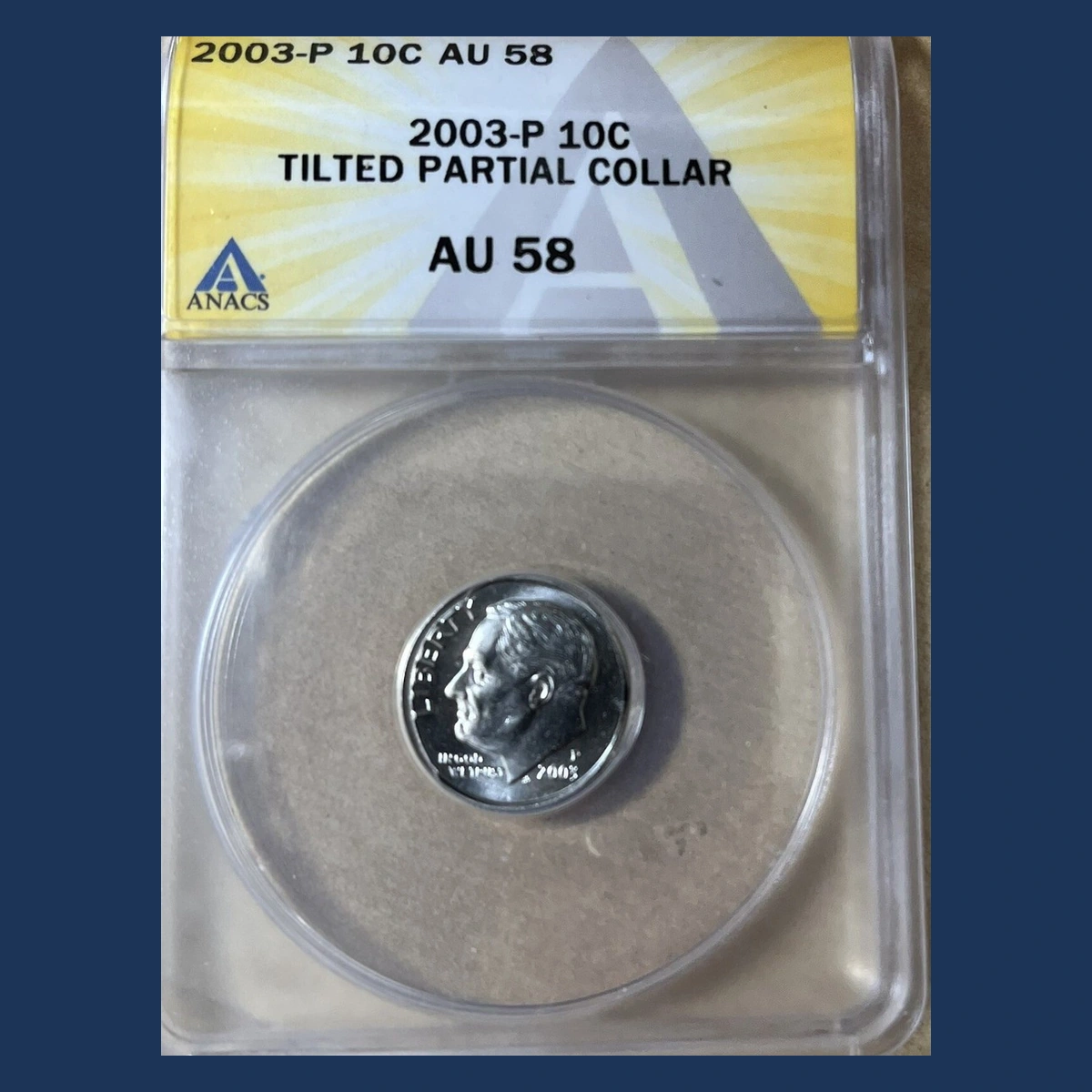
Viewed from the side, the edge can show two levels instead of one continuous grooved wall. Part of the blank stayed inside the collar, the ring that controls the coin’s width during striking.
The unsupported portion spread beyond it, creating a step beside the normally grooved section. Collectors often call this a railroad rim.
Fred Weinberg’s price list includes a 2003-P partial-collar dime. A doubled-looking border on the flat face is not enough to identify the same error, because the important difference lies in the edge’s two levels.
Estimated Value
Fred Weinberg’s January 2007 price list offered a 2003-P partial-collar dime for $5. That historical asking price provides a useful modest comparison, rather than evidence of a four-figure sale.
Use an estimated $5–$75 for ordinary examples, depending on how clearly the edge step shows. A strong, undamaged step is easier to collect than a slight uneven border.
The estimate concerns the visible edge error, and a vague double-rim nickname alone should not raise the price.
How to Identify
Look along the edge at eye level, using a 5× or 10× magnifier. Find where a grooved section meets a wider, smooth section at a distinct step.
With calipers, compare those levels with the ordinary 17.91-millimeter width. A loose clad coin should remain near 2.268 grams on a scale unless metal has been lost.
Follow the step around the edge rather than assuming that it continues all the way around. Its extent can vary.
Now compare the borders on the two faces. A double-looking border without the edge step is not enough.
Check for battered grooves and a thick rolled rim. An original transition between grooved metal and free expansion is the feature that identifies a partial collar.
2. 2003 Roosevelt Dime Raised Cracks and Small Chips
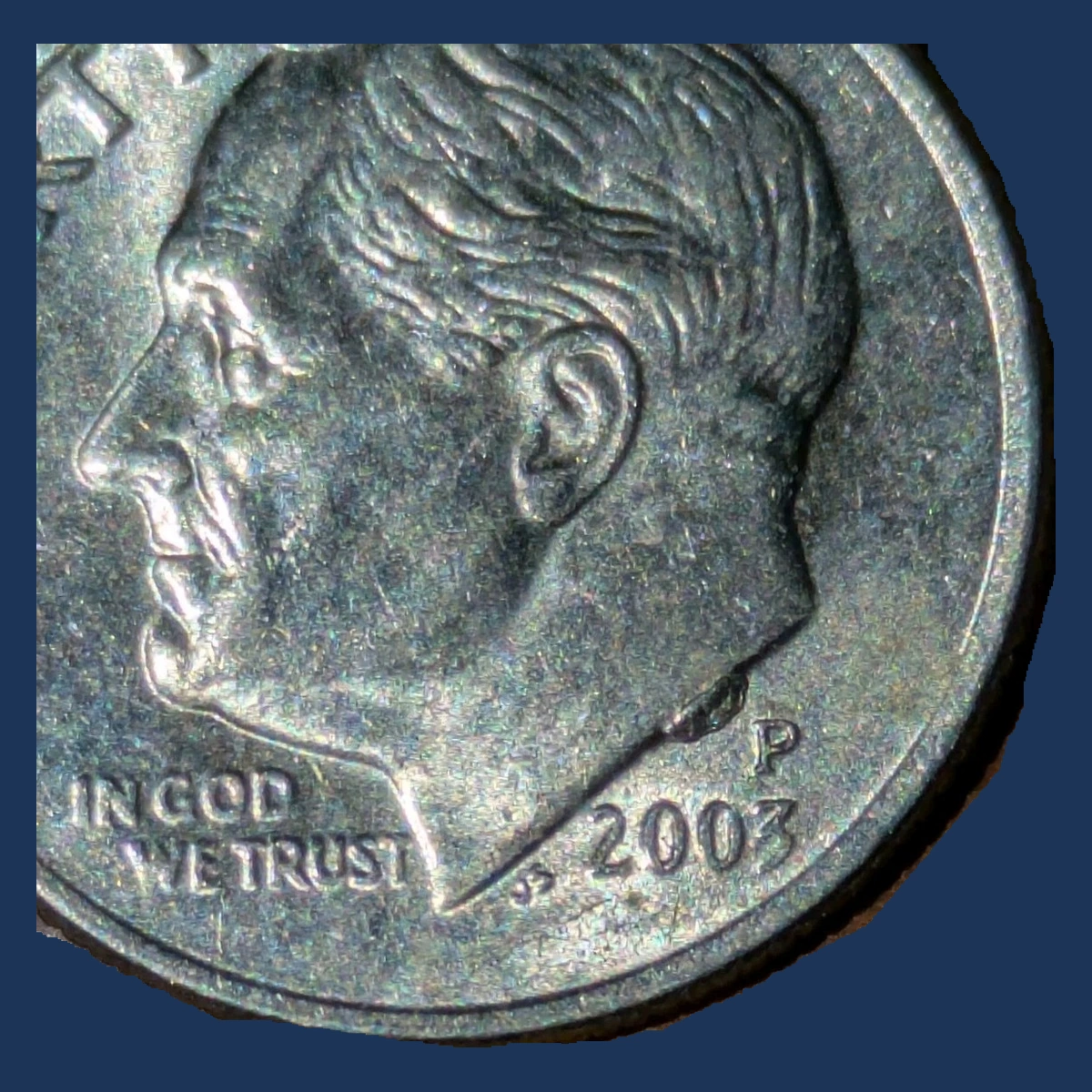
A fine raised line can run from the rim toward Roosevelt’s head. The year guide reports that appearance on a 2003-D dime, along with separate examples of small raised lumps.
These features begin in the die, the steel stamping tool. Coin metal fills a crack or a small opening left where a piece of the tool broke away.
The lump is therefore part of the struck coin, not a pile of loose steel fragments. Exact chip positions vary, and a generic illustration of a filled letter should not identify an otherwise unmatched 2003 dime.
Estimated Value
Allow an estimated $5–$150 for small chips and clearer cracks, with unusually strong examples around $150–$250. Large, easy-to-see features generally attract more interest than a hairline hidden by wear.
These ranges adapt the year guide’s comparisons rather than a named auctioned chip. Condition and placement both matter.
A raised spot with obvious added material has no comparable mint-error value. Multiple tiny bumps on one coin should not be priced as separate coins and added together.
How to Identify
Examine the reported rim-to-head line under side lighting with a 10× magnifier. Follow it continuously to distinguish a raised ridge from a scratch and its pushed-up edges.
For a lump, look at the boundary where it joins the surrounding surface. An original chip should be continuous coin metal, while an attached substance may show a different texture or seam.
Check a loose ordinary dime with a scale and calipers against 2.268 grams and 17.91 millimeters. A normal weight does not establish how an extra bump formed.
Leave all raised metal untouched rather than trying to scrape it away. The connected raised ridge or integral lump, without a gouge beside it, is the visible feature to confirm.
3. 2003 Roosevelt Dime Unusual Surface from Improper Heating
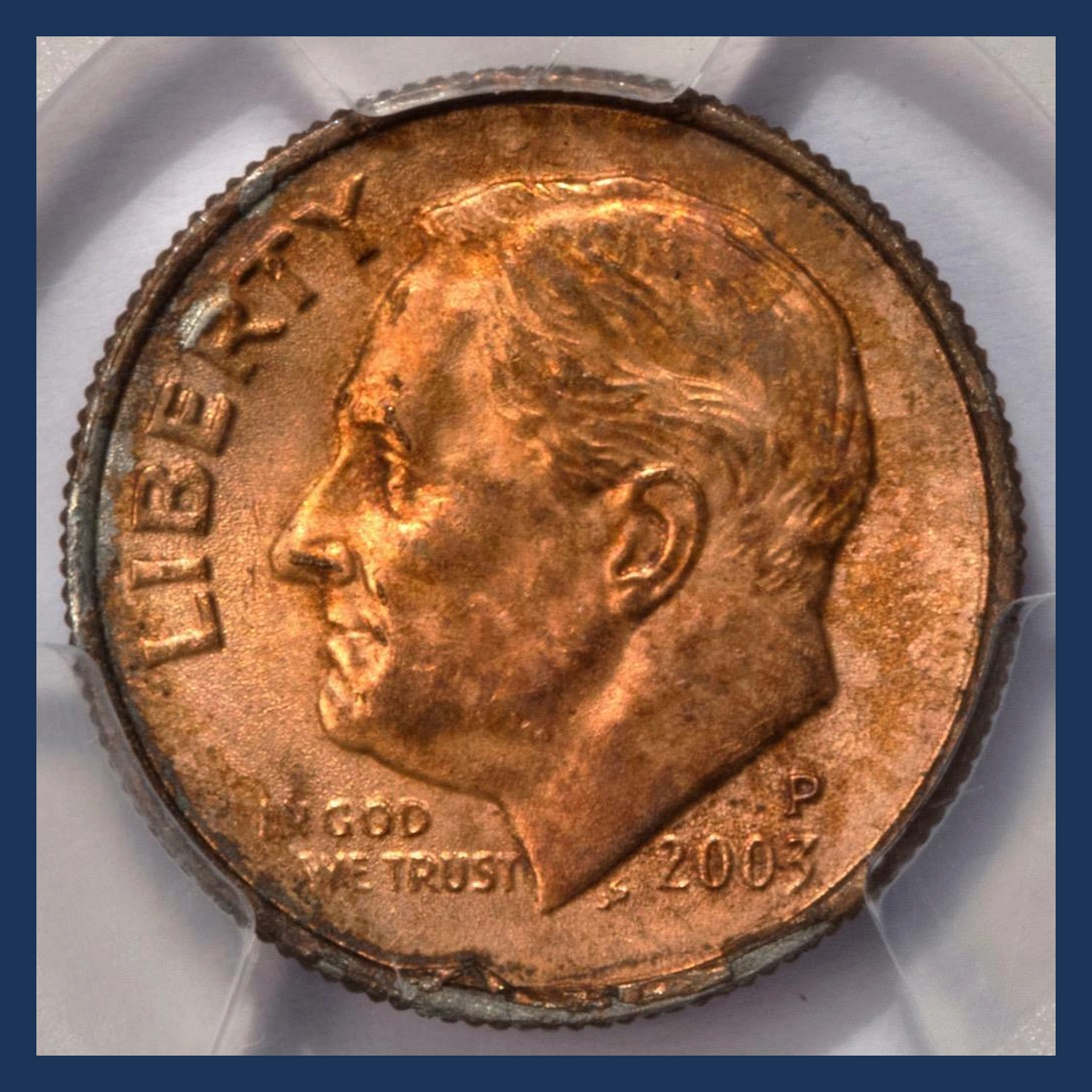
An unusually colored surface or weak design may lead to a report of improper annealing. Annealing is the heating step that prepares metal blanks to take a clear impression.
The 2003 year guide includes this category without identifying a specific mint or measured specimen. A heating problem could affect the metal’s response to striking, but softness and dark color alone cannot prove that cause.
Low striking pressure, environmental staining, and later heat can create similar appearances. A complete diagnosis needs the surface and shape together, rather than a decision based on one dull-looking photograph.
Estimated Value
For an identified mint heating error, use an estimated $40–$300. The lower portion suits modest changes, while a striking original appearance in good condition may justify more.
The year guide gives comparable ranges without a specific auction result for a 2003 specimen. A heavily stained or corroded coin should not be compared with an intact mint surface.
Neither weak detail nor an unusual shade earns this range on its own; the heating-related mint origin must first be established.
How to Identify
Compare the surface with an ordinary dime under neutral light before changing the viewing angle. Look for staining, pits, or coatings that could explain the color without a minting problem.
A 10× magnifier helps separate shallow original detail from areas rubbed smooth after circulation. Check several places on both faces rather than relying only on Roosevelt’s hair.
Measure a loose clad coin with a scale and calipers: normal specifications are 2.268 grams and 17.91 millimeters. Missing metal, unusual thickness, or a bent outline needs its own explanation.
Do not heat or clean the coin to test it. Have the original surface examined together with the strike before treating discoloration or overall weakness as an annealing error.
4. 2003 Roosevelt Dime Broadstrike with an Uneven Wide Border
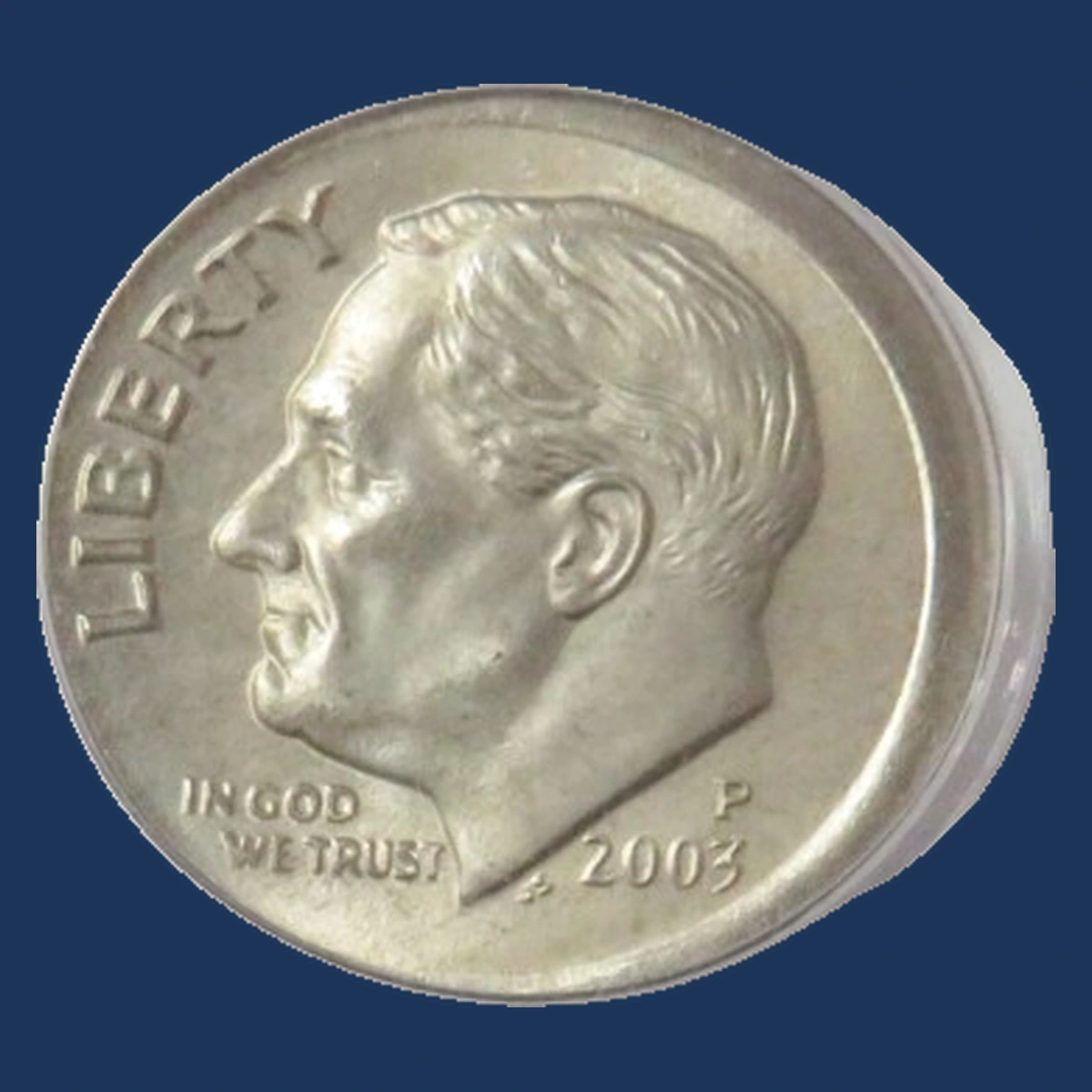
A dime can look off-center because one border is much wider than the other, yet still carry the complete design. This is an uncentered broadstrike when metal spreads without proper support from the collar.
Fred Weinberg specifically described 2003 examples with that appearance. His explanation separates them from true off-center strikes, which lose part of the design.
The coin may spread unevenly rather than form a perfect larger circle. Both centered and uncentered broadstrikes belong to the same general error, so an asymmetric border does not create a separate mechanism.
Estimated Value
Weinberg’s historical list offered a 2003-P uncentered broadstrike at $12 and a Denver example at $15. These were dealer requests for ordinary unworn examples, not auction results.
Estimate $10–$400 across minor through more dramatic broadstrikes, with clear expansion and attractive original surfaces supporting the stronger prices. Most slight uneven borders belong nearer the modest end.
The original price list is a better starting comparison than assuming every wide-looking dime commands several hundred dollars.
How to Identify
Read the entire design on both faces, including the letters beside the narrowest part of the border. If nothing is missing, an uneven wide border can be an uncentered broadstrike rather than a true off-center strike.
Use a magnifier to inspect the edge, then measure the unequal spans with calipers against 17.91 millimeters. A scale should place a loose ordinary clad dime near 2.268 grams, since the spreading does not require any metal loss.
Look for crushed lettering, rubbing, or a thick rounded edge that would suggest a vise or repeated tumbling. The useful combination is complete struck detail with an outwardly spread border, even when that border is wider on one side.
5. 2003 Roosevelt Dime Off-Center Strike
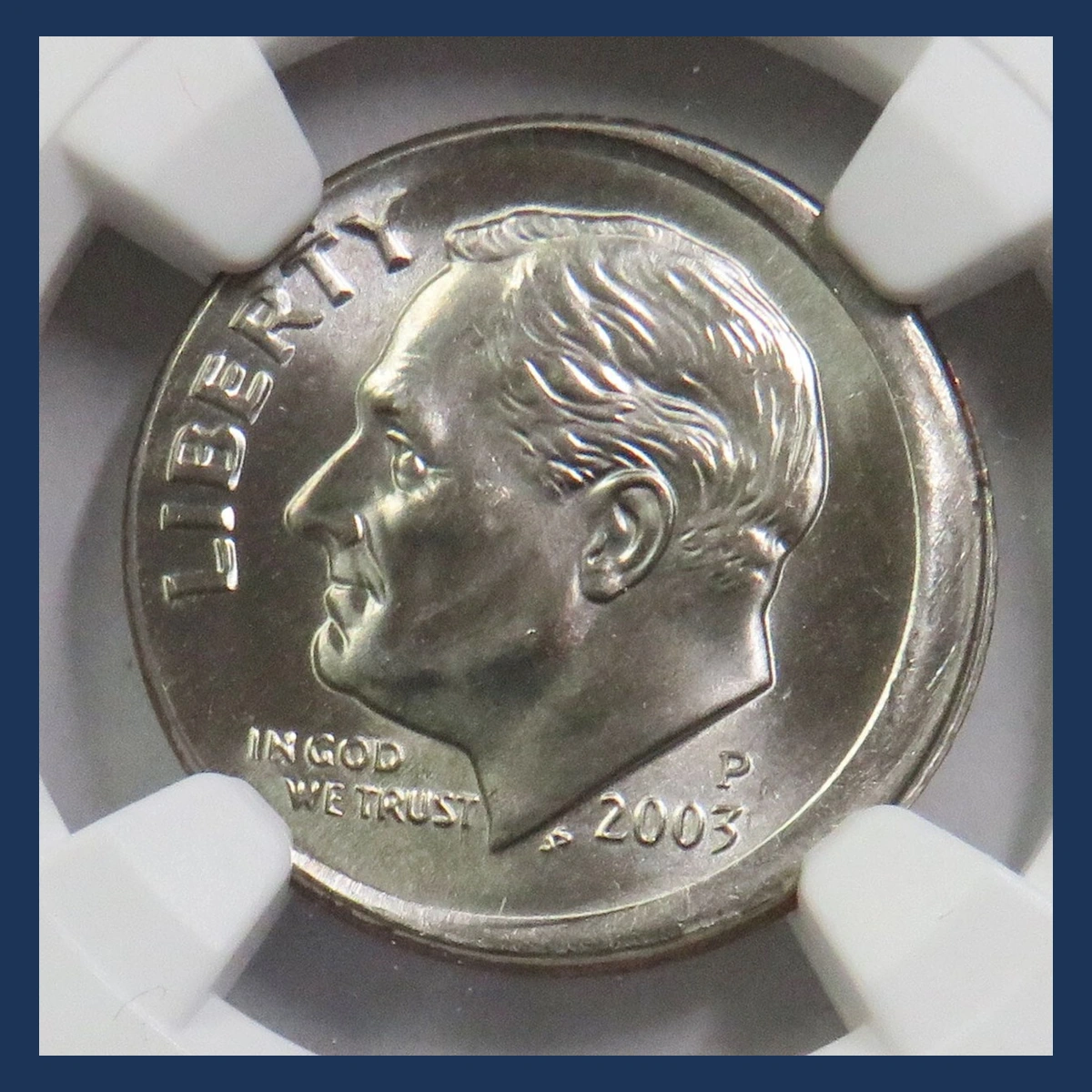
The key difference from a broadstrike is missing design, not simply an uneven border. An off-center blank receives only part of the impression, leaving a crescent untouched on one side.
GreatCollections sold a 2003-P example graded ICG MS65 in 2011. MS65 describes an unworn coin with relatively few marks, and ICG was the grading service for that piece.
Its listing does not supply the direction or percentage of the shift. Those details must come from the actual coin rather than another year-guide example with a different description or sale history.
Estimated Value
PCGS’s auction index records $14 for the ICG MS65 piece sold at GreatCollections in July 2011. It should not be confused with a separate high-priced fifteen-percent example claimed by the year guide.
Estimate $10–$500, depending on displacement, readable date, and condition. Smaller visible shifts may stay inexpensive even on an unworn coin.
The original GreatCollections listing confirms the coin’s identity, while larger estimates require a more dramatic actual appearance.
How to Identify
Read the surviving date and P mintmark under a magnifier before comparing the auctioned coin. An undated example cannot simply be assigned to 2003.
Find where the design stops at the edge, then turn the coin over. Both faces should show a related shift and an untouched crescent.
Inspect that crescent for grinding marks or a newly smoothed surface. It should be original blank metal.
For a loose clad example, check 2.268 grams on a scale and record the outline with calipers against 17.91 millimeters. Spreading can alter its shape without cutting away metal.
Do not borrow the shift percentage from another listing. Genuine design loss beside the original blank crescent separates this error from a complete design with an uneven border.
6. 2003 Roosevelt Dime Elliptical and Ragged Incomplete Blanks
The auctioned Philadelphia dime has a football-like outline and a complete date. Heritage described a ten-percent elliptical clip extending around the front from roughly 9:30 to 3 o’clock.
Much of ONE DIME falls outside its remaining metal. The unusual outline began with an incomplete blank, rather than a normal finished coin being stretched.
The year guide separately reports a 2003-D ragged clip, which has an irregular missing edge. These shapes differ, but both concern metal absent before striking and must be distinguished from later cutting, squeezing, or filing.
Estimated Value
The PCGS MS66 elliptical example sold for $172.50 at Heritage in February 2005. MS66 means unworn with few marks and strong overall appearance.
Estimate $100–$500 for comparable elliptical pieces and $30–$1,000 for ragged clips of differing size and quality. The upper ragged range reflects the guide’s reported $985 Denver example, not another price for the Philadelphia coin.
Original edge evidence matters more than an unusual outline by itself.
How to Identify
Compare the complete date and missing portion of ONE DIME with the Philadelphia auction photographs. Its ten-percent clip describes absent blank metal, not a ten-percent off-center strike or a measurement of lost lettering.
Use calipers to record the unequal spans and a scale to check weight, without squeezing or bending the coin. The normal clad comparison is 17.91 millimeters and 2.268 grams, but the auction page does not provide this clipped specimen’s measured weight.
Under a 10× magnifier, inspect the missing boundary for original metal flow rather than saw marks or fresh shearing. A ragged Denver candidate needs the same edge examination, with nearby struck detail and any opposite-rim weakness supporting a pre-strike gap.
7. 2003 Roosevelt Dime Missing Portions of an Outer Layer
A copper-colored patch can mark a place where the normal outer layer is absent. A clad dime normally has two silver-colored copper-nickel skins surrounding a copper core.
The 2003-D reports include a seller’s description of missing portions, not necessarily one completely bare face. The surviving layer and its boundary matter when deciding how much metal is missing.
Chemical stripping and grinding can also expose the core after minting. The normal ninety-percent-silver S Proof, a specially made collector coin, uses intentionally different metal and is not a missing-layer error.
Estimated Value
Estimate $50–$200 for smaller genuine missing portions and $250–$1,000 for a larger, well-preserved missing-layer example. These are comparison ranges, not a confirmed transaction for the listed Denver coin.
A broad copper area with original struck detail generally makes a clearer comparison than a tiny discolored patch. Professional identification becomes especially important toward the higher prices.
The amount of exposed copper alone cannot set value, because a damaged or stripped ordinary dime can look similarly dramatic.
How to Identify
Examine the transition from copper to silver-colored metal under a 10× magnifier. A partial loss should have a meaningful layer boundary, rather than simply a change of color across intact metal.
Take photographs of both faces and the edge before handling the coin further. Scraped letters or an etched, porous surface may reveal metal removed after striking.
Use a precise scale for a loose clad dime, comparing it with the normal 2.268 grams. Calipers should place its unaffected width near 17.91 millimeters.
A normal silver S Proof weighs 2.50 grams. On the Denver clad candidate, the edge boundary and preserved struck surface need to support missing outer metal, not just a low weight and copper color.
8. 2003 Roosevelt Dime Localized Missing Detail from a Blockage
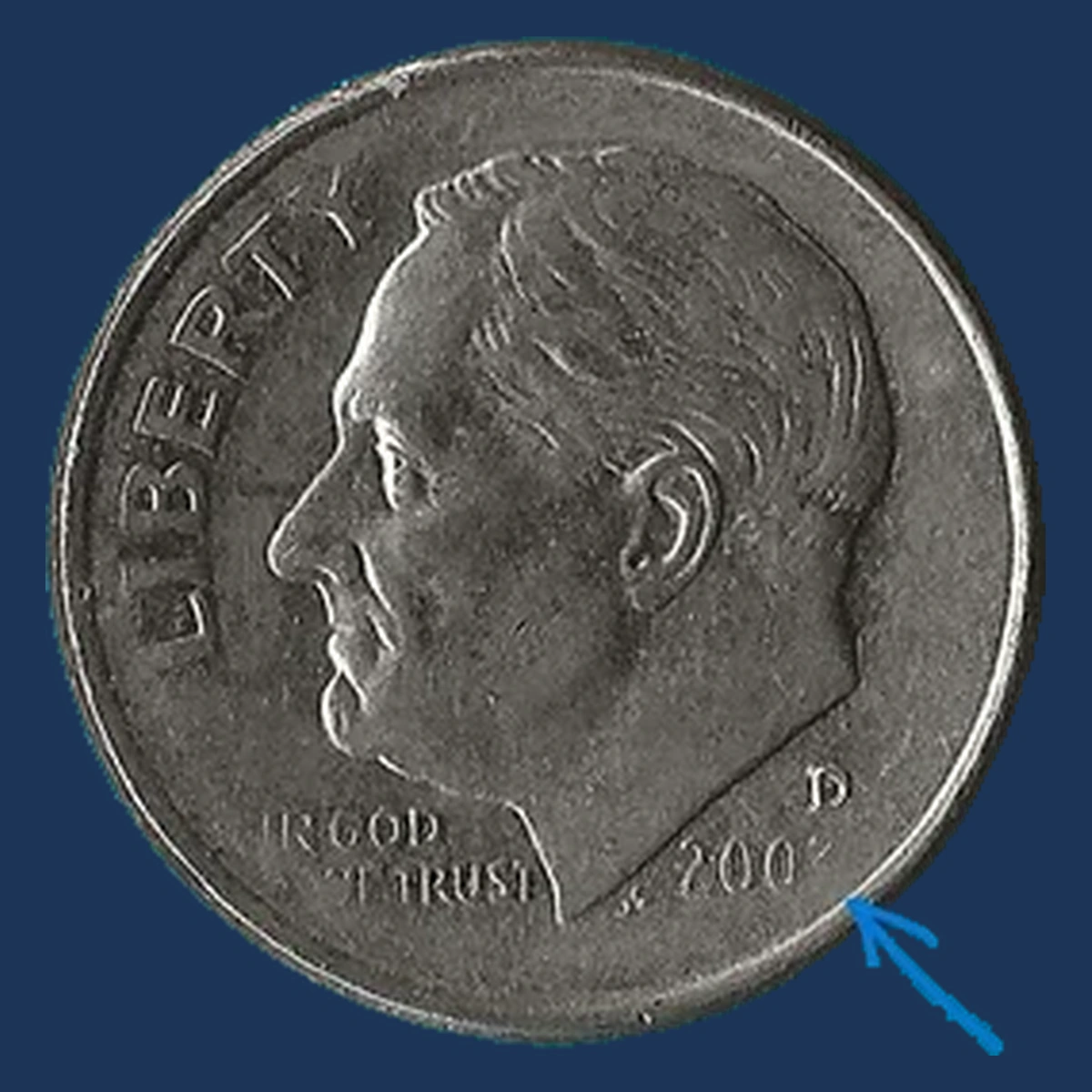
A letter or small design area may fail to appear while nearby details remain much sharper. Material between the blank and stamping tool can block part of the impression.
The year guide reports a 2003-D grease-related example. Grease can fill a recessed part of the tool, preventing the blank’s metal from entering it fully.
The exact affected location and trapped material are not established for an individual specimen here. A smooth weak patch therefore needs examination, because wear, grinding, and a low-pressure strike can also make design details disappear.
Estimated Value
Small blocked areas can fit an estimated $10–$50 range, with larger, clearly original impressions around $75–$350. Stronger examples may reach $350–$1,100, using the guide’s reported $1,075 Denver result as a secondary comparison.
The higher range should not be applied to a faint letter on a worn coin. Sharp surrounding detail and a clearly defined affected area make a stronger case.
No extra premium for retained material belongs on a coin that only shows an empty impression.
How to Identify
Inspect the sharpest nearby letter first, then compare it with the weak area under the same light. If everything is equally worn, a localized blockage is harder to establish.
Use a 10× magnifier to look for scraping, abrasive lines, or a cut edge around the missing detail. Leave any suspected material undisturbed rather than trying to remove it.
A loose D circulation dime normally weighs 2.268 grams on a scale and measures 17.91 millimeters with calipers. A large weight loss suggests missing metal or later removal, not merely a filled design recess.
Also compare both faces for overall strike weakness. Local missing detail beside original sharp features is the useful starting point for the grease-blockage report.
9. 2003 Roosevelt Dime Reported Doubled Motto on a Collector Proof
The motto IN GOD WE TRUST is the area to examine for this reported doubled design. A genuine doubled die carries an extra design outline in the stamping tool itself.
The year guide describes a 2003-S Proof, a specially made collector coin. Its finish and grading details conflict, so the particular coin’s identity still needs confirmation.
Both clad and silver S Proofs were made in 2003. A doubled-looking motto cannot determine which metal was used, and a flat ledge beside the letters may be movement during striking rather than a doubled tool.
Estimated Value
For a confirmed doubled motto on the appropriate 2003-S Proof, use a conditional estimate of $100–$1,200. The upper end requires clear, identifiable doubling and attractive preservation.
The guide reports $1,180 but pairs a Proof description with an MS grade, normally used for circulation-style coins. That conflicting description should not become a firm sale comparison.
A slight shadow or a flat striking ledge does not qualify for this range merely because the coin has an S mintmark.
How to Identify
Check the S mintmark and collector finish before inspecting the motto. If the coin is graded, read the holder’s complete description and leave it sealed.
For a loose coin, a scale separates the normal 2.268-gram clad issue from the 2.50-gram silver issue. Calipers should show about 17.91 millimeters for either.
Examine IN GOD WE TRUST under a 10× magnifier. Move the lamp to distinguish a reflection from a second edge in the metal.
Rounded separation is more promising than a flat ledge beside the letters. A lone thick letter does not identify a doubled tool.
Compare the actual motto pattern with an identified example of the same issue. The matching second outlines are the important evidence, rather than the S mintmark alone.
10. 2003 Roosevelt Dime Reported One-Sided Design Shift
One face may have a narrow border on one side and a broad border opposite it. If the other face remains centered, one stamping tool may have sat off to the side.
The 2003 guide reports this on an S Proof, but the coin’s finish and grade description need confirmation. The report does not settle whether it is clad or silver.
This category concerns a sideways shift, not a rotated design after flipping the coin. Both faces must be compared before a lopsided border can be separated from a broadstrike or an off-center blank.
Estimated Value
Use a conditional estimate of $100–$1,350 for a genuine, clearly identified 2003-S Proof with a significant one-sided shift. A small uneven border should stay near the modest end.
The guide’s $1,320 claim contains a Proof-versus-MS grading conflict, so it is not treated as a settled transaction. The estimate depends on confirming the actual collector issue and error.
An ordinary circulation dime with slight misalignment is a different comparison and can be worth far less.
How to Identify
Photograph both faces straight on at the same size. Compare the distance from the rim to several letters, noting whether one face moves sideways while the other stays centered.
A magnifier helps inspect the narrow border for genuine design cutoff or damage. An untouched crescent with corresponding missing design on both faces points instead toward an off-center strike.
Check the S issue before applying Proof prices. A scale and calipers should show 2.268 grams for clad or 2.50 grams for silver, with a normal width of 17.91 millimeters.
Keep a certified coin sealed and use its recorded identity. The unequal placement of the two designs, not just one broad rim, is the feature that supports a single misaligned tool.
11. 2003 Roosevelt Dime Reported Die Cap or Strike Through a Cap
A coin that sticks to a stamping tool can gradually cup around it as more blanks enter the press. That stuck coin is a die cap.
A later coin struck beneath it is a different object. It may receive weakened detail or a sunken, backward impression from the cap instead of the normal design.
The 2003-D guide mixes these two descriptions, so the reported specimen still needs identification. A curved dime is not automatically the cap, and a faint face alone does not prove that a cap blocked the strike.
Estimated Value
If the coin is confirmed as a genuine cap, an initial estimate is $500–$1,500. For a coin struck through a cap, use $200–$1,350, depending on the visible impression and preservation.
The year guide reports $1,315 for a 2003-D example but does not clearly separate those identities. The amount cannot settle which object it was.
A strong cup or recognizable backward design can support interest, while ordinary bending or vague weakness does not justify either range.
How to Identify
Begin with the side profile to decide which object might be present. A cap should have metal shaped around the tool, while a coin struck beneath it need not be cupped.
Use a magnifier to inspect a suspected backward impression. Letters should be sunken and reversed where a genuine brockage, an impression from another coin, is present.
For a loose clad piece, record weight with a scale against 2.268 grams. Calipers can document its altered outline against the usual 17.91-millimeter diameter, without forcing a cup flat.
Examine the bends and surface for tool marks or crushing from later damage. Identify the cup or the blocked impression separately before assigning the reported 2003-D coin to either description.
12. 2003 Roosevelt Dime Splitting Within the Blank
A seam through the edge or a rough exposed inner surface can reveal a split within the metal. A weak bond inside the blank may open before or after the design is struck.
The year guide reports a 2003-P split-planchet example without enough detail to settle when or where its metal separated. Planchet is the term for a prepared coin blank.
A coin with an attached opening can retain all its original metal. It should not automatically be called lightweight, and a whole split piece must be distinguished from just one missing outer skin.
Estimated Value
Estimate $100–$500 for a clear partial split and $500–$1,500 for a more complete, attractive separation. The amount of original metal remaining and the preserved design affect the comparison.
The guide reports $1,480 for a 2003-P described as MS66, meaning unworn with few marks. That remains a secondary report without a clear description of the split surfaces.
A complete matching pair would need its own assessment; the same coin’s pieces should not be valued as unrelated complete dimes.
How to Identify
Look into the opening under a magnifier without pulling the pieces apart. A rough inner surface and a natural seam are more useful than a shallow scratch across the face.
Weigh a loose example with a scale before assuming that any metal is gone. The normal clad weight is 2.268 grams, and a retained split can remain close to that figure.
Use calipers gently to compare the unaffected width with 17.91 millimeters. Do not press on a loose flap or try to close the seam.
Check whether the exposed surface carries struck detail, rough internal metal, or signs of grinding. The relationship between that surface and the remaining design helps distinguish a true split from removal after minting.
13. 2003 Roosevelt Dime Collapsed Reverse Tool with Clash Marks and Weak Striking
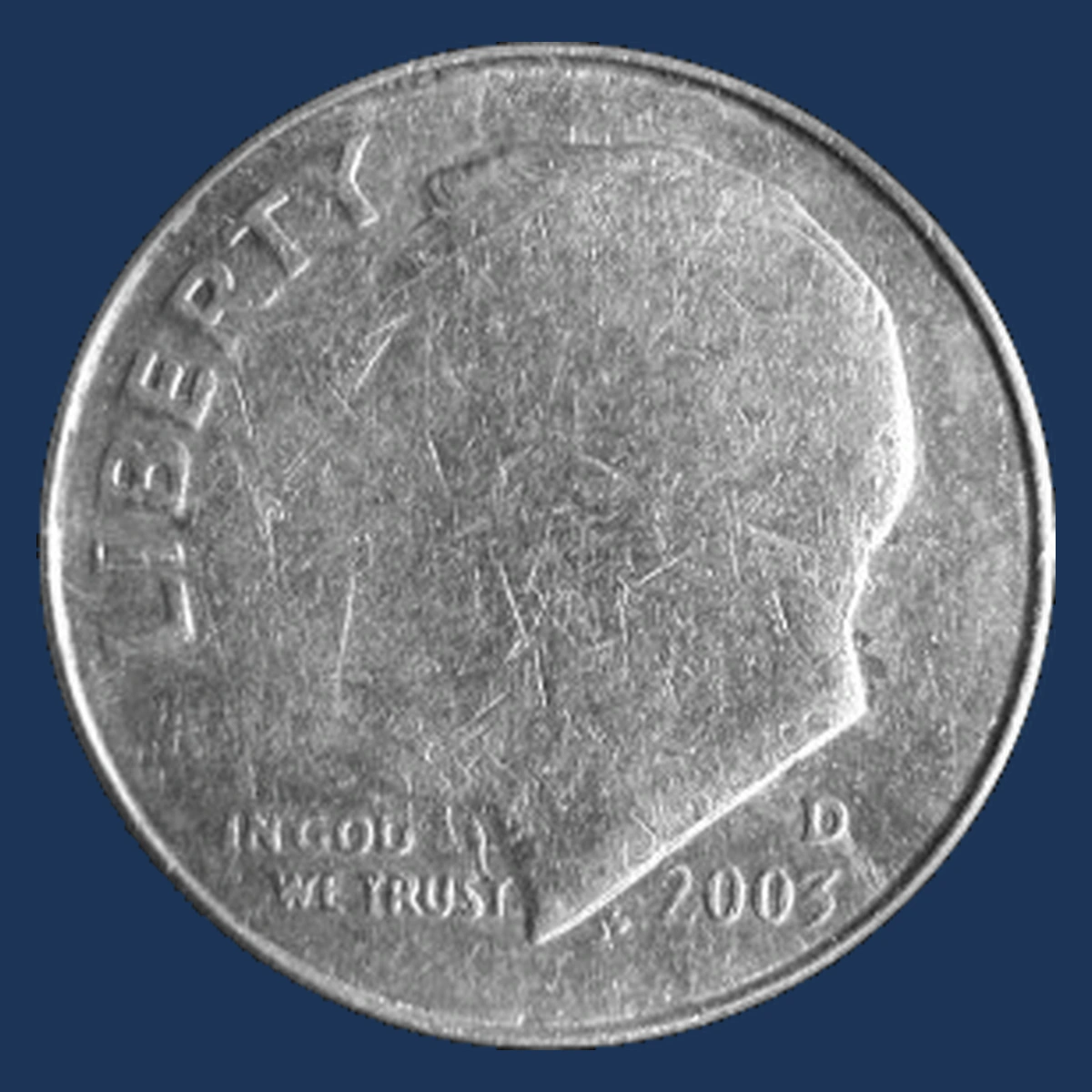
This unusual Denver dime has a blank bulge in the reverse center and a hollow center on the front. Mike Diamond described it as the result of a collapsed reverse stamping tool combined with weak striking.
The same coin also carries clash marks, traces left after the two tools contacted each other. Raised cracks pass through the N in ONE and between UNITED and STATES.
These features belong to one coin. Their presence does not prove which fault came first, and the missing central design should not be explained simply as wear or grease.
Estimated Value
A working estimate of $300–$1,500 reflects the combination’s unusual, clearly visible shape and its published specialist description. It is not a recorded sale price for this particular dime.
The intact surfaces and distinctive central bulge make stronger comparisons than ordinary worn or flattened coins. A newly found candidate would need to match the actual combination before receiving a similar estimate.
The clash marks, cracks, and weak strike belong to one coin. Their imagined separate values should not be added together.
How to Identify
View the coin from the side without trying to flatten it. Its reverse center rises above the rim while the front center is hollow.
The described specimen weighs 2.24 grams and measures 17.76 millimeters. Use a scale and calipers to compare a loose candidate with those figures and the ordinary 2.268-gram, 17.91-millimeter standard.
Under magnification, find the cracks through the N in ONE and between UNITED and STATES. Check the blank center for original pre-strike marks rather than grinding.
Edge grooves are strongest around twelve o’clock and absent from roughly 4:30 to nine. This uneven edge is another part of the same combination.
Compare the bulge, hollow, cracks, and edge with Diamond’s illustrated coin; a blank center by itself does not identify it.
14. 2003 Roosevelt Dime Design Struck on a Cent-Stock Blank
The dime design appears on a copper-colored blank described as cent stock rather than normal dime metal. Fred Weinberg advertised a 2003-P example graded PCGS MS64 Red in Mint Error News.
MS64 means unworn with some marks, while Red describes its preserved copper color. Cent stock refers to material intended for cents, not automatically a complete cent-sized blank.
The advertisement does not supply this specimen’s measured weight or exact metal structure. It is also different from a Lincoln design struck over an already finished dime, which would show two denominations on one coin.
Estimated Value
Weinberg’s original advertisement offered the PCGS MS64 Red cent-stock dime for $8,500. This is an asking price, not an auction result.
Use a working estimate of $3,000–$8,500 for a correctly identified example of this unusual wrong-material error. The original color, preserved design, and strength of professional identification would influence a buyer’s offer.
A copper-colored ordinary dime with missing cladding is a different error and should not inherit the cent-stock coin’s advertised value.
How to Identify
Read the certified holder’s exact description before treating the coin as an ordinary dime struck on a complete cent blank. The cent-stock wording concerns the source material and does not supply this specimen’s original blank dimensions.
For a loose candidate, record weight on a precise scale and width with calipers against a normal dime’s 2.268 grams and 17.91 millimeters. Examine its edge and faces under a 10× magnifier for coatings, removed layers, or disturbed lettering.
Professional metal examination should establish what lies beneath the copper-colored surface, since missing cladding and plating can imitate the appearance. Confirm the dime design on identified wrong stock, instead of using color to assume both the metal and the blank’s size.
Conclusion
The estimated range for these 2003 dime errors is $5–$8,500, spanning modest edge defects and an unusual cent-stock coin. The $172.50 elliptical-clip auction result and the $8,500 dealer request describe different coins and different kinds of prices.
Compare what actually remains: a complete design, missing blank metal, a separated layer, or a changed center. Those visible relationships are more useful than applying one dramatic error name to every unusual dime.