2009 Dime Error List with Pictures

A woven pattern helped a dateless Roosevelt dime sell for $384 in September 2024. That actual sale offers a comparison for the cloth-strike error reported on 2009 coins.
This 2009 dime error list also covers shifted designs, peeling metal, and unusual surface colors. Estimated values span $10–$1,000, depending on the error, condition, and clear evidence of its cause.
Read on to see which visible features matter and how to separate them from damage.
1. 2009 Roosevelt Dime Low-Pressure Weak Strike (Estimated Up to $350)
The whole design can look faint even on a coin that has barely been handled. Too little striking force leaves metal short of the deep spaces inside a die, the steel stamping tool.
A 2009-D example is reported with this shallow appearance. It is sometimes called a die adjustment strike, although its appearance alone cannot show why the pressure was low.
Look beyond the portrait. Weak lettering and an incomplete rim help show how widely the problem affected the strike.
Wear has a different sequence: it rubs away high details that were originally present.
Estimated Value
Original surface texture is especially useful on a weak strike. An unworn coin gives collectors more to examine than one whose faint details have also suffered circulation wear.
Allow an estimated $75–$350 for identified examples with broad weakness. The year guide reports $315 for a 2009-D graded MS62, meaning unworn with noticeable marks.
That reported amount is a guide comparison, not an independently checked auction result. Small differences in preservation can matter greatly here.
How to Identify
Hold a normal dime beside the suspect coin, then compare the rim and lettering on both faces. Broad, shallow detail deserves a closer look than one flat spot on Roosevelt.
A 10× magnifier should reveal whether the weak areas retain their original texture. Smooth patches across the highest points usually suggest wear instead.
Check the D above the date. On a loose clad coin, a scale should read near 2.268 g and calipers near 17.9 mm.
Inspect the grooved edge without rubbing or polishing the surface. These measurements help identify the coin but do not explain weak detail by themselves.
The useful first clue is shallow design across both faces beside an underdeveloped rim, with no matching pattern of worn high points.
2. 2009 Roosevelt Dime Die Clash (Estimated Up to $400)
A stray curved line beside the torch may belong to Roosevelt’s portrait rather than the back design. Two stamping tools can touch when no blank sits between them.
That contact damages their surfaces. Later coins can then pick up traces of the opposite design.
The 2009-P report describes such traces near the torch and olive branch. Their position should make sense when the front and back designs are compared.
An isolated line is not enough. Scratches can run through the same area, but they do not reproduce a recognizable part of the opposite design.
Estimated Value
For comparison, a 1978-S proof clash graded PR68 Deep Cameo sold for $159 in October 2022. A proof is a specially made collector coin, so its finish differs from the reported ordinary 2009-P.
An estimated $40–$400 covers identified 2009 examples with visible clash traces. Their strength and the coin’s preservation matter more than the number of random lines.
A clear portrait fragment beside the torch is more persuasive than faint marks requiring a favorable photograph.
How to Identify
Photograph the front and back straight on, keeping the designs at the same size. Compare the suspect curve beside the torch with Roosevelt’s outline.
Move a small lamp while viewing the coin through a 10× magnifier. Follow the complete shape, including where it meets nearby back-design features.
Do not decide that every clash mark must sit below the surface. Its shape and position provide better clues than that rule.
The P issue normally weighs 2.268 g and measures 17.9 mm. Check loose coins with a scale and calipers, or use existing records for sealed examples.
For a quick first check, find an opposite-design fragment whose position fits contact between the two stamping tools.
3. 2009 Roosevelt Dime 5% Off-Center Strike (Estimated Up to $450)
A narrow blank crescent can accompany a design pushed toward the other side of the coin. The metal blank entered the striking area in the wrong position.
The reported 2009-P is described as about 5% off center. This is a modest shift, so the difference between a displaced blank and a misaligned tool matters.
Both faces belong in that comparison. A wide border on just one face may have another cause.
Unlike a clip, an off-center strike leaves the extra metal present. Its unstruck area lies beside the incomplete impression rather than ending at a missing piece.
Estimated Value
The guide’s reported $450 for an unworn 2009-P gives an upper comparison for this small displacement. It should not be applied to every dime with an uneven border.
Use an estimated $40–$450 for identified examples with a readable date and clear unstruck metal. Worn coins or barely visible shifts fit nearer the lower end.
A clear P and intact 2009 date help preserve the connection to this issue. Attractive surfaces can support a stronger price.
How to Identify
Find the point where the design stops, then turn the dime over and locate the matching interruption. The two faces should support the same displaced position.
A 10× magnifier helps separate original unstruck metal from a surface flattened by grinding. Inspect the transition rather than judging only the widest border.
Check that the date and P are readable before assigning the coin to 2009 Philadelphia production. No particular clock position is established for this report.
Use a scale to compare 2.268 g and calipers to record the outline against the normal 17.9 mm. An unusual outline does not necessarily mean metal is missing.
Start with an unstruck crescent accompanying incomplete design on both faces, not one wide rim alone.
4. 2009 Roosevelt Dime Feed-Related Die Scrapes (Estimated Up to $600)
Closely spaced, raised lines can record scratches that were already in a stamping tool. Metal entering those scratches forms narrow ridges on the coin.
A moving feeder or ejector can scrape a tool, as explained by Error-Ref’s die-scrape guide. Other moving parts can also leave similar tool damage.
The 2009-P report links parallel portrait-area marks to a feeder. That explanation requires more than a set of lines.
This is different from a foreign object being struck into the coin. Cut-in scratches made after minting also need to be excluded before naming the cause.
Estimated Value
Surface height comes before price here. Identified ridges copied from a damaged tool can fit an estimated $25–$600, with a striking pattern on an unworn coin toward the upper end.
The year guide reports $615 for a 2009-P MS62, just above this working range. That grade describes an unworn coin with noticeable marks.
A feeder label alone adds little if the photographs only show ordinary scratches. Collectors need to see the raised pattern clearly.
How to Identify
Look across the lines from a low angle under one lamp. Under a 10× magnifier, raised ridges should stand above the surrounding coin surface.
An ordinary scratch cuts into metal and may push a small ridge along its edge. That combination differs from a complete group of raised lines copied from tool damage.
Compare any available matching coins. Repeated marks in the same locations strongly support a mark carried by the stamping tool.
Check the usual clad specifications with a scale and calipers: 2.268 g and 17.9 mm. Measurements cannot identify which machine part caused the scrape.
The immediate test is whether the parallel marks form genuine raised ridges rather than grooves cut into the finished dime.
5. 2009 Roosevelt Dime Improper Alloy Mix (Estimated Up to $600)
Different-colored streaks may follow unevenly mixed metal, but streaks alone do not establish that cause. Staining and natural color changes can look similar.
The 2009-P report describes an improper alloy mix. An alloy is a mixture of metals, such as the copper and nickel in a dime’s outer covering.
Normal clad dimes already contain different layers. A visible copper strip along the edge is therefore not evidence of poor mixing.
The unusual surface needs to be considered alongside a composition test. Its color cannot reveal an exact metal recipe, and no special mixture is established for this reported coin.
Estimated Value
A verified metal problem can command a premium that a merely streaky dime cannot. Budget an estimated $50–$600 for identified 2009 examples, depending on the affected area and condition.
The guide describes a $575 example as MS60, an unworn coin with substantial marks. Its reported amount supplies a comparison rather than proof that a colored coin has the same composition.
Pay for the demonstrated alloy problem. An attractive stripe or unusual photograph does not replace that evidence.
How to Identify
Examine how the streaks cross the portrait and smooth background with a 10× magnifier. Photograph both faces before considering any cleaning, which could destroy useful surface evidence.
A precise scale and calipers can check the normal 2.268 g and 17.9 mm. Normal readings do not rule out a composition difference, and odd readings have several possible causes.
Ask a qualified coin specialist about a nondestructive composition test. Surface readings must be interpreted with the dime’s copper-nickel coverings and copper center in mind.
Compare the edge with a normal clad dime to avoid mistaking its copper center for an error. Begin with persistent metal streaks, then require a test that supports an actual composition problem.
6. 2009 Roosevelt Dime Grease and Cloth Strike-Throughs (Estimated Up to $700)
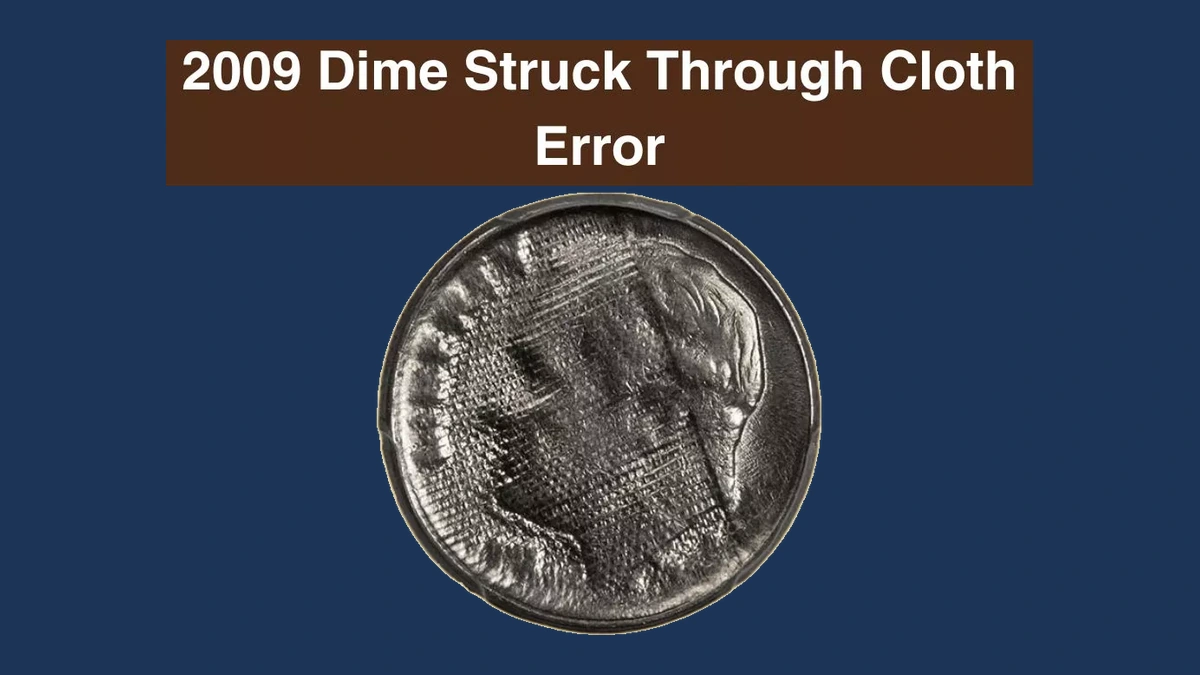
A smooth missing patch and a woven impression can share one cause: something came between the metal and a stamping tool. The object or material blocked part of the design.
The reports describe grease affecting the 2009-D portrait and cloth leaving a pattern on a separate 2009-P. They should not be mistaken for two features on one coin.
Grease can fill design spaces and leave details weak or absent. Cloth can instead press its crossing threads into the surface.
A cloth pattern does not mean fabric remains attached. That would require visible retained material on the actual coin.
Estimated Value
A dateless Roosevelt dime with a cloth impression, graded AU55 for slight wear, sold for $384 in September 2024. It is a same-mechanism comparison, not a 2009 sale.
Estimate $10–$450 for grease effects and $100–$700 for clear cloth patterns. A small missing letter belongs near the low end of the grease range.
Broad interruptions and distinct woven lines attract more attention. Damage across those features can reduce their appeal.
How to Identify
For the D coin, trace the border between the missing portrait detail and the surrounding clear design. Under a 10× magnifier, look for original surface rather than polishing lines or scraped metal.
The P cloth report calls for a different inspection. Find lines crossing in a regular weave, then check how that impression meets the remaining struck design.
Loose threads resting on top prove little. Do not pull at any material attached to the coin.
Both ordinary clad issues normally weigh 2.268 g and measure 17.9 mm. A scale and calipers provide useful comparisons, although an obstruction need not change either measurement.
Check first for a local design interruption on the D or a pressed-in woven pattern on the P.
7. 2009 Roosevelt Dime Doubled Front Design (Estimated Up to $750)
An extra rounded letter outline can come from a doubled design in the stamping tool. Coins struck by that tool can carry the same small extra feature.
The 2009-D report names the motto, LIBERTY, date, eye, and ear as inspection areas. It does not show all these areas doubled on one known example.
This is not a second blow shifting the whole portrait. The extra shape belongs to the tool’s design.
Flat shelves beside letters have another possible cause: movement during striking. Those shallow ledges should not be identified as a doubled die merely because they look repeated.
Estimated Value
Clear separation makes a doubled design easier to collect than a feature visible only under extreme enlargement. An estimated $25–$750 allows for that difference among identified examples.
The guide reports $703 for a 2009-D MS64, meaning unworn with fairly few marks. No specific cataloged variety is established by that price statement.
A matching doubled pattern matters more than the label. A worn coin with strong separation may be easier to appreciate than a sharper coin with vague extra thickness.
How to Identify
Choose the clearest alleged extra feature instead of trying to confirm every suggested area at once. Enlarge it with a 10× magnifier and keep the light steady.
Trace the normal letter or portrait edge beside the extra one. Rounded separation or a small split at a letter corner deserves comparison with photographs of the same variety.
Low, flat shelves that narrow the normal design can indicate movement during the strike. Thickness alone does not settle the question.
Confirm the date and D, then use a scale and calipers for the normal 2.268 g and 17.9 mm. A doubled tool does not normally change those specifications.
The most useful starting point is one distinct extra design contour that repeats in the same position on matching examples.
8. 2009 Roosevelt Dime Peeling Metal and Layer Separation (Estimated Up to $900)
A thin flap rising from the front may show where the coin’s metal has separated. The surrounding split can remain visible even if part of the flap has broken away.
The guide reports this on a 2009-P. The exposed edge can distinguish a split within metal from separation between clad layers.
A normal dime has copper-nickel coverings over a copper center. The name lamination does not automatically place every split at one of those boundaries.
Leave the flap alone. Bending or peeling it farther can remove the features that help explain when and how the separation happened.
Estimated Value
The size of the loose area is only part of its value. A natural split with recognizable struck detail is more useful than a large patch damaged by handling.
Estimate $30–$900 for identified examples, ranging from small worn peels to substantial, well-preserved separation. The guide reports $865 for a 2009-P MS63, an unworn coin with noticeable marks.
Treat that as a reported comparison. A pried-up covering on an otherwise normal dime has a different origin and value.
How to Identify
Use a 10× magnifier to follow the split without lifting the flap. Look at where the loose metal joins the coin and how the struck design crosses that boundary.
A shallow gouge can leave a curled piece of metal too. Scraped surfaces and pushed-up edges need to be separated from a natural internal split.
Photograph any exposed layers from the side. Their position helps determine whether the covering separated or the break runs within another part of the metal.
A scale compares the remaining coin with 2.268 g, while calipers compare its width with 17.9 mm. Lost metal can reduce weight, but an attached flap may leave it nearly normal.
Follow the natural split into an attached flap before judging the error from the size of the damaged-looking patch.
9. 2009 Roosevelt Dime Improper Annealing Color (Estimated Up to $1,000)
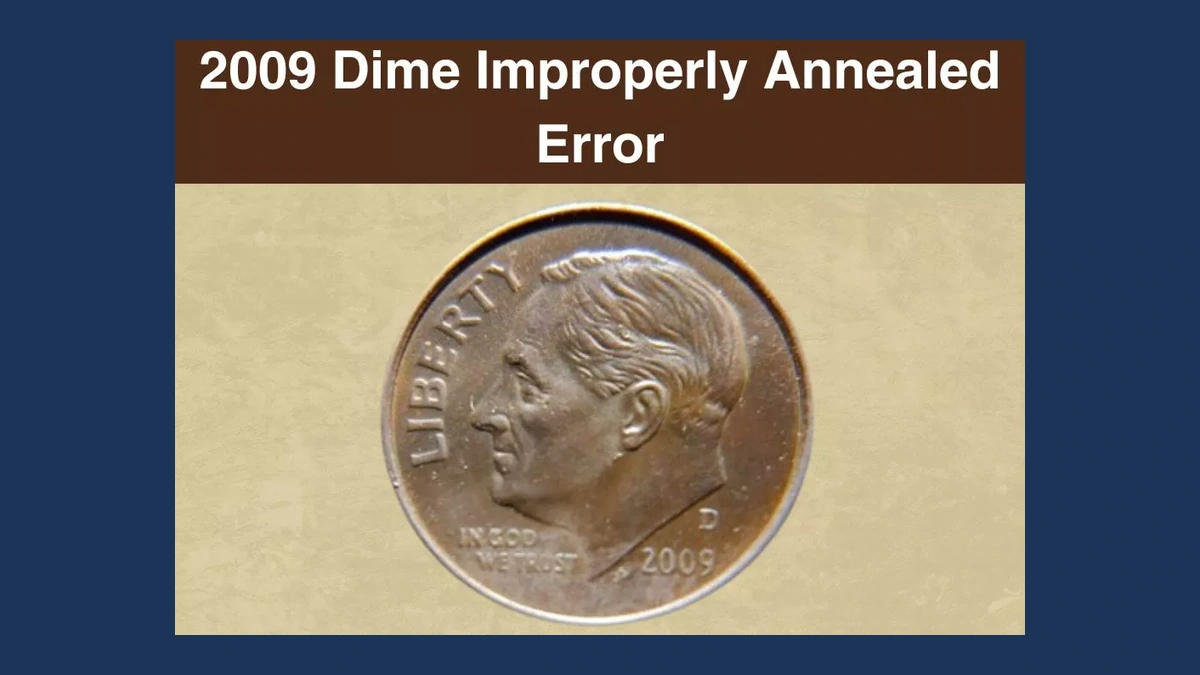
A coppery or dark surface can form before a dime receives its design. Heating prepares blanks for striking, and a problem during that step can change their surface appearance.
This process is called annealing. Changes in heating conditions can affect the copper-rich color at the surface of a clad blank.
The 2009 error guide reports a Denver example. Its color must be separated from later heating, chemicals, and ordinary discoloration.
The affected color need not cover every part evenly. A partial patch can occur, while an evenly colored coin can still have changed after it left the Mint.
Estimated Value
An estimated $40–$1,000 applies to identified examples with original Mint-made discoloration. The high end calls for a convincing error on an attractive unworn coin.
The guide reports $978 for a 2009-D MS65, an unworn grade with relatively few marks. That amount is not a verified auction record here.
Color alone should not carry that premium. A specialist’s conclusion about the cause matters more than whether a photograph makes the coin look unusually dark or bright.
How to Identify
Check the coin in neutral light before judging its color. A warm lamp or altered photograph can make a normal silver-colored surface look coppery.
View the portrait, background, and edge through a 10× magnifier. Look for original struck texture and any signs of chemical attack, coating, or later heat damage.
A scale and calipers should compare the ordinary D dime with 2.268 g and 17.9 mm. Correct measurements identify the normal clad size but do not prove when the color formed.
A 2009-S silver proof is a different normal issue, weighing 2.50 g. Do not mix that collector coin with this Denver report.
Begin with color lying on an undisturbed struck surface, then have its cause checked before calling it improper annealing.
Conclusion
A missing patch, an extra line, and a colored surface each call for a different check. Start with that visible change instead of a price attached to a similar-looking photograph.
The estimated $10–$1,000 range covers several kinds of error reported for 2009. Keep grease and cloth patterns separate, leave loose metal untouched, and confirm the cause before paying for the strongest examples.