1914 Nickel Error List with Pictures

One 1914 error survives as only the portrait-side half of a nickel; another has a hole near the buffalo’s mouth. These unusual shapes need different explanations.
A subtler date variety reached the largest recorded price here: PCGS lists a $63,250 Heritage sale in June 2002 for a 1914/(3) nickel. Estimated values for the 1914 nickel errors below span $20–$65,000.
Explore the six groups to compare physical clues, ordinary wear, and the prices of different examples.
1. 1914 Buffalo Nickel Repunched Mintmark
The small S can contain part of another S when the mint letter was punched more than once. The letter was added to a die, the steel tool that stamps coins.
A shift between punches left an extra curve that later appeared on coins. A collector’s display describes a PCGS minor repunched-mintmark variety for 1914-S without giving a specific direction for the extra outline.
Weakly formed design is a separate issue. A soft S may be difficult to read, but softness alone does not demonstrate another letter, and a bump from damage is not an earlier punch.
Estimated Value
For a matched minor repunched S, estimate $50–$500 across ordinary worn through attractive unworn examples. The clarity of the extra letter and the condition of the San Francisco coin both matter.
A 1927-D repunched-mintmark variety sold for $335 in May 2021 in worn XF40 condition. That is a different year, mint, and letter pattern rather than a sale of this 1914-S variety.
The collector’s recorded example supplies no auction amount here. This range remains an estimate for the whole coin.
How to Identify
A soft S is not enough: place a sharp photograph of the reported 1914-S variety beside a 10× view of your coin. Compare where an extra stroke joins the main letter, rather than deciding from general thickness.
For a loose nickel, a scale should show near 5 grams and calipers about 21.2 millimeters, with a plain edge. Keep FIVE CENTS in the mintmark photograph so its direction and position remain clear.
Move the light to distinguish a separate raised S fragment from a flat shelf, corrosion bump, or damaged curve. If the strike is too soft to show the extra letter, the photograph cannot establish the variety merely from a thick-looking outline.
2. 1914 Buffalo Nickel Clipped Planchet
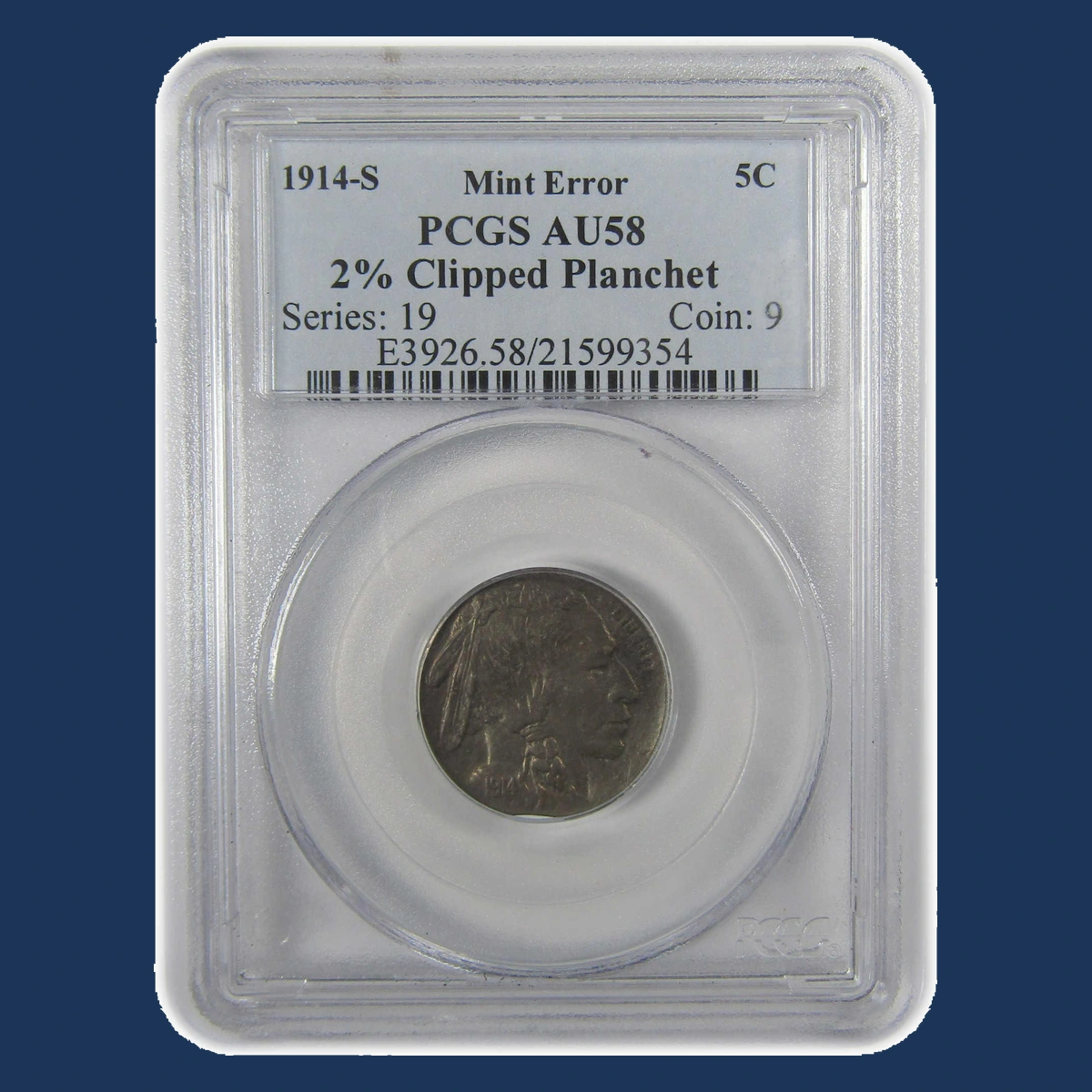
A missing piece near the lower-right edge distinguishes the recorded Denver example. Its collector describes a PCGS MS62 nickel clipped at 5 o’clock, with the date upright.
MS62 means unworn with noticeable marks. The blank lacked part of its metal before striking, so the design and rim formed around an incomplete shape.
The amount missing is not stated in the written description. This should not be turned into a guessed percentage, and a later notch cut into an ordinary 1914-D nickel would be damage rather than the same mint-made feature.
Estimated Value
An estimated $75–$750 covers ordinary 1914-D clips from worn examples to attractive unworn coins. The date’s normal value and the condition of the missing edge both influence the total.
The collector-listed MS62 has no sale amount supplied here. A Philadelphia 1918 nickel with a 5% clip sold for $141 in August 2014, providing a different-year comparison.
That comparison does not establish a 5% size for the 1914-D clip. Price the actual coin and its preserved detail.
How to Identify
Check the D beneath FIVE CENTS and orient the front upright. The reported gap lies near 5 o’clock, but its location alone cannot show whether it formed before striking.
A scale can measure a loose coin against the usual 5 grams. Use calipers across its intact diameter, normally about 21.2 millimeters, and examine the surviving plain edge.
Under a 10× magnifier, inspect the two ends of the gap for metal shaped by the strike. Saw marks, a smooth filed wall, or a fresh cut point toward later removal.
A weak rim opposite the shortage can support a genuine clip, but it need not appear clearly on every coin. Give the gap’s surfaces and their meeting with the design more weight than that single supporting clue.
3. 1914 Buffalo Nickel Lamination and Split Planchet
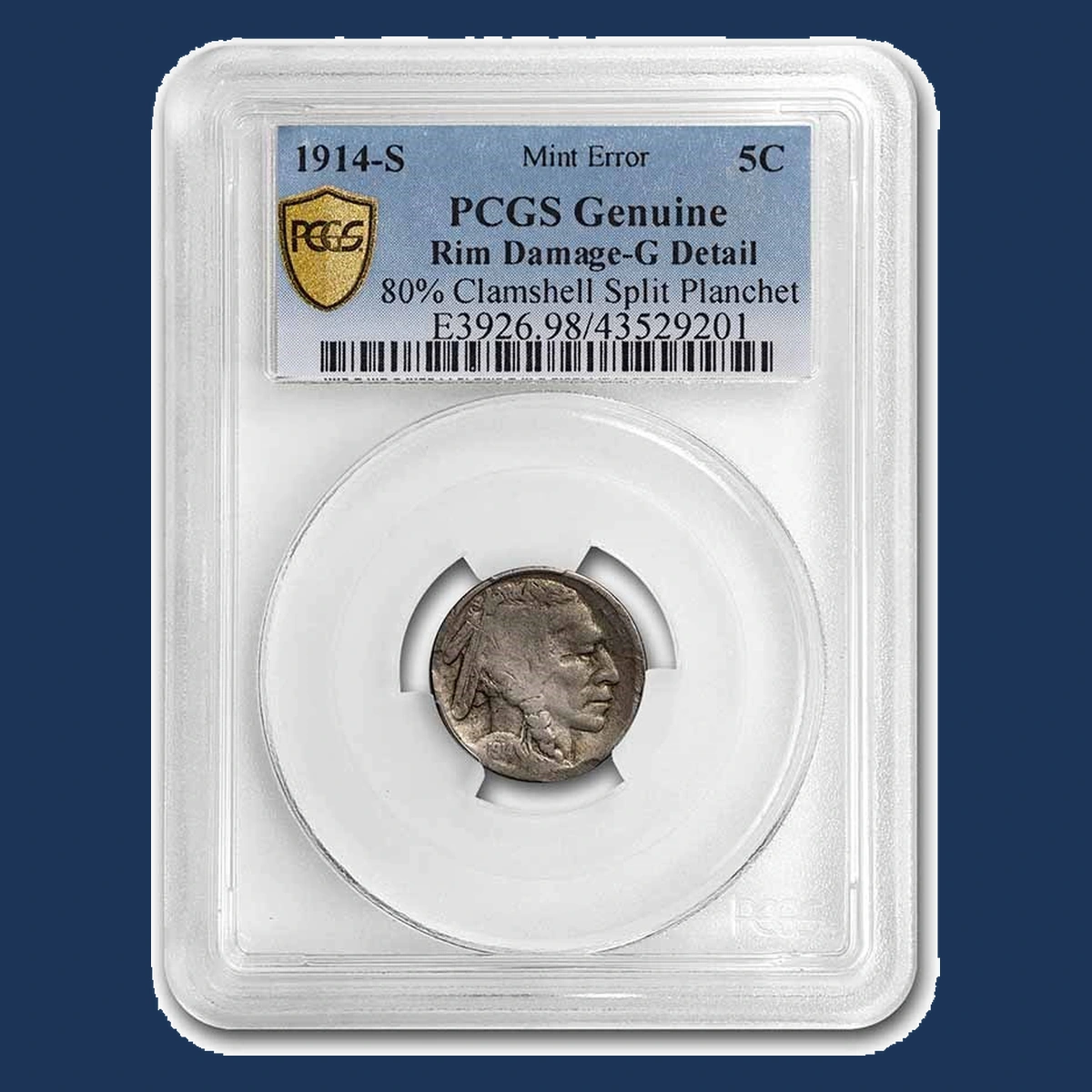
A collector’s 1914 Philadelphia example retains the portrait-side half after the coin split through its thickness. Its other face is the exposed separation surface, not a weakly struck buffalo design.
The recorded grade is VF25, indicating moderate wear. This complete separation differs in appearance from the smaller surface peels also recorded for Philadelphia and Denver.
A San Francisco example opens from roughly 9 to 3 o’clock while remaining joined, like a partly opened shell. All involve weak metal separating internally, but the detached half, local peel, and still-attached shell must be kept as different physical examples.
Estimated Value
The Denver front-lamination coin graded F12 sold for $52 at Heritage in July 2013. That is a worn example with a localized peel.
Estimate $20–$250 for ordinary surface laminations and $150–$800 for a clearly identified detached half or partly opened shell. The size of the separation and remaining detail explain much of the difference.
The Philadelphia MS64 lamination listing does not provide a sale amount used here. Its grade should not be assigned to the separate VF25 split half.
How to Identify
Identify the structure before touching the edge: a loose flap, a partly opened coin, or an already detached face. Do not force a partly open example farther apart.
For a loose detached half, a scale should show substantially less than the normal 5 grams. Use calipers gently to compare the surviving outline with the usual 21.2 millimeters; the original outer edge was plain.
Under a 10× magnifier, compare the struck portrait with the rough separation face. On the known Philadelphia half, the readable date remains on the portrait side.
A detached back without a date cannot establish 1914 by itself. For local peels, inspect the internal seam and any original design on the flap rather than borrowing the complete split half’s appearance.
4. 1914 Buffalo Nickel Defective Planchet with Hole
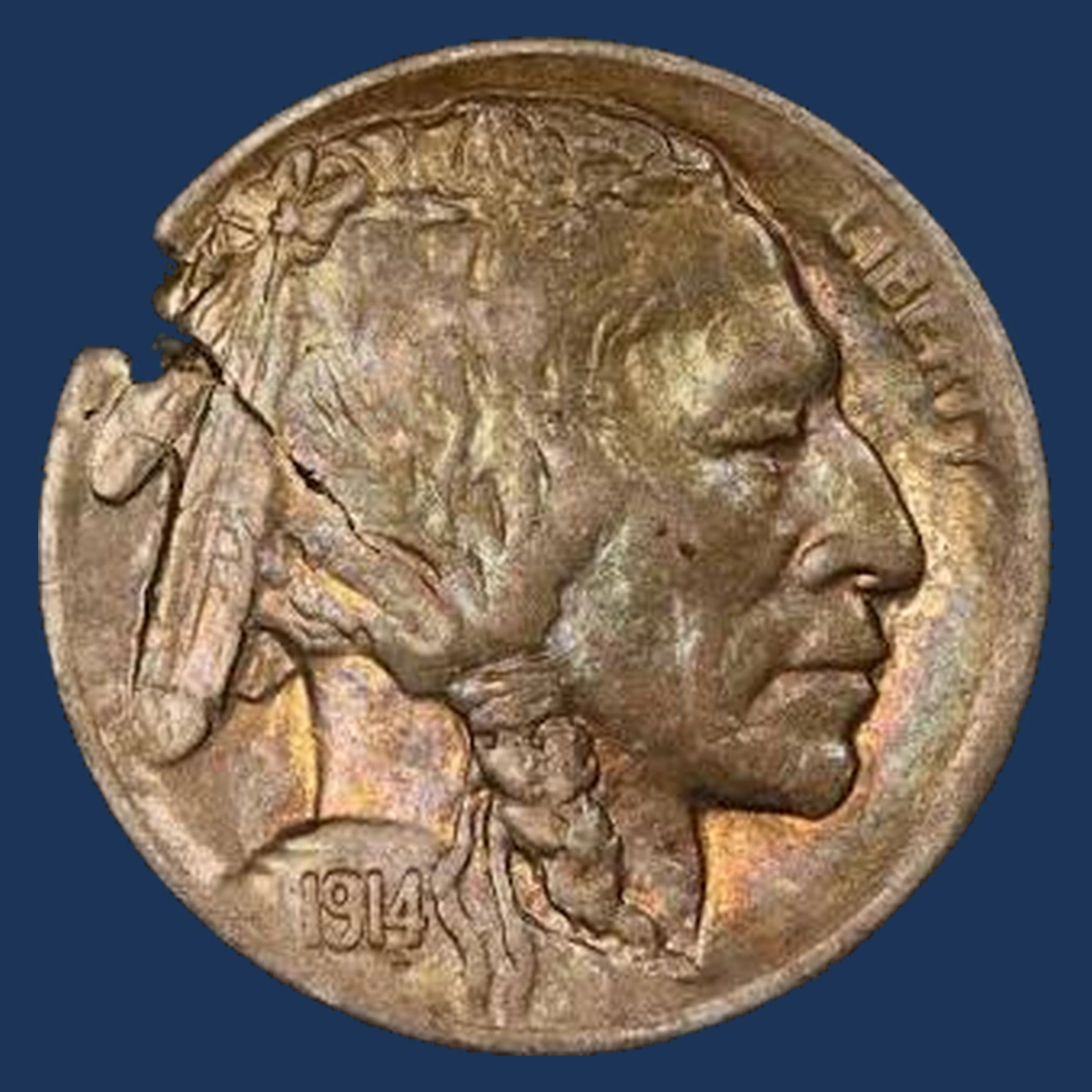
A hole near the buffalo’s mouth gives this San Francisco example its “Smoking Buffalo” nickname. The collector describes it as a defective-planchet error graded AU55, meaning lightly worn.
A planchet is the prepared blank before it receives a coin’s design. Here, the reported opening passes through the metal rather than forming a shallow dent on just one side.
The nickname describes what the hole resembles; it does not explain how every similar hole formed. A drilled coin or metal eaten away by corrosion can create a similar outline after minting and needs a different conclusion.
Estimated Value
For a genuine 1914-S defective blank with a clear through-hole, use an estimated $200–$2,000. The size, original surfaces, and amount of surviving design determine how compelling the error appears.
No completed-sale amount accompanies the collector’s AU55 example here. The range is an estimate for that type of mint-made defect rather than an auction record.
The nickname alone adds no premium. A drilled or corroded hole remains damage, even if it also looks like smoke leaving the buffalo’s mouth.
How to Identify
Photograph both faces in matching orientation to establish that the opening passes through the same part of the blank.
Light visible through a hole proves an opening, not that it was made at the Mint.
Inspect its walls and surrounding design with a 10× magnifier. Repeated circular tool marks, pushed-up burrs, or corrosion spreading beyond the opening can indicate later damage.
For a loose coin, use a scale and calipers against the normal 5 grams and about 21.2 millimeters. Missing metal may reduce weight; the remaining edge should be plain.
Compare the whole San Francisco specimen and its certification, including the S below FIVE CENTS. The relationship between the hole and the struck design matters more than the descriptive nickname.
5. 1914 Buffalo Nickel Off-Center Strike
A quarter of the design can miss its intended position when the blank sits too far to one side. The 1914-S auction example is described as 25% off-center and graded XF45, meaning worn with much detail remaining.
The design is cut off at one edge while an unstruck crescent remains opposite it. That pairing distinguishes an off-center strike from an unusually wide rim around a complete design.
The written record does not provide a clock direction for this example. Its percentage should also not be borrowed for another 1914 coin with a different amount of displacement.
Estimated Value
A working estimate for a readable 1914-S off-center nickel is $150–$2,500, depending on preservation and the amount of visible displacement. The recorded 25% XF45 example provides an identity comparison without a sale amount used here.
A 1918-D nickel struck 10% off-center sold for $3,120 in January 2022. Its exceptionally well-preserved MS66 condition and different mint make it a higher-grade comparison, not a direct price for the worn 1914-S coin.
Keep the date and mint visible when comparing value.
How to Identify
Use a scale and calipers on a loose coin to record the metal that remains. The normal nickel is 5 grams and about 21.2 millimeters across, but a displaced design can retain nearly all its weight.
Inspect the plain edge and both faces through a 10× magnifier. Identify the unstruck crescent and then follow the opposite side to see which design details run beyond the metal.
A shifted rim on only one face, with all major design intact, calls for a different explanation. Compare the complete outline with the recorded 25% San Francisco example rather than guessing its direction.
Read the surviving 1914 date and S beneath FIVE CENTS. A striking error that loses those identifying details cannot be assigned confidently from its blank crescent alone.
6. 1914 Buffalo Nickel 1914/(3) Date Variety
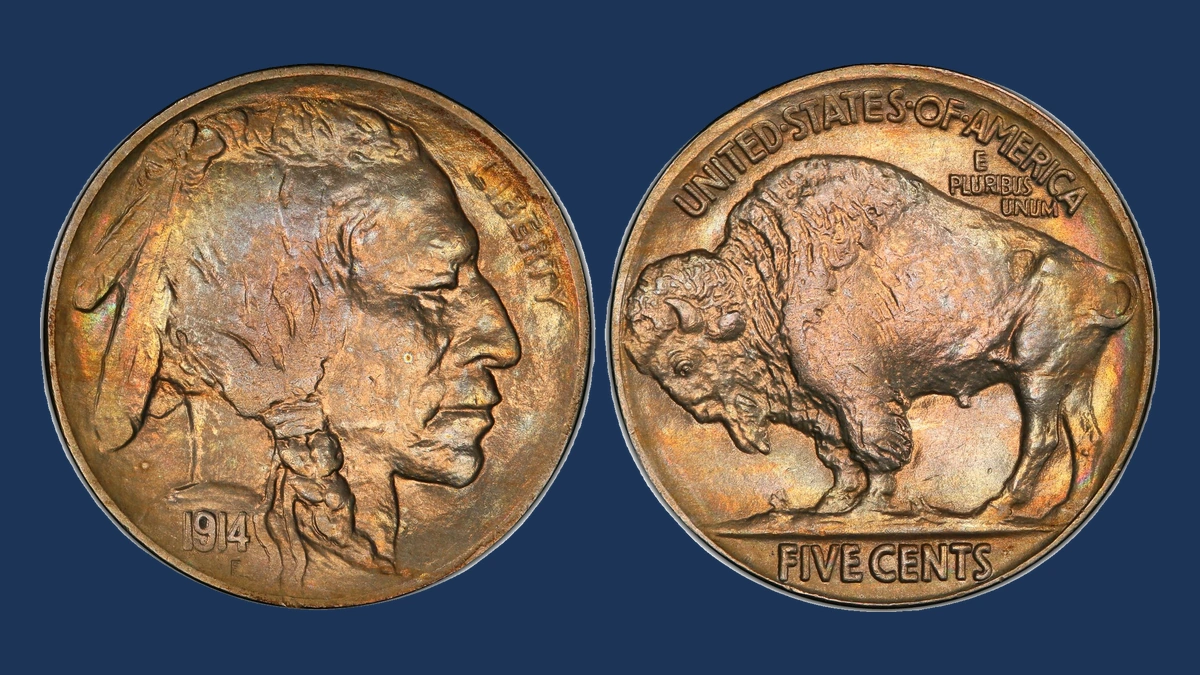
The 1914/(3) name refers to a trace of an earlier 3 around the upper part of the final 4. Some examples also show extra outlines on the other date digits.
PCGS lists the Philadelphia variety and describes reuse of an earlier dated design tool as a proposed explanation. That explanation should not be confused with a worker carving a new date into a finished coin.
The strongest and weaker patterns differ in visibility. Denver and San Francisco reports do not automatically identify their coins as the same Philadelphia pattern, so the date and mint must be compared together.
Estimated Value
PCGS records $63,250 for an MS65 example at Heritage on June 1, 2002. MS65 means an attractive unworn coin with relatively few marks.
Use an estimated $100–$65,000 span across visible varieties and different conditions. Strongly defined examples command more than faint date traces, and an exceptional historical result is not a routine price.
The comparison must match the Philadelphia date pattern and preservation. The same price should not be assigned to every thick 4 or to an unverified branch-mint report.
How to Identify
Choose the date comparison carefully before inspecting the tiny mark. PCGS illustrates the 1914/(3) variety and explains that its patterns vary in strength.
Under a 10× magnifier, look around the top of the 4 and compare the other date digits. One damaged corner without the accompanying pattern does not establish the variety.
Check whether the back has the normal Philadelphia absence of a mintmark. A D or S needs its own supported comparison rather than the Philadelphia photograph.
For a loose specimen, measure about 21.2 millimeters with calipers and weigh near 5 grams on a scale; its edge is plain. Inspect the date’s surface for scratches or added metal before accepting the old-digit shape.
Conclusion
The surviving face of a split coin, a clipped edge, and a hole through the blank all involve missing metal. Their structure tells you why they need different comparisons.
Estimated values here range from $20 to $65,000, with the highest historical sale belonging to a strong Philadelphia date variety. Most ordinary peels and minor mintmark errors sit much lower.
Preserve fragile edges and match the exact mint and visible feature before applying a price.