1921 Nickel Error List with Pictures

The 1921 Buffalo Nickel errors include a doubled eyelid, a missing small feather, and a strike that left almost half the disk blank. Each feature tells a different story about how the coin was made.
A Philadelphia Two Feathers nickel graded MS67 brought $7,800 at Heritage in January 2020. Estimated whole-coin values across the examples below span $15–$8,000.
Follow the visible clues to learn which checks matter for your coin, including where San Francisco’s mint letter changes the comparison.
1. 1921 Buffalo Nickel Clash Marks
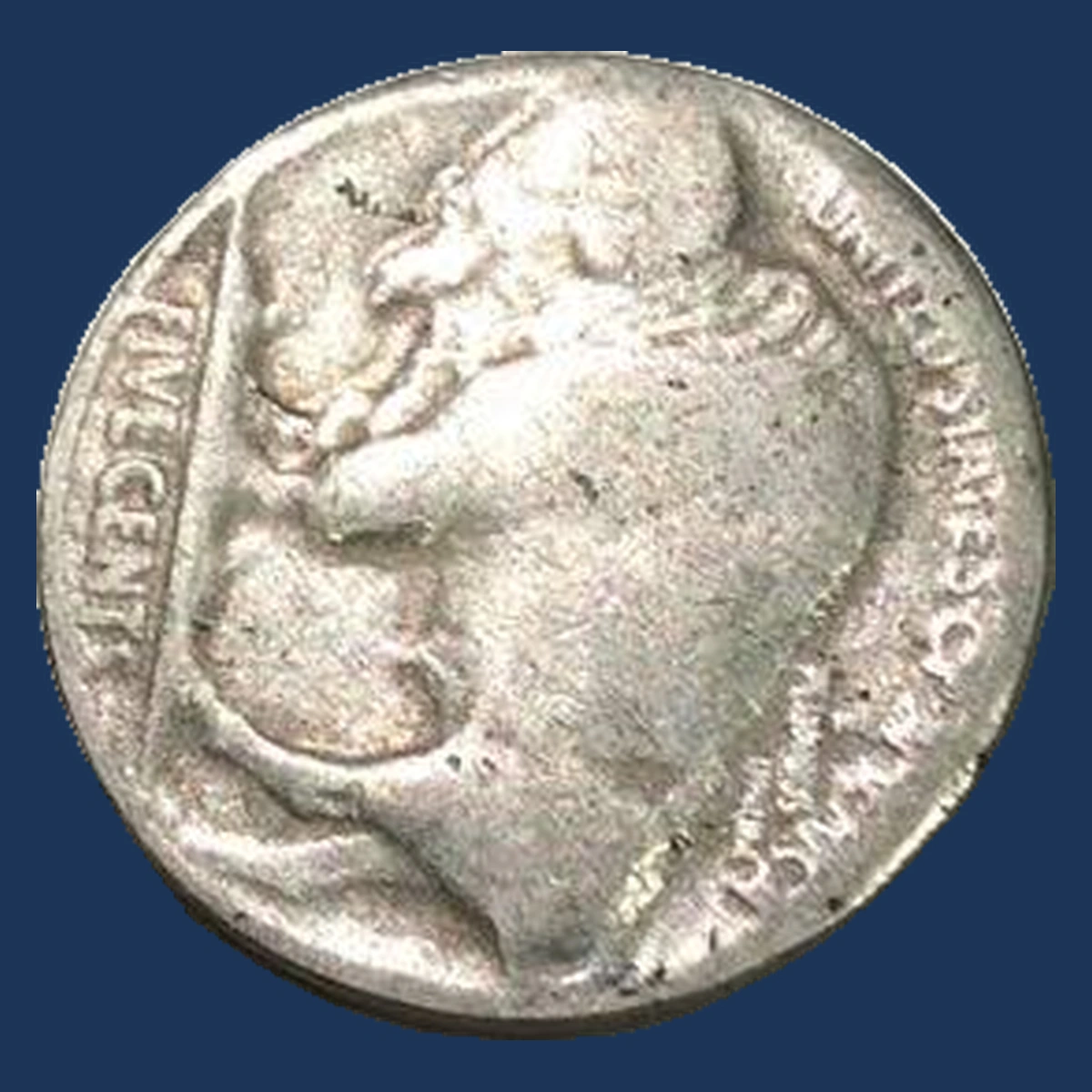
Faint extra shapes at the portrait’s throat can be traces of the opposite design. They form when the front and back stamping tools strike each other without a metal disk between them.
The damaged tools then pass those outlines to later coins. Collectors call these marks a die clash.
On a recorded later stage of the 1921 doubled-design variety, clash marks appear at the throat and near E PLU on the back. Earlier coins from the same tools can lack them, so the doubling does not require a clash.
Estimated Value
For a clearly visible clash, estimate $15–$250 on circulated through attractive Philadelphia coins. Fine outlines that need ideal lighting usually add less than bold, easily recognized marks.
This is an estimate for the whole coin, using the usual difference between minor and prominent Buffalo Nickel tool marks. No separate auction price is assigned to this particular clash.
If the coin also has the doubled design, price that combination once rather than adding two full coin values.
How to Identify
Compare the throat area with a normal portrait before searching elsewhere. Turn the coin over and inspect the area around E PLU with a 10× magnifier under light from several directions.
A scratch usually forms a narrow cut, sometimes with displaced metal along its sides. A clash follows part of the other face’s design instead of a random path.
For a loose coin, a scale and calipers should show approximately 5 g and 21.2 mm. Its edge should be plain, without added grooves or a seam.
Do not reject the doubled-design variety just because these marks are absent. For the later clashed stage, the paired throat and E PLU marks provide a much stronger comparison than one unexplained line.
2. 1921 Buffalo Nickel Raised Cracks and Rim Breaks
A raised thin line can appear when the steel tool used to stamp coins develops a crack. Metal fills that narrow opening during striking and leaves a ridge on the coin.
If a piece of the tool breaks away at its edge, the coin can instead show a smooth raised patch touching the rim. That larger feature is called a cud.
Both have been reported for Philadelphia 1921 Buffalo Nickels. A specific crack path has not been established here, so an ordinary scratch should not be labeled from its location alone.
Estimated Value
A small genuine raised crack suggests an estimated $15–$100 whole-coin value. A clear rim-connected break can extend the combined range to about $400, depending on its size and the coin’s condition.
These are estimates for reported 1921 Philadelphia examples, not a claimed auction sale of a named cracked tool. Stronger breaks generally attract more attention than faint hairlines.
A cut, dent, or attached material does not receive the same mint-error premium.
How to Identify
Begin with low side lighting rather than the apparent direction of a line. A crack-made ridge should rise above the surrounding surface, while a scratch cuts into it.
For a larger patch, use a 10× magnifier to trace whether it actually joins the rim. A lump isolated inside the design is not automatically a cud.
Examine the edge next for a dent that could have pushed metal onto the face. A normal edge is plain.
Check a loose coin with a scale and calipers against 5 g and 21.2 mm. Those checks support the coin’s identity, but do not explain a particular lump.
Look for raised metal continuous with the coin itself, and reject a claimed rim break if a clear gap separates it from the rim.
3. 1921 Buffalo Nickel Reported Double Clip
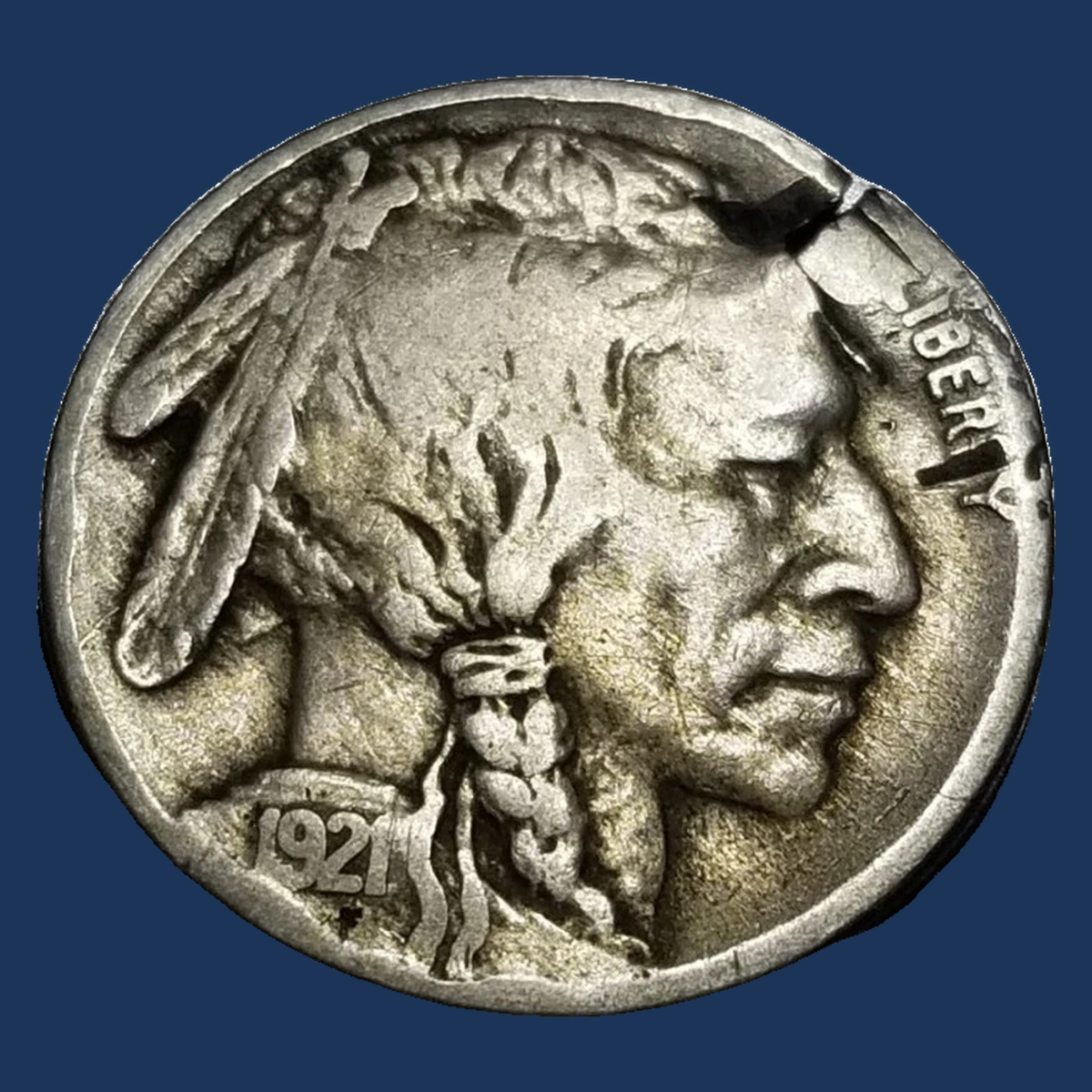
Two gaps in a coin’s outline can come from an unfinished metal disk that was cut incorrectly before striking. Each gap should belong to that original disk rather than later damage.
A collector has reported seeing a double-clipped 1921 Buffalo Nickel. The report does not establish the mint, the shapes of the gaps, or their positions around the edge.
Those details therefore need to come from the coin itself. Two missing areas do not automatically prove a mint error, since cutters and heavy impacts can also remove metal.
Estimated Value
Use an estimated $75–$750 for a genuine double-clipped example, with larger clear gaps and better preservation toward the upper end. The mint and ordinary coin value also matter.
This is a comparison-based estimate, not the selling price of the reported 1921 coin. For perspective, a scarce 1926-S single ragged clip graded AU58 brought $1,860 in October 2025.
That different year and mint cannot be priced as an ordinary Philadelphia double clip.
How to Identify
Measure across undamaged portions with calipers and compare them with the normal 21.2 mm diameter. A scale may show less than 5 g because two pieces were missing before striking.
Then inspect each gap separately through a 10× magnifier. Look for design weakness or metal flow toward the missing area, rather than sharp cutting marks or crushed edges.
The remaining edge should be plain. Weakness opposite a clip can support the diagnosis, but a missing patch alone is not enough.
Read the entire date and inspect below FIVE CENTS for a mint letter wherever that area survives. Both gaps must show natural mint-made boundaries; one genuine clip does not make a second damaged area genuine.
4. 1921 Buffalo Nickel Doubled Facial Details
An extra eyelid or doubled lip can be easier to find than doubled lettering on this variety. The second outlines lie toward the upper left of the main facial details.
Wexler identifies this Philadelphia coin as WDDO-001. The nose and the left side of the right ribbon also show doubling.
The design became doubled while the stamping tool was being made, so later coins repeated it. This is not evidence that each coin was struck twice, and a blurred portrait from wear does not create the same repeated shapes.
Estimated Value
For a matching doubled-design coin, estimate $40–$1,500. A worn example with readable facial doubling belongs below a sharp unworn piece with clean surfaces.
The 1926 Philadelphia paired front-and-back variety provides a broader comparison: an MS65 example sold for $3,120 in 2018. That was a different, more extensive doubled design.
The range here is an estimate for the 1921 variety, not a claim that its smaller doubled features have sold for that comparison price.
How to Identify
Keep the portrait upright while examining the eyelid through a 10× magnifier. Follow the extra outline toward the nose and lips, checking whether the upper-left direction stays consistent.
The coin should have no mint letter below FIVE CENTS. If loose, check its normal 5 g weight, 21.2 mm diameter, and plain edge with a scale and calipers.
Now compare the ribbon as a separate test rather than relying only on the eye. The Wexler photographs show the left edge of the right ribbon doubled as well.
Flat shelf-like doubling or general softness does not establish this variety. Matching the facial direction and ribbon detail is more useful than finding an isolated thick line.
5. 1921 Buffalo Nickel Off-Center and Spread Strikes
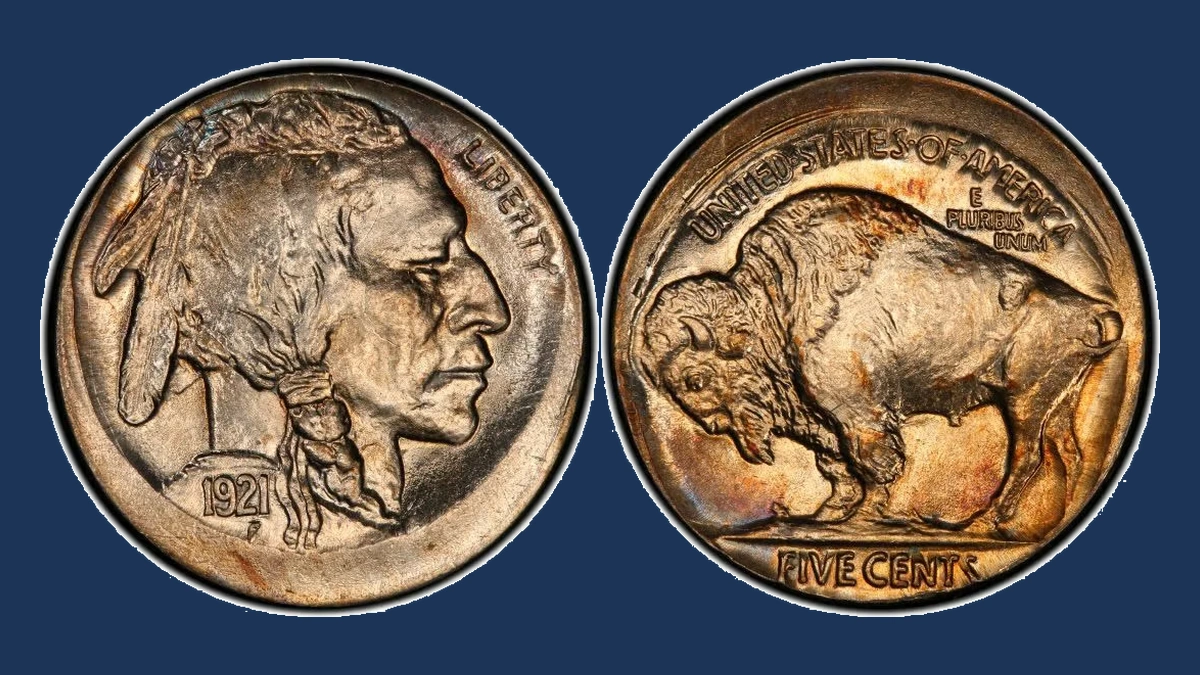
A shifted strike can leave a wide blank crescent and remove part of the design. One 1921 example graded MS63 was struck 45% off center toward twelve to one o’clock.
Its original auction title leaves the mint unidentified. The date survives, but that does not establish Philadelphia.
Another coin has been described as an uncentered broadstrike, meaning it spread without normal support from the surrounding steel ring. Its clipped bottom of S in CENTS raises the off-center question, because a pure broadstrike should retain the complete design.
Estimated Value
Estimated whole-coin values span $200–$3,500, with a modest spread strike below a dramatic dated off-center error. The amount of missing design and the surface condition both matter.
The 45% off-center NGC MS63 coin sold for $2,300 on September 11, 2009, at Heritage. The auction noted scratches in the unstamped area.
That sale belongs to the large off-center coin, not the separate example whose broadstrike label has been questioned.
How to Identify
Find the bottom of S in CENTS before deciding whether an unevenly spread coin is a broadstrike. If the original strike cuts off the letter, the design is incomplete.
Check the other outer letters and both faces under a 10× magnifier. A 45% off-center coin should have a substantial unstamped area, whereas a broadstrike can retain every design element.
Use calipers to compare the spread with the normal 21.2 mm diameter. The coin should remain near 5 g on a scale unless metal was also lost.
Inspect the plain edge for later squeezing or cutting. Preserve the distinction between complete lettering on a spread coin and lettering that ran beyond the metal during the strike.
6. 1921 Buffalo Nickel Peeling Metal
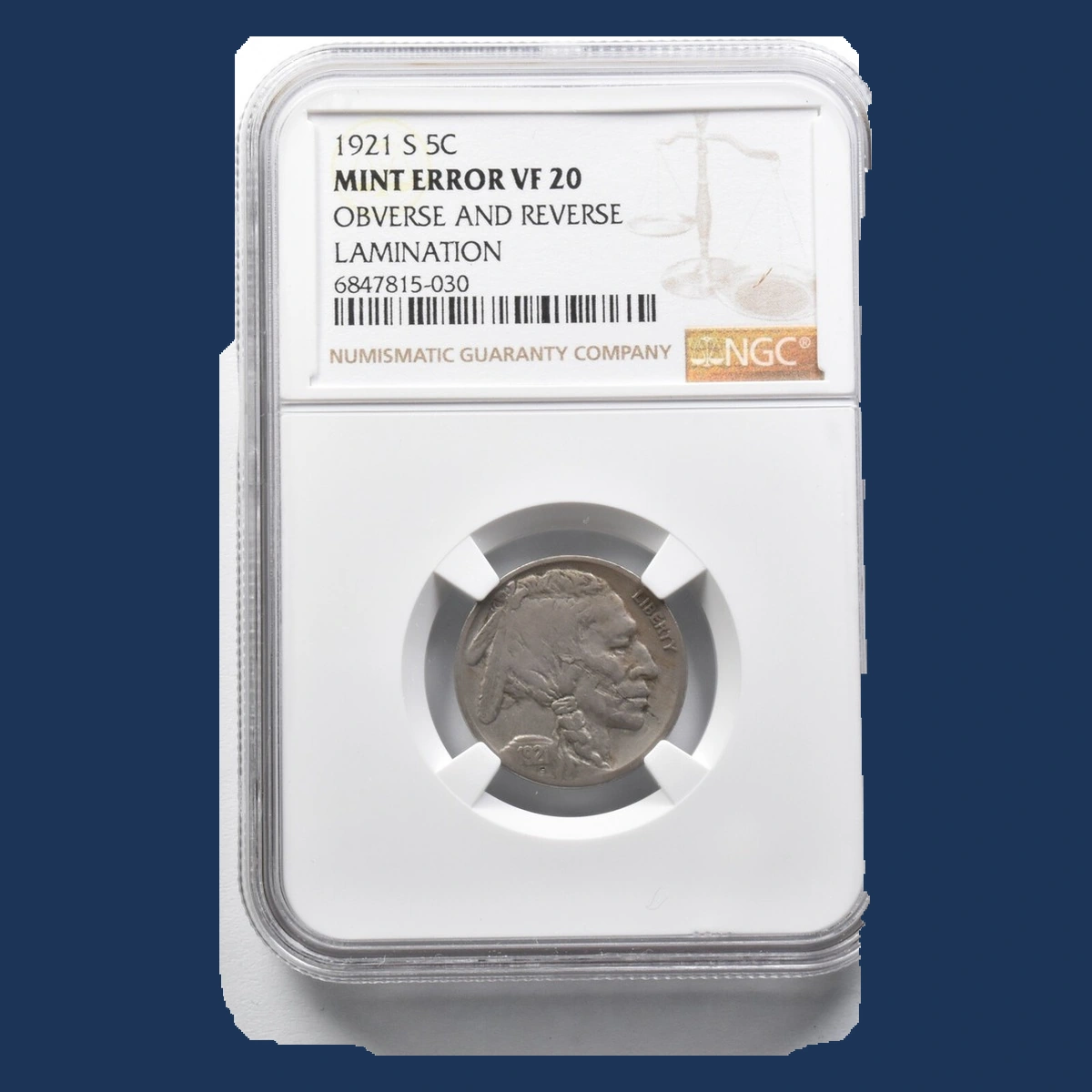
A patch that looks flaky or split may be a lamination: metal separating within the coin. Buffalo Nickels use a copper-nickel mixture, so this is not a thin silver coating peeling away.
A 1921-S example graded MS64 has separation on the back and another area at the far left of the front. Both belong to one coin.
Philadelphia examples have also been reported, without a fixed location for the peeling. The defect begins in imperfect metal and may remain as an attached flap or a shallow missing patch.
Estimated Value
Allow an estimated $20–$5,000 across Philadelphia and San Francisco examples, depending on wear and the value of the underlying coin. Scarce unworn 1921-S pieces can be expensive even with only modest peeling.
The NGC MS64 coin with peeling on both faces realized $3,304 at Scotsman on July 23, 2021. That total included the buyer’s fee above its $2,800 winning bid.
It is one whole-coin sale, not separate prices for the two affected faces.
How to Identify
Do not test a flake by lifting it. Examine its edge through a 10× magnifier while moving a light sideways across the surface.
On the recorded San Francisco coin, inspect the back and the far left of the front. A thin layer boundary should differ from a gouge with metal pushed up along its sides.
Turn to the plain edge to check for damage from cutting or squeezing. Read S below FIVE CENTS before comparing prices with that scarce mint.
A scale and calipers normally read about 5 g and 21.2 mm for a loose coin. A small peel may change neither measurement noticeably.
An attached thin layer or a shallow natural separation is the useful sign; reduced weight by itself is not.
7. 1921 Buffalo Nickel Reported Cent-Blank Strike
A Buffalo Nickel design on a smaller copper-colored disk would look crowded, with some outer details missing. Such a coin can result when a blank intended for a cent reaches the nickel press.
A blank is the metal disk before its design is stamped. A cent blank from this period normally weighed 3.11 g, compared with 5 g for a nickel.
The reported 1921 candidate requires its date and metal to be established before that explanation applies. Copper color alone can come from staining or plating instead.
Estimated Value
If authenticated as a 1921 Buffalo Nickel struck on a cent blank, an estimated range is $1,500–$6,000. Condition, a readable date, and clear evidence of the wrong metal would drive the price.
A genuine 1936 Buffalo Nickel on a cent blank graded AU55 sold for $3,290 in June 2017 at Heritage. That is a different-year comparison.
The estimate does not represent a verified sale or completed authentication of the reported 1921 candidate.
How to Identify
Start with a scale, not color. Compare a loose candidate with the period cent’s 3.11 g weight and a normal nickel’s 5 g weight.
Calipers should help distinguish a cent-sized disk, normally 19 mm before striking, from a 21.2 mm nickel. Striking can spread the smaller blank, so size and weight need to be considered together.
Inspect the plain edge and any exposed metal with a 10× magnifier. Plating can change color without creating the original smaller disk or its natural loss of outer design.
Read 1921 clearly and have the metal checked without scratching the coin. A copper-colored surface becomes convincing evidence only when the lighter metal disk and crowded nickel design also fit.
8. 1921 Buffalo Nickel Two Feathers
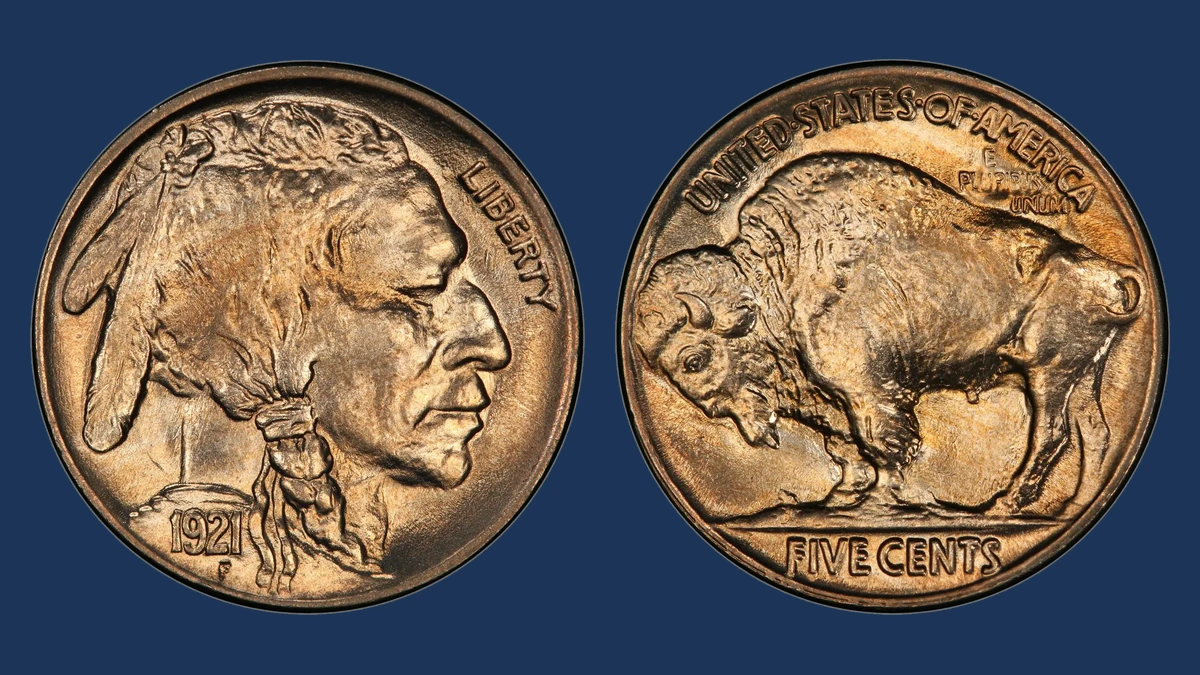
Only two clear feathers may remain behind the portrait’s neck when the smallest inner feather has been polished out of the stamping tool. Nearby details can remain much sharper than that missing feature.
The Two Feathers variety is recorded for both Philadelphia and San Francisco in 1921. A Philadelphia example can also show missing detail along the upper back edge of the neck.
The two mints need separate comparisons. A worn coin with a faint feather is not automatically this variety, and scraping the feather off does not reproduce its mint origin.
Estimated Value
Estimated values range from $40–$8,000 across the two mints and a broad span of condition. Well-worn coins belong far below unusually sharp, unworn examples.
A Philadelphia Two Feathers coin graded MS67 sold for $7,800 on January 12, 2020, at Heritage, as recorded by PCGS. MS67 denotes exceptional preservation without circulation wear.
That high-grade result should not be applied to a heavily worn coin merely because only two feathers can be counted.
How to Identify
Check the mint first: Philadelphia has no letter, while San Francisco has S below FIVE CENTS. Choose a photograph of the same mint’s Two Feathers variety.
For a loose coin, verify the plain edge and approximate 5 g weight and 21.2 mm diameter with a scale and calipers.
Place the coin beside a normal example of similar wear. Use a 10× magnifier to inspect the small inner feather between the neck and the larger feathers.
Notice whether adjacent hair and neck details survive more clearly. General smoothness across the portrait favors wear, while scratches or a recessed patch can suggest deliberate removal.
Look for the missing small feather in its exact position, with the surrounding detail matching the same-mint variety photograph.
Conclusion
Estimated 1921 Buffalo Nickel error values of $15–$8,000 cover small tool marks through scarce, well-preserved varieties. Start with the feature itself: doubled facial lines, a missing feather, peeling metal, or an incomplete strike.
A San Francisco coin may already be valuable without an error. Keep both faces and the edge in view, and compare the correct mint before paying for a label or a dramatic appearance.