1942 Nickel Error List with Pictures

A sideways D hiding beneath an upright D can turn a 1942 nickel into a valuable variety. One example with sharply defined steps on Monticello brought $32,200 in January 2006.
The 1942 Jefferson Nickel errors below have estimated values of $10–$35,000. This year includes ordinary copper-nickel coins and wartime silver coins, so the mintmark matters before any unusual feature is named.
Look closely at the letters, missing metal, and overlapping designs to see which kind of mistake your coin might show.
1. 1942 Jefferson Nickel Peeling Surface Metal
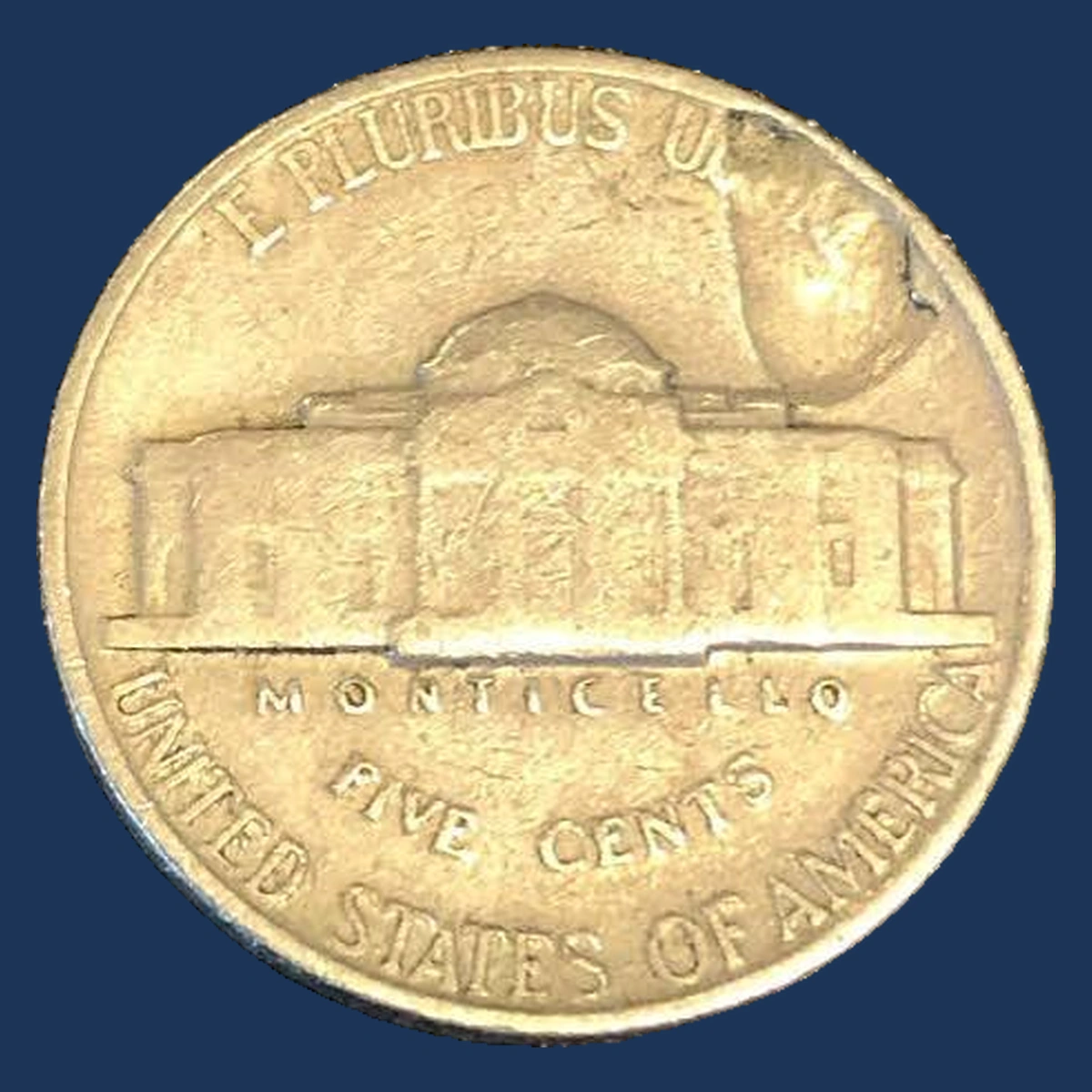
A thin flap or rough shallow patch can begin inside the coin’s metal. A weak area separates, leaving a loose layer or the surface exposed beneath it.
This is called lamination. A recorded 1942-P silver nickel with the defect was graded ANACS VG8, meaning it had considerable circulation wear.
The wartime metal contains thirty-five percent silver mixed into the alloy. It is not a silver coating over a different core.
An ordinary copper-nickel coin can also develop a weak layer. Neither version should be described as losing a separate outer silver shell.
Estimated Value
The worn 1942-P ANACS VG8 example is reported at $10 in November 2008. Estimate $10–$300 for genuine laminations, with the size of the separation and remaining detail affecting the price.
A small shallow patch usually attracts less attention than a broad attached flap. The range prices the complete coin, including its condition and metal.
Cleaning or tearing away an attached layer can reduce its appeal. Preserve loose metal rather than trying to make the flaw more obvious.
How to Identify
Leave an attached flap in place and tilt the coin under light to see its boundary. Pulling it back can destroy the very surface that explains how it separated.
Use a 10× magnifier to inspect the rough inner metal and surviving struck detail. Scraping may leave tool tracks, while corrosion often produces scattered pits instead of a peeling layer.
The recorded silver example has a large P above Monticello, but its alloy has no separate silver coating to peel off. A scale and calipers normally show about 5 grams and 21.21 millimeters on an intact loose nickel, with a plain edge.
Identify the natural layer boundary, allowing for reduced weight if material is missing.
2. 1942 Jefferson Nickel Material Blocking the Strike
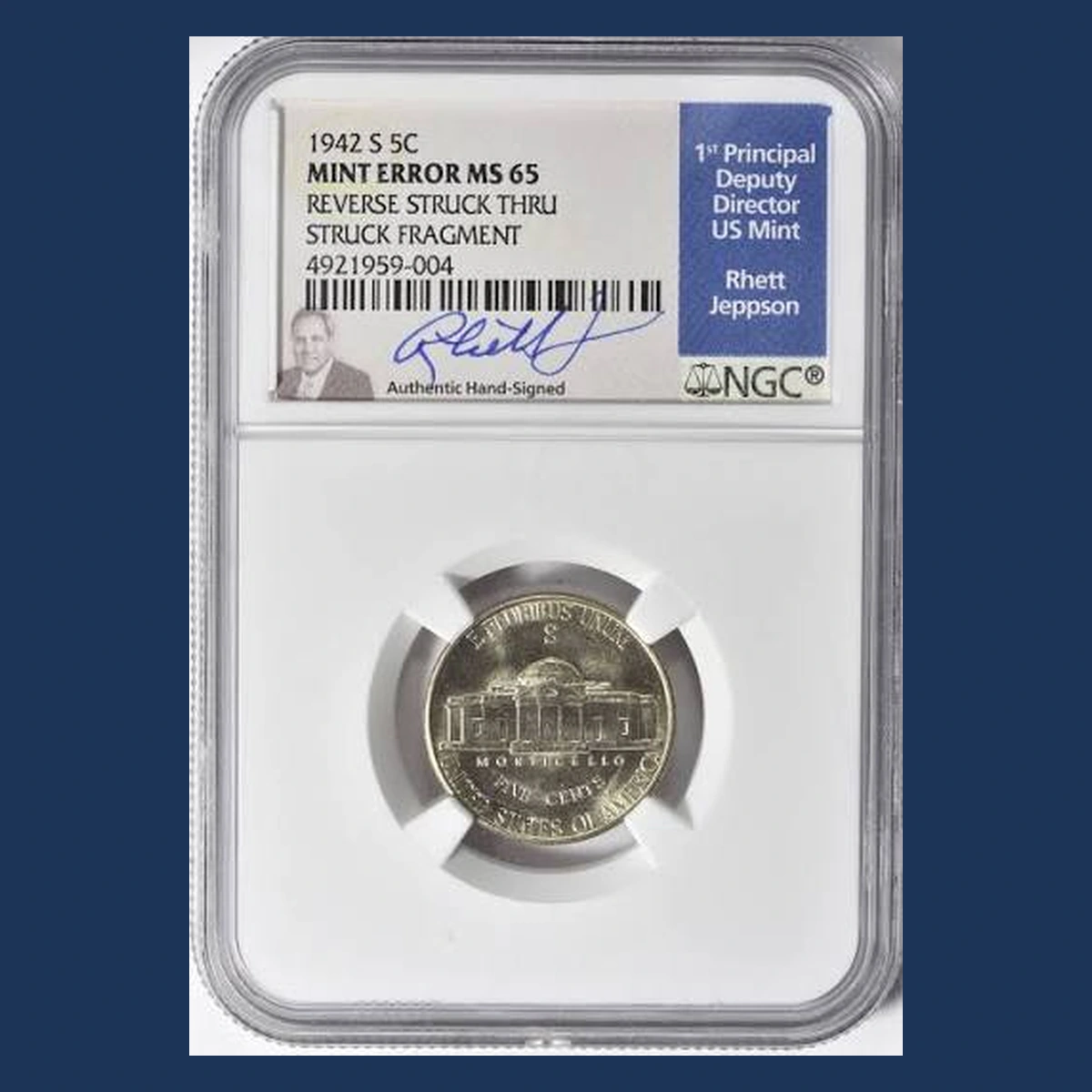
Material between a stamping tool and the metal disk, or blank, can stop part of the design from forming. The result may be a weak patch or an impression shaped by the obstruction.
A year guide reports this struck-through error on 1942-S nickels. It does not identify one particular material or position on the coin.
The large S above Monticello belongs to the normal wartime design. It is not itself evidence that anything blocked the strike.
Wear also removes detail, but it usually affects exposed high points. A localized interruption surrounded by sharper design deserves a closer look.
Estimated Value
Use an estimated $15–$350 for a genuine 1942-S struck-through error. A faint blocked detail belongs near the lower end; a clear, larger impression can be more appealing.
As a different-year comparison, a 1958 Philadelphia nickel described with cloth across the portrait was reported at $68 in 2024. That texture must not be assumed on a 1942-S coin.
The visible shape and preservation guide the comparison. A weak patch caused by ordinary wear receives no equivalent error premium.
How to Identify
Check that the 1942 date and large S above Monticello belong to the same coin before matching the weak area. The letter identifies the reported wartime version; it does not itself show an error.
A scale and calipers can compare an intact loose example with 5 grams and 21.21 millimeters, and its edge is normally plain. Then inspect the affected surface through a 10× magnifier for a depression, texture, or missing detail.
Compare neighboring raised features to see whether they remain sharper than the interrupted area. Local loss beside well-preserved detail supports an obstruction more than general wear, without naming the material cloth or wire from guesswork.
3. 1942 Jefferson Nickel Defective Blank
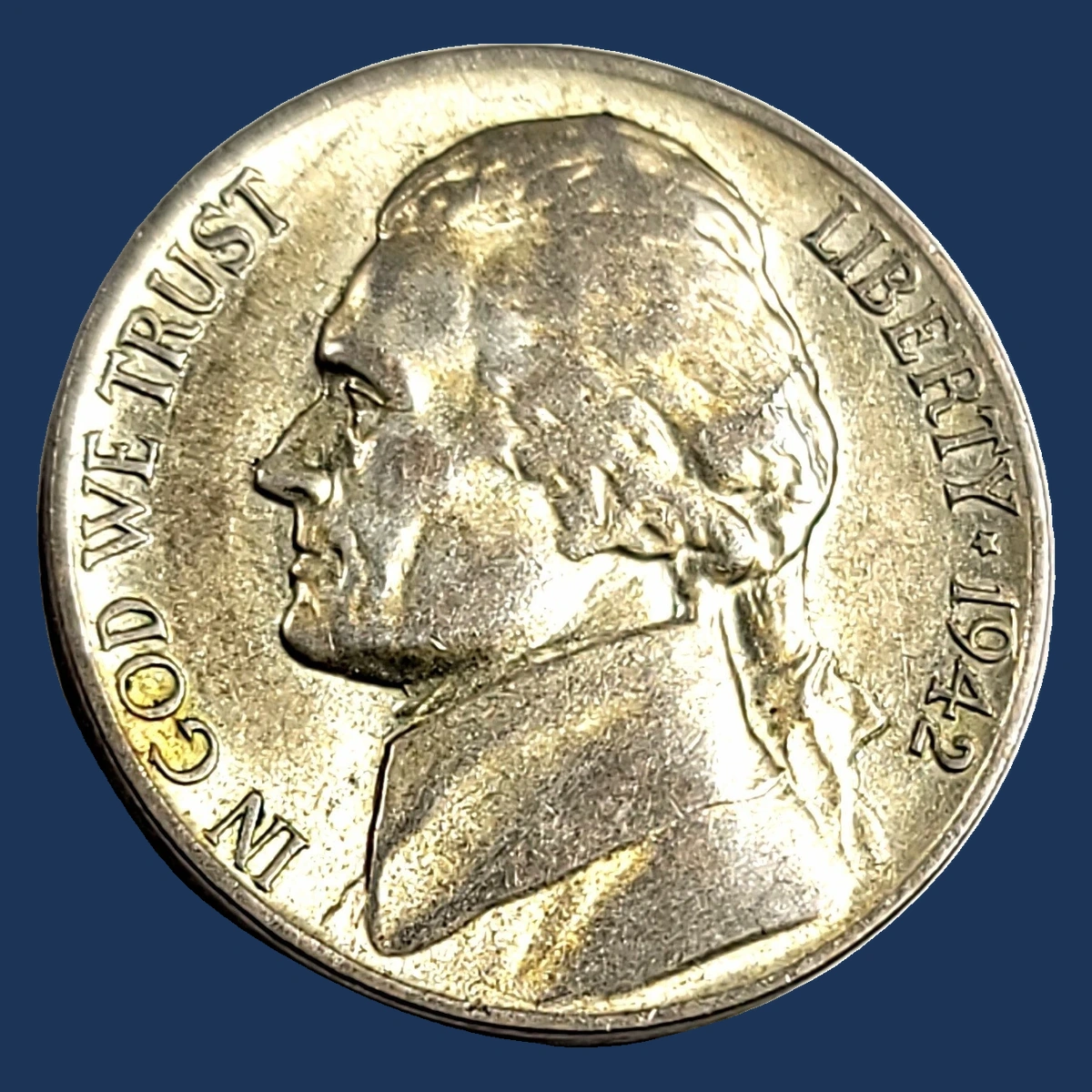
At 4.4 grams, this Denver nickel is lighter than the usual five-gram coin. Its auction description identifies a defective blank rather than simply an ordinary worn nickel.
NGC graded it MS64 Full Steps. That means an unworn coin with some marks and clearly defined steps on Monticello.
The listing does not specify a clip, a thin rolled section, or a peeling layer. Those are different possible defects and should not be attached to this specimen without matching evidence.
A low weight is a useful clue. The coin’s original surface and edge must still explain how the shortage arose.
Estimated Value
This 4.4-gram example sold for $156 in July 2021. Estimate $75–$400 for comparable genuine 1942-D defective-blank nickels, depending on the visible flaw and condition.
The Full Steps designation adds information about the sharpness of Monticello. It does not identify the particular blank defect or mean that every light nickel deserves the same price.
An original, clearly demonstrated shortage supports collector interest. A coin made lighter by grinding, heavy corrosion, or later cutting belongs outside this comparison.
How to Identify
A scale reading of 4.4 grams matches the recorded weight, but cannot establish why metal is missing. Compare that figure with the normal five-gram nickel before studying the specimen’s surface.
The small D beside Monticello identifies the copper-nickel version. A large wartime letter above the building belongs to a different regular issue.
Use calipers against 21.21 millimeters to check the outline, and a 10× magnifier to inspect the plain edge. Filing, cutting, and corrosion can make a finished coin lighter.
Record any original thickness changes without automatically naming a clip or peeling layer.
The identifying evidence must connect the low weight with a blank defect visible in the original struck metal.
4. 1942 Jefferson Nickel Curved Clip
A curved bite can be present before a nickel receives its design. The punch removes an incomplete disk when it overlaps a hole left by an earlier blank.
The incomplete disk then travels through the remaining minting steps. Its rim and design form around the existing shortage.
A curved clip is reported for the 1942-S silver version. No particular size or clock position is established for that report.
This is different from an off-center strike, where unused metal remains beside the shifted design. It also differs from a finished nickel that someone cuts into a similar shape.
Estimated Value
Estimate $30–$500 for a genuine 1942-S curved clip. A clear natural gap, readable date, and well-preserved surface support the stronger end of the comparison.
A later Philadelphia 1946 clipped nickel graded MS65 sold for $30 in March 2025. That ordinary copper-nickel example provides context for a modest clip rather than a direct price for the wartime coin.
The missing percentage alone does not determine value. Buyers still need to see original rim formation around the shortage.
How to Identify
Inspect both ends of the curved opening with a 10× magnifier, looking for a rim formed around missing metal. A cut across completed lettering or sharp filing burrs suggests later removal.
Weakness opposite a clip can help, but it need not appear clearly on every coin.
Measure intact spans with calipers against 21.21 millimeters, then compare a loose specimen’s weight with the normal 5 grams. Do not measure through the gap and call that its original diameter.
The large S above Monticello identifies the reported silver version; inspect the remaining plain edge for damage too. Natural struck boundaries at the opening are more useful than the curved silhouette alone.
5. 1942 Jefferson Nickel Doubled Front or Back Design
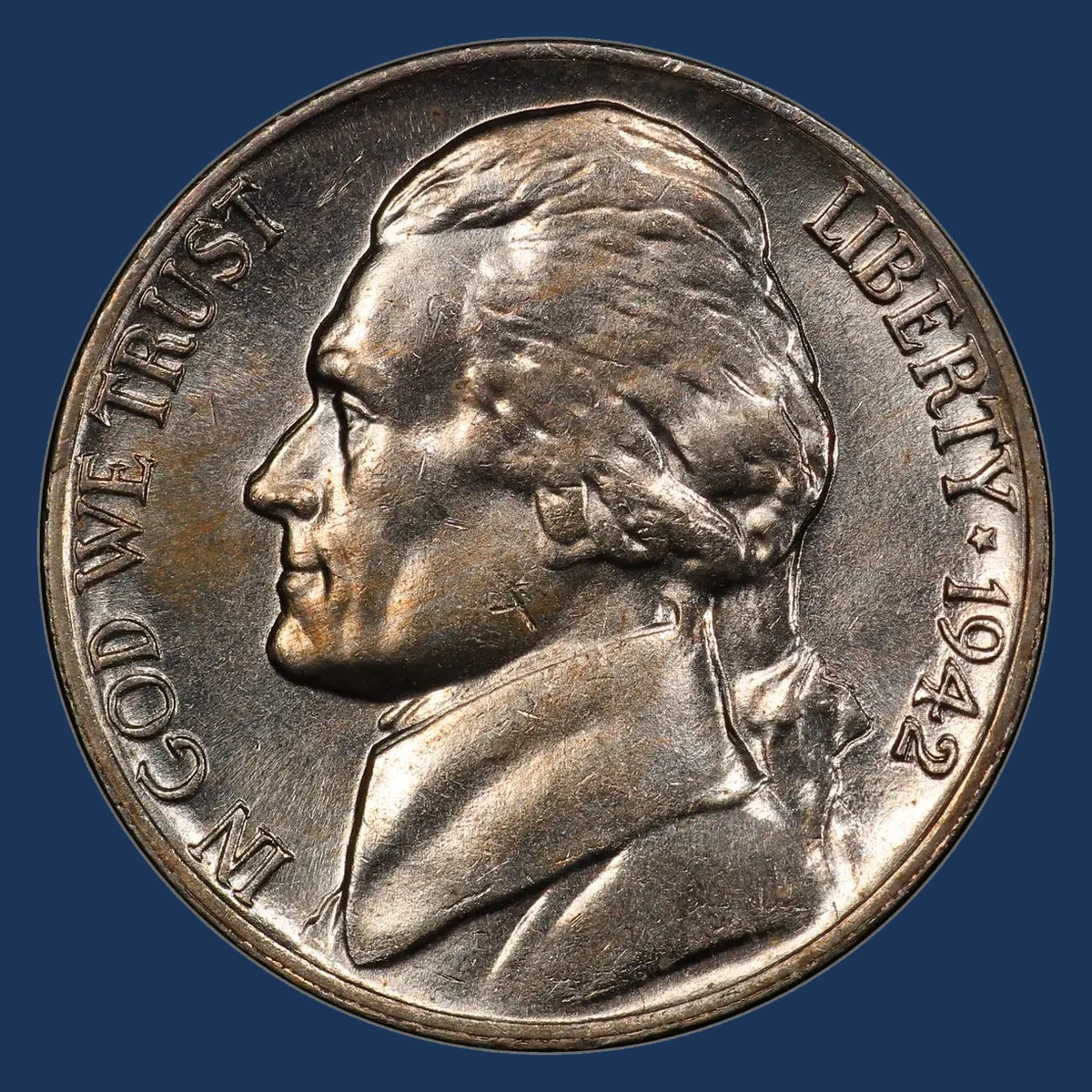
Two outlines around a letter can come from one strike when the stamping tool already carries doubled detail. Collectors call that tool a doubled die.
Philadelphia’s ordinary copper-nickel FS-101 and FS-102 varieties show strong repetition around the date, motto, and portrait. They are distinct patterns, not two names for one coin.
Denver and San Francisco have other front or back varieties. Philadelphia also has examples on specially made collector coins called Proofs, including silver and copper-nickel versions.
The correct mint, alloy, and finish come first. One doubled nose does not identify every variety listed for the year.
Estimated Value
Estimate $20–$1,500 across these doubled designs, with stronger named varieties and better preservation commanding more. Minor repeated lettering should not automatically receive the price of a dramatic doubled portrait.
A Philadelphia copper-nickel FS-102, formerly called FS-026, graded PCGS MS65 sold for $690 in February 2010. That is an unworn example of one particular pattern.
Proof examples need comparisons with the same finish and metal. Wear, cleaning, and scratches can lower the complete coin’s value.
How to Identify
Choose the normal issue first: no letter means early Philadelphia, a small D means Denver, and a large P or S marks wartime metal. Identify a Proof separately before selecting the comparison photographs.
Use a 10× magnifier and the illustrated 1942 varieties to compare the actual repeated shapes. FS-101 and FS-102 have different front patterns; other coins require their own lettering or building matches.
Both ordinary alloys started at 5 grams and 21.21 millimeters, so a scale and calipers cannot identify the doubled tool. Inspect the plain edge for damage, then confirm several matching contours instead of relying on one flat shelf or thick letter.
6. 1942 Jefferson Nickel Second Strike with Rotation and Expansion
This nickel received another blow after turning inside the press. Its second strike also took place outside the ring that normally holds the metal to its proper width.
That ring is the collar. Without its restraint, the coin could spread outward as the new design overlapped the earlier one.
NGC graded the recorded example MS67 Six Full Steps, describing clean unworn surfaces and six distinct steps below Monticello. The available record does not establish its alloy version.
The rotation belongs to the movement between two strikes. It is different from a back design that is simply misaligned with the front.
Estimated Value
The documented double-struck nickel sold for $862.50 in September 2010. Estimate $400–$2,500 for comparable genuine 1942 examples, considering the separation of the designs and the remaining condition.
Its exceptional grade and clear steps help describe the whole coin. They do not mean every faintly doubled nickel belongs in this range.
Both the overlapping strike and outward expansion are parts of this one example. Price the complete result rather than adding separate full premiums for each feature.
How to Identify
Photograph both faces before focusing on one doubled-looking letter. Follow an earlier design position beneath the later strike with a 10× magnifier, looking for a consistent turn between the blows.
The exact alloy version needs a separate check of the coin; the grade label alone does not establish it.
Calipers can compare the expanded outline with the normal 21.21 millimeters. A scale should check a loose intact specimen against 5 grams, allowing for any documented metal loss.
Inspect the plain edge for squeezing, joining, or another cause of later distortion.
Outward spread without overlapping design would show a different mistake. Match two struck positions and expansion belonging to the later blow.
7. 1942 Jefferson Nickel Struck on a Cent Blank
A brown nickel can be stained, but this Philadelphia example began on the wrong metal disk. The early copper-nickel design was struck onto a blank intended for a cent.
The auction recorded an actual weight of 3.04 grams. NGC graded the coin MS62 Red and Brown, meaning unworn surfaces with noticeable marks and a mixture of original copper colors.
A cent blank is smaller than a nickel blank. The nickel’s outer design can therefore run beyond the available metal.
There should be no earlier Lincoln design beneath it. An already struck cent would create the separate two-denomination error discussed below.
Estimated Value
The 3.04-gram coin sold for $2,280 in July 2021. Estimate $1,000–$4,000 for comparable genuine 1942 nickels struck on cent blanks, with readable identity and preservation influencing the price.
An unworn coin with clear nickel design is a stronger comparison than a corroded or heavily worn piece. Copper color alone does not support this valuation.
The estimate concerns an originally blank cent disk. Visible surviving Lincoln details would require comparison with an already struck cent instead.
How to Identify
The documented coin weighs 3.04 grams, close to a cent blank’s standard 3.11 grams and well below a nickel’s 5 grams. Check a loose candidate on a scale without replacing its actual reading with the standard.
Use calipers against the cent’s starting 19.05 millimeters and the nickel’s 21.21 millimeters; striking can spread the smaller disk. Examine its cropped wording, date, and plain edge with a 10× magnifier for trimming or a coating.
No mintmark is normal on the early Philadelphia design, but both faces should also be checked for surviving Lincoln details. Nickel design on an originally blank smaller disk differs from nickel design over a previously struck cent.
8. 1942 Jefferson Nickel Struck on a Silver Dime Blank
Only the lower half of the date survives on this San Francisco example, but enough remains to identify 1942. Its large S nearly touches the upper edge.
The nickel design was struck onto a smaller silver dime blank. Most of E PLURIBUS UNUM fell beyond the available metal.
PCGS graded the coin MS63, an unworn grade allowing noticeable marks. The catalog describes a shape affected by contact with the surrounding ring near twelve o’clock.
A separate dealer example graded AU58 retains a complete date. Its photographs should not be used to fill in missing digits on the MS63 coin.
Estimated Value
The PCGS MS63 example brought $3,600 in January 2023. Estimate $1,500–$6,000 for genuine 1942-S dime-blank nickels, with readable date, remaining detail, and preservation affecting the comparison.
The separate AU58 coin shows that date visibility can differ between specimens. A more complete year is helpful, but it does not erase the effect of wear or surface problems.
Compare the complete wrong-blank coin rather than treating silver content alone as its source of value. The striking mistake creates the main collector interest.
How to Identify
On the MS63 example, begin with the lower portions of the date and the large S near the upper edge. Most of E PLURIBUS UNUM is missing because the smaller disk could not receive it.
The separately offered AU58 coin has a complete date and needs its own photographs.
A silver dime blank normally starts at 2.5 grams and 17.91 millimeters, versus 5 grams and 21.21 millimeters for a nickel. Use a scale and calipers on a loose candidate, allowing for spread during striking.
These are standards, not recorded measurements of the MS63 specimen. Inspect the edge with a 10× magnifier for trimming; normal dime grooves need not form under nickel tools.
The smaller original disk must explain the missing wording and distorted outline.
9. 1942 Jefferson Nickel Design over a Finished Cent
Lincoln’s head appears almost upside down beneath Monticello on the PCGS example. His coat edge also crosses part of E PLURIBUS, revealing the coin’s earlier identity.
The cent had already been struck before it entered a nickel press. The later wartime Philadelphia tools added Jefferson and the large P design to the copper coin.
This is a double-denomination error: two different coin designs share one piece of metal. It differs from a nickel struck on a cent blank.
Records include PCGS and NGC MS64 Brown examples. Their matching grade and color do not establish that they are the same specimen.
Estimated Value
The PCGS MS64 Brown example is reported at $5,760 in November 2022. A separate NGC MS64 Brown auction record lists $4,320 in December 2022.
Estimate $2,500–$8,000 for comparable genuine 1942-P examples. Clear surviving Lincoln details make the sequence easier to see and can strengthen collector interest.
Price the entire coin with both designs together. Neither record should be transferred to an ordinary copper-colored nickel or a cent blank lacking an earlier struck design.
How to Identify
Find Lincoln’s nearly inverted head under Monticello on the PCGS example, then follow his coat edge across part of E PLURIBUS. A 10× magnifier should show those earlier details surviving beneath the later nickel design.
Keep any surviving cent date separate from the 1942 nickel date. The later Philadelphia wartime design is the relevant nickel identity.
A loose coin can be checked with a scale and calipers against the cent’s original 3.11 grams and 19.05 millimeters. Neither figure is presented as an actual measurement of the PCGS or NGC specimens.
Examine the plain edge for joins and both faces for later pressure damage. Recognizable earlier cent detail beneath the nickel strike establishes the two-denomination sequence.
10. 1942 Jefferson Nickel Early Design on Wartime Silver Metal
This nickel has the early Philadelphia back without a large P, yet its metal belongs to the wartime silver mixture. The mismatch joins the earlier design with the later blank.
PCGS graded the documented coin Good 6, a heavily worn grade. Its recorded weight is 4.7 grams.
The auction included a 1965 identification letter and a contemporary report about the discovery. Those records concern this particular coin, rather than all silver-colored nickels without a mintmark.
Both regular 1942 alloys normally began at five grams. Color and weight alone cannot establish this unusual combination of design and metal.
Estimated Value
The documented Good 6 coin sold for $9,987.50 in August 2016. Estimate $5,000–$15,000 for a genuine comparable example, with established metal identity central to the valuation.
This strong price despite heavy wear reflects the unusual design-and-metal mismatch. It should not be applied to an ordinary no-mintmark nickel merely because it looks pale.
Surfaces, remaining details, and reliable identification still matter. A coating or an altered wartime mintmark would change the explanation completely.
How to Identify
A pale color cannot distinguish a silver-alloy blank from a coating, and both normal 1942 alloys began near 5 grams. Use a scale and calipers against 5 grams and 21.21 millimeters only as preliminary checks on a loose coin.
The auctioned Good 6 specimen actually weighed 4.7 grams after considerable wear.
Inspect the date and the space above Monticello with a 10× magnifier. Removal marks where a large P should be would change the explanation.
Check the plain edge for a coating, and keep earlier identification records with the same specimen. Qualified non-destructive testing must confirm thirty-five-percent silver in the original metal alongside the unaltered early design.
11. 1942 Jefferson Nickel Repunched Mintmarks, Including the Sideways D
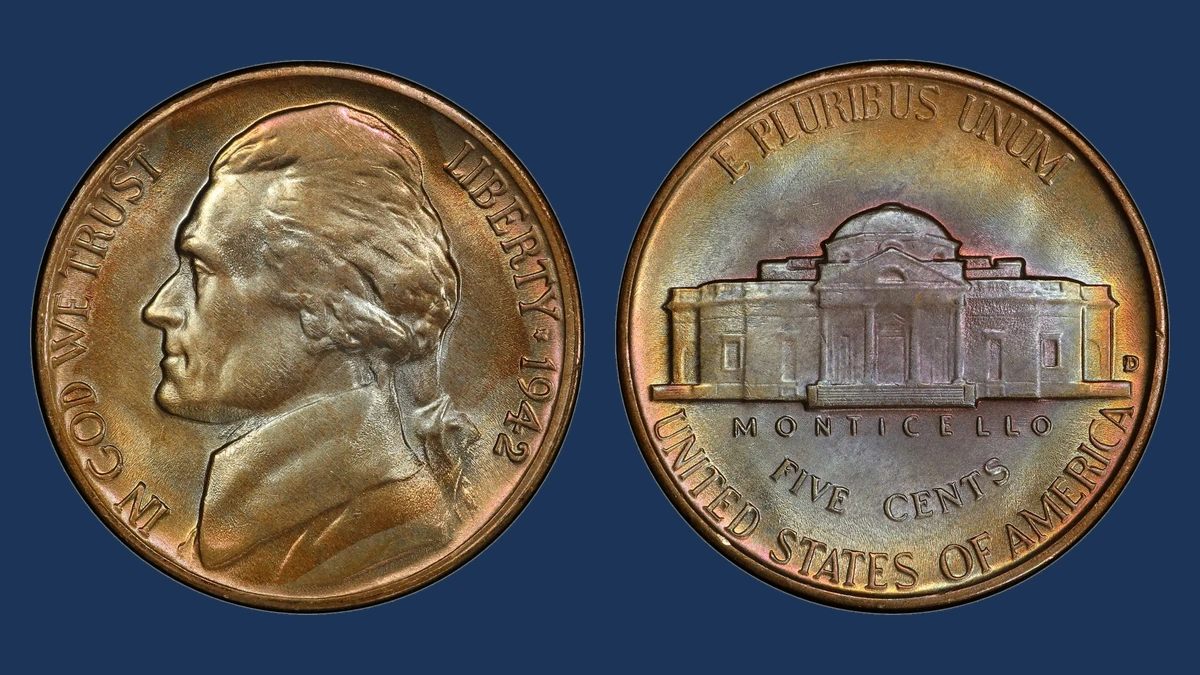
A sideways D beneath an upright D creates the best-known mintmark mistake for this year. The two impressions were made in the stamping tool before it struck the coins.
Other Denver varieties show different repeated D shapes. Silver Philadelphia and San Francisco coins have repeated large P or S marks above Monticello.
Some letters were punched more than twice, leaving several partial outlines. Each pattern needs its own comparison photograph.
The mintmark’s location also identifies the normal version. A small D belongs beside the building; the large wartime P and S belong above its dome.
Estimated Value
Estimate $10–$35,000 across these mintmark varieties, with minor patterns far below exceptional sideways-D coins. Most small repunches should be compared within roughly $10–$300.
PCGS records a $32,200 January 2006 sale for an MS64 Full Steps sideways-D example. Full Steps means the steps below Monticello remain especially clear.
That historical high is not a routine price for every sideways D. The exact variety, wear, surface quality, and step detail all affect the complete coin’s value.
How to Identify
Turn a normal D photograph sideways to understand the earlier letter below the famous variety. Compare its curves with the small D beside Monticello, using a 10× magnifier rather than guessing from one bump.
Large P and S varieties need different comparisons above the dome. Use their own mintmark photographs, including the correct ordinary or Proof issue.
A scale and calipers should place a normal loose example of either alloy near 5 grams and 21.21 millimeters. Inspect its plain edge for damage; those specifications cannot establish a repunch.
The earlier letter’s full shape and position must match the named pattern before its price is relevant.
Conclusion
These 1942 Jefferson Nickel errors have estimated values of $10–$35,000, from modest peeling metal to exceptional sideways-D varieties. First identify the normal version by its mintmark, then examine the unusual feature.
A copper coin needs the right original blank or surviving cent design, while a silver-alloy mismatch needs metal testing. Keep separate specimens and their auction results distinct, and preserve the surfaces exactly as found.