1945 Nickel Error List with Pictures

Extra back lettering helped make one 1945-P nickel worth $14,100 at a March 2014 auction. Its exceptional condition and sharply defined steps also contributed to that result.
These 1945 nickel errors have estimated values from $5–$15,000. All normal nickels of this year contain 35% silver, so silver content alone is not a wrong-metal error.
Look through the examples below to compare the actual design, edge, and blank behind each mistake.
1. 1945 Jefferson Nickel Die Cracks
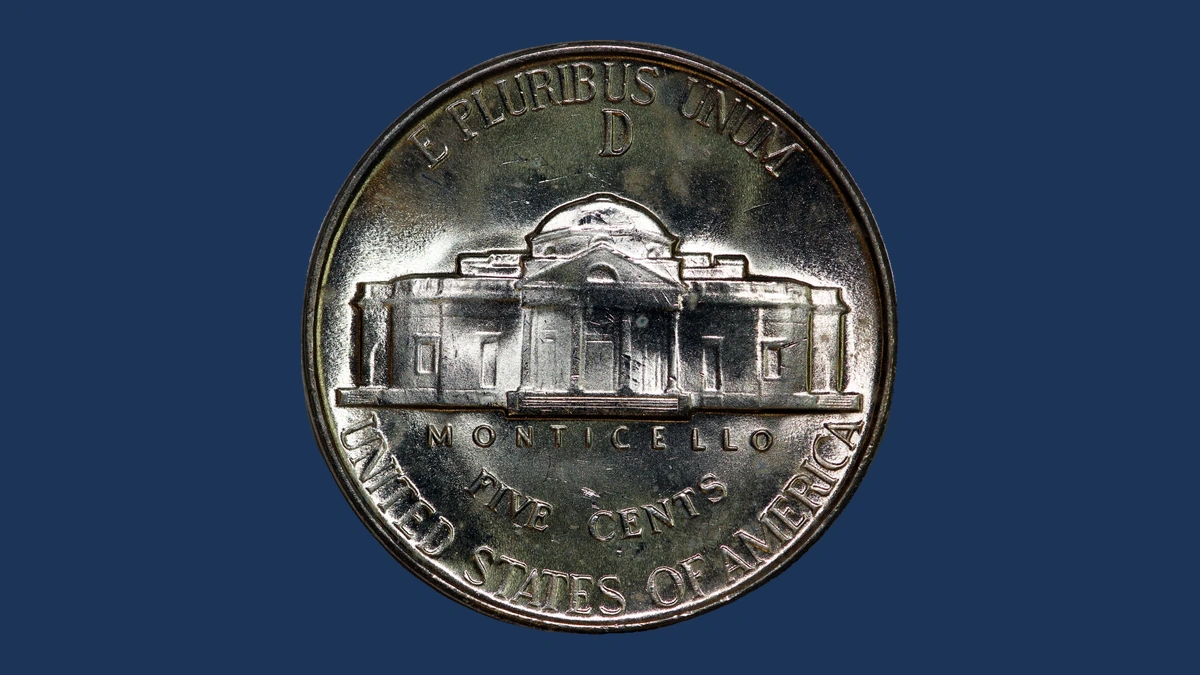
A raised line across Jefferson’s face can come from a cracked stamping tool. The tool is called a die, and metal pressed into its crack creates a narrow ridge on the coin.
A San Francisco year report describes this feature on 1945-S nickels. The line must be examined as raised coin metal rather than a cut made after striking.
Scratches can also cross the portrait, but they usually leave a groove and displaced metal. A dark line or a bright edge alone cannot establish which process produced the mark you see.
Estimated Value
A confirmed modest crack across the portrait is estimated at $5–$100. Larger clear ridges can attract more interest, provided the rest of the surface remains recognizable and original.
This estimate does not assign a separate auction record to the year report. The line’s shape and the coin’s condition matter, while a later cut through Jefferson’s face should not receive a Mint-error premium merely because its edges reflect the light.
How to Identify
Look through a 10× magnifier at the middle of the line. A raised center supports a die crack, while a recessed center points toward a scratch even when its sides stand up.
Turn the light rather than rubbing the surface. Follow the line across the portrait to see whether its shape remains consistent.
Check the large S above Monticello’s dome for the reported San Francisco type. The normal wartime coin weighs 5.00 g and measures 21.21 mm, checked with a scale and calipers if loose.
The edge should be plain. A continuous raised ridge through the original design is the visible feature to separate from a later cut.
2. 1945 Jefferson Nickel Lamination
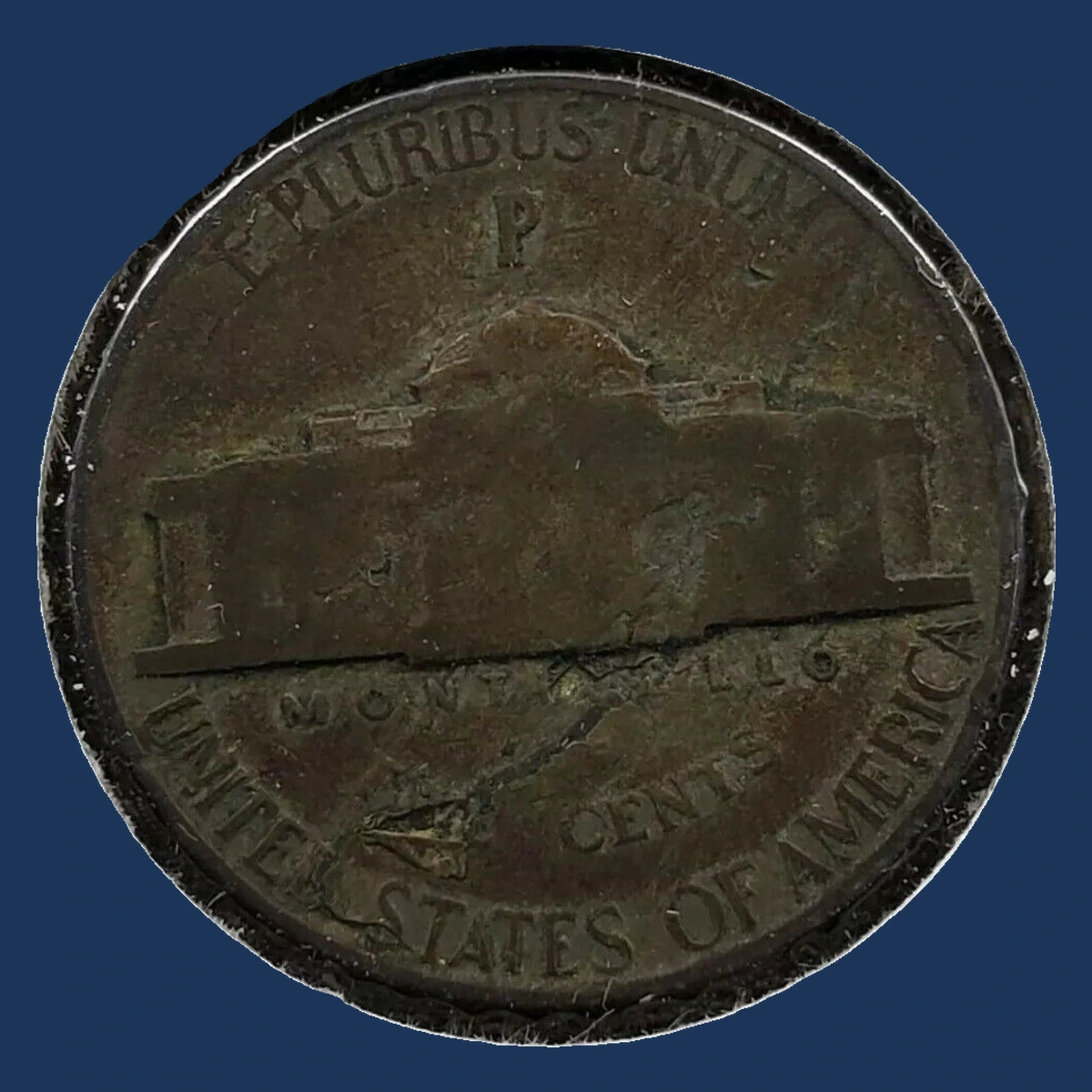
Part of a wartime nickel’s surface can flake or separate along a weak area in the metal. Collectors call this lamination.
The normal 1945 mixture contains 56% copper, 35% silver, and 9% manganese. A weakness within that mixture can create a peeling patch without another metal blank being involved.
San Francisco examples are reported, and the same general problem can occur on other wartime nickels. A dark or rough surface by itself does not establish lamination.
The useful feature is actual separation within the metal, rather than ordinary toning or corrosion eating away the surface.
Estimated Value
For a clear genuine lamination, estimate $10–$150, depending on its size and the coin’s condition. An attached flake can help explain the original separation.
These are estimates for the reported type, not a fixed price for all wartime surface problems. A small patch may add little, and cleaning or pulling away loose metal can make the error harder to understand rather than increase what a collector will pay.
How to Identify
Leave a loose flake attached. Its edge may show how a thin layer separated from the underlying metal.
With a 10× magnifier, examine where the original surface continues over the split. A dug-out gouge or corroded pit has a different boundary.
Check any exposed plain edge for a deeper separation. Do not pry it open.
A digital scale can record metal loss against the normal 5.00 g, while calipers check the usual 21.21 mm outline. A small flake may change the weight very little.
The silver-bearing wartime mixture is normal for this year. Look for a real layer boundary, not a different color that merely suggests one.
3. 1945 Jefferson Nickel Repunched Mint Mark
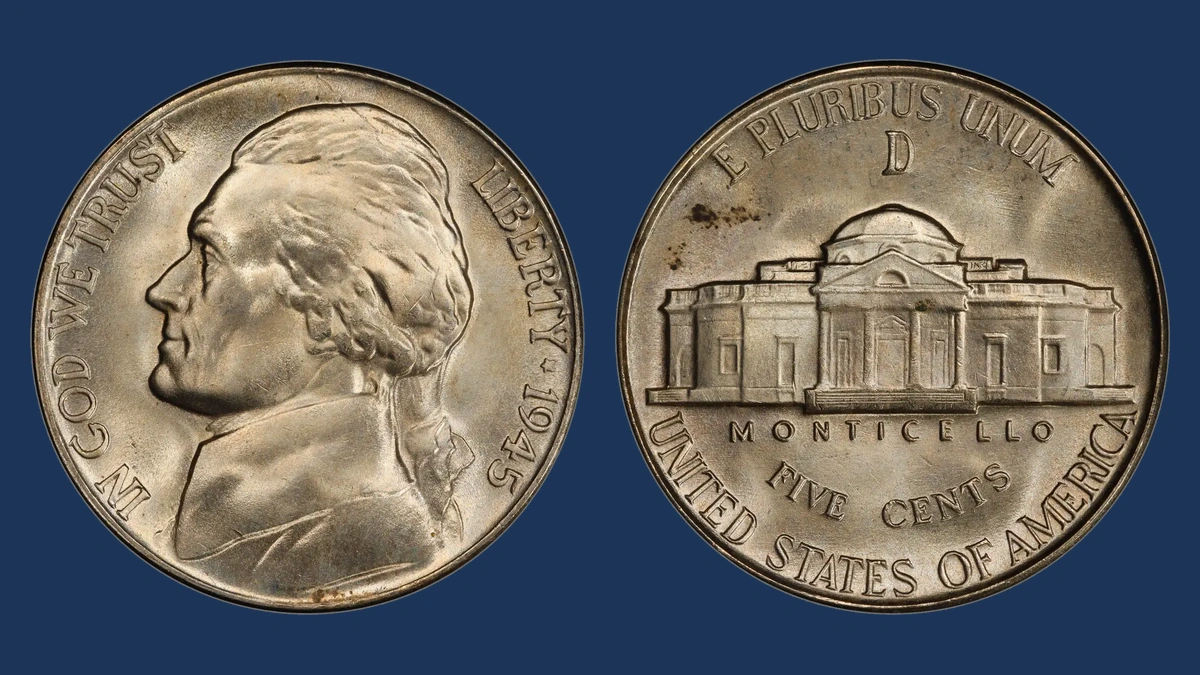
A large mint letter may contain an extra curve or stem from an earlier punch. Mint workers applied the letter to the stamping tool, and a misplaced first impression could remain.
Reports for 1945 include S/S, D/D, and P/P forms. Each repeats its own mint letter rather than changing the coin’s date or denomination.
The wartime letters sit above Monticello’s dome. They are larger than the small side-position mint marks used in many other years.
Extra lettering from movement during striking can look similar, but a low flat shelf does not necessarily preserve another punched letter.
Estimated Value
For identified repunched mint marks, estimate $10–$300. A strong recognizable extra stroke on a well-preserved coin is more appealing than a faint mark obscured by wear.
This range does not make every P/P, D/D, or S/S equally valuable. The exact shape needs a matching example.
On an unusual foreign-blank coin, the repunched mark belongs to the whole object’s price. Its presence does not add another complete coin value to that total.
How to Identify
Start above the dome, where the large wartime mint letter belongs. A tiny letter beside the building would not be the normal mint-mark position for 1945.
Use a 10× magnifier to compare the inner curves and outside strokes with the same reported P/P, D/D, or S/S form. A general thick outline is less useful than a recognizable second part of the letter.
For a loose normal coin, a scale and calipers should show roughly 5.00 g and 21.21 mm. The ordinary alloy includes 35% silver, so that composition does not establish an extra error; the mint-mark evidence is the repeated letter shape itself.
4. 1945 Jefferson Nickel Clipped Blank
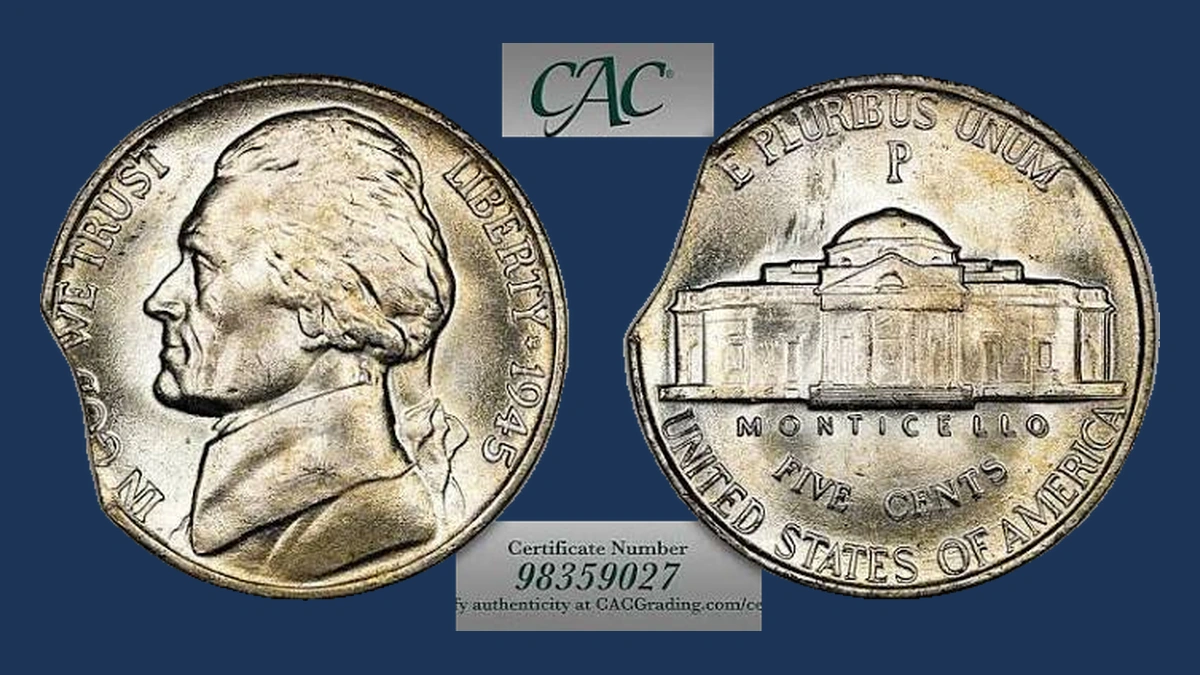
A curved gap can begin when the blank-cutting punch overlaps a hole already in the metal strip. The incomplete piece then enters the press with part of its edge missing.
A 1945-P example combines a 5% curved clip with the FS-801 doubled back design. CAC graded it MS63 and recorded a weight of 4.75 g.
The clip and doubling have different causes but occur on one coin. A separate Philadelphia curved clip appears near 2:30 on an MS65 example.
That second coin’s position should not be assigned to the 5% combination without comparing the actual images.
Estimated Value
For ordinary identified clips, estimate $25–$200. A comparable MS63 coin combining a clear small clip with the recognized doubled back may fit roughly $150–$400.
The published 4.75 g example provides its appearance and grade, not a completed sale used here. The combination range is one estimated whole-coin price; it should not be calculated by adding the price of a separate high-grade doubled-die coin to a separate clip.
How to Identify
The reported 5% example weighs 4.75 g rather than the normal 5.00 g. That measurement helps explain the missing metal, but a digital scale alone cannot prove the gap formed at the Mint.
Under a 10× magnifier, inspect both ends of the opening for naturally weakened rim or lettering. Saw marks and sharp cut edges suggest later removal.
Calipers can measure the intact outline against 21.21 mm without treating the gap as the full diameter. Check the opposite rim for possible weakness too.
The published combination also has doubled back lettering. Identify the natural gap and the extra letter outlines separately, then keep them tied to that same coin.
5. 1945 Jefferson Nickel Partial Collar Strike
A ledge around part of the edge can form when the blank enters its holding ring only partway. The collar restrains one area while another portion spreads outward during striking.
This is a partial collar strike. A 1945-P example appears in an auction catalog as PCGS MS64 Full Steps.
The grade describes an unworn coin with some marks, and Full Steps describes clear stair detail on Monticello. Neither tells you the exact position of the edge ledge.
Jefferson nickels have plain edges, so this error does not require the grooves seen on some other denominations.
Estimated Value
Estimate $100–$500 for a comparable confirmed partial-collar wartime nickel. A clear natural step and readable identity are useful when assessing its appeal.
The MS64 Full Steps catalog example has no individual sale price used here. Its well-defined stairs contribute to the complete coin’s condition assessment, but do not establish the edge error themselves.
A later flattened or squeezed rim requires a different explanation before this estimated range applies.
How to Identify
View the edge at eye level under side lighting. Turn the coin gently and look for a step separating metal held by the collar from metal that expanded beyond it.
A 10× magnifier helps inspect that change without mistaking a flattened rim from an impact. Look for fresh scraping or repeated pressure marks.
Use calipers to compare the different parts of the outline with the normal 21.21 mm. A scale should stay near 5.00 g if the coin has not lost metal.
The plain edge is normal. The identifying feature is the change in edge level that fits partial restraint during the strike, rather than a requirement for grooves.
6. 1945 Jefferson Nickel Off-Center Strike
A blank can sit off center when the tools meet it. Part of Jefferson and Monticello misses the metal, leaving a solid unstamped crescent beside the remaining design.
A period error catalog lists a Philadelphia 1945 off-center wartime nickel. Other year guides discuss examples without giving a fixed mint or percentage.
The ordinary-blank type should stay separate from the San Francisco coin struck 40% off center on a foreign blank. That piece also has different metal and dimensions.
A slightly uneven rim alone may come from a shifted tool rather than a true off-center blank.
Estimated Value
A confirmed dated off-center strike on normal wartime metal is estimated at $100–$800. The amount of surviving identity, the shift, and the surface condition all influence a comparison.
The Philadelphia catalog mention supplies no individual sale used here. The $2,350 foreign-blank combination belongs to another category of comparison, so its price should not be assigned to an ordinary 1945 nickel merely because both coins show an off-center design.
How to Identify
The large mint letter above Monticello helps establish which wartime coin you have. Inspect the date too before judging how much design is missing.
Use a 10× magnifier to compare both faces. The unstamped metal and missing design should fit one displaced strike.
If only one face has an uneven border while all design remains present, examine the possibility of a shifted tool instead. Border width alone is not the test.
A loose normal-alloy nickel should remain near 5.00 g, checked with a scale. Calipers compare the outline with 21.21 mm, allowing for spreading.
Follow the design to where it runs off the blank. The surviving crescent should be original unstruck metal, not a scraped patch.
7. 1945 Jefferson Nickel Struck Through a Retained Object
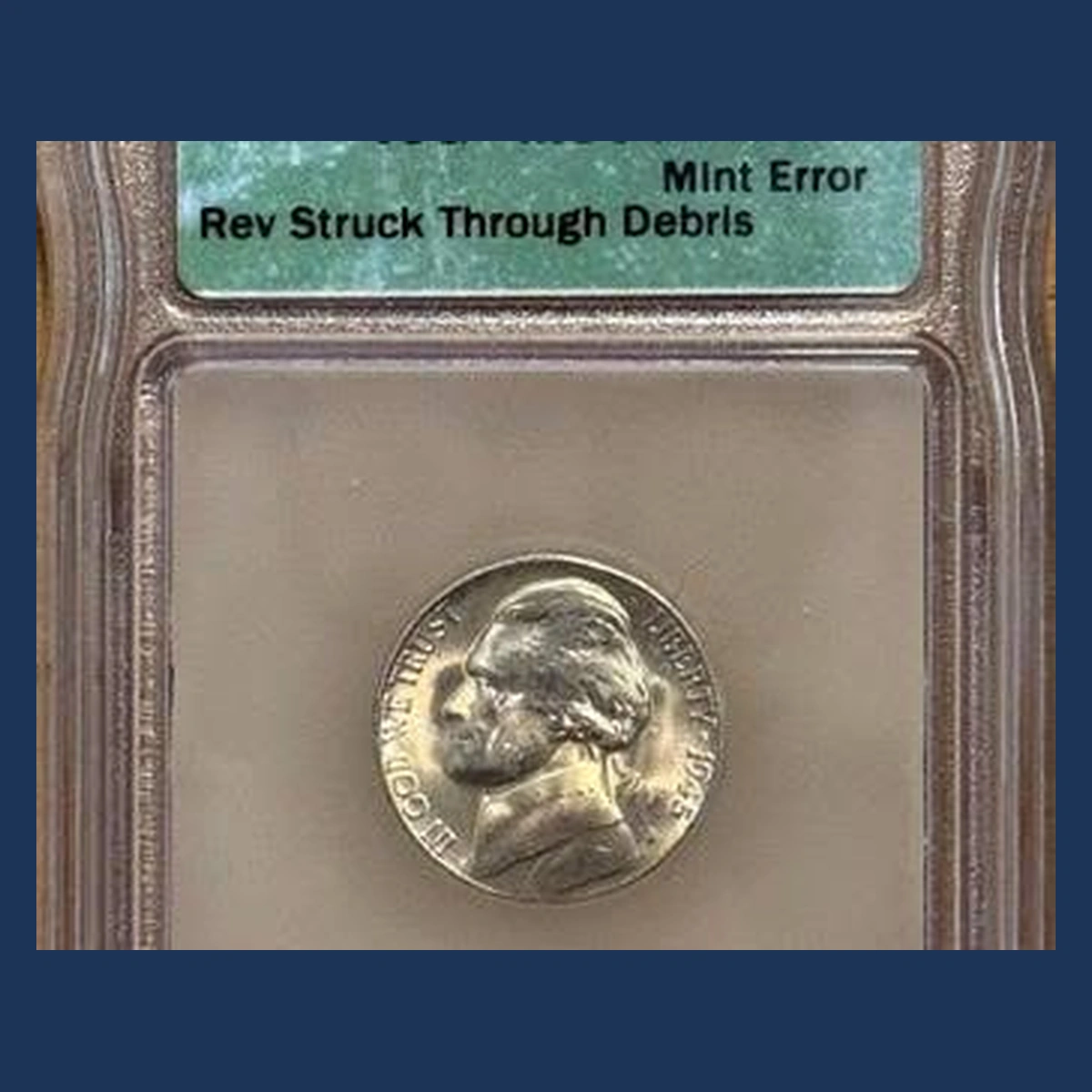
An object can remain trapped on a coin after blocking part of the strike. The surrounding design may stop at its outline or appear weak where the tool could not reach the blank.
A 1945 year guide reports this retained-object type without identifying one specific material or mint. Mentioning cloth, wire, or plastic as possible obstructions does not establish an example of each.
The object must belong to the original striking event. Something glued or pressed onto a finished nickel later may look unusual but has a different relationship to the already formed design.
Estimated Value
For a confirmed retained-object strike, use an estimated $150–$1,000, depending on size, visibility, and preservation. The material’s relationship to the design matters more than an interesting shape alone.
This is a conditional range for the reported category, not a sale of a particular 1945 cloth or wire example. An unidentified attachment should not receive a premium until its connection to the original strike is established on the actual coin.
How to Identify
Do not remove the object to inspect underneath it. The boundary between the object and the surrounding struck metal may be the strongest evidence.
Photograph that boundary under several light angles and examine it with a 10× magnifier. Check whether normal design stops where the obstruction blocked the tool.
Look for glue, solder, or fresh pressure damage over already complete lettering. Those suggest an attachment made after the coin was finished.
A scale and calipers can record the whole loose object against a normal nickel’s 5.00 g and 21.21 mm. An attached object may affect the reading, so the important test is how the original design meets it, not a required exact combined weight.
8. 1945 Jefferson Nickel Wrong Planchet and Foreign-Blank Combinations
The wrong blank can change a nickel’s metal, weight, and outline. A recorded Philadelphia coin used a 3.0 g cent blank, while an older auction labeled an S coin as a silver-dime-blank strike.
San Francisco also struck nickel designs on Netherlands East Indies quarter-gulden blanks. One recorded example weighs 3.1 g.
A separate 3.2 g foreign-blank coin was struck 40% off center toward 10:30. Its date and S survive despite the shift.
These pieces need separate measurements; a silver-colored smaller nickel is not automatically a U.S. dime-blank error.
Estimated Value
The older silver-dime attribution brought $3,220 in January 2006. The identified foreign-blank coin with a 40% shift sold for $2,350 in November 2013.
Estimate $300–$1,500 for cent blanks and $1,000–$5,000 for comparable identified silver or foreign blanks, including dramatic combinations. The 3.0 g cent example’s April 2013 appearance was not sold, so it supplies no completed price for that coin.
How to Identify
A digital scale helps separate the candidates: 3.0 g is recorded for the cent example, and 3.1 g for one foreign blank. The off-center foreign piece instead weighs 3.2 g.
A normal U.S. silver dime blank starts near 2.50 g. That is a standard, not a measured weight established for the older auctioned S coin.
Compare the metal and edge under a 10× magnifier, then use calipers against the normal nickel’s 21.21 mm. The foreign quarter-gulden blank has a normal starting weight near 3.18 g, before striking spreads the metal.
Normal wartime nickel metal weighs 5.00 g and already contains silver. Correct alloy identification and naturally cut-off design must support the proposed wrong blank together.
9. 1945 Jefferson Nickel Doubled and Tripled Dies
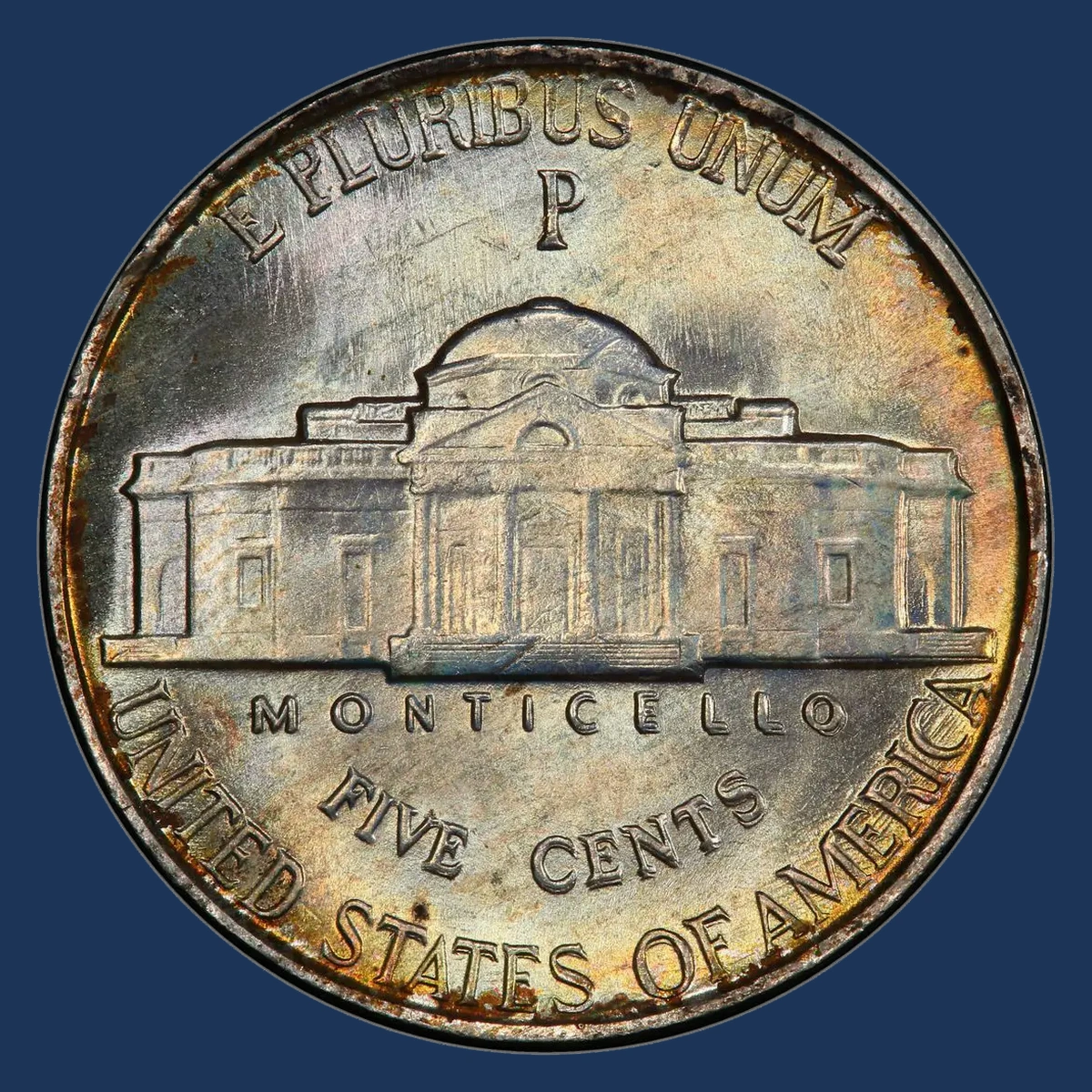
Repeated raised letter outlines can come from a doubled design in the stamping tool. The 1945-P FS-801 variety is especially noticeable around the back lettering, including MONTICELLO and FIVE CENTS.
Denver also has a recognized front doubled die, called FS-101. Its comparison points include the motto, LIBERTY, and date.
Other reports describe close or tripled back details, including San Francisco examples. Those need their own matching images rather than a Philadelphia identification.
The FS numbers are catalog labels; 1945 nickels did not yet carry the small FS designer initials seen on later coins.
Estimated Value
PCGS records $14,100 in March 2014 for an MS66 Full Steps Philadelphia doubled reverse. MS66 means unworn with few marks, while Full Steps describes sharply defined stairs.
Identified ordinary examples may fit $25–$1,500, while outstanding Full Steps pieces can reach roughly $3,000–$15,000. Minor reported patterns belong nearer $10–$150; the record should not be applied to every doubled-looking letter or to the separate Denver front variety.
How to Identify
On Philadelphia FS-801, inspect the back wording with a 10× magnifier, especially MONTICELLO’s ending and FIVE CENTS. Compare the extra raised outlines rather than general thickness.
For Denver FS-101, move to the front motto, LIBERTY, and date. Use the correct variety image for that side and mint.
The large wartime mint letter is above the dome. A scale and calipers check a loose ordinary coin against 5.00 g and 21.21 mm.
Flat shelves can come from movement during striking and differ from rounded repeated design. The absence of tiny designer initials is normal for 1945.
Match the same split letter detail on the same variety. Clear steps help grade the coin but do not identify doubling by themselves.
Conclusion
Estimated values of $5–$15,000 reflect very different 1945 nickel features. A small raised crack, a foreign blank, and an exceptional doubled-die coin should not share one price comparison.
Remember the wartime starting point: 35% silver, a large mint letter above Monticello, and a normal weight of 5.00 grams. Check the visible anomaly against that standard.
Keep clipped and doubled features on the same coin together when assessing its total value.