1955 Nickel Error List with Pictures

No San Francisco nickels were issued in 1955, yet part of an S can hide beneath a Denver D. This famous D-over-S variety reached about $3,738 in a June 2008 auction.
It is one of several 1955 Jefferson Nickel errors worth recognizing. Estimated values below range from $5 to $4,000, covering small flaws, shifted designs, and a nickel made on a silver dime blank.
Start with the visible feature and work through the checks below.
1. 1955 Jefferson Nickel Repunched D Mintmark
A second curve or upright stroke beside the D can come from a repeated mintmark punch. The Mint added these letters to its steel stamping tools by hand.
If two impressions landed in slightly different positions, both could appear on coins made from that tool. This is a repunched mintmark, often shortened to RPM.
Recorded 1955-D varieties include WRPM-001 and WRPM-006. Their exact letter shapes must be matched separately; an S beneath the D is the distinct D-over-S variety, while a solid-looking center can have a different cause altogether.
Estimated Value
Estimate $10–$50 for a clearly identified worn example and $50–$150 for an attractive unworn coin. These are estimates for repeated D punches, not auction results for the two catalog numbers.
Do not transfer the much higher price of an exceptional D-over-S nickel to a small D-over-D variety. The repeated letter needs to remain visible, and scratches or a filled center should not receive that premium by themselves.
How to Identify
On a loose coin, check the normal 5-gram weight with a scale and 21.2 mm diameter with calipers, including the plain edge. Then find the D to the right of Monticello; a coin without that mintmark cannot match a D-over-D variety.
Photograph the letter through a 10× magnifier and compare the repeated curves or straight strokes with photographs of the specific variety. Do not assign a number from the direction of a vague shadow or a lump filling the letter’s center.
The extra shape should be part of another D, while an S-shaped remnant needs comparison with the separate D-over-S variety. Follow the secondary letter outline itself before using minor surrounding marks to identify its catalog number.
2. 1955 Jefferson Nickel Peeling Metal
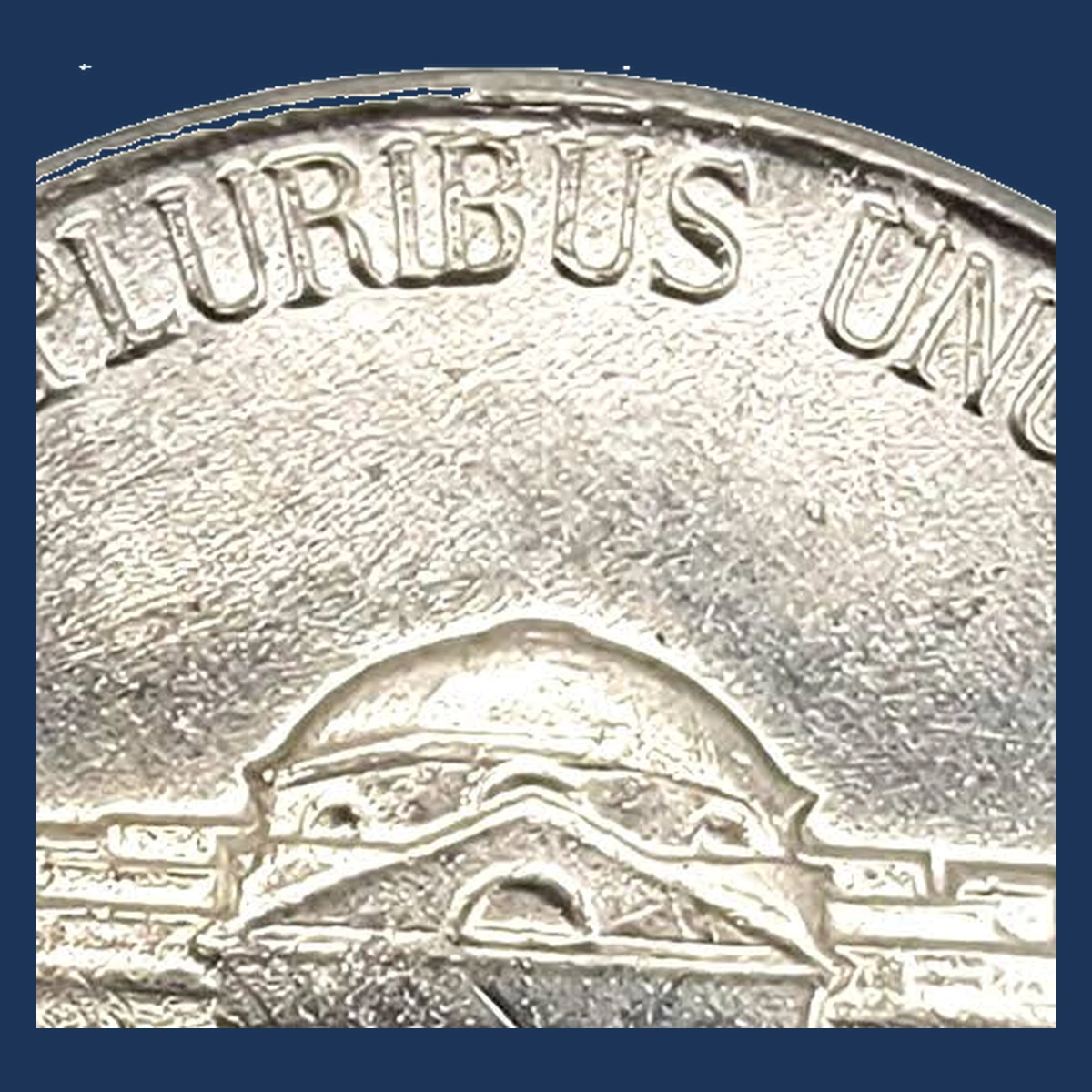
A thin flap or shallow missing patch can reveal metal separating within the coin. This is called lamination, and it begins with a weakness in the original blank.
One reported 1955-D piece has this appearance on both faces. The two sides should be examined as parts of one coin, rather than assuming any two peeling-nickel photographs show that example.
The normal alloy is copper mixed with nickel throughout. There is no separate outer layer to peel off like paint, and a scraped surface or corrosion can imitate some features of a genuine separation.
Estimated Value
A genuine modest lamination has an estimated value of $5–$50, while a larger, attractive separation can reach $50–$250. These figures assume original metal weakness rather than later damage.
The reported two-sided 1955-D coin has no confirmed sale attached to this estimate. Judge the amount of intact design, the size of any retained flap, and overall surface condition; extensive corrosion can reduce value even when an original flaw is present.
How to Identify
If the surface has a loose flap, keep it flat and untouched. Lifting it would change the error.
Check whether the separation reaches the plain edge, using side lighting and a 10× magnifier to see its depth. A genuine flap consists of the coin’s own metal, not an added coating.
Photograph each face with the date or D visible so the two-sided claim can be checked. Look for struck details continuing across the separated area, and note any pits or tool marks.
A scale reading near 5 grams is possible when the flap remains attached. Use calipers against the normal 21.2 mm diameter and follow the opening into the original metal to distinguish separation from surface scraping.
3. 1955 Jefferson Nickel Clipped Blank
A clipped blank is missing part of its intended outline before the coin is struck. The remaining metal still receives Jefferson’s portrait and Monticello.
For example, a blank-cutting punch can overlap a hole already left in the metal strip. The next disk then has a gap instead of a complete circle.
The type is reported for 1955, but no fixed shape, percentage, or mintmark applies to that report. Those details must come from the actual coin; a large gap shown in a general illustration does not establish a matching 1955 specimen.
Estimated Value
For a genuine clip, estimate $15–$75 in a modest worn example and $75–$300 for a larger, well-preserved piece. The date must remain identifiable for a firm year-specific valuation.
A 1997-P nickel with a twenty-percent clip sold for $124 in March 2025. This different-year comparison helps set expectations without assigning its percentage to the reported 1955 type; a later cut or filed edge earns no equivalent error premium.
How to Identify
First decide whether metal is actually absent. An untouched area still made of solid metal is not a clip, even if it carries no design.
Weigh the loose coin and compare with the standard 5 grams. Calipers can compare intact spans with the normal 21.2 mm diameter, but reduced size and weight also occur after cutting.
Inspect the boundary with a 10× magnifier, looking for softened detail and natural metal flow from striking. Follow the plain edge around the coin to check for file marks or sharp burrs.
Weakness on the rim opposite the gap may help. The strongest practical check is an original-looking missing-metal boundary combined with striking effects, rather than weight alone.
4. 1955 Jefferson Nickel Struck Through Foreign Material
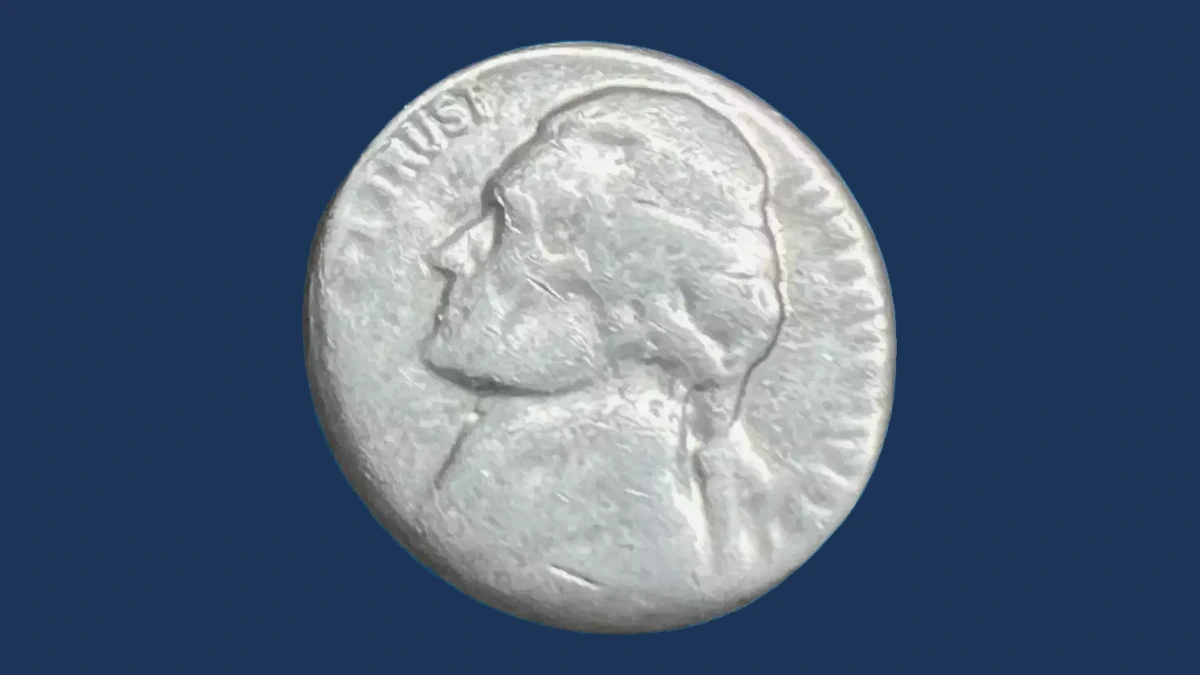
A localized depression or missing patch of design can form when foreign material enters the press. The material lies between the blank and a stamping tool, blocking part of the impression.
Collectors call this a strike-through. Its outline depends on the object, and soft material may leave a different surface from a hard fragment.
The error type is reported for 1955 without a confirmed material or position. A hollow mark is not automatically cloth, wire, or a mirror image from another coin; each of those explanations requires its own visible evidence.
Estimated Value
Allow an estimated $10–$75 for a small genuine interruption and $75–$350 for a larger, clearer impression. These estimates do not assume that an object remains attached.
The shape and visibility of the missing design matter more than an imaginative name for the material. Deep later gouges can look dramatic without being Mint errors, while a modest original impression can be collectible when the surrounding struck surface remains intact.
How to Identify
Find where the normal design stops at the unusual patch. Study that boundary through a 10× magnifier.
An obstruction during striking can interrupt details without leaving a fresh cut through finished metal. Look across to the opposite face for later impact damage at the same spot.
For a loose normal-alloy coin, record roughly 5 grams and 21.2 mm with a scale and calipers. Check the plain edge for deformation.
If the mark is narrow, determine whether it sinks into the surface or rises above it. A raised line fits a tool crack more readily than an ordinary wire impression.
Keep the explanation tied to the actual interrupted design, rather than naming a material from the outline alone.
5. 1955 Jefferson Nickel Die Cracks and Breaks
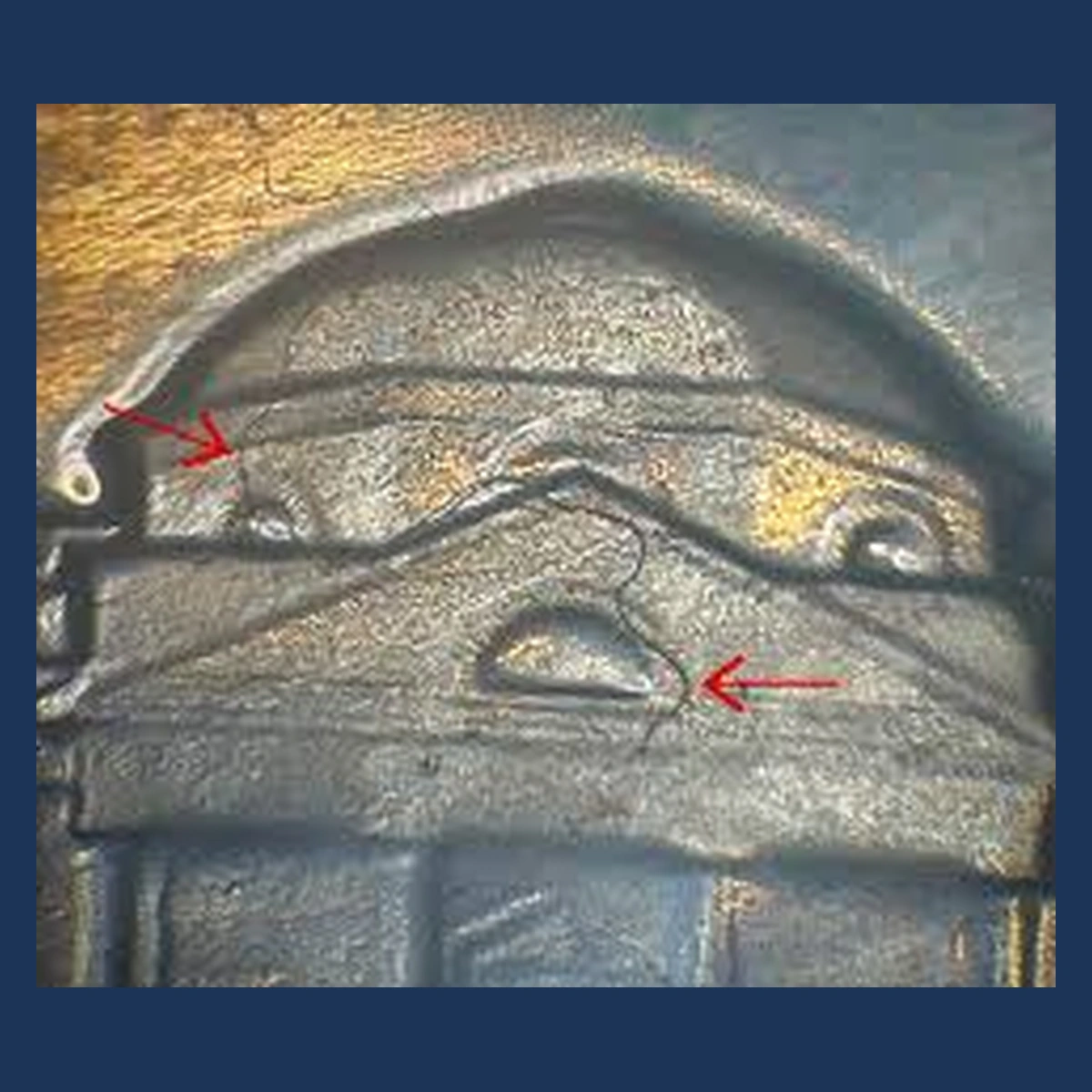
A narrow raised line can be a sign that the steel tool used to stamp the coin had cracked. Metal entered that opening and formed an extra ridge on the nickel.
A small broken spot can leave a lump, while a break reaching the tool’s edge can produce a blob joined to the rim. That larger form is called a cud.
These types are reported for 1955 without one fixed path or position. A filled-looking D may involve a small tool break, but it should not automatically be explained as grease blocking the design.
Estimated Value
Estimate $5–$50 for minor raised cracks or chips and $50–$500 for larger, clear rim breaks. Small filled letters usually belong toward the lower end unless another desirable feature is present.
For context, a 1959-D cud graded MS65 sold for $504 in May 2021. That different-year coin is a comparison for a substantial break, not a price to apply to every tiny raised line on a 1955 nickel.
How to Identify
A light held low to the surface helps reveal whether the feature is raised. Turn the coin slowly before deciding from one shadow.
Through a 10× magnifier, follow the line through nearby design details. A scratch is cut inward, although metal pushed beside it can create a misleading ridge.
For a rim blob, examine the plain edge where the blob joins the coin. Added solder may show a join or different texture.
A scale and calipers can document the normal loose-coin measurements of about 5 grams and 21.2 mm. They are useful checks, not proof of a cracked tool.
Look for continuous struck surface across a raised line or rim-connected patch, without signs of cutting or attached metal.
6. 1955 Jefferson Nickel Doubled and Tripled Design Details
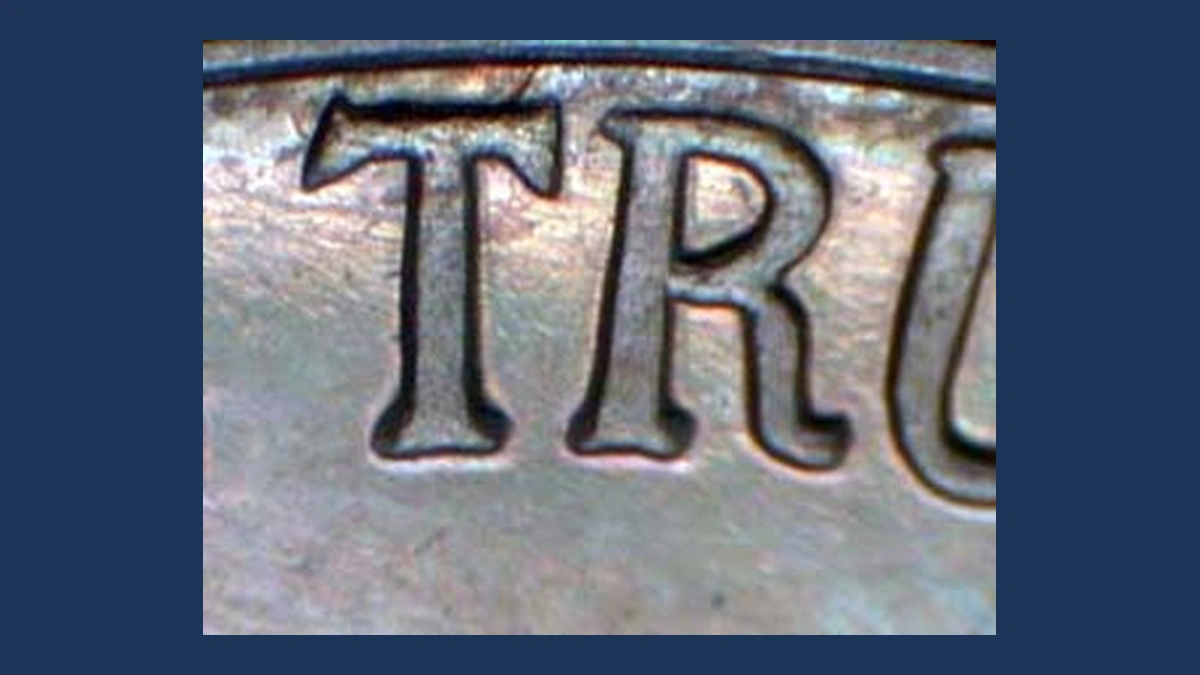
Letters can show two or three closely spaced outlines even though the coin did not move through the press three times. The repeated details can originate while the stamping tool is being made.
The recognized FS-801 tripled-back variety belongs to 1955 Philadelphia Proofs, specially made collector coins. Its repeated back lettering is separate from more general reports of front or back doubling.
Front-doubling reports point to Jefferson’s eye as a place to inspect. A flattened shelf beside a feature can instead result from movement during striking and should not be mistaken for a doubled tool.
Estimated Value
Minor authenticated varieties can be estimated at $10–$75, with stronger, attractive examples around $75–$600. The finish and condition of a Proof also affect its total value.
PCGS records a 1955 FS-801 Proof graded PR68 at $400 in May 2021. That marketplace result belongs to the tripled-back variety; it does not establish the price or authenticity of a reported eye-doubling example, and it is unrelated to the famous 1955 Lincoln cent.
How to Identify
For the FS-801, establish that the coin is a Proof before matching the back. Both 1955 Philadelphia Proofs and ordinary nickels lack a mintmark, so the blank mintmark position cannot choose between them.
Study the repeated letters with a 10× magnifier and compare their rounded outlines with photographs of the same Proof variety. A flat shelf that narrows the original letter is a different clue.
For the separate front report, inspect the eye without borrowing the back variety’s identity. A loose normal nickel should weigh about 5 grams on a scale and measure 21.2 mm with calipers, with a plain edge.
Match the repeated feature and the correct finish together before assigning a variety name.
7. 1955 Jefferson Nickel Fifteen-Percent Off-Center Strike
The recorded 1955-D example has its design shifted away from the center by fifteen percent. An unstruck portion of metal remains beside the area that received the design.
This happened because the blank was not properly centered between the stamping tools. Some outer design fell beyond the blank’s edge during the blow.
The example was graded NGC MS66, indicating an unworn coin in strong condition. Its fifteen-percent description belongs to that coin; it does not describe every 1955 nickel with an uneven border or a design shifted on just one face.
Estimated Value
The recorded NGC MS66 fifteen-percent off-center nickel sold for $402.50 on October 31, 2010. Use an estimated $100–$300 for more worn or modest examples and $300–$750 for attractive, clear offsets.
The estimate considers both the error and preservation. Readable dates are especially helpful, and a coin with severe scratches should not inherit the MS66 sale price merely because its design appears shifted by a similar amount.
How to Identify
Locate the date first and photograph it together with the unstruck area, so the year remains tied to the error. On the back, check the D to the right of Monticello.
Compare the shift on both faces through a 10× magnifier. A wide rim on one side of just one face can result from tool alignment rather than the whole blank sitting off center.
Use a scale to check for a weight near 5 grams: the blank has moved, not necessarily lost metal. Calipers can compare its span with the normal 21.2 mm, allowing for an altered outline.
Follow the plain edge into the untouched crescent. Actual unstruck metal beside a displaced design is the visible feature to establish.
8. 1955 Jefferson Nickel Struck on a Silver Dime Blank
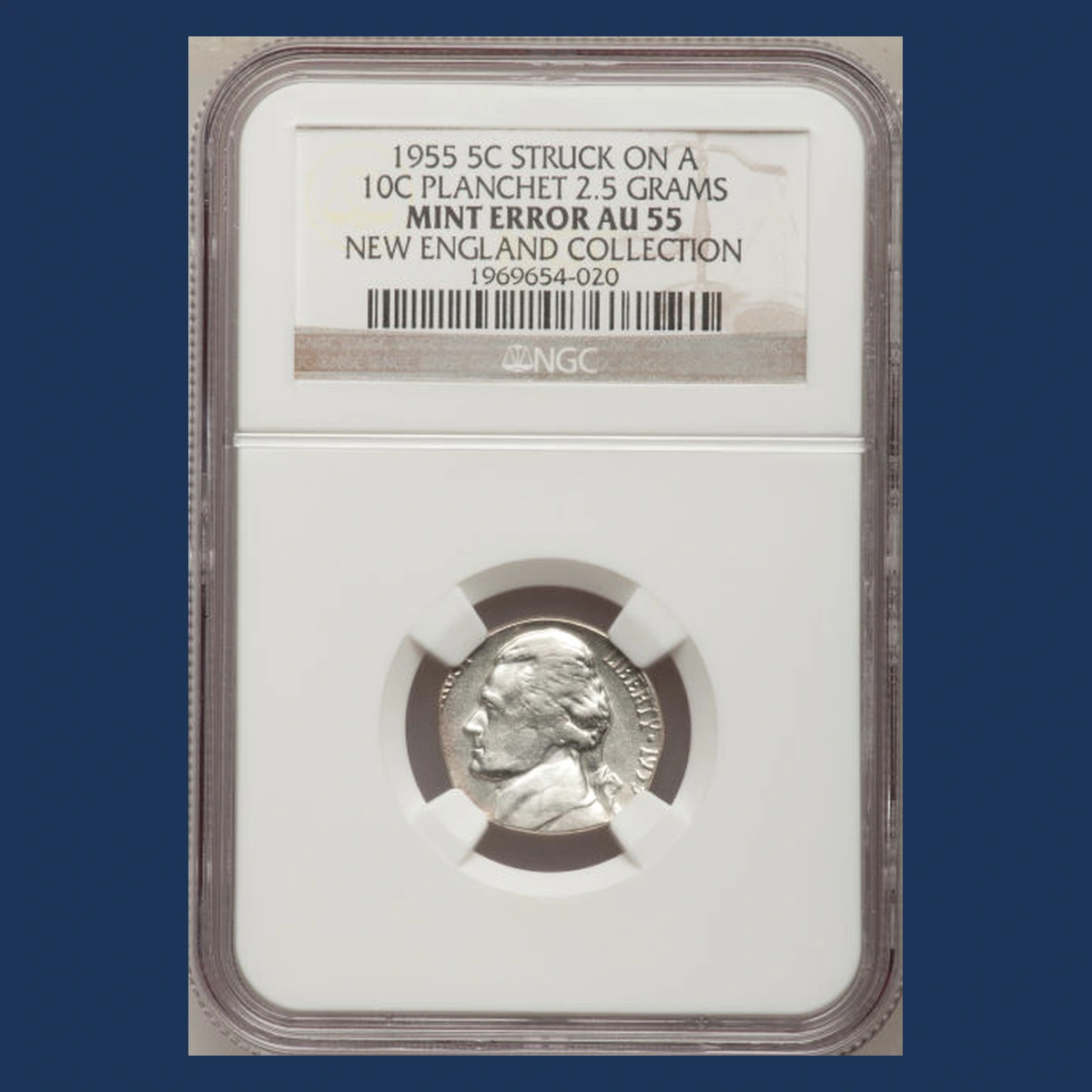
The nickel design looks too large for this coin’s small silver blank. The recorded example weighs 2.5 grams, half the normal nickel weight, and was graded NGC AU55.
A dime blank entered the nickel press by mistake. Its thinner metal produced weak central details, while the rim remained more complete near LIBERTY and OF AMERICA.
The strike is shifted toward the lower left, around 7:30, and the tops of the final two date digits extend beyond the edge. This is still a 1955 nickel design, rather than an ordinary Roosevelt dime.
Estimated Value
The NGC AU55 silver dime-blank example sold for $499.38 in October 2012. Estimate $350–$750 for comparable lightly worn pieces and $750–$1,500 for stronger examples in better condition.
The clearly surviving date and clear nickel identity matter more than silver color alone. A normal nickel plated with silver or reduced by grinding should not be valued as the same wrong-blank error.
How to Identify
Weigh a loose candidate: the recorded silver-blank coin is 2.5 grams, compared with a nickel’s usual 5 grams. A silver color without that major weight difference is weak evidence for this specific error.
Measure the diameter with calipers against a normal 21.2 mm nickel and examine the plain edge through a 10× magnifier. Naturally cropped design should look different from a ground wall or a coating that is peeling away.
The recorded specimen has weak central details but a more complete rim near LIBERTY and OF AMERICA. Compare these features and the surviving date, then have the metal tested without scratching or applying acid to the coin.
9. 1955 Jefferson Nickel D over S Mintmark
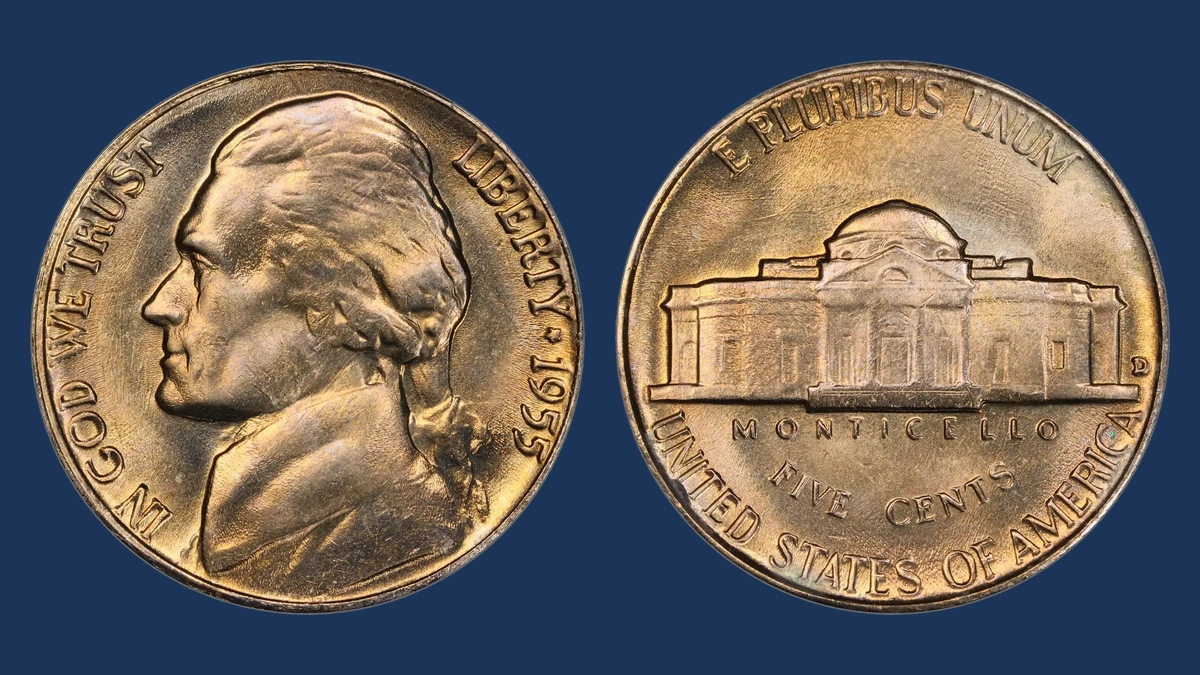
A small piece of an S beneath the D reveals a mistake made before the coin was struck. The tool first received an S mintmark, then a D was punched over it.
Enough of the earlier letter survived to appear on finished Denver coins. The upper end of the S can be seen beneath the top of the D on the recognized variety.
This is called an overmintmark because two different mint letters overlap. It does not establish a separate 1955-S nickel issue; the coins were made as Denver nickels with the corrected tool.
Estimated Value
For identified examples, estimate $20–$100 when worn and $100–$500 for many unworn coins. Exceptionally well-preserved pieces can reach an estimated $500–$4,000.
PCGS lists an MS66 example at about $3,738 from a June 2008 Heritage auction. That exceptional result reflects both the variety and condition, so a heavily worn D-over-S should not be priced like the top-grade example merely because the S remains visible.
How to Identify
Find the D beside Monticello and look just beneath its upper portion. A 10× magnifier should reveal the surviving end of an S, rather than simply a second D-shaped curve.
Compare the mark with a clear photograph of the recognized D-over-S variety before relying on the seller’s label. A cut, filled center, or ordinary repeated D needs a different explanation.
On a loose coin, check the plain edge and use a scale and calipers against 5 grams and 21.2 mm. The overmintmark changes the lettering, not the intended metal or size.
Turn the lighting slightly to keep a shadow from hiding the remnant. The specific S stroke beneath the D is the feature that settles the first comparison.
Conclusion
A hidden S beneath the D is the best-known clue on a 1955 nickel, but weight and shape can reveal very different mistakes. The estimated $5–$4,000 range spans small metal flaws through exceptional D-over-S examples.
Keep ordinary nickels separate from specially made Proofs when comparing doubled letters. For an unusual blank or peeling metal, preserve the surface and record both faces before having the coin examined.