1970 Nickel Error List with Pictures

Two dates can survive on one 1970 nickel when its design was stamped over a finished cent. A Denver example sold for $3,737.50 in January 2011.
The 1970 Jefferson Nickel errors below also include tiny repeated letters and a pair containing a deep cup-shaped coin. Estimated values range from $10–$6,500.
Denver and San Francisco made nickels that year. Read on to compare the design, metal, and shape before choosing a price.
1. 1970 Jefferson Nickel Die Clash
Faint parts of the opposite design can appear where they do not belong. These marks can come from a die clash, when the steel stamping tools strike each other.
Normally, a blank disk of metal separates the tools. Without it, their collision can damage the tools, and later coins can pick up the transferred marks.
Clashes are reported on 1970 nickels, but no single location or mint applies to every example. An extra line needs a recognizable shape from the opposite design.
Scratches and lines from polishing the tools can also cross the background.
Estimated Value
Estimate $10–$150 for modest, genuine 1970 clash marks. A recognizable transferred shape on an original surface has more appeal than a faint line with several possible explanations.
This is a working range for minor Jefferson clashes, not a sale assigned to one specific 1970 coin. Condition and the strength of the match affect the whole price.
A second strike or backward coin impression is a different error. Their prices should not be transferred to a small clash trace.
How to Identify
A faint part of Monticello on the front needs comparison with a photograph of the back. Likewise, a suspected portrait trace on the back should fit Jefferson’s outline on the front.
Follow several connected shapes with a 10× magnifier, rather than naming one stray line. Scratches cut into the finished surface, while a clash comes from marks transferred between the steel stamping tools.
For a loose coin, use a scale and calipers to check about 5 grams and 21.21 millimeters. Inspect the plain edge for a join or signs of squeezing.
Keep the D or S visible when photographing the affected face. A shallow trace that matches the opposite design is more useful than a line with no recognizable shape.
2. 1970 Jefferson Nickel Repunched Mintmark
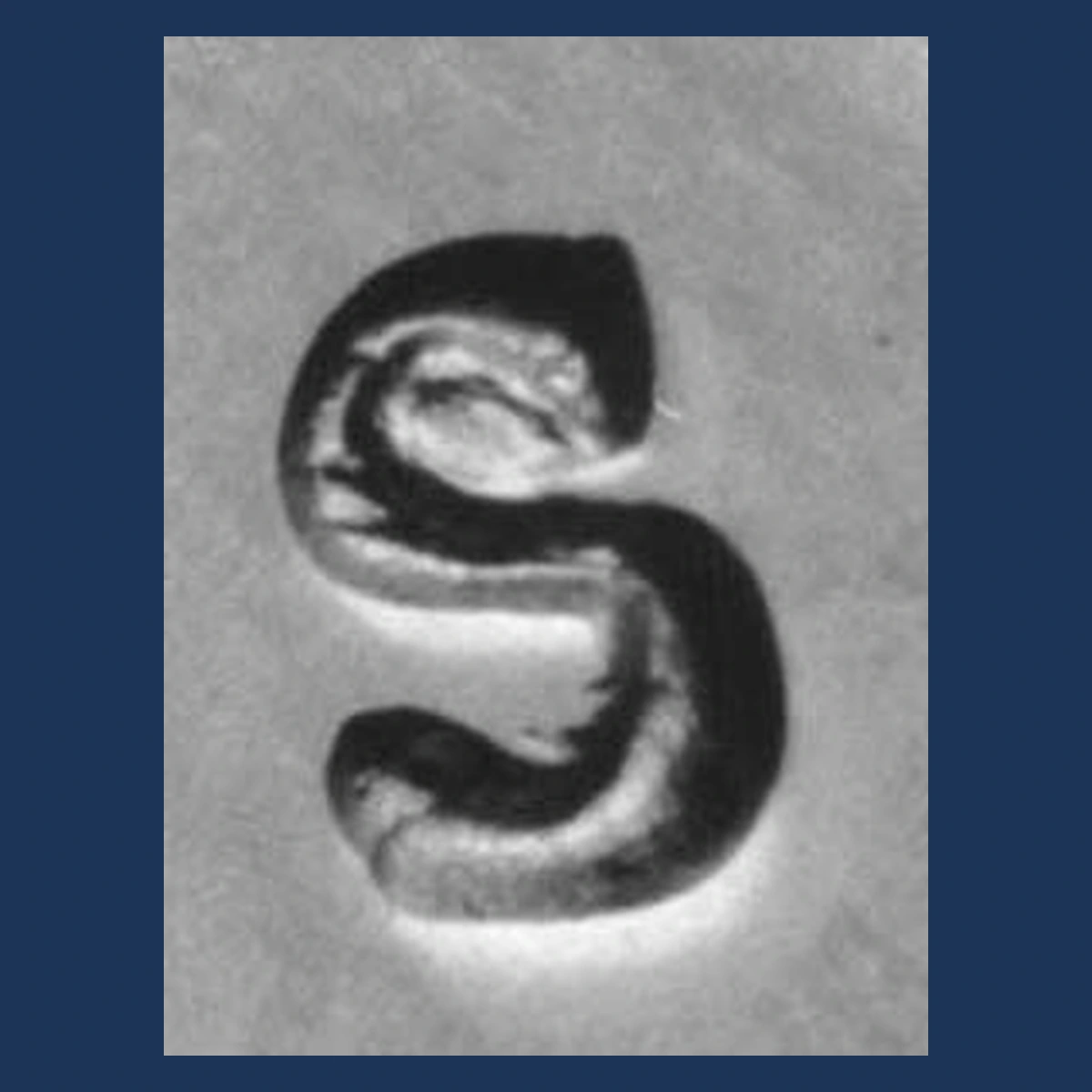
An extra D or S curve can remain beside the main mint letter. The letter was punched into the steel stamping tool separately, and a shifted repeat punch could leave another outline.
Denver examples have tilted or rotated overlapping D shapes. San Francisco examples include extra S curves in several directions.
These occur on ordinary coins and specially made collector Proofs. One Proof combines a leftward repeated S with doubled back lettering.
Those are two features on one coin. Other mintmark patterns need separate comparisons, since their extra curves do not all occupy the same position.
Estimated Value
For identified minor repunched mintmarks, estimate $10–$250, depending on the pattern, visibility, and preservation. Ordinary Denver coins and San Francisco Proofs should be compared with their own issue and condition.
The range uses Jefferson mintmark varieties as a guide, rather than assigning one sale to all the cataloged patterns. A normal S alone does not prove either repunching or Proof manufacture.
When doubled back lettering accompanies the extra S, assess the complete coin once instead of adding two maximum estimates.
How to Identify
San Francisco made both ordinary coins and collector Proofs in 1970. Establish the finish before comparing an extra S curve, since the same mint produced several different patterns.
For a Denver coin, follow the D below the date with a 10× magnifier and look for a tilted or rotated extra outline. For an S, compare its extra curve with the illustrated 1970 varieties.
The Proof with a repeated S to the left also has doubled back lettering. Check both features separately; a bright reflection around one curve cannot establish either pattern.
A scale and calipers should show about 5 grams and 21.21 millimeters for a loose, normal-size coin. Examine the plain edge before matching the complete extra letter shape.
3. 1970 Jefferson Nickel Doubled Front and Back Designs
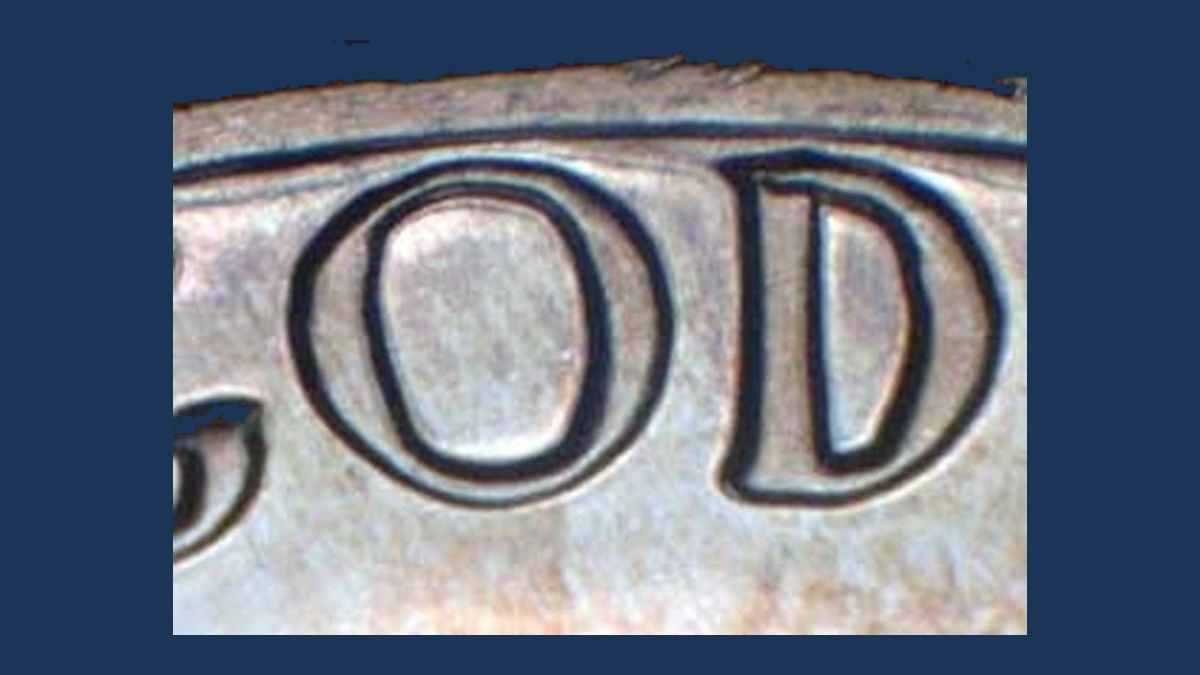
Letters can carry repeated outlines because the stamping tool itself was made with a doubled design. Collectors call that tool a doubled die.
On Denver coins, front examples involve LIBERTY, the star, date, motto, and lower hair ribbon. A back variety is clearest in AMERICA, with related doubling elsewhere in the inscriptions.
San Francisco Proofs have separate front and back patterns. Some affect the motto or designer’s initials.
Others involve back lettering, the building, or steps. Each pattern comes from its own tool, so one coin need not show all these areas.
Estimated Value
Use an estimated $10–$500 across the identified 1970 doubled designs, comparing the specific pattern and condition. Clearer examples can appeal more than extremely close outlines that are difficult to see.
This range concerns the extra design, not every high-grade 1970 nickel. A strong Full Steps grade can add value for sharp staircase detail without establishing a doubled die.
A San Francisco Proof needs a Proof comparison. Its polished-looking surfaces alone cannot justify borrowing a rare ordinary-strike auction price.
How to Identify
AMERICA is the best place to begin on the Denver back variety. Use a 10× magnifier to separate rounded extra outlines from flat ledges beside the letters.
Then follow the weaker lettering toward the left side of the coin. On a front example, instead compare the reported lettering, star, date, motto, or lower hair ribbon.
San Francisco Proofs need their own photographs for comparison, since their patterns differ from Denver coins. Do not expect every doubled coin to repeat all the listed features.
For a loose coin, record its weight and diameter with a scale and calipers against 5 grams and 21.21 millimeters. Inspect the plain edge for damage, then check for matching split letter ends rather than general thickness.
4. 1970 Jefferson Nickel Clipped Planchet
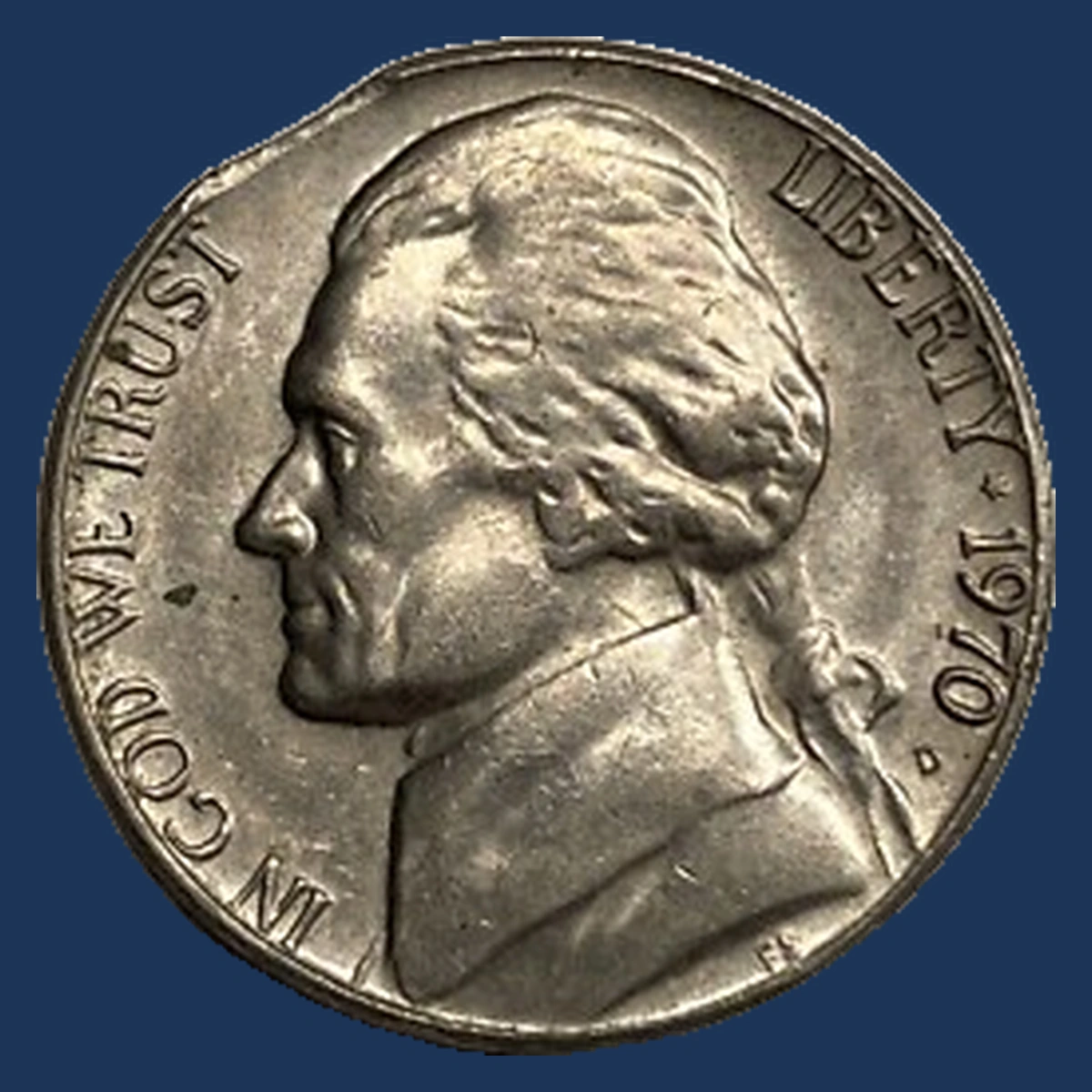
A clipped planchet is an incomplete blank that received a coin’s design. Metal was already absent before the stamping tools came down.
The 1970 reports include curved and straight missing sections. A Denver example in a 2007 auction had two clips and part of a third.
That coin was graded AU50, meaning light wear showed on its high points. Its several gaps belong to one piece.
The gaps need not be equally large. Compare their positions with that particular coin, since a general description cannot show exactly where each missing section lies.
Estimated Value
An estimated $10–$600 covers modest single clips through clearer multiple-clip examples. The amount missing, remaining date, and preservation matter more than simply counting gaps.
For a different-year comparison, a 1974 double-curved clip graded MS66 sold for $132 in July 2021. That result does not supply a sale or exact shape for the 1970-D AU50 coin.
The range applies to original missing blank metal. A cut made after the design was struck is damage, even if it resembles a smooth curve.
How to Identify
A large missing section should reduce the weight below the normal 5 grams. Weigh a loose candidate first, then use calipers across intact spans to compare with 21.21 millimeters.
Count the gaps without assuming they must match in size. The Denver auction example has two main clips and only part of a third.
Under a 10× magnifier, examine the ends of each gap for lettering and rim shaped around the missing metal. A cut made after striking can slice through already finished letters.
Look along the remaining plain edge for filing. A weak rim opposite a curved opening can support the identification, but the opening itself should retain naturally struck surfaces.
5. 1970 Jefferson Nickel Off-Center Strike
An off-center strike moves the design away from the middle of the blank. Some details miss the metal while an untouched area remains on the opposite side.
Denver reports include examples described as sixty-five and eighty percent off center. These percentages belong to different coins rather than two views of the same strike.
Both faces should fit the misplaced blank. A coin with only one shifted face may instead have a misaligned stamping tool, while a broadstrike can spread beyond normal size and still keep its entire intended design on the metal.
Estimated Value
Estimate $30–$700 for identified 1970 off-center nickels, depending on displacement, readable date, and condition. A larger shift does not automatically guarantee a higher price.
A 1999-D nickel struck sixty-five percent off center sold for $75 in September 2024. That different-year result shows a modest outcome for a substantial shift without assigning its amount to the reported 1970 Denver examples.
Keep the actual mint and surviving design in the comparison. Missing identification can limit collector interest despite a dramatic outline.
How to Identify
Check both faces before estimating how far the design has shifted, looking for matching divisions between stamped and untouched metal. A shift on only one face points to a different problem with the stamping tools.
Read the surviving date and mint letter with a 10× magnifier; Denver and San Francisco made 1970 nickels. Inspect the plain edge and bare area for filing or flattened letters that would show later damage.
Weigh a loose coin against 5 grams, since no metal needs to be removed, and use calipers to record its shape against 21.21 millimeters. The strongest check is untouched metal beside a design that runs off the same part of both faces.
6. 1970 Jefferson Nickel Broken Tools and a Covered-Tool Example
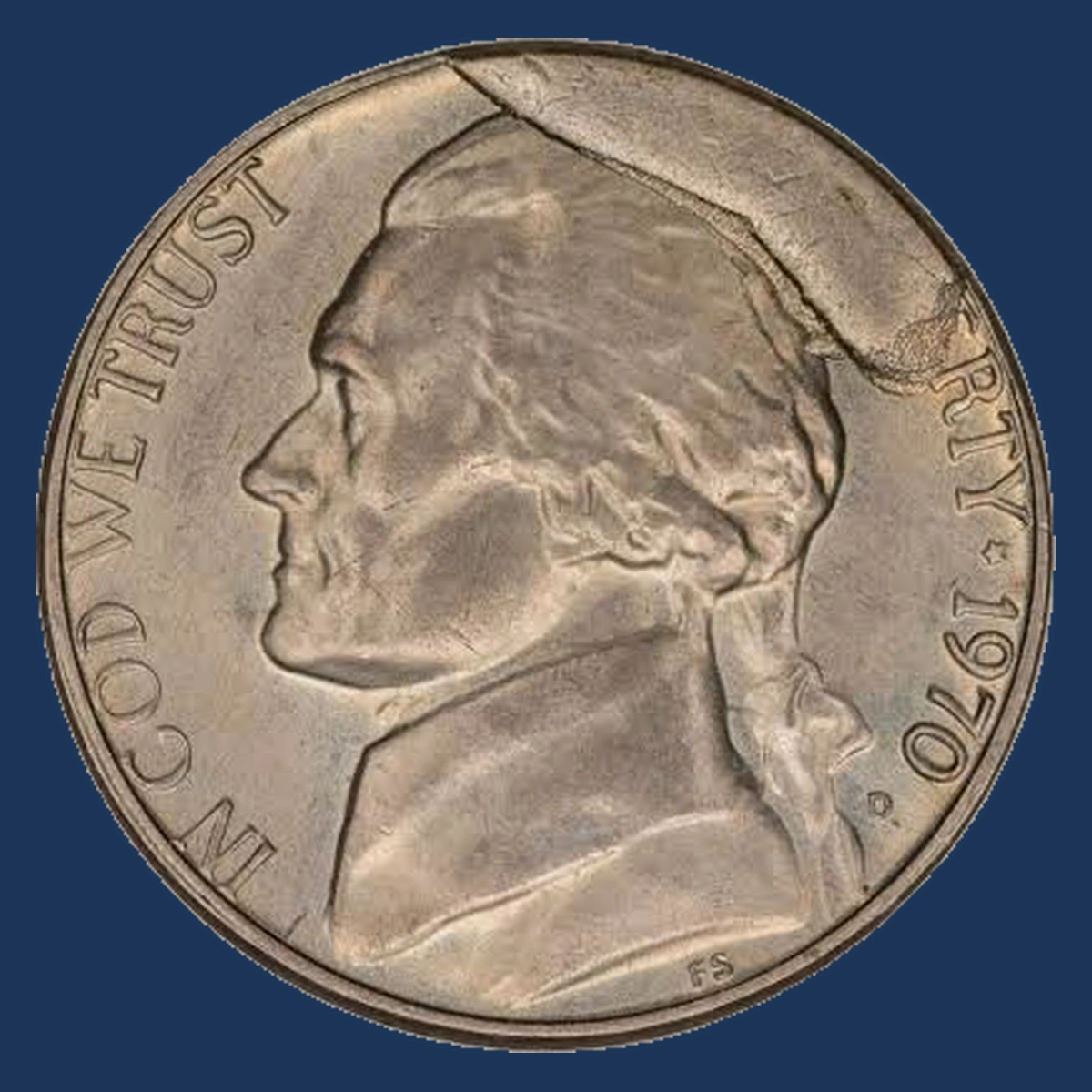
A missing piece of the stamping tool can leave a raised patch joined to the rim. This kind of break is called a cud.
One Denver coin has separate breaks at the top and bottom of the front. Other Denver patterns and a San Francisco example have their own boundaries.
Another Denver sequence combines two breaks with a strike through a die cap, a coin stuck over the tool. Its portrait becomes flatter because that covering interferes with the design, but the receiver is not itself the cup-shaped cap described later in this guide.
Estimated Value
The lightly worn Denver two-break coin graded AU58 sold for $63 in October 2022. A separate MS61 example struck through a cap with two breaks brought $94 in August 2013.
Another coin from the latter break sequence, graded MS63, sold for $199.75 at that auction. These are separate specimens, not stages sold as one pair.
Estimate $15–$800 across clear breaks and the covered-tool combination. Value the complete coin once, including its preservation and all visible effects.
How to Identify
A flattened portrait needs a different check from an ordinary raised rim patch. On the covered-tool example, inspect the weak portrait together with its two breaks, since all three features record the same striking sequence.
The receiver did not become the cup-shaped cap. Use a 10× magnifier to distinguish its altered face from dents or scratches added after the coin left the press.
For the separate top-and-bottom break pattern, keep Jefferson upright and trace both raised patches back to the rim. Added metal may leave a seam along the normally plain edge.
Check a loose coin with a scale and calipers against 5 grams and 21.21 millimeters. The missing metal came from the tool, so a genuine raised patch need not make the coin underweight.
7. 1970 Jefferson Nickel Struck on a Cent Blank
A copper-colored Jefferson nickel may have started as a disk intended for a cent. Its smaller size leaves too little metal for the full five-cent design.
A recorded San Francisco example was graded PCGS MS64, an unworn grade allowing visible marks. This is an ordinary strike, although San Francisco also made collector Proofs in 1970.
The disk had not already become a Lincoln cent. It received only the nickel design.
A finished cent struck again would retain parts of both designs. Copper plating added to a normal nickel is another explanation for color.
Estimated Value
The ordinary-strike San Francisco MS64 example sold for $420 in December 2024. An estimated $200–$1,000 covers comparable identified cent-blank errors across different preservation.
Readable date and mint letter help establish the coin, while original surfaces make grade comparisons more useful. A damaged or cleaned piece needs a lower condition comparison.
That result is not a Proof price. The S identifies the mint, while the coin’s manufacture and grading description establish whether it is an ordinary strike or Proof.
How to Identify
Weigh a loose copper-colored candidate before deciding what its color means. A contemporary cent blank normally starts near 3.11 grams, compared with 5 grams for a nickel.
Use calipers to compare the shape with the cent’s starting 19.05-millimeter diameter and the nickel’s 21.21 millimeters. Striking can spread the smaller disk beyond its original width.
Look for outer lettering lost beyond that smaller disk with a 10× magnifier. Inspect the plain edge for trimming or a coating added to a normal-size nickel.
The auctioned coin has an S and the surviving 1970 date. These standard sizes and weights are comparison figures, not recorded measurements of that specimen.
A smaller copper coin carrying only Jefferson’s design fits an unused cent blank; surviving Lincoln-cent details point to a different error.
8. 1970 Jefferson Nickel Double Strike with an Indent
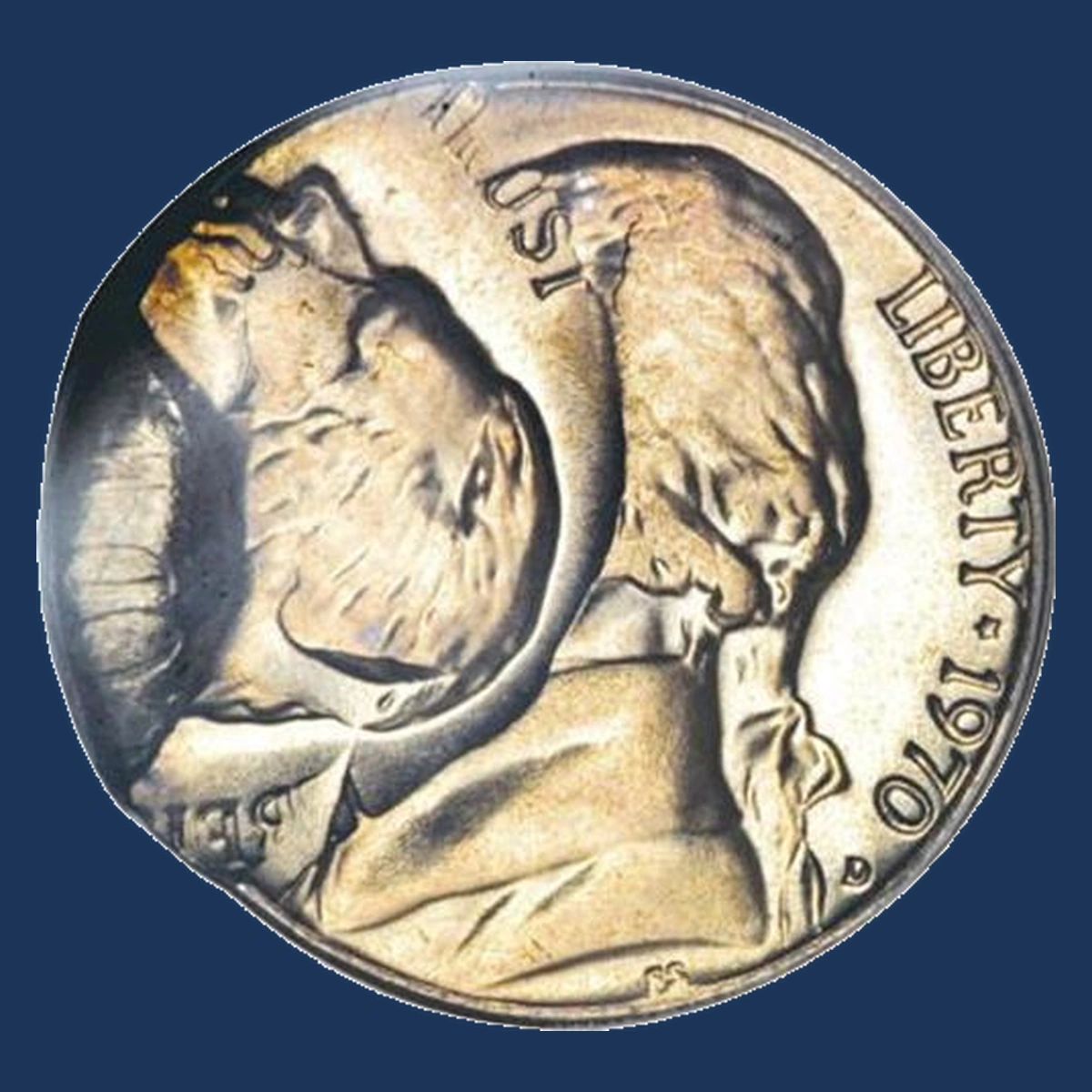
One Denver nickel received a normal first strike, then another blow about fifty percent off center. A second blank entered the press between those strikes and covered part of the coin.
That intervening blank pressed a depression into roughly ten percent of the front. The mark lies near nine o’clock when the first design is upright.
PCGS graded the coin MS64, meaning unworn with noticeable marks. The other blank was not included in the sale, so this is one coin combining repeated design and an indent, not a documented two-coin matched set.
Estimated Value
The auction archive records a $750 winning bid plus buyer’s premium in February 2008. That bid is not the final fee-inclusive cost.
For a comparable identified double strike with an original indent, estimate $400–$1,500. The repeated design, depression, and preservation contribute to one whole-coin value.
A simple off-center strike lacks the same second-image sequence. Likewise, a later dent does not add the original intervening-blank feature, even if its outline appears in a similar place on the front.
How to Identify
Two overlapping images alone do not explain the depression on this coin. First find a recognizable letter or portrait detail from each strike with a 10× magnifier.
Turn the first design upright. The depression should lie near nine o’clock in that view, even though its position looks different when the second image is upright.
Follow the depression’s boundary to see where the intervening blank blocked the front tool. A random dent made later will not explain the overlapping stamped details around it.
If loose, weigh the coin against the usual 5 grams and measure its altered outline with calipers against 21.21 millimeters. Inspect the plain edge for later squeezing without pressing on the depression or bending the coin.
9. 1970 Jefferson Nickel Struck on a Dime Blank
The nickel design can be too large for a gray disk intended to become a dime. Outer lettering runs beyond the smaller metal, and the finished coin weighs much less than an ordinary nickel.
A San Francisco Proof graded NGC PR66 is recorded at 2.2 grams. Proof means specially made for collectors, and this grade indicates well-preserved surfaces.
An ordinary-strike example is separately reported in MS62 condition. These dime blanks use copper between copper-nickel outer layers, not ninety-percent silver; the ordinary coin’s mint must be established from its own surviving details.
Estimated Value
The 2.2-gram San Francisco PR66 example sold for $1,020 in October 2022. Estimate $700–$2,500 for comparable identified Proof errors, allowing for preservation and readable design.
For the separately reported ordinary strike, use a working $200–$1,000 range. A 1974 ordinary nickel on a dime blank brought $299 in January 2011, offering a different-year comparison.
The ordinary coin should not inherit the Proof’s grade or measured weight. Both the finish and the smaller blank must match the chosen comparison.
How to Identify
At 2.2 grams, the recorded Proof weighs much closer to a dime than a nickel. Use a scale on a loose candidate, comparing it with the normal dime’s 2.27 grams and nickel’s 5 grams.
A dime starts at 17.91 millimeters, while a nickel measures 21.21 millimeters. Calipers can show the difference, although the smaller blank may spread during striking.
Check the edge with a 10× magnifier for copper between the outer metal layers. A normal nickel has a plain edge, but that fact alone cannot identify an unusual smaller blank.
The outer lettering should run beyond the available metal. Establish the date, surviving mint letter, and ordinary or Proof finish separately; an S alone does not prove collector manufacture.
10. 1970 Jefferson Nickel Proof Struck on a Philippine Blank
A foreign-coin blank can receive a United States design if it enters the wrong press. One 1970-S Proof nickel was identified as struck on a Philippine five-sentimo blank.
The coin was graded NGC PR66, a well-preserved collector Proof. Its unusual starting disk is different from the regular nickel alloy and must be checked through its dimensions and metal.
This is a blank error, not necessarily a nickel struck over a completed Philippine coin. A foreign design need not remain underneath Jefferson, and color alone cannot establish the intended denomination or the original blank.
Estimated Value
Mint Error News records $1,110 for the PR66 Philippine-blank example at Heritage in September 2020. Estimate $750–$3,000 for a comparable identified Proof error.
The attribution, readable nickel design, and preservation all contribute to that range. A generic foreign-blank claim without a matching certification is not the same comparison.
The result belongs to the San Francisco Proof. It should not be transferred to a different-year Denver ordinary strike merely because both mention Philippine blanks.
How to Identify
Keep the foreign-blank identification separate from the Proof finish. A shiny surface or unusual color cannot establish that the disk was intended for a Philippine five-sentimo coin.
For a loose example, measure weight with a scale and diameter with calipers. A normal nickel is 5 grams and 21.21 millimeters; those figures are not measurements of the foreign blank.
Professional metal testing can help identify what the disk was made from. Compare the result and the coin’s photographs with the complete grading label.
Use a 10× magnifier to check the cropped letters and edge for trimming or plating. The ordinary nickel edge is plain.
Finally, locate the 1970 date and S on the actual coin, then match its Proof appearance and smaller disk with the documented example.
11. 1970 Jefferson Nickel Mated Die-Cap Pair
Two San Francisco nickels preserve the same accident. One first spread outward without normal edge restraint, then received another strike through a blank that covered its front.
The other piece became a die cap, a coin stuck over a stamping tool and shaped into a deep cup. Jefferson’s portrait is clear inside that cup.
A flattened, backward portrait remains on the cap’s outside bottom. Both coins were graded NGC MS67, meaning unworn with very few marks; the broad, repeated-strike partner also has Six Full Steps, describing its sharp staircase rather than another error.
Estimated Value
The complete pair sold for $2,070 in September 2010. Estimate $1,500–$4,000 for a comparable intact pair with matching features and strong preservation.
This amount covers both coins together, including the deep cap and its broadstruck partner. It is not a separate price for each piece or each mistake.
Their connection helps explain the accident. A single cap or an unrelated expanded nickel needs its own comparison, even when one part of its appearance resembles a member of this pair.
How to Identify
Do not press these two pieces together to test whether they match; start with photographs of both faces and the sides. The cap should have Jefferson inside its cup and a flattened backward portrait on the outside bottom.
Examine those features with a 10× magnifier, then compare them with the partner’s expanded back and interrupted front. The blocked area on that partner should fit the transfer preserved by the cap.
If already loose, weigh each piece against the ordinary 5 grams, and use calipers to record its shape against 21.21 millimeters. Keep pressure off the fragile cup wall and original plain edge while checking the shapes in photographs.
12. 1970 Jefferson Nickel Struck over a Finished Lincoln Cent
This copper coin received two different denominations. It was already a 1970-D Lincoln cent when nickel tools stamped Jefferson and Monticello onto it.
Enough of each date remains to identify both strikes as 1970-D. The older cent details survive underneath parts of the later five-cent design.
NGC graded the coin MS66 Red and Brown, meaning a very well-preserved unworn piece with mixed copper color and toning. This is different from an unused cent blank carrying only the nickel image, because the earlier Lincoln coin supplies a second recognizable set of design details.
Estimated Value
The MS66 Red and Brown example sold for $3,737.50 on January 7, 2011. Estimate $1,500–$6,500 for comparable genuine double-denomination coins across different preservation.
The readable remains of both dates and mint identities strengthen the comparison. Damage or weak older design can make a different specimen less appealing.
The whole coin has one value despite carrying both cent and nickel designs. It should not be priced by adding an unused-blank estimate to a separate double-strike estimate.
How to Identify
One readable 1970 date is not enough to date both strikes. Find a Lincoln-cent feature first, then a Jefferson-nickel feature, using a 10× magnifier to follow where they overlap.
On this documented coin, surviving details identify each design as 1970-D. Compare the two dates and mint identities separately rather than assigning the nickel’s date to the coin underneath.
A scale and calipers can compare a loose example with a copper cent’s standard 3.11 grams and 19.05 millimeters. These are normal cent figures, not recorded measurements of this specimen.
An ordinary nickel is 5 grams and 21.21 millimeters. Examine the plain edge for a join between two attached coins.
The older Lincoln details should continue naturally beneath the later Jefferson design on the same piece of metal.
Conclusion
Estimated values of $10–$6,500 cover small letter varieties through coins bearing two denominations. A missing piece, doubled letter, and second complete design each point to a different event.
Keep ordinary strikes separate from collector Proofs, even when both carry S. For unusual metal, compare actual measurements with the correct blank rather than relying on color.
The mated cap pair belongs together, while multiple effects on one coin still produce one whole-coin value.