1998 Nickel Error List with Pictures

A copper-colored nickel weighing only 2.5 grams sold for $2,875 in August 2010. This 1998-P coin had received its nickel design on a cent blank.
The 1998 Jefferson Nickel errors below range from small repeated outlines to two blanks joined during striking. Their estimated values span $5–$5,000.
Check the visible feature first, then use the matching section to compare its shape, metal, and price.
1. 1998 Jefferson Nickel Extra Outlines on the Back
An extra raised outline beside a letter can come from the stamping tool itself. If the tool carries a repeated design, later coins can copy that same pattern.
The tool is called a die, and this feature is a doubled die. It does not mean that each coin received two separate blows.
Year lists point toward Monticello, UNUM, and FIVE CENTS as areas to examine on 1998 nickels. Those suggestions do not establish a single pattern shared by every mint.
Thick lettering alone can come from worn tools or lighting. A specific repeated shape is the feature to match.
Estimated Value
For an identified minor doubled design, estimate $10–$50, rising to $50–$150 for a stronger, attractive example. The extra outlines need to remain clear enough for another collector to recognize.
These figures estimate the reported type rather than record a sale for one numbered 1998 variety. A generally thick building or word is not enough to support the range.
Wear and cleaning can hide the useful detail. Flat shelves caused by movement during striking need a different explanation.
How to Identify
Keep a whole word in the close-up, rather than enlarging one bright corner until it loses its shape. With a 10× magnifier, follow the extra outline around several parts of the same letter.
Choose a comparison with the same mint and finish, since ordinary P and D coins differ from specially prepared S Proof collector coins. A scale and calipers can check a loose nickel against 5 grams and 21.21 millimeters, but normal size cannot identify doubling.
Now move the light while keeping the coin still. A reflection moves or disappears; a genuine repeated raised shape stays on the letter, unlike a flat shelf that narrows the original stroke.
2. 1998 Jefferson Nickel Locally Missing Design
A patch of grease or debris can prevent part of the tool from reaching the blank. The affected area may show weak lettering or a depression where the normal design should be.
This is called a struck-through error. It records an obstruction during striking rather than metal removed from a finished coin.
The type appears in 1998 year lists without one established object or location. A soft building or portrait therefore needs examination on its own merits.
Monticello’s steps are often incomplete on ordinary coins. Missing stair lines alone do not identify trapped material or establish a valuable error.
Estimated Value
A clearly identified small blocked area is estimated at $5–$40. Larger, well-defined impressions can fall around $40–$175, depending on the surrounding condition.
These estimates require an original minting obstruction, not ordinary wear or later scraping. No sale is assigned to a specific piece of cloth or wire for this reported 1998 category.
The useful price comparison follows the actual impression. An obvious shape is easier to explain and sell than a generally weak patch with several possible causes.
How to Identify
Look away from the weak patch for a moment. If Jefferson’s face and other exposed high points are also worn smooth, circulation may explain the lost design.
Return to the patch with a 10× magnifier. Study the boundary where strong detail gives way to weak or missing lettering.
An obstruction can explain that boundary without fresh cuts through completed letters. Scraping may instead leave tool lines across the affected surface.
For a loose coin, a scale and calipers check the usual 5 grams and 21.21 millimeters. Examine the plain edge for signs of squeezing.
A smooth weak area does not establish cloth. A cloth claim needs visible woven texture within the impression, not merely absent detail.
3. 1998 Jefferson Nickel A Turned Back Design
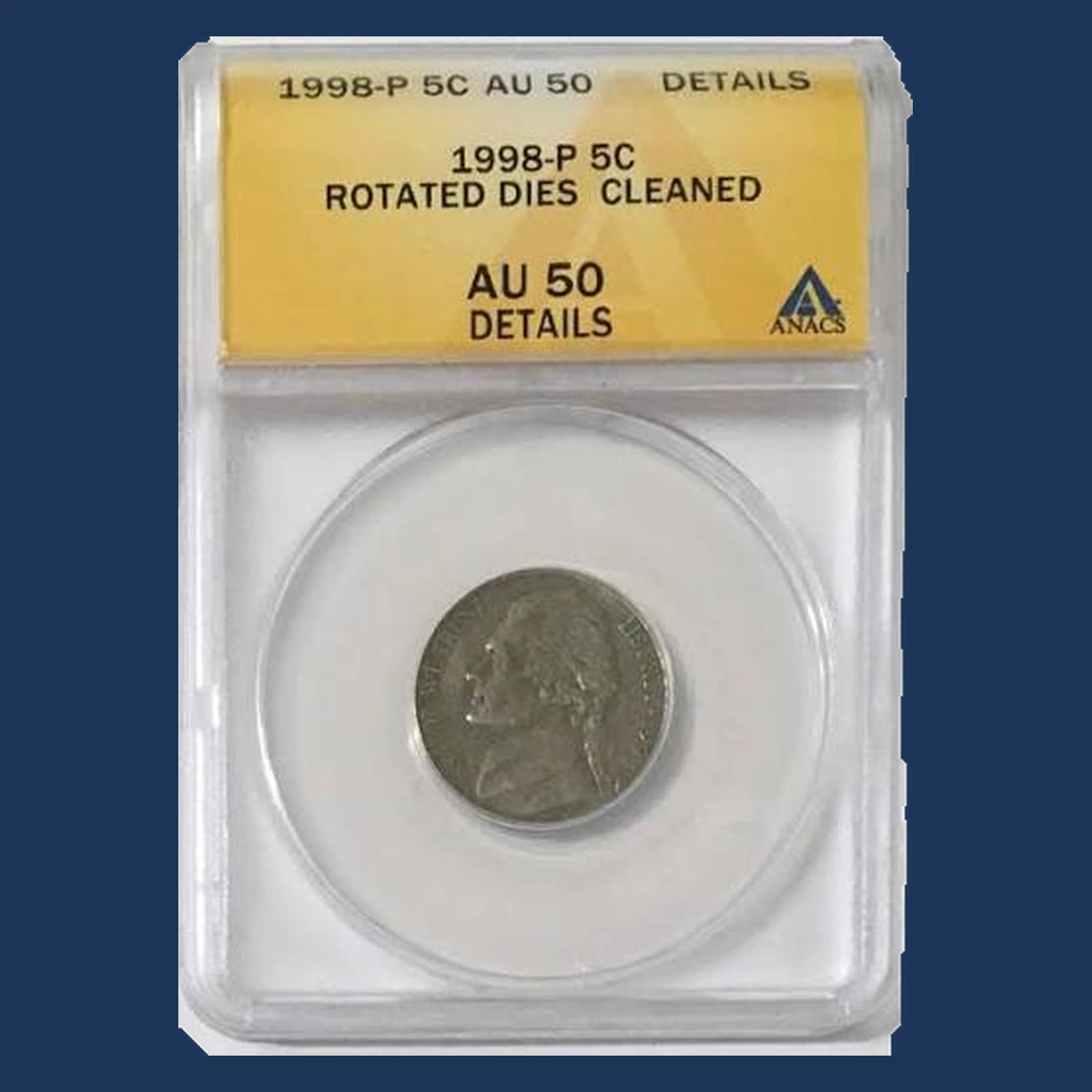
Monticello should stand upright after you hold Jefferson upright and turn a normal nickel over from top to bottom. An angled building after that movement may show rotated dies.
The two stamping tools were not aligned in their usual relationship. Each face can still have a complete, centered design.
A 1998-P year report describes approximately forty-five degrees of rotation. It does not establish a clockwise direction or the same angle for every candidate.
Turning the coin sideways uses a different test and can create a misleading result. Keep the starting portrait and the turning motion consistent.
Estimated Value
An original, clearly measured rotation is estimated at $25–$200. Larger visible turns generally attract more interest than a small tilt difficult to distinguish from handling.
A different-year 2015-D nickel with a ninety-degree counterclockwise rotation sold for $79 in October 2021. That is a comparison, not the angle or sale price of the reported 1998-P coin.
The estimate also depends on wear and surface quality. A photograph with a tilted camera cannot establish the error being priced.
How to Identify
Hold Jefferson upright against a straight background line. Turn the coin from top to bottom while keeping its left and right sides in the same positions.
Compare the base of Monticello with that reference line and repeat the movement. A real relative turn should remain consistent rather than change with your grip.
Use a 10× magnifier to check the P on the front and inspect the plain edge for a seam. Joined pieces can create unusual orientations after minting.
A loose example should remain near 5 grams and 21.21 millimeters on a scale and calipers. Record the measured angle from the repeated test, without assigning a direction merely from the year report.
4. 1998 Jefferson Nickel A Curved Piece Missing from the Blank
A curved bite can begin when a blank is cut from the metal strip. The punch overlaps an earlier opening, leaving an incomplete disc for the coin press.
A collector displays a 1998-P curved clip. Its shape belongs to the blank before striking, rather than to a finished coin cut afterward.
The display does not establish one missing percentage or clock position for every example. Those details must come from the actual piece.
Striking can soften the rim near a genuine opening. A weak opposite rim can be another clue, but a clip need not show every possible supporting feature.
Estimated Value
Estimate $15–$200 for a genuine curved clip, allowing for its size, visible date, and condition. A cleanly preserved natural boundary makes the mistake easier to recognize.
The collector’s 1998-P display is not an individual sale record. For a different-year comparison, a 1997-P nickel with a twenty-percent clip sold for $124 in March 2025.
That percentage belongs to the 1997 coin. A smaller 1998 gap should not inherit its dimensions or price simply because both openings are curved.
How to Identify
Inspect the missing edge under a 10× magnifier before estimating the clip’s size. Saw grooves, file strokes, and a sharply folded lip suggest metal removed later.
Follow the struck rim toward both ends of the gap. Natural changes in the rim and nearby design support an opening that existed before striking.
A scale should show some loss from the normal 5 grams, depending on how much metal is absent. Calipers can compare intact spans with 21.21 millimeters without treating the gap as the coin’s full diameter.
Photograph the plain edge and the opposite rim. A weak opposite rim helps the comparison, but its absence should not automatically disqualify a natural-looking clip.
5. 1998 Jefferson Nickel A Complete Design on Wider Metal
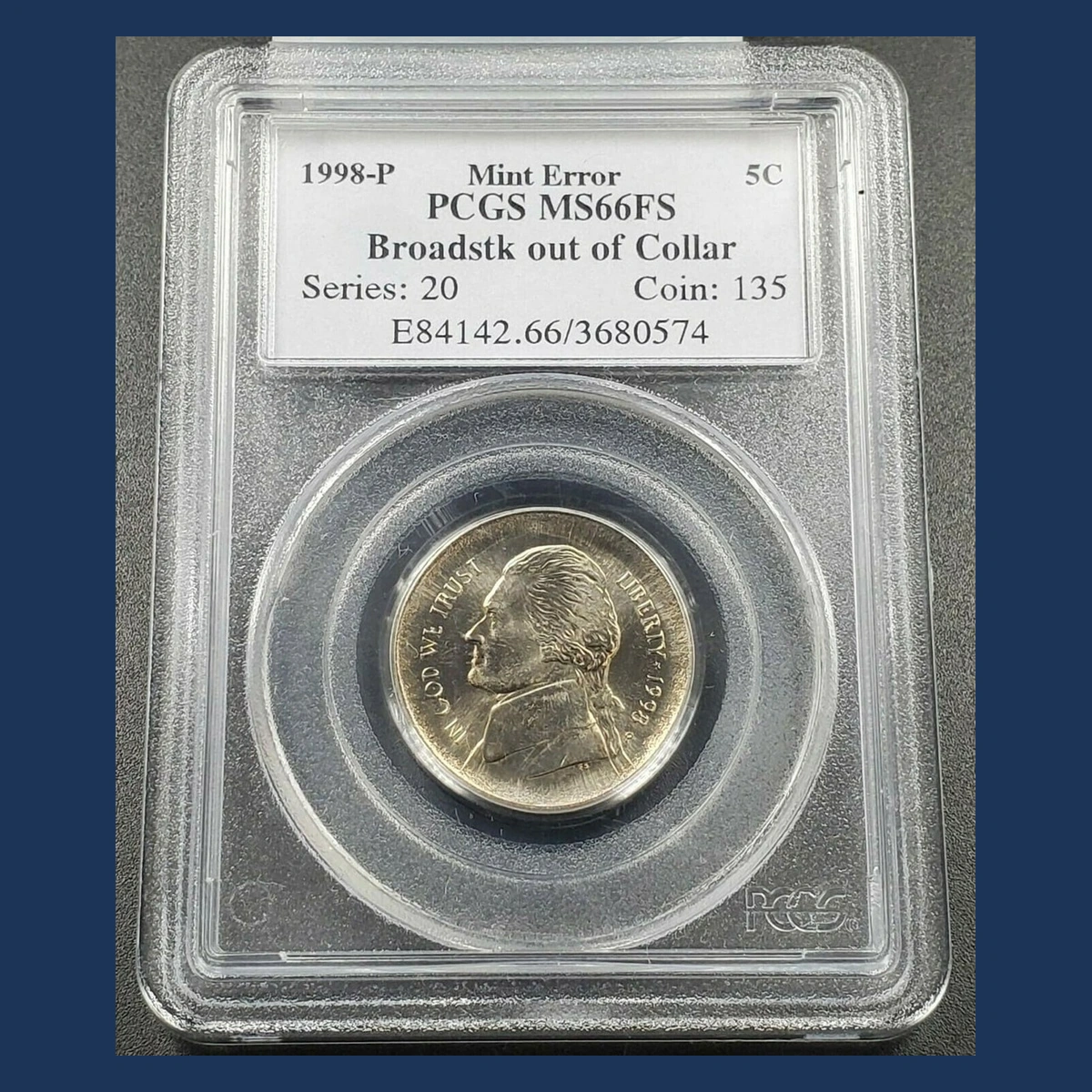
The nickel’s letters can stretch outward while the design still fits inside the coin. A ring called the collar normally limits that outward spread during striking.
Without that restraint, the blank can expand into a broadstrike. A 1998-P example graded PCGS MS66 Full Steps was described as spreading evenly in every direction.
Full Steps refers to the sharp stairs on Monticello, not another mistake. The widened outline is the error here.
A collector also shows a separate Philadelphia piece described as quarter-sized. That comparison is not an exact diameter for the auctioned coin or all other broadstrikes.
Estimated Value
The evenly spread PCGS MS66 Full Steps example sold for $57.50 in July 2002. An estimated $30–$250 allows for different amounts of expansion and preservation.
A later comparison is a 1999-P broadstrike at $89 in March 2025. Neither result guarantees that every nickel with a wide border has the same value.
An attractive complete design strengthens the comparison. A coin flattened after minting may be wider too, but its crushed letters and impact marks describe a different object.
How to Identify
Calipers can compare the width in several directions with the usual 21.21 millimeters, while a scale should stay near 5 grams. Expansion alone does not remove metal, and an uneven broadstrike need not measure the same across every direction.
With a 10× magnifier, read the outside words on both faces and check that the complete design fits inside the enlarged outline. Crushed letters or repeated impact marks can instead explain a nickel hammered wider after minting.
The edge is normally plain, so its lack of grooves proves nothing about this error. The useful combination is naturally expanded metal and complete outer lettering, without flattened detail from later blows.
6. 1998 Jefferson Nickel Raised Lines and Rim-Connected Breaks
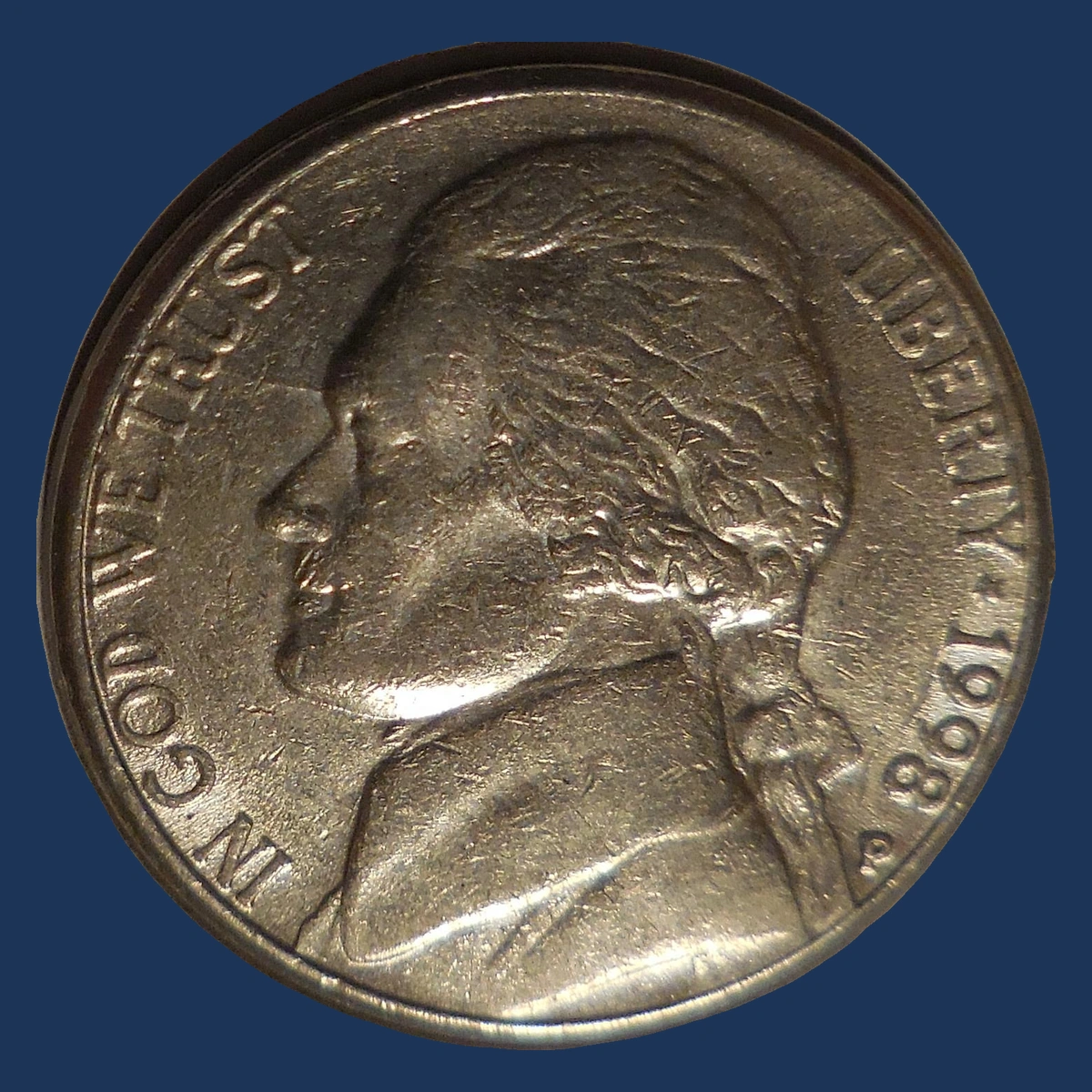
A raised line running from Jefferson’s head toward the border can come from a crack in the stamping tool. Metal rises into that opening when the coin is struck.
A Philadelphia head-crack type is reported for 1998. The location should be compared with the whole portrait rather than an isolated bright line.
Year lists also include larger breaks where part of the tool’s edge is missing. The resulting raised blank patch touching the rim is called a cud.
A cud has no single established position for this year. It differs in size and shape from a narrow head crack.
Estimated Value
Modest original cracks can fit an estimated $5–$40, while stronger rim-connected breaks may reach $40–$350. The size and clarity of the raised feature matter alongside the rest of the coin’s condition.
A worn 1983-P nickel with a cud sold for $63 in July 2022. This different-year comparison does not establish a sale for a 1998 head crack.
Dirt, solder, and metal pushed upward by a later impact should not receive the same mint-error premium.
How to Identify
For the reported head crack, begin at Jefferson’s hair and follow the line toward the rim. Side lighting and a 10× magnifier help show whether its center is raised or cut into the surface.
A scratch can have raised sides while remaining a groove in the middle. Keep that distinction visible in your close-up.
For a larger suspected cud, show how the patch joins the rim. An isolated lump elsewhere needs another explanation.
Weigh a loose coin against 5 grams and measure it against 21.21 millimeters. Inspect the plain edge beside the patch for an impact that could have squeezed metal upward after the original design was finished.
7. 1998 Jefferson Nickel An Unused Crescent beside the Design
A solid empty crescent can remain when the blank sits partly outside the normal striking position. Some design misses the metal on the other side.
One 1998-D example is described as sixty percent off center toward eleven-thirty. ANACS graded it MS64, indicating an unworn coin with noticeable marks.
Philadelphia examples are also reported, but their placement must be read independently. The Denver percentage and direction should not be assigned to every 1998 off-center nickel.
The unused crescent still contains metal. A clip removes part of the blank, while a simple uneven rim may involve only one displaced tool.
Estimated Value
The sixty-percent Denver example appears in a January 2022 auction record at $75. Estimate $25–$500 for genuine dated examples with different shifts and conditions.
This result shows that a large percentage does not guarantee a four-figure price. Surviving identity, surface quality, and visual appeal all influence the comparison.
A Philadelphia piece needs its own condition assessment. A later scraped patch should not receive an off-center premium merely because it now looks like unused metal beside the design.
How to Identify
Locate the date and mint letter before estimating how much design is missing. The Denver record should show D, while a Philadelphia candidate needs its own P identification.
On both faces, compare the design with the same solid unused crescent. A shift confined to one face suggests a displaced stamping tool instead.
Use a 10× magnifier at the boundary between struck and unused metal. Scratches crossing that boundary can reveal later removal of the design.
A scale should remain near 5 grams unless another feature removes metal. Calipers record the outline against 21.21 millimeters; inspect the plain edge without assuming every offset points toward the Denver example’s eleven-thirty position.
8. 1998 Jefferson Nickel A Front Struck through a Stuck Coin
An earlier coin can stay stuck to a stamping tool and cover its design. The next blank receives pressure through that coin instead of directly from the tool.
This later coin is a capped-die strike. It is the receiver of the blow, not the stuck coin that formed the cap.
A 1998-P example was cataloged as front struck through a capped die and graded PCGS MS64 Full Steps. The stair detail on the back remained sharply formed.
The blocked front needs comparison with its own photograph. The description does not establish cap thinning or a complete backward portrait.
Estimated Value
Estimate $75–$600 for comparable original capped-die receivers. A strong contrast between the blocked front and a well-preserved back can make the error easier to appreciate.
The 1998-P auction catalog identifies the type without a selling price adopted here. A different-year 1964-D receiver with its back affected sold for $360 in July 2021.
That comparison involves the opposite face. Neither coin should be priced as the detached cup-shaped cap itself, and later smoothing of a portrait does not qualify.
How to Identify
The sharp back provides the best starting point on the cataloged receiver. Examine Monticello’s stairs through a 10× magnifier, then compare their detail with the affected front.
If both sides are equally smooth on their high points, consider ordinary wear instead. A capped-die receiver needs more than a generally soft portrait.
Photograph the side profile. A tall cup could be the stuck coin that made the cap, rather than a later flat coin struck through it.
For a loose example, use a scale and calipers against 5 grams and 21.21 millimeters. Check the plain edge for reshaping.
The front’s blocked design and the back’s sharp stairs should be considered together. That contrast explains more than weak front detail alone.
9. 1998 Jefferson Nickel A Depression on a Broadstrike
Another blank can overlap a nickel during striking and leave a depression where it blocked the tool. That hollow area is called an indent.
A collector’s 1998-P nickel combines an indent with a broadstrike. It was graded ANACS MS65, describing an unworn piece with relatively few marks.
The coin therefore records both an obstruction and outward spreading. These features belong to one object rather than two separately priced errors.
The recorded description does not fix the indentation’s face, size, or direction. A genuine plain indent also differs from an impression containing backward letters transferred from an already struck coin.
Estimated Value
For a clearly identified indent combined with a broadstrike, estimate $100–$750. A larger, recognizable boundary and clean surrounding surface support the more attractive comparisons.
The collector display does not provide a completed price for its 1998-P specimen. As related different-year examples, 1964 broadstruck indents sold for $150, $216, and $312 in July 2021.
Those are individual whole-coin results. The range should not be built by adding the entire price of a separate broadstrike to an indent price.
How to Identify
Inside the depression, look first for any backward lettering. Under a 10× magnifier, a sunken mirror image suggests contact with a finished coin rather than a plain unused blank.
A plain indent should instead have a boundary consistent with the overlapping blank and interrupted nickel design. Follow the rim into the depression, watching for later impact marks or scraped metal around its border.
Calipers can record the widest and narrowest spans against 21.21 millimeters, and a scale should remain near 5 grams if all metal remains. The curved blocked area and expanded outline must make sense together, rather than simply being two unrelated odd-looking features.
10. 1998 Jefferson Nickel Repeated Strikes on One Coin
The portrait can appear in several positions if a coin remains in the press and moves between blows. A repeated strike changes more of the design than a tiny doubled letter.
A 1998-P example was cataloged as struck four times and graded NGC MS64. Another Philadelphia coin carries an ANACS MS65 label describing one hundred strikes.
The larger count is a cataloged identification, not something to count from one photograph. The two descriptions concern separate coins.
Each surviving impression must fit the actual sequence. Earlier designs may be flattened or hidden beneath later strikes rather than remain equally clear.
Estimated Value
The NGC MS64 four-strike example appears in an August 2014 auction record at $940. Estimate $150–$1,500 across recognizable repeated strikes with different complexity and preservation.
The separately cataloged one-hundred-strike coin has no selling price adopted here. Its count should not be used to multiply the four-strike result.
Overlapping portraits, readable dates, and undamaged surfaces help explain the error. A coin with several vague marks or later hammering needs a different assessment from a clearly repeated Mint strike.
How to Identify
Locate two separate centers of the nickel design before counting more blows. A portrait or date in a different position is more useful than one thick letter.
Use a 10× magnifier to trace where a later impression crosses an earlier one. Follow the overlapping shapes on both faces.
The scale reading of a loose coin may remain near 5 grams even when repeated strikes spread its outline. Calipers record that changed shape against the normal 21.21-millimeter diameter.
Inspect the plain edge for squeezing or later hammer marks. Those can create extra marks without another Mint strike.
Many strikes can flatten earlier detail. Where the sequence disappears, use the documented identification rather than claiming to count one hundred visible portraits.
11. 1998 Jefferson Nickel A Coin Curled around a Stamping Tool
The stuck coin itself can develop curved walls as more blanks press against it. The resulting cup-shaped piece is called a die cap.
A 1998-P front cap graded NGC MS68 was described with a sharply formed front and a soft Monticello image on the back. Its depth required a thick holder.
A collector separately displays a Philadelphia reverse cap. Its opposite direction should be checked rather than assuming it shares the auctioned front cap’s shape.
These objects differ from flat coins struck through a cap. Later bending can imitate a cup, but does not reproduce the original pattern of stretching.
Estimated Value
A genuine 1998-P cap is estimated at $300–$2,000, depending on depth, surviving design, and preservation. The front-cap grade MS68 describes unusually well-preserved surfaces, not a standard for every cap.
For a same-design comparison from another year, a 1977-D front cap sold for $487.20 in July 2021. That result is not a sale of either 1998 specimen.
An undamaged curved wall helps show the process. Flattening a cap can destroy the shape that makes it appealing to collectors.
How to Identify
Photograph the side profile before the two faces. Determine whether the walls cup toward Jefferson or Monticello rather than naming the direction from a label alone.
With a 10× magnifier, follow the original design into the stretched metal. Abrupt folds, vise marks, or cuts through completed detail suggest later reshaping.
For a loose piece, a scale can compare its remaining mass with the normal 5 grams. Gentle caliper measurements can record width and depth, with 21.21 millimeters only the normal starting diameter.
Keep the plain edge untouched and do not press the cup flat. The stretched design and continuous curved walls should explain each other as parts of one striking process.
12. 1998 Jefferson Nickel A Nickel Design on a Cent or Dime Blank
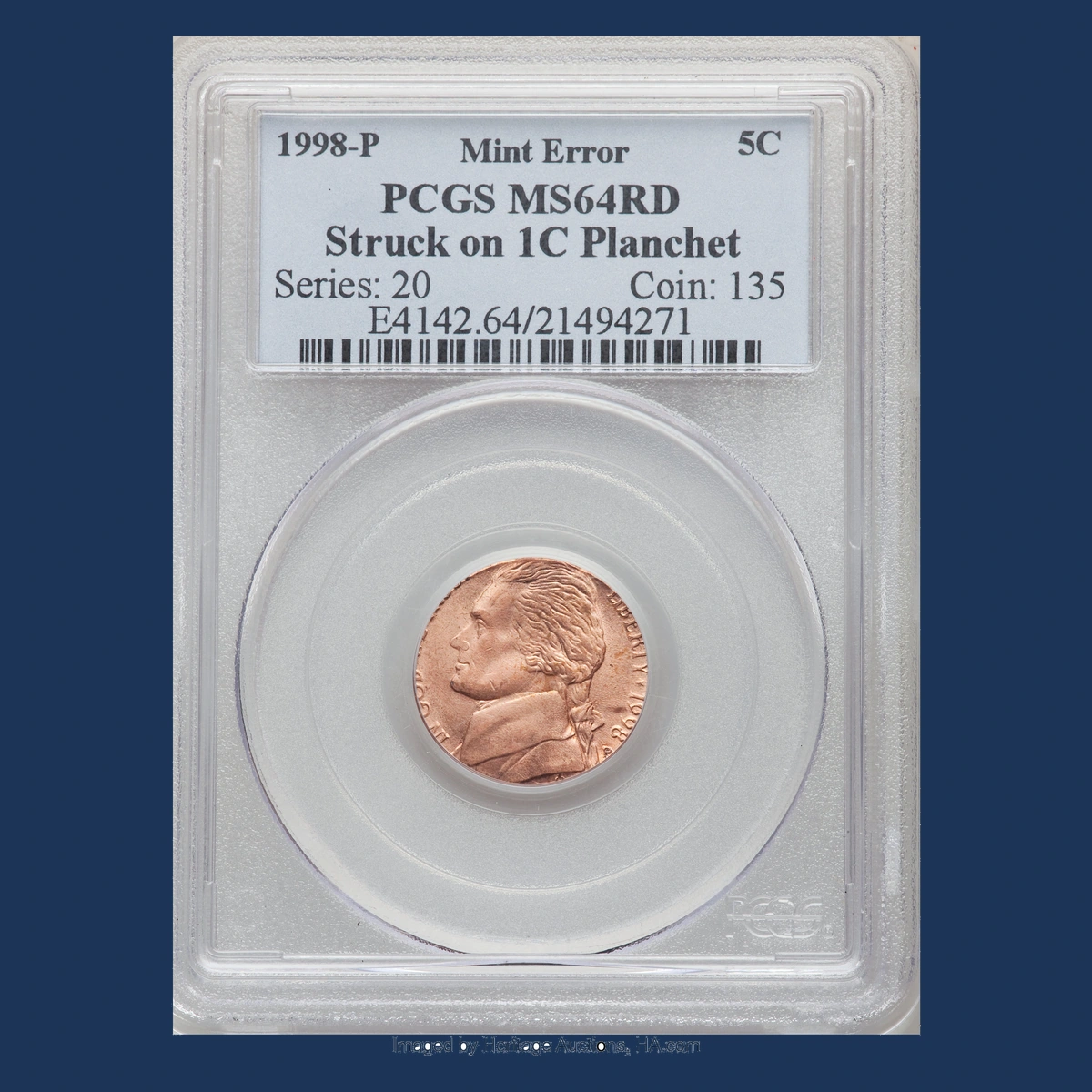
A blank intended for another denomination can receive a nickel design. The wrong size or metal changes how Jefferson and Monticello fit on the finished piece.
The auctioned 1998-P cent-blank example weighs 2.5 grams and was graded NGC MS67 Red. Its copper-colored surface belongs to a copper-plated zinc blank, not the heavier old copper cent metal.
A separate Philadelphia nickel on a dime blank was graded PCGS MS65. Its listing does not give an actual weight.
Both starting pieces were unused blanks. No earlier Lincoln or Roosevelt design is required beneath the nickel impression.
Estimated Value
The 2.5-gram cent-blank coin sold for $2,875 in August 2010. Estimate $300–$3,000 for cent-blank examples, with that highly preserved specimen near the upper end.
For dime-blank nickels, estimate $300–$1,500. The PCGS MS65 1998-P coin sold with a separate 1997-P dime-blank nickel for $630 in August 2023.
That two-coin total cannot be assigned to either nickel alone. Each range depends on the actual blank, visible date, and quality of the surviving design.
How to Identify
Weigh a loose coin before relying on its color. Compare the recorded 2.5-gram cent example with the normal nickel’s 5 grams; a modern clad dime blank normally starts near 2.27 grams.
That dime figure is a standard, not a measured weight for the listed 1998 specimen.
Use calipers against the starting widths of 19.05 millimeters for a cent and 17.91 for a dime. Both are smaller than the nickel’s 21.21 millimeters, although striking can spread them.
Under a 10× magnifier, inspect the edge and naturally cropped letters for plating or later trimming. Search for an earlier coin design too; finding Lincoln or Roosevelt would change the explanation to a finished-coin overstrike.
13. 1998 Jefferson Nickel A Nickel Struck over a Finished Cent
Lincoln or his memorial can remain beneath Jefferson’s newer design when a finished cent enters the nickel press. This is a double denomination, with two coin designs sharing one piece of metal.
A 1998-P nickel over a 1998 cent was cataloged as NGC MS66 Red. Another report describes a Philadelphia nickel over a 1997 cent with the same grade.
Each cent date identifies a different starting coin. The older designs need separate comparisons.
This is not the same as a nickel struck on an unused copper-colored blank. The old cent design provides evidence of the earlier completed strike.
Estimated Value
Estimate $600–$3,500 for authenticated 1998 nickel-over-cent examples with readable traces of both designs. Strong preservation and an easily followed earlier date can improve the comparison.
No individual price is assigned here to the two cataloged MS66 Red specimens. A different-year 1999-D nickel over a finished 1999-D cent sold for $1,320 in September 2024.
That result values one combined object. Do not add an ordinary cent price to a wrong-blank nickel price to calculate the overstrike’s value.
How to Identify
Start by finding something that belongs to a cent rather than a nickel. Lincoln’s profile or parts of the memorial can help establish the earlier design under a 10× magnifier.
Photograph both complete faces, then follow where the nickel design crosses those older details. Sunken reversed marks made by squeezing finished coins together need a different explanation.
A scale should compare a loose coin made from a modern cent with about 2.5 grams, rather than a nickel’s 5 grams. Calipers document expansion beyond the cent’s original 19.05-millimeter width.
Inspect the edge for later coatings or cutting. Read the surviving cent date instead of assigning 1997 or 1998 from another coin carrying the same grade.
14. 1998 Jefferson Nickel Two Blanks Joined by Repeated Strikes
Two pieces of metal can become joined when one remains in the press and another enters. Further pressure can bond them while leaving a shared striking pattern.
The cataloged 1998-P pair was graded PCGS MS66. Its first two strikes had blocked fronts, with the second greatly off center.
The final strike was clear on both faces and centered across the meeting point of the two blanks. That shared impression helps explain their connection.
This is one bonded object with two starting blanks. It differs from two unrelated errors placed together in a holder.
Estimated Value
For an authenticated bonded pair with a clear shared strike, estimate $1,500–$5,000 for the entire object. The strength of the joined pattern and its preserved shape affect collector interest.
The 1998 catalog establishes its appearance without a selling price adopted here. A related 1999-P multiply struck bonded error with a split back die sold for $2,645 in August 2010.
That different-year combination is a comparison, not this pair’s sale. The estimate does not apply separately to each starting blank.
How to Identify
Keep the pair intact and photograph the junction from both faces and the side. Do not pull, flex, or clean the join to test its strength.
Use a 10× magnifier to trace the final design across the meeting point. Its continuous struck pattern is more useful than simply finding two pieces that touch.
Look for solder, glue, or later pressure marks around the connection. They can reveal an assembly made after minting.
A scale and calipers can record the loose object’s total weight and spans without forcing it into a normal outline. A single nickel begins near 5 grams and 21.21 millimeters; those standards are not a published measurement of this distorted pair.
Conclusion
The estimated $5–$5,000 range covers very different 1998 nickel errors. A raised crack, a wrong blank, and a bonded pair each need their own visible evidence.
Check whether the metal is missing, spread, blocked, or carrying an older design. Keep the two-coin auction total separate from individual prices, and compare the actual mint and condition.
Clear photographs and gentle measurements preserve the clues that help an experienced collector assess the coin.