2001 Nickel Error List with Pictures

A tiny upside-down date can reveal a cent hidden beneath Jefferson’s portrait. A 2001-D nickel struck over a cent brought $600 at Heritage in December 2024.
The 2001 nickel errors below include missing metal, tilted buildings, extra strikes, and small raised lines. Their estimated ranges run from $5–$1,500, with the coin’s shape and remaining design guiding the comparison.
Start with the feature you can see, then follow the checks that distinguish a Mint error from later damage.
1. 2001 Jefferson Nickel Misaligned Die
One side of a nickel may look shifted while the other remains centered. This happens when one die, the steel tool that stamps the design, moves out of its proper position.
A year guide reports this feature on a Philadelphia coin. The visible border should be wider on one side and narrower on the other.
An uneven rim is only a starting clue. A misplaced blank, an angled photograph, or damage along the edge can create a similar first impression without showing that one tool moved.
Estimated Value
For a clear one-sided shift, a reasonable estimate is $5–$75. Very slight rim differences often attract little additional interest, especially on worn coins.
The high-priced Philadelphia example claimed by a year guide lacks enough detail for a direct comparison. The estimate here concerns an observable Mint-made displacement, not a particular numerical grade.
A buyer should be able to see the uneven face beside a substantially centered opposite face.
How to Identify
Set the coin flat before photographing it directly from above. An angled camera can make a perfectly round border look uneven.
Compare Jefferson’s distance from the rim around the entire front, then repeat that check around Monticello. A similar shift on both faces suggests the blank moved rather than one tool alone.
Measure several widths with calipers against about 21.21 millimeters and weigh a loose example on a digital scale against 5.00 grams. Filing or squeezing can change the edge as well as the apparent centering.
Use a 10× magnifier where the narrow border meets the design. The useful contrast is one displaced face with the other still centered, not simply a complete date.
2. 2001 Jefferson Nickel Die Cracks
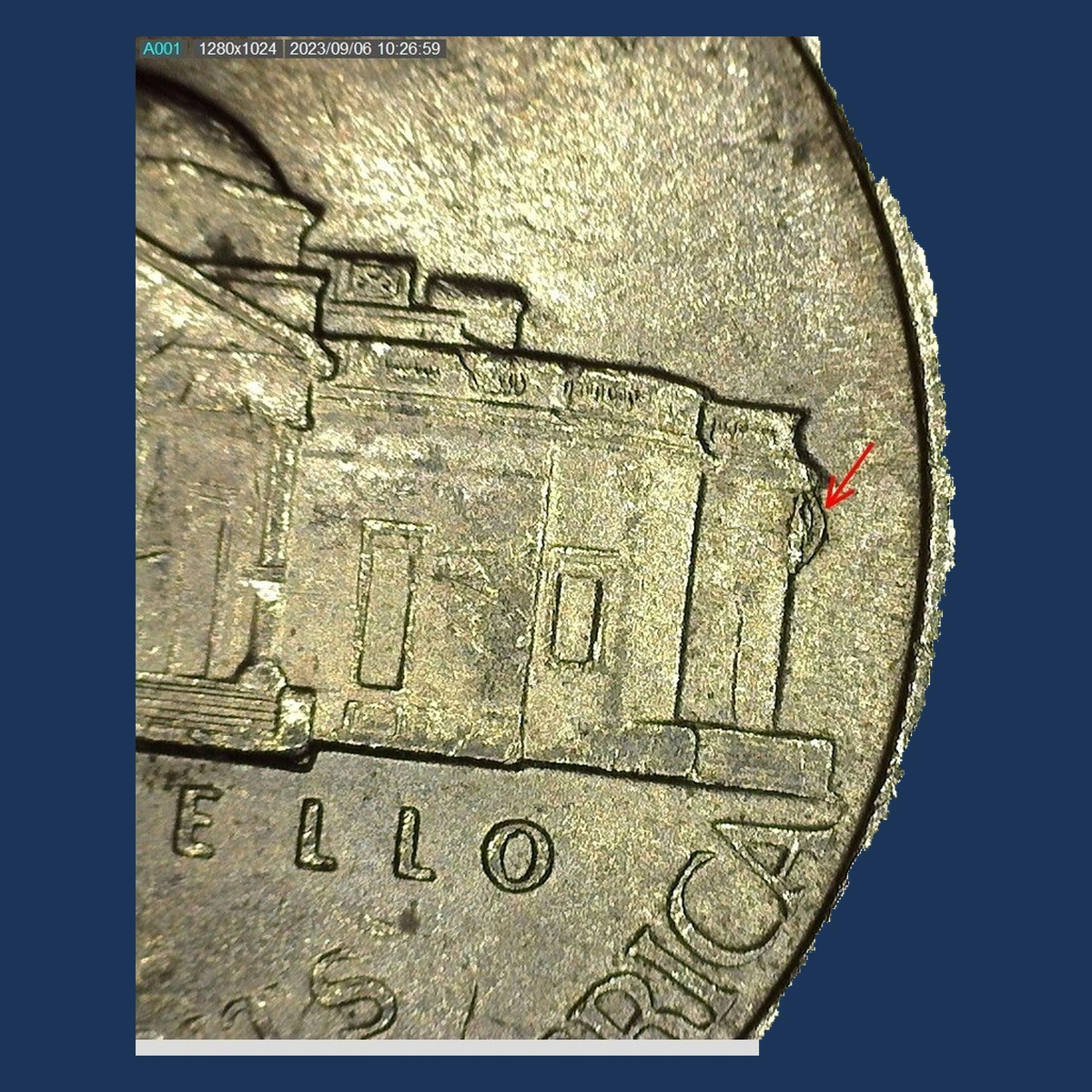
A fine raised line may wander across Jefferson or the building on the back. It forms when coin metal enters a crack in the stamping tool.
A year guide describes a Philadelphia nickel with several cracks on both faces. Its exact paths are not established well enough to turn one particular letter or window into a required marker.
More than one coin can carry the same pattern because the cracked tool may keep working.
The lines can also grow between strikes, so a crack is not automatically unique to one coin.
Estimated Value
Allow about $5–$100 for readily visible cracks, with larger networks on clean coins toward the higher end. Fine lines that need difficult lighting usually bring less.
A year guide claims a much higher sale for a top-grade Philadelphia example, but it does not provide a closely matched original transaction. This range therefore values the visible breaks conservatively.
Ordinary scratches do not qualify, even when several cross both faces.
How to Identify
Try moving the lamp low across one line without touching the surface. A 10× magnifier should reveal a ridge, whereas a scratch usually forms a cut.
Follow that ridge into nearby normal detail. Several branches can support a cracked-tool explanation, but a normal hair strand or architectural line should match an ordinary nickel.
Record the whole path on both faces rather than relying on a tiny bright close-up.
A loose, otherwise normal coin should weigh near 5.00 grams on a digital scale and measure about 21.21 millimeters with calipers. A raised crack redistributes the coin’s own metal rather than adding a glued-on wire.
Check that the line grows from the surface without a separate seam or coating.
3. 2001 Jefferson Nickel Die Clash
Unexpected fragments of the opposite design can appear around the normal portrait or building. They begin when the two stamping tools meet without a blank between them.
That contact marks the tools, and later coins receive traces of those marks. The result is called a die clash.
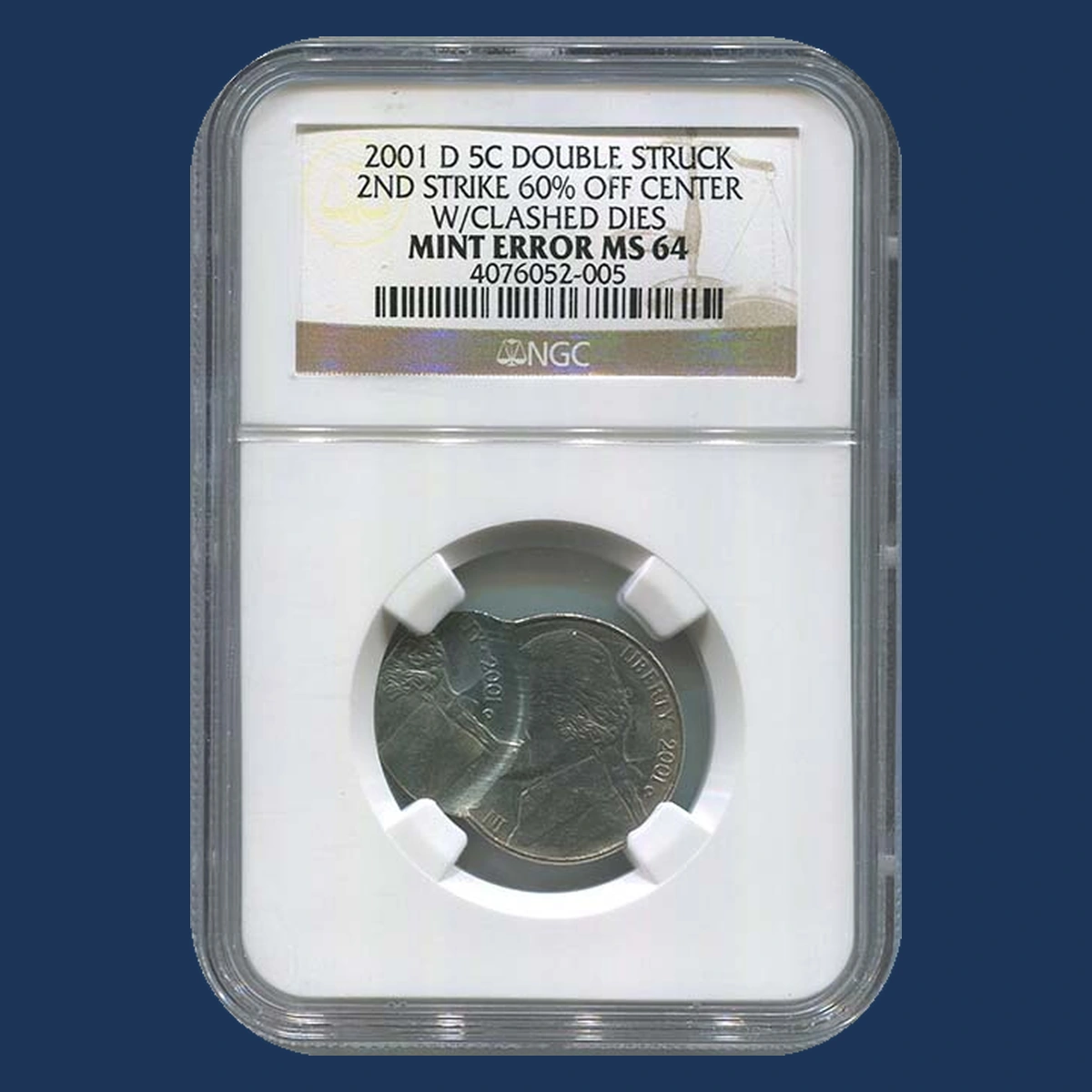
A recorded Denver example also received two strikes, with the second sixty percent off center. Its clash traces are separate features of the same coin, so the extra strike and the tool contact must not be counted as two independent finds.
Estimated Value
Recognizable clash traces on an otherwise ordinary 2001 nickel can be estimated at $20–$150, depending on clarity and surface condition. Several matching fragments usually attract more interest than one faint line.
Heritage’s $360 result from January 2018 belongs to the Denver coin with both a clash and a dramatic second strike. That amount bought the complete coin, so it cannot be assigned to the clash alone or added again under double strikes.
How to Identify
Keep a photograph of the opposite design beside the coin under a 10× magnifier. Look for fragments that fit Jefferson or Monticello rather than assuming every unusual line is transferred design.
The published double-struck example needs special care: a complete displaced building can belong to the second strike. A clash usually leaves smaller pieces in the spaces around the normal design.
Inspect the plain edge for squeezing or a seam between joined pieces. On a loose coin, check about 5.00 grams with a digital scale and roughly 21.21 millimeters with calipers.
Trace several matching fragments together; a single sunken line or bright scratch cannot establish a clash by itself.
4. 2001 Jefferson Nickel Rotated Dies
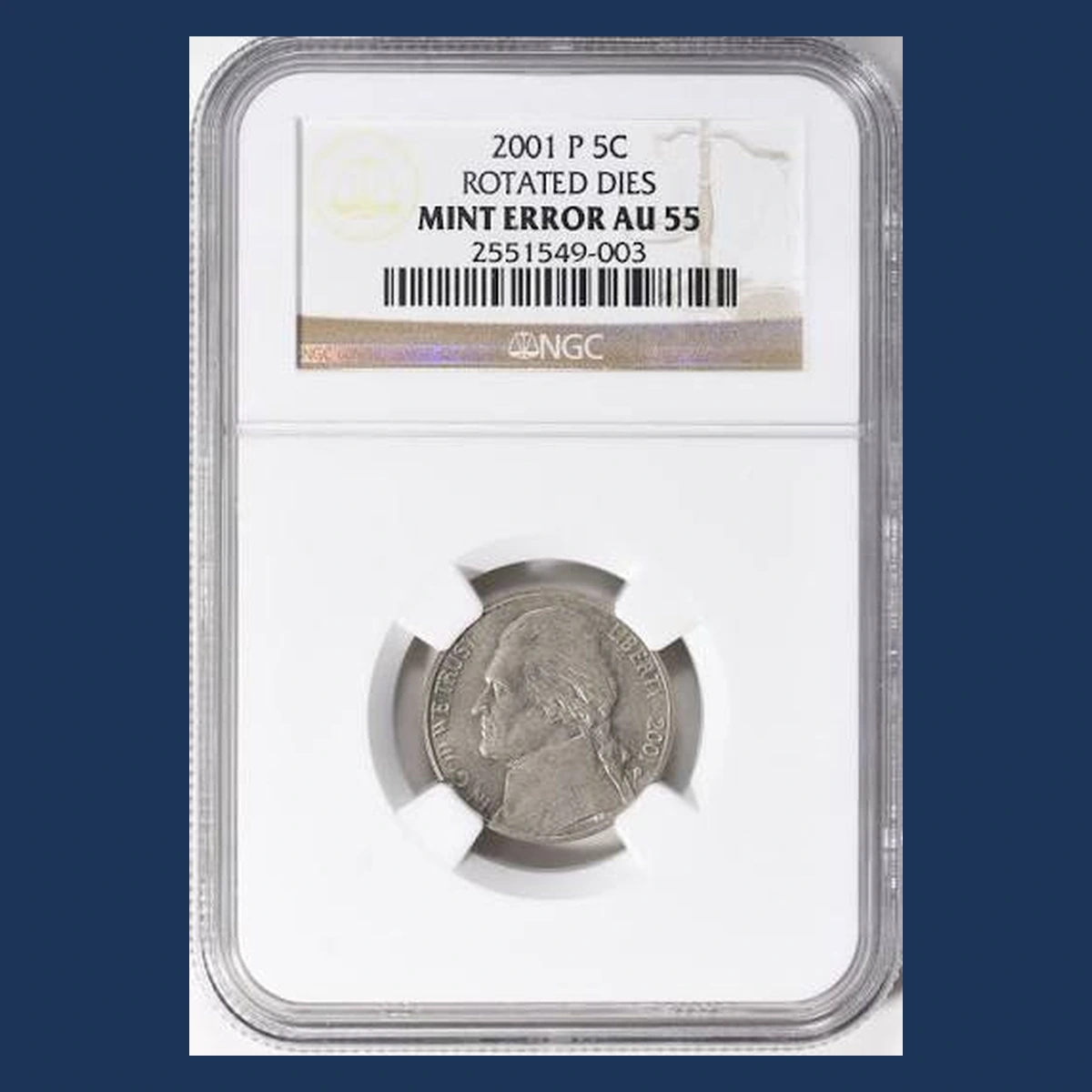
Monticello may lean sharply after you turn an upright Jefferson over. On a correctly aligned nickel, a top-to-bottom flip should leave both designs standing upright.
Collector records show several Philadelphia examples, including a building rotated about forty-five degrees counterclockwise. Other coins have larger clockwise turns.
Those angles belong to different pieces, not different views of one coin. A Denver rotation also appears in a year guide, but the Philadelphia photographs should not be used as proof of that separate mint’s example.
Estimated Value
Estimate $25–$250 for a clearly established rotation, with larger turns and clean surfaces generally attracting more attention. Small angles may be difficult to sell at a substantial premium.
A Philadelphia coin with light wear sold through GreatCollections in April 2020, but the public page does not display its price. The estimate is therefore not a claim about that result.
Measure the angle before comparing two coins described simply as rotated.
How to Identify
The Philadelphia collector records include turns of about forty-five degrees counterclockwise and larger clockwise angles on separate coins. Your coin needs its own measurement rather than a borrowed number.
Hold Jefferson upright, then turn the coin over its horizontal axis without twisting it. Compare Monticello’s position with a normal nickel turned the same way, using an angle guide to measure the difference.
A continuous video of this movement is more useful than two separately rotated photographs. The collector’s illustrated examples provide comparisons.
Check a loose piece with a digital scale against 5.00 grams and calipers against 21.21 millimeters. For a sealed coin, leave it inside and turn the whole holder so the two designs stay fixed together.
5. 2001 Jefferson Nickel Elliptical Clipped Planchet
An oval-looking nickel may have started as an incomplete blank rather than a full round disk. Collectors use the term elliptical clip for this kind of missing-metal shape.
A David Lawrence listing, preserved in Greysheet’s auction records, describes a Denver example weighing 4.06 grams. That is substantially below the normal nickel weight.
The lighter weight fits missing metal, but an oval outline alone does not prove how it happened. A coin stretched in a machine or cut after striking can look oval for an entirely different reason.
Estimated Value
An estimated $60–$300 covers a clear, professionally identified elliptical clip of this date. Greysheet’s record reports a $104 David Lawrence result in August 2006 for the 4.06-gram NGC MS63 coin.
That grade describes an unworn piece with noticeable marks. The old result provides a useful starting comparison, rather than a current offer.
A pleasing original edge and readable identity matter more than an oval shape alone.
How to Identify
Photograph the oval and the design together before measuring anything. A portrait stretched in the same direction as the metal suggests rolling or squeezing, which differs from striking an incomplete blank.
Use a 10× magnifier to examine the boundaries for original struck detail flowing toward the missing sections. Record the long and short spans with calipers, using 21.21 millimeters as the normal round diameter rather than a requirement for this incomplete shape.
Weigh the loose piece on a digital scale: the reported coin is 4.06 grams against a normal 5.00 grams. That loss supports missing metal only when the edge also lacks the saw cuts or filing of later alteration.
6. 2001 Jefferson Nickel Partial Collar Strike
The edge can show two levels instead of one smooth vertical wall. Part of the nickel was held inside the surrounding ring while another part spread beyond it.
That ring is called the collar. A year guide reports this partial collar feature on a Denver nickel.
Nickels normally have plain edges, so the clue is a step rather than missing edge grooves. The border seen from the front may look fairly ordinary, making a side view far more useful than a photograph taken only from above.
Estimated Value
About $50–$350 is a working estimate for a clear Denver partial collar strike. A sharp ledge around a substantial part of the coin is more desirable than a vague uneven edge.
For context, Fred Weinberg offered a 2001-S Proof partial collar for $375. That was an asking price for a specially made collector coin, not a Denver sale.
The different finish prevents treating those two pieces as identical comparisons.
How to Identify
View the edge straight on rather than tilting the face toward the camera. A partial collar should reveal a narrow confined section beside metal that expanded farther outward.
Use calipers at those two levels. The held portion can remain near the normal 21.21-millimeter diameter while the other section is wider.
A digital scale should still read near 5.00 grams because expansion does not remove the metal.
Under a 10× magnifier, examine the ledge for scrapes or battered areas. Damage from repeated impacts can push metal into a lip without creating the same struck step.
Turn the coin slowly to see where the two levels continue or meet; the side profile explains this error better than the width of the front rim.
7. 2001 Jefferson Nickel Off-Center Strike
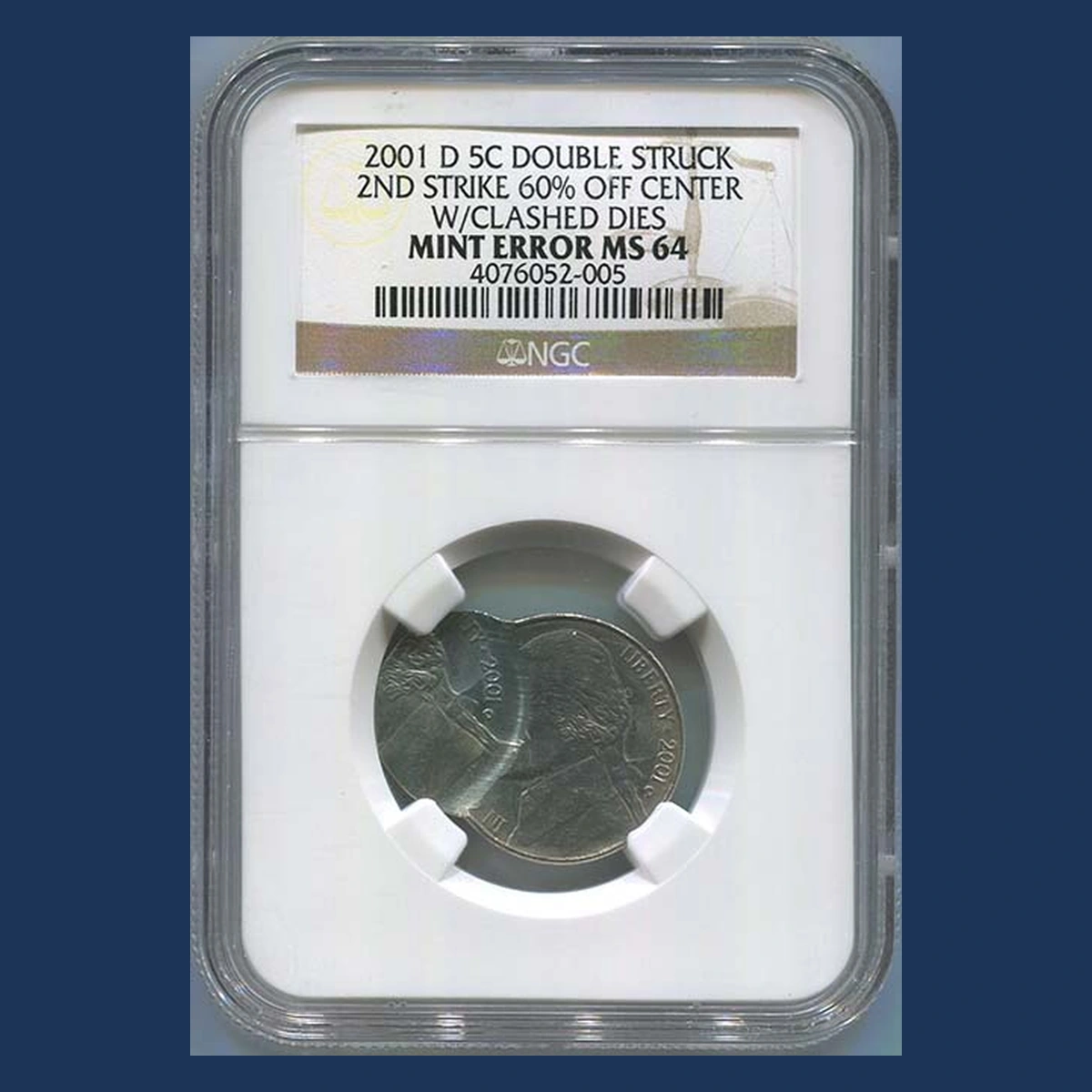
Most of the design can miss the blank when it enters the press in the wrong place. The finished piece then has a large unused area beside a partial portrait and building.
A Denver example was struck sixty percent off center toward eleven o’clock. It appeared in an auction alongside a different nickel dated 2003.
A Philadelphia twenty-percent example is also reported in a year guide. These are individual cases, so the Denver direction should not be assigned to every off-center nickel dated 2001.
Estimated Value
Use an estimated $30–$400 for dated examples, depending on displacement, surfaces, and the amount of design remaining. The Denver sixty-percent coin was part of a two-coin lot that brought $63 at Heritage in January 2022.
That payment also bought a 2003-P off-center nickel. It cannot be quoted as the price of the 2001 coin alone.
A readable date and an attractive original blank area improve the comparison.
How to Identify
The Denver example’s large unused area makes a useful distinction from a clipped blank: its metal is still present. Check a loose piece on a digital scale for a weight near 5.00 grams.
Photograph both sides before estimating the missing design. Jefferson and Monticello should reflect the same misplaced blank rather than one face being shifted independently.
Use calipers to record its outline against the normal 21.21-millimeter starting diameter. A 10× magnifier will help show whether the unused metal was originally unstruck or later ground smooth.
Keep every remaining digit visible in your pictures. The full blank area and matching displacement on both faces are more useful than a guessed percentage.
8. 2001 Jefferson Nickel Struck-Through Grease
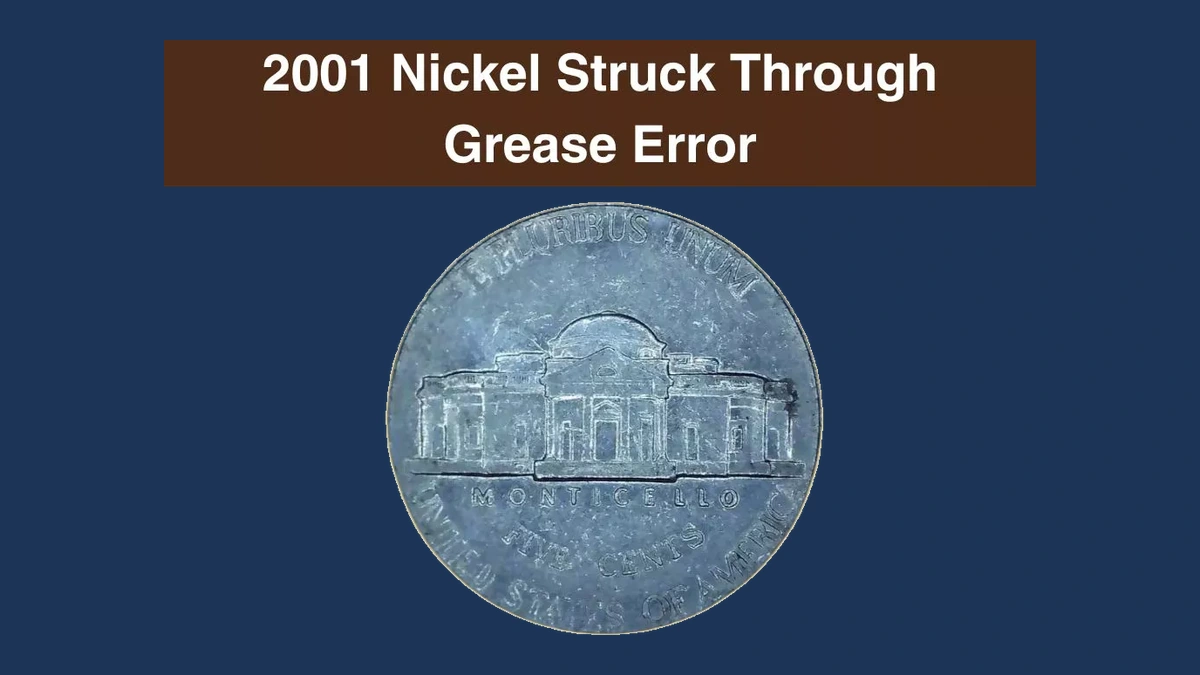
A patch of Monticello can look soft while nearby parts remain sharp. Grease or other material blocking the stamping tool can prevent those details from reaching the coin.
A year guide describes this effect on a San Francisco Proof, a specially made collector coin. Its listed grade conflicts with that finish, so the coin’s label and surfaces need to establish its identity.
The visible weakness still belongs in the error discussion. It should not be confused with wear across the entire building or polishing that removed detail after striking.
Estimated Value
For a genuine 2001-S Proof with a clearly blocked area, estimate $50–$500. A large, obvious interruption can command more attention than a slight softness in one window.
The year guide reports $750, but its conflicting grade and finish prevent a reliable direct comparison. The range here assumes a correctly identified Proof strike-through with original surfaces.
A reflective nickel alone is not enough, since polishing can make a damaged coin shine.
How to Identify
Read the mint letter and any grading label before deciding that the coin is a Proof. S identifies San Francisco, while the specially made finish must be judged from the complete coin.
With a 10× magnifier, compare the weak area of Monticello with the adjacent columns and lettering. Material blocking one part of the tool can leave nearby details much clearer.
Look for scraping across the supposed missing design. A normal digital-scale weight near 5.00 grams and caliper diameter near 21.21 millimeters help rule out major removal but do not prove grease.
Do not wipe the weak area to improve the view. A smooth transition into otherwise sharp, undamaged detail is more useful than shine alone.
9. 2001 Jefferson Nickel Struck over a Lincoln Cent
Two presidents share this piece of metal, but they face in nearly opposite directions. A finished Lincoln cent entered the nickel press and received Jefferson’s design over its existing image.
The recorded Denver example shows a faint inverted cent date across the bridge of Jefferson’s nose. Much of the outer lettering is incomplete, while the nickel’s date, mint letter, and LIBERTY remain readable.
Philadelphia overstrikes are also reported, with their own arrangements. A different orientation can still be genuine, but it needs its own surviving cent details.
Estimated Value
Comparable clear examples can be estimated at $400–$1,000. A Denver piece graded PCGS MS63 sold for $600 at Heritage in December 2024.
The different MS64 Red coin with the inverted date brought $576 in September 2019. Both grades describe unworn coins, with MS64 generally showing fewer marks; Red describes the copper color.
The two prices belong to separate pieces, and neither implies that an ordinary copper-colored nickel has the same value.
How to Identify
The older design provides the strongest starting point. Use a 10× magnifier to locate Lincoln or Memorial details beneath Jefferson and Monticello, rather than relying only on copper color.
On the described Denver MS64 Red example, check the bridge of Jefferson’s nose for the upside-down cent date. Do not transfer that exact position to a different overstrike.
A modern cent begins at about 2.50 grams and 19.05 millimeters, compared with a nickel’s 5.00 grams and 21.21 millimeters. Use a digital scale and calipers on loose coins, allowing for spreading during the second strike.
Keep the two dates separate when recording your find. Remains of the already struck cent distinguish this error from a nickel design on an unused cent blank.
10. 2001 Jefferson Nickel Die Cap
A nickel can curve around a stamping tool and take on the shape of a small cap. It stays in the press and may strike additional blanks while attached.
The trapped coin is the die cap itself. Coins struck underneath it can have distorted impressions without becoming the same cup-shaped object.
A year guide reports a Denver cap but does not establish which face stayed against the tool.
The shape and metal flow must explain the piece, rather than a seller simply calling any bent nickel a cap.
Estimated Value
For a genuine 2001-D cap with a clear cup shape, estimate $300–$1,200. The amount of spreading and the remaining readable design affect where a coin fits.
A useful different-year comparison is a 1977-D front die cap graded NGC MS67, which brought $487.20 at Heritage in July 2021. That is an actual auction result, not a sale of the reported 2001 piece.
A sharply bent pocket coin does not qualify for this range.
How to Identify
A cup-shaped nickel needs examination from inside the cup as well as along its outer wall. Support it on padding and avoid pressing its edge flat.
Use a 10× magnifier to see how the design stretches into the curved metal. A local sharp fold or crushed patch suggests later bending rather than a coin spreading around a stamping tool.
Measure the wall height and widest span with calipers; its original blank was about 21.21 millimeters across. A digital scale should still show close to 5.00 grams unless metal is missing, and the stretched design should fit the developing wall rather than stop at one abrupt crease.
11. 2001 Jefferson Nickel Double and Multiple Strikes
The press can leave two or more sets of design on a nickel that fails to exit normally. Movement between blows determines where the next portrait or building appears.
Denver examples include a double strike with its second blow sixty percent off center. Another coin received three blows, including one with only the front tool shifted.
A San Francisco Proof overlap is also reported, but its published grade conflicts with its finish. Proofs normally receive repeated pressure, so only an unintended displacement makes that repetition an error.
Estimated Value
Estimate $150–$600 for clear ordinary multiple strikes and $500–$1,500 for a correctly identified displaced Proof strike. The Proof range is an estimate, not a verified sale of the reported coin.
A Denver double strike with clash traces brought $360 in January 2018. Another double strike sold for $307.44 in June 2026, while a separate triple strike brought $192 in October 2022.
More blows do not automatically mean a higher price.
How to Identify
Find portions of complete repeated designs before counting the strikes. A second date, portrait boundary, or building is stronger evidence than a thin shelf alongside one letter.
Mike Diamond’s three-strike explanation shows why the faces need separate attention. One Denver coin had its front tool shift right during a second blow while the blank stayed within the surrounding ring.
Compare both faces under a 10× magnifier, then map the later off-center impression.
An ordinary starting nickel is 5.00 grams and 21.21 millimeters across. A digital scale and calipers help record the surviving metal and its expansion without requiring the distorted coin to stay perfectly round.
For a Proof, seek a genuinely displaced image; repeated blows in the same position are normal production.
Conclusion
These 2001 nickels span estimated values of $5–$1,500. Small raised cracks sit near the lower end, while a convincing misplaced Proof strike can justify a much higher estimate.
The recorded cent overstrikes, clipped blank, and multiple strikes show why identity matters as much as appearance. Keep the original cent date separate from the nickel date.
For tilted designs, turn the whole coin; for an odd edge, inspect it from the side.