2018 Nickel Error List with Pictures

Turn a nickel over carefully: a tilted building can reveal a mistake that its portrait does not. A 2015-D example with a ninety-degree rotation sold for $79 in October 2021.
That different-year result offers a comparison for rotation reported among 2018 Jefferson Nickel errors. Other clues include repeated letters, raised bumps, and an unusually wide outline.
The estimates below range from $5–$350. Read on to see where to look and how to separate these errors from ordinary damage.
1. 2018 Jefferson Nickel Missing Detail from a Blocked Tool
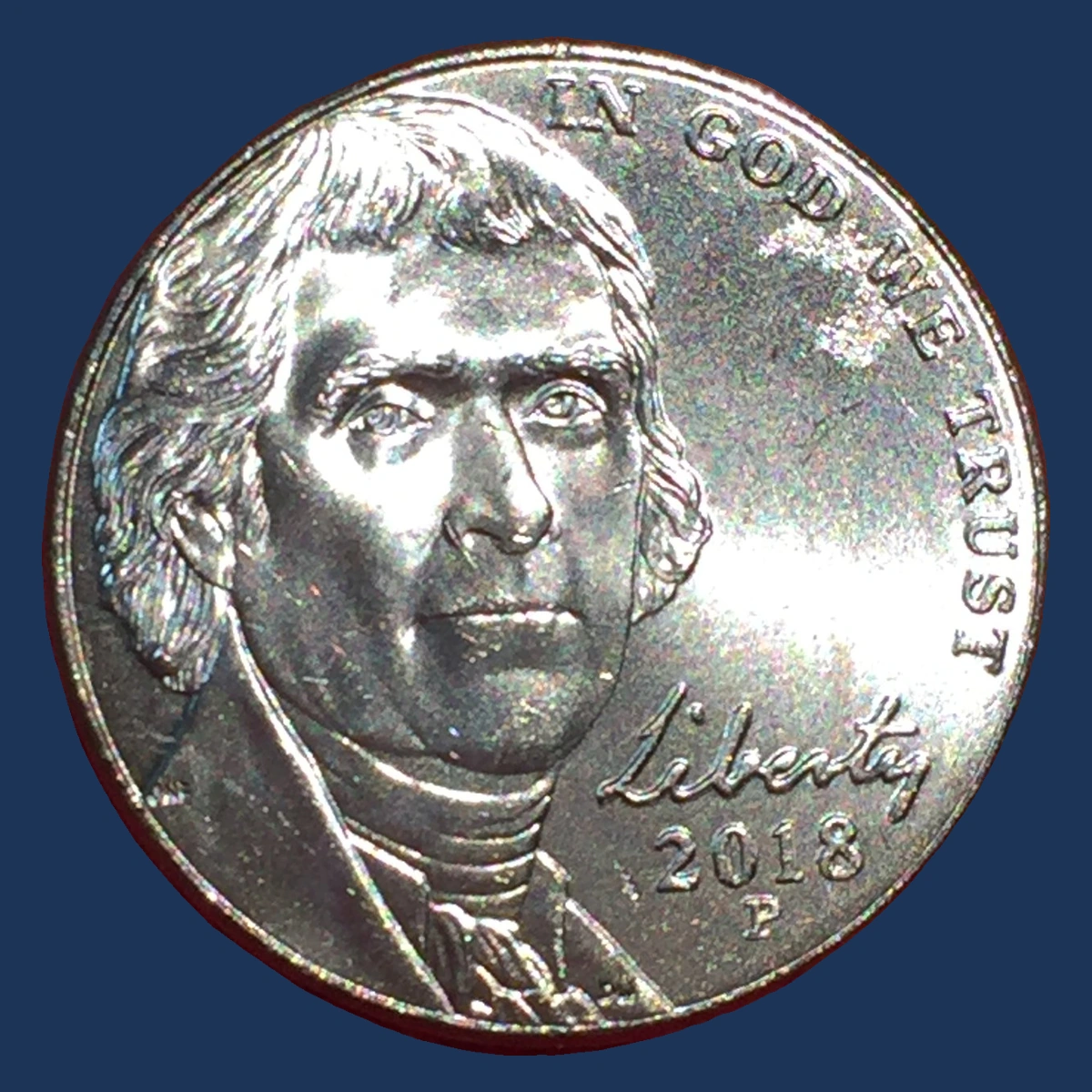
Parts of FIVE CENTS or Monticello can look faded while nearby details remain clear. A report for 2018-D describes this contrast on the back.
Grease or debris can fill part of a die, the steel tool that stamps the design. The blocked area cannot give the blank its normal detail.
This is commonly called a grease strike-through. A separate report concerns weak portrait detail, without establishing that both faces belong to one example.
Ordinary wear also removes detail. The useful clue is a local interruption beside a better-preserved part of the design.
Estimated Value
Estimate $5–$20 for a modest genuine blocked area and $20–$50 for a clearer interruption. These figures apply to a flaw made during striking, rather than a worn or polished surface.
A readable date and sharp nearby details help show the contrast. Extensive wear can make a small original weakness difficult to recognize.
The reported 2018 examples do not establish a separate sale for each affected word. Value the whole coin and its visible effect.
How to Identify
Compare FIVE CENTS with the other back lettering under one light. If nearly everything is soft, ordinary wear or a generally weak strike deserves attention first.
Use a 10× magnifier to study the boundary around the missing detail. Fine polishing lines or scraped metal can explain a smooth patch that formed later.
Now turn to Jefferson and compare the wear on his cheek. Keep the separate portrait report separate from the Denver back example.
Check a loose coin with a scale against 5 grams and calipers against 21.21 millimeters, including its plain edge. Photograph the weak patch beside sharp detail instead of filling the frame with only the blur.
2. 2018 Jefferson Nickel Repeated Doorway Details and Letters
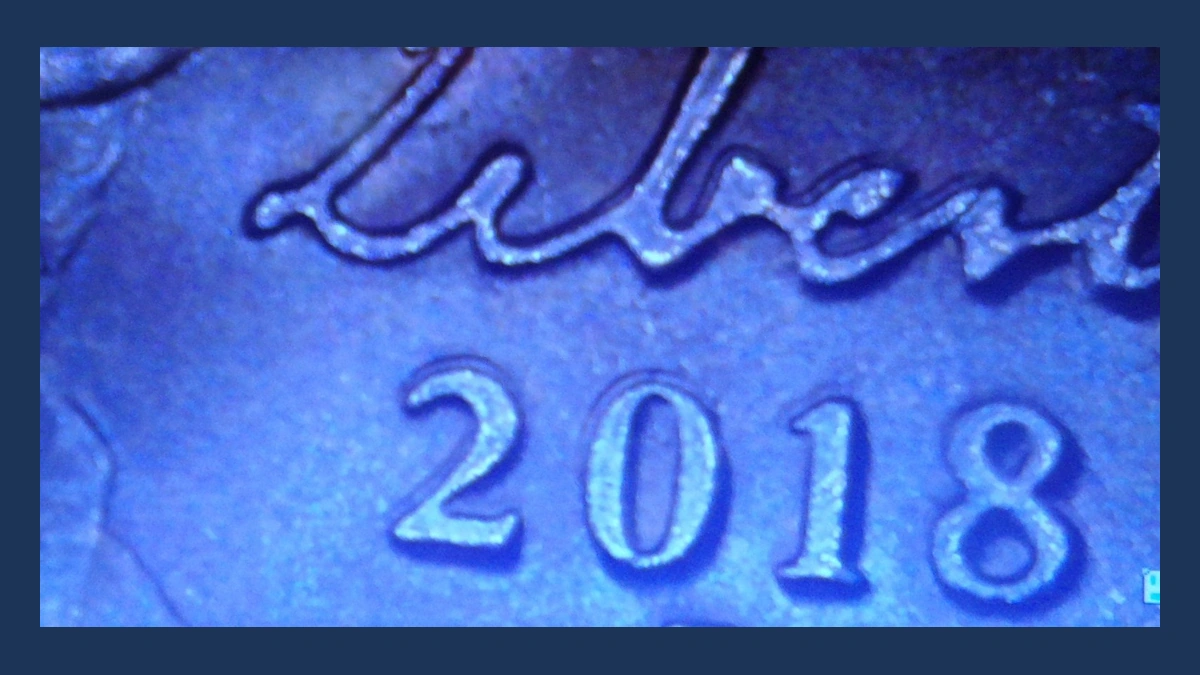
Monticello’s doorway can carry an extra line beneath its upper frame or near an upper corner. These are recorded Philadelphia varieties with doubling built into the stamping tool.
Another example has three outlines on the second L of MONTICELLO. It is a separate pattern, not an extra feature required on every doubled doorway.
Front-doubling reports point to the date and words around Jefferson. Those reports should not be treated as proof that a particular cataloged back also has a doubled front.
A flat shelf from movement during striking has a different cause.
Estimated Value
For a matched minor variety, estimate $10–$30, rising to $30–$75 for a clear, attractive example. These are estimates for the visible patterns, not separate auction records for each catalog number.
The strength of the extra outline matters. Thick letters without a matching pattern do not earn the same premium.
A coin that also carries small raised chips receives one total valuation. Adding the full price of each tiny feature would overstate its value.
How to Identify
Confirm the P beneath the date before comparing the back with the 2018 Philadelphia variety photographs. Choose either the doorway or second L as your starting point.
Enlarge that feature with a 10× magnifier. Follow a separate rounded outline rather than a bright shadow or flat shelf.
The doorway examples differ in location. Match the upper frame or appropriate corner without borrowing the tripled L from another coin.
A loose nickel should measure about 21.21 millimeters with calipers and weigh 5 grams on a scale. Its edge is plain.
Keep the full letter or doorway visible in the photograph. A close match of shape and position is more useful than thickness alone.
3. 2018 Jefferson Nickel Gray or Dark Color from Improper Annealing
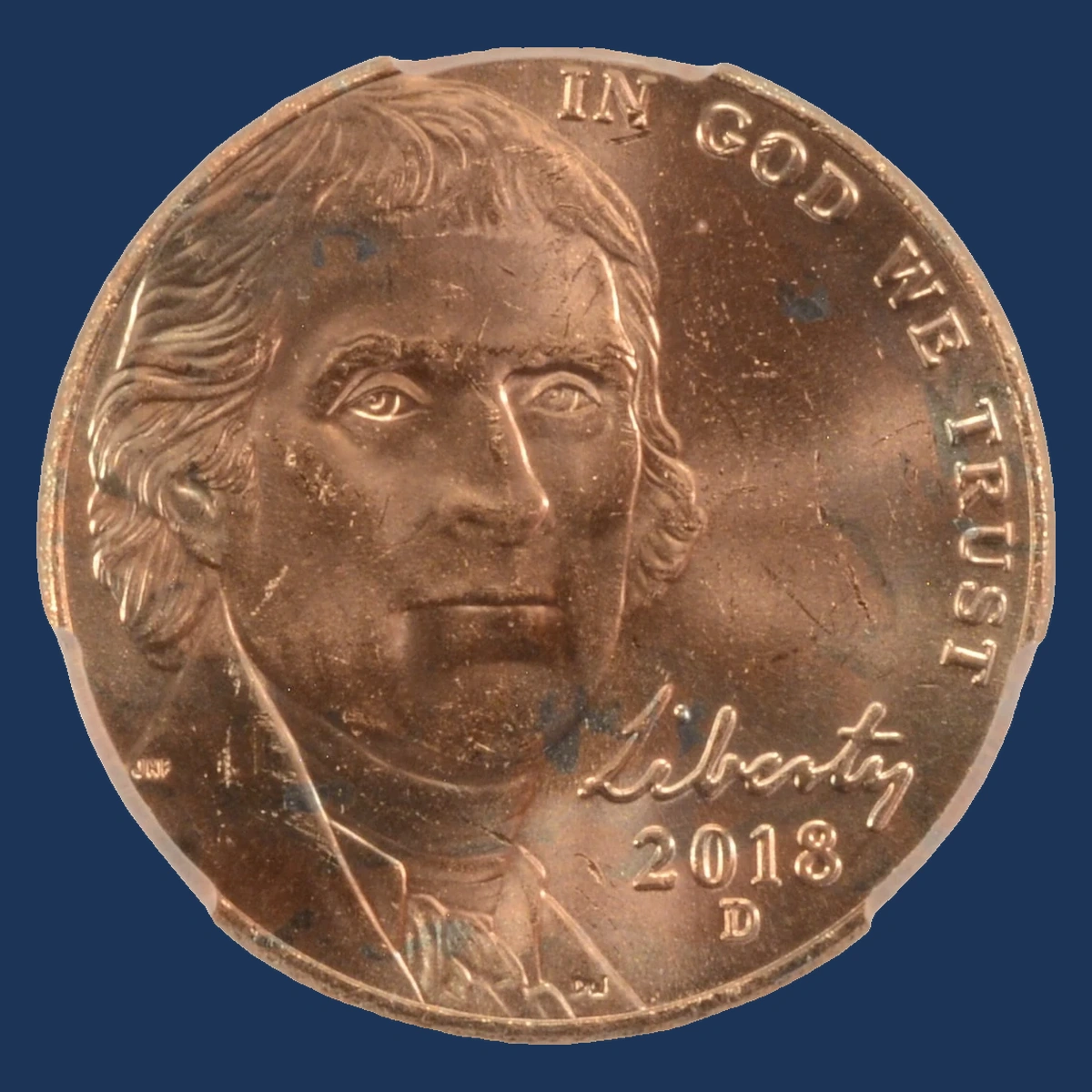
A nickel blank is heated to soften it before striking. This step, called annealing, can change the surface when conditions are wrong.
A 2018-P report describes an unusually gray or dark example. The color provides a starting point, but it does not show when the change occurred.
The coin contains copper mixed with nickel throughout. It does not have a pure copper center hidden beneath a separate outer nickel layer.
Burial, chemicals, and heating after minting can also change its appearance. Original texture and shine need to be considered along with the shade.
Estimated Value
A correctly identified heating error has an estimated range of $15–$125. Strong original color on a well-preserved coin usually attracts more interest than a slight shade difference.
As a comparison, a 2005-D nickel labeled improperly annealed sold for $119 in December 2022. That result concerns a different year and does not authenticate a dark 2018 coin.
The estimate excludes ordinary stains and later heat damage. A smooth, even color alone cannot establish the same value.
How to Identify
Place the coin beside an ordinary nickel under neutral light and turn both together. Compare the shine in protected areas beside the letters, not just the darkest open patch.
Inspect the plain edge and both faces with a 10× magnifier for paint, crusts, or a peeling coating. Do not scratch through the color to test what is underneath.
Use a scale and calipers on a loose example, comparing with 5 grams and 21.21 millimeters. A much lighter, smaller piece needs a different investigation from a normal-sized dark nickel.
Preserve the surface for specialist examination. Color and normal measurements can guide the check, but neither proves that the Mint’s heating caused the change.
4. 2018 Jefferson Nickel A Tilted Back after Turning the Coin
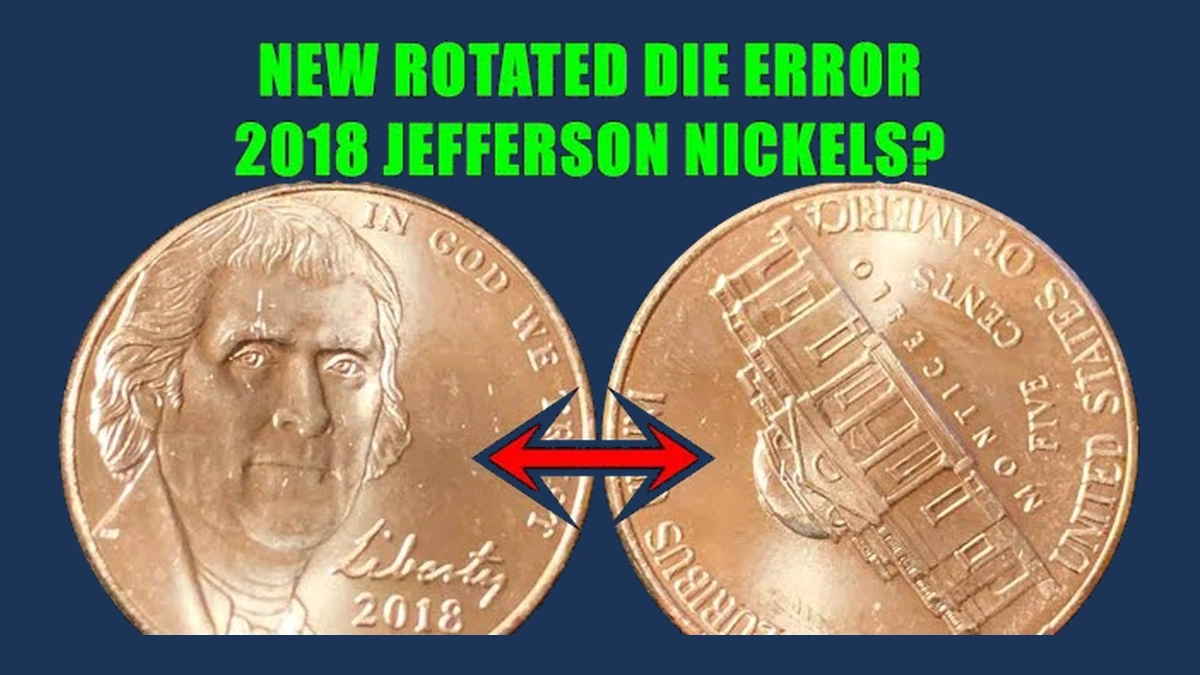
Jefferson can stand upright while Monticello appears tilted after a careful top-to-bottom turn. That fixed mismatch is the feature to check on a reported 2018-D rotated example.
The two stamping tools should hold the designs in their intended relationship. If one turns in the press, coins can receive a different alignment.
No single measured angle applies to the 2018 report. General examples described as thirty or ninety degrees should not supply a measurement for your coin.
Two separately rotated photographs can also create an apparent mismatch. The turning method matters more than a tilted photograph.
Estimated Value
Allow an estimated $10–$40 for a clear modest rotation and $40–$150 for a more striking, correctly measured example. Condition remains part of the total price.
A 2015-D nickel with a ninety-degree rotation sold for $79 in October 2021. This is the different-year comparison introduced above.
That angle belongs to the 2015 coin. Use the actual alignment of a 2018 candidate rather than pricing it from a general description.
How to Identify
Hold Jefferson upright, then turn the coin from top to bottom around a horizontal axis. Monticello should now be upright; a side-to-side turn would give the wrong starting test.
Repeat the movement without twisting your fingers, watching whether the same tilt returns. Photograph both faces in a holder that keeps their relationship fixed.
Check the date and D with a 10× magnifier, then measure the building’s actual angle from upright. For a loose example, compare scale and caliper readings with 5 grams and 21.21 millimeters, and inspect the plain edge.
The important result is a repeatable alignment difference. An independently straightened front photograph beside a tilted back photograph cannot prove it.
5. 2018 Jefferson Nickel Peeling or Separating Metal
A thin flap or shallow opening can reveal weakness inside the coin’s metal. When part separates, collectors call the result a lamination error.
The reported 2018-P type involves this internal separation. It should not be described as an outer nickel layer exposing a pure copper core.
A Jefferson nickel is made from one copper-nickel alloy throughout. Peeling can still occur within that mixture, but its cause differs from a missing layer on a clad coin.
Scraping and corrosion may leave similar rough patches. The boundary of the separation is more useful than color alone.
Estimated Value
Estimate $5–$50 for a small genuine separation and $50–$200 for a larger, clear example. A retained flap may help explain the error without requiring a dramatic missing section.
The reported Philadelphia piece supplies no confirmed sale for this range. The estimate assumes that the weakness began in the original metal.
If corrosion or scraping caused the patch later, the same premium does not apply. Keep any attached metal in place when comparing value.
How to Identify
Look for the mouth of the separation under a 10× magnifier. Light from the side can show a thin flap lifting from the coin’s own metal.
Leave that flap untouched. Pulling it up would remove part of the evidence.
Follow any surviving design across the flap and adjoining surface. A painted layer or a trench with scraping marks suggests another explanation.
Weigh a loose specimen against 5 grams, then use calipers against 21.21 millimeters. Missing metal can lower the weight, while an attached flap may leave it nearly normal.
Inspect the plain edge if the opening reaches it. Record both faces and the natural split before asking a specialist to examine the surface.
6. 2018 Jefferson Nickel A Wide Coin with a Complete Design
An unusually wide nickel may have spread beyond its intended outline during striking. A surrounding ring, called the collar, normally limits that spreading.
If the collar fails to contain the blank, the press can produce a broadstrike. The portrait, building, and outer words remain on the available metal.
The extra border need not have equal width all around. What matters is that the complete design stays within the coin.
This type is reported for 2018 without one established mint or diameter. A separate ten-percent off-center report should not be used as its example.
Estimated Value
For a genuine broadstrike, estimate $30–$100 with modest spreading and $100–$250 for a more striking, well-preserved example. The full design should remain visible.
A 1999-P broadstruck nickel sold for $89 in March 2025, providing a different-year comparison. It does not establish the size or mint of a reported 2018 piece.
Coins flattened after minting do not receive the same premium. Extra width matters only when the original striking features support the cause.
How to Identify
Use calipers to measure several spans across a loose coin, then weigh it on a scale. The usual measurements are 21.21 millimeters and 5 grams; spreading changes the outline without removing metal.
Extra width alone does not settle the question. Follow the outer words on both faces to check whether the entire design remains on the coin.
A broadstrike can have an uneven border, but it should not lose design beyond the edge like a simple off-center strike. Compare the wide border with the lettering through a 10× magnifier.
Hammer marks or crushed letters suggest later flattening. Photograph those areas and the plain edge alongside the complete coin before deciding what caused its shape.
7. 2018 Jefferson Nickel Raised Building Chips, Cracks, and Rim Breaks
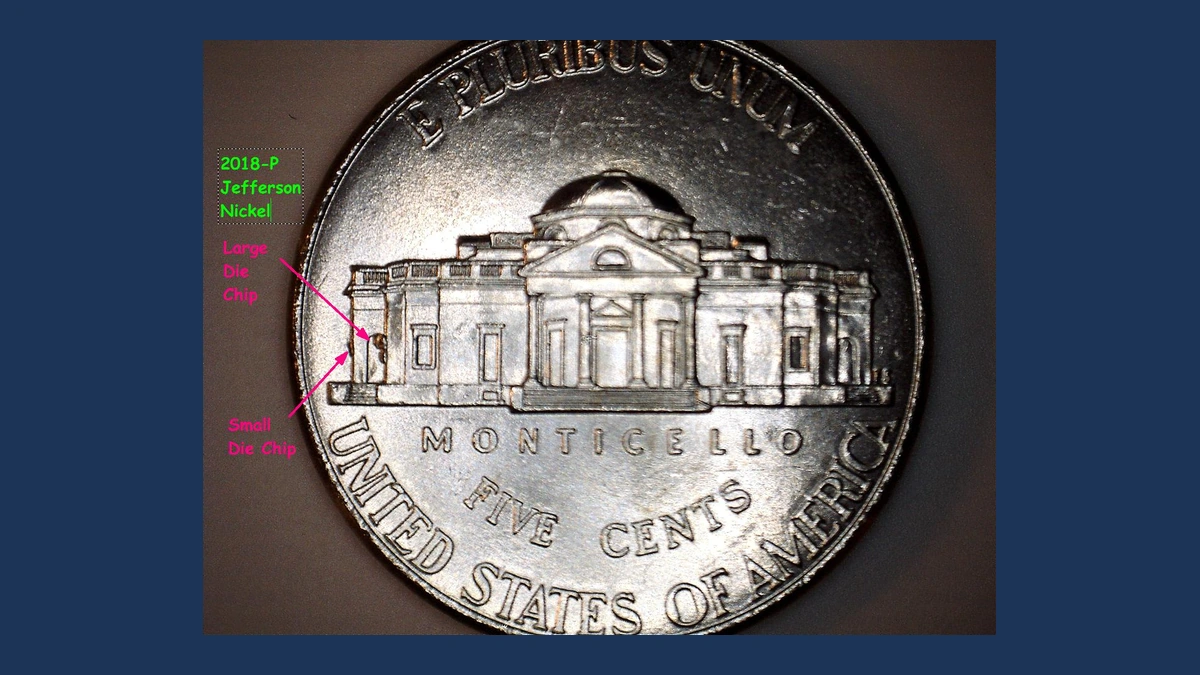
Small lumps around Monticello can come from pieces breaking out of the stamping tool. Metal fills those empty spaces and leaves raised features on the coin.
Philadelphia examples include chips at the left wall, inside the left arch, and near the small FS designer initials. Reports also describe paired Denver wall bumps nicknamed Beehive.
These positions do not identify one shared tool for both mints. A crack can produce a thin raised line instead of a lump.
A larger break connected to the rim is called a cud. It belongs apart from isolated building chips when identifying the visible shape.
Estimated Value
Minor cracks and chips are estimated at $5–$30. A substantial, original rim-connected cud can be estimated at $30–$300, depending on size and preservation.
For comparison, a 1983-P cud on a worn nickel sold for $63 in July 2022. That is a different-year sale, not a price for every Beehive nickname.
Attached dirt or metal squeezed up by a later hit does not earn the same premium. Judge the original raised feature and the whole coin.
How to Identify
Keep the P or D visible beside a full view of Monticello. Begin with a normal coin from the same mint so ordinary building details do not become imagined lumps.
Use a 10× magnifier at the left wall and arch on a Philadelphia example. Denver wall bumps need their own matching photographs.
Trace a thin line across nearby details: a ridge fits a cracked tool, while a cut center suggests a scratch. An isolated building lump is a chip, not a rim-connected cud.
For a suspected cud, inspect where the raised patch joins the rim and plain edge. On a loose coin, compare scale and caliper readings with 5 grams and 21.21 millimeters; a crushed edge can reveal later damage.
8. 2018 Jefferson Nickel A Design Shifted Ten Percent Off Center
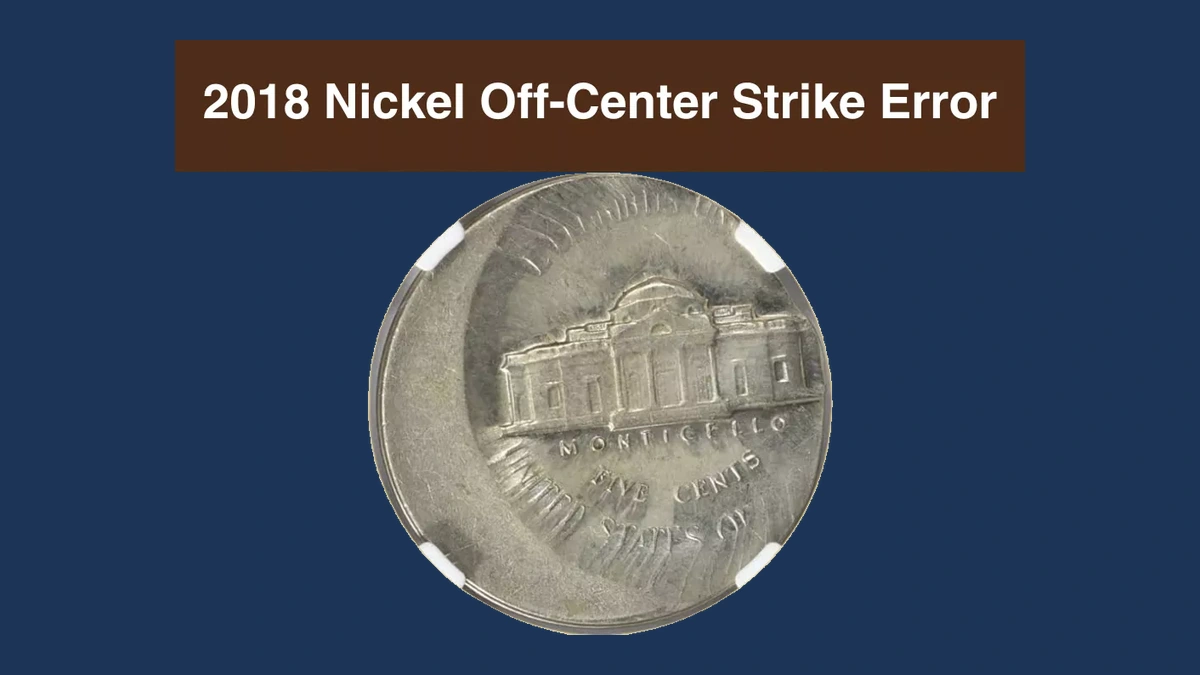
An unused crescent of metal can remain beside a shifted portrait and building. A year report describes a 2018-P nickel struck ten percent off center.
The blank was not centered between the stamping tools when they came together. Part of their design fell beyond its edge, leaving another part of the blank untouched.
The report does not establish a clock direction or a larger forty-to-sixty-percent shift. Those details must come from the actual example.
An uneven border on just one face can have another cause. The displaced blank should explain what happened on both faces.
Estimated Value
Estimate $25–$100 for a modest, genuine offset and $100–$350 for a stronger example with a readable date. The upper range is not a claim that the reported ten-percent piece sold for that amount.
A 1999-P fifteen-percent off-center nickel sold for $64 in March 2025. This offers a different-year comparison for a modest shift.
Heavy damage or a missing year can reduce appeal. Compare the actual amount of displaced design and the condition together.
How to Identify
Find the area with no design and determine whether it is still solid metal. A missing section suggests a clip or later cutting, rather than an unstruck crescent.
Compare that unused area on both faces with the design lost beyond the opposite edge. A shift confined to one face needs a different explanation.
View the boundary through a 10× magnifier for natural metal flow. Scraping marks can reveal an area made smooth after striking.
For a loose coin, document its weight against 5 grams and outline against 21.21 millimeters with a scale and calipers. Inspect the plain edge for trimming, and photograph the P and surviving date before estimating how far the design moved.
Conclusion
The estimated $5–$350 range for these 2018 nickel errors covers tiny tool flaws through larger striking mistakes. A second doorway line needs magnification, while an expanded outline or tilted back calls for a different first check.
Keep the date and mint letter in your photographs. Original surfaces, a correctly measured shape, and the right comparison are more useful than a dramatic nickname or an unusual color alone.