2020 Nickel Error List with Pictures

Monticello’s doorway is a useful starting point when checking 2020 nickel errors. Extra building detail can come from a doubled tool, while missing detail can come from something blocking the strike.
The estimated ranges below extend from $3–$2,500, including an earlier-coin overstrike only if authenticated. For comparison, a 1989-P nickel struck over a cent sold for $840 in December 2024; it was a different year and underlying coin.
Use the checks below to connect each unusual mark with the process that caused it.
1. 2020 Jefferson Nickel Clashed Design Outlines
An outline where no design belongs may have been borrowed from the opposite face. Clash reports for 2020 nickels describe marks around Jefferson and beneath Monticello.
A die is the steel tool that stamps one side of a coin. If the two tools touch without a blank between them, their designs can mark each other.
Later nickels receive the transferred outlines along with the normal design. The coin itself does not need to turn over or receive a second blow.
Random scratches can occupy the same open areas. Their location alone is not enough to establish a clash.
Estimated Value
Budget an estimated $5–$60 for a 2020 nickel with clear, recognizable clash traces. Most faint marks remain inexpensive, even on a coin that has little wear.
A clean transferred outline is easier to collect than a mass of unexplained lines. Strong photographs can show buyers how it connects to the opposite design.
The range is an estimate for genuine clashes. It does not include a premium for scratches, surface staining, or a vague resemblance visible only at one lighting angle.
How to Identify
Use a normal nickel as a map of the design that might have been transferred. Compare that design with the unusual marks around the portrait or below the building.
Tilt the suspected coin and inspect it with a 10× magnifier. Follow each outline beyond a single bright point, since a reflection can briefly imitate a line.
For a loose example, compare its weight with 5.00 grams and diameter with 21.21 millimeters using a scale and calipers. Inspect the plain edge for pressure damage from another coin.
A clash should explain a recognizable fragment of the opposite face. If the mark follows an unrelated scratch through several raised details instead, treat that as a reason to reject the match.
2. 2020 Jefferson Nickel Cracks and Small Tool Breaks
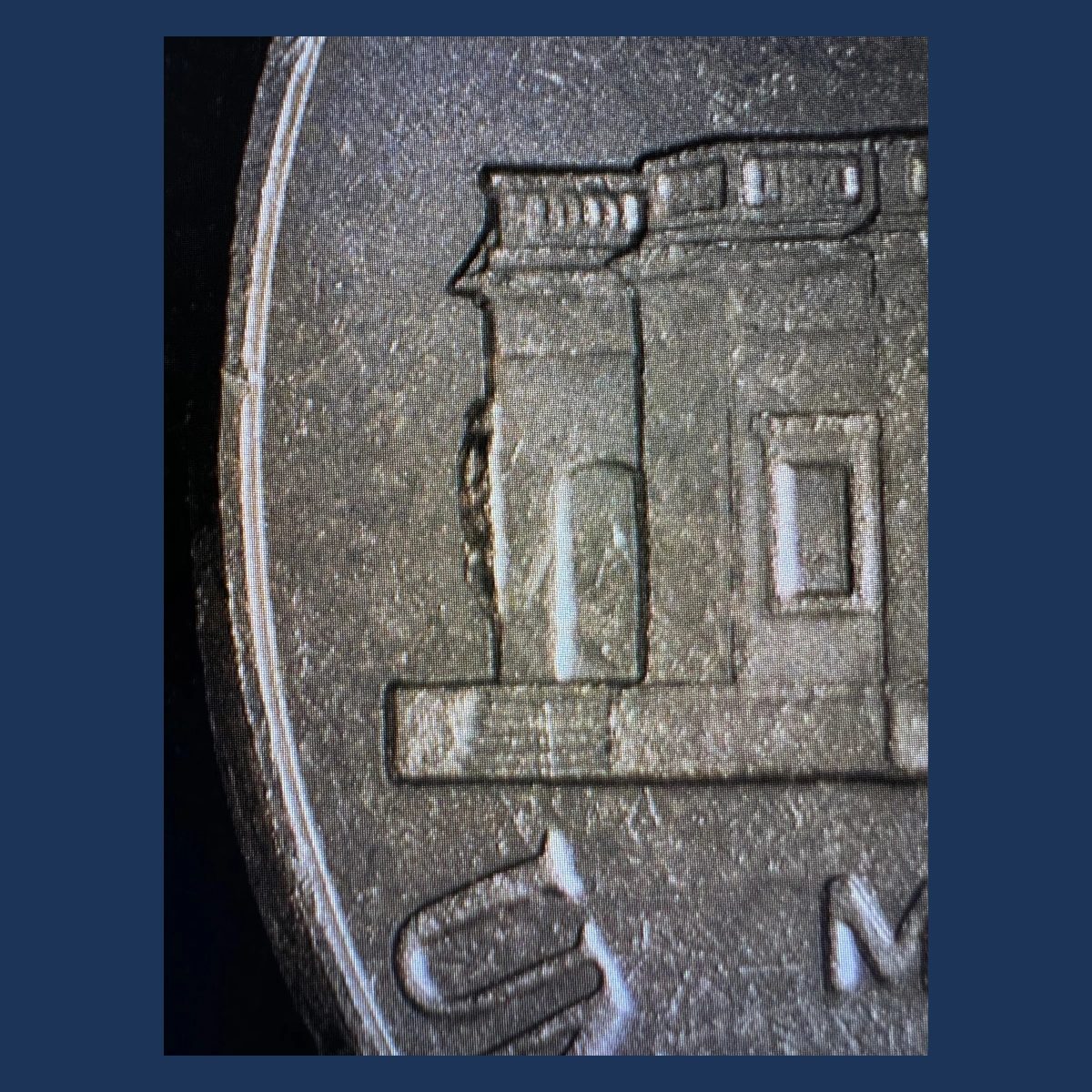
Extra metal beside a nose or letter can begin as missing steel in the stamping tool. The coin’s metal fills the damaged space during striking.
A narrow crack produces a raised line. A small piece breaking away inside the tool leaves a chip-shaped patch, while a larger edge break can join the rim.
Reports for 2020 include the nose, chin, LIBERTY, and the building. These locations describe different examples, not a requirement that every mark appear on one nickel.
A coin damaged after minting can also have raised metal, but that usually comes from metal pushed out of another area.
Estimated Value
An estimated $3–$100 covers small 2020 cracks and chip effects, from faint lines to larger, easily recognized patches. Tiny marks on worn coins belong near the low end.
The price depends on how clearly the extra metal can be seen. A distinct shape beside an intact letter is usually easier to explain than a rough, battered area.
These are estimates for tool damage. Do not count several nearby lines as separate additions to the coin’s value.
How to Identify
Find where the extra metal begins and ends under a 10× magnifier. A chip effect rises from the design without a matching gouge made by pushing the coin’s metal aside.
With the lamp coming from the side, follow any narrow raised line through its whole path. A scratch runs into the surface instead.
Examine the plain edge near a large patch. A rim hit may create both a dent and a displaced lump, unlike the missing-tool effect.
Use a scale and calipers on a loose coin to compare 5.00 grams and 21.21 millimeters. These ordinary measurements help rule out broader alteration.
Compare the affected nose, chin, lettering, or building with a normal 2020 nickel before calling a natural design feature extra metal.
3. 2020 Jefferson Nickel Peeling Alloy
A small flap near the portrait or Monticello’s dome is among the reported lamination features for 2020. Lamination means a layer within the metal has begun separating.
The nickel is a uniform copper-nickel alloy, not a copper core covered by separate outer sheets. A weak area within that alloy can lift, crack, or leave a shallow hollow.
The result may retain part of the design on the loose flap. A fully detached layer can reveal rougher metal underneath.
This differs from grease blocking a strike: lamination involves the coin’s own metal separating rather than an outside object interfering.
Estimated Value
For genuine 2020 lamination, an estimated $10–$150 covers small visible defects through larger, attractive retained flaps. A clear connection between the flap and coin helps show the cause.
An empty rough patch may attract less interest if its origin is difficult to see. Heavy corrosion also hurts the coin’s appearance.
These are estimated values for the reported type, not a quoted auction result. The size of a defect alone does not guarantee a higher price.
How to Identify
Protect a lifting piece before you examine it. Do not press it flat, pull it upward, or clean beneath it.
A 10× magnifier can reveal a thin boundary between the separating layer and the metal below. Check whether the design continues onto the flap rather than assuming every rough patch is peeling metal.
For a loose nickel, use a scale to compare with 5.00 grams and calipers with 21.21 millimeters. A small retained flap may leave the weight almost unchanged.
Examine the plain edge for a deeper separation, then compare the affected area with nearby healthy metal. Scattered pits favor corrosion; a scraped channel with pushed-up sides favors tool damage rather than a natural layer lifting away.
4. 2020 Jefferson Nickel Doubled Building and Lettering
Monticello’s central doorway and nearby architecture look heavier on the listed 2020-P doubled variety. Some details also show extra separation rather than simple thickening.
The added design was present on the stamping tool before it struck the nickel. Collectors call that a doubled die, whether the affected design is on the front or back.
The back pattern includes central columns, doorway, steps, triangular roof, window, and parts of MONTICELLO. Front doubling is separately reported on the motto and handwritten LIBERTY.
A front report should be checked on its own coin; the confirmed back pattern does not prove front doubling.
Estimated Value
A matched 2020 doubled design has an estimated range of $5–$200. Strong, clear additions on a clean unworn nickel support more interest than slight thickening on a worn coin.
The building variety is best valued after comparison with a matching photograph. Ordinary thick-looking architecture or a flat shelf beside a letter does not receive the same premium.
This range is an estimate, not a claimed sale of every reported front or back pattern from this year.
How to Identify
Compare the building with the listed 2020-P example, using a 10× magnifier. Start at the doorway and follow the related thickening into the central columns and nearby details.
Confirm the P first; a general resemblance on another mint’s coin is not the same match. Check the front motto and LIBERTY separately if those are the features that drew your attention.
A loose example normally weighs 5.00 grams and measures 21.21 millimeters, checked with a scale and calipers. Its edge is plain.
Change the lighting to separate a real added outline from glare. A flat shelf caused by movement during the strike differs from the listed tool-made pattern, which should remain visible as the light moves.
5. 2020 Jefferson Nickel Clipped Blank
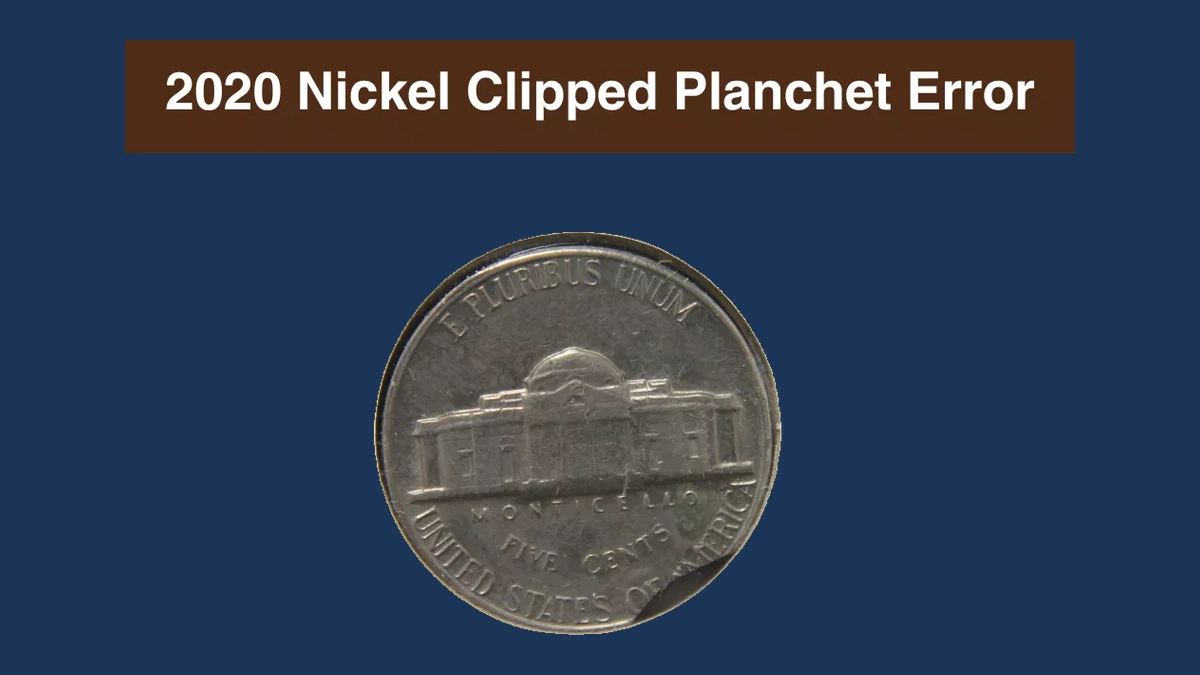
The missing section of a clipped nickel began before the coin received its design. A blank cut from the wrong place in a metal strip can be incomplete.
An overlap with an earlier punched hole produces a curved gap. Cutting across the strip’s edge can leave a straighter missing section.
Both forms are reported for 2020 nickels and belong to the same missing-blank group. Their size is a feature of the individual coin, not a fixed characteristic of the year.
The strike presses metal toward the opening. Later cutting or filing removes metal after those striking effects have already formed.
Estimated Value
For a genuine 2020 clip, estimate $15–$200, allowing for tiny missing sections and larger, clearer examples. The upper part needs convincing original edges and good remaining detail.
A 1997-P nickel with a 20% curved clip sold for $124 in March 2025. It provides a different-year comparison for a substantial opening.
A straight gap is not automatically more valuable than a curved one. Buyers judge the amount missing, visibility of the error, and condition of the complete coin.
How to Identify
Study the two ends of the gap at 10× magnification before deciding how much metal is missing. Natural metal flow at the boundary differs from file marks left by later cutting.
Check the rim opposite the opening for weakness. That can support a genuine clip, although not every clipped nickel shows it clearly.
For a loose example, weigh it against the usual 5.00 grams and measure the surviving round outline against 21.21 millimeters. Use a scale and calipers without squeezing the edge.
The normal edge is plain. Fresh bright cuts, repetitive tool scratches, or a sharply carved notch call for further examination even if the coin weighs less than normal.
Keep both ends of the gap visible in one photograph so the shape can be judged as a whole.
6. 2020 Jefferson Nickel Blocked Strike
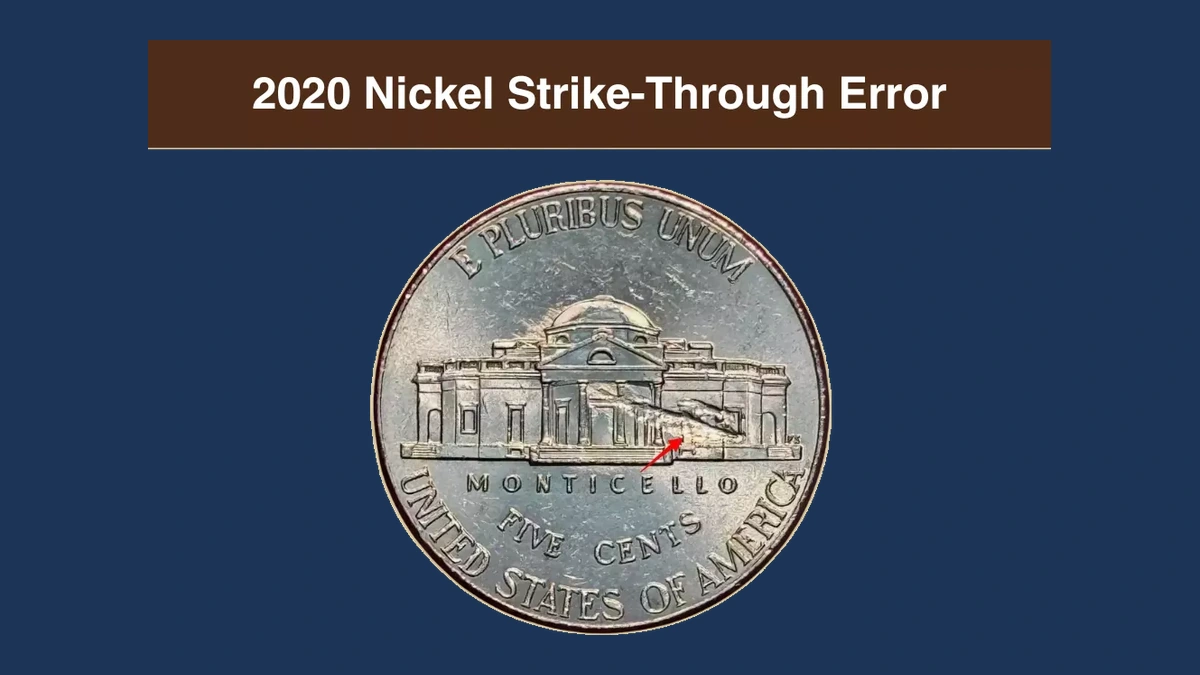
A large weak patch can form when material comes between the coin and its stamping tool. The blocked area receives less of the intended design.
Mint Error News displays an NGC-labeled 2020 major struck-through nickel. Separate collector reports describe a 2020-P back error and a 2020-D front error affecting much of the portrait and some lettering.
These examples should be compared individually. A label on one coin does not authenticate another owner’s nickel.
Grease and solid debris can produce different shapes. The weak area alone does not name the material that blocked the strike.
Estimated Value
Estimate $10–$250 for genuine 2020 struck-through nickels, from small weak areas to broad, clearly recognizable interruptions. The size and definition of the blocked design affect interest.
A 2000-D nickel struck through a coin stuck to a tool sold for $84 in September 2025. That earlier example involved a different obstruction.
It provides a modest price comparison, not the value of the NGC 2020 display coin. A clear major defect may attract more than a faint patch.
How to Identify
Choose the correct face before comparing examples: the reported P coin affects Monticello, while the D report affects Jefferson and nearby lettering. Examine the date and mint letter with the defect still in view.
With a 10× magnifier, look across the boundary between clear and missing design. A blockage may leave a depression or weak detail without the scraping lines of later removal.
For a loose nickel, compare 5.00 grams and 21.21 millimeters using a scale and calipers. Check the plain edge for compression associated with deliberate flattening.
Do not rub any material that remains attached. If a label states only struck-through, keep the object’s identity open rather than deciding from its outline that it was cloth, wire, or grease.
7. 2020 Jefferson Nickel Broadstrike
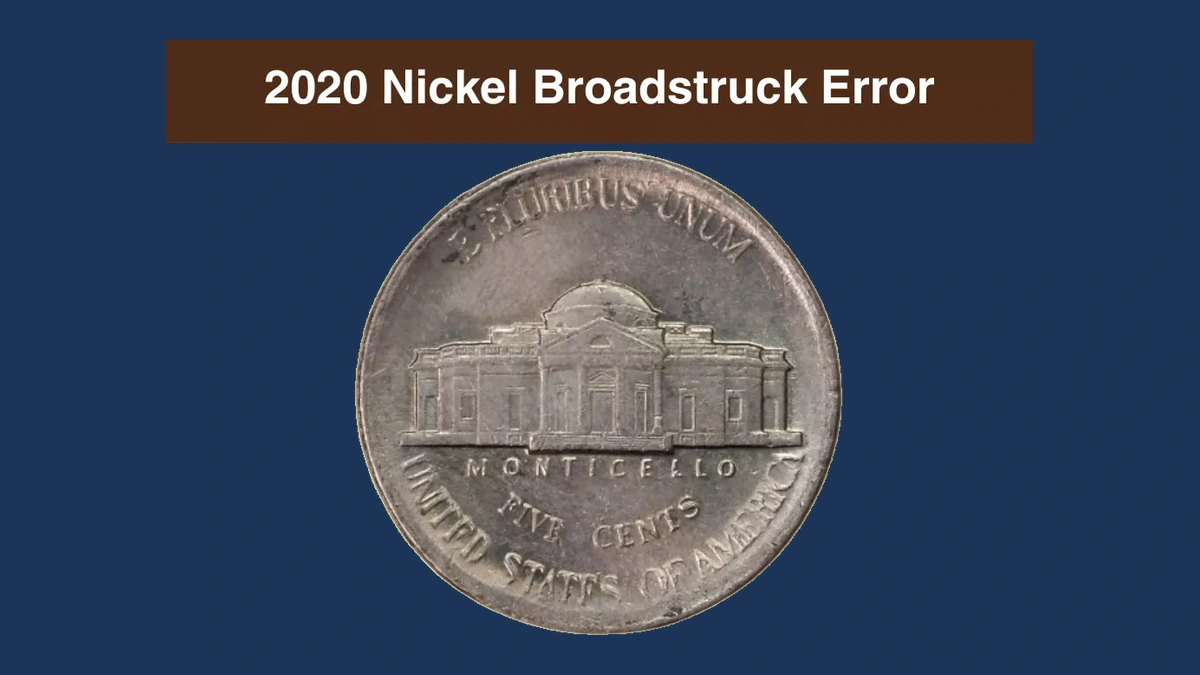
A broadstrike can give a nickel an unusually wide border around a complete design. Metal spread outward because the retaining collar did not properly surround the blank.
The collar is the ring that controls the coin’s diameter during the blow. Without its support, expansion can be uneven rather than a perfect circle.
Broadstrikes are reported for 2020 nickels. A complete design and genuine outward spreading are more useful clues than a wide rim on only one face.
The ordinary nickel already has a smooth edge. Smoothness therefore does not prove that the collar failed during production.
Estimated Value
Use an estimated $40–$300 for a genuine 2020 broadstrike. Clearly expanded examples with strong design usually attract more than coins with barely noticeable spreading.
A 1999-P broadstruck nickel graded PCGS MS63 brought $89 in March 2025. That grade describes an unworn coin with visible marks, and its date is different from the coins discussed here.
The earlier sale offers a useful comparison. It does not make every 2020 nickel with a wide-looking border worth the same amount.
How to Identify
Count the design elements before measuring the outline. Both faces should retain their intended designs; missing portions may instead point toward an off-center strike.
Use calipers to compare a loose example with the normal 21.21-millimeter diameter. Weigh it against 5.00 grams to check whether metal was added or removed.
An uneven expansion can still be genuine. Inspect the expanded area and plain edge with a 10× magnifier for repeated hammer marks, squeezed lettering, or folds from later damage.
Compare the apparent extra border on both faces rather than judging only one photograph. A shifted tool can create an uneven border on one side without the whole coin spreading into a broadstrike.
8. 2020 Jefferson Nickel Improperly Heated Blank
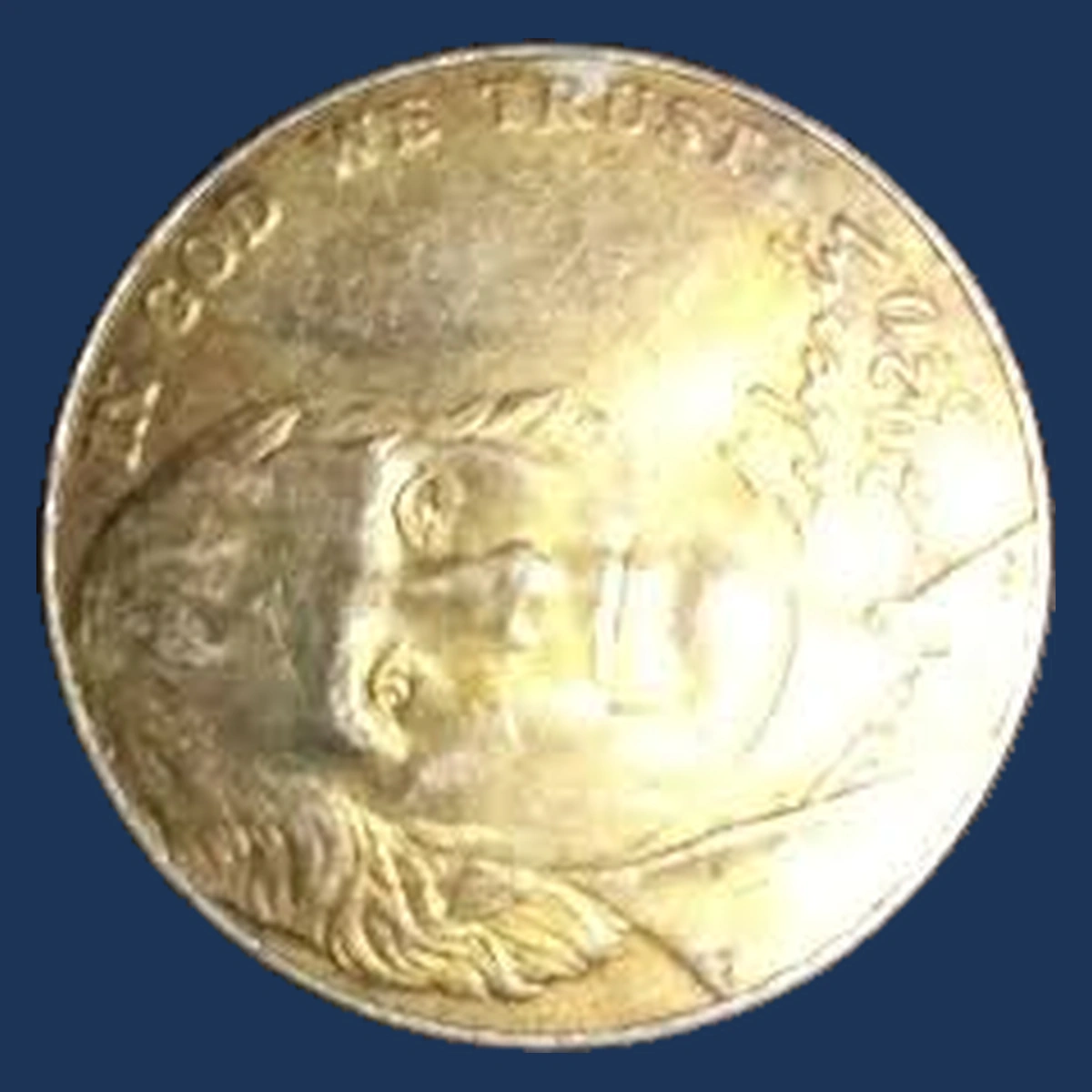
A dark, brown, or coppery nickel can raise a question about how its blank was heated. Annealing is the heating step that softens metal before striking.
Problems during that process can change the blank’s surface. The design is then struck into the affected metal.
Improper annealing is reported for 2020 nickels, but color alone cannot distinguish it from later staining or heating. The condition of the surface must also be examined.
The alloy remains a uniform mixture of copper and nickel. This is not a thin nickel coating peeling away to expose a copper center.
Estimated Value
A 2005-D Bison nickel described as improperly annealed sold for $119 in December 2022. It was graded NGC MS62, meaning unworn with fairly noticeable marks.
For an authenticated 2020 example, estimate $30–$400, depending on the strength of the effect and surface condition. That is a different design from the Bison comparison.
Brown color by itself does not earn the range. A heavily stained or heat-damaged coin can look dramatic without having a mint-made annealing error.
How to Identify
Keep the coin away from polish or chemical cleaners. Removing the color also removes evidence about the surface.
Examine both faces and the plain edge under neutral light, then use a 10× magnifier on the colored areas. Look for pitting, loose residue, or damage associated with later exposure.
For a loose coin, record its weight and diameter with a scale and calipers. The normal figures are 5.00 grams and 21.21 millimeters, though matching them does not prove when the color formed.
Compare the underlying design and surface with an ordinary nickel of the same finish. A color claim needs expert authentication before it becomes an annealing diagnosis, especially when staining or later heating could explain the same appearance.
9. 2020 Jefferson Nickel Off-Center Strike
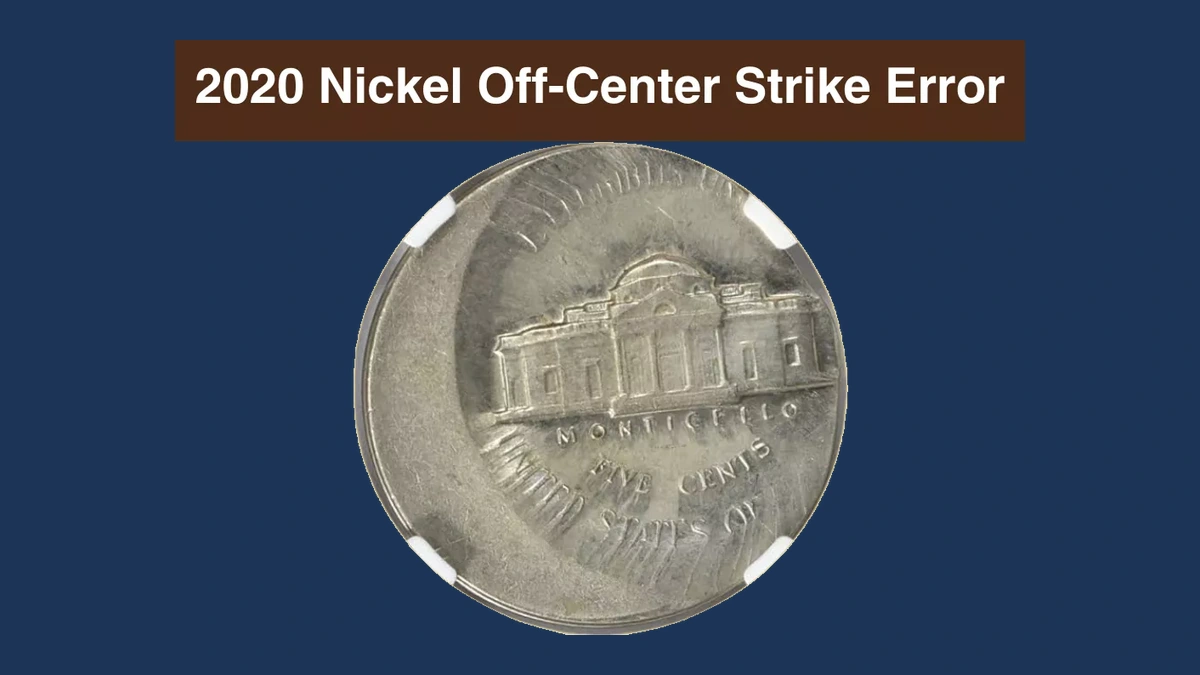
A nickel that missed the center of the press can show a smooth blank area beside a cut-off design. Both tools struck the same misplaced blank.
The amount of displacement controls how much portrait or building remains on the coin. A complete date may survive even when another large part of the design is missing.
Off-center strikes are reported for 2020, including coins that also received a second blow. A single shifted strike and a doubled design should not be confused.
If only one face appears displaced while the other is normal, the tool alignment needs a separate check.
Estimated Value
A 1999-P nickel struck 15% off-center sold for $64 in March 2025. The earlier year makes it a comparison rather than a sale record for 2020.
For genuine single-strike 2020 examples, estimate $30–$400. Modest shifts generally bring less than large, attractive errors that still show the entire date.
A second strike can change the price and should be assessed with the complete coin. Do not add this range to a double-strike range for the same object.
How to Identify
Find the date and mint letter first, then turn the coin to examine the building. Both faces should show how the blank missed the intended striking area.
Use a 10× magnifier along the unstruck portion. Natural untouched metal differs from design flattened by a later blow or removed with a tool.
The two faces must be compared against the same physical edge. A wide border on one side alone can result from a misaligned tool.
For a loose example, use a scale to compare 5.00 grams and calipers to compare the usual 21.21-millimeter outline. Inspect the plain edge for cutting or bending.
Now look for a separate earlier design beneath the shifted one. If another set survives, evaluate the coin as a multiple strike rather than a simple off-center strike.
10. 2020 Jefferson Nickel Double Strike with Displacement
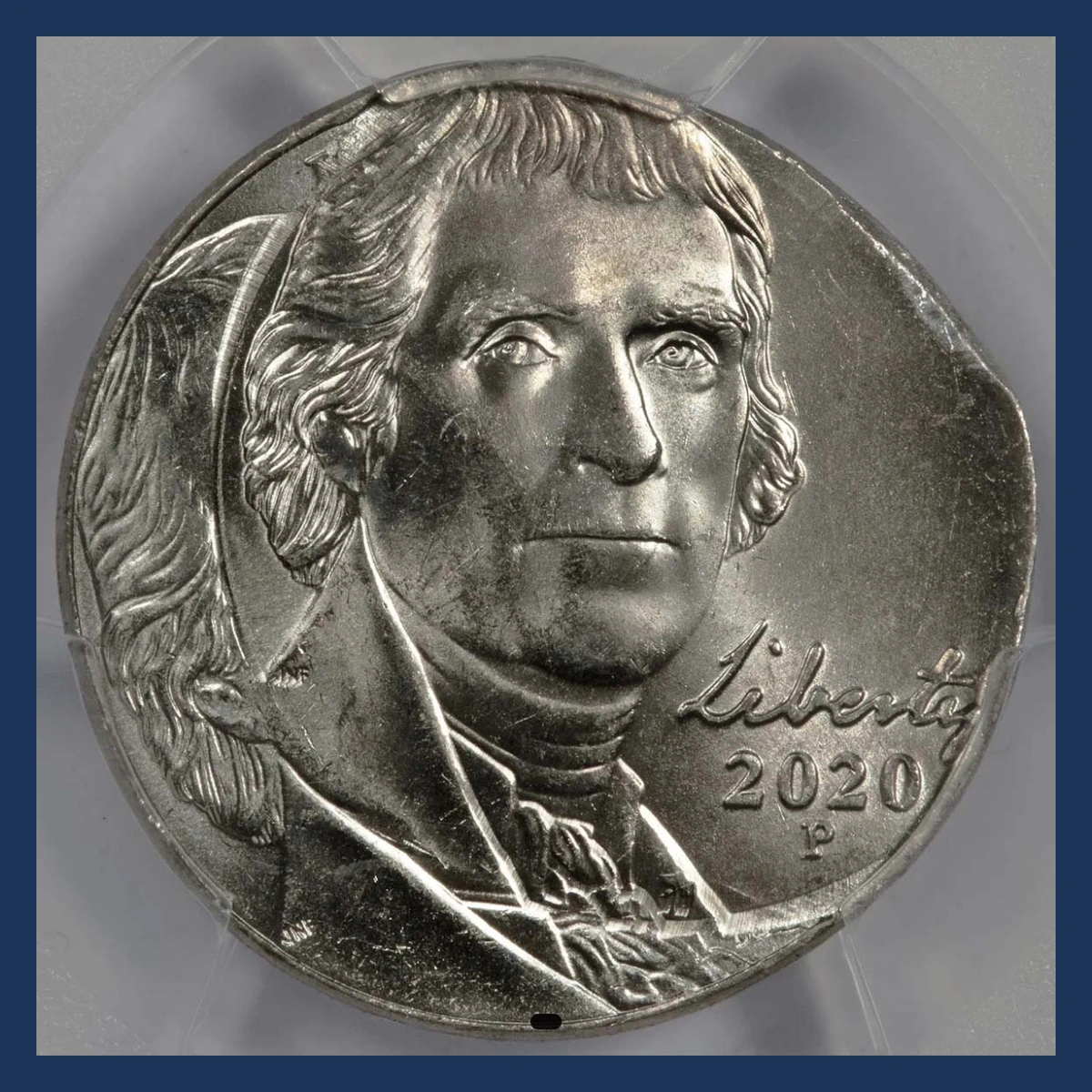
Two positions of the portrait or building can reveal a nickel that remained in the press for another blow. The later strike partly overwrote the earlier design.
The reported 2020 double-strike category includes displacement, so the second design need not fit entirely on the coin. Surviving fragments can be more useful than searching for two complete portraits.
This happens during coin striking. A doubled die instead carries an extra design on the tool and repeats that same pattern on later coins.
The original impression may be flattened in places by the second blow, making its remaining edges unevenly visible.
Estimated Value
For genuine 2020 double strikes with clear displacement, estimate $100–$800. Strongly separated designs and a readable date generally attract more than faint overlaps.
An earlier 1984-P flipover double strike sold for $480 in September 2024. Its coin turned over between blows, unlike a double strike that keeps the same face upward.
That sale is a broader multiple-strike comparison, not proof that a reported 2020 coin also flipped. Wear and damaged surfaces can reduce the appeal of either kind.
How to Identify
Map one design at a time on enlarged photographs. Trace a surviving portrait edge or building line, then look for another part that moved by the same amount.
A 10× magnifier helps follow fragments where the later blow flattened the first. A single flat shelf beside a letter does not establish two separate strikes.
If the coin is loose, compare 5.00 grams and 21.21 millimeters with a scale and calipers. Check the plain edge for crushing or signs that two altered pieces were joined.
Classify the finish too: collector Proof coins are normally struck more than once under controlled conditions. Extra blows become an error when a separate displaced impression survives, not simply because a Proof coin received its normal repeated strikes.
11. 2020 Jefferson Nickel Reported Earlier-Coin Overstrike
A reported 2020-over-2004 claim concerns an already finished coin receiving a later year’s design. Such an overstrike would preserve parts of the older coin beneath the new impression.
To identify it, both sets of designs must belong to real coins. A few lines that resemble digits are not enough to establish an earlier date.
The reported claim should therefore be judged by readable older features on the actual piece. It does not follow that ordinary 2004 nickels were routinely returned to make 2020 coins.
Transferred clash lines and displaced same-year strikes provide different explanations for extra marks.
Estimated Value
If authenticated as a genuine earlier-coin overstrike, use an estimated $500–$2,500 for a 2020 example. Clear older designs and a readable later date support the stronger end.
A 1989-P nickel struck on an already struck cent brought $840 in December 2024. That was a different denomination beneath the nickel, not a 2004 nickel.
The sale is a related overstrike comparison. It does not authenticate the reported 2020-over-2004 claim or establish its market price.
How to Identify
Start with the alleged older design, not the seller’s label. Compare each surviving feature with a normal coin of the claimed earlier year and type.
For 2004, identify which of that year’s designs is supposed to be underneath. Several recognizable features should agree in their orientation; a lone shape resembling a 4 is weak evidence.
Use a 10× magnifier to examine where the later design crosses the older details. Genuine striking relationships must be separated from engraving, squeezing, or added metal.
A loose nickel-on-nickel example should be compared with 5.00 grams and 21.21 millimeters using a scale and calipers. Inspect its plain edge for seams and obtain specialist authentication of both design sets before assigning the conditional value.
Conclusion
These estimated ranges span $3–$2,500. Small tool marks occupy the modest end; the highest estimate requires authentication of a coin struck over an earlier coin.
Monticello’s extra outlines deserve a photo match, while a weak portrait calls for a check of the surrounding surface. Missing metal and moved designs require different tests again.
Keep the date, mint letter, both faces, and edge together in your records before comparing prices.