1826 Cent Error List with Pictures

A well-worn 1826 cent struck twice after flipping over sold for $460 in February 2003. Its overlapping images made it interesting even after much of the original detail had worn away.
This 1826 penny error list covers estimated values of $50–$5,000, including a hidden older date, peeling copper, and misplaced strikes. The coin is the large Coronet Head cent, also called the Matron Head cent.
Begin with the date and both faces before checking the smaller clues.
1. 1826 Coronet Head Cent Strike Doubling
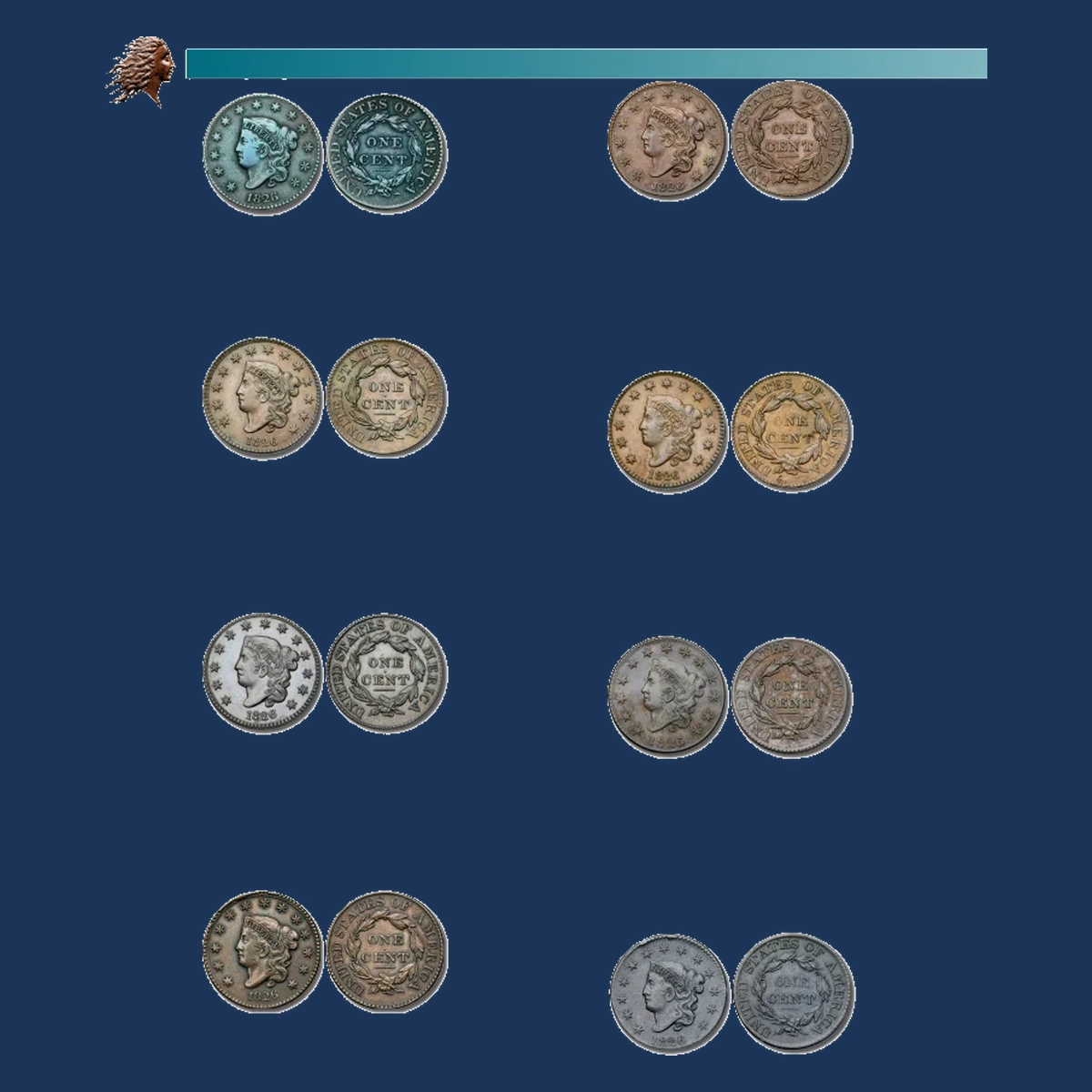
A second edge beside Liberty’s face can be easier to notice than a tiny date detail. The 2026 Early American Coppers catalog describes double outlines along the face, coronet, and upper stars on one 1826 cent.
Another listed coin has strike doubling on the upper stars. These are separate examples, rather than one coin carrying every reported feature.
Strike doubling describes extra outlines made during the blow. It should not automatically be renamed a doubled die, which means the stamping tool itself carried doubled design.
Wear can soften these outlines, making clear photographs especially useful.
Estimated Value
Estimate $50–$200 for a worn cent with visible extra outlines and $200–$800 for a sharper example. These are estimates for the complete coin, including its ordinary collectible value.
A dramatic double profile can attract more attention than a tiny step beside one star. Surface quality and remaining portrait detail also matter.
The catalog descriptions establish the reported features, not a separate sale price for each extra line. Several doubled stars do not create several premiums.
How to Identify
The portrait and the upper stars need separate inspection because the catalog describes different examples. Start with whichever area shows a clear extra edge on your coin.
Under a 10× magnifier, move the light across that edge and compare its height with the main design. A flat step or smeared border is different from a complete second portrait displaced across the surface.
Check the plain edge for a later impact that could have pushed metal sideways. Use a scale and calipers on a loose cent to compare it with 10.89 grams and roughly 28–29 millimeters.
Take a steady photograph directly above the affected area. Camera movement can also make an ordinary edge appear doubled in a picture.
2. 1826 Coronet Head Cent Lamination
The back of one 1826/5 cent has a copper flake that remains attached. It runs from above IT in UNITED toward the left side of the wreath near the bow.
Stack’s Bowers described this feature in its March 2016 Twin Leaf catalog. The same coin also carries the overdate discussed later in this list.
This surface separation is called a lamination. A weak area inside the metal lets part of the surface loosen instead of staying firmly joined.
The description concerns an attached flake, not a large cent split into two complete disks.
Estimated Value
Use an estimated $75–$300 for a worn example with a visible flake and $300–$1,000 for a clearer, well-preserved coin. A lamination that leaves the date and main design readable is easier to appreciate.
The reported 1826/5 example also has an overdate, which affects its total value. Do not add the full price of each feature together.
For scale, an 1841 large cent with a front lamination brought $564 in December 2021. Its later date makes it a comparison only.
How to Identify
Protect the attached flake before handling the coin. Do not lift it, press it down, or clean beneath its edge.
Look above IT in UNITED and follow the separation toward the left wreath and bow. Low side lighting through a 10× magnifier can show a raised flap rather than a groove cut into the copper.
If a loose example can be handled safely, use a scale against the original 10.89 grams and calipers against 28–29 millimeters. An attached flake may change the weight very little.
Inspect the plain edge if the separation reaches it.
Include the nearby surface in photographs, since corrosion can leave rough patches that resemble peeling. The recognizable attached layer matters more than a low weight reading.
3. 1826 Coronet Head Cent Clipped Blank
An 1826 Matron Head cent from the Rippere collection was listed by GreatCollections with a clip. ANACS graded it G4 Details, describing a heavily worn coin with an additional condition problem.
A clip begins with an incomplete blank, the metal disk used to make the coin. The missing section interrupts the outline before the design is stamped.
The listing title does not give the gap’s direction or shape. Those details must come from the actual coin rather than another date’s photograph.
The Details grade does not by itself cancel the clip attribution.
Estimated Value
Estimate $75–$350 for a worn 1826 clipped cent and $350–$1,200 for a stronger example with an obvious original gap. These are estimates, not a claimed result for the Rippere coin.
An unworn 1852 clipped large cent sold for $384 in June 2024, providing a different-date comparison. A heavily worn coin with other surface problems needs its own assessment.
The gap’s visibility helps, but a large cut made after minting does not earn the same premium.
How to Identify
Compare the gap’s two ends with the adjacent design through a 10× magnifier, looking for marks from striking around an incomplete blank. Saw lines or repeated file strokes cutting through finished details instead suggest later removal.
Examine the plain edge and the border opposite the opening, where weakness may help support an original clip. Heavy circulation can soften those signs, so their absence should not decide the identification alone.
For a loose cent, compare its weight with 10.89 grams on a scale and intact spans with 28–29 millimeters using calipers. Lower weight confirms missing metal, but a later cut also removes metal and needs to be ruled out.
4. 1826 Coronet Head Cent Rim Cud
A raised patch can swallow a star and continue into the rim. This is a cud, formed when a piece breaks away from the edge of a die, the steel stamping tool.
Copper rises into the empty space during striking. The patch replaces design that the missing tool section can no longer make.
Early American Coppers references describe several 1826 examples. Their locations include beside the fifth star, above the seventh, and across the fifth through eighth stars.
Those positions belong to separate examples. A genuine coin need not display all three breaks together.
Estimated Value
An estimated $100–$400 suits a smaller visible cud on a worn coin, while $400–$1,500 covers larger, clearer examples. These ranges value the complete cent rather than the raised patch alone.
An 1829 large cent with three cuds brought $810 in September 2020. That different-date result is a useful scale comparison, not a sale of an 1826 example.
Collectors consider the patch’s size, its connection to the rim, and the amount of original detail around it.
How to Identify
A cud redirects copper into a broken tool rather than adding a separate lump to the coin. Compare a loose example with 10.89 grams and roughly 28–29 millimeters using a scale and calipers.
Then find where the raised patch joins the rim. Through a 10× magnifier, inspect the nearby plain edge for a dent, folded metal, or an attachment seam.
Number the stars from the lower left around Liberty to compare the reported locations. The fifth-star, seventh-star, and fifth-through-eighth-star descriptions belong to separate examples.
Check the matching area on the back for weak detail. Such weakness may support a large break, but its absence on a worn coin does not automatically reject the raised patch.
5. 1826 Coronet Head Cent Rotated Dies
To check a rotated die, compare the entire front with the entire back. After a normal American coin is flipped top to bottom, the back should appear upright.
If a stamping tool turned away from its intended position, the completed coin can show a tilted back. The price depends partly on how far that complete design turns.
The 1826 check needs special care because a known coin has tilted clash marks but normally aligned main designs. Its thirty-degree ghost outline is not evidence that the coin itself has a thirty-degree rotation.
Estimated Value
For an 1826 cent with a measured, genuine rotation, estimate $100–$500 in worn condition and $500–$2,000 for a pronounced turn on a sharper coin. These are conditional estimates for the complete coin.
A lightly worn 1830 example with a much larger turn is a different-date comparison in collector catalogs. Small alignment differences are less striking.
The tilted ghost on an 1826 cent belongs under die clashes. Its angle should not be used to price a rotated-die error.
How to Identify
Hold Liberty upright and turn the coin from top to bottom without twisting it sideways. Watch ONE CENT and the surrounding letters, not the faint ghost of Liberty on the back.
The main back lettering should finish upright on an ordinarily aligned American coin. Repeat the turn and use a fixed photograph or video to record any consistent tilt.
Before trusting the result, use a 10× magnifier to inspect the plain edge for a seam or other alteration. A scale and calipers can compare a loose large cent with its original 10.89 grams and roughly 28–29 millimeters, but those measurements do not establish the rotation angle.
6. 1826 Coronet Head Cent Die Clash
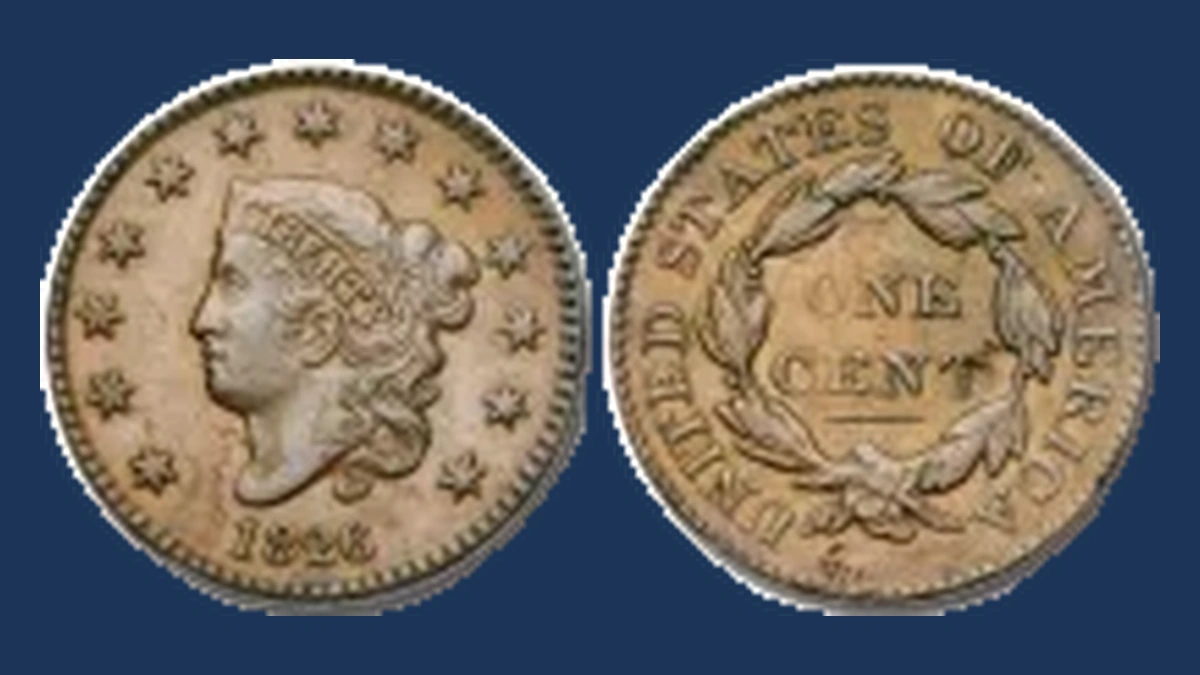
A faint portrait where the wreath belongs can come from a clash. The stamping tools struck each other without a blank between them and picked up unwanted design traces.
Later coins received those extra marks. The result is a ghost of the opposite design, rather than a second full strike on the coin.
Goldberg described an 1826 N-7 cent whose back has a Liberty outline turned about thirty degrees clockwise. N-7 is a catalog number for its tool pairing.
The coin’s main designs still align normally. This example separates a rotated clash image from an actual rotated-die coin.
Estimated Value
Estimate $100–$500 for a worn cent with recognizable clash traces and $500–$2,500 for a sharper example. These are whole-coin estimates; better preservation contributes much of the higher value.
The Goldberg N-7 example was graded PCGS MS64, meaning unworn with some visible marks. Its tilted portrait ghost is an identification feature, not a price by itself.
Random scratches do not receive the same premium. Several connected ghost lines should be evaluated as one visible clash pattern.
How to Identify
Begin by turning the coin top to bottom with Liberty upright. On the described N-7 example, the main back design remains upright even though its faint extra portrait is tilted.
Now examine that extra outline through a 10× magnifier with light from the side. Use the wreath and ONE CENT to keep track of where the ghost portrait lies.
Compare several connected curves with Liberty’s face rather than judging one bright scratch.
Check an ordinary loose cent with a scale against 10.89 grams and calipers against roughly 28–29 millimeters. Inspect its plain edge for later squeezing.
The reported thirty-degree clockwise tilt belongs to the ghost alone. Preserve photographs that show it beside the normally aligned main lettering.
7. 1826 Coronet Head Cent 1826/5 Overdate
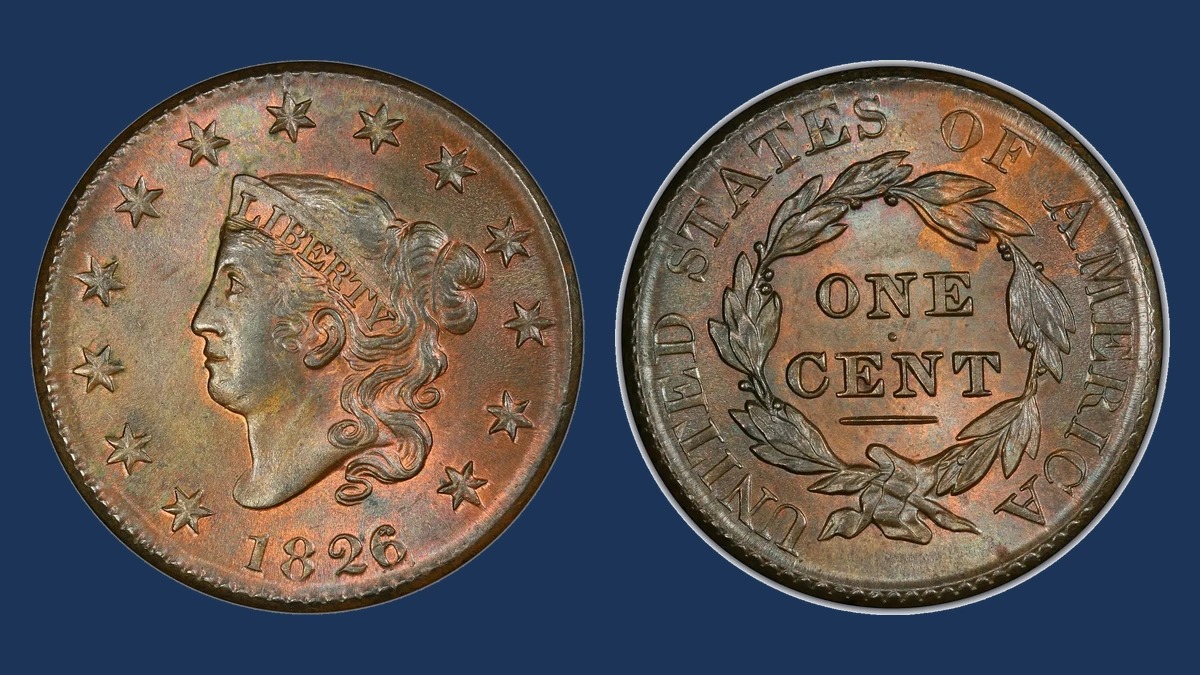
A small trace inside the final 6 can reveal an earlier date. On the 1826/5 overdate, part of the old 5 survives beneath the newer numeral.
This happened when the date was changed on the stamping tool. It does not mean a finished 1825 cent was engraved into an 1826 coin.
The 2026 collector catalog points to the old 5’s upper stroke inside the 6. Wear and later use of the tool can make it much harder to see.
Compare the stroke with the surrounding date. Dirt or scratches inside an ordinary 6 can imitate an extra line.
Estimated Value
Estimate $100–$600 for a worn but identifiable 1826/5 cent and $600–$3,000 for a sharper example. Clear date detail and original surfaces help place a coin toward the higher end.
The retained-flake coin described earlier was graded PCGS AU55, indicating light wear. Its overdate and lamination belong to the same cent, so their full estimates should not be added together.
These are practical whole-coin ranges. Dirt inside an ordinary 6 does not create an overdate premium.
How to Identify
Confirm ONE CENT on the back before examining the date, since an 1826 half cent is a different coin. A loose copper large cent can be checked with a scale and calipers against 10.89 grams and roughly 28–29 millimeters.
Inspect its plain edge and the surface around the date for signs of alteration. Engraving a finished coin leaves cuts that differ from an old numeral retained in the stamping tool.
Focus a 10× magnifier on the upper part of the final 6 and compare the interior stroke with a clear 1826/5 photograph. Move the light to separate metal from shadows, but never scratch inside the numeral to remove dirt.
8. 1826 Coronet Head Cent Off-Center Strike
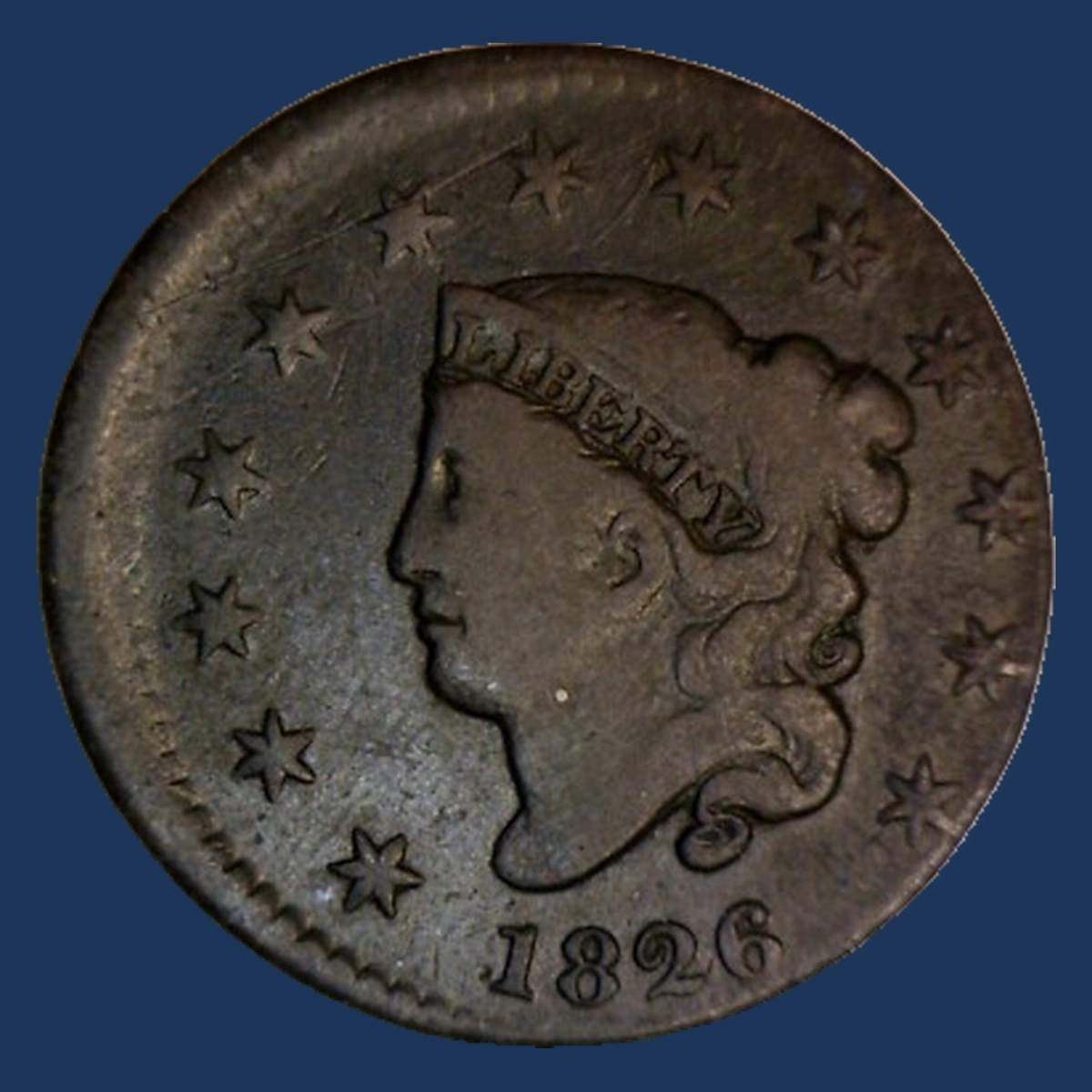
A misplaced blank leaves an empty crescent beside the design. Part of the intended image lands beyond the metal’s edge, creating an off-center strike.
Mint Error News reproduced an older catalog recording an 1826 large cent about ten percent off center toward nine o’clock. With the front upright, that direction is to the left.
The complete coin matters more than the percentage alone. A shifted image on just one face may instead result from a misplaced stamping tool.
This report concerns the large cent. An 1826 half cent is a different denomination and cannot substitute for it.
Estimated Value
Use an estimated $250–$900 for a worn but clear off-center example and $900–$4,000 for a sharper, more visually striking coin. A readable date helps establish its identity.
These estimates are not a sale result for the ten-percent catalog example. They allow for condition and the amount of displaced design.
For a different-date comparison, a thirty-percent off-center cent attributed to 1808 brought $6,462.50 in February 2018. Its greater displacement and better preservation place it above an ordinary worn example.
How to Identify
With Liberty upright, locate the date and the part of the design that runs beyond the left edge. The cataloged example is about ten percent off center toward nine o’clock.
The unused crescent still contains copper. Use a scale on a loose example against 10.89 grams and calipers to compare intact spans with roughly 28–29 millimeters.
Photograph the back using the same physical edge as a reference. Both faces should show a compatible shift, unlike a misplaced tool affecting only one side.
Examine the unused surface and plain edge under a 10× magnifier. Scraped-away lettering, grinding, or trimming can imitate missing design without reproducing the original surface of an unstruck area.
9. 1826 Coronet Head Cent Multiple Strike and Brockage
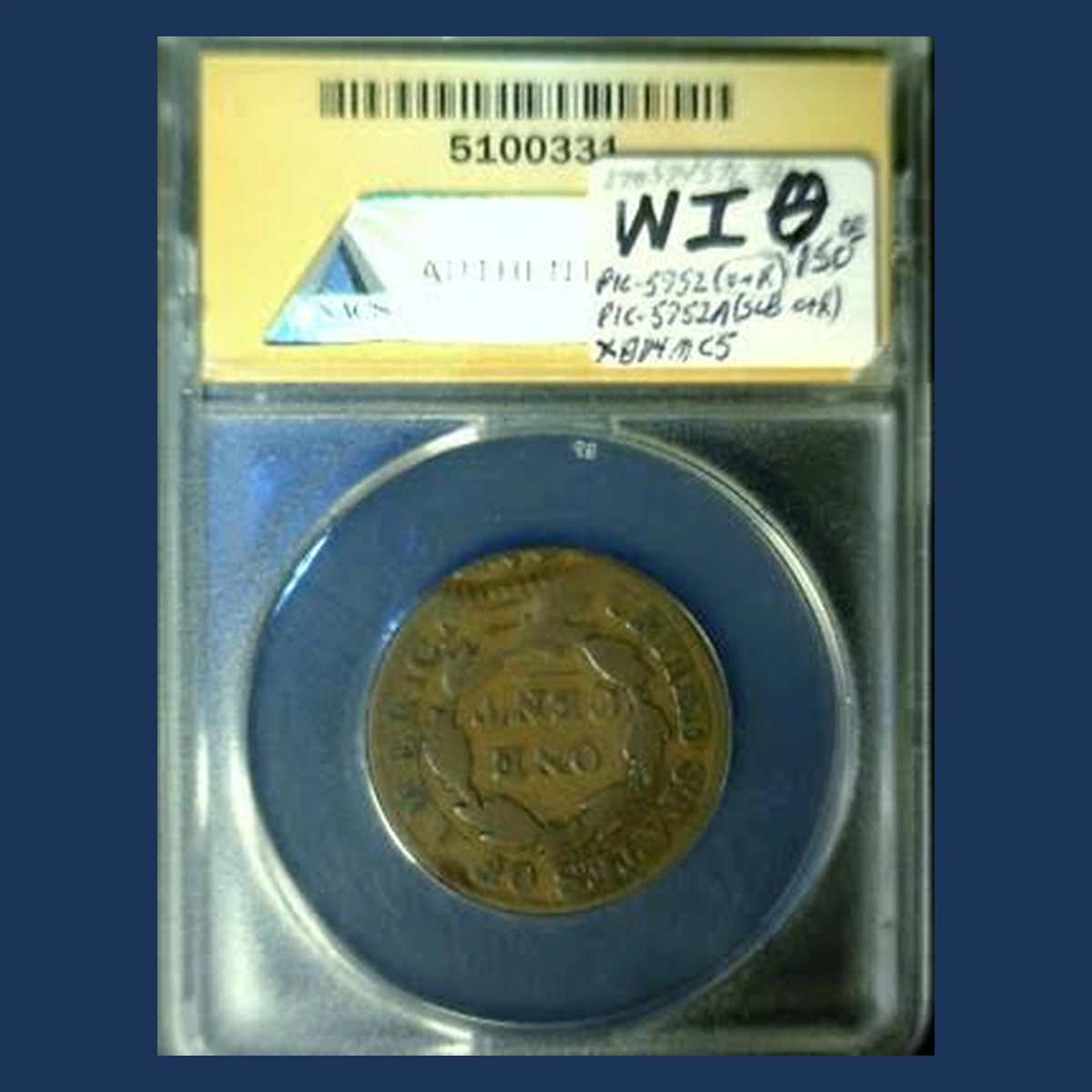
One 1826 cent flipped over before receiving another blow. Its front and back designs overlapped in a way that an ordinary single strike could not produce.
A PCGS auction record identifies that worn coin as VG10. A separate Mint Error News example was struck three times and graded NGC VG8.
The triple-struck cent also has back brockage: a sunken, mirror-image impression transferred by another coin. This backward detail accompanies the overlapping marks of its repeated strikes.
Compare the depth and direction of the surviving images on each example. Those clues help explain how the coin moved inside the press.
Estimated Value
Estimate $350–$1,500 for a readable worn multiple strike and $1,500–$5,000 for a stronger compound example. The number of blows alone does not determine the price.
The PCGS VG10 flip-over cent sold for $460 in February 2003 and $352.50 in January 2014. Those two results concern the same recorded coin.
The separate triple-struck brockage has no sale amount supplied here. Its estimate depends on how clearly the extra strikes and mirror-image impression remain visible.
How to Identify
For a flip-over double strike, find part of the opposite face’s design beneath the stronger image. That crossover is the main clue that the cent turned over before another blow.
Photograph several surviving letters or portrait features together. Do not infer the whole movement from one thick edge.
A scale and calipers can record a loose example against its original 10.89 grams and roughly 28–29 millimeters. Inspect the plain edge for later squeezing.
On the separate triple-struck coin, use a 10× magnifier and low light to examine the back. Its brockage should be sunken and backward, unlike faint raised lines from a clash.
Keep certified pieces in their holders and compare those different depths through photographs.
Conclusion
The best clue on an 1826 cent may be a tiny old digit, a raised rim patch, or a whole second design. This list places complete coins across an estimated $50–$5,000 range.
Keep the two rotation checks separate: a tilted ghost portrait does not mean the main designs are misaligned. Photograph both faces, preserve any loose copper flap, and compare actual design shapes before assigning an error name.