1830 Cent Error List with Pictures

A second trace beside the date’s 1 survives on an 1830 cent that brought $3,360 including the buyer’s fee in May 2026. Its unworn brown surfaces help explain that price alongside the small date feature.
For the examples in this 1830 penny error list, estimated whole-coin values range from $30–$8,000. A tilted wreath, peeling copper, and missing edge metal each call for a different check.
Compare the features below with your coin, keeping its condition and complete design in view.
1. 1830 Coronet Head Cent A Missing Edge Section
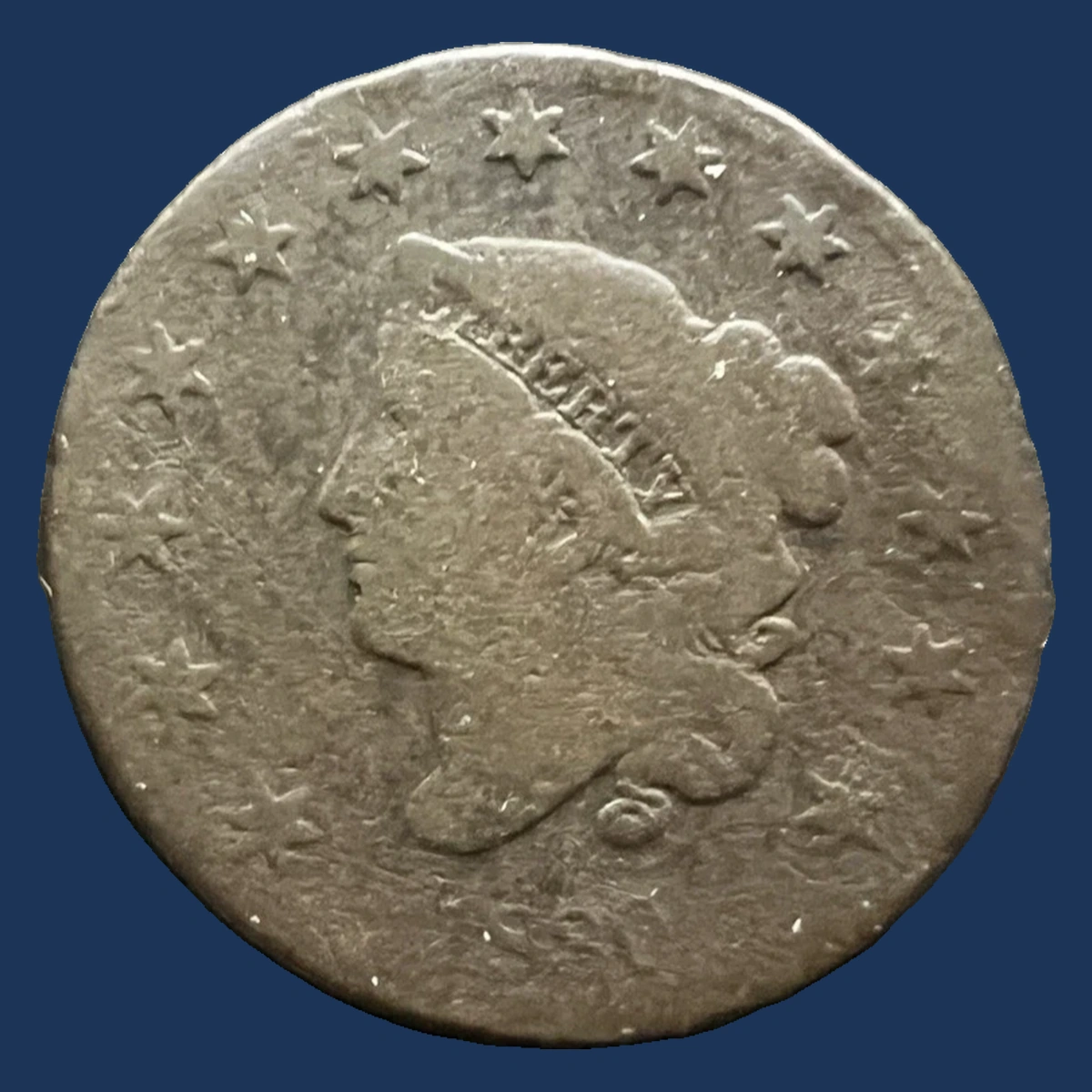
A gap at the edge can begin before the design is struck. The press stamps an incomplete copper disk, leaving the intended design interrupted by missing metal.
This is called a clipped blank. However, someone can also cut or file a finished cent into a similar shape.
A seller described an 1830 large cent as clipped and noted severe back scratches. Those scratches are separate damage and do not prove how the edge gap formed.
The report gives no gap direction. The original boundary must be examined before the candidate is valued as a mint error.
Estimated Value
If the gap formed before striking, estimate $40–$250 for a worn 1830 clipped cent and $250–$1,000 for a clearer, better-preserved example. These are estimated values for genuine clips.
The reported candidate’s severe back scratches would affect its appeal even if its clip were authenticated. A clean comparison should not set the price of a badly marked coin.
An unworn 1852 clipped large cent brought $384 in June 2024. Its later date and condition make it a general comparison only.
How to Identify
Look at the gap before trying to estimate how much copper is missing. Through a 10× magnifier, inspect the wall and both ends for saw marks, repeated filing strokes, or cuts through completed design.
Check the opposite border for supporting weakness, allowing for the heavy wear an early copper cent may have. The back scratches need to be recorded separately from the gap.
A loose original started near 10.89 grams and roughly 28–29 millimeters. Use a scale and calipers on intact areas, then inspect the remaining plain edge.
Both a genuine clip and a later cut can lower the weight. Full views of the two faces and the opening are needed to show whether the missing portion predates the strike.
2. 1830 Coronet Head Cent Small Flakes and Separation within the Copper
A small missing flake along Liberty’s jawline appears on an N-1 cent in an early-copper auction. ANACS graded that example MS61 Brown, indicating an unworn coin with noticeable marks.
The flaw is part of the original copper blank. A weak internal layer can separate and leave a shallow opening, an effect called lamination.
A different auction lists an 1830 lamination without stating its exact location. Its description does not place that flaw on the jaw.
The N-1 coin also has tiny raised bumps from rust on the stamping tool. Those bumps form differently from copper peeling out of the coin.
Estimated Value
For original 1830 laminations, estimate $40–$350 on worn coins and $350–$1,500 on attractive unworn pieces. The amount of surviving detail is often more important than the flaw’s size.
A separate 1830 lamination listing reports a $150 result from April 2023. It is not the ANACS MS61 jawline-flake example.
These prices concern complete cents. A small original flake may be tolerated, while a large separation removing important design can reduce what collectors will pay.
How to Identify
Find the jawline on an N-1 comparison and inspect the small opening with a 10× magnifier. The other listing requires its own photographs because its location was not stated.
Use low-angle light to see whether the boundary runs between layers of copper. Raised rust bumps copied from a tool sit above the surface instead of leaving a thin layer missing.
Keep any surviving flap attached and avoid rubbing the exposed metal. Photograph the connection before further handling.
If safe, compare a loose coin with 10.89 grams on a scale and roughly 28–29 millimeters using calipers. Touch only intact areas and include the plain edge if a split reaches it.
Ordinary corrosion can make irregular pits. A continuous layer boundary is more informative than a rough patch by itself.
3. 1830 Coronet Head Cent An Unusually Expanded Outline
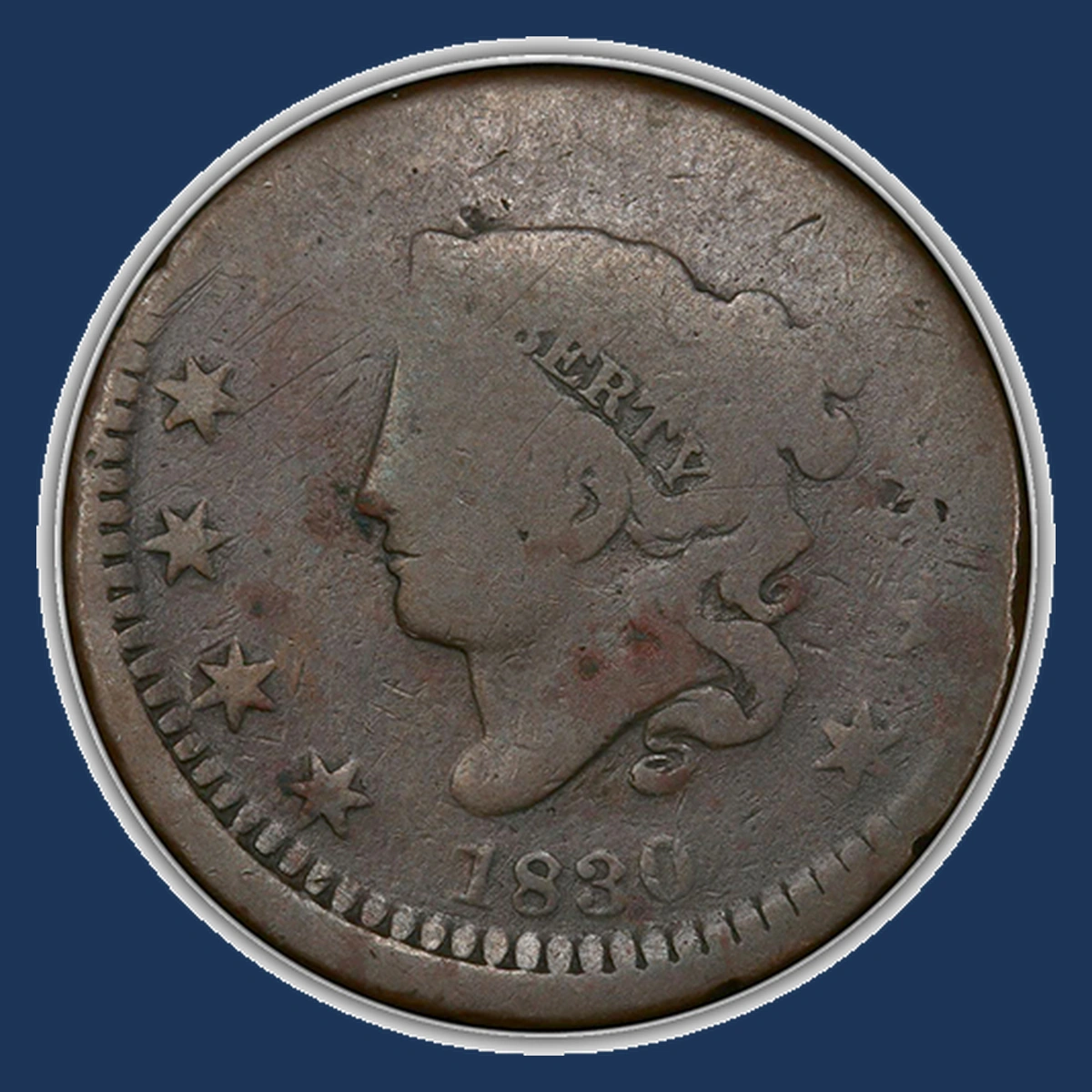
A dealer offered an 1830 large cent described as broadstruck outside the collar. The collar is the ring around the blank during striking.
On a broadstrike, copper spreads outward while the intended design remains on the coin. This differs from part of the design missing the blank during an off-center blow.
The offered coin was described as PCGS Good 4, a heavily worn grade. No exact expanded diameter accompanies the report.
Early cents already vary in outline because their production differs from modern close-fitting collar striking. A slightly wide coin therefore needs more evidence than a diameter measurement alone.
Estimated Value
The dealer’s listed price was $350 for the PCGS Good 4 example. That amount was an offer, not a recorded completed sale.
For a confirmed 1830 broadstrike, estimate $150–$600 in worn condition and $600–$1,500 for stronger, attractive examples. Genuine outward spread and surviving design need to support the comparison.
The estimate does not apply to every early cent with an uneven outline. Later hammering or ordinary variation in early manufacture can change the apparent width without establishing this error.
How to Identify
Compare the entire design with a normal 1830 cent before looking at the widest part. A broadstrike should retain the intended design within its expanded outline.
Use calipers in several directions on a loose example, comparing the usual 28–29-millimeter size rather than assuming one rigid modern tolerance. A scale records its weight against 10.89 grams.
Under a 10× magnifier, examine the border and plain edge for hammer marks, flattened letters, or later thinning. A wider outline alone does not establish when the spreading happened.
Keep photographs of both faces and the edge together for a specialist familiar with early copper. Look for outward spreading that ordinary early manufacturing variation or later hammering cannot explain.
4. 1830 Coronet Head Cent Raised Lines across the Stars and Date
Fine raised lines can connect separate stars or letters. Copper entered cracks in the stamping tool and reproduced them on the finished cent.
An N-4 catalog example has a line around much of the front’s stars and date. Back cracks connect letters with the rim.
A different N-8 example has a crack from the bust tip toward the border below star one. These are different tools and different paths.
The year guide also discusses a cud, a broader raised patch from missing steel at the rim. Its general explanation does not establish a particular rim patch on either recorded coin.
Estimated Value
Estimate $30–$750 for worn 1830 cents with clear tool cracks. Attractive unworn pieces, or confirmed substantial rim breaks, can fit an estimated $750–$4,000 whole-coin range.
The N-8 coin sold for $3,360 including the standard buyer’s fee in May 2026. Its repunched date and strong preservation share that same price with its crack.
A small line alone does not explain such a result. A broad cud must be confirmed on the actual coin rather than inferred from a thin crack nearby.
How to Identify
On the N-8 coin, the raised line leaves Liberty’s bust tip and reaches the border below the lowest left star. Follow that short path with a 10× magnifier and side light, without running anything across the coin.
A loose cent can be weighed on a scale against 10.89 grams and measured with calipers against roughly 28–29 millimeters. If a broad patch reaches the plain edge, examine that connection for a dent or added material.
The N-4 pattern requires a different comparison, extending around the front stars and date and through back lettering. Light each line from both sides: a crack stands above the surface, while a scratch has a cut center.
5. 1830 Coronet Head Cent A Second Trace beside the Date’s 1
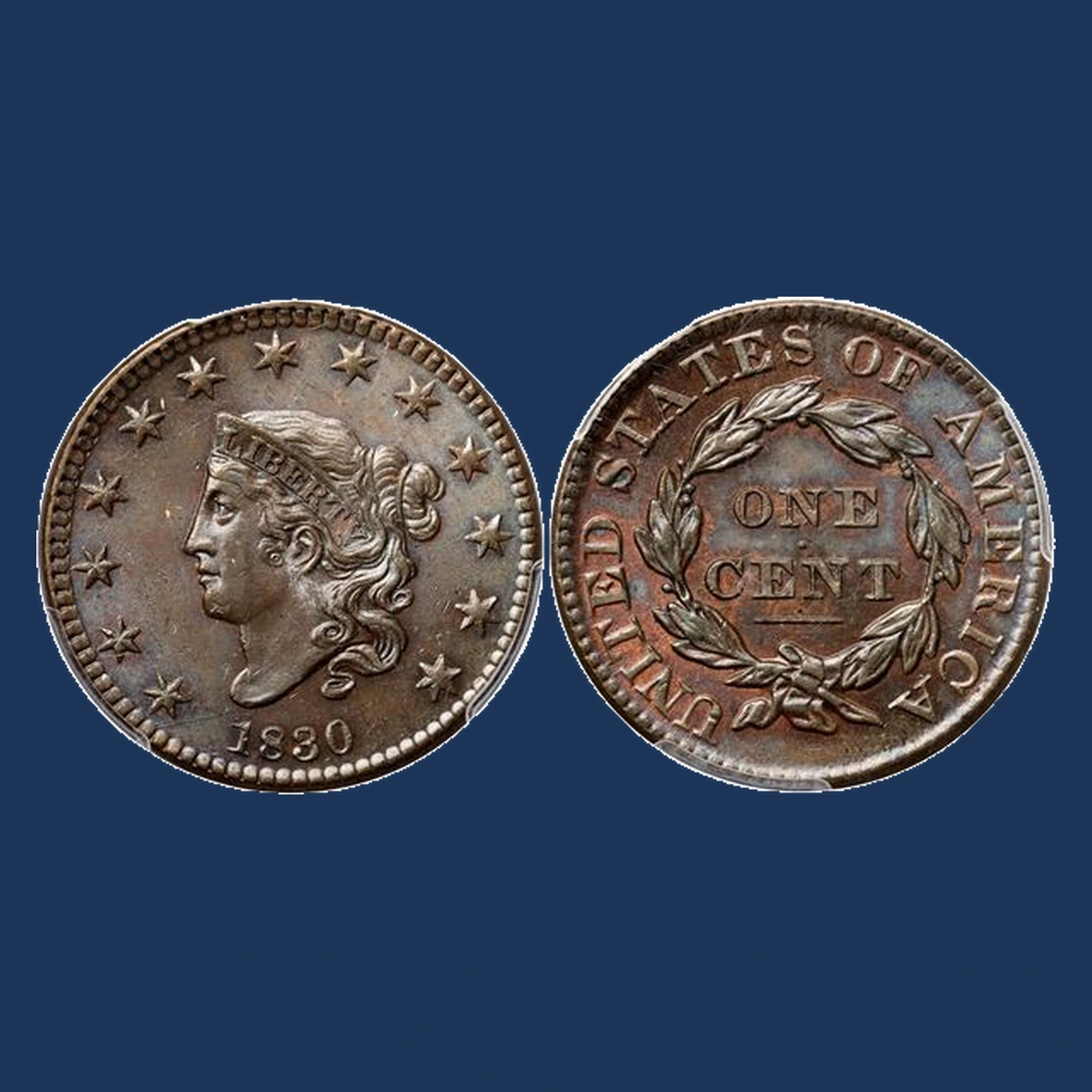
The 1 in the date can carry a small extra trace along its left edge. It comes from a numeral punched into the steel stamping tool more than once.
The later punch did not completely remove the earlier outline. Coins struck with that tool could copy both traces in a single blow.
An N-8 auction example preserves this repunching beside a clear front crack. N-8 is the catalog name of its particular front and back tool pairing.
This is not a different year hiding beneath 1830. A thick-looking numeral from glare, damage, or tool movement also needs a different explanation.
Estimated Value
The PCGS MS64+ Brown example sold for $2,800 before fees in May 2026. Adding its standard 20% buyer’s fee gives $3,360.
Estimate $40–$500 for worn examples with a visible matching trace and $500–$5,000 for attractive unworn pieces. The plus sign recognizes strong quality within that unworn grade.
The sale values the complete cent, including its surfaces and crack. The tiny earlier numeral is not a separate $3,360 addition to an ordinary coin.
How to Identify
The useful detail is small: an earlier trace along the left side of the 1. Put the date under a 10× magnifier and compare it with the N-8 photograph.
Examine the other digits for scraping or cuts that could come from someone reshaping the date. A natural punch trace follows the numeral rather than crossing it like a random scratch.
For a loose coin, use a scale and calipers to compare 10.89 grams and roughly 28–29 millimeters. Its edge is plain.
Match both faces before using the N-8 name, which identifies one front and back tool pairing. A nearby crack provides supporting detail.
Move the light across the 1 to separate a fixed raised trace from shifting glare.
6. 1830 Coronet Head Cent A Wreath Turned Relative to Liberty
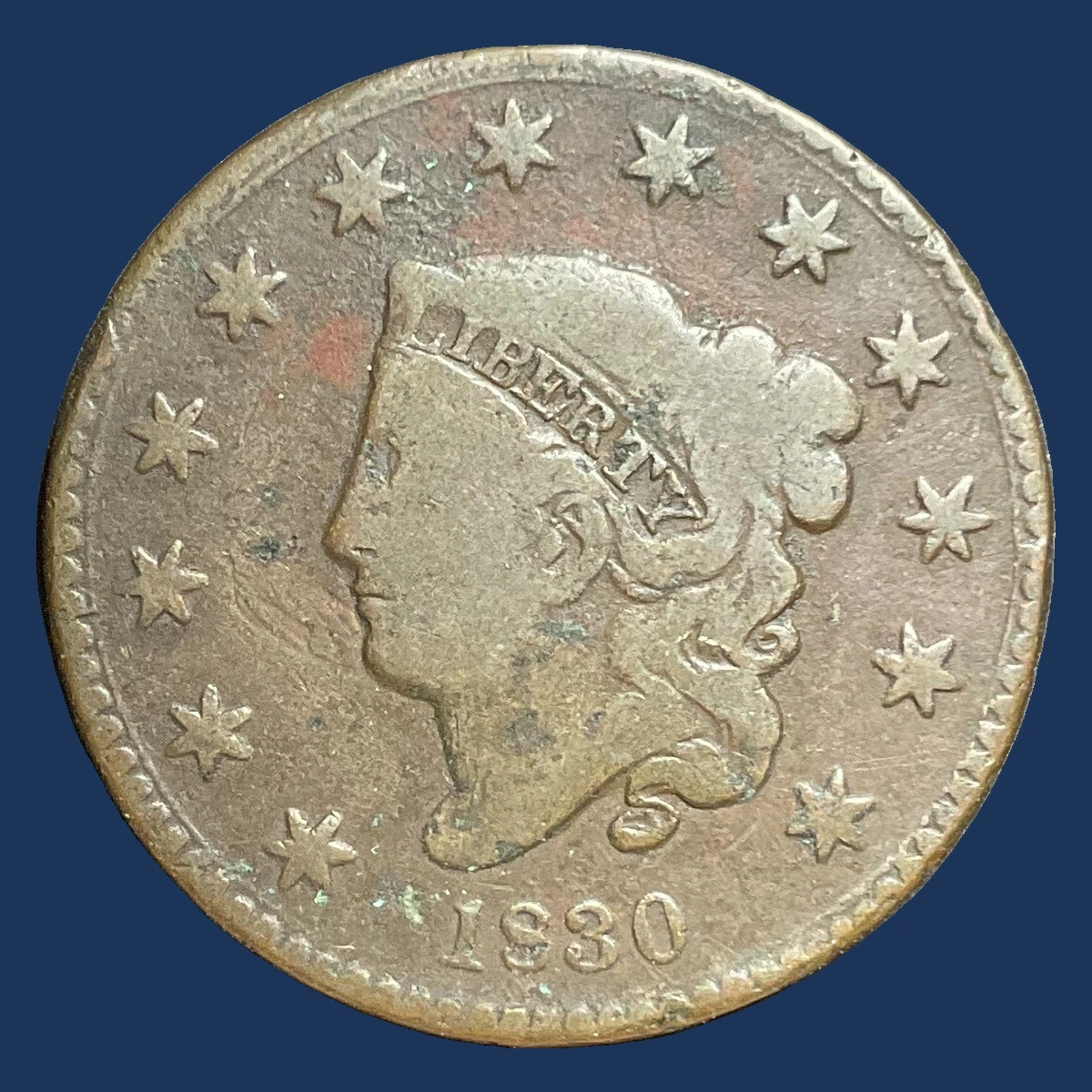
An upright front can hide an unusually tilted back. A stamping tool set at a different angle changes how the wreath lines up with Liberty.
The recorded N-2 cent has a back turned thirty degrees counterclockwise from normal. Its NGC MS66 Brown grade describes a highly preserved unworn coin.
A different N-3 example is described as one hundred fifty degrees clockwise. It appeared among several 1830 cents and has much heavier wear.
These angles belong to different specimens. Neither should be measured from separately rotated photographs, because the movement between the two faces must remain controlled.
Estimated Value
The N-2 example brought $3,220 in January 2005. Its high unworn grade was an important part of that whole-coin result.
Estimate $40–$500 for worn 1830 rotations and $500–$7,000 for attractive examples with stronger preservation. The degree of tilt and the condition both affect the comparison.
The separate N-3 coin’s larger angle does not automatically make it more valuable. Its heavier wear and different tool variety must also be considered, rather than transferring the N-2 price to it.
How to Identify
Secure the cent in a clear holder so it cannot turn. Hold Liberty upright and flip the holder from top to bottom, keeping its sides vertical.
The wreath should finish upright on a normally aligned coin. Measure its remaining lean with a protractor, then repeat the flip to check that the angle stays the same.
The thirty-degree counterclockwise N-2 and one-hundred-fifty-degree clockwise N-3 reports concern separate coins. A 10× magnifier helps match the date and other features before applying either name.
Before mounting a loose coin, record its weight and width with a scale and calipers against 10.89 grams and roughly 28–29 millimeters.
Inspect the plain edge for a joining seam that could reveal two altered faces.
7. 1830 Coronet Head Cent Design Struck beyond the Copper Disk
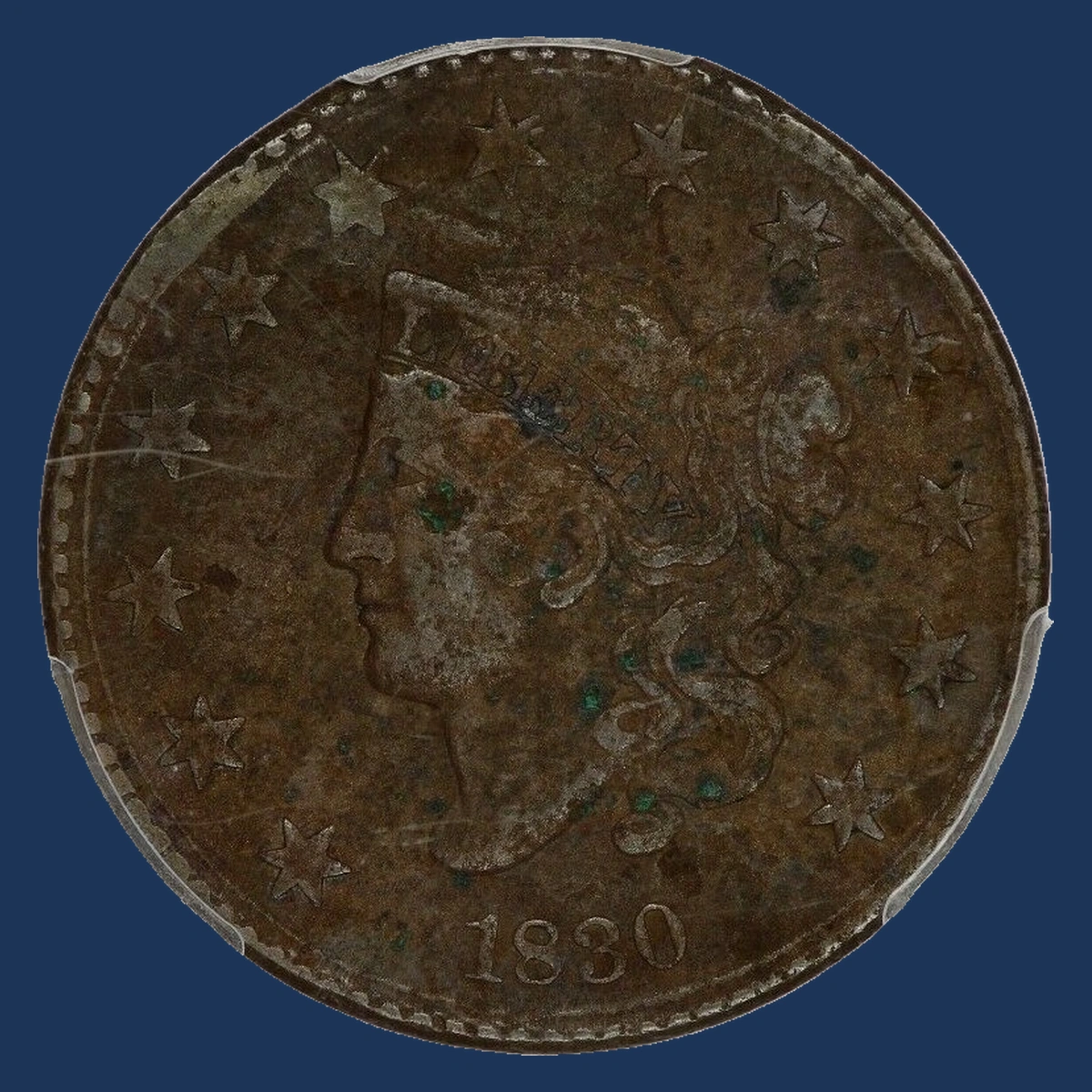
A misplaced copper disk can miss part of the design when the press closes. One side of the coin then carries an unstruck area beside the shifted portrait or wreath.
Mint Error News compares an 1830 off-center cent with a different 1829 coin that also has a clip. The 1830 example is not assigned that other coin’s missing metal.
A year guide separately reports a ten-percent off-center 1830 cent. The two reports do not establish that they describe the same specimen.
The visible date and the two faces need to identify the coin. A tight photograph can exaggerate uneven spacing.
Estimated Value
For genuine 1830 off-center cents, estimate $200–$2,000 in worn condition and $2,000–$8,000 for attractive examples with stronger remaining detail. A readable date makes comparisons more useful.
No individual auction amount is assigned to the two reported 1830 examples here. An undated cent identified as 1808 from its stamping tools brought $6,462.50 in February 2018.
That lightly worn coin was thirty percent off center. Its larger shift and preservation should not be copied onto the ten-percent 1830 report.
How to Identify
A complete photograph should show both the shifted design and the empty copper beside it, including the date if visible. Under a 10× magnifier, inspect that empty area for original surface rather than scraped-away lettering.
A normal loose cent began around 10.89 grams and roughly 28–29 millimeters, checked with a scale and calipers. An off-center blow shifts the design without deliberately removing metal, so ordinary weight does not rule it out.
Follow the same physical edge as you turn the coin over, checking whether both impressions fit one displaced blank. Compare the two borders: a shift confined to one face points toward a different stamping-tool problem.
Conclusion
The estimated $30–$8,000 range covers different 1830 features and levels of preservation. A fine date trace on an unworn cent can share a high whole-coin price without being worth that amount on every worn example.
Inspect the date closely, preserve fragile copper, and use a controlled turn when checking alignment. For changed outlines, compare both faces and the edge.
Clear photographs and a matching explanation help separate an original minting feature from metal removed or damaged much later.