1844 Cent Error List with Pictures

The famous “1844/81” cent does not hide an 1881 coin beneath its date. Its misplaced-looking strokes came from a date punch used upside down before correction.
PCGS records an MS64 Red-Brown example at $33,350 in September 2009. That grade describes an unworn, well-preserved coin retaining some red copper color.
This 1844 cent error list covers estimated whole-coin ranges of $20–$35,000. Follow the checks below for date mistakes, broken-tool marks, and designs struck away from the center.
1. 1844 Braided Hair Cent Back Cracks and Raised Front Rim Breaks
A fine raised line through MER in AMERICA records a crack in the back stamping tool. Copper pushed into that opening and left a narrow ridge on the coin.
A larger tool break produces a different shape. Where a piece has broken away beside the rim, copper can form a raised patch called a cud.
One 1844 example has a strong front cud beside star 1, the lowest star on the left. Another recorded break extends from that area toward the date.
The back cracks and front patches belong to separate specimens. A cent need not show every feature together.
Estimated Value
Estimate $20–$200 for circulated 1844 cents with modest cracks. More prominent rim breaks can fit roughly $100–$2,500, depending on their strength and the coin’s condition.
For comparison, an 1852 cent with a strong back cud sold for $1,920 in 2021 at PCGS MS64 Brown. That other-year unworn coin is a quality comparison, not a price for the worn 1844 star-1 example.
Corrosion and scratches can outweigh the appeal of an unusual break. Keep them in the price comparison.
How to Identify
Examine MER on the back under a 10× magnifier while moving a lamp from left to right. A fine ridge should catch light differently from a scratch cut below the surface.
Then inspect star 1 on the front, just above the date’s left side. A genuine cud joins the rim rather than sitting as an isolated blob in the middle of the design.
A scale and calipers compare a loose copper cent with 10.89 g and 27.5 mm. Do not press a measuring jaw into the raised patch.
Turn the edge toward the light to check for folded copper or added material. A rim dent can push metal inward, whereas the described cud was already present when the surrounding design was struck.
2. 1844 Braided Hair Cent Design Shifted off the Copper Blank
When a blank misses the center of the striking position, part of the design lands beyond its edge. Bare copper remains beside the section that received the portrait and lettering.
Northeast Numismatics listed an 1844 cent struck fifteen percent off-center and graded PCGS F12. That grade means the coin shows substantial circulation wear.
The year guide separately reports a fifteen-percent example graded NGC MS62 Brown, meaning no circulation wear. These are not interchangeable descriptions of one coin.
A dealer also reported an off-center 1844/81. Its date variety does not tell us the amount of displacement or its direction.
Estimated Value
The PCGS F12 fifteen-percent example was listed at $1,695. This was a dealer’s asking price, not a recorded auction sale.
Estimate $500–$2,500 for circulated 1844 off-center cents with readable dates, and $2,500–$8,000 for better-preserved examples. A separate 1848 cent struck thirty percent off-center sold for $1,980 in December 2023 at PCGS XF40.
That comparison differs in year, wear, and displacement. The reported 1844/81 combines two features, but neither a second price nor a fifteen-percent measurement follows automatically.
How to Identify
Lay the cent beside a normal 27.5 mm large cent and use calipers to record its outline. A scale checks the normal 10.89 g weight on a loose piece; displacement does not require missing copper.
Photograph both faces straight on, including the entire bare crescent.
Use a 10× magnifier to see whether the date and outer letters run beyond the struck area. Grinding a finished coin can remove detail, but usually leaves a worked surface rather than untouched copper.
The front and back should reflect the same misplaced blank. A centered back with only the front shifted instead points toward one stamping tool being out of position.
3. 1844 Braided Hair Cent Corrected Upside-Down Date and Other Repunched Digits
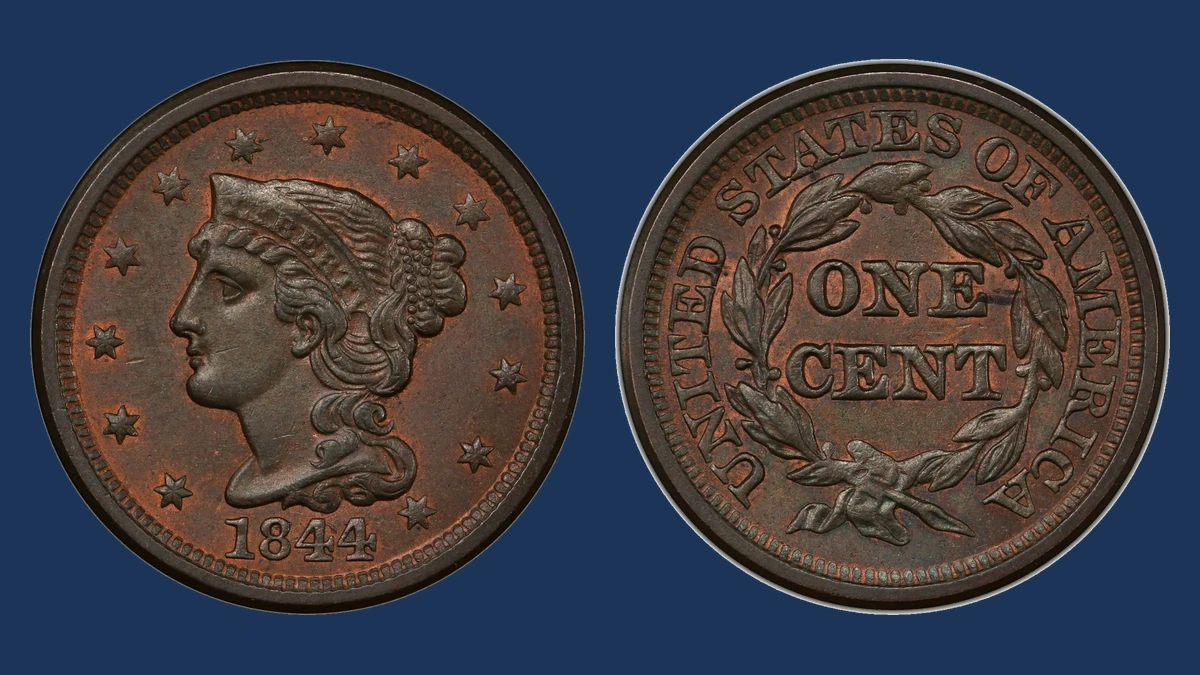
Small extra curves beneath the two 4s can be remnants of an upside-down date impression. The engraver corrected the punch’s orientation, but the first impression was not completely removed.
The familiar name is 1844/81, also called “44 over 81.” It describes inverted date strokes, not an 1881 coin reused decades earlier.
Other 1844 cents have ordinary repunching on the opening digits or first 4. In those cases, part of an earlier same-direction impression remained on the stamping tool.
The date marks therefore need separate visual comparisons. A repeated stroke beside one numeral does not automatically identify the better-known inverted-date variety.
Estimated Value
PCGS records $33,350 for an MS64 Red-Brown 1844/81 sold by Goldberg in September 2009. Its preservation and remaining copper color are important parts of that price.
Estimate $50–$800 for many circulated repunched-date examples, depending on the variety. Better-preserved brown examples can fit roughly $800–$6,000, with exceptional 1844/81 Red-Brown pieces around $6,000–$35,000.
A faint ordinary repunched 4 does not inherit the top range. Match the inverted strokes as well as the condition and color.
How to Identify
Keep 1844 upright in a close photograph and examine below both 4s with a 10× magnifier. The earlier upside-down shapes should occupy the locations seen on a matching 1844/81.
For an ordinary repunched first 4, follow only the repeated strokes belonging to that numeral. Do not force them into the inverted-date pattern.
Measure a loose cent with calipers against 27.5 mm and weigh it against 10.89 g on a scale. Those checks support its identity as a large copper cent, not the date variety itself.
Watch for sharp engraved grooves, disturbed copper, or unusual spacing around an altered digit.
Look for recognizable inverted shapes beneath the main 4s, not simply extra thickness somewhere in the date.
Conclusion
Read the date before deciding what happened to an unusual 1844 cent. The “44 over 81” name describes a corrected upside-down punch, while an off-center strike moves the design across the copper.
Estimated whole-coin values span $20–$35,000, with condition and the precise variety explaining much of the difference. A raised rim break needs a different comparison from a faint back crack.
Keep both faces visible in photographs and match the actual feature before applying a price.