1846 Cent Error List with Pictures

Two kinds of lines can share one 1846 cent: a peeling flaw in the copper and raised cracks copied from a damaged stamping tool. A well-preserved Medium Date example with both features sold for $9,600 in August 2020.
These 1846 Braided Hair cent errors also include shifted strikes, repeated date digits, and a turned back. Estimated whole-coin values range from $20–$12,000, including exceptional Medium Date coins.
Use the checks below to identify the actual feature; the normal Small, Medium, and Tall Date styles are not errors by themselves.
1. 1846 Braided Hair Cent Rotated Dies — Estimated Up to $800
The back turns almost a quarter of a circle clockwise on a recorded Tall Date cent. When the front is upright and the coin is flipped from top to bottom, ONE CENT appears strongly tilted.
The two stamping tools, called dies, were not in their usual rotational relationship. This can happen even when each design remains centered on the disc.
The recorded angle is 85 degrees for one N-13 example. It does not apply to every Tall Date coin, and an independently rotated photograph cannot establish the same feature.
Estimated Value
Use an estimated $40–$800 for a clearly demonstrated rotation on a collectible 1846 cent. The recorded example has front-surface pitting, which must be considered along with the angle.
A smaller 1858 Flying Eagle cent with rotated dies sold for $154 in June 2026 at Fine 12. That recent comparison shows a modest price for a worn example, while a better-preserved 1846 large cent can justify a different whole-coin estimate.
How to Identify
Begin with the date, not the back lettering. Level the front in a clear holder that stops the cent moving independently.
Flip the holder from top to bottom around a horizontal axis. A sideways turn gives the wrong comparison.
Measure the back against an upright line, then repeat the movement. Record its actual clockwise angle instead of assigning 85 degrees merely because the date style matches.
Check the plain edge under a 10× magnifier for a join. For a loose coin, a scale and calipers compare the normal 10.89 grams and 27.5 mm.
The same near-quarter-turn must return after each controlled flip to support the recorded type of rotation.
2. 1846 Braided Hair Cent Repunched Date — Estimated Up to $2,500
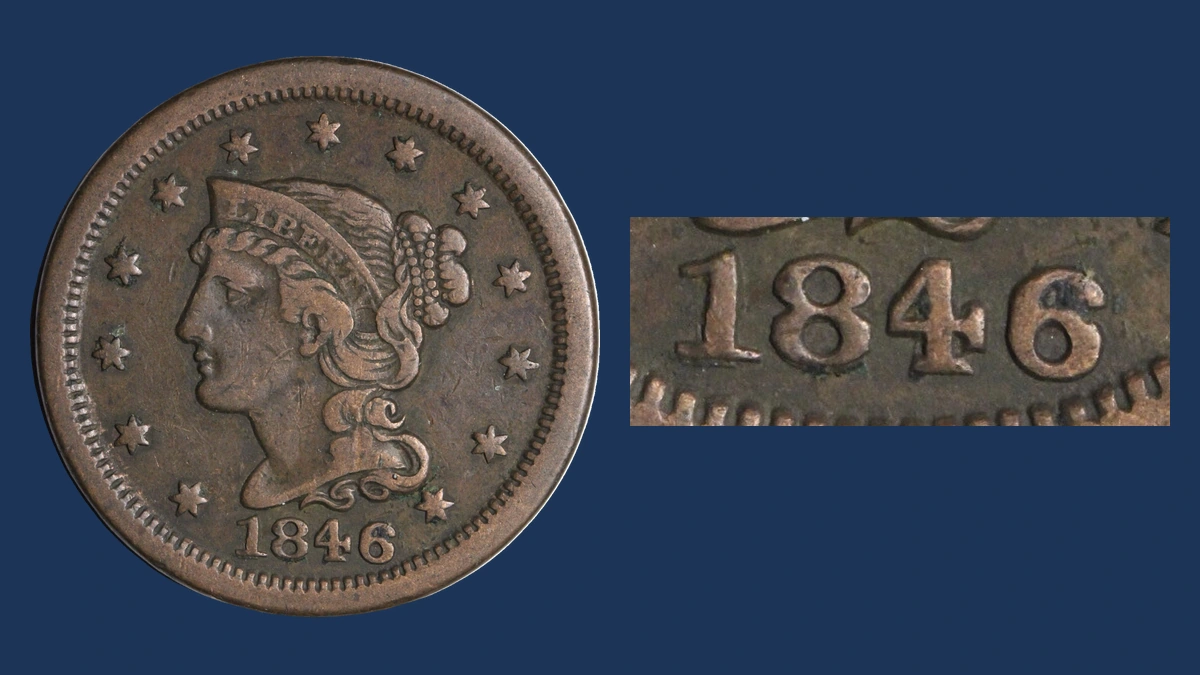
Extra number strokes appear below the 1 and 8 on a recorded 1846 cent. They remain from an earlier position of the date punch in the stamping tool.
When the date was applied again, parts of the first impression survived. Later coins copied those extra strokes alongside the final numbers.
This is repunching within the same date, not proof that one year was changed into another. The normal Small, Medium, and Tall Date styles also need to be kept separate from the additional strokes that identify an actual repunched date.
Estimated Value
Estimated whole-coin values of $40–$2,500 allow for different varieties and levels of preservation. Strong extra digit strokes are easier to identify than worn fragments or a thick-looking date.
A later 1864 L bronze repunched-date cent sold for $1,560 in July 2024 at MS65 Brown. That different coin is a price comparison for a collectible punched-date variety; it does not establish a sale or a guaranteed premium for the 1846 example.
How to Identify
Choose a normal coin with the same date style before using a 10× magnifier. Comparing different numeral sizes can create an apparent difference that has nothing to do with repunching.
Look beneath the 1 and 8 for strokes shaped like the earlier digits, then check for cuts or metal pushed aside by damage. A scale and calipers compare the cent with 10.89 grams and 27.5 mm, and the plain edge should show no alteration.
Keep the date upright while matching its extra strokes with the documented coin. Follow the second outline below a digit far enough to recognize the number itself, rather than accepting a short isolated ridge.
3. 1846 Braided Hair Cent Off-Center Strike — Estimated Up to $4,000
A shifted design leaves unused metal at one edge and cuts off detail at the other. The disc was not properly centered between the stamping tools.
An 1846 N-10 collector example was specifically described as off center. Its rim breaks appear weak because the displaced strike did not reproduce them fully.
That combination can make the coin confusing at first: a known raised break may look less complete than expected. The surviving date and outer design help establish the coin’s identity and the direction of movement.
Estimated Value
Estimate $300–$4,000 for genuine, identifiable off-center 1846 cents, depending on displacement, readable design, and surface condition. The reported N-10 example also has altered color, which affects its value.
An 1854 large cent struck about 50% off center sold for $1,527.50 in September 2016 at ANACS VF20. That same-series auction offers a comparison, while the 1846 coin’s actual displacement must be judged from its own outline rather than assigned the later coin’s percentage.
How to Identify
Examine the full front and back together before concentrating on a weak rim break. Both designs should fit the same displaced metal disc.
At 10×, follow the transition between struck and unstruck areas. A later ground-down border removes finished metal instead of leaving an original unused crescent.
Weigh the coin against 10.89 grams, and record its outline with calipers relative to the normal 27.5 mm. Inspect the plain edge for cutting or flattening.
The N-10 coin’s weak breaks should be read alongside its displaced design. Locate where detail runs beyond the available disc and compare that area with the untouched metal opposite it.
4. 1846 Braided Hair Cent Die Cracks and Rim Breaks — Estimated Up to $12,000
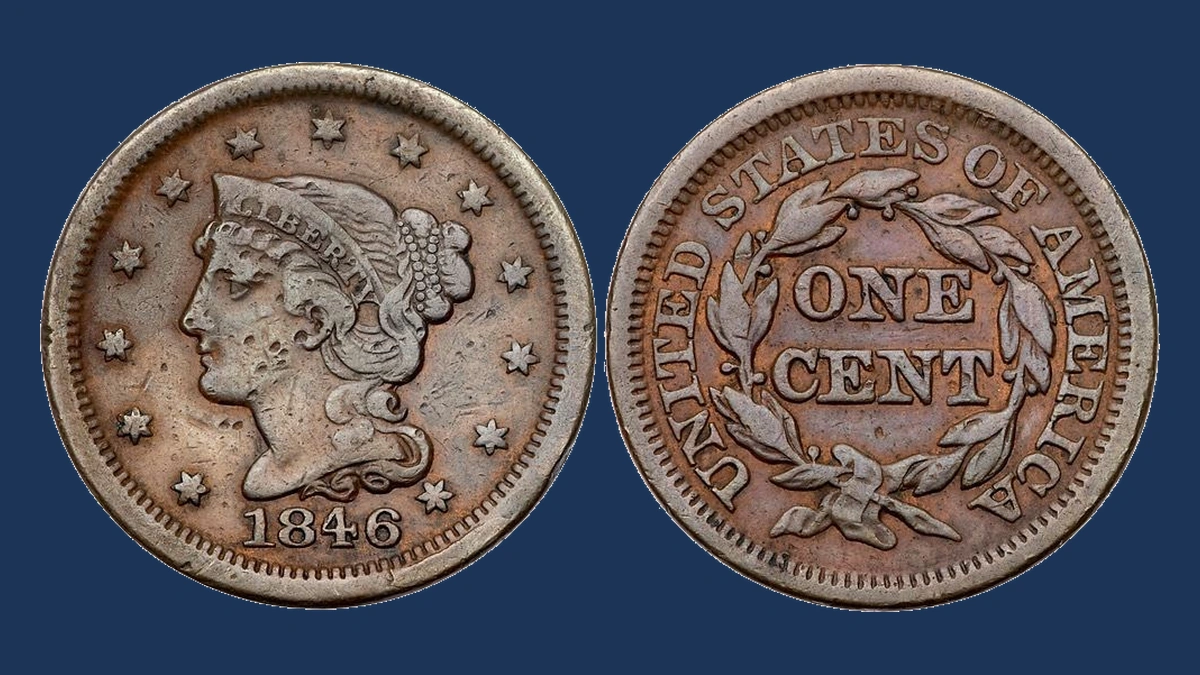
A raised line can fork through the ribbon beneath the wreath or run through the E in STATES. These are recorded crack paths on a Medium Date example.
A crack in the steel tool leaves raised metal on the coin. If a larger piece of the tool breaks away at the edge, it can produce a rim-connected lump called a cud.
Other 1846 examples have cuds below the date, beside outer stars, or near back lettering. These locations belong to different coins, rather than a single pattern every example should display.
Estimated Value
Ordinary circulated coins with these features have an estimated range of $20–$1,500. An exceptional Medium Date coin can reach roughly $6,000–$12,000 as a whole collectible.
One such example graded PCGS MS64 Red and Brown sold for $9,600 in August 2020. Its fine preservation and desirable date variety drove much of that price; the back cracks and accompanying front lamination do not each add another $9,600 to its value.
How to Identify
Test a line’s height by moving the light while viewing it through a 10× magnifier. A tool crack stands above the surface, whereas a scratch cuts into it and may push a ridge along its sides.
For the Medium Date example, follow the back line from the lower border into the ribbon and the upper line through E in STATES. For a large patch, inspect where it joins the plain edge and look for solder or a folded rim.
A scale and calipers check the usual 10.89 grams and 27.5 mm. Compare the raised feature with the correct coin’s photograph, using its actual path or rim connection rather than combining several different examples.
5. 1846 Braided Hair Cent Lamination — Estimated Up to $12,000
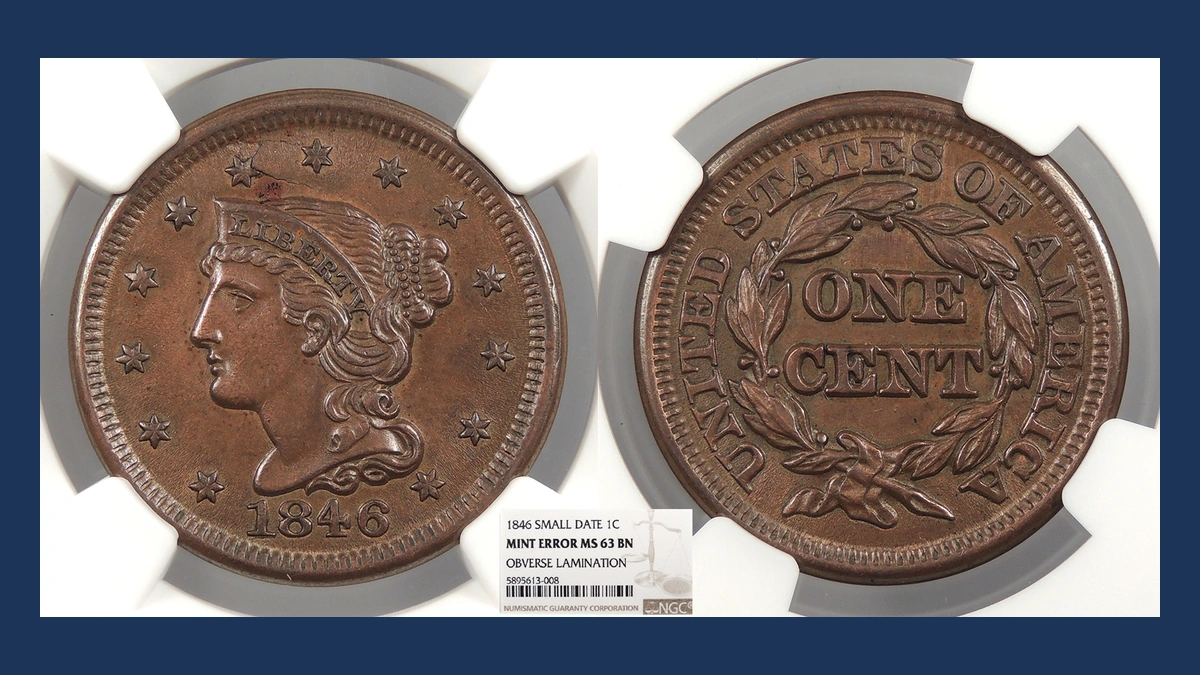
A thin irregular metal-layer flaw crosses the portrait on the documented Medium Date cent. It runs from the sixth star toward the 1 in the date.
This is lamination, a separation caused by weakness in the copper. It is a surface-layer problem rather than evidence that the entire coin split into two discs.
The same coin also has raised cracks on the back, but those came from the stamping tool. Separating the two causes matters: a line in the coin’s metal and a raised line copied from a tool require different checks.
Estimated Value
For ordinary examples, allow an estimated $25–$1,500, depending on condition and the affected area. A similarly preserved Medium Date coin can have a whole-coin value around $6,000–$12,000.
The documented PCGS MS64 Red and Brown example brought $9,600 in August 2020, according to the auction record. Its rarity as a well-preserved variety matters far more than treating the fine lamination as a stand-alone premium.
How to Identify
Count the stars from the lower left to locate the sixth star. Under a 10× magnifier, follow the thin flaw across the portrait toward the 1.
Look for a layer boundary within the copper rather than a clean raised line. Compare it with the raised cracks on the back to see the difference.
Do not probe or lift the surface. Preserve the remaining copper in place.
For a loose coin, compare its weight against 10.89 grams and use calipers on an intact span against 27.5 mm. Examine the plain edge wherever the flaw reaches it.
Trace the irregular separating line from star six toward the date; that continuous route identifies the flaw on the recorded example.
Conclusion
The ordinary date styles help choose a comparison, while raised lines, peeling copper, and displaced designs tell you what happened to the coin. Study their shape before deciding that every unusual mark is a Mint error.
Estimated whole-coin values run from $20 to $12,000. The upper end includes exceptionally preserved Medium Date cents, whose collector value should not be mistaken for the separate price of a small crack or lamination.