1798 Dollar Coin Error List with Pictures

A row of tiny sunken teeth above the back lettering can be a useful clue on a 1798 dollar. Those marks tell a different story from a raised crack or a whole design struck twice.
This 1798 Draped Bust Dollar error guide covers the large-eagle version, with estimated whole-coin values of $1,000–$100,000. A lightly worn BB-102 brought $20,400 in March 2023, a variety-and-condition comparison rather than a fixed error premium.
Use the checks below to match each feature to the right coin.
1. 1798 Draped Bust Dollar Blank Flaw above the Forehead
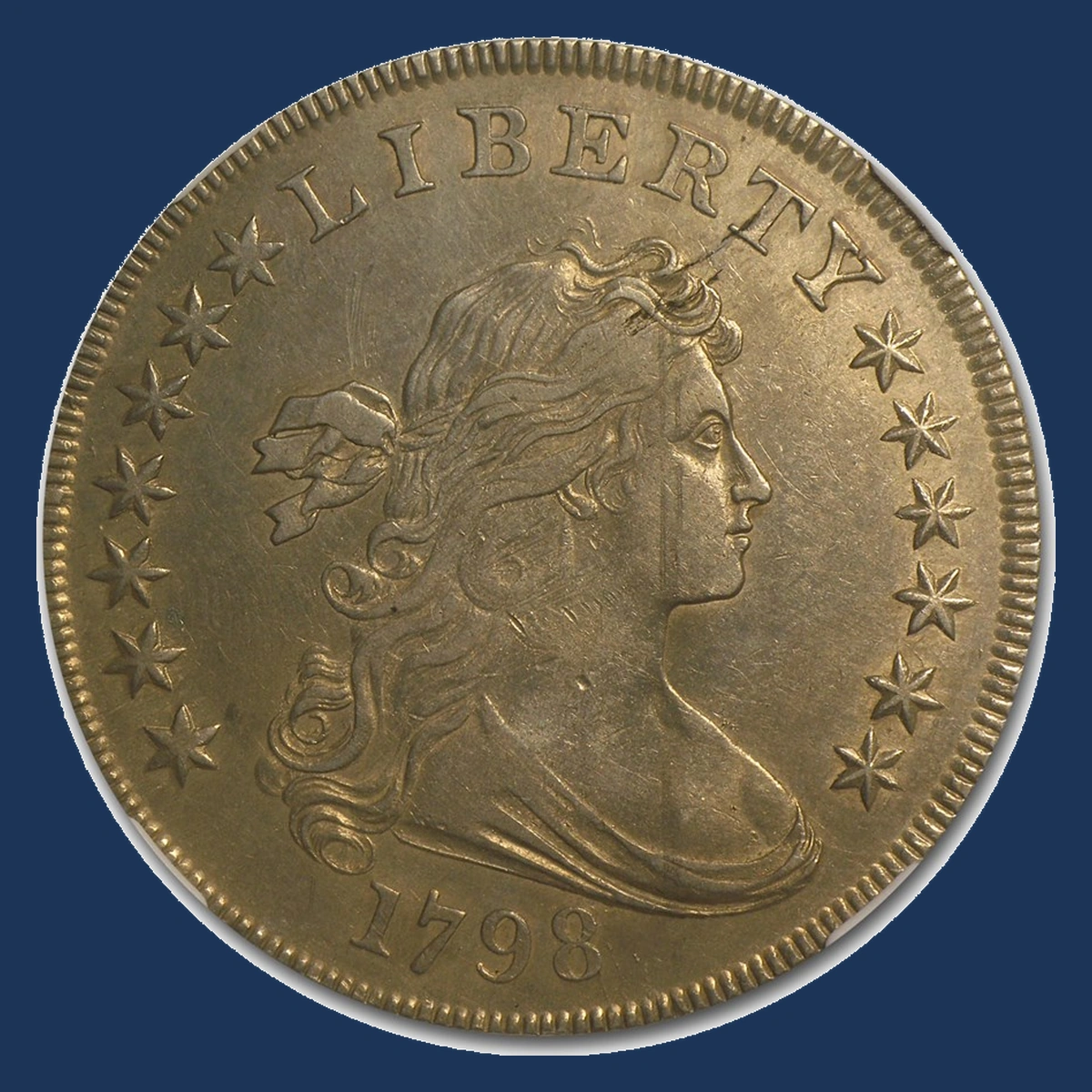
An uneven patch in the hair above Liberty’s forehead is described as a flaw in the original blank. The blank is the metal disc that receives the design.
APMEX listed this 1798 large-eagle dollar in an NGC AU Details holder. That label indicates lightly worn detail with a noted problem or surface issue.
An irregular hollow is a broad metal flaw, while a peeling layer has an edge that separates from the surface. A crack through the disc is different again.
Later digging and corrosion can leave similar-looking hollows, making the surrounding hair detail important.
Estimated Value
Estimate $1,000–$15,000 for genuine examples with comparable blank flaws across worn through lightly worn condition. This includes the dollar’s normal value and the effect of its surface problem.
A shallow original flaw is not automatically worth more than an undamaged dollar. The size of the patch and its effect on Liberty’s hair help determine the comparison.
Preserved hair detail and an unobtrusive defect can help appeal. Harsh cleaning, added cuts, or an altered surface call for a different comparison.
How to Identify
Compare the full front with the dealer’s photographed example before enlarging the flaw. The affected hair lies immediately above Liberty’s forehead.
Keep the nearby curls in view and trace how their struck details meet the irregular patch. Detail pressed into an uneven surface can support an origin before striking.
Change the lighting before judging depth. A dark patch can look like a hole in a single photograph.
Check for a later cut slicing across the hair or pushing metal into a raised lip.
Do not lift or scrape any metal to test it. The patch’s outline and its relationship to the struck curls provide the useful comparison.
2. 1798 Draped Bust Dollar Front Design Interrupted by Material
A small interruption in the front design can mark where material blocked the strike. The coin may retain an impression after that material falls away.
GreatCollections listed a 1798 BB-107 Ten Arrows dollar as struck through on the front. Its PCGS VF25 grade describes a circulated coin with moderate wear.
The impression’s outline and depth matter more than guessing what caused it. A shallow mark alone cannot distinguish cloth, wood, or grease.
Ten Arrows describes this coin’s design variety; the arrow count is not itself the striking mistake.
Estimated Value
For an authenticated example, estimate $1,200–$20,000 across worn through lightly worn condition. The size and visibility of the interruption matter alongside the underlying early dollar’s value.
A small shallow mark may add little, while a larger clear impression can attract error collectors. On a worn coin, compare how much of the original impression remains visible.
An old scrape is a different surface problem. It should not receive a premium simply because it interrupts some of the design.
How to Identify
Compare the affected patch with the reported BB-107 example using a full-front view and a close-up. The portrait and nearby lettering help keep the location clear when the patch is enlarged.
Follow the boundary between intact detail and the interrupted area, checking whether the change is confined to one patch. Ordinary circulation wear usually flattens exposed design details more broadly.
Use angled light to look for scraping lines, displaced metal, or a loose layer that could point to another cause. Matching the original impression’s shape and its boundary with the struck design is more useful than guessing the trapped material.
3. 1798 Draped Bust Dollar Back Turned about Twenty-Five Degrees
Liberty can be upright while the large eagle leans to one side after a straight flip. The two stamping tools were turned relative to their normal alignment.
A Stack’s Bowers catalog describes a PCGS AU53 BB-111 dollar with its back rotated about twenty-five degrees clockwise. AU53 indicates light wear on the raised design.
The amount applies to that described example, not every 1798 dollar. Separate photographs can appear rotated simply because the coin moved between shots.
This feature changes the relationship between the faces, rather than making another overlapping impression on either one.
Estimated Value
Use an estimated $1,000–$20,000 for circulated dollars with a confirmed moderate rotation. The particular variety, wear, and original surface quality still explain much of the price.
The PCGS auction archive lists the described AU53 at $6,463 for Stack’s Bowers’ 2013 Baltimore sale. That is the complete coin’s recorded result, not an isolated payment for its turn angle.
A repeatable measured rotation can support collector interest. A tilted photograph alone should add nothing to an estimate.
How to Identify
Set Liberty upright and keep the top of the coin aligned with a fixed mark on the table. Flip it top to bottom without turning it sideways.
Repeat the movement to see whether the eagle consistently leans clockwise. For the cataloged BB-111, the reported difference is about twenty-five degrees.
An angle tool on the photographs can help measure the result, provided the camera stayed square to both faces. A short video of the flip can make that relationship easier to demonstrate.
Do not confuse this with a coin that rotated between two strikes. That event should leave overlapping design details on a face; this check concerns one face’s orientation relative to the other.
4. 1798 Draped Bust Dollar Sunken Border-Tooth Clash Marks
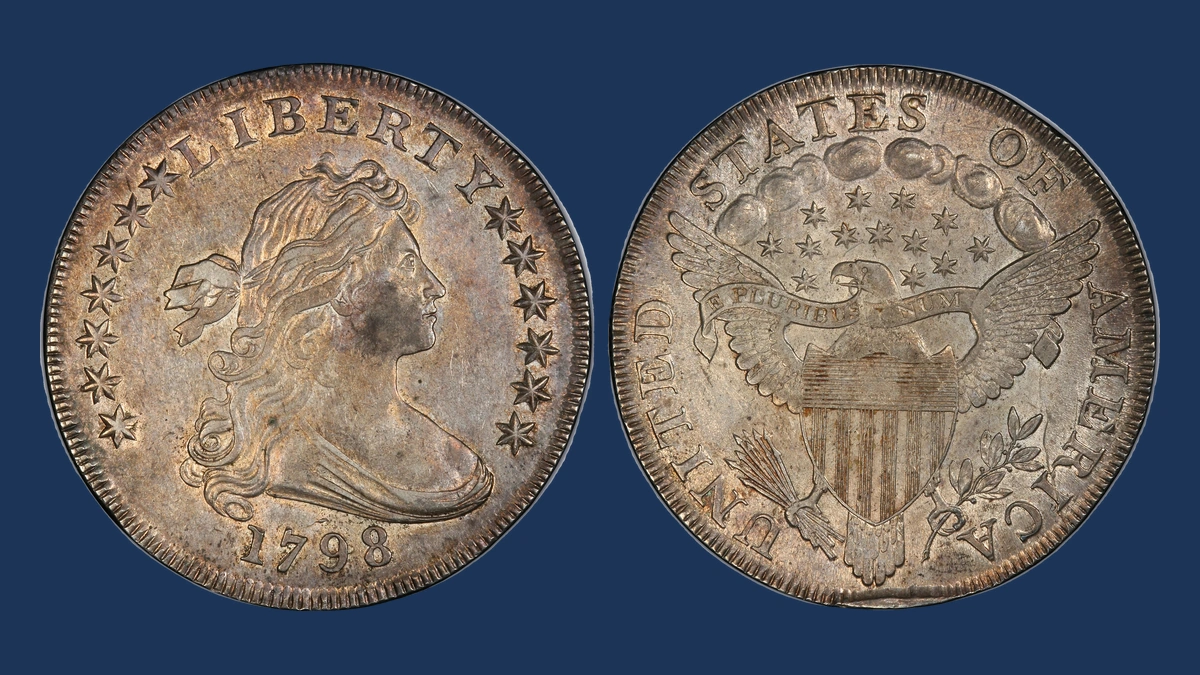
A row of tiny tooth-like impressions can appear above ES and OF on the back. They resemble the small teeth normally arranged around the coin’s inner border.
The specialist account identifies them as clash traces transferred from the front tool. A clash occurs when the stamping tools meet without a blank between them.
These particular impressions are described as sunken, so a rule that every clash must stand above the surface would be misleading. Their shape and placement are the useful clues.
Random scratches or a ring pressed into the finished coin can create different nearby marks.
Estimated Value
An estimated $1,000–$25,000 covers worn through lightly worn BB-102 dollars with matching clash traces. The uncommon tool variety and surface preservation carry much of that value.
For context, PCGS records $20,400 for an AU55 BB-102 sold by Stack’s Bowers in March 2023. AU55 indicates light wear; the result does not measure a separate price for the tooth marks.
A coin may also show raised cracks. Those features remain parts of one whole-dollar valuation.
How to Identify
Compare the shape and spacing of the tiny marks with the coin’s normal border teeth, using a magnifier that keeps several marks in view. This establishes what kind of repeated pattern you are looking for before checking its position.
On the BB-102 back, examine the space above ES at the end of STATES and above the neighboring OF. The matching marks should be sunken rather than raised.
Change the light to see the individual depressions and check for a later circular scrape connecting unrelated cuts. A known BB-102 photograph should show the same tooth shapes in the same positions above those letters.
5. 1798 Draped Bust Dollar Raised Cracks and Rim Breaks
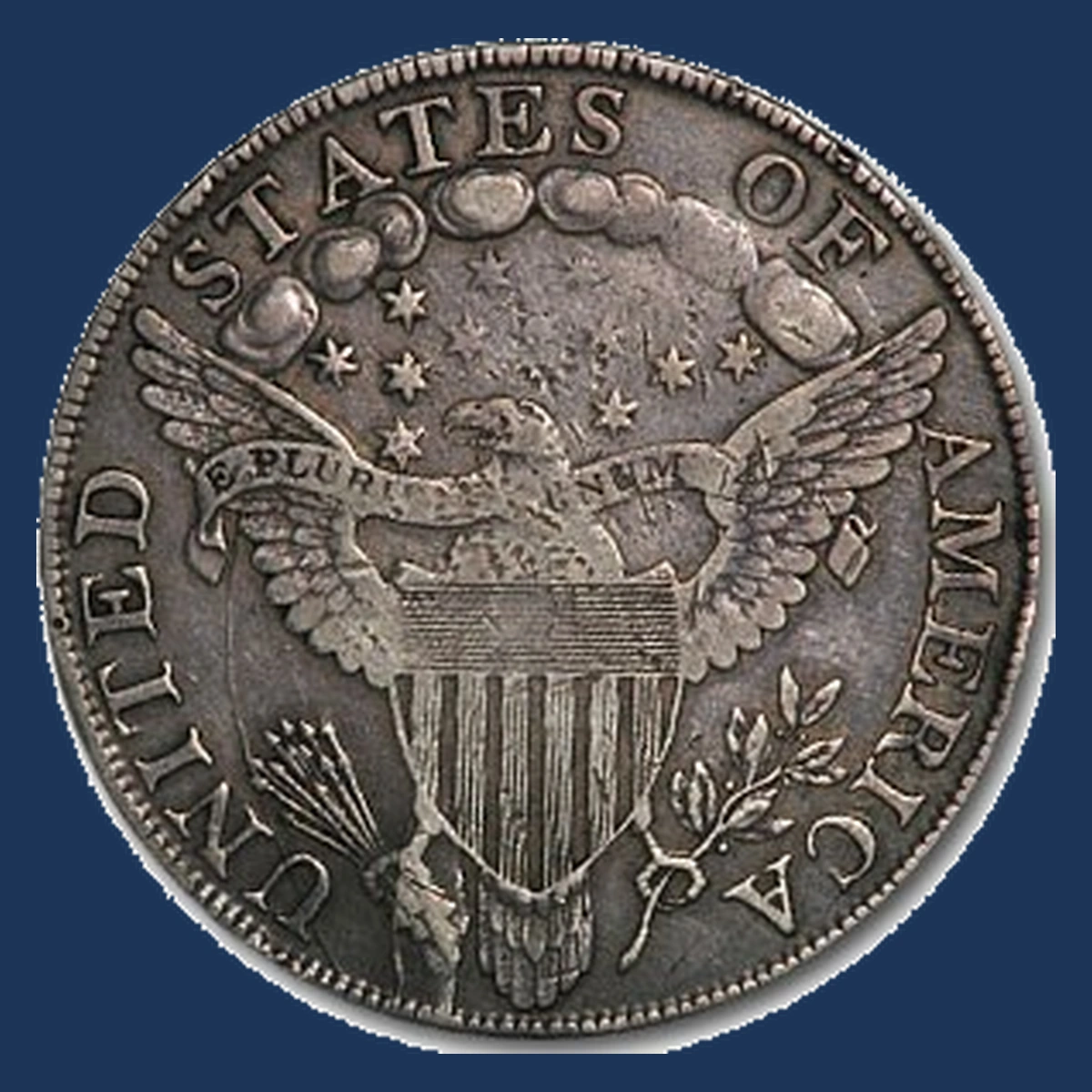
A crack can run from the right wing through I in AMERICA to the rim on BB-102 dollars. Other paths lie below ER and between OF and the first S in STATES.
A broken area below the eagle’s tail can leave a larger raised patch touching the rim. Collectors call such a rim-connected lump a cud.
A separate BB-110 example has a major break on the front. Its outline should not be borrowed from the back of BB-102.
Thin ridges and larger lumps both result from damaged stamping tools, rather than pieces glued onto finished coins.
Estimated Value
Estimate $1,000–$50,000 across worn through attractive unworn dollars with the recorded cracked or broken tools. A prominent rim break can attract more specialist attention than a fine common ridge.
PCGS lists the $20,400 AU55 BB-102 result from March 2023 as a useful whole-variety comparison. It does not establish the premium for each possible break stage.
Compare the same tool pattern and preservation. A rim dent or added metal deserves a different assessment.
How to Identify
For a large raised patch, start by inspecting its connection to the rim. The recorded BB-102 break lies below the eagle’s tail, while the BB-110 example belongs on the front.
Compare each with a photograph of that particular variety. Do not use one coin’s back to locate the other coin’s front break.
For the narrower BB-102 cracks, trace the line from the right wing through I in AMERICA. Also check below ER and between OF and the first S in STATES.
Light from the side should reveal raised ridges, not scratched channels.
Inspect the edge for pushed-over metal or an unnatural seam around an added lump. A matching raised outline with an intact rim connection supports the original tool break.
6. 1798 Draped Bust Dollar Off-Center Strike
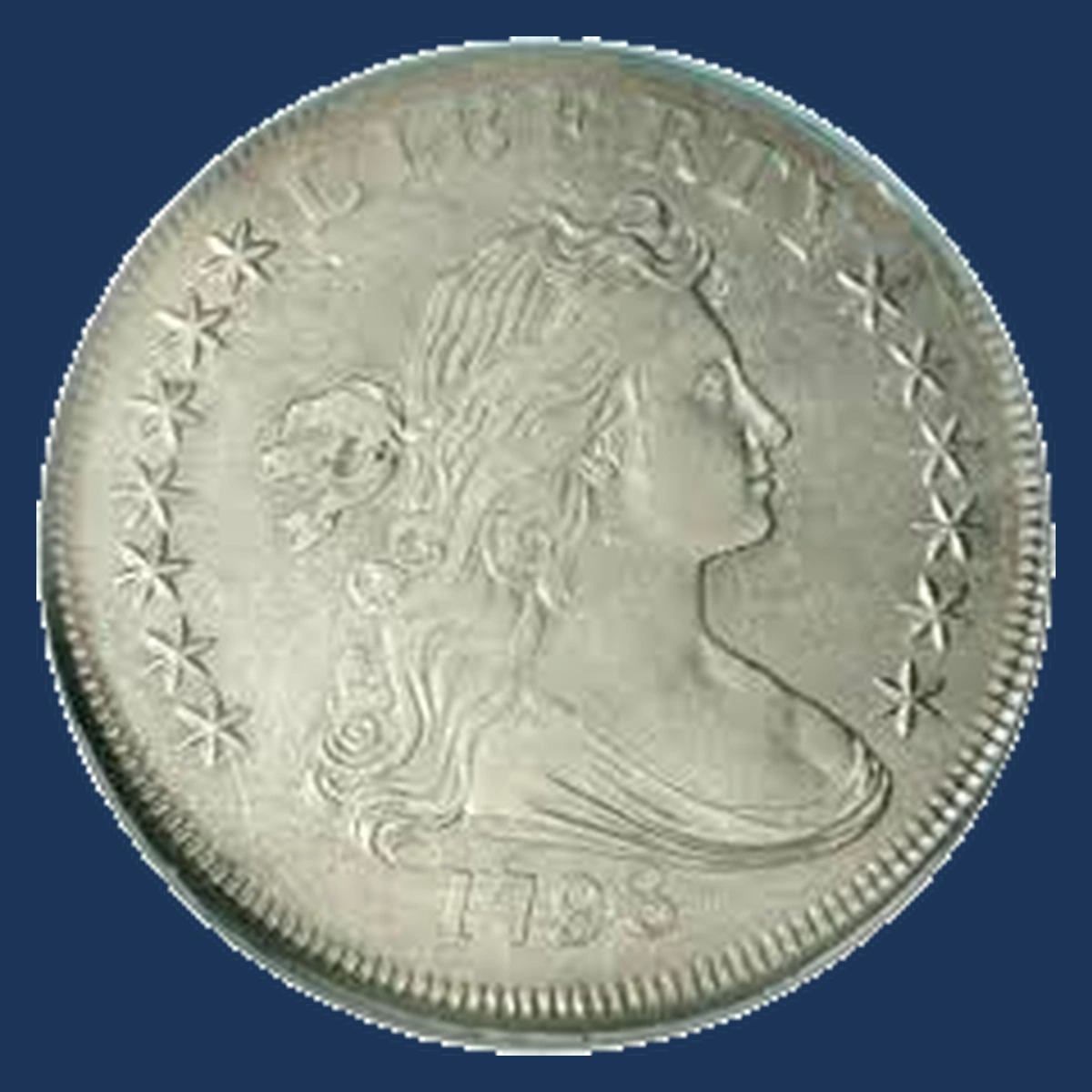
One 1798 large-eagle dollar was cataloged as three percent off center. It retained much of its design but had enough displacement to be described as a striking error.
The Heritage example was graded PCGS AU55 and identified as BB-96. An older catalog separately reported a ten-percent example without establishing the same grade or direction.
The difference begins with a blank positioned incorrectly between the stamping tools. Unused metal remains beside the displaced design.
An uneven border by itself does not prove this error, especially on early dollars whose striking was less uniform than on modern coins.
Estimated Value
For authenticated 1798 off-center dollars, estimate $3,000–$50,000 across worn through lightly worn condition. The preserved date, visible displacement, and surface quality affect the comparison.
The three-percent AU55 is a lightly worn comparison for appearance and condition. A coin with stronger original surfaces can be more desirable than one with a larger but damaged error.
A modest shift on an attractive early dollar can still appeal to collectors. A larger percentage does not automatically outweigh lost date detail or serious damage.
How to Identify
Check the date and the large eagle with its shield before comparing the strike. A small-eagle 1798 dollar is a different design version.
Place uncropped views of both faces side by side, keeping track of the same physical margin. Look for unused metal beside the shifted impression and note whether intended design falls beyond the disc.
If only one face is shifted, one stamping tool may have been out of line.
If all intended design remains on an expanded disc, compare an uncentered broadstrike instead. Early dollars can also have uneven borders without a distinct Mint error.
The cataloged three-percent example and the older ten-percent report are separate coins. Match the actual border and surviving design, rather than assigning a direction from the percentage alone.
7. 1798 Draped Bust Dollar Repeated Design from Two Strikes
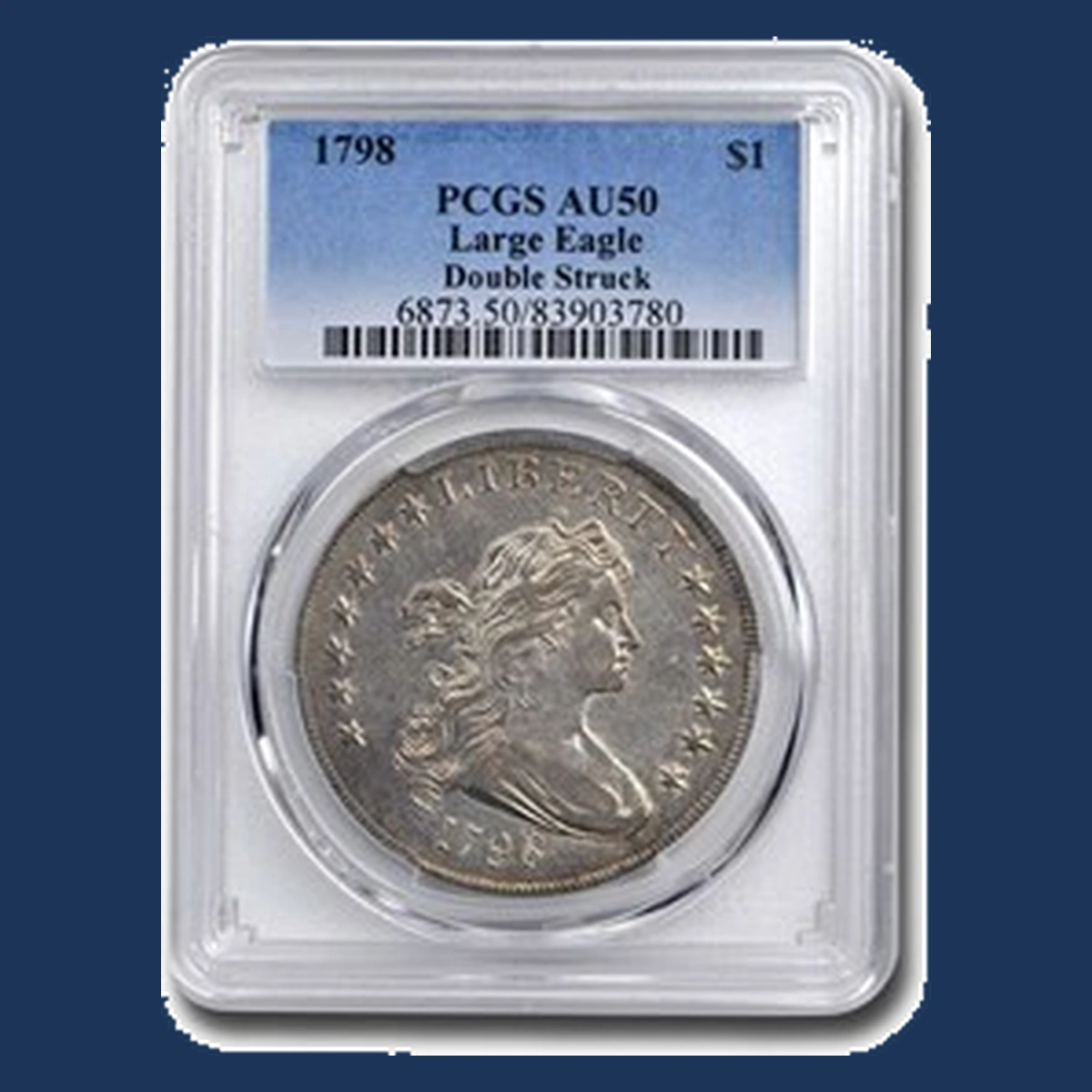
On the reported AU50 dollar, much of the design appears twice. Both the portrait side and the large-eagle side show repeated outlines after a slightly shifted second strike.
Brian Hodge described the coin in a published dealer account. AU50 means light circulation wear, with much of the struck detail still visible.
The impression moved only slightly, so the result differs from two widely separated portraits. Its exact direction and distance should be read from the specimen rather than guessed.
A fixed doubled feature in the stamping tool would require a different explanation from this whole-coin event.
Estimated Value
Estimate $5,000–$100,000 for authenticated double strikes, from damaged worn coins through strongly detailed early-dollar examples. The number of visible repeated features can matter greatly.
As a different-year comparison, a heavily worn and countermarked 1795 Flowing Hair double strike sold for $6,037.50 in January 2007. That sale does not price the much better-preserved 1798 AU50.
Clear repetition on both faces gives buyers more to study than one doubled letter. Original surfaces and a readable date also support stronger prices.
How to Identify
Begin with a full view of each face rather than one enlarged letter. Look for several separated features that repeat with the same small displacement.
Compare the portrait and lettering on the front, then the large eagle and surrounding words on the back. Wear may hide parts of the first impression after the second blow flattened them.
The published dealer photographs provide the specific AU50 comparison. A blurred photograph that duplicates every bright edge is not equivalent evidence.
Choose sharp images under steady light and trace several linked remnants. Their shared movement across the design is more useful than one isolated doubled-looking letter.
Conclusion
The 1798 large-eagle dollar can show mistakes in its metal, stamping tools, or final strikes. A sunken tooth trace, raised rim lump, and repeated portrait require different explanations.
Estimated values of $1,000–$100,000 describe complete coins across those different conditions. The $20,400 BB-102 sale is a variety-and-grade comparison, while the double-strike estimate concerns a much larger manufacturing event.