1846 Dollar Coin Error List with Pictures

An eagle that leans after a straight flip tells a different story from extra numbers beneath 1846. This year’s silver dollars offer both alignment errors and unusual date details.
A Proof with a repunched date brought $32,200 in April 2002. Proofs were specially prepared collector coins.
This 1846 Liberty Seated dollar error list covers estimated whole-coin values of $350–$150,000, from heavily worn coins to scarce Proofs.
Check the rim, the back’s angle, and the date in the sections below.
1. 1846 Liberty Seated Dollar Retained Break at the Rim
A broken piece of the stamping tool can stay partly in position instead of falling out. The resulting coin may show a raised boundary while retaining some of the design inside the affected area.
Collectors call this a retained cud. A cud involves a break reaching the tool’s edge, which places the affected area against the coin’s rim.
Heritage cataloged an 1846 Philadelphia example graded Good 6 by ANACS. That grade describes heavy circulation wear.
Close views of the actual rim are especially useful on a heavily worn dollar. They show how the break meets the surviving design.
Estimated Value
The ANACS Good 6 example sold for $440.63 on August 5, 2012 at Heritage. Its low grade did not prevent the retained break from being cataloged.
Estimate $350–$3,000 for comparable worn examples with a recognizable original break. The size of the affected area, surviving detail, and overall surface quality influence the price.
An irregular rim alone is not enough. A later dent or added metal should not receive the same error premium.
How to Identify
Examine the full rim before zooming into one raised area. The reported feature needs a boundary joining the rim, with some original design remaining inside it.
Move the light from side to side to see how that area stands relative to its surroundings. Heavy wear may soften both the boundary and the surviving design.
Look for pushed-over metal, impact marks, or signs of added material along the edge. Those can indicate later damage or repair instead of a partly retained tool break.
Compare your photographs with the cataloged Good 6 coin, without assuming a clock position from another year. Both faces and an edge view give an examiner more useful evidence than an isolated lump.
2. 1846 Liberty Seated Dollar Rotated Eagle on New Orleans Coins
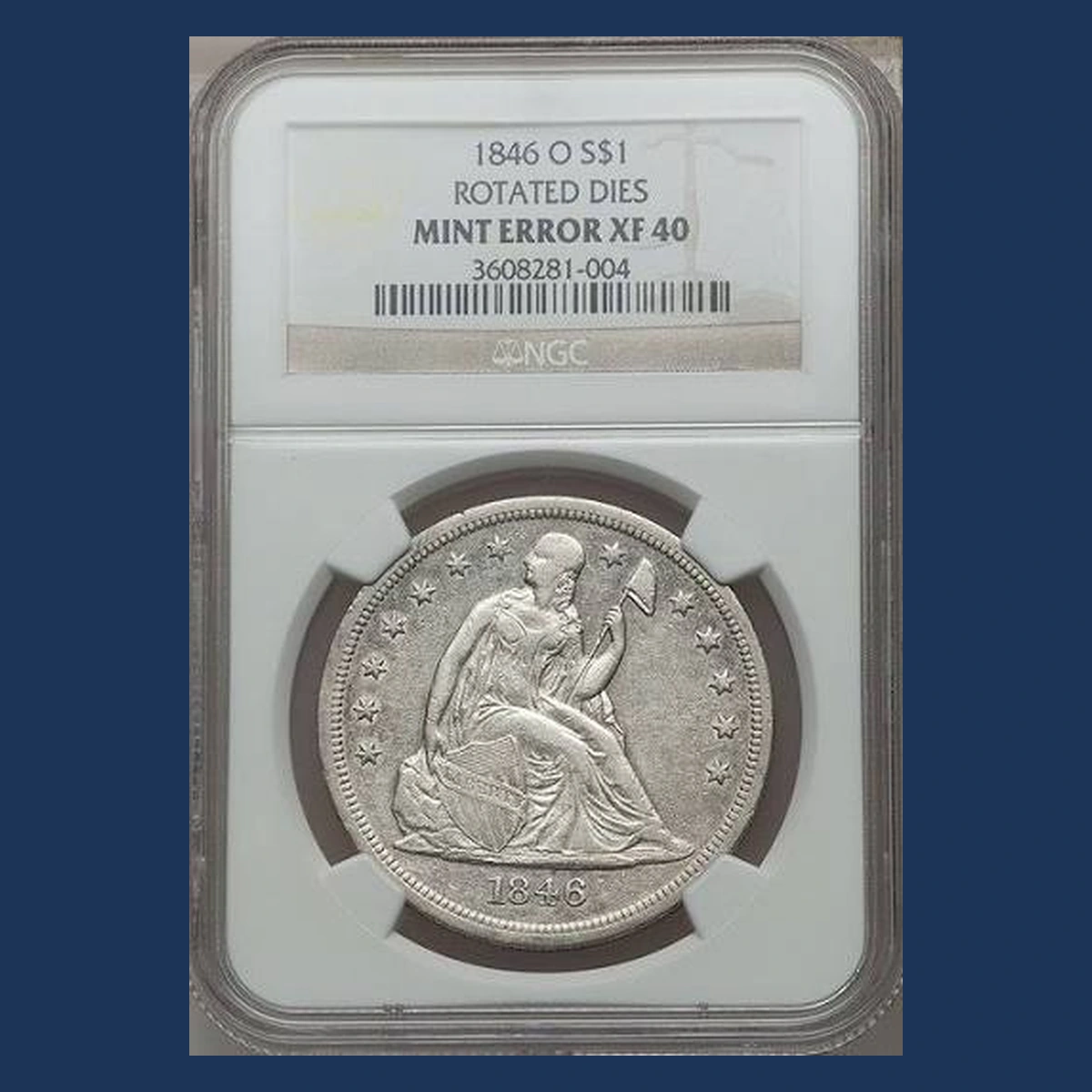
After a normal top-to-bottom flip, the eagle should stand upright. A rotated stamping tool leaves it leaning relative to Liberty on the front.
An 1846-O graded PCGS AU58 was cataloged with a 45-degree clockwise back rotation. AU58 means slight wear, and the O identifies New Orleans.
A separate NGC XF40 example also carries a rotated-dies description. XF40 indicates more wear, but its listing does not supply the same angle.
The eagle, words, and surrounding design all turn together. The amount of rotation belongs to the individual coin, not every 1846-O dollar.
Estimated Value
The NGC XF40 rotated-dies dollar brought $780 in October 2024 at Heritage. This result belongs to that worn New Orleans example, not the separate 45-degree AU58.
Estimate $500–$10,000 for genuine 1846-O rotations across worn through modest unworn conditions. The coin’s preservation and the strength of the turn both affect interest.
A small lean on a damaged dollar should not inherit the price of a much better-preserved coin. Show the alignment clearly when comparing offers.
How to Identify
Secure the dollar in a clear holder with Liberty upright against a vertical guide. Mark the holder’s top, keeping the mark off the coin itself.
Flip the holder from top to bottom around a horizontal axis. Do not turn it sideways or twist it while checking the eagle’s position.
Repeat the movement to make sure the lean stays the same. Then use a protractor over a photograph to measure the turn from normal upright.
The documented AU58 has a clockwise turn of about 45 degrees. Treat that as a comparison for that specimen, while measuring another dollar independently.
Keep the O and full back lettering in view. All parts of the back should share the same turn.
3. 1846 Liberty Seated Dollar Low Date Remnants on a Proof
The date was first punched too low into the steel stamping tool, then corrected. Small parts of the earlier numerals remained below the final date.
The Proof variety is cataloged as OC-P1 Repunched Date. Proofs were specially prepared coins, usually showing sharp details against reflective backgrounds.
A published auction description reports traces beneath all four digits, with the final two especially clear. Those remnants are parts of a repeated date, not evidence of a different year underneath.
The pattern belongs to the identified Proof tool. A shiny ordinary dollar or an isolated scratch under 6 needs a separate explanation.
Estimated Value
A PCGS PR64 with the low repunched date sold for $32,200 in April 2002 at Heritage. PR64 indicates a Proof with some visible marks.
Estimate $15,000–$150,000 for properly identified examples across differing levels of preservation. For wider context, PCGS records a $149,500 PR65 sale in 2008 for the general Proof issue.
That higher result is a whole-Proof comparison, not a stated OC-P1 premium. Scratches, cleaning, and the coin’s overall appearance still matter.
How to Identify
Begin with a recognized Proof and a photograph of its complete date. Compare the low remnants beneath all four digits, paying particular attention to 4 and 6.
A magnifier should reveal pieces that follow the shapes of the original numbers. Unconnected scratches or normal details in the nearby rock do not make another date.
Change the light direction while keeping the coin still. The surviving raised strokes should remain in the same physical positions rather than disappear as reflections move.
Use a clear OC-P1 image to compare the pattern as a whole. Leave a certified Proof in its holder and avoid wiping its reflective areas, since even gentle rubbing can leave permanent fine scratches.
Conclusion
Three separate checks help with 1846 dollars: the retained rim break’s boundary, the New Orleans eagle’s angle, and the Proof’s low date remnants. Each feature belongs to its own kind of example.
Estimated whole-coin values span $350–$150,000. The $440.63 heavily worn rim-break dollar, $780 rotated example, and $32,200 Proof show why the coin’s identity and preservation matter alongside the error.