1852 Dollar Coin Error List with Pictures

Follow the stripes on an original 1852 silver dollar’s shield. Some continue past the places where a neatly finished design would stop.
This rare date can already command a large price: an MS63 example brought $91,062.50 in July 2022. Its value belongs to the whole coin, not to each extra line.
The 1852 Liberty Seated dollar error list below covers shield features and a reported ring on Liberty’s arm. Read on for the visible differences and estimated whole-coin values from $10,000–$100,000.
1852 Liberty Seated Dollar Extended Shield Lines and Spur
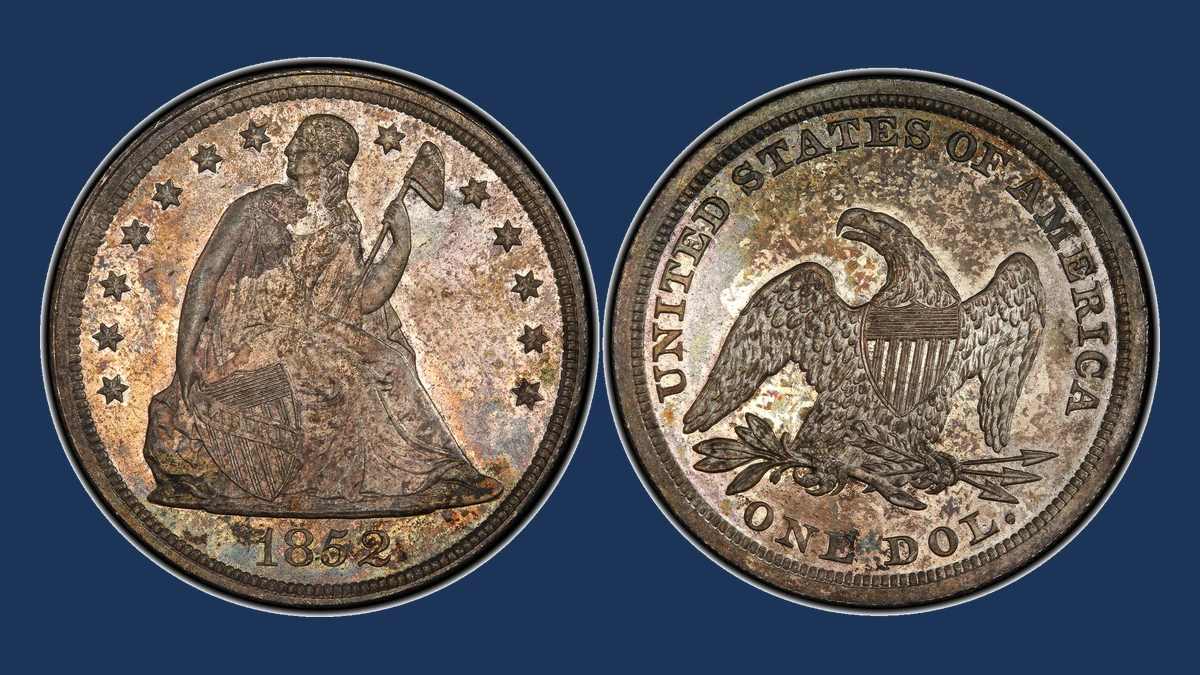
The shield on the eagle’s chest has vertical lines that run too far. Some reach into the horizontal lines above, while others pass through the shield’s lower outline.
A tiny spur can also project from the right edge of the rightmost group of vertical stripes. That detail remains on later examples after other fine tool marks have faded.
These are features copied from the steel stamping tool. They help identify the original ordinary-strike dollar, rather than proving that the coin was struck twice.
Do not mistake extra shield lines for a second complete shield.
Estimated Value
Estimate $10,000–$100,000 for genuine original 1852 dollars across worn and desirable unworn grades. The low production and surviving condition explain the large range.
A PCGS MS63 example sold for $91,062.50 in July 2022, according to PCGS Auction Prices. That result values a rare, well-preserved coin, not a separately priced shield mistake.
Cleaning, scratches, or heavy wear can lower demand. Several extended lines do not multiply the value of one dollar.
How to Identify
Choose a comparison photograph of an original 1852 dollar before enlarging the shield on the eagle’s chest. Liberty’s front shield is not the target.
Later restrikes are coins made after the date they carry, and their front details can match while their back tools differ. A matching date alone therefore cannot settle this comparison.
On the eagle’s shield, follow several vertical stripes beyond the horizontal band at the top and the outer line below. Connected extensions matter more than a scratch cutting across several separate features.
Finish at the rightmost group of stripes and move the light gently over its right edge. A small raised projection connected to that edge matches the described spur.
1852 Liberty Seated Dollar Ring Mark on Liberty’s Arm
A small circular mark on Liberty’s left forearm was described as a raindrop ring on the Floyd Starr dollar. The name describes its appearance, not water trapped during striking.
The ring belongs to that particular example. A round mark on another dollar may instead be a stain, contact mark, or surface deposit.
Calling the shape an error requires evidence that it came from the Mint’s tools or striking process. The shape by itself does not supply that evidence.
This makes the mark worth examining closely without assigning it an invented cause.
Estimated Value
Use an estimated $10,000–$100,000 whole-coin range for a genuine original 1852 dollar with this reported feature. The mark receives no separate automatic premium.
The $91,062.50 sale cited above is a rare-date comparison, not a sale of the Starr ring-mark coin. Condition and originality remain the main pricing factors.
If a round mark proves to be damage, it may reduce the value instead. A matching date alone does not make two coins equally desirable.
How to Identify
Locate Liberty’s left forearm and compare the position with the Starr coin, not merely with a photograph showing any circular spot. Keep the full arm visible in both images.
Next examine the ring with a 10× magnifier under light from opposite sides. Check whether it has raised edges, a depression, or only a change in color.
Do not rub the area. Cleaning can remove surface evidence and damage a valuable coin.
A matching ring in the same position on another coin made by the same tool would strengthen a Mint-origin explanation. A similar-looking stain elsewhere would not.
Photograph the whole forearm and the enlarged ring together so its position and surface shape can both be compared.
Conclusion
Extra shield lines and a tiny spur help identify original 1852 dollar tools. The arm ring describes one particular coin and should not become an automatic error label for every round spot.
Estimated values of $10,000–$100,000 reflect the rare date and the coin’s preservation. Compare the entire dollar before attaching a price to a small mark.
A later collector restrike also needs its own comparison, even when the date matches.