1865 Dollar Coin Error List with Pictures

The U in UNITED can show a wide extra outline on an 1865 dollar. One unworn example sold for $25,850 in June 2014.
This 1865 Liberty Seated dollar error guide separates repeated tool details from a coin struck twice. Estimated whole-coin values span $1,000–$40,000.
Proofs, specially prepared coins, also have their own reported doubled-design variety. Read on to choose the right comparison before assigning a price.
1865 Liberty Seated Dollar Repeated Tool Details on Ordinary Coins and Proofs
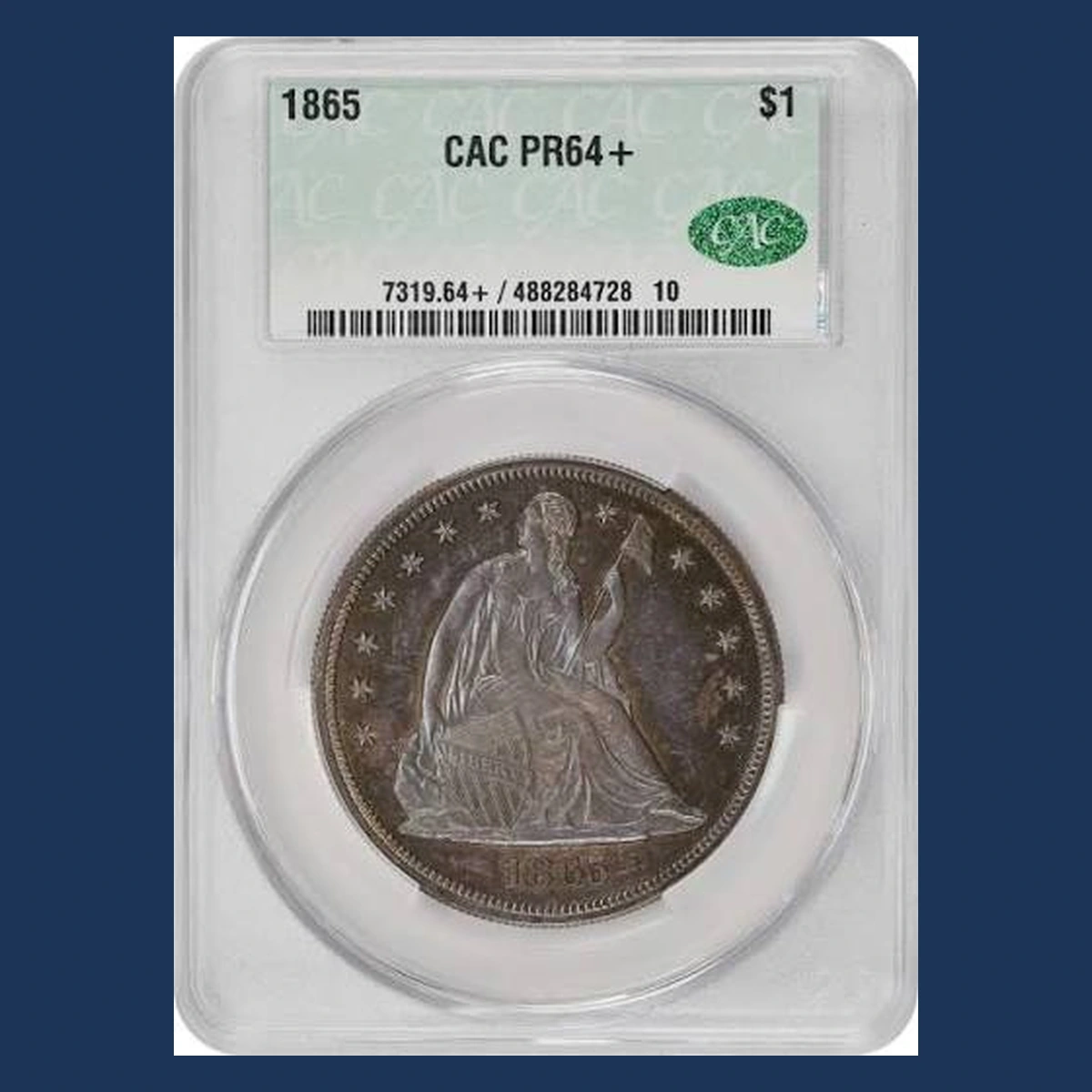
A wide second outline affects U in UNITED on one ordinary-strike variety. Heritage noted no matching repetition elsewhere and suggested that a worker repunched the letter into the stamping tool.
That explanation differs from the doubled-die name used in a variety catalog. The visible repeated U is clear, even though its cause has been interpreted differently.
A separate Proof variety, OC-P2, is cataloged with doubled details on both faces. It must be matched to its own photographs.
Its marks belong to those particular Proof tools, rather than the ordinary dollar’s isolated repeated U.
Estimated Value
The PCGS MS64 ordinary dollar with the repeated U brought $25,850 in June 2014 at Heritage. MS64 describes an unworn coin with some surface marks.
Estimate $1,000–$30,000 for identified ordinary examples across worn through attractive unworn conditions. For the separately identified Proof variety, use $1,500–$20,000 in usual collector grades.
These ranges value complete dollars. The ordinary coin’s sale is not a Proof result or a measured premium for one extra letter.
How to Identify
Choose an ordinary dollar or an identified OC-P2 Proof as your comparison, matching the type of coin you have. A shiny surface alone does not prove that an old dollar was specially prepared as a Proof.
For the ordinary variety, trace the wide extra outline of U in UNITED and inspect the surrounding letters. Repetition limited to that letter differs from matching extra outlines across several parts of a design.
For the Proof, inspect both faces against an identified OC-P2 photograph. Its pattern must be matched separately rather than borrowed from the ordinary dollar’s U.
Move the light across raised outlines under a magnifier. Flat shelves from movement during striking or a bright edge beside one letter do not establish the complete variety.
1865 Liberty Seated Dollar Close Double Strike Inside the Collar
One dollar received two closely spaced impressions while remaining inside the collar, the ring that controlled its edge. The second strike left more obvious repetition on the back than on the front.
Collector Bert Schlosser described the coin in a 2009 article. ANACS identified the back double strike after he had initially considered another kind of doubling.
The front shows slight repetition in the small border teeth. These details support a whole-coin event rather than a single letter already repeated in the stamping tool.
Small shifts between blows can leave close outlines without producing a second, widely separated portrait.
Estimated Value
For an authenticated 1865 in-collar double strike, estimate $5,000–$40,000, depending on preservation and how clearly both impressions can be traced. This is a whole-coin range for a substantial striking error.
As a mechanism comparison, a 1921 Morgan in-collar double strike graded ANACS MS64 sold for $8,050 in July 2002. It is a different design and year, not a sale of Schlosser’s coin.
A single thick letter does not qualify. The surviving design must establish two actual strikes.
How to Identify
The back is the better starting face because its repeated design is stronger on the reported coin. Follow several separated features and check whether their extra outlines could come from one small shift between blows.
Next inspect the front’s tiny border teeth under a magnifier, where the collector’s account describes slight repetition. The second blow can flatten parts of the first design, so both faces need not preserve equally strong outlines.
A shelf beside only one letter can result from movement during a single strike. Matching repeated details across the back, supported by repeated front-border teeth, give a specialist stronger evidence for the two-strike explanation.
Conclusion
The key 1865 distinction is whether extra detail came from the stamping tool or from a second strike to the coin. Keep the ordinary repeated U, the separate Proof pattern, and the close double strike in their proper comparisons.
Estimated whole-coin values run from $1,000–$40,000. The $25,850 ordinary MS64 result reflects the complete well-preserved dollar, while the $8,050 double-strike comparison belongs to a 1921 Morgan.