1870 Dollar Coin Error List with Pictures

A shallow edge flaw appears on an 1870-S dollar that sold for $505,250 in May 2015. The price reflects an exceptionally rare coin, not the value of that small flaw by itself.
This 1870 Liberty Seated Dollar error list ranges from an extra curve on the date to an unevenly expanded Carson City dollar. Estimated whole-coin values span $500–$1,200,000.
Use the locations and checks below to compare the right mint and feature.
1. 1870 Liberty Seated Dollar Repunched Final 0
A faint extra curve around the final 0 can reveal where a date punch first touched the die. The die is the steel tool used to stamp a coin.
If the punch shifted before another blow, part of its first position could remain. Every coin struck with that tool could then carry the same small trace.
Heritage has cataloged an 1870 Philadelphia dollar as OC-6, Repunched 0. Its MS63 grade describes an unworn coin with noticeable marks.
The extra curve belongs to this identified pattern, not to every irregular-looking zero.
Estimated Value
For an identifiable repunched 0, estimate $500–$12,000 from worn coins through attractive unworn examples. Preservation of the complete dollar accounts for much of that spread.
Heritage’s archive lists the PCGS MS63 OC-6 at $7,050 on April 6, 2017. A later PCGS MS64 OC-6 brought $7,200 in August 2025.
These are whole-coin results. A sharper date trace may interest variety collectors, while heavy cleaning can outweigh that attraction.
How to Identify
Enlarge the final 0 and compare its entire curve with a labeled OC-6 date photograph. Do not start by assuming the extra stroke must appear on a particular side.
Use a magnifier to follow the raised outline. A punch remnant should fit part of the numeral, while a scratch may cut across the zero and surrounding surface.
Check the earlier digits for similar damage that could explain a false appearance of doubling.
Confirm that the back has no mintmark and compare the rest of the coin with the same variety. A photograph showing the full date plus the matching secondary curve is more useful than an isolated bright spot.
2. 1870 Liberty Seated Dollar Repeated Back Letters and Eagle Feathers
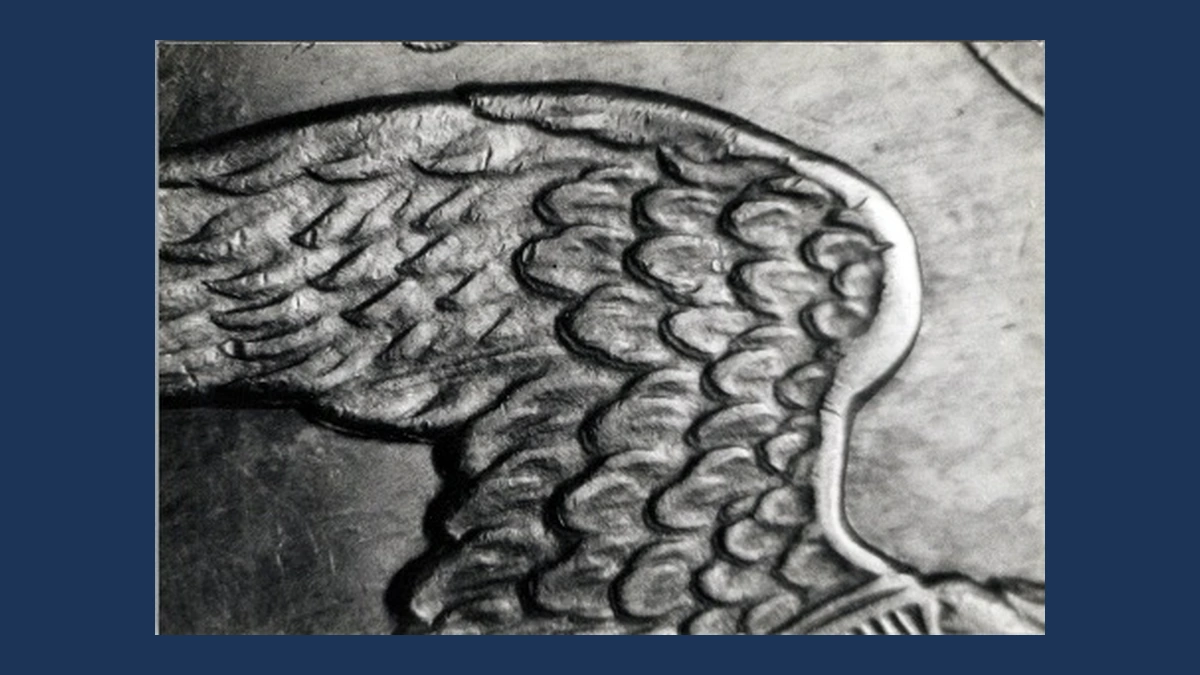
The eagle’s feathers can reveal this doubled design more clearly than a quick look at the date. The listed Philadelphia pattern has strong repetition on the upper right wing and right leg feathers.
Closer repetition appears at the eye and in ONE, the surrounding country name, and IN GOD WE TRUST. STATES also shows a small clockwise spread.
Wexler’s catalog names it WDDR-001. These connected features come from a doubled design on the stamping tool.
A flat shelf beside one letter can instead form through movement during striking.
Estimated Value
Budget an estimated $500–$15,000 for an authenticated Philadelphia example in circulated through well-preserved condition. The exact coin’s grade and production style need to be established before choosing a comparison.
Clear feather separation makes the pattern easier to show than a faint outline hidden by wear. That visibility may attract a specialist buyer.
This range is an editorial estimate, not an auction result for WDDR-001. Deep scratches, cleaning, and worn feather edges can reduce value.
How to Identify
Find the repeated feather edges with a ten-power magnifier before moving to the smaller lettering. Compare the upper right wing, right leg feathers, and eye with the catalog photographs.
Now follow ONE and the motto, looking for rounded second outlines rather than flat ledges.
The catalog also describes small raised tool lines above T in LIBERTY and just left of the top of W in WE. These help check the same stamping tools; they are not separate varieties to price.
Confirm the Philadelphia identity and production style with a specialist. This pattern cannot simply be assumed on every ordinary coin or Proof, a specially made collector coin.
Use separate comparisons for CC and S dollars. Matching both feathers and lettering gives a stronger identification than one doubled-looking letter.
3. 1870 Liberty Seated Dollar Tilted Back Design (1870-CC)
Liberty can sit upright while the eagle appears tilted after a straight top-to-bottom flip. This happens when the two stamping tools do not share their intended angle.
PCGS preserves a collector report of two 1870-CC dollars with a 12-degree shift. It also records a 25-degree shift to the left.
The report does not state the direction of the smaller angle. Neither figure should be attached to a coin merely because its holder or photograph is crooked.
This feature concerns the relationship between both faces, not the spacing of the two C mintmark letters.
Estimated Value
An estimated $1,000–$20,000 covers circulated 1870-CC dollars with a verified moderate rotation. The date, mint, remaining detail, and surface quality still drive much of the price.
A 12-degree shift is less visually striking than a large turn, so avoid expecting a dramatic bonus. The reported 25-degree example offers a clearer display.
Buyers need photographs that demonstrate the angle consistently. An unexplained tilt in one auction image should add nothing to a valuation.
How to Identify
Keep Liberty upright and turn the coin over from top to bottom without twisting it sideways. On a normally aligned United States coin, the eagle should finish upright.
Repeat that movement several times, using a holder or clear flip to avoid touching the silver. If the eagle leans the same way each time, photograph both faces without changing their positions.
Use a protractor or an angle tool on the photographs to measure the difference from vertical. Record both the amount and direction for your own coin.
The published 25-degree example leans left, but the smaller report leaves direction open. A repeatable angle after a straight flip establishes the observation.
4. 1870 Liberty Seated Dollar Expanded, Uneven Border (1870-CC)
One 1870-CC dollar stood out to collector Allen Rowe because its spread-out border looked close to an off-center strike. He described finding it while searching for dollars for type sets.
His published account calls it a broadstrike. That term means the blank spread without the collar, the ring that normally controls the coin’s width.
A broadstrike can be unevenly centered while retaining the full design. If original design is actually cut off, an off-center description may be more appropriate.
The reported coin remains one example, not two separate errors to count.
Estimated Value
Use an estimated $3,000–$50,000 for a genuine 1870-CC broadstrike, depending on grade and how clearly the silver expanded. The collector’s account describes a private purchase without disclosing its price.
As a different-series comparison, an 1877-S Trade dollar broadstrike graded NGC AU58 brought $6,300 in November 2018. Its date, type, and mint differ from this Carson City coin.
A pleasing original surface and obvious expansion can matter more than a small measurement difference.
How to Identify
Lay photographs of both faces side by side and trace the outermost stars, letters, and border teeth. Determine whether all intended design remains on the blank or whether part falls beyond its edge.
That distinction helps separate an uncentered broadstrike from a true off-center strike.
For a loose dollar, gently measure several widths with calipers against the normal 38.1 millimeters. No exact diameter was published for Rowe’s coin, so compare its shape as well as its size.
Inspect the edge and nearby silver for filing, hammer blows, or crushing that could imitate expansion.
An original expanded border surrounding a complete design supports broadstriking, even when one margin is wider than the other.
5. 1870 Liberty Seated Dollar Shallow Blank Flaw beside Star Seven (1870-S)
A shallow flaw beside a front star helps identify one of the rare 1870-S dollars. Heritage described it on the edge just past star seven.
The auction catalog calls it a planchet flaw, meaning a defect in the blank metal. It does not name peeling layers or trapped material as the precise cause.
The same PCGS XF40 coin also has fine scratches and a small nick between stars three and four. Those separate marks should not be mistaken for the blank flaw.
Its extraordinary rarity comes from the date and mint, not from this small surface feature alone.
Estimated Value
The described PCGS XF40 coin sold for $505,250 on May 12, 2015 at Heritage. XF40 means the coin is worn but retains substantial detail.
For that rare 1870-S coin in comparable condition, use a broad whole-coin estimate of $400,000–$1,200,000. This is not a price for adding a small blank flaw to an ordinary dollar.
Identity, ownership history, preservation, and demand for the rare date dominate the valuation.
How to Identify
Count the stars around the front carefully and locate the edge just past number seven. Compare the shallow irregularity with the auction photograph of the PCGS XF40 coin.
Also locate the separate nick between stars three and four. Keeping the two marks apart helps prevent a mistaken match.
Under angled light and a magnifier, examine whether the shallow feature belongs to the original metal surface. Do not scrape it or try to lift an edge to test for peeling.
Because 1870-S dollars are exceptionally rare, an S alone is not enough to establish identity. Ask a specialist to compare the whole coin and its known history with the documented example.
The flaw beyond star seven is a useful matching point, not an independent certificate of authenticity.
Conclusion
These 1870 Seated dollar estimates extend from $500–$1,200,000, but the mint explains much of that wide range. The rare S-mint coin belongs in a different price class from ordinary Philadelphia examples.
Check a repeated zero with a date photograph, rotation with a straight flip, and broadstriking through the complete border. A shallow flaw or extra line needs a close match before it supports an identification.