1877 Dollar Coin Error List with Pictures

A second outline on the eagle side helped identify an 1877-S Trade dollar recorded at $7,800 in February 2018. PCGS lists that Heritage result for an MS65 example, an unworn coin with few marks.
This 1877 Trade Dollar error list covers repeated details, missing small features, and unusual edges. Estimated whole-coin prices run from $150–$12,000.
Follow the checks below to distinguish a cataloged pattern from wear, scratches, or a damaged rim.
1. 1877 Trade Dollar Missing Arrow Shafts or Punctuation (1877-S)
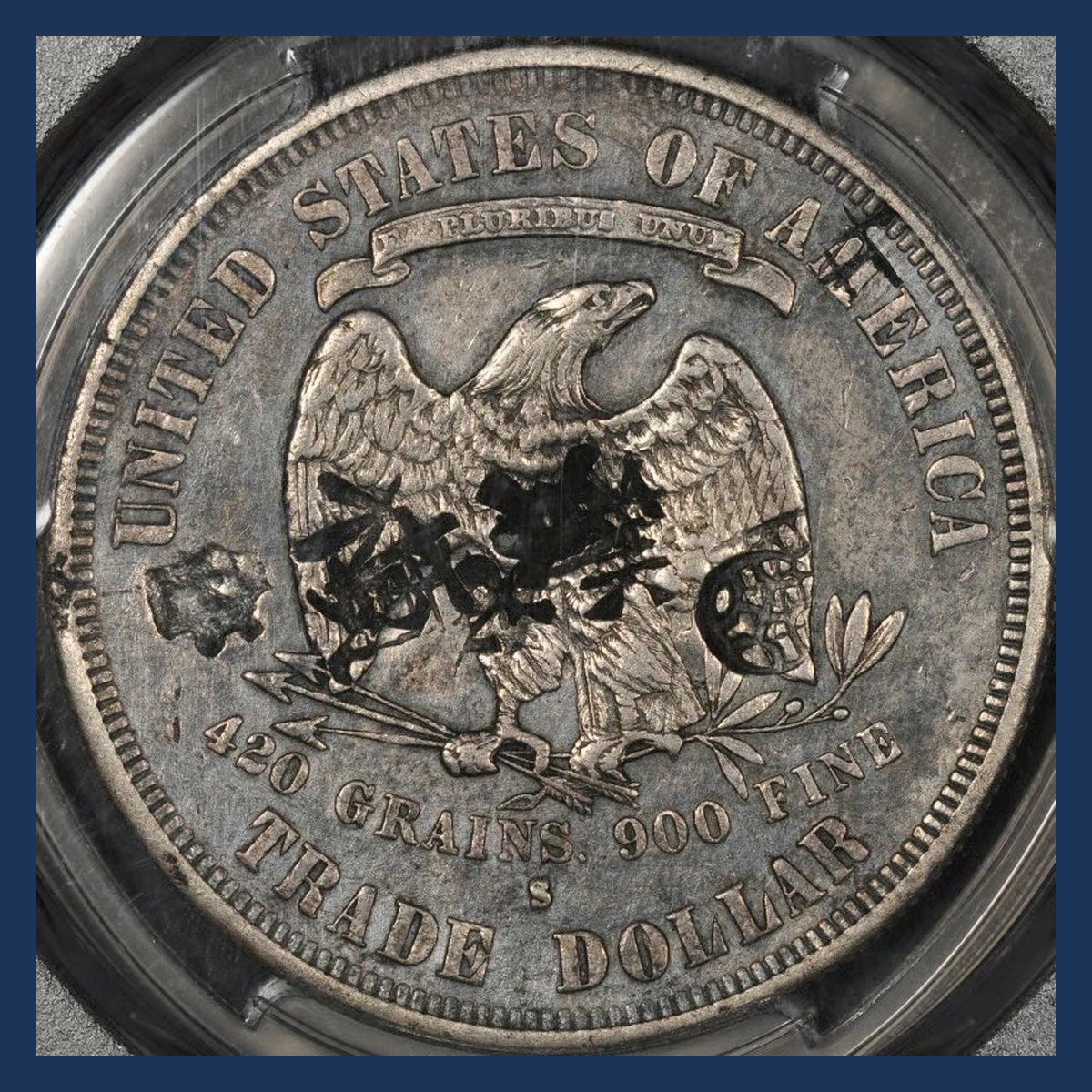
The upper and lower arrow shafts can appear as short remnants rather than continuous lines. This named Broken Arrows variety repeats a defect already present in the stamping tool.
A researcher quoted by Heritage suggested the problem began in an earlier master tool. That explanation differs from wear erasing the arrows on one circulated dollar.
Another 1877-S pattern lacks the periods after FINE and DOLLAR and has a blunt ending on R. These are separate comparison coins.
The missing punctuation should be checked alongside the letter shape, rather than treating every faint dot as an error.
Estimated Value
Heritage sold an NGC AU58 Broken Arrows example for $431.25 in November 2006. AU58 means only slight wear, so the remaining shaft details were easier to inspect than on a heavily circulated coin.
Estimate $150–$2,500 for identifiable 1877-S missing-detail varieties from worn through lower unworn grades. The range covers whole coins; a missing period alone does not justify the upper end without a matching pattern and strong preservation.
How to Identify
Compare the arrow shafts with the surrounding eagle detail under a magnifier. If the entire area is flattened by wear, missing thin lines may not identify the Broken Arrows variety.
Look for the characteristic remnants of both the upper and lower shafts while nearby detail remains readable. Deep scratches or later merchant stamps cutting through the arrows need separate treatment.
For the other pattern, examine the spaces after FINE and DOLLAR, then the end of R. Use angled light to look for faint punctuation before deciding it is absent.
The combination of missing periods and the blunt R is more useful than one weak dot.
2. 1877 Trade Dollar Partly Restrained Edge (1877-S)
A tall, narrow rim and a change in the edge’s level can show that the collar caught only part of the blank. This ring normally limits the dollar’s width and makes its edge grooves.
The documented 1877-S PCGS AU55 has only light wear. Heritage noted that a blank flaw near one to two o’clock on the front helps reveal the edge inside its holder.
Other records include more worn examples, including a G4 and a separately reported VF30. They are not automatically the AU55 coin.
A rim dent by itself does not establish partial collar restraint.
Estimated Value
The PCGS AU55 example sold for $1,035 on April 17, 2008 at Heritage. That result combines a visible edge error with a lightly worn Trade dollar.
For authenticated 1877-S partial collars, estimate $250–$3,000 across heavily worn through attractive examples. A strong, original edge step is easier to appreciate than a small irregular rim.
Cleaning, corrosion, or damage from mounting the coin can reduce its appeal despite a genuine striking error.
How to Identify
On the auctioned AU55, use a magnifier to examine the front rim near one to two o’clock. The small blank flaw there gives a view toward the edge without removing the dollar from its holder.
Follow any grooved band into the smoother expanded portion. Check that the transition looks struck rather than filed, crushed, or compressed by a later jewelry mount.
For loose coins, calipers can compare several widths with the normal 38.1-millimeter diameter. A tall rim alone is less persuasive than a clear step between grooved and expanded silver.
An edge photograph should show that transition clearly, with no filing or crushing along its boundary.
3. 1877 Trade Dollar Extra Strokes around the Sevens
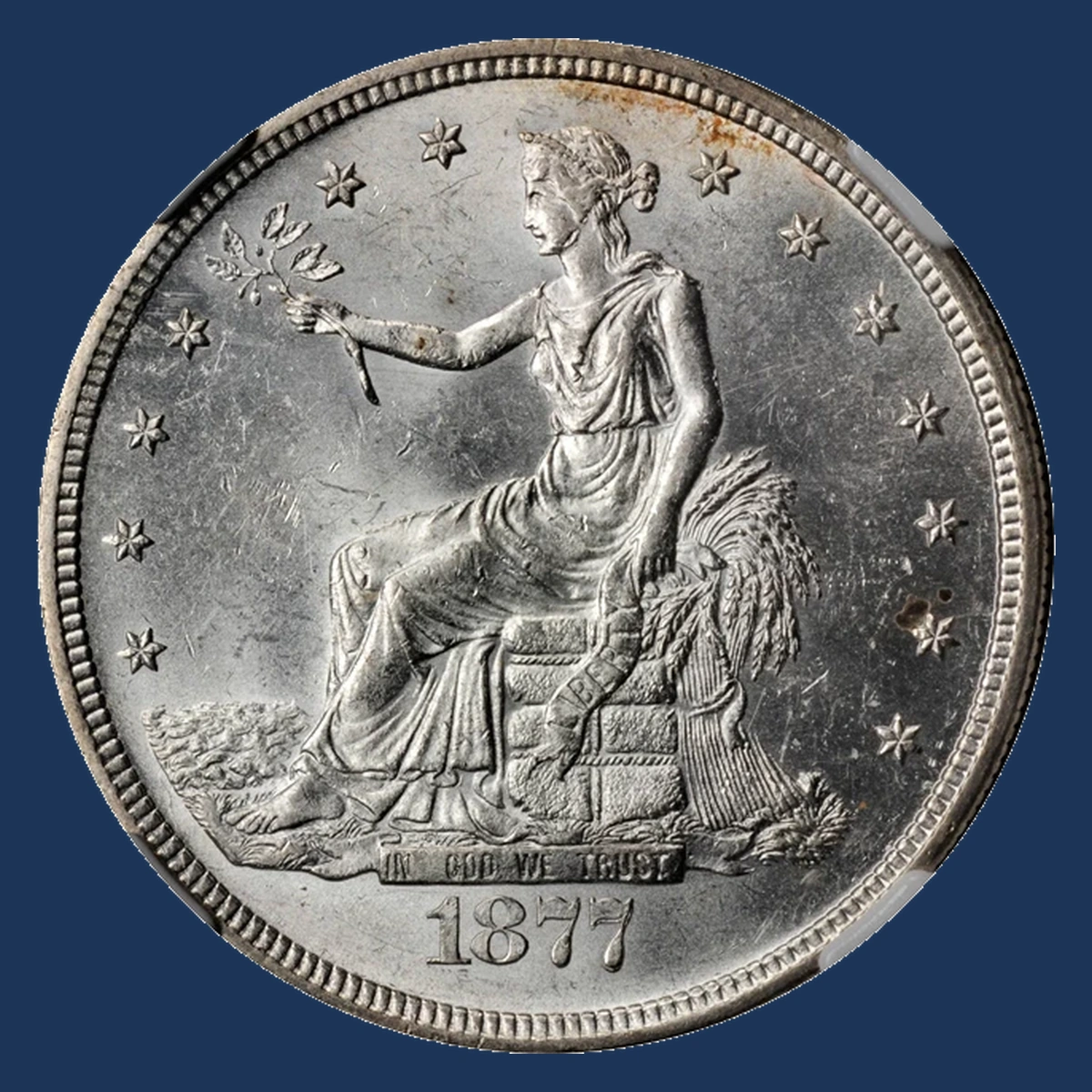
An extra line beside a 7 can be left by an earlier date-punch position. The punch entered the die, the steel stamping tool, again after shifting slightly.
Philadelphia and Carson City catalogs include 77 over 77 patterns. San Francisco has a repeated final 7, and one cataloged variety also has a repunched S mintmark.
That San Francisco combination is listed as FS-301, C-21. The catalog numbers identify its particular pattern rather than additional errors to count on the same coin.
Some Carson City examples also carry back-design doubling, which needs its own matching features.
Estimated Value
Estimate $200–$5,000 for Philadelphia or San Francisco repunched-date examples, and $400–$10,000 for Carson City dollars. These whole-coin ranges cover circulated through attractive unworn pieces, with mint and grade contributing heavily.
A clear secondary 7 is useful, but a scarce mintmark or clean original surface can explain more of the price. Where date and mintmark repetition appear together, assess the complete coin rather than adding two estimated premiums.
How to Identify
Read the mintmark before selecting a date photograph. Philadelphia has no mintmark, while S and CC identify different patterns that should not be mixed.
Under a ten-power magnifier, follow the top and diagonal strokes of each 7. Look for an earlier stroke that fits the numeral’s shape rather than a cut passing through it.
Compare the spacing between the primary and secondary strokes with the same cataloged pattern.
For the San Francisco combination, turn to the S and compare its extra outline with a labeled FS-301 photograph. Check the shape and position of that small trace.
Two matching features on the same coin support the combined date-and-mintmark identification.
4. 1877 Trade Dollar Repeated Details on the Front or Back
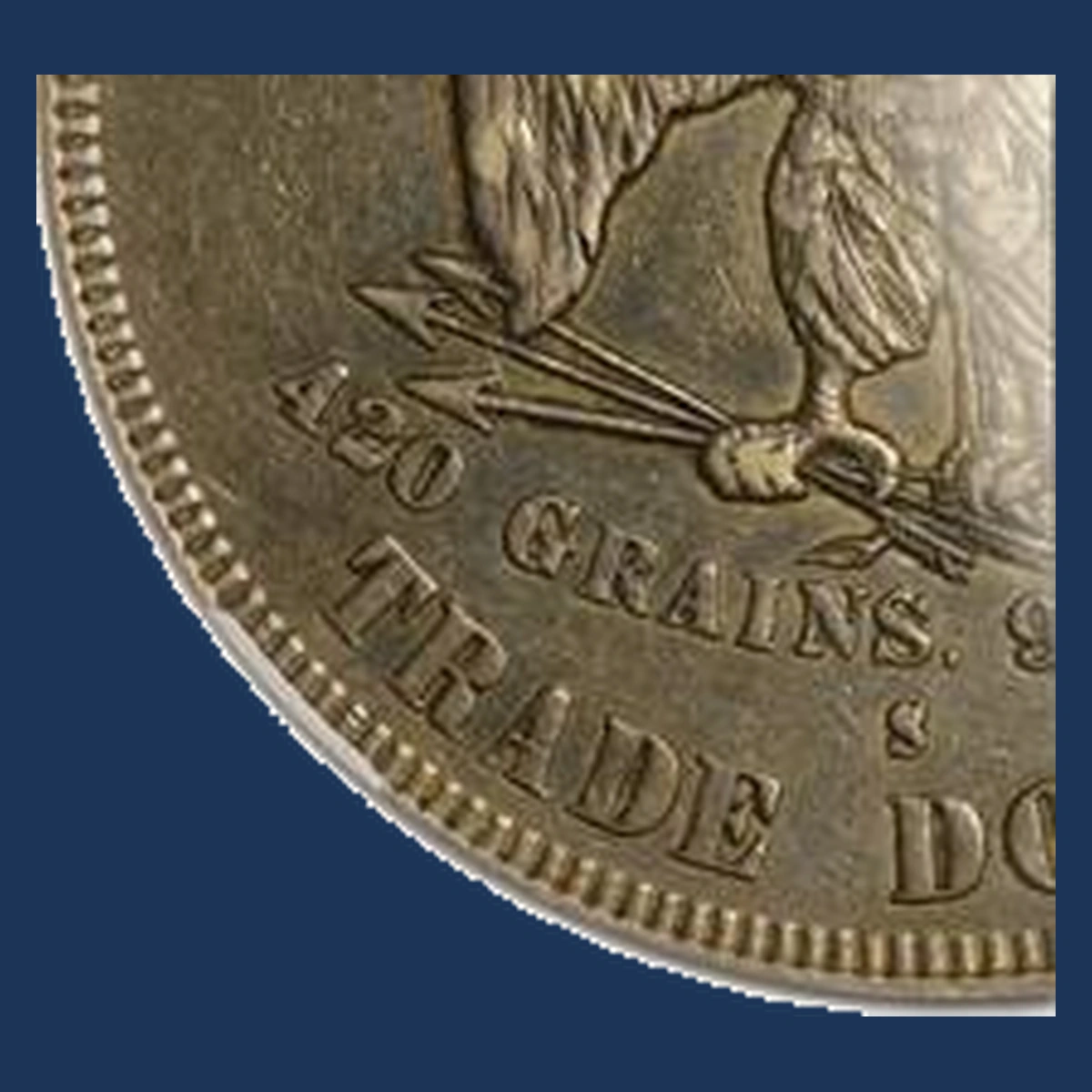
Letters, stars, or other parts of the picture can show an extra rounded outline. The die already carried that repeated design before it struck the coin.
Philadelphia front patterns include the LIBERTY ribbon, cotton-bale top, motto scroll, and far-right star. They belong to the front-design group, not to every dollar with a repeated date.
San Francisco back varieties affect surrounding words, 420 GRAINS, 900 FINE, and the motto. Carson City also has cataloged back doubling.
Compare the individual pattern for each mint. These features should not be assumed to occur together on one example.
Estimated Value
PCGS records $7,800 for an 1877-S FS-802 back-doubling example graded MS65 at Heritage in February 2018. That is a specific unworn variety coin.
Estimate $200–$12,000 across the identified front and back patterns in differing grades. Worn, weaker examples belong far below an attractive high-grade dollar.
Later merchant stamps and scratches can lower the price by interrupting the original design. Their depth and placement matter, especially when they obscure the repeated letters that identify the variety.
How to Identify
For a suspected Philadelphia front variety, compare the LIBERTY ribbon and far-right star first. Then check the cotton-bale top and motto scroll against the matching pattern.
On a San Francisco back, use a magnifier to inspect the outer words, weight-and-fineness wording, and motto. Carson City needs a separately identified back-doubling comparison.
Tilt the light to see whether the extra outlines are rounded parts of the design. A flat shelf can come from movement during striking rather than doubling already on the tool.
Do not mistake a punched merchant symbol for repeated original lettering. The same rounded repetition in the correct locations is the useful match.
5. 1877 Trade Dollar Centered Design on an Expanded Blank (1877-S)
The documented 1877-S broadstrike measures 39 millimeters across, wider than the normal roughly 38.1-millimeter Trade dollar. Its full design remains centered within broad, somewhat irregular borders.
The blank spread outward because the collar did not hold it during the strike. Some back lettering and border teeth stretched as the metal moved.
Heritage described the coin as NGC AU58 with a large S mintmark. Light wear appears on the eagle’s breast feathers.
The larger diameter is a measurement of this example, not a requirement that every broadstruck Trade dollar must reach exactly 39 millimeters.
Estimated Value
The NGC AU58 broadstrike sold for $6,300 on November 9, 2018 at Heritage. Its complete centered design and visibly expanded borders give it a clear error display.
Use an estimated $2,000–$12,000 for comparable 1877-S broadstrikes. A lightly worn example can command substantial interest when the error is obvious.
Irregular width from hammering or later flattening should not receive the same estimate merely because it exceeds the normal diameter.
How to Identify
Place clear photographs of both faces together and trace the full outer design. All intended detail should remain on the blank, even where the letters and border teeth look stretched.
For the cataloged AU58, compare the centered picture with the broad, irregular margin.
If the coin is loose, use calipers gently at several points to check its width. Compare those readings with the normal 38.1 millimeters and the reported 39-millimeter example without treating one number as sufficient proof.
Inspect the edge for collar restraint and both faces for crushing caused by later blows.
The intact centered design, naturally stretched outer detail, and expanded original border form the useful combination.
Conclusion
Estimated whole-coin values for these 1877 Trade dollar errors and varieties span $150–$12,000. The mint and condition can be as important as the extra stroke or unusual edge.
Missing arrow shafts need a different check from repeated letters. A partial collar also leaves different edge evidence from a fully expanded broadstrike.
Keep ordinary wear and later merchant stamps separate from features formed at the Mint when making comparisons.