1921 Peace Dollar Error List with Pictures

PCGS records a $32,000 result for a 1921 VAM-1A Peace dollar graded MS66 in December 2021. That high-grade coin combined a recognized tool break with exceptional preservation.
This 1921 Peace Dollar error list covers estimates of $150–$35,000 for complete coins. Small raised dots, crossing rays, and a tilted eagle each call for a different check.
Read on to see which marks belong to the Mint’s tools and which can come from later damage.
1. 1921 Peace Dollar Dot from a Damaged Stamping Tool (VAM-1B)
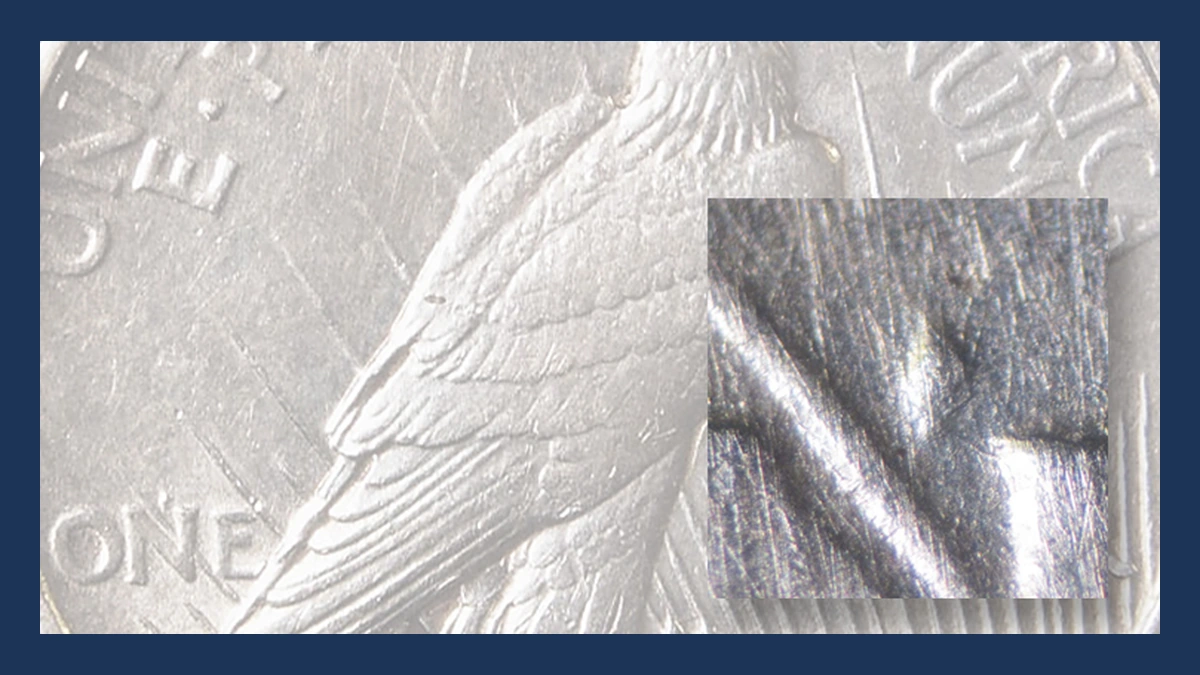
A small raised dot can come from damage to the steel tool that stamps the coin. Silver enters the tool’s hollow and leaves a bump on the finished dollar.
John Roberts lists VAM-1B as a strong, dot-like tool gouge. VAM numbers identify particular stamping-tool patterns used for Morgan and Peace dollars.
The dot belongs to the struck surface. A piece of dirt, dried residue, or a later impact can produce a misleading spot instead.
A random bump is not enough to identify VAM-1B. Its shape and position must match a named example.
Estimated Value
For a correctly identified VAM-1B, use an estimated whole-coin range of $150–$1,500. This allowance reflects the collectible 1921 issue and the added interest of a clear tool mark.
Wear that flattens the dot makes comparison harder. Clean, original surfaces and a readable raised feature give buyers more to judge than an uncertain spot on a scratched dollar.
The estimate is a collecting guide, not a recorded VAM-1B auction result.
How to Identify
Before touching the spot, tilt the dollar under a lamp and use a magnifier. A raised silver feature should cast a small shadow that changes as the light moves.
Do not scrape it to test whether it is dirt. Scraping can remove original metal and leave permanent damage even when the spot began at the Mint.
Compare the exact dot with clear photographs of an identified VAM-1B. Include nearby letters or picture details so that the location, size, and outline can be matched together.
A dent beside a pushed-up ridge suggests an impact instead. Matching the whole dot and its surroundings is more useful than simply finding a raised speck.
2. 1921 Peace Dollar Rotated Back Design
The eagle can lean when the front portrait is held upright and the coin is flipped correctly. The two stamping tools were not aligned in their usual relationship.
PCGS describes 1921 examples with the back rotated about 20 degrees counterclockwise. That is a particular reported angle, not a feature expected on every coin dated 1921.
The entire back picture turns together. One crooked letter or a tilted photograph does not show the same error.
No piece of the design needs to be missing. The important clue is how the two complete faces line up.
Estimated Value
A confirmed rotation around the reported 20 degrees has an estimated whole-coin range of $200–$2,000. A clear demonstration of the tilt is essential when offering the coin for sale.
Condition remains important because 1921 Peace dollars already attract collectors. A worn example and an attractive unworn dollar should not receive the same price simply because their angles match.
Independently rotated photographs cannot demonstrate the error, even when the resulting picture looks dramatic.
How to Identify
Hold Liberty upright, with the date level below her portrait. Keep your fingers at the left and right edges and flip the coin over from top to bottom.
The eagle should now be upright in normal United States coin alignment. For the reported error, the back instead leans about 20 degrees counterclockwise.
Repeat the flip without turning your hands sideways. Marking the top of a transparent holder with removable tape can help keep the starting direction consistent.
Take photographs before and after that same flip, then compare vertical lines through the two designs. A protractor or simple angle overlay can measure the back’s tilt.
The whole eagle and surrounding lettering should share the same rotation.
3. 1921 Peace Dollar Re-engraved Ray Crossing the L (VAM-3)
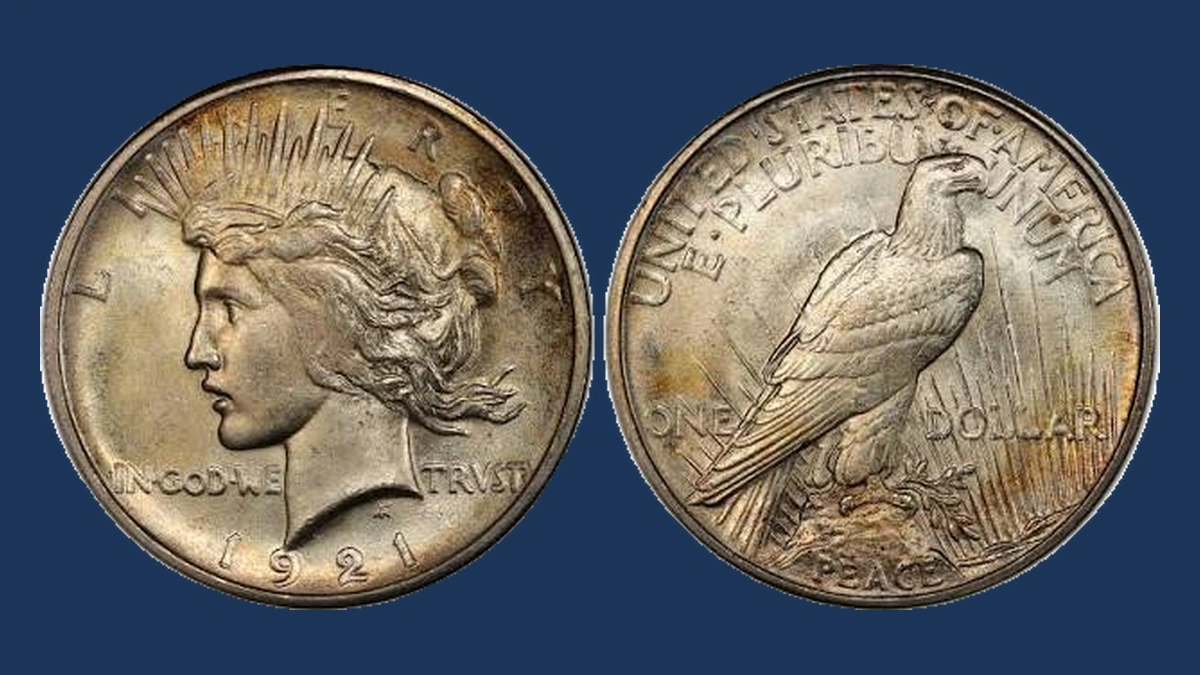
Follow the sunray into the first L of DOLLAR. On VAM-3, the ray crosses over the letter instead of disappearing beneath it.
A Mint worker strengthened details by cutting them into the stamping tool by hand. The extra cut placed this ray where it did not belong.
Nearby rays also show strengthening. John Roberts describes the work in his illustrated VAM-3 study, without treating a collision between the tools as a proven cause.
This is a repeated tool pattern, also called FS-1003. It is not a scratch added separately to each finished dollar.
Estimated Value
An NGC MS63 example sold for $840 in August 2023 at Stack’s Bowers, as recorded by PCGS. MS63 means an unworn coin with noticeable marks.
Estimate $200–$3,500 across worn examples and attractive higher-grade coins with a clear crossing ray. The variety adds interest, but preservation and the strength of the original strike still influence the complete dollar’s price.
A faint line on a cleaned coin should not be compared directly with a sharp, undamaged example.
How to Identify
Read DOLLAR on the back and find its first L, the letter immediately after O. Under a magnifier, follow the ray as it meets and crosses that letter.
Compare the crossing with a clear VAM-3 photograph. A later scratch cuts into the silver, while this detail was formed when metal filled the hand-cut line in the tool.
On a worn coin, the main crossing can be faint. Fine tool lines below the R of DOLLAR and crisscrossing lines at the front of Liberty’s crown can help.
Check those supporting marks without confusing them with fresh scratches. The ray continuing across the first L remains the most direct feature to find.
4. 1921 Peace Dollar Raised Polishing Lines (VAM-1F and VAM-1H)
Fine lines can be part of the original dollar rather than evidence that someone cleaned it. Polishing a stamping tool can leave tiny grooves that become raised lines on the coins.
VAM-1F and VAM-1H name two different patterns. Their lines must be compared separately instead of assuming that any group of fine marks identifies either variety.
The VAM-1H auction description notes swirling lines around OF on the back and some near WE on the front.
These patterns also occur on ordinary circulation strikes. They do not, by themselves, establish a Proof, a specially made collector coin.
Estimated Value
A VAM-1F graded PCGS MS65 brought $2,400 in March 2018. A VAM-1H graded MS65 with CAC approval sold for $7,343.75 in October 2021.
An estimated $200–$20,000 covers worn through exceptional unworn examples. The higher end reflects rare quality: the latter auction description also cites a different MS66 VAM-1H sale at $19,200 in 2019.
These are whole-coin prices. Identifying tool polish does not turn a modestly preserved dollar into a top-grade example.
How to Identify
For a possible VAM-1H, begin around OF on the back and WE on the front. Use a magnifier and change the lamp angle to reveal the fine curved lines.
Look for lines standing slightly above the surrounding silver. Cleaning usually leaves scratches cut into the surface, although wear and bright lighting can make the difference difficult to see.
A possible VAM-1F needs its own identified comparison photographs. Do not use the VAM-1H locations as a substitute for matching its different pattern.
Keep the coin in its holder if it is already certified. Read the label, then compare the visible lines with photographs of the same named variety.
Raised lines that repeat the pictured pattern support identification; a shiny surface alone does not.
5. 1921 Peace Dollar Break in the Back Stamping Tool (VAM-1A)
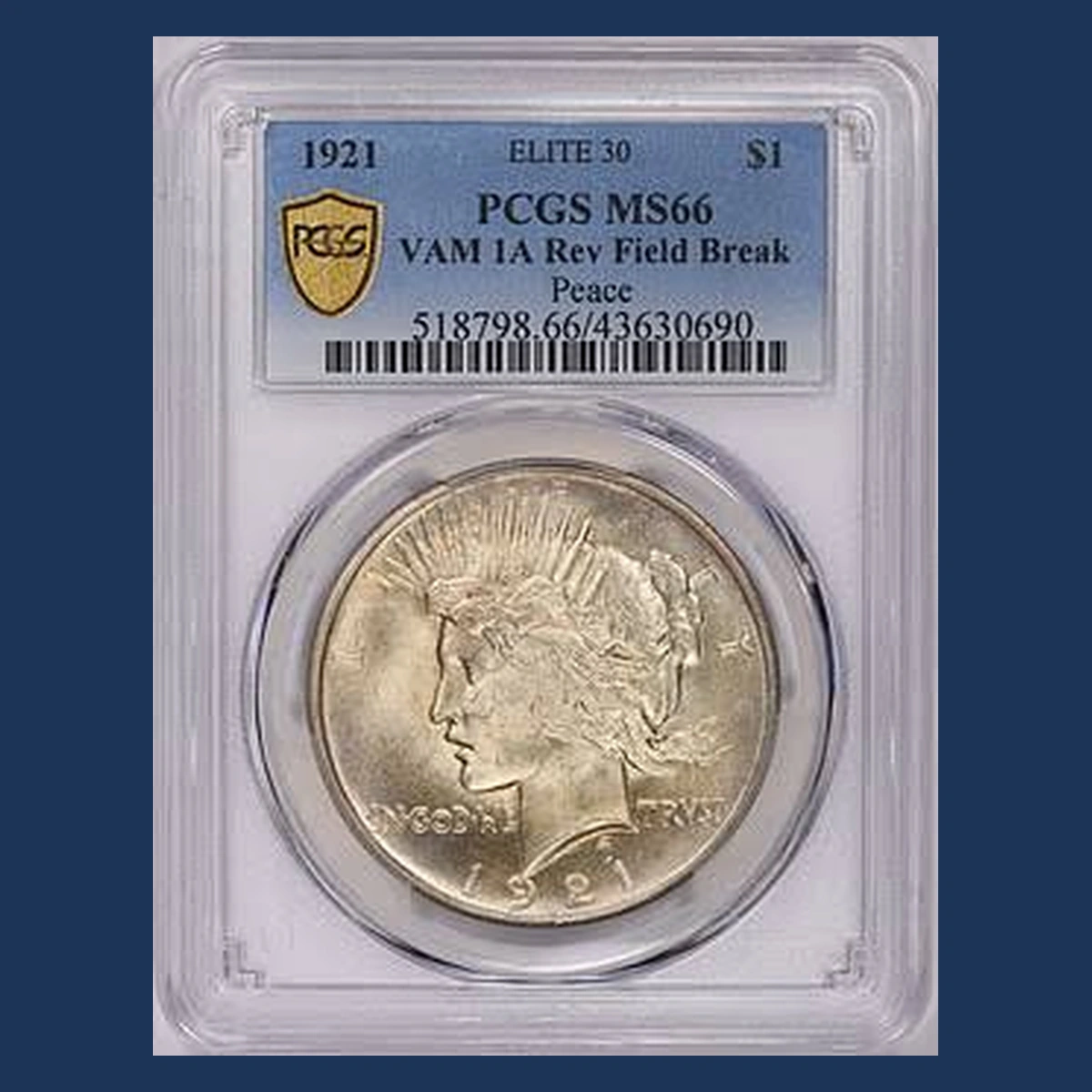
The smooth area to the right of the eagle can carry an abnormal feature from a broken stamping tool. This is the VAM-1A variety, commonly named the back field break.
Field simply means the smooth background around the design. Damage to the tool changed how that part of the silver surface formed during striking.
A coin can also acquire a dent or scrape in that area during handling. The location alone therefore does not establish VAM-1A.
The break’s outline and its relationship with nearby design details provide the useful comparison. A small random mark needs a different explanation.
Estimated Value
PCGS records $32,000 in December 2021 for an MS66 example sold through eBay. That result includes the value of an unusually well-preserved, unworn 1921 dollar.
Use an estimated $200–$35,000 for confirmed VAM-1A coins across a broad condition range. The tool break does not account for the entire difference between a worn coin and that top-grade example.
Large handling marks, cleaning, or weak remaining detail can hold the price much lower.
How to Identify
Position the eagle upright and examine the smooth silver to its right. Use a low lamp angle to see changes in height and the outline of the affected area.
Compare that shape with an identified VAM-1A photograph at similar size. A tight crop should still include nearby rays or letters so you can judge the position without guessing.
Inspect the border of the mark through a magnifier before deciding that the tool broke. An impact may leave a hollow and displaced metal, while scraping can leave several parallel cuts.
Turn the coin slowly instead of polishing the area to make it clearer. A matching boundary beside the same surrounding design is the practical check for this variety.
Conclusion
For the varieties and rotation covered here, estimated whole-coin values run from $150 to $35,000. The strongest prices depend on preservation as well as the named feature.
Look closely before choosing a label. A ray crossing the first L is a different clue from polishing lines or a tilted back.
Keep the surface untouched and compare the exact pattern before paying a large premium.