2000 Dollar Coin Error List with Pictures

George Washington should not appear on the front of a golden Sacagawea dollar. One such mixed-design coin sold for $194,062.50 in January 2024, making it a memorable example of 2000 Sacagawea dollar errors.
Other mistakes are smaller: an extra line across the eagle, a stepped edge, or a missing piece of metal. Estimated values for the groups below span $10–$225,000.
Read on to separate those features and understand why two unusual-looking dollars can have very different values.
1. 2000 Sacagawea Dollar Clashed Dies
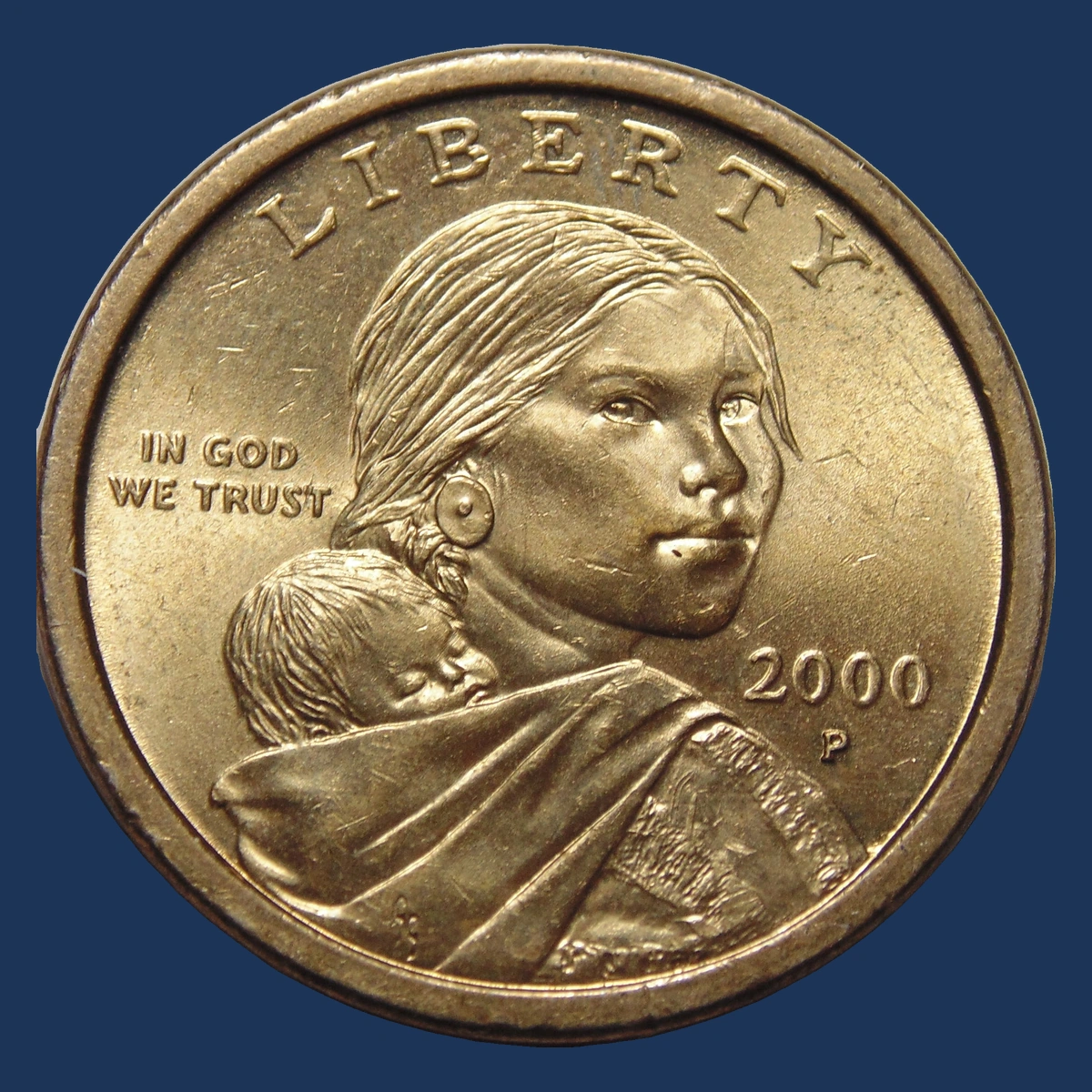
A faint outline belonging to the opposite face can appear among a dollar’s normal details. This happens when the two steel stamping tools, called dies, hit each other without a coin between them.
The tools can leave shallow marks on one another. Later coins pick up those marks alongside their normal pictures.
Recorded 2000-P examples include an ANACS MS64 coin and a separate ICG MS67 coin described with marks on both faces.
These faint transferred shapes differ from the raised line across the Wounded Eagle variety’s belly. Random scratches do not establish a clash.
Estimated Value
An estimated $10–$150 covers minor to clearly visible clash marks on ordinary 2000-P dollars. Strong, recognizable outlines are easier to enjoy than marks that disappear in most lighting.
High numerical grades do not guarantee a large error premium. The unusual feature must remain easy to show on the actual coin.
Wear, cleaning, or heavy spotting can reduce interest further. Compare the strength of the clash itself before paying extra for an otherwise common first-year dollar.
How to Identify
Set a normal 2000 dollar beside the candidate and study the unfamiliar outline. It should resemble part of the opposite face, not merely a doubled edge beside the same letter.
A photograph of the opposite stamping design can help explain how the outline fits. Use a magnifier and low lighting to follow the faint mark through open areas.
Inspect both faces independently, since a clear mark on one side does not prove equally strong marks on the other. Do not press another coin against it as a test.
A later squeeze between coins often leaves depressed, distorted details. Trace the suspected outline against a documented clash photograph with the same surrounding design.
2. 2000 Sacagawea Dollar Stepped Edge from a Partial Collar
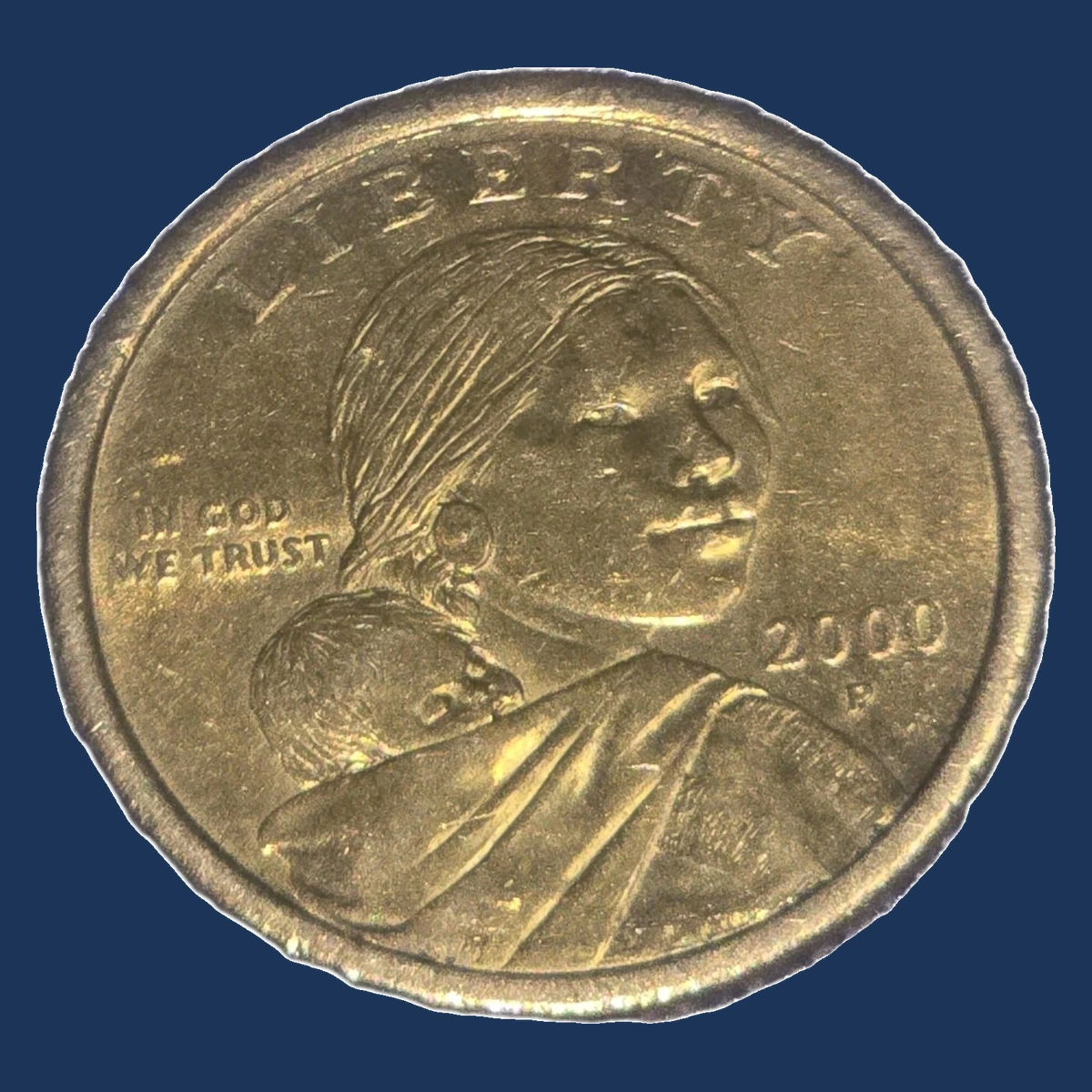
A ledge around part of the edge can reveal that the coin sat only partly inside its collar. This ring normally controls the coin’s width during the strike.
The section held by the ring stays narrow. Metal above it can spread farther, leaving two levels along the edge.
A 2000-P example graded PCGS MS61 appears in the auction record. Its shape is described as a partial-collar strike.
The normal 2000 Sacagawea dollar has a plain edge. Missing grooves or missing edge lettering therefore cannot identify this error on a coin from this year.
Estimated Value
The recorded PCGS MS61 example sold for $126.50 in August 2009. MS61 describes an unworn coin with many noticeable marks, rather than a heavily circulated dollar.
For comparable partial-collar errors, an estimated $75–$500 allows for differences in the step’s strength and the coin’s condition.
A distinct ledge running around a meaningful part of the edge offers a better display. A tiny flattened spot from later contact should not receive the same premium.
How to Identify
Hold the coin by its edges and examine its thickness from the side. Turn it slowly to follow the ledge, rather than relying on a single front photograph.
A partial-collar edge has a narrow section beside a section that spread farther outward. Compare that two-level shape with a normal plain-edged 2000 dollar.
Look closely at the transition for flattened metal or repeated dents from later rolling. Damage can thicken an edge without producing the original collar relationship.
For a loose coin, calipers can help compare widths at different heights without squeezing the metal.
Follow the same step around successive parts of the edge to see where the confined section gives way to outward spread.
3. 2000 Sacagawea Dollar Turned Back Design
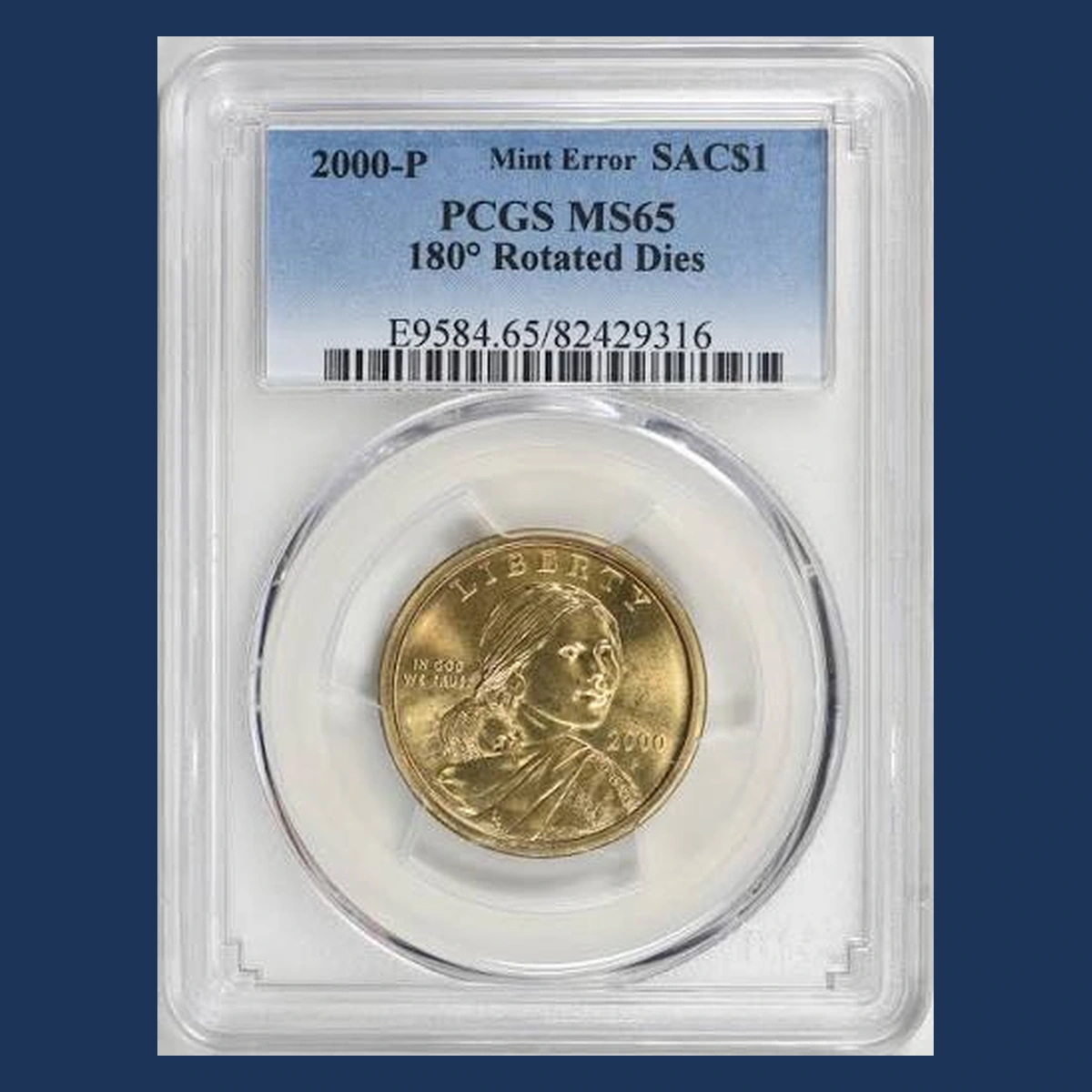
The eagle can finish tilted or nearly upside down after a properly held dollar is flipped from top to bottom. One stamping tool was turned away from its intended position.
The coin still carries only one normal front and one normal back. Collectors call the mistake a rotated die or rotated reverse.
A PCGS MS66 example has a recorded 140-degree rotation. Other 2000-P coins show smaller and larger turns, each measured on its own specimen.
Rotating separate photographs proves nothing. The important relationship is the angle between the two faces of the same coin.
Estimated Value
For a clear, authenticated rotation, estimate $50–$600. A nearly sideways or inverted eagle tends to make the error easier to demonstrate than a small turn.
The recorded 140-degree example graded PCGS MS66 sold for $322 in March 2010. Its grade indicates an unworn coin with relatively few marks.
The angle is only one part of the price. Clean surfaces and an easy-to-repeat demonstration matter more than a seller assigning a dramatic nickname to the tilt.
How to Identify
Practice with an ordinary dollar: hold Sacagawea upright, then flip the coin from top to bottom without spinning it sideways. The normal eagle should finish upright, providing a simple control for your hand movement.
Repeat that movement with the suspected error, keeping your fingers at the same two rim points throughout the turn. If the eagle is tilted, photograph its angle against a straight reference without rotating the back image afterward.
A clear holder can keep the coin fixed, but check that it cannot move inside the holder while turning. Repeat the controlled top-to-bottom flip and see whether the eagle returns to exactly the same wrong angle.
4. 2000 Sacagawea Dollar Expanded Broadstrike
An unusually wide outline can surround a complete dollar design. The coin spread outward because the collar, the ring around its edge, failed to restrain it during striking.
This is a broadstrike. Sacagawea and the flying eagle can remain complete even when the picture sits closer to one side.
A PCGS MS65 2000-P example has been listed at auction. It belongs to the simple expanded type, separate from coins with several strikes or missing sections.
The edge is naturally plain on a normal dollar of this year. The useful difference is uncontrolled spreading, not absent lettering or grooves.
Estimated Value
A simple, authenticated broadstrike has an estimated value of $100–$1,500. Broad expansion and a complete, attractive design can place a coin toward the upper portion.
The closest comparisons should also have just one strike. A dollar that combines spreading with repeated strikes, a clip, or an extra impression can command a different price.
Check preservation as well as width. Scraped portraits, flattened lettering, and obvious later hammering reduce appeal and may explain the unusual shape altogether.
How to Identify
Compare the outline with a normal 26.5-millimeter dollar, then measure the loose coin in several directions. The expanded piece need not be perfectly circular or equally wide everywhere.
Read the outer words and follow the portrait around the coin. A broadstrike retains the intended design, while an off-center strike loses part of the picture beyond the metal.
The empty margin can be wider on one side without losing those outer details. A centered picture is therefore not the only acceptable appearance.
Now tilt the portrait and lettering under a lamp to inspect their raised tops. Look for crushing, fresh scratches, or repeated pressure marks that would instead explain a normal coin widened by hammering.
5. 2000 Sacagawea Dollar Wounded Eagle Raised Mark
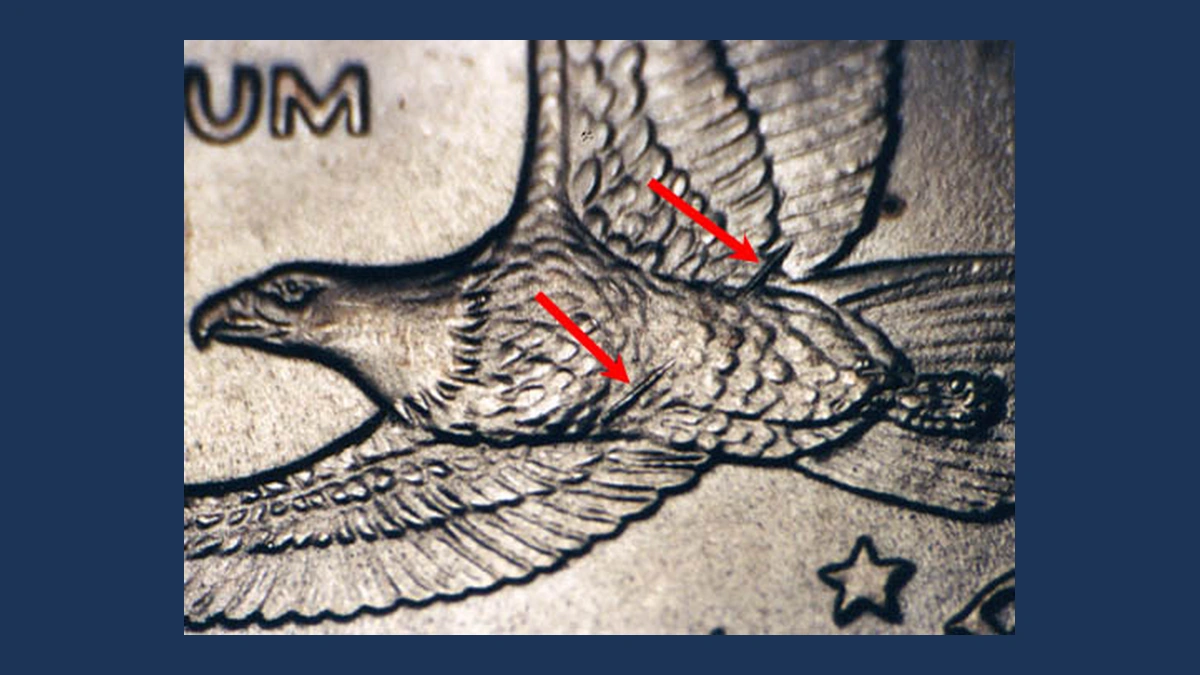
The eagle appears to have a line running across its belly. On a genuine Wounded Eagle dollar, that unusual line stands above the surrounding surface.
The nickname describes its appearance, not a wound in the metal. PCGS calls the feature a raised die flaw, meaning a defect in the stamping tool.
The recognized 2000-P variety is cataloged as FS-901. Its shape and position must match the known example.
A scratch usually cuts into the coin instead. Neither ordinary feather lines nor a random raised bump can establish this named variety simply because they touch the eagle.
Estimated Value
Identifiable Wounded Eagle dollars have an estimated range of $50–$2,000. Worn examples with a clear mark sit nearer the lower end, while exceptionally clean unworn coins can cost much more.
PCGS lists an MS67 example at $1,800 in November 2020. That high-grade result should not be applied to every circulated discovery.
Preserve the original surface around the mark. Polishing away dirt or discoloration can harm both its appearance and its value.
How to Identify
Find the eagle’s belly in a clear FS-901 photograph, then locate the matching area on your dollar. Check the date and P on the front before comparing the unusual line with the picture.
Use a magnifier and tilt the coin beneath a small lamp, watching how the line casts a shadow. A ridge standing above the surface differs from a groove cut into it, even if both cross the belly.
Include neighboring feathers in the close-up so the mark’s length and direction can be compared, rather than photographing one isolated streak. Follow the entire raised line against the FS-901 photograph without rubbing or probing the metal.
6. 2000 Sacagawea Dollar Missing Back Metal Layer
A copper-red back can contrast strongly with the normal golden front. This appearance can result when the outer metal layer is missing and the copper center remains exposed.
Sacagawea dollars use bonded layers, called clad construction. Their outer alloy contains manganese and brass-forming metals; it is not a sheet of pure manganese.
A PCGS MS63 2000 dollar with the back layer missing appears in a specialist dealer list. The mintmark is not specified in that description.
Color alone is not proof. Stains, chemical treatment, and added copper plating can change a normal coin’s appearance.
Estimated Value
For an authenticated dollar missing its back outer layer, estimate $300–$3,000. The amount missing, surface preservation, and clarity of the exposed copper guide the value.
As a different-year comparison, a 2007 Washington dollar missing its front layer was historically offered at $1,150. That was a dealer’s asking price, not a recorded auction sale.
A complete, undisturbed missing layer makes a stronger display than patchy discoloration. Damage caused by grinding away metal does not deserve the same premium.
How to Identify
Weigh the coin first if it is loose. A complete normal Sacagawea dollar weighs about 8.1 grams, while an absent metal layer should lower that weight.
Next inspect the edge where the golden surface ends and the copper-colored area begins. Look for the layer relationship rather than judging the back’s color alone.
Grinding can reduce both weight and thickness, so examine the eagle and open areas for scraping or unusually flattened detail. Added copper plating may cover the edge without removing an original layer.
Do not clean the surface to brighten the color. Ask an error specialist to check the exposed metal and edge together, using the measured weight to support the identification.
7. 2000 Sacagawea Dollar Clipped Blanks and Clipped Multiple Strikes
A missing section can begin before a metal disc, or blank, reaches the dollar press. Documented 2000-P examples include a 38% curved clip, a 21% unspecified clip, and a ragged edge.
Others combine clips with repeated strikes. One has a 20% straight gap; another has two gaps and three strikes.
A five-strike example also spread beyond the collar and received a depression from another blank. A separate roughly 11% straight-end clip has closely overlapping strikes.
These are different coins. Their missing sections and extra designs must be examined together, rather than priced as separate loose features.
Estimated Value
Allow an estimated $50–$600 for simpler clips and $400–$4,000 for major combined errors, giving an overall $50–$4,000 range.
A PCGS MS64 dollar with a 38% curved clip sold for $360 in September 2024. The 20% straight-clipped, repeatedly struck NGC MS65 coin brought $1,840 in October 2006.
Both amounts bought whole coins. A clip percentage alone cannot price an example with additional strikes, and later scratches can reduce its appeal.
How to Identify
Inspect where each gap meets the original rim. A genuine pre-strike missing section can leave weak rim formation or stretched detail near those junctions.
For curved clips, also examine the opposite rim for weakness, but do not require this supporting sign to be equally obvious on every example. Reject fresh saw lines or sharp cutting burrs.
On the straight 20% example, the first strike is about 10% off center, followed by a slight clockwise turn and another strike. Its narrow overlapping outlines belong to the same coin.
The triple-struck coin has gaps near twelve and five o’clock, with separate later scratches on the back. The five-strike example has a right-side gap and lower-left depression.
Compare each coin’s gap junctions and surviving design with its own full-coin photograph before accepting the combined error.
8. 2000 Sacagawea Dollar Blocked Design and Retained Material
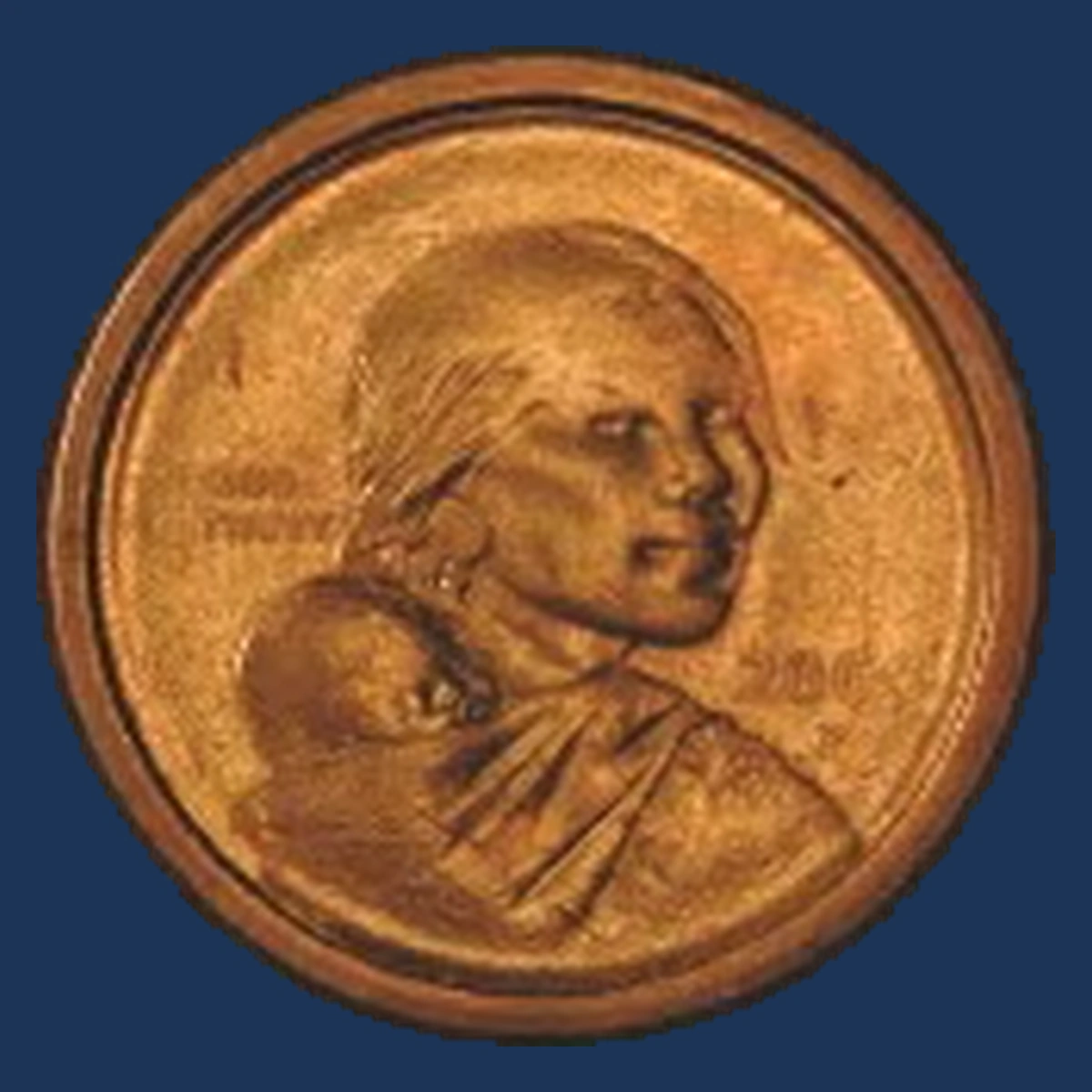
A patch of design can disappear when material lies between the blank and a stamping tool. The obstruction may leave an impression or remain attached to the finished coin.
This is called a struck-through error. A reported 2000-P example does not have a specifically identified blocking material.
A separate NGC MS64 dollar was struck four times and retains feeder-finger aluminum scrap on its back. A feeder finger is part of the mechanism that moves blanks.
Here the dollar itself carries the fragment. That differs from an entire irregular piece of scrap receiving the dollar design.
Estimated Value
Minor blocked designs have an estimated range of $20–$300; impressive retained-material combinations may reach $1,500–$5,000. The overall range is $20–$5,000.
The four-strike dollar with aluminum on its back sold for $3,120 in September 2024. That price reflects the complete NGC MS64 coin, including its repeated strikes.
A vague weak patch should not be priced like that complex example. The fragment’s relationship to the design and the coin’s undisturbed condition are essential parts of its appeal.
How to Identify
If material remains attached, leave it in place and inspect its contact with the surrounding design. A fragment added with glue after minting does not show the same struck relationship.
Photograph the border from low angles, looking for design that stops or changes where the obstruction lay. Avoid lifting the fragment to see underneath.
For an empty depression, compare the matching area on a normal 2000 dollar. General wear flattens high points across the design rather than leaving one isolated blocked patch.
The aluminum-bearing example also has repeated strikes, so keep those overlapping features separate from the fragment’s outline. Check where the preserved coin design meets the obstruction before deciding that the material was present during minting.
9. 2000 Sacagawea Dollar Off-Center Strikes
An empty crescent can occupy much of a dollar while the picture runs off the opposite edge. The blank was misplaced between the tools when the strike occurred.
A 2000-P example graded NGC MS66 is about fifty percent off center. Its remaining date and mintmark help identify the coin.
Another coin, attributed as (2000-P) and graded NGC MS65, is about sixty percent off center with a front depression. That depression is called an indent and can result from another blank obstructing the strike.
Parentheses in the second coin’s identity matter. They do not promise a fully visible date or mintmark.
Estimated Value
An NGC MS66 dollar struck fifty percent off center brought $3,120 in April 2021. That provides a useful comparison for a dramatic, unworn example.
Estimated values of $300–$5,000 cover lesser shifts through major authenticated examples, including coins with an additional indent.
A visible date and recognizable portrait help collectors understand the error at a glance. The percentage off center is not a price formula, and damaged surfaces can outweigh a particularly large blank crescent.
How to Identify
Check what remains of the date and mintmark before describing the coin. If either fell beyond the metal, rely on the certified identification instead of filling in missing characters.
Follow the struck portrait toward the opposite edge from the empty crescent. The picture should run out of metal, with a corresponding off-center effect on the other face.
Inspect the unstruck area under angled light for filing or faint remnants of a removed design. Grinding can create an apparently blank patch after the coin leaves the Mint.
For the example with an indent, examine the depression separately from the unstruck crescent. Locate the original strike boundary on both faces to distinguish the misplaced blank from a later alteration.
10. 2000 Sacagawea Dollar Repeated and Flip-Over Strikes
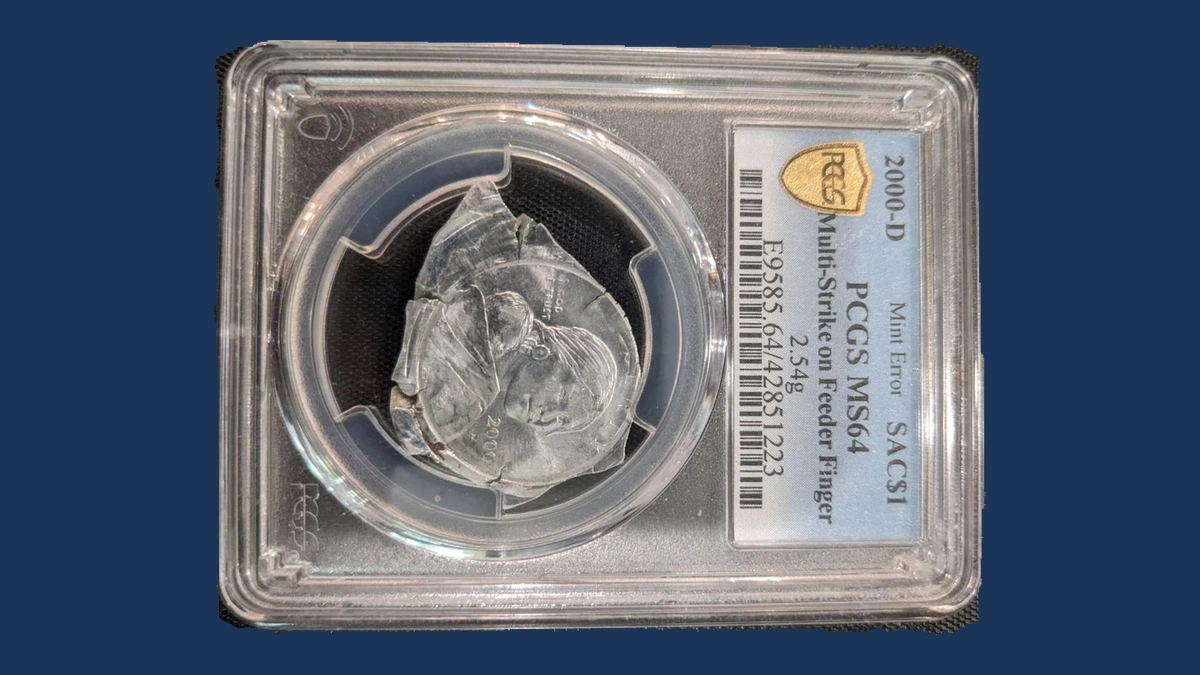
Portraits or rows of letters can crowd the same dollar when it stays in the press for extra strikes. The coin may shift, turn, or flip between blows.
Recorded 2000-P coins include two, three, six, and fifteen strikes. One four-strike coin has its last two impressions about halfway off center.
A different four-strike example has three later impressions displaced roughly seventy-five to eighty percent. Another dollar flipped over within the collar, mixing front and back designs on both faces.
Large repeated pictures differ from tiny doubling already present in a stamping tool. Each extra strike must leave recognizable design evidence.
Estimated Value
An estimated $500–$7,500 covers these repeated-strike dollars, depending on the clarity and arrangement of their extra designs. More strikes do not automatically mean more value.
A fifteen-strike ANACS MS63 coin sold for $3,360 in April 2018. A PCGS MS64 double strike with its second impression twenty percent off center brought $2,280 in September 2024.
Collectors pay for the complete display. Widely separated portraits may be easier to appreciate than a crowded stack of barely distinguishable outlines.
How to Identify
Choose one repeated letter or portrait edge and trace the whole extra impression it belongs to. A collection of unrelated scratches cannot establish a second strike.
For the four-strike example with two half-off-center impressions, separate the closely placed early designs from the later displaced ones. Do not apply that sequence to the other four-strike coin.
The fifteen-strike example has crowded outlines above LIBERTY and around the upper-left back rim. Individual scratches should not be counted as extra strikes.
A flip-over coin needs parts of the opposite face mixed into each side, rather than two front portraits alone.
Compare both whole-coin photographs with the holder’s description and locate matching letters within each claimed extra impression before accepting the stated strike count.
11. 2000 Sacagawea Dollar Designs on Scrap Metal
An irregular metal piece can carry a complete dollar design. Instead of a normal blank, part of a feeder mechanism or another scrap entered the striking area.
One 2000-P fragment graded NGC MS65 weighs 2.5 grams. Extra outlines appear above Sacagawea’s forehead and LIBERTY, while the date and P remain clear.
A separate PCGS MS65 aluminum piece was struck twice. Its thick unstruck portions have three splits, and repeated letters are visible around UNITED STATES.
The second piece may have come from a feeder tip, but that origin is not established. Its aluminum and double strike are the firmer features.
Estimated Value
The 2.5-gram feeder fragment sold for $10,925 in January 2009. The separate double-struck aluminum piece brought $5,760 in January 2020.
An estimated $3,000–$15,000 suits authenticated pieces in this group, with surviving design, material, and preservation affecting their individual values.
A readable date and portrait make an odd-shaped object easier to identify. The prices concern dollar designs actually struck on scrap, not ordinary dollars with a piece of metal later glued to them.
How to Identify
Examine the entire object’s outline, thickness, and unused metal before concentrating on the portrait. These pieces are the struck material itself, rather than normal dollars carrying a small attachment.
On the 2.5-gram example, compare the extra forehead and LIBERTY outlines with its full front image. That stated weight belongs to this fragment, not every feeder error.
The aluminum double strike has thick unstruck portions with three splits. Check UNITED STATES for letters belonging to its two impressions.
Plating can change a normal dollar’s color without making its underlying metal aluminum. Have the material examined without scraping, and match the irregular edge and repeated designs to photographs of the certified piece.
12. 2000 Sacagawea Dollar Struck over a Finished Quarter
Traces of a state quarter can remain underneath the larger dollar design. The quarter was already a finished coin when it received the new strike, creating a double-denomination error.
A PCGS MS63 example retains Massachusetts details, including the minuteman’s legs near Sacagawea’s baby. Washington’s portrait also survives near E PLURIBUS UNUM.
Other examples were struck over Maryland quarters. One graded PCGS MS65 has clear MARYLAND and 1788 lettering and a certified flip-over double strike.
The flip-over features on that coin are difficult to separate visually. The underlying Maryland lettering is much easier for a beginner to recognize.
Estimated Value
The Massachusetts example sold for $8,812.50 in April 2017. Its visible quarter details help explain the appeal of this combination.
For authenticated dollars struck over finished state quarters, estimate $3,000–$15,000. A clear state name, recognizable earlier artwork, and an attractive later dollar strike can support stronger prices.
Extra strikes should be assessed as part of the same coin. Do not add separate dollar amounts for the quarter, the overstrike, and a flip-over feature already included in the example.
How to Identify
Start with any letters that do not belong to a normal Sacagawea dollar. A readable state name or an earlier quarter date is stronger evidence than an unexplained shadow.
On the Massachusetts example, look for the quarter’s 2000 on Sacagawea’s back, the minuteman’s legs near the baby, and Washington near E PLURIBUS UNUM.
Maryland examples should show their own state lettering or building details, not Massachusetts features. The flip-over specimen preserves MARYLAND and 1788 particularly clearly.
Photograph both faces with light from several directions to separate the earlier quarter design from the later dollar impression. Identify a recognizable piece of the quarter underneath, rather than calling a small silver-colored dollar a double denomination from size alone.
13. 2000 Sacagawea Dollar Wrong Coin Blanks
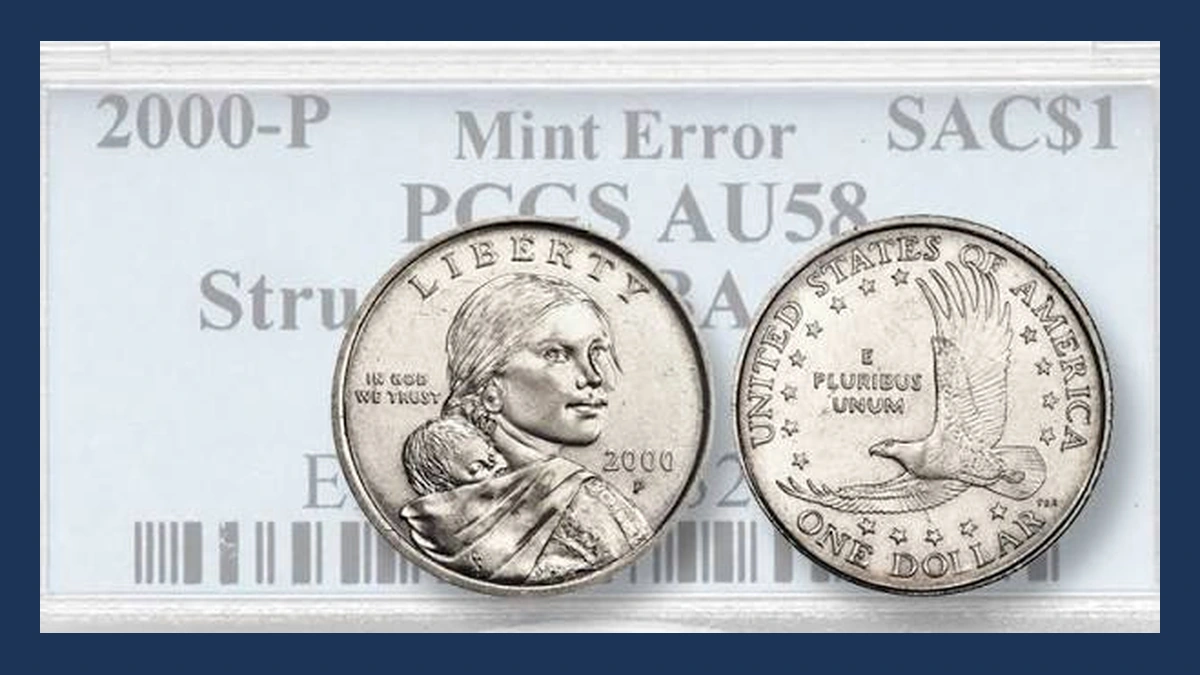
A silver-white dollar can have been struck on a blank intended for the earlier Anthony dollar. A smaller silver-colored example may instead use a quarter blank.
A recorded 2.5-gram cent-blank example has copper-colored surfaces and cropped outer design. Another certified foreign blank is roughly quarter-sized, but its country is unidentified.
The Ghana example is different again: its copper-nickel outer ring has a hole where another metal center normally belongs.
All five carry dollar designs on the wrong starting material. They must be distinguished from finished quarters struck again and from normal dollars altered after minting.
Estimated Value
Estimate $1,500–$25,000 across these authenticated wrong-blank combinations, with the exact blank and preservation setting a coin’s position.
The PCGS MS65 unidentified foreign-blank coin sold for $4,920 in April 2021. A specialist auction report records $3,737.50 for a PCGS MS64 Ghana outer-ring example in January 2008.
The ring’s open center and a cent blank’s small size create very different displays. A silver-colored normal dollar should not receive these prices without proof of its original metal and manufacture.
How to Identify
Use weight to narrow the possibilities, not to certify the error. Both normal Sacagawea and Anthony-dollar blanks weigh about 8.1 grams, so their different metals need examination.
A normal quarter blank starts near 5.67 grams and 24.26 millimeters; a modern cent blank starts near 2.5 grams and 19.05 millimeters. Striking can change the width.
The foreign solid blank needs its own metal analysis, without guessing a country from its size. The Ghana outer ring must show design struck onto an already open ring, not a hole drilled through finished artwork.
Inspect both inner and outer edges for cutting, plating, and grinding under a magnifier. Match the actual weight, metal, edge, and cropped design to the specific certified blank type before naming it.
14. 2000 Sacagawea Dollar Mixed Dollar and Quarter Designs
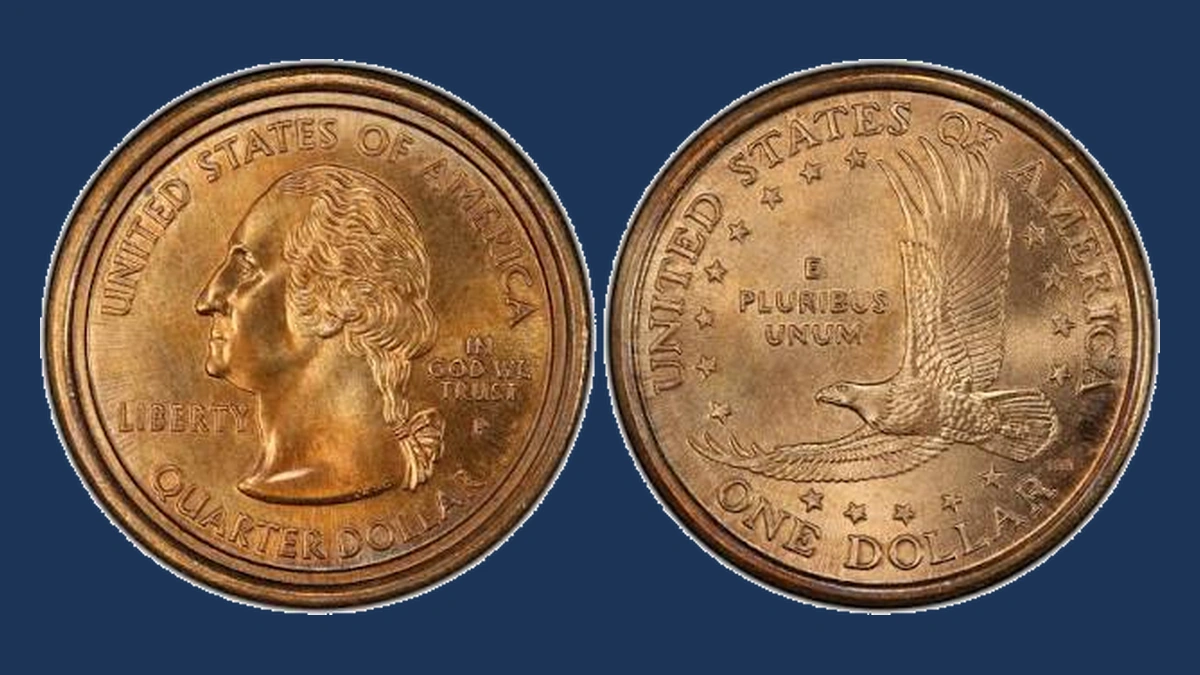
A dollar can carry two designs that were never meant to meet. When the wrong front and back stamping tools are paired, collectors call the result a mule.
The Philadelphia version combines Washington’s quarter portrait with the flying eagle from the dollar. Neither face supplies a date, so its identity is written (2000-P).
The Denver version keeps Sacagawea and 2000-D on the front but carries South Carolina’s quarter design on the back.
Both use a golden dollar blank. They differ from an older quarter covered by a later dollar strike, which leaves overlapping designs on the same faces.
Estimated Value
An estimated $50,000–$225,000 covers these major mule combinations, with the exact pairing and condition making a substantial difference.
GreatCollections sold a Washington-front PCGS MS66 mule for $194,062.50 in January 2024, including the buyer’s fee. The Denver South Carolina PCGS MS64 mule brought $84,000 in August 2024.
These are whole-coin prices for authenticated rarities. Joining two ordinary coins together does not create a comparable mint error.
How to Identify
First identify each whole face: Washington with the dollar eagle, or Sacagawea with South Carolina. Both designs must be naturally struck into one piece of metal.
Examine the edge for a seam, glue, or a channel that might conceal joined coin halves. Normal golden-dollar dimensions, about 8.1 grams and 26.5 millimeters, do not alone prove authenticity.
Washington-front mules come from different tool pairs. One pair has a crack near the F in OF, another has cracks near the lower wing, and a third differs again.
Do not require every mule to share one pair’s cracks. Have a specialist compare both faces and the edge with the exact certified pairing before treating an unusual two-design coin as genuine.
Conclusion
The estimated $10–$225,000 range covers everything from faint tool-contact marks to rare mixed-design dollars. Most discoveries belong much nearer the lower end.
Check the whole coin before pricing one unusual feature. A raised eagle mark, a missing piece, and a second set of designs each need different evidence.
Keep original surfaces intact and have major errors examined before buying, selling, or trying to remove anything attached.