2011 Presidential Dollar Error List with Pictures

A Hayes dollar can carry faint letters, gaps in the inscription, or a second set facing the opposite way. These are different edge patterns, and an upside-down single inscription is perfectly normal.
The 2011 Presidential dollar errors below have estimated values of $10–$4,000. For scale, a different design, a 2000-P Sacagawea dollar struck fifty percent off center, brought $3,120 in April 2021.
Use the checks below to connect an unusual edge or displaced picture with the process that made it.
1. 2011 Presidential Dollar Grease-Blocked Design
Letters or part of a portrait may fade in one area while surrounding details remain clear. Grease can collect on a die, the steel tool that stamps a coin, and stop metal from filling its design.
The resulting weak patch is often called a grease strike-through. It need not leave a deep hole or retain a visible piece of material.
This type is reported for 2011 without a specific president or mint identified. It should not be confused with ordinary wear, which gradually rubs down exposed parts of a finished coin.
Estimated Value
A confirmed grease-blocked example has an estimated range of $10–$300. One faint letter generally offers less visual appeal than a broad interruption beside sharp design.
For comparison, a 2014-P Native American dollar with a front strike-through sold for $31 in October 2016. It was a different dollar design, not a 2011 presidential issue.
Condition and the amount of missing detail guide the comparison. A rubbed or ground-down patch is damage rather than this Mint error.
How to Identify
Check several high points outside the weak patch. If the portrait and nearby lettering are worn down together, circulation may explain the missing detail without an obstruction in the press.
Then inspect the patch under low-angle light, looking for shallow remnants of the intended design. Grease can weaken those features without cutting scratches across their surface.
A magnifier helps reveal grinding lines or polished metal that may have removed finished detail. Do not clean the area to make it easier to see.
Compare the same location on an ordinary dollar with the same president. A local loss of struck detail beside intact high points supports a blocked-design explanation better than general flatness across the coin.
2. 2011 Presidential Dollar Two Sets of Edge Lettering
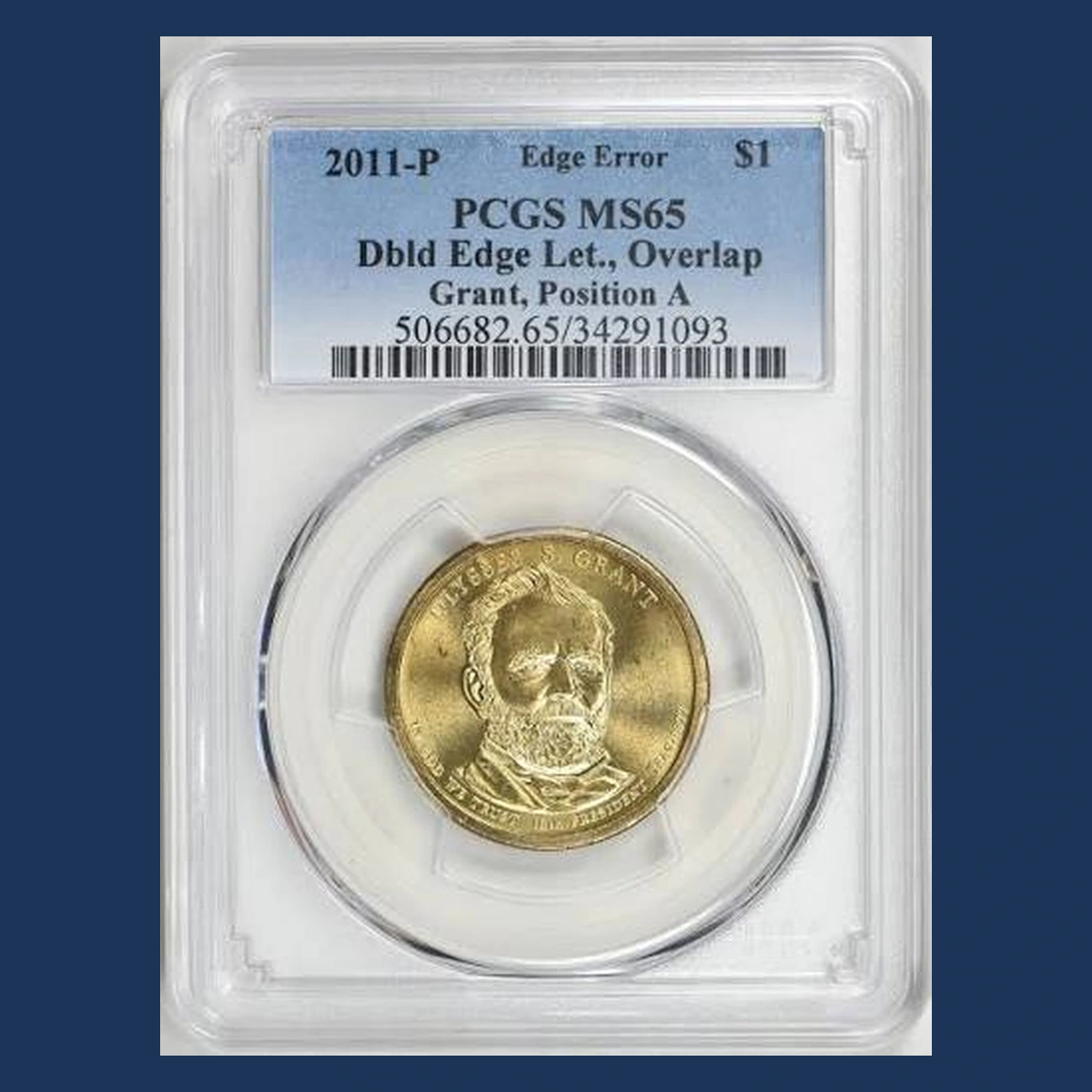
Repeated words can crowd the edge even though the portraits look ordinary. The coin passed through the edge-lettering equipment twice, pressing another inscription into the same narrow surface.
A Grant example in GreatCollections’ edge-lettering collection was graded PCGS MS65 with overlapping letters. MS65 means an unworn coin.
Overlapping forms are also listed for Philadelphia Hayes and Garfield dollars. The PCGS Hayes catalog separately includes two inscriptions facing opposite directions.
Both appearances involve repeated lettering; one normal inscription viewed upside down is not the same thing.
Estimated Value
The estimated range for genuine 2011 repeated lettering is $50–$600. Long readable overlaps or two clearly opposed inscriptions are easier to show than a few crowded marks.
A 2007-P John Adams overlapping-edge dollar sold for $59 in March 2010. That older sale is a comparison for the mechanism, not a price assigned to Grant or Hayes.
Grade and display quality also matter. Preserve the original edge, since knocks or rubbing can hide the second inscription.
How to Identify
For a Hayes coin with supposedly inverted lettering, identify two separate sets on the metal at once. Turning a single inscription over merely changes its viewing direction.
For an overlapping example, trace a repeated word rather than one doubled-looking stroke. Look for characters that continue at consistent spacing alongside the first inscription.
Keep the president visible in a whole-coin photograph.
Next photograph adjoining edge sections in order, with some overlap between frames. This prevents the same word from being counted twice when photographs are rearranged.
Examine suspicious characters with a magnifier for fresh cuts or random contact dents. Two complete letter sequences pressed into the original edge identify repetition more reliably than isolated marks.
3. 2011 Presidential Dollar Faint, Partial, or Missing Edge Inscriptions
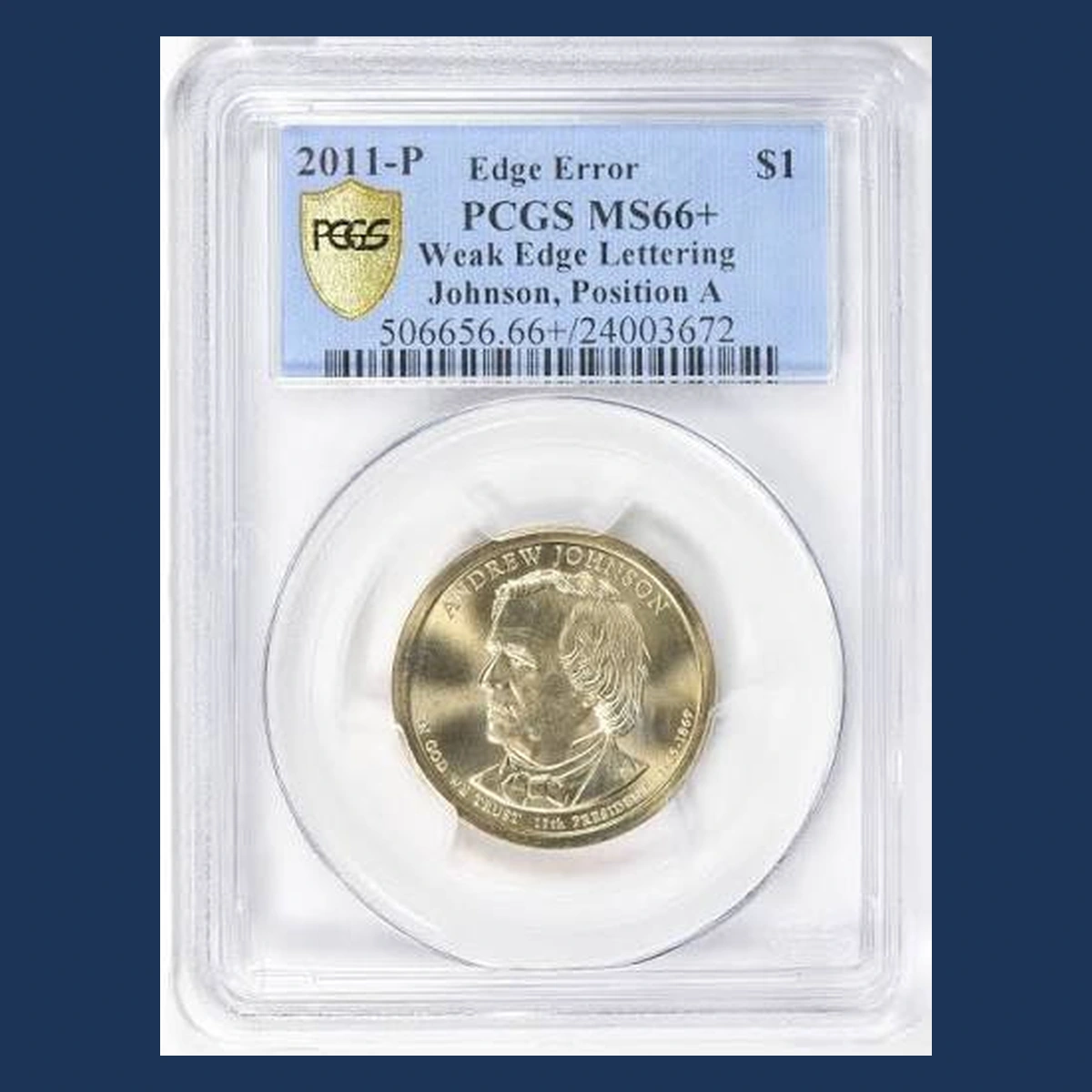
A weak inscription still has shallow letter cuts; partial lettering leaves gaps among surviving characters. These reflect an incomplete edge-lettering operation, which follows the face strike on ordinary presidential dollars.
Weak lettering is reported for Philadelphia Grant and Garfield dollars and Philadelphia or Denver Hayes dollars. Separate Philadelphia Hayes and Garfield examples have PCGS MS65 partial-edge labels.
Completely missing lettering is a separate appearance needing authentication. An NGC account published in 2015 reported no known 2011 examples at that time.
That historical statement does not prove a later discovery impossible. A fully smooth candidate still needs its own examination.
Estimated Value
Allow estimated ranges of $20–$150 for weak letters and $40–$400 for partial inscriptions. For an authenticated complete-loss discovery, use a conditional estimate of $100–$1,000.
This produces a combined range of $20–$1,000. A 2007 Madison dollar with completely missing lettering sold for $119 in July 2025, providing a different-year comparison.
The extent of missing text matters alongside wear and surface condition. A polished smooth edge does not receive the same premium.
How to Identify
Map the surviving letters before deciding how much is absent. Rotate the coin through one full turn, recording where 2011, the mint letter, and E PLURIBUS UNUM appear or fade.
Compare faint areas with deeper characters under the same light, then check every apparent gap with a magnifier. One readable letter rules out a completely missing inscription, even when most of the edge looks smooth.
Inspect both rims for filing, polishing, or metal worn away along the side. For a complete-loss candidate, the president can identify the design, but an absent mint letter does not establish Philadelphia or Denver.
Preserve any faint surviving cuts: they distinguish weak or partial lettering from a genuinely unlettered edge.
4. 2011 Presidential Dollar Off-Center Strike
Part of the picture can fall beyond the coin’s edge, leaving a blank crescent on the opposite side. The metal disc, called a blank before striking, was not centered between the stamping tools.
Both faces must agree with that displacement. A shifted portrait on only one face can have a different cause, especially if the other face remains centered.
Off-center strikes are reported for the 2011 series without a specific president or mint established. A wide or uneven rim with every design element present does not by itself prove this error.
Estimated Value
For a genuine identified 2011 off-center example, estimate $100–$4,000. A larger shift can be striking, but enough design must remain to identify the president and issue.
A 2000-P Sacagawea dollar struck fifty percent off center sold for $3,120 in April 2021. It was graded NGC MS66, an unworn grade.
That result concerns a different year and design. A smaller shift or a heavily worn surface would call for a lower comparison.
How to Identify
Turn the coin over before focusing on the blank crescent. Compare how much of the portrait and Statue of Liberty lie beyond the metal on their respective sides.
A centered back behind a shifted front suggests a misplaced tool rather than a blank struck off center. Likewise, an intact full design inside a wide outline needs a different explanation.
Inspect the blank-looking area for flattened letters, scraping, or grinding under magnification. A genuine untouched crescent should not contain a finished picture that someone removed afterward.
Find the president’s name and any surviving edge year to establish the issue. Matching displacement on both faces beside original unstruck metal is the useful physical check.
Conclusion
Estimated values run from $10–$4,000, but the visible mistake matters more than the error name. Weak or interrupted letters, two real inscriptions, a blocked patch, and a displaced strike each leave different evidence.
Preserve the edge before making comparisons. Photograph the president and the complete inscription together, and separate a documented partial-edge example from a claim that every edge character is missing.