2016 Sacagawea Dollar Error List with Pictures

The two helmets and V-shaped feathers identify the Code Talkers dollar. Missing detail in that picture calls for different checks from missing words along the edge.
Among the 2016 Sacagawea dollar errors reported below, estimated values span $20–$3,500. A collector’s Philadelphia example is described as having material block part of the back design.
A larger striking mistake on an older 2000-P dollar brought $3,120 in April 2021: it was fifty percent off center. Read on to see how each type leaves its own clues.
1. 2016 Sacagawea Dollar Weak or Incomplete Edge Lettering
Shallow words and gaps between otherwise clear letters can both point to incomplete edge lettering. They need a full-edge comparison, because a faintly visible stroke differs from a section with no impression at all.
The 2016 Code Talkers guide reports both appearances. It does not establish which mint or finish belongs to a particular example.
Ordinary coins receive their recessed edge inscriptions in a separate operation. Weak contact can affect the impression, while later wear can produce a similar appearance.
Normal Position A and Position B describe reading direction, not missing depth or missing letters.
Estimated Value
An estimated $20–$250 covers authenticated weak or incomplete lettering on ordinary 2016 dollars. A clear change from deep, readable characters to faint or missing strokes supports the stronger end.
For a different-year comparison, the PCGS guide places ordinary 2010-P weak-edge examples from roughly $10 to $285, depending on grade and position.
A worn edge is a poorer comparison than an untouched one. Small differences in normal letter depth should not automatically receive an error premium.
How to Identify
Photograph a complete circle of the edge in overlapping sections, keeping the lighting and magnification steady. Start comparing where a clear letter becomes faint, rather than treating one bright reflection as an empty patch.
Use a normal Code Talkers dollar to locate the expected words, date, and mint letter around the edge. A partial omission should leave a real interruption, while weak lettering may retain shallow bottoms of the affected strokes.
Inspect the surrounding metal for rubbing, filing lines, and rounded rims that could explain loss after minting. If two complete sets of letters appear instead, compare the coin with repeated edge lettering rather than putting both appearances under a weak-letter label.
2. 2016 Sacagawea Dollar Material Blocking the Code Talkers Design
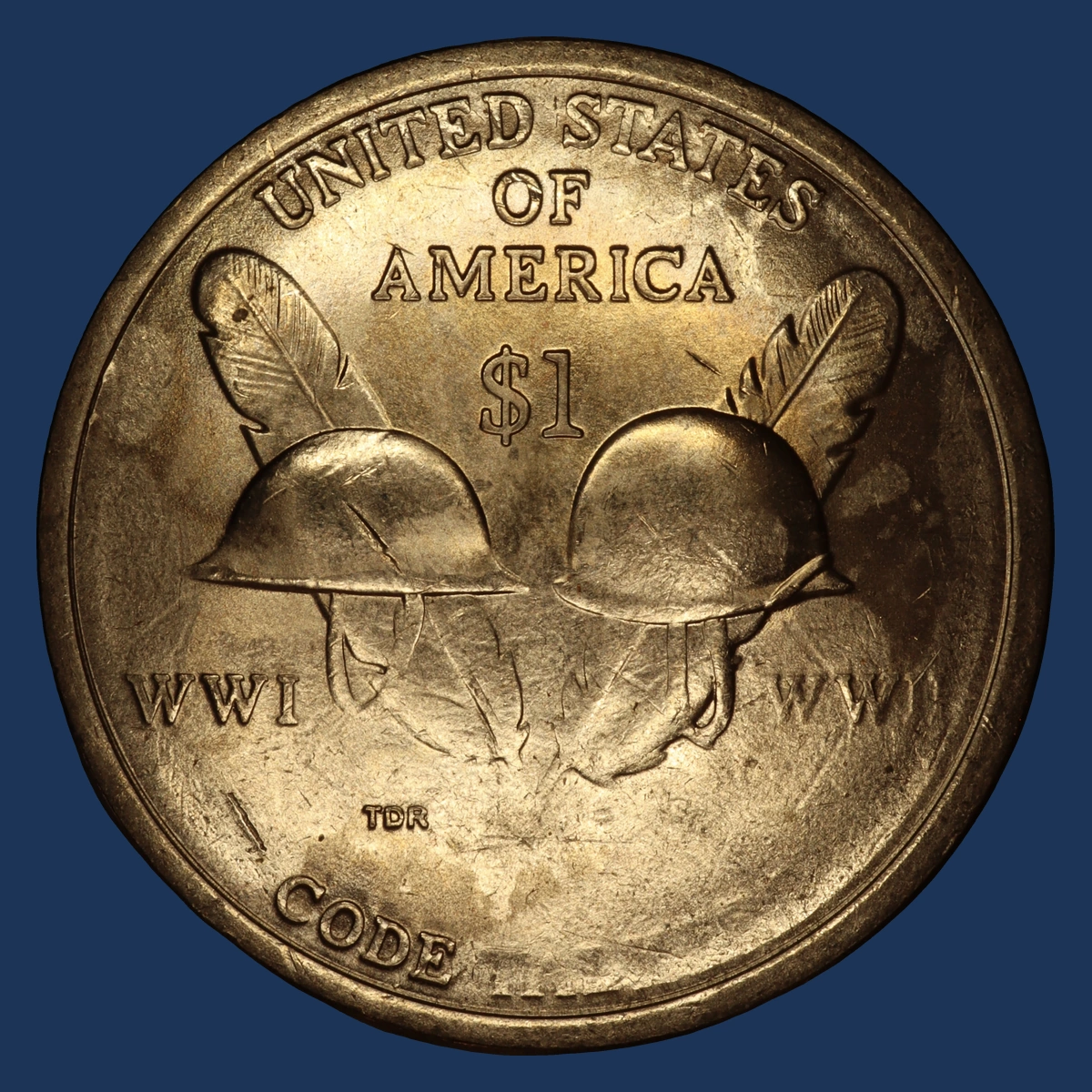
A collector displayed an ungraded 2016-P dollar with an area of the back described as struck through grease or oil. That description suggests material stood between the blank and the design tool.
The tool, called a die, normally presses its complete image into the metal. Material in the way can leave part of that image faint or absent.
The owner’s account is a report, not a grading-service opinion about the substance involved. Its Position A label refers to normal edge-lettering direction and is not another error.
Estimated Value
Allow an estimated $25–$300 for a genuine ordinary 2016-P strike-through with a visible missing-design area. A small soft patch would fall below an extensive, clearly defined interruption.
The estimate concerns the surviving coin, not the supposed identity of grease or oil. Without retained material, an exact substance may be impossible to establish from appearance alone.
Original surface texture and strong surrounding detail help buyers see the difference. Scratches, cleaning, or ordinary wear can weaken both the diagnosis and the value.
How to Identify
Begin with the normal Code Talkers picture and locate which part has become weak on the suspected coin. The report does not assign a particular helmet or feather to the affected area.
Compare nearby raised details. Sharp features immediately beside a soft patch can help distinguish local blockage from general wear.
Look across the flat background under angled light. A scrape can leave parallel lines or displaced metal where the surface was altered after striking.
Check Sacagawea’s side as well, looking for the overall level of wear and strike strength. A weak back should be assessed alongside the rest of the coin.
Do not clean the area to make its boundary clearer. Close-ups of the untouched texture and surrounding design give a specialist more useful evidence than a polished patch.
3. 2016 Sacagawea Dollar Repeated Edge Lettering
Extra edge words indicate another kind of problem from a faint inscription. An ordinary dollar can receive a second set if it passes through the lettering equipment again.
The Philadelphia year guide reports this type for the 2016 Code Talkers issue. It does not establish the spacing or direction of a particular example’s second set.
Two lines might overlap, or one might face the opposite direction. The important feature is that both sets exist on the same coin.
A single inscription facing either normal direction is not doubled lettering, even if a holder identifies its position.
Estimated Value
Estimate $50–$500 for a properly identified 2016-P repeated-edge example. The higher end favors two legible sets that can be followed around an undamaged edge.
A 2007-P John Adams dollar with overlapping edge lettering sold for $288 in February 2022. PCGS recorded it as MS66, an unworn grade with relatively few marks.
That Presidential dollar offers a different-series comparison. The 2016 estimate should follow the visible repetition and preservation, not the normal Position A or B designation.
How to Identify
Choose an edge photograph that shows more than a single letter. Try reading one uninterrupted sequence of words, then locate the second sequence crossing or running beside it.
Compare repeated numbers, stars, and letters with the original inscription. Genuine extra lettering should make sense as another impression from the equipment, rather than a collection of unrelated dents.
Turn the photograph if necessary to read an opposite-facing set. Do not turn the two coin faces separately and mistake normal edge orientation for an extra line.
Include the surviving P and the Code Talkers back in the same photo set. Those views keep the reported Philadelphia issue separate from other dollar designs or a mint letter guessed from an unreadable edge.
4. 2016 Sacagawea Dollar Completely Missing Edge Lettering
An entirely unlettered edge would leave the dollar without its normal date, mint letter, and E PLURIBUS UNUM inscription. The Code Talkers helmets and feathers can still identify the 2016 annual design.
This type is reported in the year-specific guide. A mint and finish are not established for its example.
On an ordinary dollar, missing the separate lettering operation can leave a complete blank edge. That explanation should not be applied automatically to specially prepared collector coins.
The S Proof and Enhanced Uncirculated versions have intentional special finishes; their appearance alone is not a production mistake.
Estimated Value
For an authenticated ordinary 2016 Code Talkers dollar with no edge lettering, estimate $50–$650. The range assumes original edge metal and a clearly identified annual design.
PCGS lists 2010 Native American missing-edge dollars at about $65–$650 across several unworn grades. This is a guide comparison, not a 2016 auction result.
Clear faces and minimal handling marks help value. A smoothed or filed edge cannot be priced as a genuine missed production step.
How to Identify
Select a starting point beside a recognizable face detail, then inspect the edge until you return to that point. Overlapping photographs help prove that the whole circumference was examined, including any shallow letters hidden by glare.
Look for the bottoms of numbers or stars as well as complete words; any surviving inscription changes the classification. Compare the Code Talkers back directly with a normal example rather than using another 2016 dollar design as identification.
For a loose coin, measure diameter and weight against the normal 26.49 millimeters and 8.10 grams when metal removal is suspected. Scraping lines or a reduced edge need expert examination, while absent mint lettering should remain unassigned unless reliable evidence establishes its origin.
5. 2016 Sacagawea Dollar Off-Center Strike
A blank that sits partly outside the striking area receives only part of the intended picture. The tools miss one section of metal, leaving a bare crescent beside the design.
On a Code Talkers dollar, this could cut through the helmets, feathers, or surrounding words according to the direction of the shift. The year-specific report does not establish a particular direction or percentage.
Both faces should show the effect of the same misplaced disc. A single uneven border or one shifted face can arise for other reasons and does not establish this error.
Estimated Value
Genuine 2016 off-center dollars have an estimated range of $300–$3,500. A readable annual design and an attractive, substantial unstruck crescent help support the stronger end.
NGC reports a 2000-P Sacagawea dollar struck fifty percent off center selling for $3,120 in April 2021. It carried an MS66 grade and the older eagle design.
That percentage belongs to the comparison coin. A 2016 example must be priced from its own displacement, condition, and surviving identity rather than borrowing that description.
How to Identify
Use a normal Code Talkers dollar to work out what the incomplete image should contain. Follow the helmets, feathers, and outer words until they disappear at the edge of the struck portion.
Find the remaining bare metal on the opposite side. It should be an unstruck part of the original disc, not an area ground smooth after the picture was made.
Compare Sacagawea’s face side with the Code Talkers side. The same misplaced blank should explain the unstruck areas on both.
Check the edge for any surviving date or mint inscription. Do not infer a mint from the side toward which the design has moved.
If the image remains complete around both faces, investigate expansion outside the surrounding collar ring instead. That wider coin needs a different comparison from an off-center strike.
Conclusion
The Code Talkers dollar offers both edge and face features to examine. Keep weak letters separate from a wholly unlettered edge, and compare a faded design with normal detail before calling it wear.
Estimated values run from $20–$3,500 for genuine examples. Preserve the mint letter, annual design, and any original packaging in your photographs; those details help keep ordinary strikes and special collector finishes in the right comparisons.