1806 Half Dollar Error List with Pictures

A tiny date correction helped identify an 1806 half dollar that sold for $82,250 in 2015. Its final 6 had first been punched upside down.
These 1806 half dollar errors and major varieties have estimated values from $300 to $90,000. That highest range concerns exceptional coins with no circulation wear.
The shield and edge hold other clues. Read on to compare extra digits, broken designs, and off-center strikes without confusing them with later damage.
1. 1806 Draped Bust Half Dollar Repunched Date or Letters (Estimated Up to $2,500 in Circulated Grades)
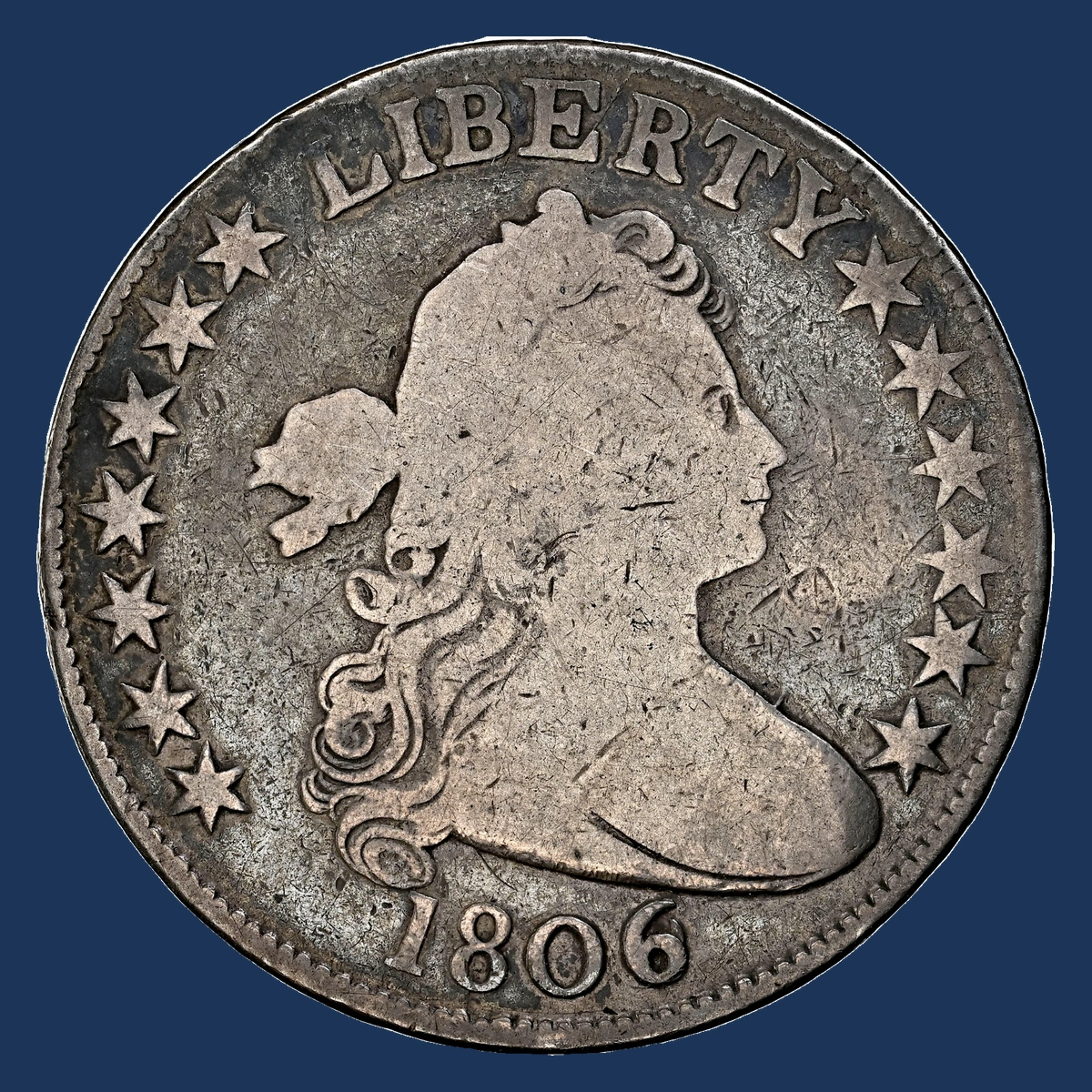
Small extra strokes appear beside the final 6 on an O-115a half and beside TY on an O-114a. Those catalog numbers identify two different examples.
Workers punched the characters into a die, the steel tool used to stamp coins. A second punch could leave pieces of the first impression beside the final letter or digit.
The coin need not have a second portrait or shifted border. The extra strokes were already in the tool.
The auctioned O-115a also has an off-center strike. Its displaced design and extra 6 strokes came from different steps, even though both appear on one coin.
Estimated Value
Circulated examples with clear repunching have an estimated range of $300–$2,500. Condition, the particular variety, and attractive surfaces all affect the price.
The O-115a with an off-center strike sold for $9,987.50 in October 2016. That much larger error contributes to its value.
A centered coin with the same extra strokes beside its 6 should not inherit that sale price. First compare coins with similar features and wear, rather than matching only the date punch.
How to Identify
Keep the full date in view while enlarging the final 6 on O-115a. For O-114a, examine TY together with the rest of LIBERTY.
Use a 10× magnifier and light from the side to find pieces of the same character beside its final outline. A scratch, flat ledge, or different underlying digit needs another explanation.
The two locations belong to separate examples. Do not expect both on every repunched coin.
Check the lettered edge and Philadelphia design with no mintmark. A scale and calipers can compare the coin with its original 13.48 grams and about 32.5 millimeters.
A matching extra piece of the 6 or TY at the documented spot is the main clue.
2. 1806 Draped Bust Half Dollar Rim-Connected Die Breaks (Estimated Up to $3,500 in Circulated Grades)
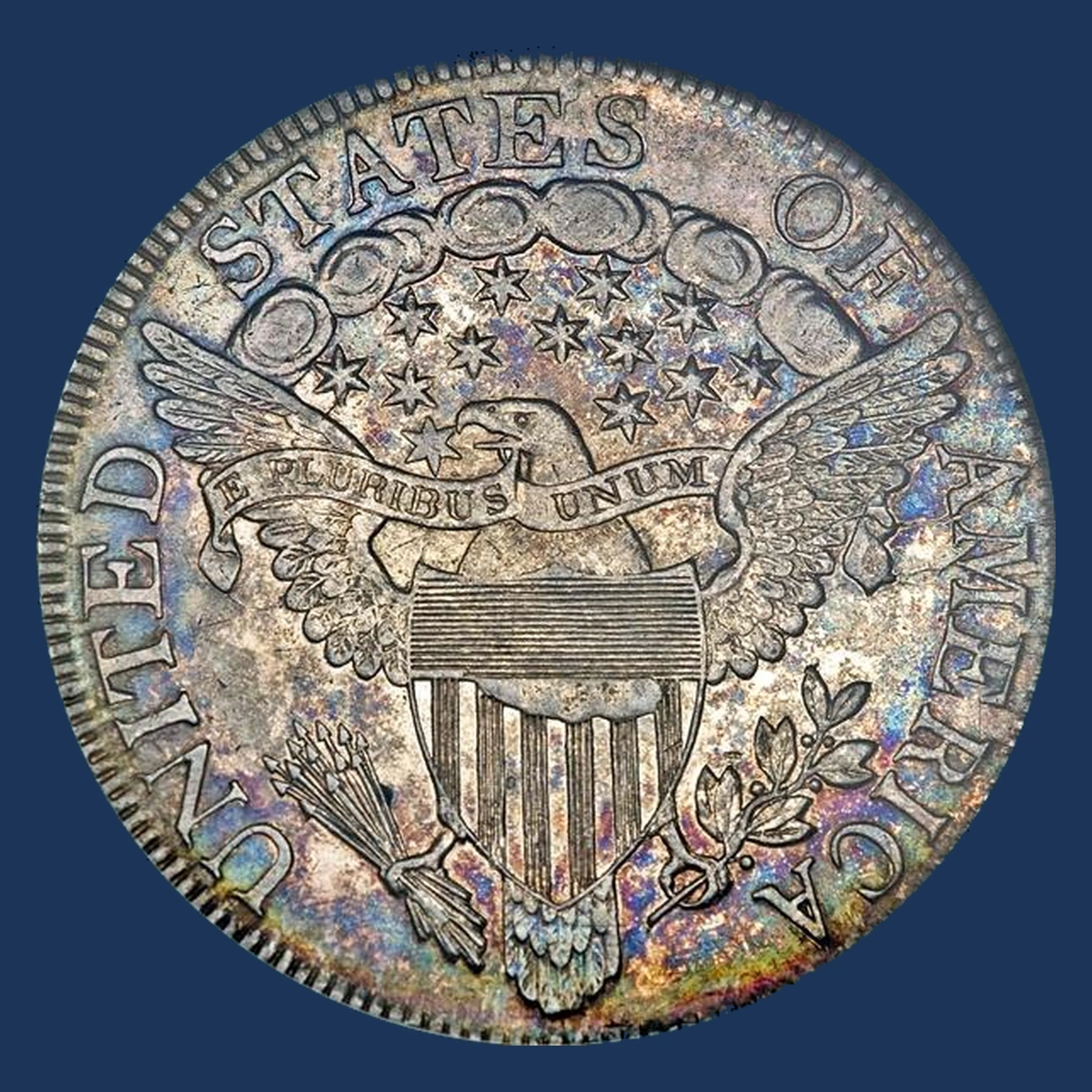
A raised area can join the rim above LIB, above UNITE, or below the arrow shafts on documented 1806 halves. These locations belong to separate coins and tools.
A piece of the stamping tool broke at its edge. It could remain partly in place or fall away completely.
The coin then received an uneven border or a raised patch where normal details should have formed. Some detail may survive if the broken piece stayed in place.
The John Reich Collectors Society examples show these rim breaks. They differ from the Broken Shield feature, which sits inside the design.
Estimated Value
Estimate $400–$3,500 for circulated halves with clear rim breaks. A larger patch may be easier to see, but grade and surface quality still matter.
A different 1806 with cracks and clash marks sold for $10,350 in 2010. PCGS graded it MS62, meaning no circulation wear, though small marks remained.
That result shows how valuable a well-preserved 1806 can be. It is not a rim-cud sale or a price to apply to a heavily worn example.
How to Identify
Find the relevant area above LIB, above UNITE, or below the arrow shafts. Compare it with the separate documented example for that location.
Through a 10× magnifier, follow the raised patch to the rim. If a broken piece stayed in the tool, some design may remain within the affected area.
A later blow to the edge instead crushes or pushes already struck metal. Photograph the edge and opposite face to help tell them apart.
This Philadelphia issue has no mintmark and normally has a lettered edge. Use a scale and calipers against the original 13.48 grams and about 32.5 millimeters.
The clearest first check is a raised broken-tool area that actually joins the rim.
3. 1806 Draped Bust Half Dollar Broken Shield Internal Die Break (Estimated Up to $4,500 in Circulated Grades)
Raised metal covers the upper ends of several vertical stripes in the Broken Shield variety. The patch lies inside the shield rather than reaching the coin’s rim.
It comes from a broken area within the back stamping tool on documented O-120 examples. Older descriptions sometimes call it a cud.
That older name does not change its location. A rim break and an internal shield break need different checks.
Wear can also erase fine shield lines. The important difference is height: this broken-tool feature forms a raised patch, while circulation tends to smooth the design down rather than build it up.
Estimated Value
A clear Broken Shield on a circulated coin has an estimated range of $400–$4,500. Attractive examples with very fine to extremely fine detail belong toward the higher end.
This range does not price the registered MS63 example. A different 1806 MS62 with cracks and clashes sold for $10,350, but it does not establish a Broken Shield premium.
Judge the raised patch together with the coin’s condition. Each missing stripe does not carry a separate dollar value.
How to Identify
Start at the upper ends of the shield’s vertical stripes. Move a lamp to the side and check whether a raised patch covers those stripe ends.
Compare the pattern with a clear O-120 photograph. A 10× magnifier should show the border of the patch rather than only general smoothing from wear.
Scrapes, weak striking, or a dent in the coin can also hide stripes. They do not create the same raised area.
Record both full designs and the lettered edge. Check the original standards of 13.48 grams and about 32.5 millimeters with a scale and calipers; Philadelphia used no mintmark.
Raised metal covering several stripe ends is the most useful first sign of Broken Shield.
4. 1806 Draped Bust Half Dollar Reported Double Strike (Estimated Up to $6,000 for Worn Examples)
One reported 1806 half has evidence of a second strike as well as graffiti on the front. NCS labeled it VG Details, indicating heavy wear and a surface problem.
The graffiti was added after the coin was made. It does not automatically rule out a genuine extra strike.
A specialist’s discussion identifies the coin as a Pointed 6, Stem half. It does not say where the extra design survives or which way it moved.
Those details must be checked on the coin. Extra strokes beside a hand-punched letter alone would not prove that the finished coin was struck twice.
Estimated Value
Estimate $1,200–$6,000 for a worn example with clear double-strike evidence and similar surface damage. No sale price is assigned here to the NCS VG Details coin.
For comparison, an 1812 Large 8 with a doubled front strike sold for $1,200 at Heritage in February 2018. PCGS graded it VF30.
That later Capped Bust half has a different design. The older 1806 coin’s extra impression, wear, and graffiti each need to be considered when comparing prices.
How to Identify
Search both sides for pieces of another design position. Use a 10× magnifier to check whether the surviving outlines fit one extra strike.
Several matching remnants are stronger evidence than one doubled-looking stroke. Separate later scratched graffiti from any raised struck details.
The specialist’s account describes a damaged half dollar. Keep the date and complete designs in the photographs so each small mark belongs to the correct example.
Check the lettered edge and both complete designs. A scale and calipers should record the coin against the original 13.48 grams and about 32.5 millimeters, allowing for wear or distortion.
Start by finding connected pieces of one additional impression, not just repunching beside TY.
5. 1806 Draped Bust Half Dollar E Over A in STATES (Estimated Up to $6,500 in Circulated Grades)
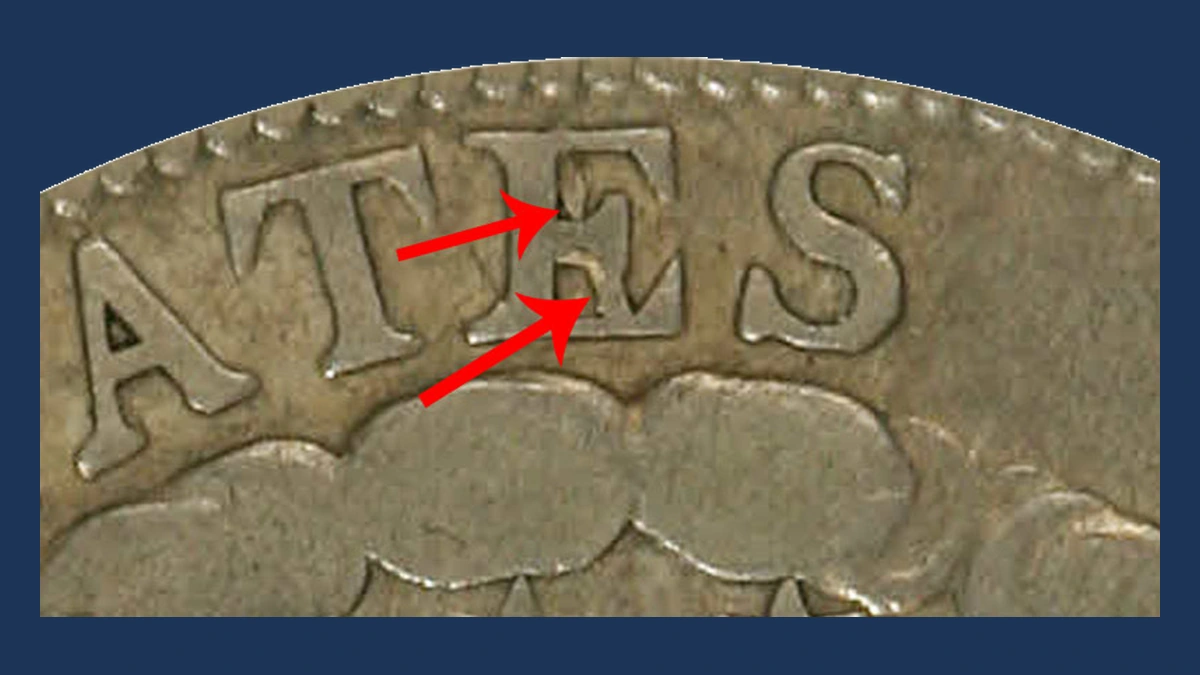
Pieces of an earlier A sit beneath the E in STATES on the 1806 O-124. A worker corrected the letter in the back stamping tool.
The first letter did not disappear. Its surviving strokes were passed to later coins made with that tool.
The feature can remain visible even on a worn half. A thick-looking E alone, however, does not prove the correction.
Heritage sold an example graded PCGS VG10, showing its appeal in a low grade. The later 1814 E/A belongs to a different Capped Bust design and is not the right picture to use for this 1806 variety.
Estimated Value
Heritage sold the PCGS VG10 O-124 for $2,040 on June 7, 2019. Circulated examples have an estimated range of $1,500–$6,500.
A sharper example with surface damage brought $3,300 including the buyer’s fee in Sheridan’s Mail Bid Sale 47. Both results price the whole coin.
Sharper details alone do not guarantee the highest value. The low-grade coin can remain desirable, while damage can hold back a coin that has more of its original design.
How to Identify
Find STATES on the back, then enlarge the E with a 10× magnifier. Use an 1806 O-124 comparison, not the similarly named 1814 variety.
Look for parts of an A beneath the corrected letter. Move the light to separate raised strokes from dirt, scratches, or the E’s normal shape.
Photographs of both sides should show the Draped Bust portrait and the large eagle design on the back. This issue has no mintmark.
Its edge carries words, not modern ridges. A scale and calipers can check the original 13.48 grams and approximately 32.5-millimeter diameter.
The retained A strokes beneath the E are the quickest place to confirm the letter correction.
6. 1806 Draped Bust Half Dollar 1806/5 Overdate (Estimated Up to $7,000 in Circulated Grades)
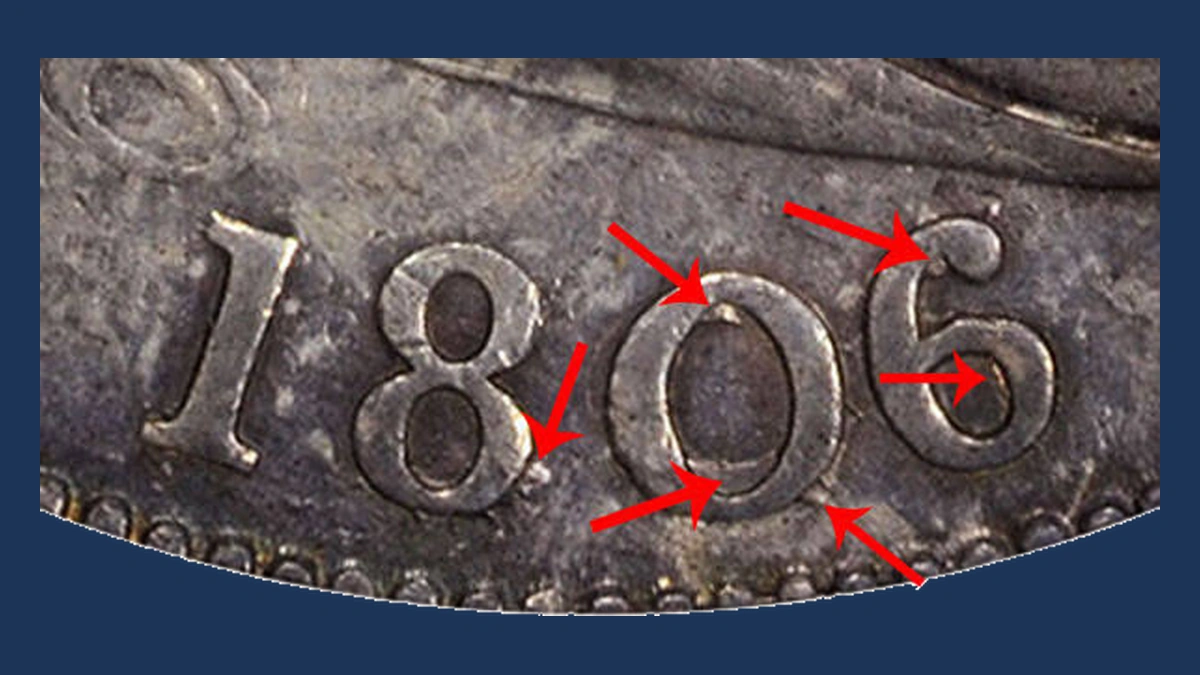
A piece of a 5 beneath the final 6 identifies the 1806/5 overdate. A date already in the stamping tool was changed for the next year.
The coin then received both the new 6 and remnants of the old 5 in the same spot. The variety is known as 1806/5 Large Stars.
This did not mean a finished 1805 coin was struck again in 1806. The correction happened in the tool first.
It also differs from the 6 over inverted 6. In that variety, the earlier shape is the same digit turned upside down, rather than an underlying 5.
Estimated Value
Estimate $500–$3,500 for readable examples from very good through extremely fine. Attractive about uncirculated coins may reach $3,000–$7,000.
These are estimated prices for the whole overdate. The related 6 over inverted 6 brought $7,871 in an XF40 example in August 2022, but it has different rarity.
That comparison shows the appeal of a major date correction. It does not mean the two varieties should receive identical prices whenever their grades match.
How to Identify
The normal Philadelphia coin has no mintmark, weighs 13.48 grams before wear, and measures about 32.5 millimeters. Check those figures with a scale and calipers, and inspect the lettered edge.
Now enlarge the last digit with a 10× magnifier. Compare the extra pieces with a clear photograph of the 1806/5 Large Stars variety.
They should fit parts of a 5 beneath the 6. A doubled outline alone is not enough.
Turn the light to check for cuts or altered metal around the date. Keep the other digits and nearby stars visible in your photographs.
The recognizable 5-shaped pieces beneath the final 6 separate this overdate from the inverted-6 variety.
7. 1806 Draped Bust Half Dollar Fifteen-Percent Off-Center Strike (Estimated Up to $14,000)
The date remains complete on a fifteen-percent off-center 1806 O-115a despite the shifted design. Bare metal is left opposite the struck area.
With each side upright, the front design shifts northeast and the back shifts southeast. These directions describe the two faces of the same coin.
NGC labeled it VF Details because of damage, meaning it retains very fine detail but has a problem. A small dent or bulge appears near seven o’clock on the front edge.
The catalog suggests the mark might have begun during minting, but does not settle its cause. The confirmed error is the off-center strike.
Estimated Value
The NGC VF Details coin sold for $9,987.50 at Heritage on October 4, 2016. Estimate $7,000–$14,000 for a similarly dramatic circulated example with a clear date.
The sale already includes the edge damage. A strong offset and readable identity can attract substantial interest despite that problem.
The small edge disturbance should not receive an automatic extra error premium. Its cause was not settled just because it appeared on this off-center coin.
How to Identify
Hold each side upright and compare the front’s northeast shift with the back’s southeast shift. The bare areas should fit the same physical offset.
Use a 10× magnifier to inspect the border between struck design and blank metal. A missing section cut away later is a different feature.
Take a separate close-up of the edge mark near seven o’clock. Keeping it separate prevents the damage from being confused with the strike boundary.
Record the full date and lettered edge. Weigh against 13.48 grams and measure the irregular outline with calipers against the normal 32.5 millimeters.
Matching displacement on both sides beside surviving bare metal is the useful first test.
8. 1806 Draped Bust Half Dollar Clash Marks Inside the Shield (Estimated Up to $15,000 for Comparable Mint State Coins)
Extra marks appear inside the shield on the O-116 half graded PCGS MS62 with CAC approval. The catalog describes them as clash marks.
They formed after the front and back stamping tools hit each other without a blank between them. Later coins could pick up outlines from that contact.
These shield marks differ from the raised patch covering stripes in the Broken Shield variety. The catalog does not identify every tiny transferred shape.
The O-116 also carries cracks. Those cracks and the shield clash have different causes, so a line should not automatically be treated as another clash mark.
Estimated Value
The PCGS MS62 O-116 with CAC approval sold for $10,350 in August 2010. Comparable well-preserved coins have an estimated range of $8,000–$15,000.
Circulated examples with readable clash marks can be estimated around $350–$2,500. Their wear calls for a different comparison.
The high-grade sale includes the whole coin and its cracks. It does not measure the extra value of marks inside the shield, and it must not be added to the crack section’s price.
How to Identify
Examine the shield for extra curves that do not belong to its normal stripes. Compare them with a reversed image of the front design.
A 10× magnifier and side lighting help separate a faint transferred shape from a scratch or a broad Broken Shield patch. Follow the actual mark rather than assuming a particular portrait feature must appear.
Keep full photographs of the O-116 with the close-up. The date and design need to stay linked to the shield detail.
Inspect the lettered edge, then use a scale and calipers against the original 13.48 grams and about 32.5 millimeters. The starting clue is an extra shield outline that matches part of the opposite design.
9. 1806 Draped Bust Half Dollar Branching Die Cracks (Estimated Up to $15,000 for Comparable Mint State Coins)
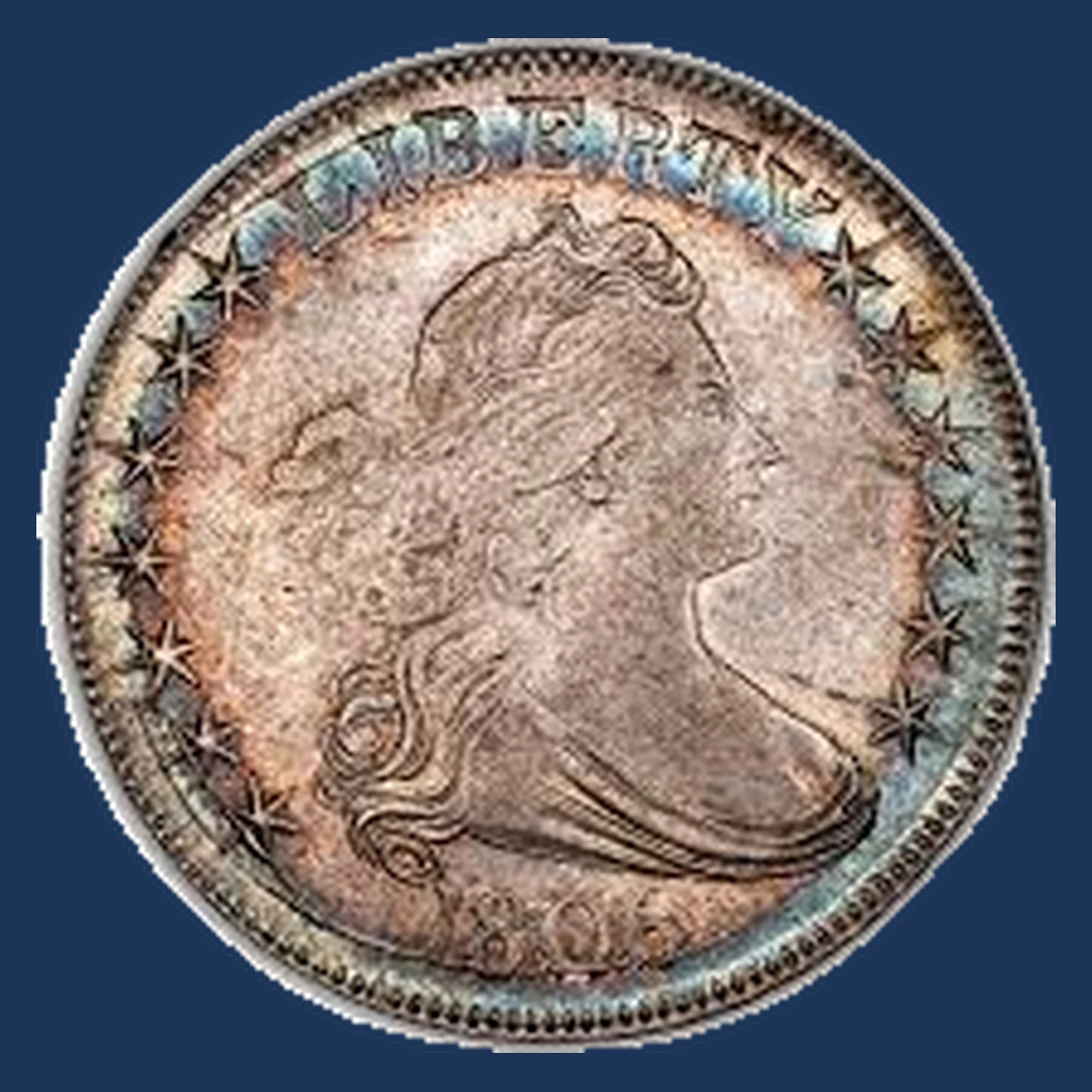
Raised lines branch through the date and left-side stars on the front of an O-116 half. Another line crosses STATES on the back.
They came from cracks in the stamping tools. Coin metal entered the narrow openings during striking and formed ridges on the surface.
The branches can remain visible after some finer details have worn down. They help collectors recognize this pair of tools.
The PCGS MS62 example with CAC approval shows the pattern clearly and also has shield clash marks. The cracks record tools breaking, while the clash marks record the tools hitting each other without a blank.
Estimated Value
Circulated examples with clear branching lines have an estimated range of $350–$3,000. Comparable MS62 coins can be estimated around $8,000–$15,000.
The PCGS MS62 O-116 with CAC approval sold for $10,350 on August 11, 2010. That is the same coin discussed under shield clashes.
Its sale price includes both features and its condition. A worn or cleaned half with the same crack paths needs a lower-condition comparison, rather than the full price of this well-preserved example.
How to Identify
Follow the raised branches from the date into the left-side stars, then turn to STATES on the back. More than one connected landmark should match the O-116 pattern.
With a 10× magnifier, tilt the light to check the line’s height. A scratch is usually cut down into the surface, while this crack forms a ridge.
Also watch for file marks or an actual split through the coin’s metal. Similar-looking lines can have different causes.
Confirm the Philadelphia designs and lettered edge. Compare a scale reading and caliper measurements with the original 13.48 grams and about 32.5 millimeters.
The date-to-stars branches and raised line through STATES give the fastest specific check.
10. 1806 Draped Bust Half Dollar 6 Over Inverted 6 (Estimated Up to $90,000 for Exceptional Mint State Examples)
An upside-down 6 resembles a 9, which explains the old 1806/9 name for this variety. The accepted explanation is a 6 first punched upside down, then corrected with an upright 6.
The PCGS explanation places the mistake in the stamping tool. The coin was not deliberately given a date three years ahead.
This corrected front tool was used with two different back tools. The extra upside-down digit remains the shared feature.
It should not be confused with the 1806/5 overdate. That variety has pieces of an earlier 5, not a turned-over version of the same 6.
Estimated Value
An XF40 O-112 sold for $7,871 at Sheridan Downey in August 2022. Circulated examples have an estimated range of $2,000–$9,000.
At the exceptional end, the PCGS MS64 Norweb coin brought $82,250 in 2015. Estimate $60,000–$90,000 for that level of preservation.
The gap reflects a major difference in condition. An extra-looking line on a worn date does not justify the MS64 price, even when the rare variety is correctly identified.
How to Identify
Compare the extra outlines with the shape of a 6 turned upside down. Their fit beneath the upright 6 explains the old 1806/9 nickname.
Use a 10× magnifier to distinguish that shape from an earlier 5 or ordinary repeated punching. A rare-looking date can also be altered, so check for cuts and disturbed surfaces.
Move the light across the digit and surrounding metal. Keep both full sides in photographs to record the particular reverse as well.
This Philadelphia half has no mintmark and a lettered edge. A scale and calipers should be compared with 13.48 grams and about 32.5 millimeters before wear.
The extra upside-down 6 shape, not the old nickname, is the deciding clue.
Conclusion
These 1806 errors and varieties span estimated values from $300 to $90,000. The highest figures concern rare, exceptionally well-preserved coins, not every unusual mark on the date.
Compare the extra digit’s shape and check whether a shield mark is a raised patch or a transferred outline. For off-center coins, inspect both sides.
Keep later damage separate from Mint-made features when deciding which price comparison fits.