1807 Capped Bust Half Dollar Error List with Pictures

A raised “beard” below Liberty’s chin helped one 1807 half dollar sell for $40,800 in August 2024. The coin was graded PCGS AU53, meaning it retained much of its detail with some wear.
The four 1807 Capped Bust half dollar errors below cover unusual size, uneven borders, a corrected number, and the famous beard. Estimated prices span $1,200–$41,000.
Read on to see where each feature appears and how condition changes the price.
1. 1807 Capped Bust Half Dollar Reported Oversized Planchet Error (Estimated Up to $2,000)
Wide gaps between groups of edge letters prompted one collector to question this coin’s size. The letters inside each group looked normally spaced, but the spaces between groups seemed unusually large.
The owner recalled a diameter of about 33.6 mm in an online discussion. That was a remembered measurement, not a grading service’s finding.
O-113a identifies the particular tools used to strike the coin. The owner’s observation suggests a possibly oversized blank before striking.
A wide coin is not proof by itself. Striking or later flattening can also spread the metal.
Estimated Value
Estimate $1,200–$2,000 for a worn example around VF30–VF35, grades that still preserve substantial design detail. This values the Small Stars variety without an added oversized-blank premium.
A PCGS VF35 O-113 sold for $1,740 in January 2025, and a VF30 brought $1,200 in September 2023. They are comparisons, not sales of the collector’s coin.
The reported extra size needs a separate check before it can justify paying more.
How to Identify
Measure in several directions with calipers. Compare the readings with the usual 32.5 mm, remembering that early halves are not always perfectly round.
Use a scale against the normal 13.48 g weight, then read the entire edge with a magnifier. Separate the spacing inside each group of letters from the wider gaps between groups.
Photograph the full edge so no gap is judged alone. A coin flattened later may be wider but also have crushed design details or damaged edge letters.
Normal striking can spread metal too, so size alone cannot identify the cause. Repeatable measurements plus the complete letter-spacing pattern give the quickest useful check of this report.
2. 1807 Capped Bust Half Dollar Slightly Off-Center Strike Error (Estimated Up to $3,500)
The small toothlike border marks nearly disappear along the left front edge of one 1807 coin. These border marks are called denticles.
Stack’s Bowers described its strike as slightly shifted toward nine o’clock. The back was shifted less, toward the upper left, where most border marks remained.
The coin was cataloged as O-111a and graded VF25, meaning it showed circulation wear. Its March 2020 auction description records the uneven centering.
This is a small displacement, not a large empty crescent. No measured percentage or separate certified error label was supplied.
Estimated Value
An estimated $2,000–$3,500 suits a similar worn O-111a with the described border shift. The range values the early half dollar and its condition, rather than a dramatic off-center error.
A PCGS VF20 O-111a brought $3,360 in January 2025. That Light Beard variety is a useful comparison, but it is not the VF25 coin described in 2020.
A small uneven border should not be priced as though much of the design were missing.
How to Identify
Photograph both faces straight on. Keep the whole rim visible so the camera angle or crop does not make the design look shifted.
Compare the left front border with the right, then inspect the upper-left border on the back. The first should lose more of its toothlike marks than the second.
A magnifier helps distinguish missing border detail from ordinary wear or filing. Inspect the edge lettering for impact damage that could explain a flattened area.
A normal coin measures about 32.5 mm and weighs 13.48 g before wear; check with calipers and a scale. The fastest match is the paired border pattern, with greater loss on the left front than the upper-left back.
3. 1807 Capped Bust Half Dollar 50/20 Corrected Denomination Error (Up to $24,000)
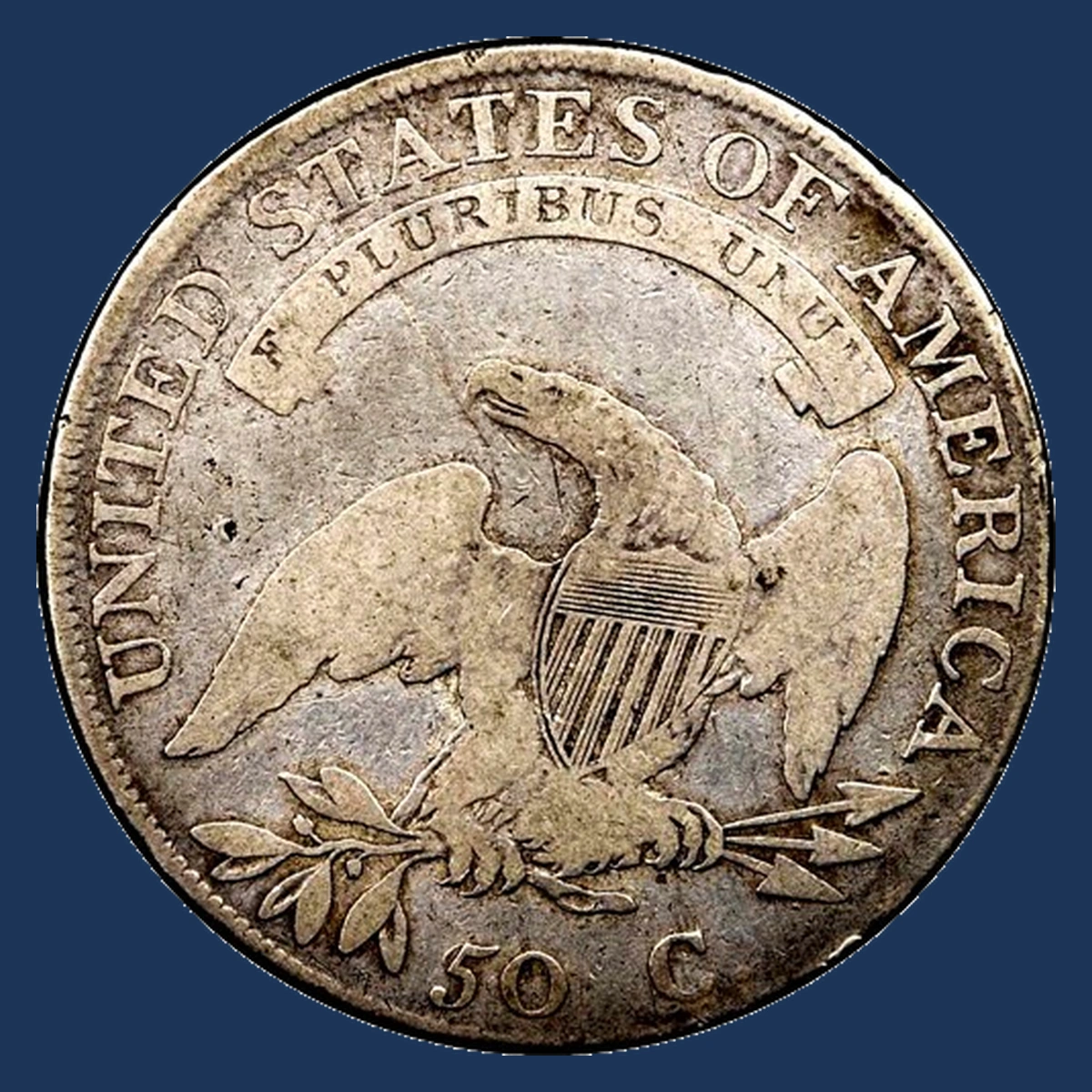
The 5 in 50 C has extra curves from an earlier punch. Collectors traditionally call this feature 50/20 because the hidden shape can look like part of a 2.
Another explanation identifies it as a 5 punched upside down and then corrected. Both names refer to the same altered number.
The John Reich Collectors Society discusses this corrected punch. It does not mean the Mint planned a twenty-cent version of this coin.
The remains of the earlier digit survive around the final 5. Those small curves matter more than trying to read a complete second value.
Estimated Value
Estimate $2,000–$24,000 across lightly worn to well-preserved uncirculated examples, roughly AU through MS64. A PCGS AU50 O-112 sold for $2,760 in January 2025.
A PCGS MS64 O-112 brought $24,000 in August 2025. The wide difference mainly reflects the coins’ preservation.
The corrected number identifies the variety, but a readable extra curve does not make a worn coin equal to the higher-grade example. Compare condition as well as the number.
How to Identify
Enlarge the 5 in 50 C with a magnifier. Focus on its upper-left area and the extra outline beneath the final punch.
Compare those curves with a clear photograph of an identified 50/20 coin. Added scratches cut into the surface, while the repeated punch details rise from it.
A flat shelf from movement during striking can also make a digit look doubled. Its shape must be separated from the particular curves of this variety.
Confirm the left-facing capped portrait, since 1807 also has a different Draped Bust design. Check 13.48 g with a scale, about 32.5 mm with calipers, and the wording around the edge.
Matching the extra curves beside the 5 gives the quickest identification.
4. 1807 Capped Bust Half Dollar Bearded Goddess Die Break Error (Up to $40,800)
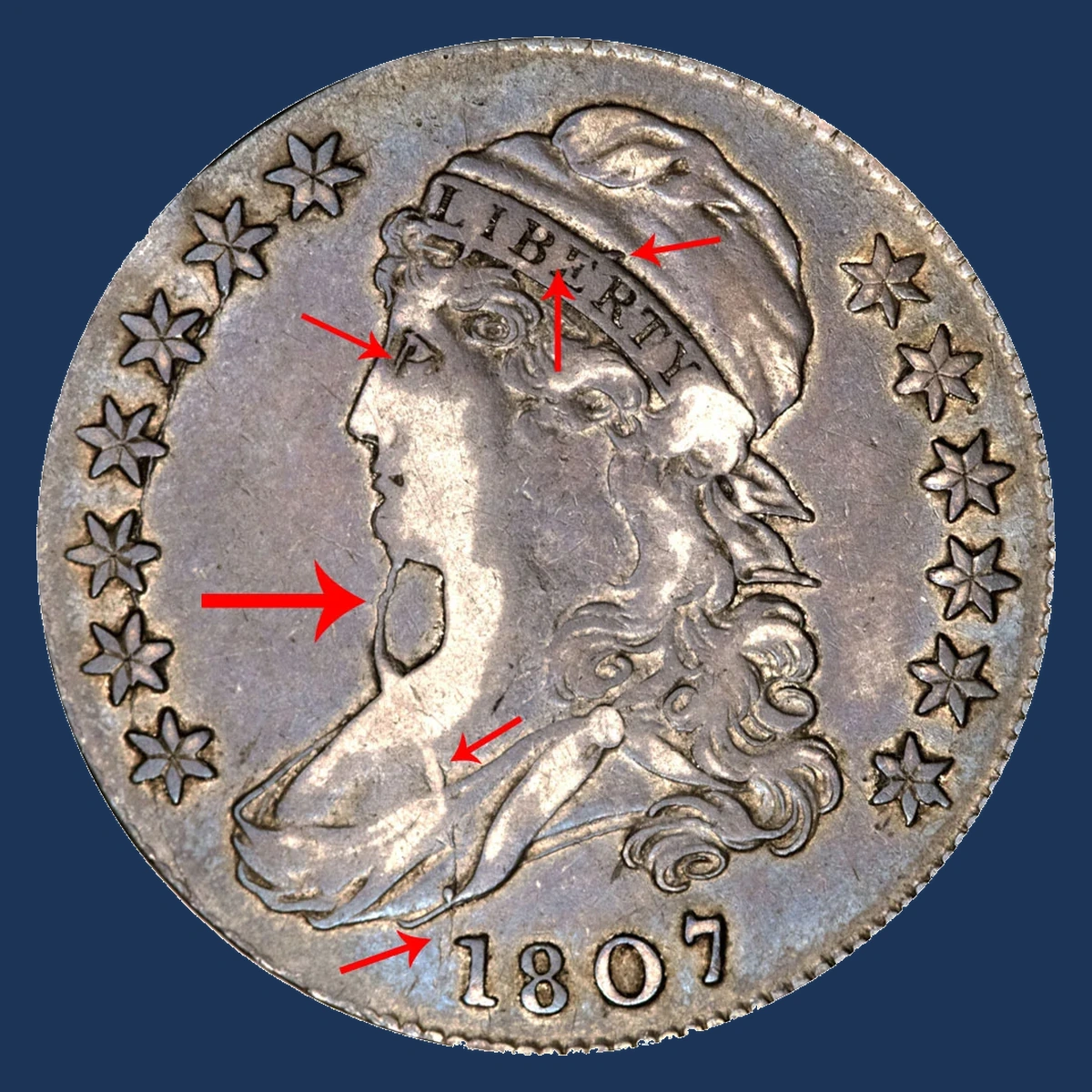
Raised metal hangs below Liberty’s chin like a beard. It came from a fracture in the die, the steel tool that stamps the front design.
As the crack grew, the raised line continued across the bust toward the area above the first date digit. A faint early trace and a strong later beard show different stages of that damage.
The bold version is known as the Bearded Goddess. It appears with the Large Stars design and the corrected reverse number.
One coin can therefore show both the beard and the 50/20 feature. Their different causes still need separate checks.
Estimated Value
An estimated $9,000–$41,000 covers the cited XF40-to-AU53 examples, from clearly worn coins to those with lighter wear. The strong, later beard is essential to this comparison.
A PCGS XF40 brought $9,250 in July 2016. Heritage sold a PCGS AU53 O-111b for $40,800 in August 2024.
The difference reflects condition and the particular coin. There is no fixed amount added for each extra millimeter of the beard.
How to Identify
Tilt the portrait under a lamp. The beard should rise above the surface, not cut a channel into Liberty’s face.
With a magnifier, follow its connection at the chin and its path across the bust. A random bump or scratch in the same area should not reproduce that connected shape.
Check the corrected number on the back as another part of the identification. Compare the beard with an example at the same stage of die damage.
Use a scale and calipers against 13.48 g and about 32.5 mm, allowing for wear, and inspect the lettered edge. A matching raised chin-to-bust path gives the fastest positive check of the Bearded Goddess feature.
Conclusion
Begin with the visible feature: edge spacing, missing border teeth, extra number strokes, or a raised beard. Each has a different explanation, even when more than one appears on a coin.
Estimated prices range from $1,200 to $41,000 across the examples discussed. The $40,800 sale belongs to a strong Bearded Goddess in AU53 condition, so a faint mark or worn coin needs its own comparison.