1833 Half Dollar Error List with Pictures

An eagle’s wing can leave a faint outline beside Liberty, while a weak layer of silver can peel from her portrait. These are different 1833 half dollar errors.
A PCGS AU55 CAC half listed as O-105a sold for $2,280 in April 2018. The label’s exact meaning is debated, so that sale is not proof that every matching coin has the reported crack.
Estimated comparisons span $150–$2,500. The checks below separate raised lines, missing detail, and flaws in the metal.
1. 1833 Capped Bust Half Dollar Rim and Blank Defects Error (Estimated Up to $350)
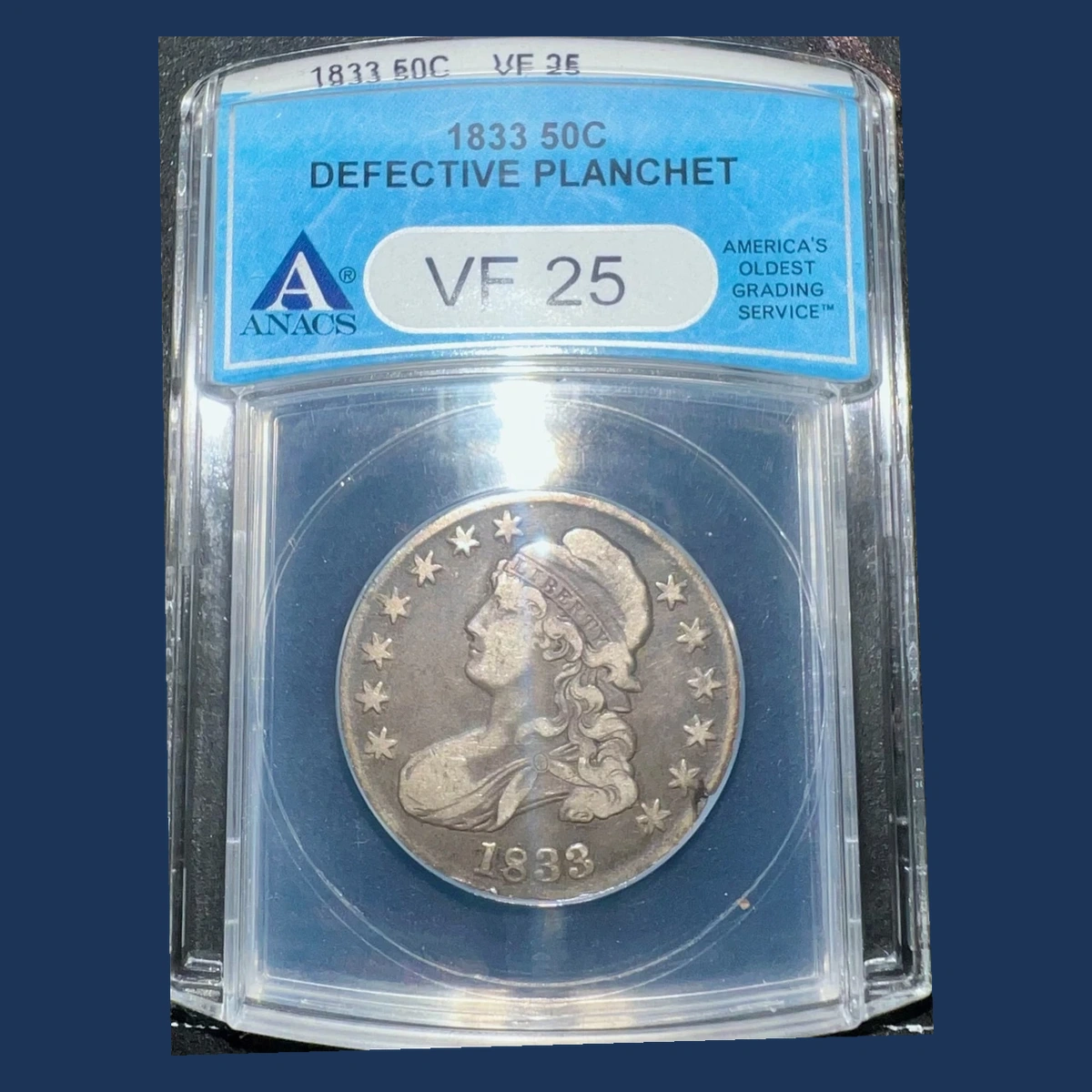
An uneven edge can start in the metal disc, called a blank before the coin receives its design. Two reported 1833 examples show different kinds of small outside defects.
One ANACS VF20 in the Rippere collection was labeled Minor Rim Defect. VF20 means a worn coin with clear major details.
A collector described another example as a blank cut from the end of a metal strip, with an irregularity near stars 8–10. That coin was identified as variety O-111.
These are separate coins. The star location belongs to the collector’s example, not automatically to the certified VF20.
Estimated Value
An estimated $150–$350 covers worn examples with visible original blank defects. The Rippere VF20 listing does not show a sale price here.
For comparison, an 1832 ANACS XF45 with a minor rim defect sold for $263.25 in July 2025. That Pristine total includes its stated buyer’s fee.
It is an older-year coin with more remaining detail. The comparison helps frame the estimate, but the size, appearance, and condition of an 1833 example must still be considered.
How to Identify
Photograph the entire edge outline. A tight crop can make a small irregularity look much larger than it is.
For the collector’s O-111, inspect the border beside stars 8–10 with a magnifier. The separate Minor Rim Defect coin needs a photo of its own affected area.
Look where the design approaches the flaw. A later hit can push metal aside, while filing can leave marks across an already finished edge.
The usual unworn weight is 13.48 grams, with a diameter near 32.5 millimeters and lettering around the edge. Use a scale and calipers when safely accessible; a small flaw may barely change the weight, so the original boundary and design are better clues.
2. 1833 Capped Bust Half Dollar Clashed Dies Error (Estimated Up to $400)
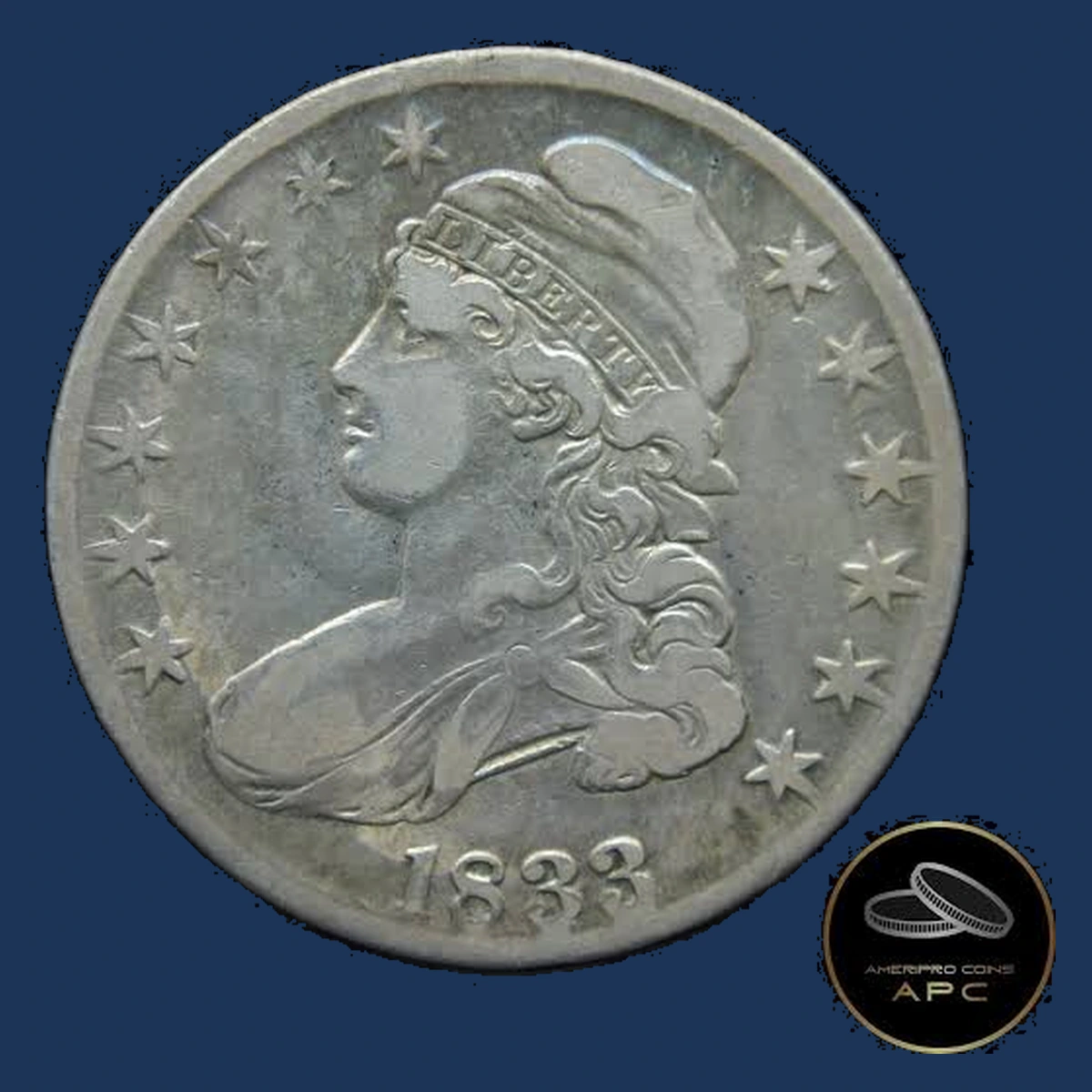
The faint shape beside Liberty comes from an eagle’s wing that belongs on the back. Heritage described this strong extra impression on an 1833 O-114 half.
The dies, the steel tools that stamp coins, had struck each other without a blank between them. Parts of their designs marked the opposite tools.
Later coins could pick up those unexpected outlines. Collectors call the effect a die clash.
The auction coin also had cleaning damage and an NCS AU Details label. That means light wear with a surface problem; the cleaning and the mint-made wing impression have different causes.
Estimated Value
The cleaned O-114 sold for $230 at Heritage in January 2006. That result already includes the effect of its surface problems.
An estimated $200–$400 suits similar worn or cleaned coins with recognizable wing detail. It is a comparison for the whole coin, not a separate payment for the clash.
Better original surfaces can change the price substantially. A finer coin with a weaker wing outline may still be worth more than this strongly clashed, cleaned example.
How to Identify
The empty area left of Liberty is the place to inspect. Use angled light and a magnifier to separate the wing-like outline from normal portrait detail.
Now compare the eagle’s wing on the back. Its shape should explain the unexpected front-side impression when the two designs are properly aligned.
Cleaning often leaves many fine parallel scratches. Those marks should not be mistaken for parts of the transferred wing.
This issue has a lettered edge, a normal diameter of about 32.5 millimeters, and an unworn weight of 13.48 grams. A scale and calipers help check a safely accessible coin, but the recognizable wing shape beside Liberty is what identifies the clash.
3. 1833 Capped Bust Half Dollar Grease Strike-Through Error (Estimated Up to $500)
Streaks across the middle of the front interrupt the design on one 1833 O-102 half. Heritage described them as grease marks made during production.
Grease between the die and blank can block some of the design from reaching the metal. This is a struck-through error.
It differs from a raised crack line or a peeling layer of silver. The important effect is missing or weakened detail where something obstructed the strike.
The documented coin was graded NGC AU55, meaning light wear. Its catalog gives the central location but does not assign an exact angle or percentage to the streaks.
Estimated Value
The NGC AU55 O-102 sold for $253 in January 2006. Its auction description connects the central grease streaks to the minting process.
A comparable lightly worn example has an estimated $250–$500 range. That range uses an older documented sale as one reference.
Ordinary weak detail does not automatically earn an error premium. The comparison requires a recognizable strike-through and similar remaining design, rather than wear alone.
How to Identify
Begin with soft light across the middle of the front. A magnifier can help follow the streaks and compare affected detail with sharper areas beside them.
Grease can interrupt the strike in a local area. Ordinary wear more often affects the high points that were exposed during use.
A later scrape may leave sharp cut edges or metal pushed to one side. Compare the complete pattern with the photographed O-102 instead of identifying it from one weak patch.
Include the back and lettered edge in your photos. When safely accessible, check the normal 13.48-gram unworn weight and roughly 32.5-millimeter diameter with a scale and calipers; the central interrupted design remains the important feature.
4. 1833 Capped Bust Half Dollar Obverse Lamination Error (Estimated Up to $600)
A thin layer separating from the silver points to a weakness inside the blank. Collectors call that split or peel a lamination.
A GreatCollections example sold in May 2023 was labeled with front-side lamination and graded NGC AU Details. The label describes light wear along with a condition problem.
The listing title does not state the peel’s exact location. Its own photograph must show that detail.
Another lamination coin was separately listed in AU53. Do not combine its grade with the GreatCollections coin’s surface marks or sale history; they are different examples.
Estimated Value
For an AU Details coin with visible front-side separation, estimate $250–$600. The May 2023 listing confirms the described feature, but its final price is hidden.
An 1832 XF45 minor-blank-defect half sold for $263.25 in July 2025. That is a related metal flaw on another date, not the same lamination.
The comparison helps set a broad range. The peel’s visibility and the condition problem behind the Details label can both affect an individual 1833 coin’s price.
How to Identify
Do not lift the loose metal. A fragile flap can break, changing the coin and removing useful clues.
Use light from a shallow angle and a magnifier to inspect the boundary. A genuine separation may show a thin raised layer or the edge of a flake that has already detached.
A gouge removes metal differently, and corrosion can also leave rough missing areas. Compare the front with clear photographs of the identified example.
The normal coin has lettering on its edge, weighs 13.48 grams when unworn, and measures about 32.5 millimeters. Use a scale and calipers when safely accessible; a small peel may cause little weight loss, so the layered boundary matters more than a slight reading change.
5. 1833 Capped Bust Half Dollar Reported Reverse Die Crack Error (Estimated Up to $2,500)
The reported crack runs from the border teeth below the denomination’s 5 across the olive-leaf tips toward UN. A real crack should leave that path raised above the surface.
Greysheet describes it under the O-105a catalog label. However, specialists have questioned whether that separate stage of the die has been clearly established.
The label alone cannot settle the question. The coin needs to show the actual raised route.
The line would form when silver entered a fracture in the die during striking. It is different from a scratch added afterward, even if the scratch follows roughly the same path.
Estimated Value
Greysheet lists a $2,280 sale in April 2018 for a PCGS AU55 CAC labeled O-105a. That result does not independently confirm the reported crack on the sold coin.
An estimated $1,500–$2,500 applies to similar lightly worn coins carrying that identification. It values the whole collectible coin and its surfaces.
An ordinary worn half with one raised line does not automatically belong in the same range. The debated label should not replace inspection.
How to Identify
Find the 5 on the back and the border teeth below it. Follow the reported route through the olive-leaf tips toward UN using a magnifier.
Move the light between opposite sides. A raised ridge should remain visible, while shadows can falsely join separate marks into one long line.
Keep a photograph of the whole back alongside the close-up. The O-105a label is not enough if the described path cannot be seen.
The normal unworn coin weighs 13.48 grams and measures about 32.5 millimeters, with a lettered edge. Scale and caliper checks when safely accessible help establish the coin, but a complete raised path matching the description is the direct evidence for this reported crack.
Conclusion
Leave peeling metal in place, keep full-coin photographs, and check whether an odd line is raised or cut into the surface. Those simple steps preserve the clues needed to separate these five features.
Estimated comparisons run from $150–$2,500. The $2,280 O-105a sale belongs to a particular lightly worn coin; it is not proof that a disputed label or an isolated line adds the same value to another half.