1836 Half Dollar Error List with Pictures

A curved trace beneath the 5 helped identify an 1836 Proof, a coin specially made for collectors. It sold for $84,000 in May 2022.
Other 1836 half dollar errors include repeated edge words, a second strike, and an extra number inside the date. Estimated values span $120–$85,000, with the upper range reserved for rare Proofs.
Start at the edge below: 1836 has two coin designs, and their differences affect every comparison.
1. 1836 Capped Bust Half Dollar Doubled Edge Lettering Error (Estimated Up to $500)
The words around the edge repeat and overlap on an 1836 half illustrated by NGC. The front and back can look normal while those extra letters remain easy to miss.
Workers applied edge lettering before striking the faces. A slip or another pass through the lettering equipment could make part of the inscription appear twice.
The illustrated coin is called O-114, a catalog label for its variety. Its holder allows the edge to be seen.
This is the older 1836 design with edge words. A second design has grooves instead, so the absence of words on that version is normal.
Estimated Value
An 1834 half with doubled edge lettering sold for $220 in July 2026, according to Greysheet. ANACS described it as Fine Details with cleaning, meaning a worn coin with a surface problem.
For similarly clear overlap on worn 1836 examples, estimate $200–$500. The comparison is another year with the same kind of edge error.
It is not a price paid for NGC’s illustrated coin. Finer examples need a different condition comparison.
How to Identify
Read the inscription all the way around the edge. Take overlapping photographs as you turn the coin so no section disappears between views.
With a magnifier, look for whole letters appearing twice or crossing the normal words. One damaged stroke is not enough.
The NGC example provides a comparison for the repeated letters. Keep the dated front and back with the edge photographs.
For a safely accessible coin of this design, calipers should show roughly 32.5 millimeters and a scale about 13.48 grams when unworn. Wear may reduce the weight, but the repeated words, not a weight difference, establish the lettering error.
2. 1836 Capped Bust Half Dollar Double Strike Error (Estimated Up to $2,500)
Parts of two designs can remain when a coin receives an accidental second strike. Look for repeated sections of the portrait, border, or lettering on its faces.
The dies are the steel tools that stamp coins. A second blow in a changed position can leave part of the first impression beside the new one.
An illustrated John Reich Journal article covers a reported 1836 example. Its index does not state the edge type or amount of shift.
Repeated edge words are a different matter. They concern preparation of the blank’s edge, rather than a second impression on the coin’s faces.
Estimated Value
For a worn lettered-edge example with clearly separated impressions, estimate $1,200–$2,500. An older comparison is an 1832 NGC XF40 double strike listed at a $1,450 floor price in April 2008.
That worn coin also showed rotation on the back. The figure is a different year’s historical floor price, not a recent 1836 sale.
The smaller 1836 design with edge grooves needs its own comparison. Its scarcity creates a different market from the lettered-edge coin.
How to Identify
Determine the edge type before comparing the error. The lettered version measures about 32.5 millimeters; the grooved version is smaller, about 30 millimeters.
Both use a nominal 13.48-gram weight for 1836. A scale and calipers can check a safely accessible coin.
Now use a magnifier to follow repeated design details. Several features sharing the same shift are stronger evidence than one extra-looking portrait line.
The John Reich Journal index points to the illustrated 1836 article. Compare its actual coin before assigning a direction or edge version.
A coherent second design on the faces confirms something different from doubled edge lettering. Keep both the edge and the full dated views in your comparison.
3. 1836/1336 Capped Bust Half Dollar Corrected Date Error (Estimated Up to $6,000)
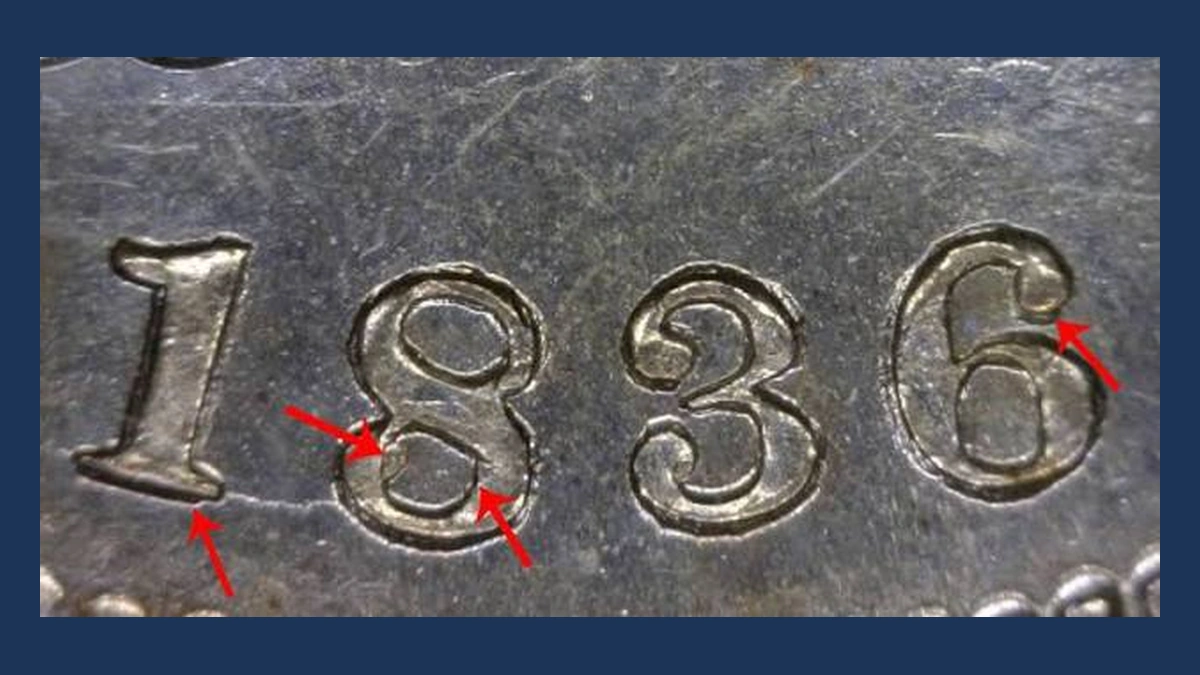
The extra-looking shape lies inside the date’s 8, especially near its lower part. It has traditionally been read as a piece of a 3 beneath that number.
That gives the variety its name, 1836/1336. It does not mean a half dollar was made in the year 1336.
The name refers to an earlier number associated with preparing the die. Coins struck afterward could show the same extra mark.
PCGS lists it among the lettered-edge halves. Compare the actual detail inside the 8, because wear or a scratch can make an ordinary number look different too.
Estimated Value
For worn coins, estimate $120–$650, using USA Coin Book’s retail guide from G4 through AU50. These grades run from heavily worn to lightly worn.
Unworn examples have an estimated $1,500–$6,000 range. An NGC MS64+ from the Newman collection sold for $5,581 in November 2013.
That finely preserved coin supports the upper comparison. The guide figures and the auction result are different kinds of price evidence, not promises for every doubled-looking 8.
How to Identify
Place a normal 1836 date beside a clear photograph of the variety. Enlarge both to the same size and compare the lower interior of the 8.
A magnifier and two light directions help show whether the suspected remnant is raised metal. Dirt, a scratch, or a shadow inside the number can create a misleading line.
Read the complete date too. The unusual catalog name is not a substitute for the matching internal shape.
The edge should have lettering, with a normal diameter near 32.5 millimeters and unworn weight of 13.48 grams. Use calipers and a scale when safely accessible; the specific extra shape inside the 8 is the feature that identifies the variety.
4. 1836 Capped Bust Half Dollar 50/00 Denomination Error (Proof Record $84,000)
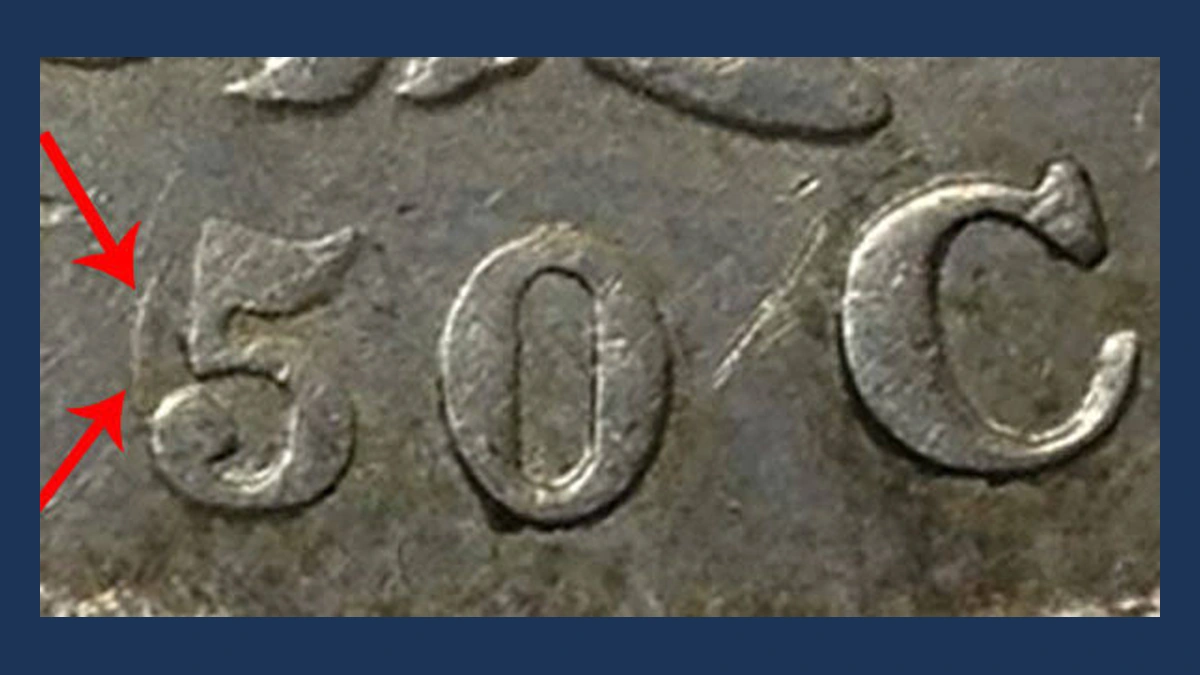
The value below the eagle should read 50 C. On this variety, part of a zero remains beneath the 5, showing a correction made in the die.
The curved remnant appears on both regular coins and rare Proofs. A Proof is specially made for collectors with carefully prepared dies and surfaces.
The corrected number belongs to the older design with lettering around the edge. It does not identify a Proof by itself.
A bright patch can come from wear or polishing. First match the extra curve, then judge the whole coin’s finish and condition separately.
Estimated Value
A PR64 Proof sold for $84,000 in May 2022. Comparable rare Proofs have an estimated $60,000–$85,000 range.
Regular coins occupy a different market. Estimate $200–$2,000 for worn examples and $10,000–$20,000 for exceptional unworn MS64–MS66 pieces.
The published regular-coin record is $18,975 for an MS66 in July 2005. Sharing the corrected number does not make an ordinary coin worth the Proof price; its manufacture and preservation must also match.
How to Identify
Examine the 5 below the eagle with a magnifier. The earlier zero should leave a curved outline in the same position as an identified 50/00 example.
A stray scratch is not enough. Look at the surrounding letters and compare the complete value inscription.
This design reads 50 C. and has a lettered edge. The smaller 1836 coin with edge grooves reads 50 CENTS instead.
For a safely accessible lettered-edge coin, use calipers against about 32.5 millimeters and a scale against 13.48 grams when unworn. Proof status requires a separate assessment of the full surfaces and strike.
A polished, shiny coin cannot be called a Proof from brightness alone. Matching the curved zero beneath the 5 to a confirmed example is the quickest check of the corrected number.
Conclusion
Turn an 1836 half on its side before studying its numbers. Edge words and edge grooves distinguish two versions of the coin, and the words may reveal an error themselves.
Estimated comparisons begin at $120 for worn date varieties and reach $85,000 for the rare Proof class. Repeated letters, a second strike, and a corrected number require different checks, so a shared year cannot make their prices interchangeable.