1837 Half Dollar Error List with Pictures

An 1837 half dollar with cracks, faint clash marks, and a tilted back sold for $19,550 in August 2006. Its NGC MS66 grade describes an exceptionally well-preserved, unworn coin.
The 1837 half dollar errors below span an estimated $100–$20,000 across very different grades. Read on to check missing metal, shifted or repeated designs, and an unusually wide coin that still has grooves around its edge.
1. 1837 Capped Bust Half Dollar Rim Clip (Estimated Up to $350)
A small missing piece at the edge may have been absent before the design was struck. The incomplete blank, or metal disc, then entered the coin press.
A seller offered an 1837 half dollar as a rim clip and described it as AU, meaning lightly worn. Neither the error nor that grade was independently certified in the listing.
No clip percentage or exact position was given. Those details must come from the coin itself.
The gap’s shape is only a clue. The surviving edge and nearby design help separate a genuine clip from later cutting.
Estimated Value
The seller asked $211.65 or Best Offer. That offer does not prove a sale, and the AU description is the seller’s grade opinion.
A modest, genuine clip on a circulated example has an estimated value of $150–$350. The date and design should remain readable at this level.
Cleaning, repairs, and the amount of missing silver all affect the price. Confirmation that the edge formed during minting matters more than the listing’s title.
How to Identify
Inspect the missing area with a 10× magnifier. Look where the normal edge grooves end and where the design meets the gap.
Fresh cuts, file marks, or an evenly shaved surface suggest later damage. A genuine clip may leave a weak rim opposite the missing piece, although this clue is not always clear.
Use a scale to compare with the original 13.36 grams, allowing for both wear and missing silver. Calipers across the intact portion should show roughly 30 millimeters.
Confirm 1837 on the front and 50 CENTS on the back. The quickest check is whether naturally struck detail meets the missing boundary without signs of later cutting.
2. 1837 Capped Bust Half Dollar Off-Center Strike (Estimated Up to $4,000)
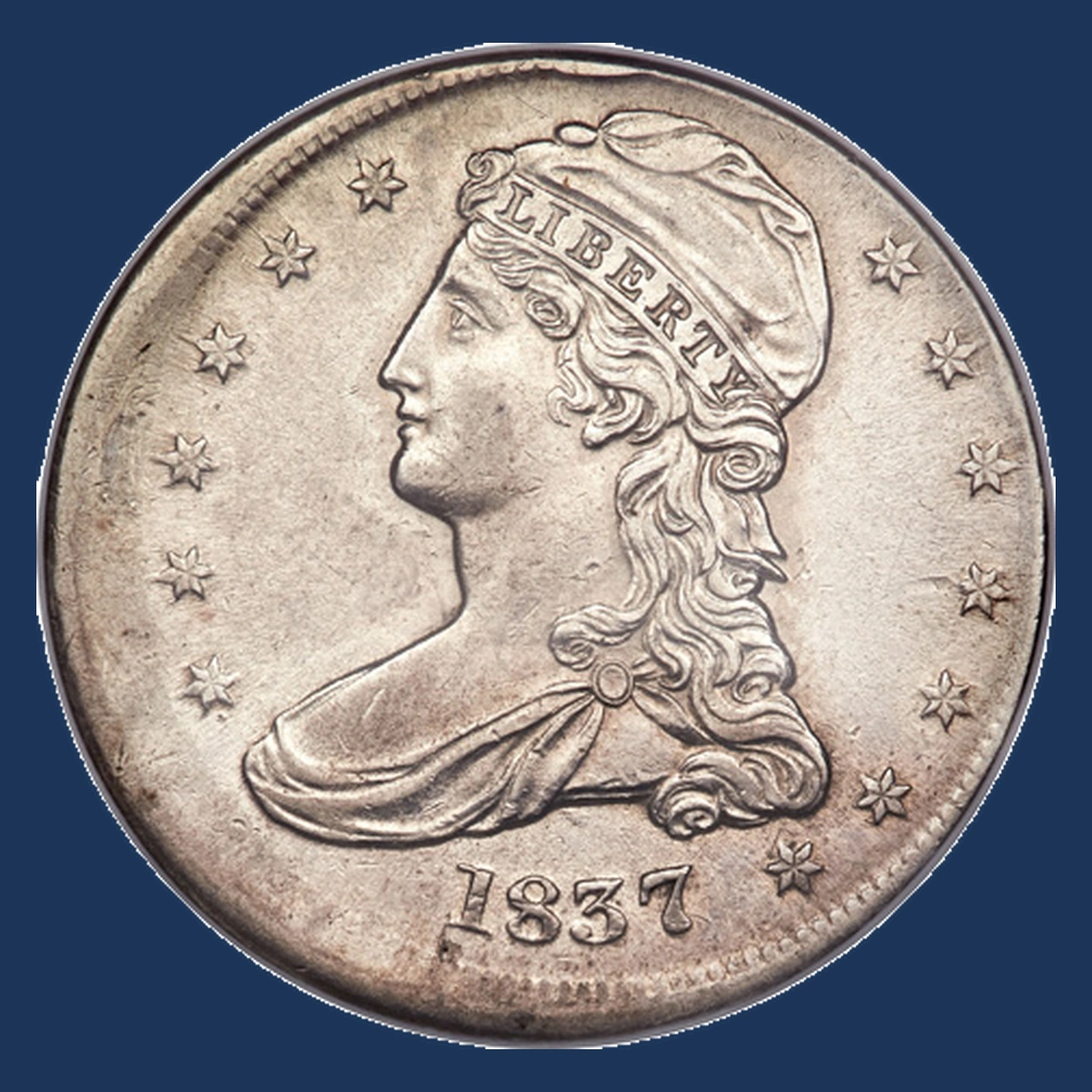
The design sits too far toward one edge on the documented five-percent off-center example. Extra blank space remains along the opposite side.
This happens when the metal disc is not properly centered between the stamping tools. Both sides receive their designs in the wrong position on that disc.
NGC graded the recorded 1837 example AU58, indicating very little wear. It appeared in Heritage’s 2010 FUN auction.
The five-percent figure describes that particular coin. It should not be copied onto another uneven-looking half dollar without checking how much of its design is shifted.
Estimated Value
The documented AU58 example sold for $2,990 at the 2010 FUN sale, according to Mint Error News. A comparable, confirmed off-center coin has an estimated value of $2,000–$4,000.
That estimate uses a historical sale, not a new transaction. Even the modest five-percent shift made this example collectible.
A much larger shift, heavy wear, cleaning, or damaged edges would require a different comparison. The error name alone does not fix the price.
How to Identify
Compare both sides with their full physical edges visible. Look for a shifted design and extra blank space on the opposite side, not an off-center photograph.
If only one side has an uneven border, a single stamping tool may have been misaligned. Both designs need checking before calling the coin off center.
Use a 10× magnifier to inspect the edge grooves for trimming or hammering. A scale should be compared with 13.36 grams; calipers can record the widest dimensions around the usual 30 millimeters.
Confirm the date and 50 CENTS. For a quick check, find matching design displacement on both faces instead of relying on one uneven rim.
3. 1837 Capped Bust Half Dollar Multiple Strike (Estimated Up to $6,000)
More than one widely separated outline of Liberty’s face appears on the reported triple-struck example. An extra piece of the cap fold lies near the upper rim.
The same metal disc received separate blows from the coin press. Movement between blows let the designs land in different places.
Collector Louis Scuderi described the coin in January 2018. He interpreted the cap-fold trace as evidence that the first strike was about ten percent off center.
That order is his explanation of the visible marks. It is not a separate certified grade or a recorded sale.
Estimated Value
A genuine multiple strike with clear separation has an estimated value of $2,500–$6,000 in circulated to lightly worn condition. The different five-percent-off-center 1837 coin sold for $2,990 in 2010.
That sale helps compare a striking error from the same year. It is not a sale price for the triple-struck coin.
The collector’s report provides no certified grade or price. Extra impressions may improve appeal, but wear and damage still matter.
How to Identify
Find the separated facial outlines, then look above the cap for the extra fold near the rim. A 10× magnifier should reveal recognizable pieces of the design.
Try to follow how the repeated shapes fit across the coin. A single doubled edge is weaker evidence than several separated parts of a complete impression.
Check the edge grooves for crushing or alteration. Use a scale against the original 13.36 grams and use calipers to record any expansion beyond the usual 30 millimeters.
The date and 50 CENTS should remain identifiable. To check the reported triple strike quickly, compare both the separated portrait and the extra cap-fold trace with the published coin.
4. 1837 Capped Bust Half Dollar Broad Collar Anomaly (Estimated Up to $8,000)
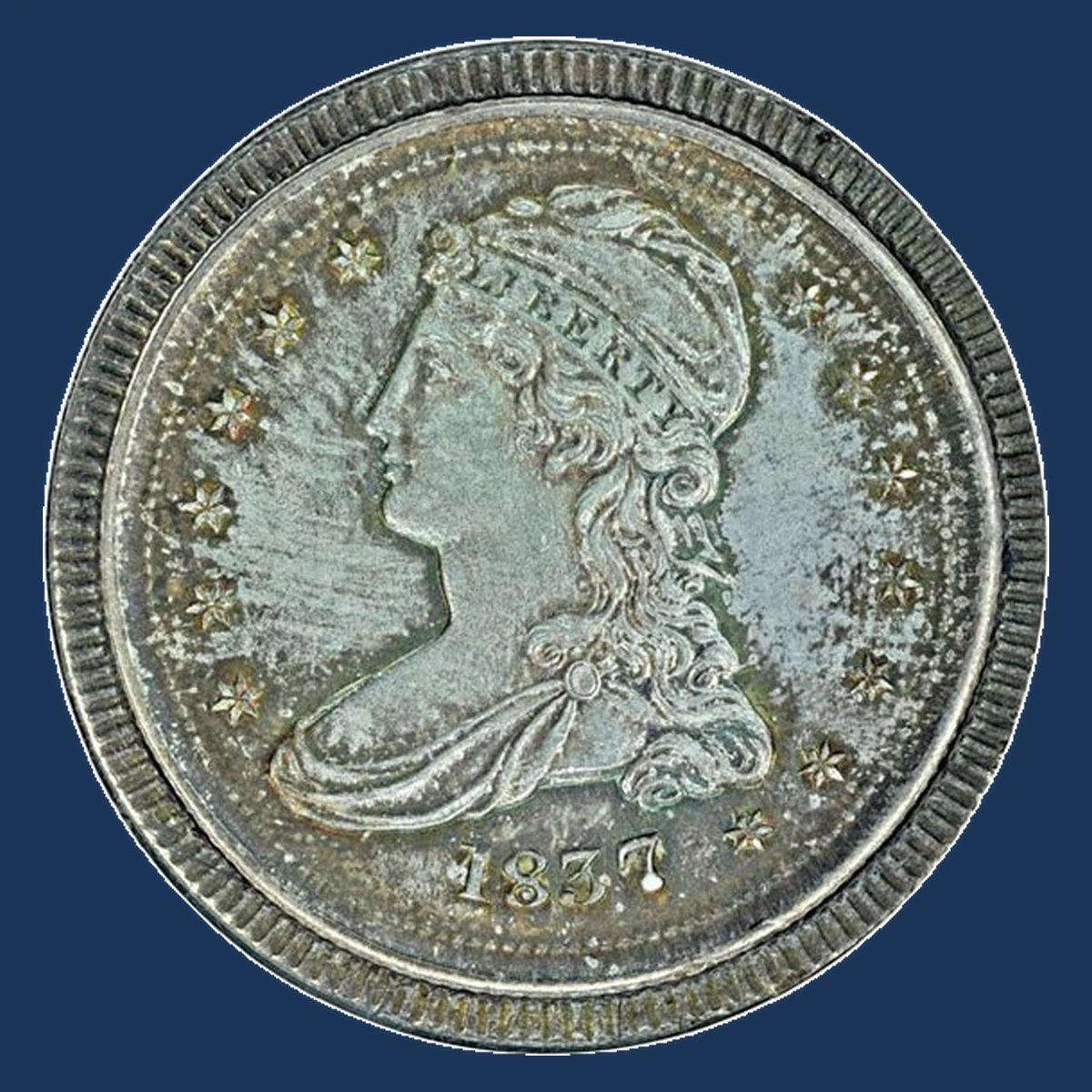
One 1837 half dollar is wider than normal but still has grooves around its edge. NGC identifies this unworn but marked MS61 coin as Broad Collar.
A collar is the ring that normally limits a coin’s width during striking. NGC proposed that this piece had edge grooves added before a strike without close-fitting restraint.
The metal could then spread outward while keeping those grooves. The service interpreted the coin as a manufacturing experiment rather than an ordinary broadstrike.
Its GR-24 catalog number identifies the stamping tools used. It does not mean that every GR-24 coin is oversized.
Estimated Value
The estimated value is $3,000–$8,000 for this unusual, certified form. NGC’s study gives no auction price for the Broad Collar coin.
For scale, a different cracked 1837 graded MS61 sold for $2,040 in 2025. The AU58 off-center example brought $2,990 in 2010.
Neither coin was made by the same proposed process. The range therefore remains an estimate for a different manufacturing feature, allowing for interest from specialists rather than claiming a matched sale.
How to Identify
Measure the width before drawing a conclusion from the edge. The NGC study records 31.95 millimeters and 13.30 grams, compared with roughly 30 millimeters and 13.36 grams normally.
For an unsealed coin, use calipers and a scale. Under a 10× magnifier, inspect the edge grooves and stretched design near the border.
Hammering can also widen a coin, so compare its surfaces with the studied example on both sides. A GR-24 identification alone cannot establish the Broad Collar feature.
To check the unusual form quickly, compare the oversized body, surviving edge grooves, and stretched outer design together with the NGC pictures.
5. 1837 Capped Bust Half Dollar Clashed Dies (Estimated Up to $20,000)
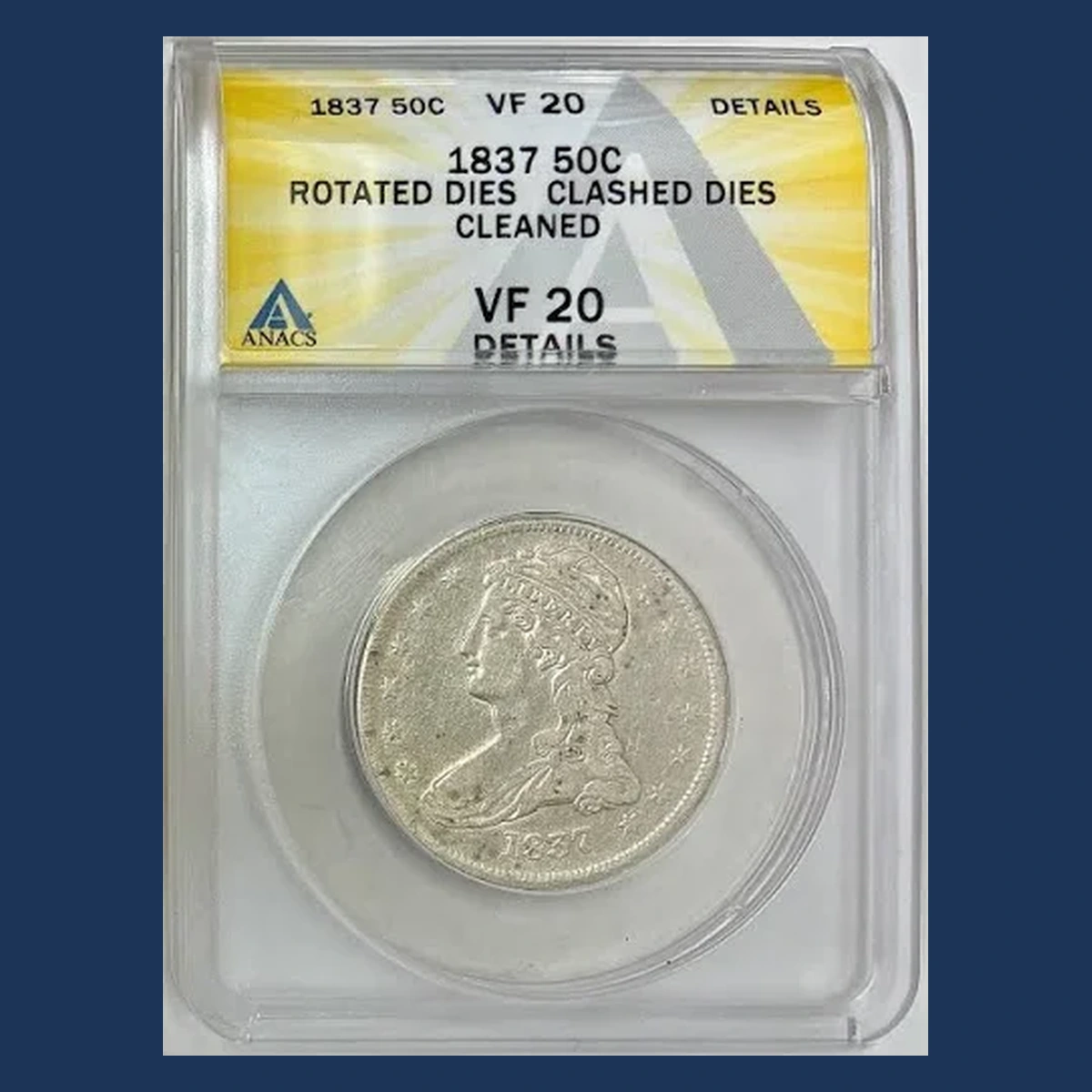
Faint pieces of the front design can appear on the back of a clashed coin. They come from contact between the two dies, the steel stamping tools.
Without a metal disc between them, the tools can strike each other and pick up parts of the opposite design. Later coins may carry those unwanted shapes.
Heritage records light back-side clash marks on an 1837 NGC MS66 example. It also has cracks and a rotated back.
No exact transferred portrait detail is named. A stray line must be matched to the opposite design before it supports a clash identification.
Estimated Value
Circulated examples with light clash marks have an estimated value of $100–$1,000, mostly reflecting the coin itself. The exceptional MS66 example belongs in a separate $15,000–$20,000 range.
It sold for $19,550 at Heritage in August 2006. That price covered its excellent condition, cracks, rotation, and clash marks together.
The sale does not show what the clash alone added. A worn coin with a faint transferred line should not receive the MS66 price.
How to Identify
Compare the suspected back-side shape with the front design. A clash needs a recognizable connection between them, rather than simply an unexplained line.
Use a 10× magnifier and light from several directions. Scratches cut the surface, while a crack line follows a break in the stamping tool and need not resemble the opposite design.
Confirm 1837, 50 CENTS, and the edge grooves. A scale and calipers can compare the coin with the original 13.36 grams and roughly 30-millimeter diameter.
Those measurements check the coin, not the clash. For a quick test, match the extra back-side shape to the opposite design and a confirmed clashed example.
6. 1837 Capped Bust Half Dollar Rotated Dies (Estimated Up to $20,000)
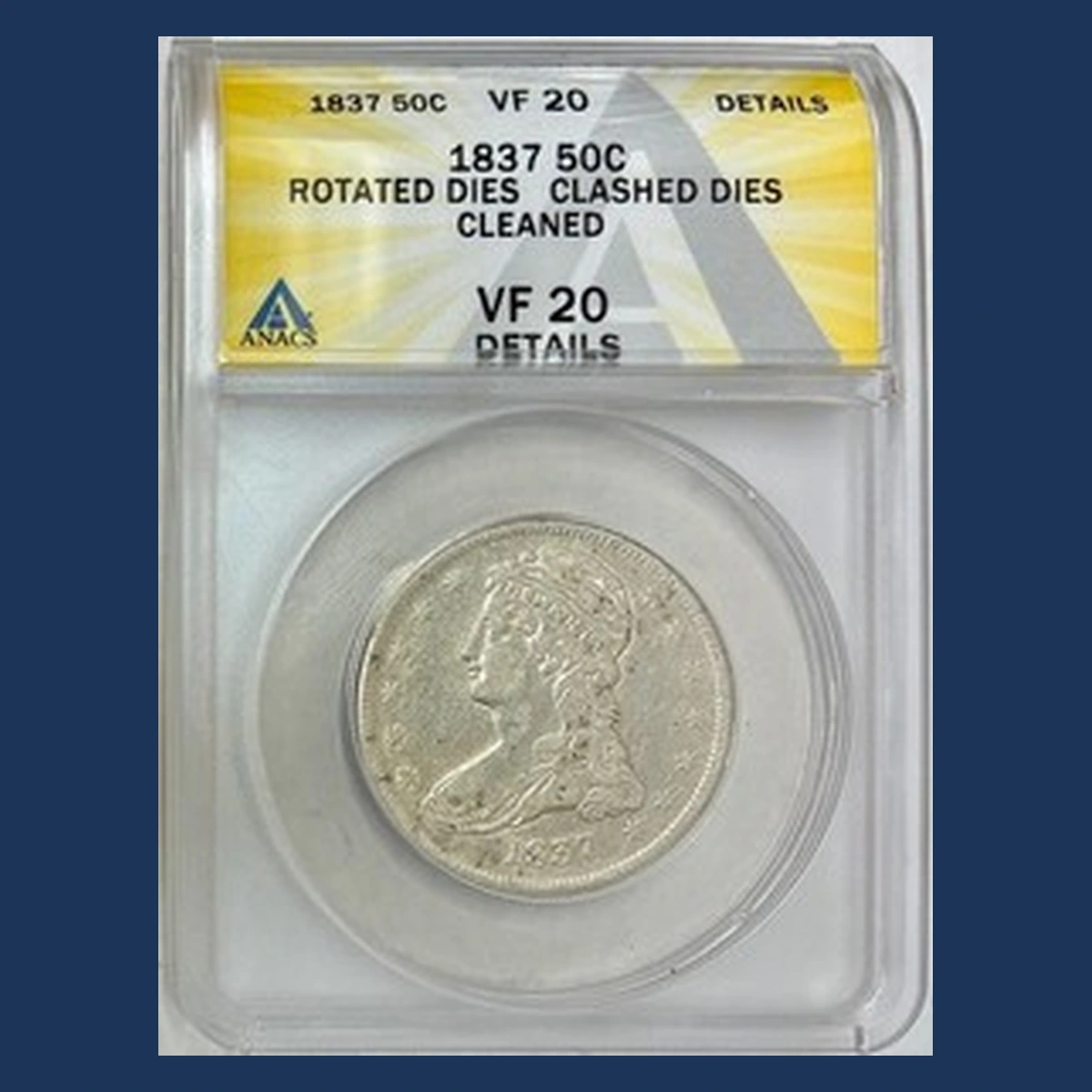
The eagle remains tilted after a straight top-to-bottom flip from an upright Liberty. The stamping tools were not aligned in the usual position when they made the coin.
The 1837 MS66 auction example has a reported back-side rotation of about 45 degrees counterclockwise. That angle belongs to this coin, not every half dollar of the year.
Separate photographs can hide the error if each image is turned upright. A fixed flipping motion is needed to show the true relationship.
The designs may otherwise look normal. Rotation concerns their angle to each other, not their sharpness.
Estimated Value
A clear rotation has an estimated value of $250–$1,500 in circulated to lightly worn condition. The amount of rotation and the coin’s surfaces affect the comparison.
The MS66 example belongs in a separate $15,000–$20,000 range. Its $19,550 sale also included cracks and faint clash marks on an exceptionally preserved coin.
That result does not price the rotation by itself. A worn discovery should be compared with other worn coins, not this top-grade example.
How to Identify
Hold Liberty upright and flip the coin straight from top to bottom, without twisting it sideways. A normally aligned United States coin should then show an upright back.
Repeat the flip against a fixed upright line. A tilt of about 45 degrees counterclockwise matches the reported auction example.
Inspect the edge grooves with a 10× magnifier for seams or alteration. Use a scale and calipers to compare with the original 13.36 grams and roughly 30 millimeters across.
Separate upright photographs cannot prove the angle. The quickest confirmation is the same back-side tilt every time you repeat the controlled top-to-bottom flip.
7. 1837 Capped Bust Half Dollar Die Cracks (Estimated Up to $20,000)
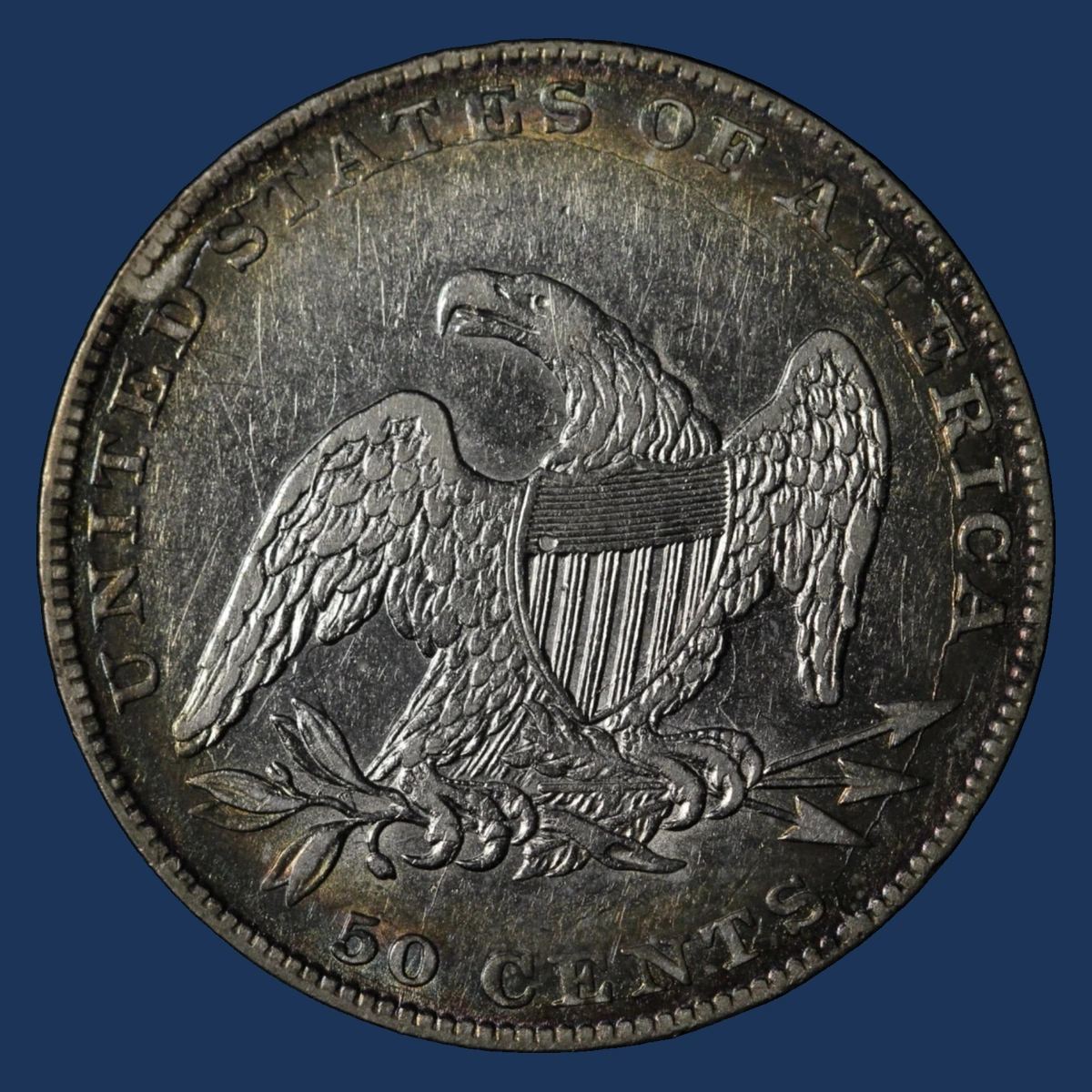
A heavy raised line reaches the D in UNITED and branches toward the eagle’s wing. Another part continues around the outer lettering through STATES.
This pattern identifies a feature of the GR-16 variety. Heritage sold the pictured reference coin, graded NGC MS61, in January 2025.
The steel stamping tool developed cracks as it was used. Silver squeezed into those gaps, leaving raised paths on the coins it made.
Follow the branches as a group. A short scratch near D is not enough, and later scratches can cross an otherwise genuine crack pattern.
Estimated Value
The GR-16 MS61 sold for $2,040 on January 14, 2025. Similar coins in lower unworn grades have an estimated value of $1,500–$3,000.
The separate MS66 example sold for $19,550 in 2006, supporting a different $15,000–$20,000 range. It also had clashes and rotation.
Neither result isolates the price of a crack. A worn coin with a minor line belongs below these unworn comparisons, even if its crack is easy to see.
How to Identify
Find D in UNITED through a 10× magnifier, then follow both branches. Compare the line toward the wing and the line along STATES with the GR-16 pictures.
Tilt the coin to see whether the lines rise above the silver. A split in the coin itself opens into the metal; a stamping-tool crack leaves a raised impression instead.
Inspect both faces and the edge grooves for damage. Compare a scale reading with the original 13.36 grams and caliper readings with roughly 30 millimeters, allowing for wear.
For the fastest specific check, trace the raised fork at D into both the wing area and the outer STATES lettering.
Conclusion
Estimated values of $100–$20,000 cover worn coins and exceptionally preserved examples, not equal premiums for every error. The $19,550 MS66 half has several features, but they still belong to one whole coin.
Check missing edges and extra width with measurements, repeated designs with magnification, and rotation with a controlled flip. For cracks and clash marks, follow complete shapes rather than judging one bright line.