1838 Half Dollar Error List with Pictures

Read the words below the eagle on an 1838 half dollar. They should say HALF DOL, a useful first check before looking for errors.
One Philadelphia GR-4 variety sold for $2,350 in January 2017. It provides a comparison for the crack variety discussed below.
The 1838 half dollar errors in this guide have estimated comparison values from $100 to $2,500. Explore the reported wrong back design, tilted eagle, and raised crack to see which clues matter.
1. 1838 Capped Bust Half Dollar Reported Wrong-Reverse Error (Base Coin Estimate Up to $350)
An owner reported an 1838 half dollar with 50 CENTS on the back. That wording is normal on the earlier 1836–1837 coins with ridged edges, but 1838 coins should read HALF DOL.
The report is not an authenticated example. If genuine, the coin would combine front and back designs that were not meant to go together.
Collectors call such a pairing a mule. Here, that name describes what needs checking, not an established rarity.
A misread date can explain the apparent mismatch. Altered digits or photographs of two different coins can also create a misleading combination.
Estimated Value
Estimate $100–$350 for the ordinary circulated coin, with no added value for the reported mismatch. The 1838 reference page lists normal values from $98 to $330 across heavily to lightly worn grades.
Those are guide figures. They are not auction results for a wrong-back error.
An authenticated mismatch would need a separate price assessment. The owner’s description alone does not establish that the coin deserves a rarity premium.
How to Identify
Begin by reading all four date digits through a 10× magnifier. Keep photographs of both faces together and make sure they show the same physical coin.
The 1838 version should read HALF DOL on the back. An ordinary 1836 or 1837 ridged-edge half reads 50 CENTS, so check those dates carefully.
Inspect the last digit for added or cut metal. Seams and strange surface changes may reveal a joined or altered coin.
Use a digital scale and calipers to check about 13.36 grams and 30 millimeters, with a ridged edge. These differ from older, larger lettered-edge halves.
An expert’s examination of the date, back design, and edge together is the direct way to resolve this report.
2. 1838 Capped Bust Half Dollar Rotated Dies Error (Estimated Up to $1,700)
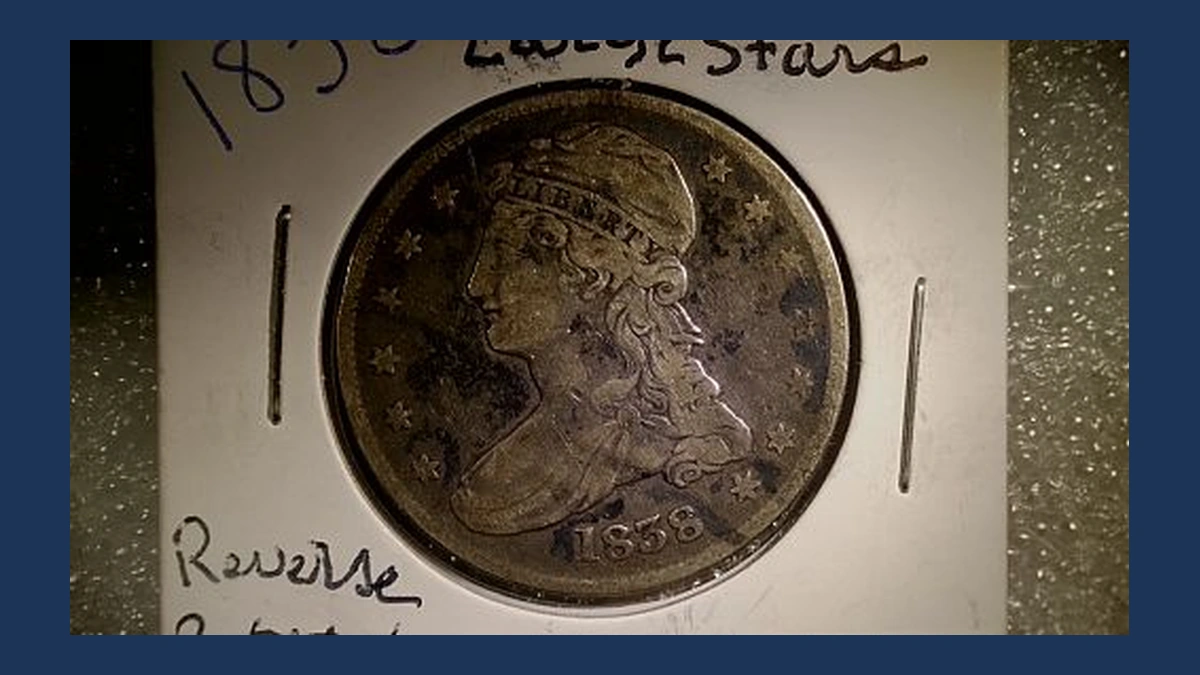
The eagle may lean to one side after you flip the coin, even when both designs sit neatly within the rims. That concerns how the two faces line up, not whether the coin was struck off-center.
A collector described an 1838 back design turned to the right on a coin listed as VF25. No angle was given.
A die is the steel tool that stamps one face of a coin. If it turns in its holder, later coins can show the changed position.
The date and lettering may otherwise look normal. A controlled flip is needed to reveal the difference.
Estimated Value
A measured comparison comes from another year. The June 2024 E-Gobrecht reports an 1839 GR-8 with a 180-degree rotation, sold for $1,680 in October 2023.
That PCGS XF40 coin had light circulation wear. Estimate $250–$1,700 for a genuine circulated 1838 example, depending on condition and the amount of rotation.
The reported 1838 angle remains unmeasured. A slight tilt should not automatically receive the comparison coin’s price.
How to Identify
Hold Liberty upright and flip the coin top to bottom, without twisting it sideways. The eagle should then be upright on a normally aligned coin.
Repeat the movement slowly. Two separately rotated photographs cannot show how the faces really line up.
Use an alignment guide or protractor to measure any tilt. A 10× magnifier can help you look for altered digits or a seam from two joined pieces.
The ridged-edge 1838 half weighs 13.36 grams before wear and measures about 30 millimeters. Check a loose coin with a digital scale and calipers.
Record one continuous video of the careful flip for a clear, quick check of its actual alignment.
3. 1838 Capped Bust Half Dollar Die Crack Error (Estimated Up to $2,500)
A raised line crosses the eagle’s shield and continues toward the rim below HALF DOL. It shows where the stamping tool for a Philadelphia GR-4 coin cracked as it wore out.
GR-4 is the catalog number for this variety. Specialists note that coins with the developed crack are more common than very early examples from the same tools.
A large crack is not always rare. Its appearance must be considered alongside the variety itself.
A crack reported on a specially made 1838-O Proof belongs to another coin. Its New Orleans origin must stay separate from this Philadelphia example.
Estimated Value
The estimated range for Philadelphia examples is $100–$2,500, from worn coins through selected unworn pieces. A PCGS MS63 CAC GR-4 brought $2,350 at Heritage in January 2017.
That sale compares the variety and condition; it does not price the crack alone. MS63 describes an unworn coin with some surface marks.
The rare 1838-O Proof has a very different market. Its price should not be applied to Philadelphia coins.
How to Identify
First check above the date. An O means New Orleans, while the Philadelphia coin has no mintmark and needs a different reference.
For the Philadelphia GR-4, inspect the shield and the rim below HALF DOL together. The reported raised line connects those areas.
A 10× magnifier and light from several directions help separate a ridge from a scratch. The scratch cuts into the surface instead.
Calipers should read about 30 millimeters, and a scale should approach 13.36 grams before wear; the edge has ridges. Match the raised line and the correct front design with the documented GR-4 example for a direct identification.
Conclusion
The estimated $100–$2,500 range here concerns the Philadelphia coins and conditions described. Start with HALF DOL on the back, then check how the faces line up and whether unusual lines are raised.
The wrong-back report still needs authentication. The crack variety has its own evidence, while rare New Orleans Proofs belong in a separate comparison, even when their lines look similar at first glance.