1862 Half Dollar Error List with Pictures

An ordinary 1862 Philadelphia half dollar graded MS64 sold for $2,880 in May 2025. That result helps value a different MS64 coin with a small flaw below its eagle, rather than proving an extra price for the flaw.
The 1862 half dollar errors below have estimated values from $200 to $3,500. Read on to find raised lines in Liberty’s clothing, faint extra shapes, a lump on the eagle’s wing, and a flaw in the original metal.
1. 1862-S Liberty Seated Half Dollar Die Gouges (Estimated Up to $650)
Two diagonal lines appear among the folds of Liberty’s clothing on the reported Large S coin. One lies below her left armpit, and the other is at her knee to the right of the staff.
Both slope from upper left to lower right. Their exact positions help separate them from ordinary clothing folds.
These raised lines came from grooves cut into the steel tool that stamped the coin, called a die. Silver entered those grooves during striking, so damage cut into the tool produced lines standing above the finished coin’s surface.
Estimated Value
An estimated $200–$650 suits worn examples whose two marks can still be clearly identified. Enough clothing detail must survive to place each line correctly.
Ordinary 1862-S halves graded PCGS XF40 and XF45 had reported sales of $250 and $475 in November 2025. Those grades describe moderate wear, and the prices are whole-coin comparisons rather than sales identified with these two lines or separate payments for each mark.
How to Identify
With Liberty upright, locate her left armpit, staff, and knee before following the two diagonal lines. Their positions matter as much as their direction.
A magnifier and light held low across the surface will help show whether each line is raised. A scratch cut down into the coin is a different feature.
Photograph the S mintmark on the back and the full date as well. If the coin is outside a grading holder, use a scale and calipers to compare 12.44 grams and 30.6 millimeters, then inspect the edge grooves.
The two raised lines together in the correct clothing positions give the quickest identifying match.
2. 1862 Liberty Seated Half Dollar Clashed Dies (Estimated Up to $800)
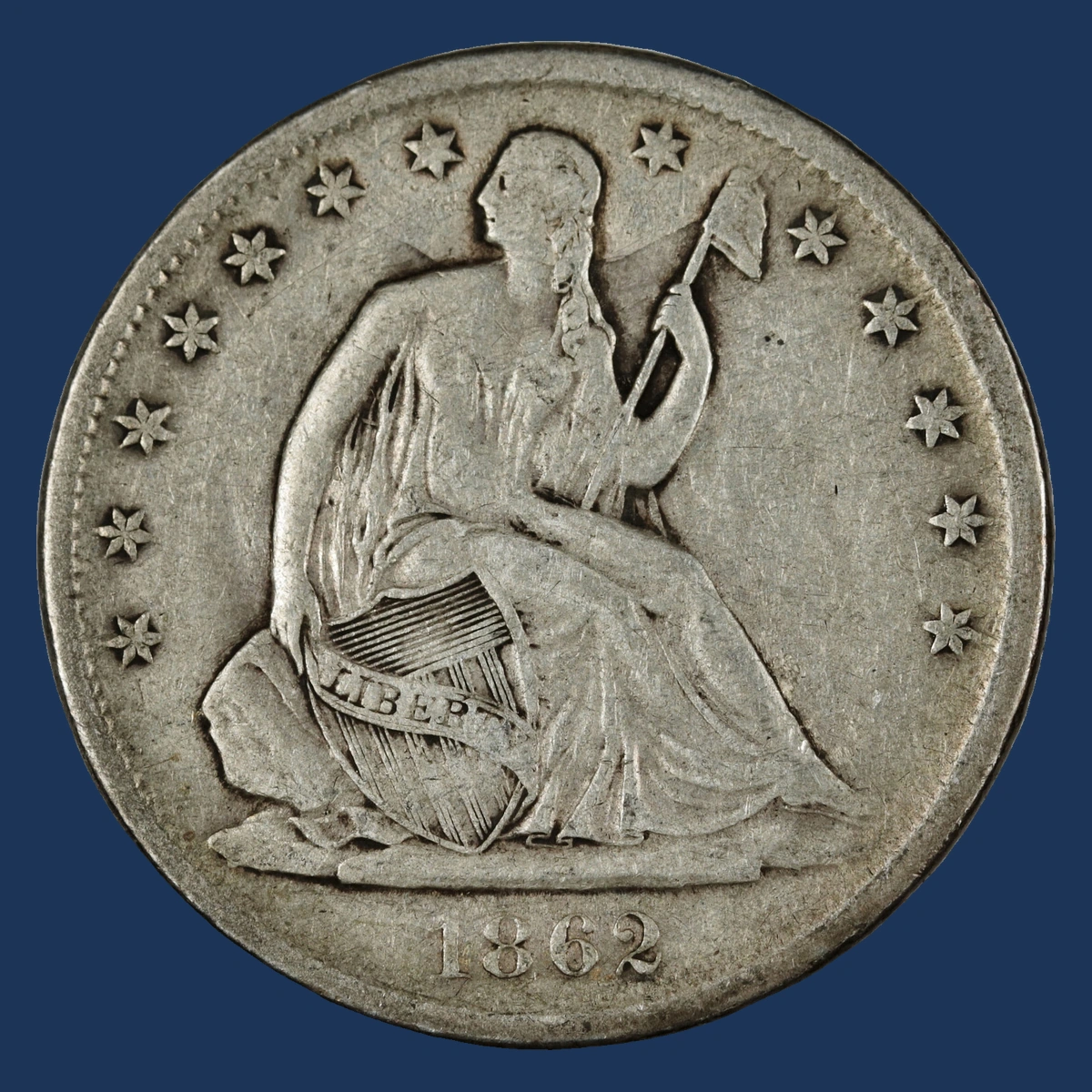
A faint shape beside Liberty’s right elbow can look out of place until you compare it with the eagle’s wing. The bend in that wing explains the reported extra outline on 1862-S halves.
The steel stamping tools can leave marks on each other if they meet with no blank between them. Later coins then receive fragments of the opposite design, called clash marks.
Another reported location is near the lower right of the shield. A separate Philadelphia auction coin also had clash marks, but its description does not establish the same elbow mark as the San Francisco example.
Estimated Value
The Philadelphia coin sold for $299.63 in May 2015, according to Coin World’s auction table. ANACS described AU55-level detail, meaning light wear, but polishing prevented a normal grade.
Estimated value is $250–$800 for worn examples across the reported mints. Ordinary San Francisco XF sales around $250–$475 provide further comparisons, while better condition and clearer clash marks can support more value than the polished example.
How to Identify
Start beside Liberty’s right elbow on a San Francisco coin and compare the faint outline with the eagle’s wing bend. Check near the lower right of the shield too.
Under a magnifier, look for recognizable connected shapes. A random straight line is not enough.
For a Philadelphia example, use photographs of that identified coin instead of assuming it shares the San Francisco marks. Soft light can help where polishing has made reflections distracting.
A scale and calipers check the normal 12.44 grams and 30.6 millimeters, and the edge should retain its grooves. The wing-shaped outline beside the elbow is the quickest direct check for the documented San Francisco clash.
3. 1862-S Liberty Seated Half Dollar Die Cracks and Breaks (Estimated Up to $1,200)
A raised lump on the eagle’s right wing is much broader than a fine crack line. A published 1862-S example shows this lump where a piece broke out of the steel stamping tool.
Silver filled the missing space when the coin was struck. A narrow crack in the tool similarly leaves a thin raised line.
Other 1862-S reports describe lines between the date and rock, or from Liberty’s toes toward the border near star thirteen. These marks were observed on different examples, so one coin need not show the wing lump and every reported line together.
Estimated Value
Estimated whole-coin value is $250–$1,200 for worn examples with identifiable marks. Small lines fit toward the lower end, while a clear, substantial wing lump can support more collector interest.
Reported 1862-S sales in XF grades include $250, $350, and $475. Those moderately worn ordinary coins help establish the date’s value, while the upper figure remains an estimate rather than a recorded sale for the pictured wing defect.
How to Identify
The date-area line starts outside the lower loop of the 8 and runs toward the small upper-left tip of the 1. Follow it toward the rock and the tiny border teeth with a magnifier.
The separate toe-area line reaches toward the border near star thirteen. For the wing lump, compare its whole shape with the published photograph.
Check for glue, corrosion, or metal pushed up beside a scratch. Read the S mintmark, inspect the edge grooves, and use a scale and calipers to compare 12.44 grams and 30.6 millimeters.
A matching raised line path or the documented wing-lump outline is the quickest useful identification.
4. 1862 Liberty Seated Half Dollar Planchet Defect (Estimated Up to $3,500)
A small irregular spot below the eagle appears on an 1862 Philadelphia half dollar cataloged by Heritage. The description calls it a planchet defect, meaning a flaw in the metal blank used to make the coin.
It does not identify peeling metal, a trapped object, or anything pressed into the surface. Those more specific explanations would need additional evidence.
The coin was graded PCGS MS64, meaning no wear but some marks, and also received CAC approval. Those details identify the particular coin without making its small flaw a separately priced error.
Estimated Value
Use an estimated $2,200–$3,500 for a similarly preserved MS64 Philadelphia half dollar with a small original flaw. A regular PCGS MS64 sold for $2,880 in May 2025, giving a recent same-grade comparison.
That sale was not the CAC-approved coin with the flaw beneath the eagle. The estimate reflects the quality and surfaces of the complete coin, rather than adding an unsupported bonus for a small imperfection in its original metal.
How to Identify
Locate the spot below the eagle in the cataloged PCGS MS64 CAC example. Keep the lower lettering visible so the exact location is clear.
Examine the spot’s border and bottom with a magnifier. A later dent or scrape can occupy the same area but disturb the nearby design differently.
Do not assume peeling metal without an actual separated layer. For an unholdered coin, inspect the grooves around the edge and use a scale and calipers to compare the normal 12.44 grams and 30.6 millimeters.
The small flaw beneath the eagle, matched directly with the cataloged photograph, provides the quickest starting check.
Conclusion
The estimated $200–$3,500 range includes both worn San Francisco coins and a much better-preserved Philadelphia example. Condition and mint matter alongside the unusual marks.
Use raised shapes to distinguish tool damage from scratches, and compare faint extra designs with the opposite side. The small flaw below the Philadelphia eagle concerns the original blank instead, so its whole-coin price should not become a bonus for every surface spot.