2003 Penny Error List with Pictures

Even a specially made collector penny can carry an error: a 2003-S Proof has a raised crack across UNITED and the Memorial. Other 2003 penny errors involve weak detail, missing copper, or a dime receiving a cent design.
A comparable 2001 cent struck over a dime sold for $1,320 in September 2025. That is a different-year sale, not a 2003 auction record.
Estimated values for the twelve groups below run from $2–$2,500. Use the following features to separate collectible mistakes from ordinary wear and damage.
1. 2003 Lincoln Memorial Penny Wavy Steps (Estimated Up to $50)
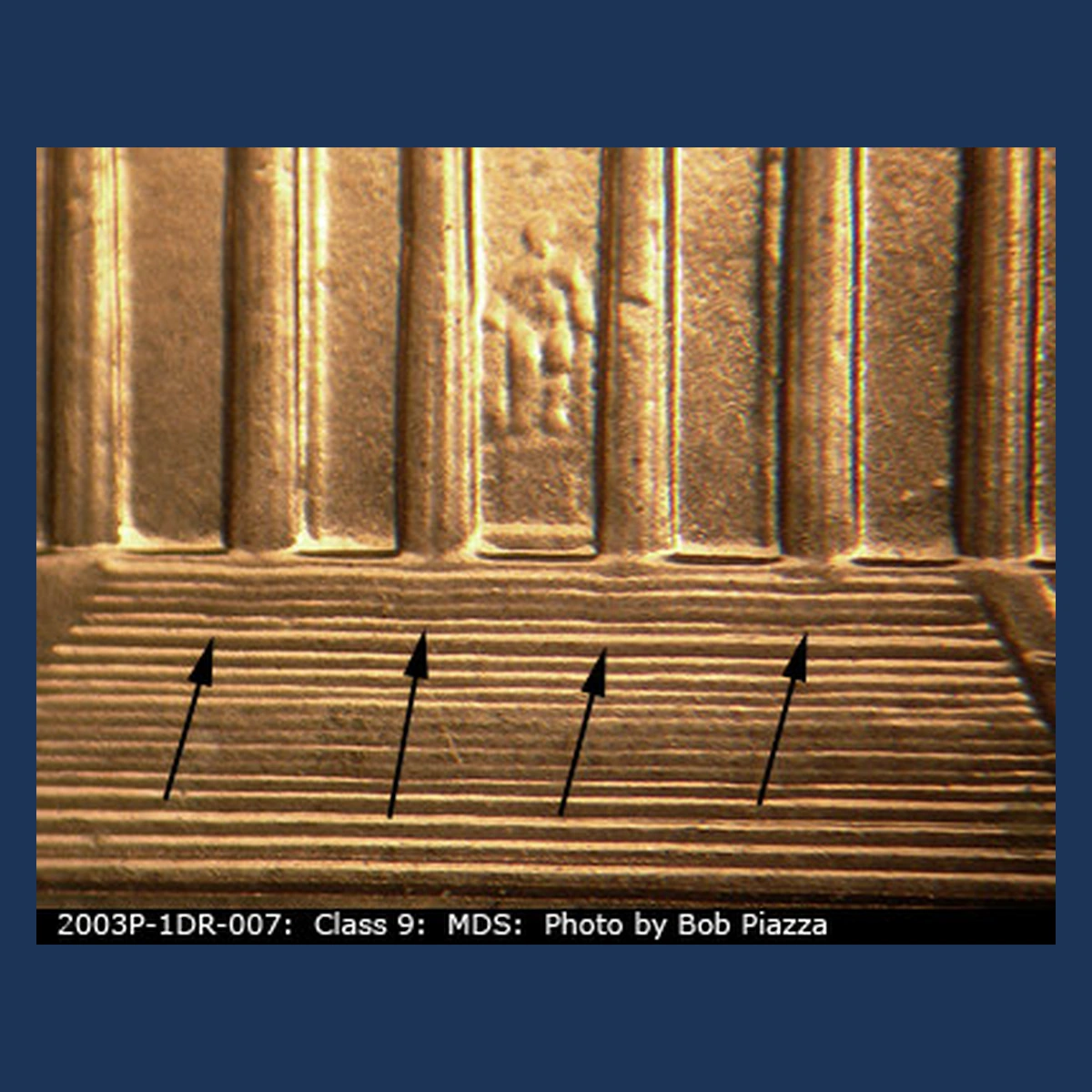
The steps beneath the Memorial can look stretched or wavy instead of forming clean, straight lines. The unusual detail seems to trail away from the normal design.
A Philadelphia 2003 example was once described as a doubled die, but its catalog explanation now calls it design extension. That means the odd shape should not be treated as a second complete design.
The appearance is still useful to collectors who study these features. Its exact cause should not be guessed from the nickname.
Strong angled light, wear, and ordinary strike doubling can also make the steps look uneven.
Estimated Value
For a clearly matched wavy-steps example, use an estimated $2–$50. The range reflects a minor modern design feature rather than a major doubled-die rarity.
The published photographs provide the comparison for identification, not a confirmed 2003 sale price. A sharp coin with visible trails is easier to collect than a worn example.
Do not pay a doubled-die premium solely because an older label uses that name. The actual photographed feature is what matters.
How to Identify
Place a normal Memorial cent beside the candidate and compare the steps under the columns. View them under a 10× magnifier with light from more than one direction.
Look for extended lines that match the photographed 2003 design extension. A reflection that disappears when the light moves is not the same feature.
This comparison concerns Philadelphia’s no-mintmark cent. Keep a Denver coin separate unless it has its own matching reference.
Use a scale and calipers on a loose coin to check 2.50 g and 19.05 mm. Inspect the plain edge and surface for alteration.
Match the actual wave-like extensions beneath the Memorial, rather than calling every uneven step doubled.
2. 2003 Lincoln Memorial Penny Misaligned Die (Estimated Up to $100)
One face can have a narrow border on one side and a wide border opposite it. The other face may remain normally centered.
That pattern can result when a die, the steel stamping tool, shifts sideways. It differs from moving the whole metal disc out of position.
A misaligned-tool error has been reported for 2003, but the specific mint and finish have not been securely established. The appearance can still be checked directly.
Photographing a coin at an angle can create a misleading border. The decision needs straight-on views of both faces, not one enlarged edge.
Estimated Value
If confirmed, a visible one-face shift has an estimated value of $5–$100. This uses comparable minor alignment errors on modern cents.
The estimate does not establish the identity or selling price of the reported 2003 example. A tiny uneven border may add little, especially when the design remains comfortably inside the edge.
Larger shifts with clear contrast between the two faces are easier to demonstrate. Uneven wear or a tilted photograph does not support an error premium.
How to Identify
Lay the coin flat and photograph each face from directly above. Compare the distance between the design and the border all the way around.
Use a 10× magnifier to check whether the apparent narrow area is actually worn or damaged. Look at the date and mint letter, but do not infer the finish from shine alone.
A loose coin can be compared with 2.50 g on a scale and 19.05 mm using calipers. Its normal edge is plain; inspect for grinding or squeezing.
The opposite face is essential to the test. If both designs shift together, consider an off-center strike instead.
Confirm that only one face is displaced while the opposite design stays centered.
3. 2003 Lincoln Memorial Penny Clashed Dies (Estimated Up to $150)
Lines from the Memorial may appear faintly around Lincoln, or parts of the portrait may leave traces on the back. They are unexpected pieces of the opposite design.
The tools normally strike with a metal disc between them. If that disc is absent, contact can transfer small design marks from one tool to the other.
Later coins may show those transferred marks. A Philadelphia 2003 clash is reported in the year’s error descriptions.
The shape and placement matter more than whether a single mark looks raised or recessed. Pressing two finished coins together can produce misleading design impressions.
Estimated Value
A modest confirmed clash has an estimated range of $10–$150. Clean surfaces and recognizable opposing design traces support the stronger values.
The estimate compares modern Memorial-cent clashes. It is not a documented auction result for the reported Philadelphia example.
Faint lines can be collectible without being expensive. A buyer should be able to match their shape to the other face of the coin, while excluding scratches, dirt, and impressions caused by later squeezing.
How to Identify
Choose a normal 2003 cent as the design guide. Compare extra lines around Lincoln with the Memorial, and examine the back for corresponding portrait traces.
A 10× magnifier helps distinguish a real surface feature from dirt or reflected light. Follow an entire shape instead of selecting one suggestive line.
Check the plain edge and both faces for crushed metal from later pressure. A deeply impressed mirror image needs a different explanation from faint tool-contact traces.
For a loose candidate, compare 2.50 g on a scale and 19.05 mm with calipers. These checks help find alteration but cannot identify a clash alone.
Match a faint unwanted shape to the opposing design at the correct position on a confirmed clash.
4. 2003 Lincoln Memorial Penny Doubled Die Obverse (Estimated Up to $200)
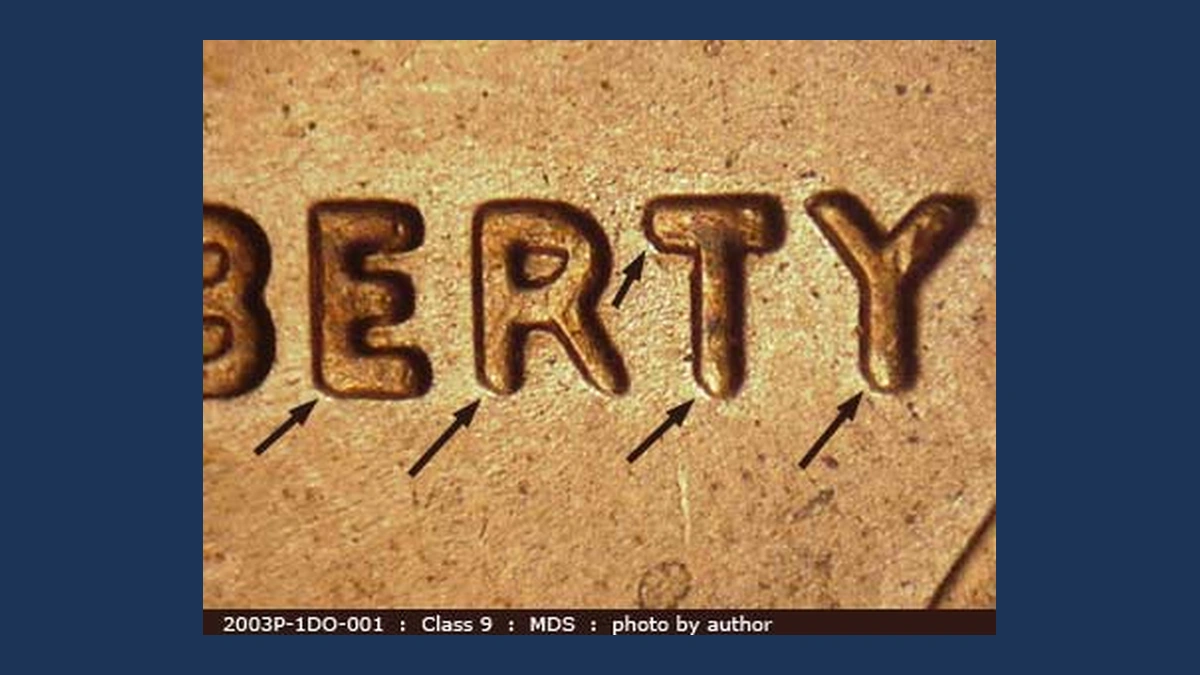
A doubled front design can add an extra outline near Lincoln’s eye or ear, or beside lettering and the date. The repeating feature belongs to the stamping tool.
Philadelphia and Denver 2003 examples have been reported. Those reports identify areas to examine, not one universal pattern shared by every coin.
A coin should match a particular confirmed example before it receives a variety name. Thickness by itself is not enough.
Movement during striking can create a flat shelf beside a letter. Cracked copper coating and worn tools can also make edges look wider without producing a collectible doubled die.
Estimated Value
An estimated $5–$200 suits confirmed minor doubled-front varieties on this date. The range compares modern cents with similarly small extra-design features.
A clear match and sharp surfaces support more than an unsupported doubling claim. No particular 2003 auction result is assigned to these reported examples.
Famous older doubled dies are not suitable price substitutes for every modern cent. Flat strike doubling and split copper coating should not receive the same premium as a recognized variety.
How to Identify
Check whether the coin has a D or no mintmark, then select a comparison from that mint. Different tools can produce different extra shapes.
With a 10× magnifier, study the eyelid, ear, lettering, and date only where the comparison indicates a feature. Do not combine marks from several unrelated coins.
Change the light to reveal flat shelves or breaks in the thin copper coat. A genuine pattern should remain a physical part of the design.
Weigh a loose coin against 2.50 g and use calipers against 19.05 mm. Inspect the normally plain edge for alteration.
Find the same extra outline in the same place on a confirmed 2003 example, rather than relying on general thickening.
5. 2003 Lincoln Memorial Penny Die Cracks, Cuds, and BIE Chips (Estimated Up to $300)
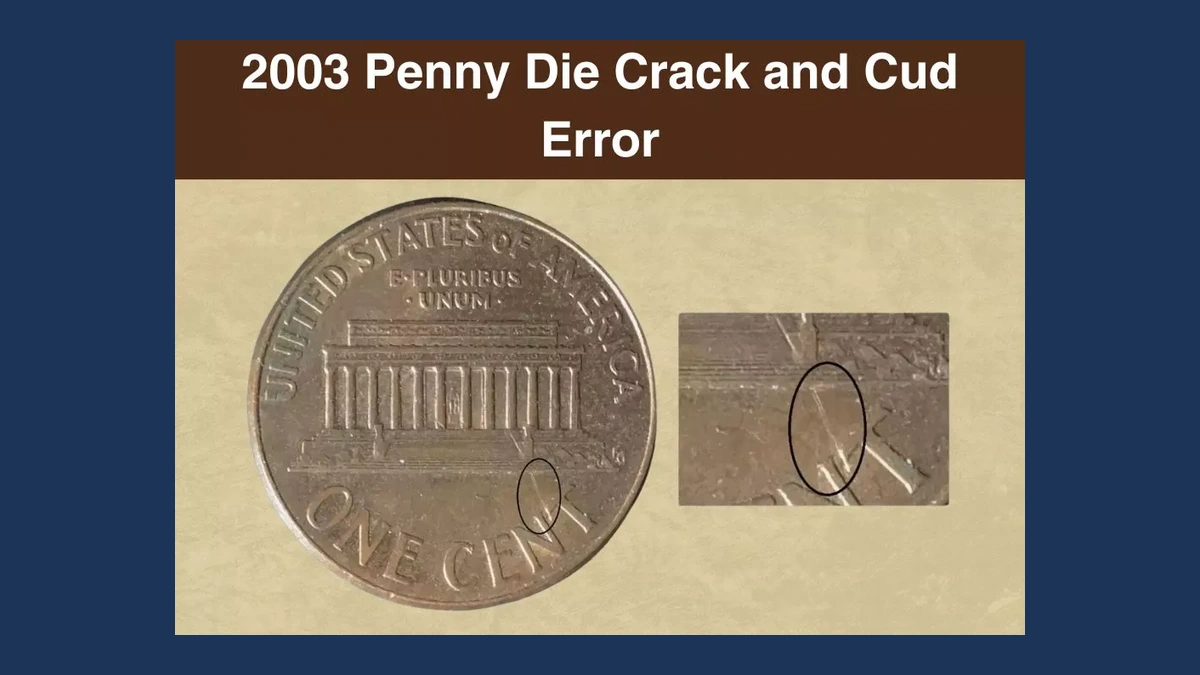
A raised line on a 2003-S Proof crosses the T in UNITED and continues toward the Memorial. Proof coins are specially made collector pieces, but their stamping tools can still crack.
The documented line begins near the upper-left border and reaches above the third column from the left. A shorter diagonal crack appears at the left roof edge.
Separate ordinary-coin reports describe a cud, a raised lump connected to the rim, and BIE bars between B and E in LIBERTY.
These all involve damaged stamping tools. The Proof’s narrow crack is not itself a large rim-connected lump.
Estimated Value
Use an estimated $2–$300 across these different tool-break features. Fine lines and tiny BIE bars usually occupy the lower end.
A large, well-confirmed rim break can attract more, while a Proof coin’s condition also contributes to its total value. The range compares similar modern-cent features, not a recorded sale of the documented 2003-S crack.
The three appearances should not receive one automatic price. Visibility, size, finish, and preservation all affect what a collector will pay.
How to Identify
For the Proof crack, first find the S below the date. Under a 10× magnifier, follow the raised line from the upper-left border through UNITED toward the third column.
The CONECA report also describes a short diagonal line near the left roof edge. Keep this example separate from ordinary-coin rim breaks.
For a BIE, inspect the gap between B and E; for a cud, check that the raised lump joins the rim. The normal edge is plain.
A loose coin should be compared with 2.50 g on a scale and 19.05 mm using calipers. Keep sealed Proofs in their holders.
Match the raised crack’s exact route, the BIE’s letter gap, or the cud’s solid connection to the rim.
6. 2003 Lincoln Memorial Penny Grease-Filled Design (Estimated Up to $300)
A section of the design can look faint or absent even though the nearby surface has little wear. Material blocked the tool from forming the detail properly.
Grease can fill the tool’s small recesses. When the coin is struck, those blocked areas fail to produce their normal raised shapes.
A 2003-D graded PCGS MS64 Red is shown as a grease-filled-dies error in a collector showcase. The effect must be judged from its actual weak areas.
An isolated missing L is not an automatic grease diagnosis. Wear, scraping, and corrosion can all make a letter difficult to see.
Estimated Value
A recent comparison is a 2021-D grease error that sold for $84 in September 2025. It was graded PCGS MS64 Red.
An estimated $5–$300 for 2003 grease-filled examples covers slight loss of detail through more obvious affected areas. The newer sale provides context rather than a transaction for the showcased 2003-D coin.
Sharp surrounding detail helps demonstrate the error. General wear or a scraped-away letter should not be priced as a mint-made obstruction.
How to Identify
Compare the weak area with Lincoln’s higher points and the nearby lettering. General wear usually affects more than one isolated detail.
Under a 10× magnifier, inspect the surface where the design fades. Look for scraping, pits, or disturbed metal that would explain the missing shape after minting.
Check the opposite face for additional blocked detail. The affected area does not need to occur in exactly the same place on every grease error.
Use a scale and calipers on a loose coin, comparing 2.50 g and 19.05 mm. Examine the plain edge for filing or squeezing.
Find a smooth area of weak design surrounded by sharper detail, with no surface damage explaining the loss.
7. 2003 Lincoln Memorial Penny Low-Pressure Weak Strike (Estimated Up to $300)
Much of the design can remain shallow, leaving soft letters and an incomplete portrait. The coin may still keep its original surface instead of showing circulation wear.
Insufficient striking pressure is one possible cause. It is different from a small area blocked by grease.
A 2003 low-pressure example has been reported, but its mint and finish need confirmation. Weakness alone also cannot show that someone was deliberately adjusting the press.
Collectors sometimes use die-adjustment strike as a label for this appearance. That name should not replace examination of the surface, since acid, grinding, and wear can also weaken detail.
Estimated Value
For a confirmed mint-made low-pressure strike, estimate $25–$300. The comparison is with weakly struck modern cents that retain convincing original surfaces.
This conditional range does not authenticate the reported 2003 coin or establish that it was a press test. A damaged penny with shallow detail is outside it.
The amount depends on how clearly the weak strike can be demonstrated. Broad weakness with undisturbed metal is more useful than a barely visible letter.
How to Identify
Inspect the whole design rather than one missing letter. A 10× magnifier should show whether shallow detail extends across the coin without the flattened high points of wear.
Look for a smooth original surface, not acid pitting or grinding lines. Compare both faces with a normal coin of the same finish.
A scale and calipers should be used against the normal 2.50 g weight and 19.05 mm diameter. A very light coin may have lost metal after minting.
Check the plain edge for thinning or filed areas. Professional examination may be needed to distinguish low pressure from other causes of weakness.
Find widespread shallow detail over undisturbed metal, then rule out wear, chemical loss, and mechanical removal.
8. 2003 Lincoln Memorial Penny Broadstrike and Partial Collar (Estimated Up to $400)
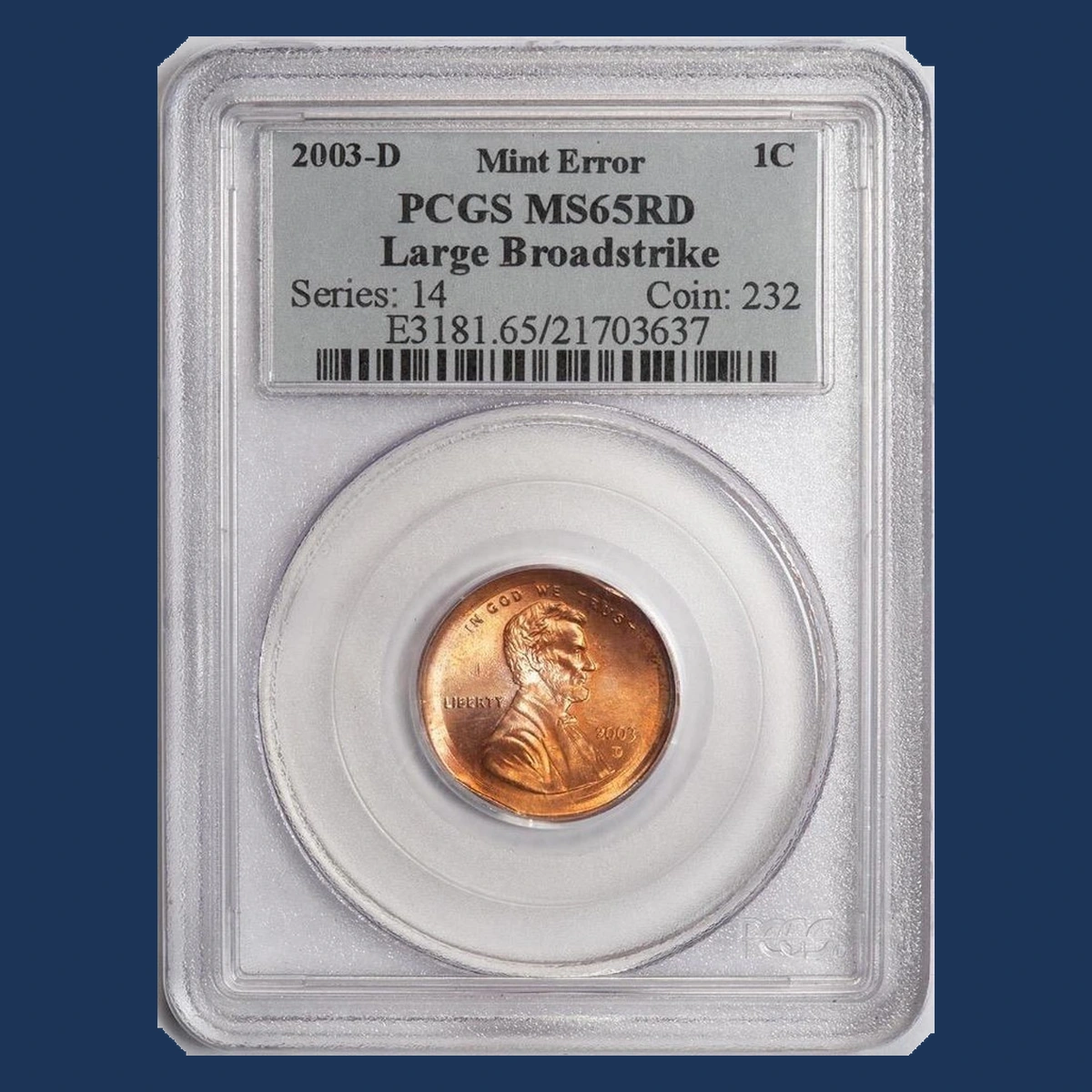
A broadstruck penny spreads wider than normal because the retaining ring fails to contain it during stamping. Both designs remain complete despite the extra metal around them.
That ring is called the collar. If it controls only part of the coin’s thickness, the edge can develop a visible step instead.
Both appearances are reported for Philadelphia and Denver 2003 cents. The edge is important for distinguishing full escape from partial contact.
Pennies normally have plain edges, so missing grooves are not a clue. Later squeezing can also widen a coin, but usually damages the design or border.
Estimated Value
An estimated $20–$400 covers confirmed collar-related errors, from a modest edge step through conspicuous broadstrikes. It compares modern cents with similar spread and edge features.
The range is not a recorded sale for a particular reported 2003 coin. A broadstrike with a large natural spread can be more striking than a small partial-collar step.
Condition remains part of the price. Flattened or rolled edges created after minting should not be sold as the same error.
How to Identify
Look at the coin edge-on before studying its faces. A partial-collar strike can show two different levels along the edge rather than one even side wall.
Use calipers to record any spread beyond the normal 19.05 mm diameter. A scale should place an intact example near 2.50 g; widening does not by itself remove metal.
With a 10× magnifier, inspect both faces for complete designs and the edge for a natural step. The normal penny edge is plain.
Check for crushed letters or a rolled border from later squeezing. An off-center strike instead leaves part of the design missing.
Confirm complete designs with natural outward spread or a clear mint-made step in the edge.
9. 2003 Lincoln Memorial Penny Off-Center Strike (Estimated Up to $500)
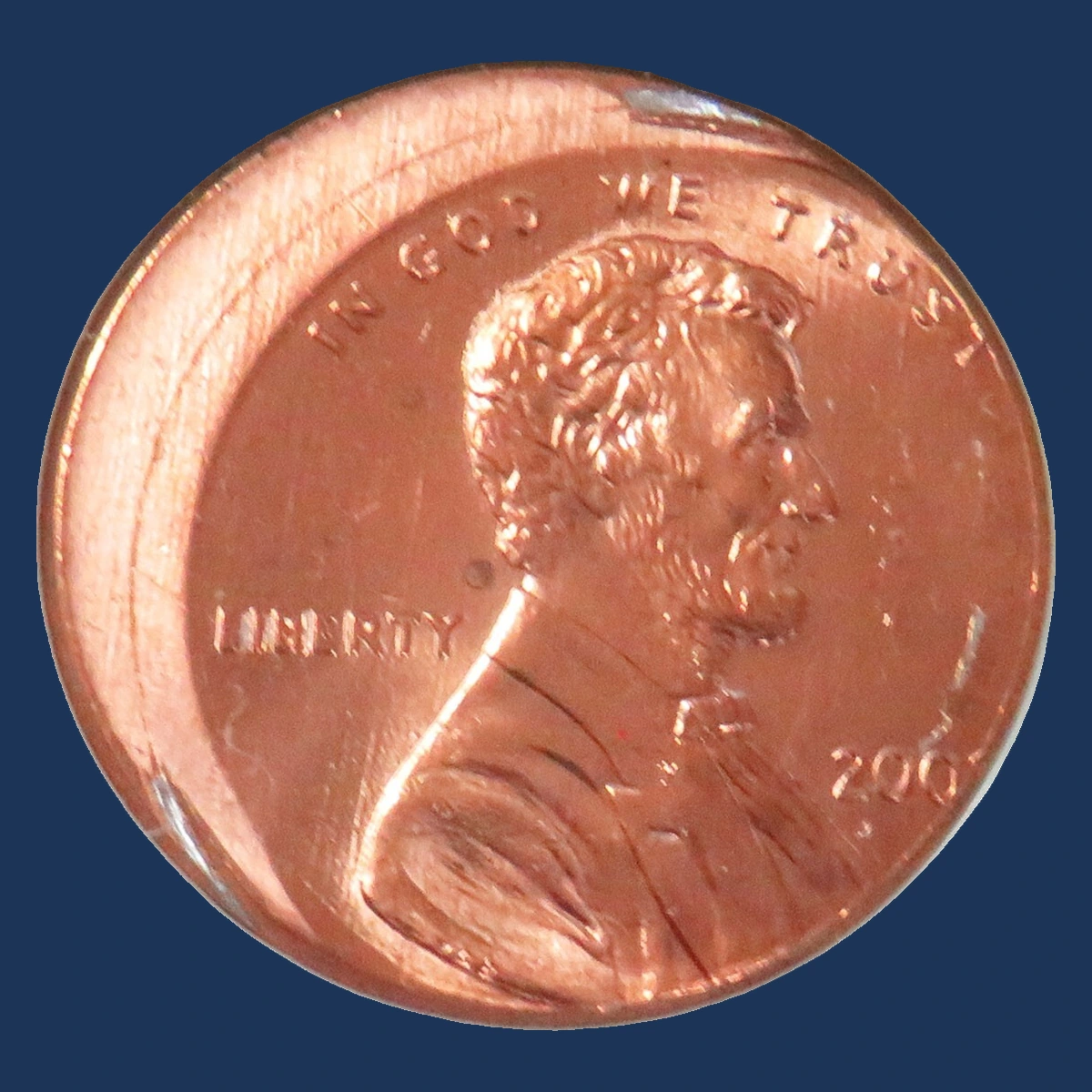
Lincoln’s design can run off one edge while a blank crescent remains opposite it. The back design shifts with it because the whole metal disc was out of position.
A published auction listing describes a Philadelphia 2003 cent struck ten percent off-center toward seven o’clock. That direction points toward the lower-left part of an upright front view.
Denver examples are also reported, with their own amounts of displacement. They should not automatically inherit the Philadelphia coin’s angle.
The date helps identify the coin when details are missing. A copper-colored blank area is normal for this type of error.
Estimated Value
Date-visible 2003 off-center cents have an estimated range of $15–$500. Small shifts generally cost less than dramatic errors with a clear date.
A 2006 four-percent off-center cent graded PCGS MS64 Red sold for $39 in March 2025. That is a different-year comparison.
The published ten-percent 2003 description supplies an example of the error, not a verified realized price here. Original surfaces and readable design should guide the amount within the estimated range.
How to Identify
Check the date and mint letter before judging the direction. For the recorded Philadelphia example, compare the shift with the lower-left seven-o’clock position.
Use a 10× magnifier on the transition between blank metal and struck design. A natural boundary should not show saw marks or scraping.
Compare the two faces without rotating the coin sideways. Their displacement should agree, while one centered face suggests a different alignment problem.
Check a loose coin on a scale against 2.50 g and record dimensions with calipers against 19.05 mm. Inspect the plain edge for cutting or grinding.
Find matching displacement on both faces with an untouched blank crescent and a readable 2003 in the struck area.
10. 2003 Lincoln Memorial Penny Missing Copper Plating (Estimated Up to $600)
Most of the coin looks gray because its normal copper coating is absent. Small remaining copper areas can mark the boundary of the missing surface layer.
A Philadelphia 2003 example graded PCGS MS64 appears in GreatCollections as ninety percent unplated. The description concerns a zinc coin lacking most of its thin copper coat.
This is different from a cent struck on a dime’s metal disc. The underlying coin material remains zinc.
Chemicals can strip copper from an ordinary penny and create a similar color. Authentication must establish that the missing coating belongs to the minting process rather than later treatment.
Estimated Value
For a confirmed example, use an estimated $50–$600. Extensive original coating loss can attract more interest than a small bare patch on an otherwise ordinary cent.
The estimate compares certified missing-plating errors on modern zinc cents. It is not a disclosed sale price for the GreatCollections 2003 listing.
The remaining surface must also be well preserved. A chemically stripped coin does not gain the same value, even when nearly all of its copper has disappeared.
How to Identify
Start by comparing the zinc-colored areas with any surviving copper. Under a 10× magnifier, look for sharp struck detail continuing across the transition.
The certified ninety-percent-unplated example provides the correct type of comparison. Its percentage should not be assigned to a different coin without examining the surface.
Weigh a loose candidate against the normal 2.50 g and measure it with calipers against 19.05 mm. A thin missing coat may produce only a small weight difference.
Inspect the plain edge for corrosion and both faces for chemical pitting. Do not clean or scrape the gray metal.
Check for intact struck detail across the copper-to-zinc boundary, then confirm that the coating was absent during production.
11. 2003 Lincoln Memorial Penny Struck on a Dime Blank (Estimated Up to $1,500)
The penny design may look too large for its silver-colored metal disc. Outer letters can fall beyond the available surface and fail to appear.
A 2003-D cent has been reported struck on a dime blank, the unused metal disc intended for a ten-cent piece. It had not yet received Roosevelt’s portrait or the torch design.
The dime’s metal uses bonded outer layers around a copper center, unlike the penny’s copper-coated zinc. The starting disc is also lighter and smaller.
A gray penny is not enough to prove this error. Later coating, copper removal, or trimming can create misleading similarities.
Estimated Value
A 2007-D cent struck on a dime blank graded PCGS MS66 sold for $600 in March 2023. It supplies a same-series, different-year comparison.
An estimated $400–$1,500 allows for variation in the reported 2003-D type’s condition and appearance. Clear date and mint identification help establish what the coin is.
A clear, correctly identified example should show more than an unusual color. Professional confirmation of the metal disc is essential before paying this premium.
How to Identify
Use a scale first: a normal dime blank is about 2.268 g, compared with a cent’s 2.50 g. Calipers can compare its original 17.91 mm size with the penny’s 19.05 mm diameter.
The cent strike may spread the smaller disc, so final diameter need not remain exactly at the dime figure. Examine the clipped-looking outer design with a 10× magnifier.
Check the edge for the dime metal’s layered structure. An unused dime blank does not already carry the grooves created during a normal dime strike.
Inspect both faces for earlier dime details; those would indicate a different error. Exclude trimming and added surface metal.
Confirm dime-type weight and metal beneath a cent design, without a surviving earlier dime image.
12. 2003 Lincoln Memorial Penny Cent Struck Over a Dime (Estimated Up to $2,500)
Two denominations can share one coin: parts of Lincoln or the Memorial overlap older dime details. The original dime had already received its design.
It then reached the cent press and was struck again. The surviving Roosevelt portrait, torch, or dime lettering distinguishes this from an unused dime blank.
A 2003 example graded PCGS MS66 appears in a specialist collection. The underlying dime’s date and exact orientation must be read from the actual piece.
The combined design is the attraction. Silver color, a small diameter, or vague extra lines alone cannot show that a dime was struck again.
Estimated Value
A 2001 cent over a struck 2001-P dime graded PCGS MS66 sold for $1,320 in September 2025. This is a recent different-year comparison.
For authenticated 2003 examples, estimate $700–$2,500, with both condition and the clarity of the two designs affecting the price. MS66 describes an unworn coin with few marks.
The comparison does not establish a sale of the collection’s 2003 coin. Recognizable dime details are central to the value.
How to Identify
Find a recognizable piece of Roosevelt’s portrait, the torch, or dime lettering under the cent design. Study both faces with a 10× magnifier.
The two designs should fit a sequence of genuine strikes. A later squeezed-together pair can leave impressed shapes without creating the same error.
A scale should be compared with the dime’s normal 2.268 g weight rather than the cent’s 2.50 g. Use calipers to record expansion from the dime’s 17.91 mm starting diameter toward the cent’s 19.05 mm size.
Look along the edge for surviving or distorted dime grooves. Some may be erased by the second strike.
Identify a specific dime feature beneath Lincoln or the Memorial, supported by the dime’s metal and weight.
Conclusion
Estimated values of $2–$2,500 cover subtle wavy steps, visible tool breaks, unusual strikes, and cents made on dime-sized metal. The price depends on which feature is actually present.
A missing copper coat, an unused dime blank, and an already struck dime can all look gray, yet they are different errors. Compare their surfaces, weight, and surviving designs.
Keep Proofs protected and avoid cleaning any candidate before it is examined.