1874 Half Dollar Error List with Pictures

A half-dollar design on a quarter blank sold for $51,754 in 2019. Its grading label gives a date range of 1871–1875, while the auction house proposed 1874 from design clues.
That remarkable coin joins other 1874 Liberty Seated Half Dollar errors involving extra arrow shapes, mint letters, and raised marks. Estimated whole-coin values span $100–$65,000.
Read on to compare the visible details and keep the proposed 1874 date separate from the broader range on the label.
1. 1874-S Liberty Seated Half Dollar Die Crack Error (Estimated Up to $1,000)
Find the M in AMERICA on the back. A raised line runs along its right side, starting at the rim and extending into the nearby flat surface.
Specialist Bill Bugert records this route on a particular 1874-S die. A die is the steel tool that stamps the coin’s design.
When that tool cracked, silver filled the opening under pressure. The coin kept a raised copy of the break.
Another line near AMERICA is not automatically the same feature. Its route needs to match the documented example rather than merely lie close to the same word.
Estimated Value
An estimated $100–$1,000 covers worn coins with a clear matching crack. Much of the amount reflects the date, San Francisco mint, and condition.
Ordinary 1874-S guide comparisons rise from a few hundred dollars as preservation improves. They are price estimates, not sales of this exact crack.
The bracket allows room for a distinctive visible feature. It does not assign an unrecorded auction premium to the raised line alone.
How to Identify
Use a 10× magnifier to follow the M’s right side out to the rim, then back inward. Change the lighting to see whether the line rises above the surface.
A scratch cuts down into the metal. An opening in the coin itself is another different feature, rather than a raised copy of a damaged tool.
Confirm S below the eagle and inspect the edge grooves. When safely accessible, a digital scale and calipers can compare with the original 12.50 grams and about 30.6 millimeters, allowing for wear.
The rim-to-flat-surface ridge beside the M gives the direct match. Its exact path is more useful than simply finding a line near AMERICA.
2. 1874-S Liberty Seated Half Dollar Repunched Mintmark Error (Estimated Up to $1,500)
Some S mint letters are tall and narrow; others are smaller and broader. Those normal shape differences do not prove that the letter was punched twice.
A specialist dealer account also reports double-punched examples for this date. An earlier S impression can remain when a worker punches the letter into the die again in a shifted position.
This is called a repunched mintmark. Its evidence is an extra curve or part of a second S.
The account gives no direction for that extra impression. A candidate should not be labeled as shifted upward or downward without an actual matching example.
Estimated Value
Use an estimated $150–$1,500 for identifiable worn examples with clear extra S detail. This is a comparison range, not a recorded 1874-S sale.
L&C Coins offers an 1877-S repunched-mintmark half graded AU50 for $1,250. That nearly unworn coin has a different year and is a dealer asking-price comparison.
Original surfaces and readable remnants matter. The exact 1874 feature still needs a photographic match before the estimate becomes useful.
How to Identify
Choose a normal S of the same shape for comparison. Otherwise, a broad letter can look doubled simply because the reference uses a narrower punch.
Examine the entire letter under a 10× magnifier. Look for a recognizable extra curve or end of a second S, and check nearby metal for engraving cuts.
The half dollar normally weighs 12.50 grams and measures about 30.6 millimeters across. Use a digital scale and calipers when safely accessible, and inspect the edge grooves.
Those measurements do not prove repunching. A second S-shaped outline distinct from the normal letter is the feature that separates a genuine earlier punch from ordinary thickness or damage.
3. 1874 Liberty Seated Half Dollar Repunched Arrows Error (Estimated Up to $2,500)
The arrows beside an 1874 date are normal. The feature here is part of a smaller arrow hiding beneath a larger one on a Philadelphia variety.
Workers used larger arrow punches after smaller ones had already marked the die. Some earlier outlines survived and appeared on coins stamped from it.
Specialist descriptions point to where each shaft enters its arrowhead. Another reported trace lies near the upper point of the right arrow.
This is called large-over-small arrows. A large arrow by itself does not establish repunching, because size alone cannot show that an earlier shape lies underneath.
Estimated Value
Worn examples have an estimated $200–$2,500 range. An ANACS AU55 large-over-small-arrows coin sold for $576 at Heritage in September 2018.
L&C Coins has more recent offers of $1,500 for a PCGS F12 and $2,500 for an XF40. Those are dealer asking prices, not completed sales.
The older auction provides a separate benchmark. Clear earlier-arrow remnants and the coin’s condition help explain which comparison fits an individual example.
How to Identify
Examine the point where each shaft enters its arrowhead with a 10× magnifier. Compare the right arrow’s upper point with a confirmed large-over-small example as well.
Philadelphia regular issues have no mint letter below the eagle. Check accessible coins with a digital scale and calipers against 12.50 grams and approximately 30.6 millimeters, then inspect the edge grooves.
Look for an older outline retained beneath or beside the larger shape. Later tool cuts go into the coin, while movement during stamping may leave a flat shelf.
A recognizable small-arrow remnant is the useful match. Neither a broad arrowhead nor a listing that merely says large arrows establishes this feature.
4. 1874-CC Liberty Seated Half Dollar Clipped Planchet Error (Estimated Up to $8,000)
A small missing section on an 1874-CC prompted a collector discussion about a possible clip. The account does not establish that it happened at the Mint.
A genuine clip begins when a blank, the metal disc before stamping, is cut from a strip. Part of its intended outline is missing before the design is applied.
The surrounding design then forms around that incomplete boundary. This can look different from filing a finished coin.
The report gives no established size or clock position for the possible clip. It remains a specific coin to examine, rather than a certified clipped-blank record.
Estimated Value
If authenticated, a worn 1874-CC with a small original clip has an estimated $1,500–$8,000 whole-coin range. The scarce Carson City date supplies much of that value.
An ordinary PCGS VF30 1874-CC sold for $7,320 at Heritage in March 2026. It provides a mint-and-condition benchmark, not a clip sale.
No confirmed premium is assigned to the discussion coin. A modern half-dollar clip would not provide a direct comparison for this scarce date.
How to Identify
Confirm both CC letters below the eagle before considering Carson City prices. Then inspect the missing section from both sides and directly along the edge with a 10× magnifier.
Look for sawing, filing, burrs, or fresh exposed surfaces. The adjacent design should explain how the coin formed around an already incomplete blank.
A digital scale can compare accessible coins with the normal 12.50 grams. Calipers may still measure about 30.6 millimeters across an intact section.
Check where the edge grooves meet the gap and whether the opposite rim is weak. Original stamped texture flowing toward the missing boundary supports a clip more directly than a small gap alone.
5. 1874-CC Liberty Seated Half Dollar Misplaced Date Error (Estimated Up to $10,000)
Could an extra digit be hidden outside the normal date? A specialist publication’s contents list identifies Paul Brill’s study of possible misplaced digits on an 1874-CC.
That listing does not give the study’s conclusion or a confirmed location. It cannot turn a particular line near Liberty or the border into an established numeral.
A misplaced date can form when the date punch hits the wrong spot on the die. A surviving piece of a digit may then appear on later coins.
The useful question is whether the extra shape belongs to a numeral. A random raised mark needs another explanation.
Estimated Value
For an authenticated worn 1874-CC example, use an estimated $1,500–$10,000 whole-coin range. The Carson City date already has substantial value before any added date feature.
An 1857-O misplaced-date half graded NGC MS65 sold for $5,280 at Heritage in May 2025. It is a different mint, year, and exceptional unworn grade.
That sale offers context alongside the 1874-CC market. It is not a realized price for the unresolved 1874 attribution.
How to Identify
Photograph the complete front because no confirmed extra-digit location is supplied by the contents listing. Keep each suspected mark in context with the normal date and design.
Confirm CC, inspect the edge grooves, and check accessible coins with a digital scale and calipers against 12.50 grams and about 30.6 millimeters. Then study the suspected shape through a 10× magnifier.
Compare any curve, base, or upright stroke with the normal date digits. Cuts added later and random marks from a damaged die may not preserve a numeral’s shape.
A repeated digit-shaped remnant matching an identified die would support this attribution. Merely finding a raised line in a plausible place would not.
6. 1874-CC Liberty Seated Half Dollar Die Gouge Error (Estimated Up to $18,000)
An extra featherlike shape behind the eagle’s eye looks like a cowlick. It sits below the first T in TRUST and comes from damage cut into the die.
The coin shows that damage as raised metal. The same cataloged NGC MS62 example also has two groups of tracklike marks crossing TES in STATES.
Stack’s Bowers suggested that an object may have damaged the tool. The exact object is not established by that interpretation.
The two locations help identify the back together. They belong to the same described coin, rather than separate errors whose prices should be added.
Estimated Value
Estimate $2,000–$18,000 from recognizable worn examples through ordinary unworn pieces. The NGC MS62 with these marks sold for $14,687.50 at Stack’s Bowers in 2013.
That is a direct variety comparison. Its cowlick and tracks are included in one sale price.
The scarce Carson City date, condition, and original surfaces all contribute to value. Pricing each raised mark separately would misrepresent what the buyer purchased at that auction.
How to Identify
Locate the eagle’s eye, then look above and behind it beneath TRUST with a 10× magnifier. Move to TES in STATES and compare both groups of tracks with the Stack’s Bowers photographs.
A cut in a die produces raised metal on a coin. A scratch made after minting instead cuts into the finished surface.
Confirm CC and the edge grooves. A digital scale and calipers can check accessible coins against about 12.50 grams and 30.6 millimeters.
Do not name a screw or another specific object from appearance alone. The cowlick and paired TES tracks in their documented positions give the useful combined identification.
7. 1874-S Liberty Seated Half Dollar Quarter-Planchet Error Candidate (Estimated Up to $65,000)
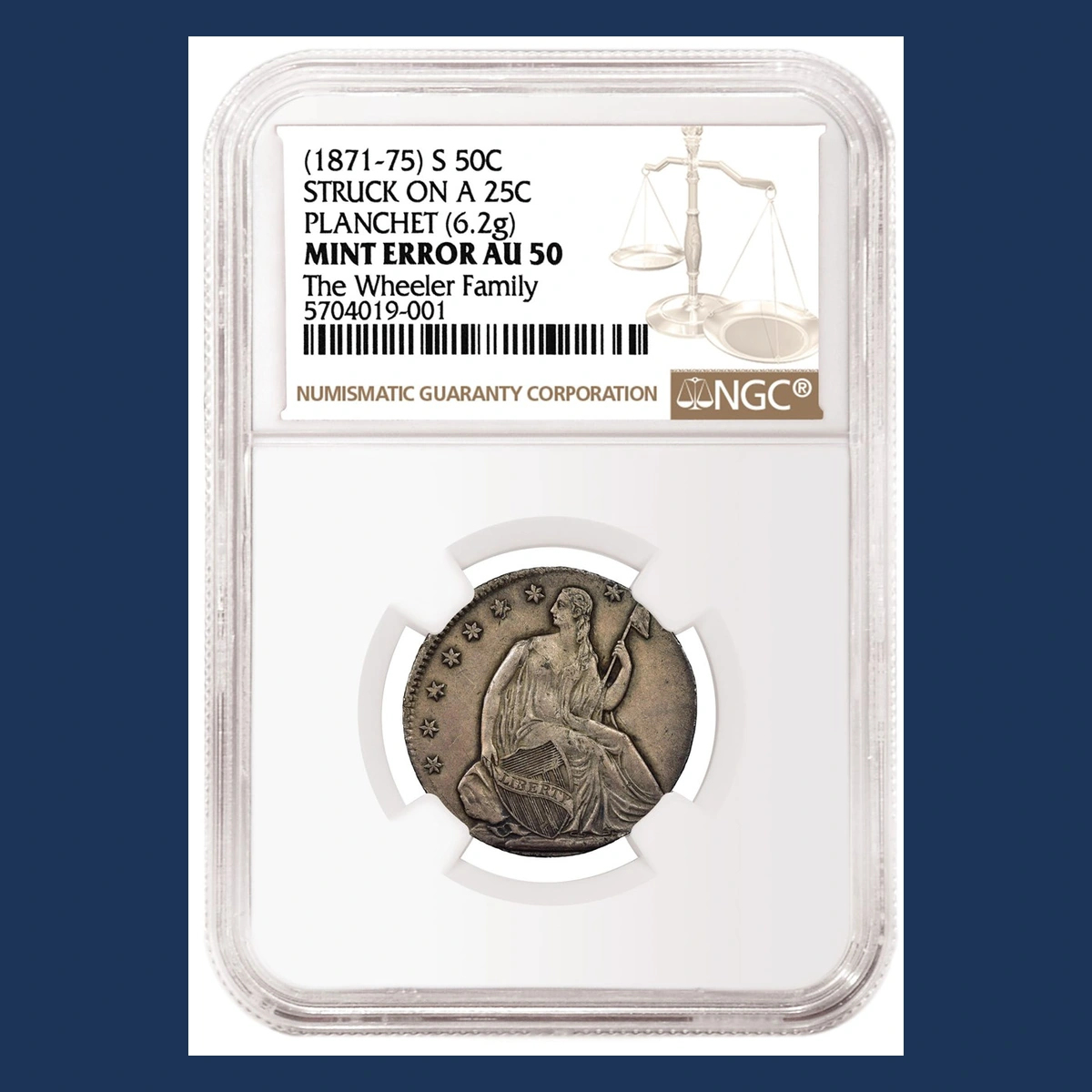
This is a certified mint error, but its exact year is a separate question. NGC graded it AU50 and assigned 1871–1875 using the S on the back.
GreatCollections proposed 1874 from details associated with particular dies. That proposal does not replace the broader date range on the grading label.
A half-dollar die struck a silver blank intended for a quarter. The smaller disc could not hold the whole design or date.
This shortage of room explains both the dramatic appearance and the missing date evidence. The surviving mint letter helps identify the coin without proving a fully readable 1874-S.
Estimated Value
The Wheeler Family coin sold for $51,754 at GreatCollections on September 29, 2019, as reported by NGC. An estimated $35,000–$65,000 provides a comparison range for this remarkable, nearly unworn error.
The sale concerns the certified coin dated 1871–1875. It does not prove a fully dated 1874-S specimen.
A trimmed or simply undersized half dollar cannot inherit that value. The smaller original blank must be authenticated too.
How to Identify
Look for full-sized half-dollar design parts cut short by the smaller disc. An ordinary quarter has a different, properly scaled design rather than cropped half-dollar details.
Use a 10× magnifier on the S and the entire edge. Trimming or machining can reduce a coin after stamping, and normal half-dollar edge grooves may be incomplete on a genuine wrong blank.
For an accessible candidate, calipers compare a quarter’s starting width of about 24.3 millimeters with the half’s 30.6 millimeters. A digital scale should reference roughly 6.22–6.25 grams for quarter blanks across 1871–1875, rather than 12.50 grams.
Correctly sized half-dollar details on naturally formed, quarter-weight metal support the wrong-blank identification. They do not resolve the exact year by themselves.
Conclusion
Normal arrows beside the date need no error explanation. Earlier arrow shapes, a second S, or raised eagle-head marks require more specific comparisons, while the Carson City reports need their own evidence.
Estimated values span $100–$65,000. The quarter-blank half supplies the standout sale, but its label still says 1871–1875; keeping that distinction visible is as important as keeping the coin’s condition beside its price.