1884 Half Dollar Error List with Pictures

An exceptionally well-preserved 1884 half dollar sold for $43,125 in November 2010. That price reflects the whole coin, not just a tiny date error.
For 1884 half dollar errors, the main feature to check is an extra stroke below the 4. Examples graded MS64–MS66 have an estimated range of $2,500–$5,000.
Keep reading to find that small mark and understand why condition changes the price so much.
1884 Liberty Seated Half Dollar Repunched Date Error (Up to $43,125)
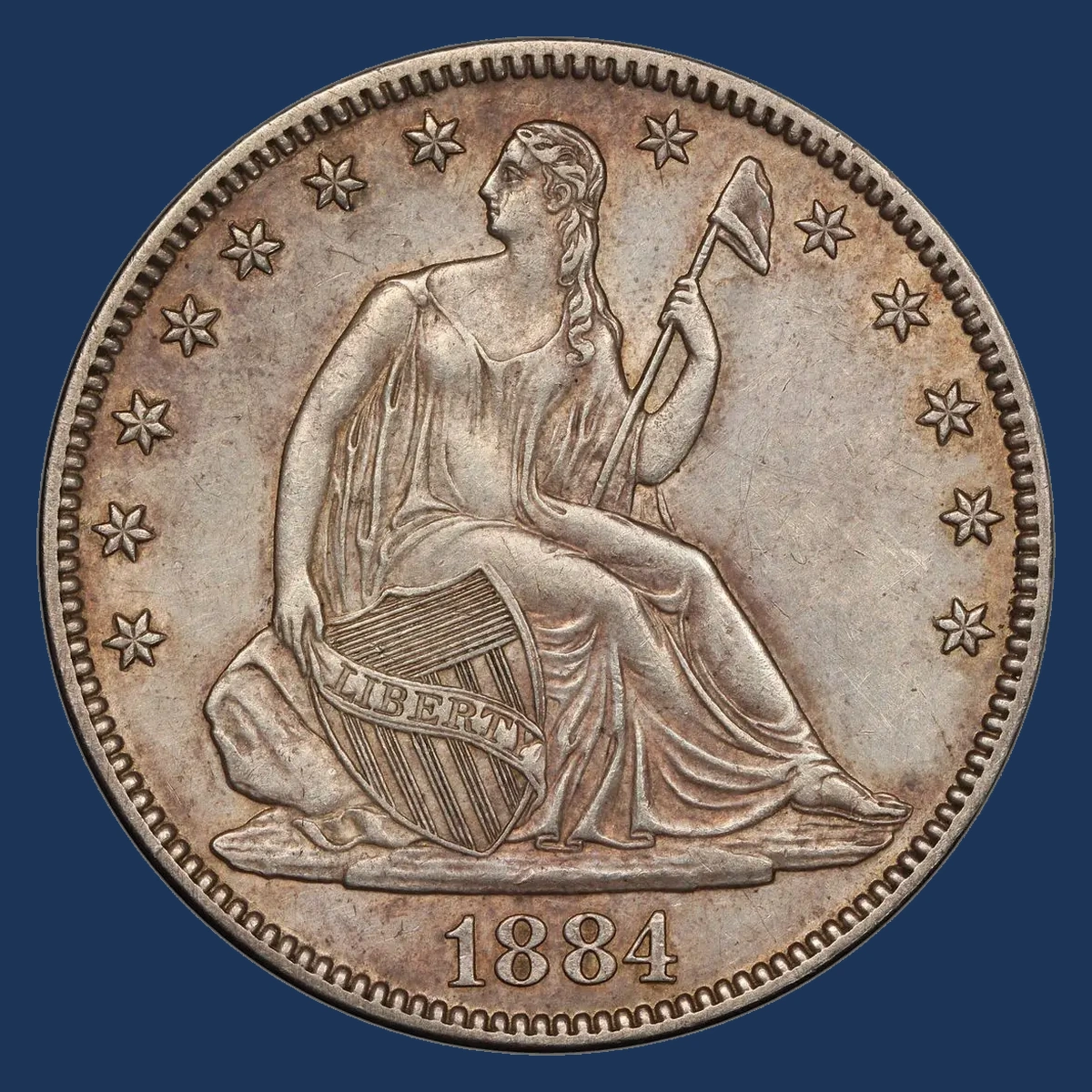
Look just below the final 4. A faint extra stroke can show where the date punch landed before workers placed it slightly differently.
The punch made the date in a steel die, the tool used to stamp coins. A second blow did not completely erase the first mark.
Coins struck from that die received the small extra stroke as raised metal. Collectors call this a repunched date and identify this version as WB-102.
It appears on regular Philadelphia coins, including some with mirrorlike surfaces. The extra mark belongs to another impression of the 4, not a different year.
Estimated Value
The estimated $2,500–$5,000 range suits examples graded MS64–MS66, meaning well-preserved coins without circulation wear. An NGC MS64 sold for $2,760 in January 2025.
An NGC MS65 brought $3,120 in August 2024. The $43,125 MS67 sale shows how much an exceptional 1884 coin can bring.
Much of that higher price comes from condition and the scarce date. The small extra stroke does not add tens of thousands of dollars by itself.
How to Identify
Use a 10× magnifier beneath the 4. Compare the small raised stroke with a clear photograph of a WB-102 example.
Move the light across the date. A real mark remains in the same place, while glare can make a normal edge seem doubled.
The extra metal should fit the repeated base of the digit. A flat shelf, an irregular bump from a hit, or a scratch has a different shape.
If the coin is outside a holder, check its weight with a scale and its diameter with calipers. The normal figures are about 12.50 g and 30.6 mm; also look for grooves around the edge.
A mirrorlike background alone does not make a coin a specially made proof. Matching the extra stroke below the 4 to a WB-102 photo is the quickest check.
Conclusion
The extra stroke below the 4 is small, but it is the key to identifying WB-102. Start there with a loupe, then judge the rest of the coin.
Estimated prices are $2,500–$5,000 for MS64–MS66 examples, while an exceptional MS67 1884 half dollar brought $43,125. That large difference comes mainly from the complete coin’s condition and rarity, rather than the size of the repunched mark.