1896 Half Dollar Error List with Pictures

The silver coin did not rust. Rust in the steel tool left raised texture on the 1896-S Duckor half dollar, which sold for $54,625 in August 2010.
Its exceptional condition was central to that price. Other 1896 half dollar errors include a shifted design on a scratched coin in a different market.
The estimated comparisons span $3,500–$55,000 for those specific coins and conditions. See how the blank margin differs from the cheek-and-neck texture below.
1896-S Barber Half Dollar Off-Center Strike Error (Estimated Up to $5,000)
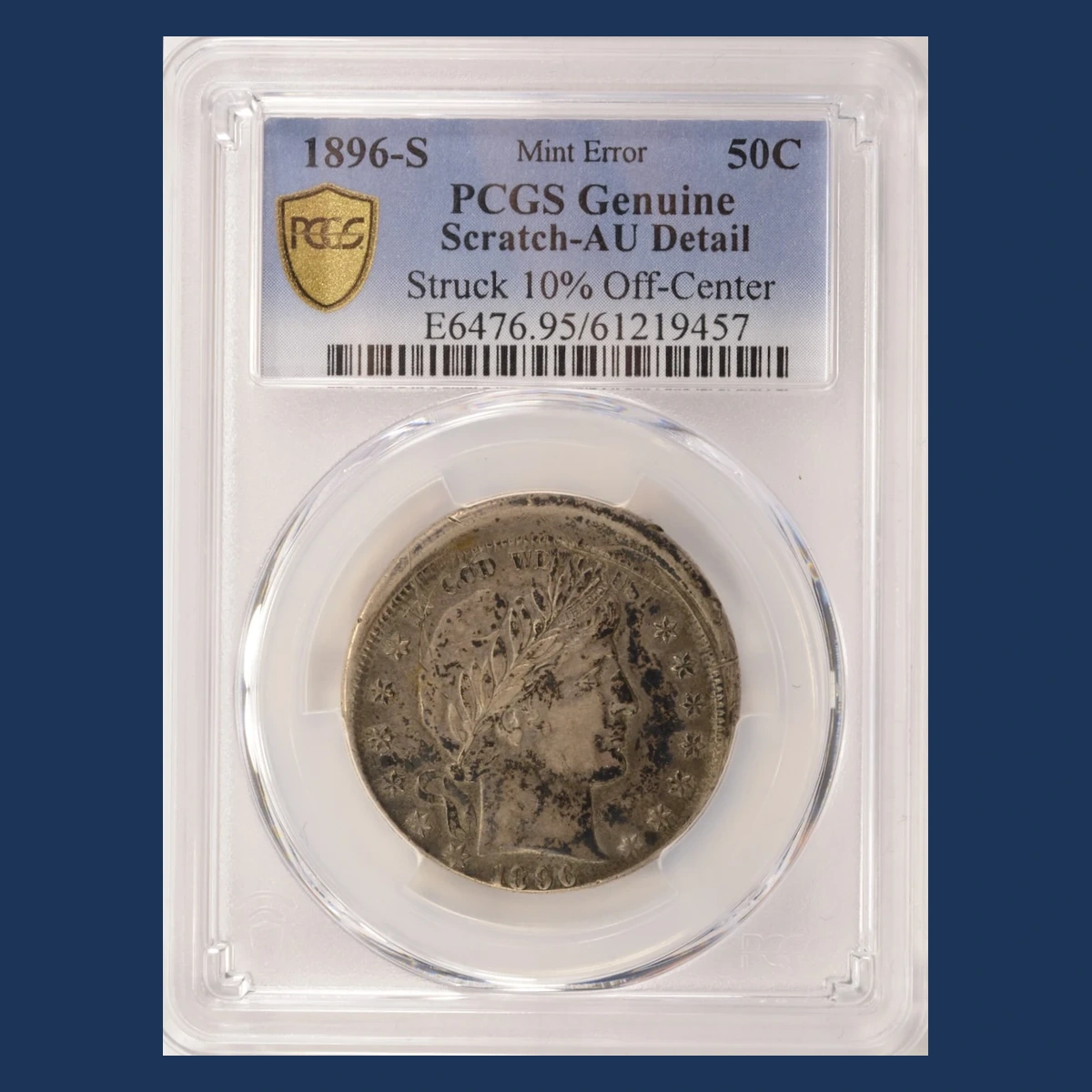
Parts of the toothlike border are missing from both faces of this 1896-S half. Sullivan Numismatics describes the design as about ten percent off center toward seven o’clock.
The blank sat out of position when the dies struck it. A die is the steel tool that stamps a coin’s design.
PCGS labeled the example AU Details because of a scratch. That means light wear, but a surface problem prevents a normal numerical grade.
The scratch did not cause the shifted design. The original blank margin and missing border details show a separate mistake made during striking.
Estimated Value
Sullivan’s eBay listing asks $4,820.40 for the scratched off-center coin. That is an offered price, not a confirmed sale.
A comparable 1896-S around AU Details has an estimated $3,500–$5,000 range. The older date, mint, and clear shift help explain that level.
For a different design, a 1976 Kennedy half fifteen percent off center sold for $480 in December 2025. Its NGC MS64 grade and modern collector market make it a comparison of the error, not an equal-value coin.
How to Identify
The Sullivan example loses border teeth on both faces. Compare those missing sections before judging the coin from an uneven rim alone.
A magnifier can help separate untouched blank metal from an edge cut or filed later. If only one face is shifted, one die may have been out of alignment instead.
Keep the date and S below the eagle visible in photographs. When safely accessible, weigh the coin against the normal 12.50 grams, allowing for wear and damage.
Calipers can record its outline against the usual 30.6-millimeter diameter, and the edge normally has grooves. Missing design on both sides beside an original blank margin is the useful combined clue.
1896-S Barber Half Dollar Rusted and Cracked Die Error (Estimated Up to $55,000)
Small raised bumps are most noticeable on Liberty’s cheek and neck on the Duckor coin. Rust had eaten tiny holes into the die before it struck the silver.
Metal filled those holes during striking. The result was raised texture on the coin, not rust growing on the silver itself.
The Heritage catalog also describes cracks on both sides and marks left by work to remove rust from the front die. These features appear together on the documented example.
It is a regular San Francisco coin. Shiny areas do not turn it into a specially made collector Proof.
Estimated Value
The Duckor MS67 sold for $54,625 at Heritage in August 2010. MS67 describes exceptionally fine unworn condition.
An estimated $45,000–$55,000 fits a comparison at that level. The coin’s preservation, appearance, and history in a noted collection all contributed to its value.
Raised rust texture on a worn half does not place it in this range. The figure belongs to an outstanding coin, not a fixed premium for bumps left by a rusty die.
How to Identify
Determine whether the texture rises or sinks. Light from the side can reveal bumps reproduced from the die, while later corrosion can leave pits in the coin itself.
Examine the cheek and neck with a magnifier. Compare the nearby lines with photographs of the Duckor coin; fine scratches from cleaning are a different kind of mark.
The cracks on both faces provide more clues. Use the same reference coin rather than combining separate marks from unrelated examples.
The S below the eagle, edge grooves, and normal dimensions should also agree. Check 12.50 grams when unworn and about 30.6 millimeters with a scale and calipers when safely accessible; the raised facial texture and matching cracks are what connect the coin to this example.
Conclusion
The height of a mark matters: raised texture can come from a rusty die, while a pit can mean later damage. The off-center example instead needs a full view of both designs and the blank margin.
Keep the two estimated ranges separate: $3,500–$5,000 for the scratched off-center comparison and $45,000–$55,000 for the exceptional MS67. Neither error name replaces a careful look at the whole coin’s condition.