1941 Half Dollar Error List with Pictures

Two 1941 error coins sold together for $24,675 in November 2013. One received a distant second strike, while the other took a tiny impression from its companion’s edge.
This 1941 Walking Liberty half dollar error list covers estimated values from $25 to $40,000. Smaller finds include extra mintmark outlines, missing proof initials, and material trapped inside the metal.
Read on to see what to check and which prices belong to one coin or a matched pair.
1. 1941-S Walking Liberty Half Dollar Reported Micro S (Estimated Up to $150)
A small-looking S can be interesting without proving a rare variety. The name Micro S appears in a 1941 guide, but an established graded variety is not identified here.
Mintmark punches varied in size and style during this period. Compare like-sized photographs before deciding how unusual a letter is.
A small S also differs from a repunched S, which needs part of an earlier letter beside the final shape. Wear or blocked detail may make either harder to read.
The familiar Micro S on the 1945 Mercury dime is another coin. Its name does not establish this half-dollar report.
Estimated Value
Use an estimated whole-coin range of $25–$150 for worn through modest unworn examples with the reported small S. No special rarity premium is assigned merely to that name.
The coin’s actual condition remains the main pricing guide. Recognized repunched mintmarks need different evidence and their own comparisons.
The market for the 1945 Micro S dime does not establish a premium for a 1941 half dollar. A small-looking letter alone cannot transfer that separate variety’s value.
How to Identify
Place the back beside a normal 1941-S photograph at identical magnification. Compare the S below the branch at the lower left.
Use a magnifier to inspect its ends and central curve. Wear, weak detail, or shadow can make a letter appear smaller.
Calibrated photographs can compare letter height, while calipers measure the coin against 30.6 mm. A scale should be compared with 12.50 g, and the edge normally has grooves.
An extra offset outline raises a separate repunching question. For the quickest size check, compare the complete S with a normal punch at the same scale, rather than trusting differently enlarged pictures or a seller’s name.
2. 1941 Walking Liberty Half Dollar Rotated Dies (Estimated Up to $350)
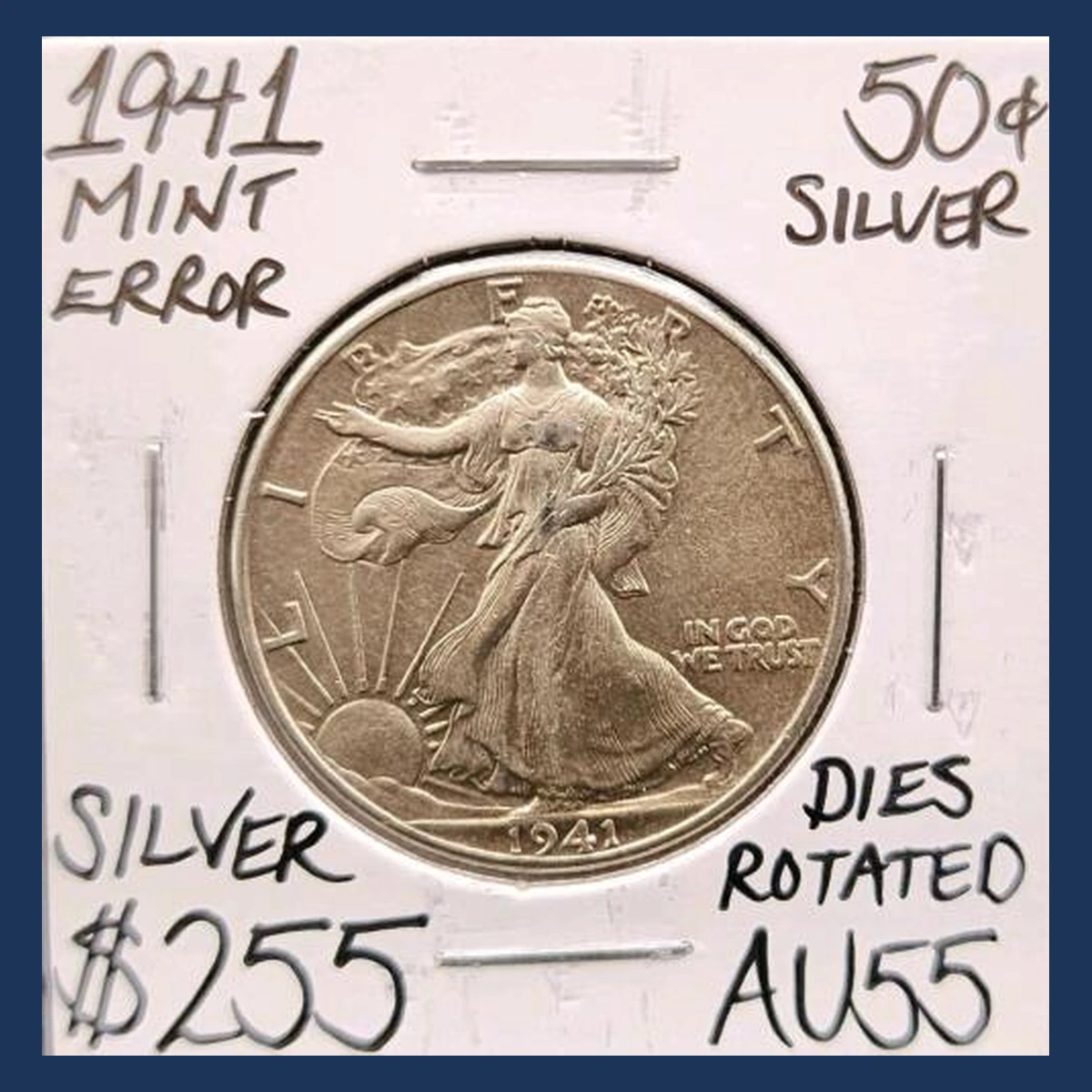
The eagle should normally finish upright after an upright Liberty is flipped from top to bottom. A repeatable tilt can show that one stamping tool turned out of alignment.
The reported 1941 example sold in a cardboard holder. Its seller called it AU55, or lightly worn, but no grading service confirmed that opinion.
The listing gave no measured rotation angle. Each side still has its own picture; their relationship is what changed.
Two photographs rotated separately can imitate the same effect. A controlled flip is therefore more useful than two pictures arranged to look unusual.
Estimated Value
The ungraded example received a $70 winning bid in May 2026 at Musick Auction. That is the bid amount, not a documented total with all fees.
An estimated $40–$350 covers confirmed rotations on collectible worn and ordinary unworn coins. Larger, obvious tilts can attract greater interest.
The seller’s AU55 wording is not an independent grade. With no stated angle, that sale cannot be used as a benchmark for a particular number of degrees.
How to Identify
Hold Liberty upright and flip the coin top to bottom without turning it sideways. Use a vertical line behind it to judge where the eagle lands.
Repeat the movement several times and record it continuously if possible. Separately rotating the back photograph would hide the relationship you need to test.
Inspect the grooved edge with a magnifier for a seam from joined coin halves. Use a scale for about 12.50 g and calipers for 30.6 mm on a loose example.
Those measurements check the ordinary ninety-percent-silver coin. Watch whether the eagle repeatedly lands at the same wrong angle after that fixed flip; this is the fastest useful test.
3. 1941 Walking Liberty Half Dollar Clipped Planchet (Estimated Up to $500)
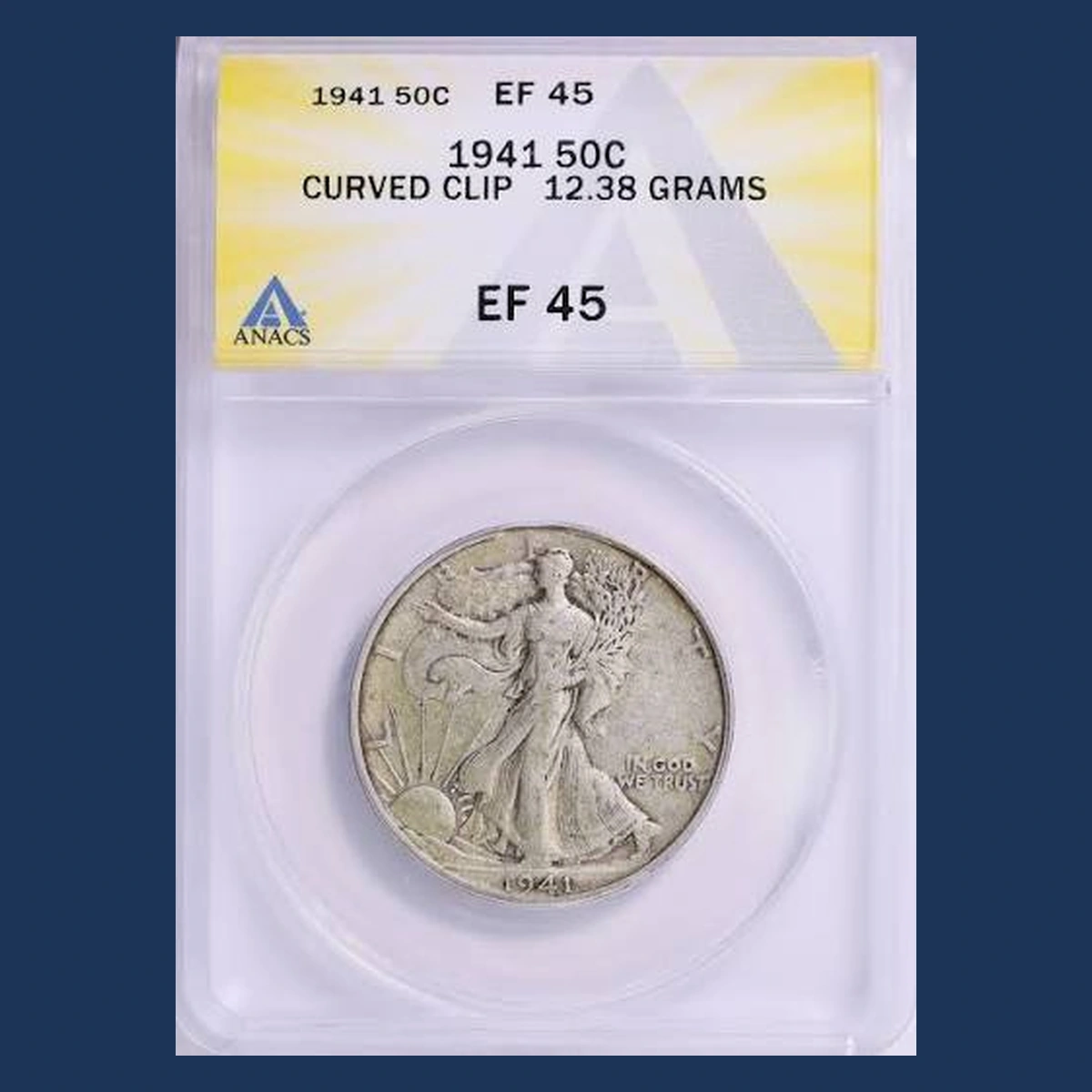
A clip starts with part of the metal missing before the coin is struck. The blank, the disc used to make it, already had an incomplete outline.
A cutting punch can overlap an earlier opening in the metal strip and leave a curved gap. Other blank-making problems can leave different shapes.
Clips are reported for 1941 without a particular mint, graded specimen, or percentage established here. No single exact crescent should be assumed.
The original design beside the gap helps reveal when the metal disappeared. A finished silver half cut smaller afterward can have a similar outline.
Estimated Value
A confirmed clip has an estimated value of $50–$500. Size, readable identity, and condition help separate a small worn example from a dramatic unworn one.
A 1942-S clip graded ANACS MS62 sold for $81.90 including the buyer’s fee in May 2025. MS62 means unworn with noticeable marks.
That nearby-year sale supplies a modest comparison. It does not identify a graded 1941 example or give the missing-metal percentage for the general report.
How to Identify
Study the gap with a magnifier before judging its size. Follow the original rim and design toward both ends of the opening.
Saw marks or grinding can cut through details that were complete when struck. Natural spreading toward an already missing boundary has a different appearance.
Look for weakness on the opposite rim, but do not rely on that clue alone. Check the remaining grooves around the edge too.
Use a scale against 12.50 g and calipers across intact spans against 30.6 mm. For a quick first check, look for original struck detail flowing into the gap rather than a sharp cut through the finished picture.
4. 1941 Walking Liberty Half Dollar Split Planchet (Estimated Up to $750)
A split follows a weakness inside the metal rather than a shifted stamping tool. Part of the blank separates along that weak area.
The 1941 reference reports a split planchet, another name for a split prepared disc. It does not establish which face was affected or whether the separation happened before or after striking.
Those timings can leave different pictures on the exposed surface. A piece still attached can preserve useful evidence of how the split opened.
No exact flap location is established here. The documented foreign-material inclusion is another error and should not be used as this split’s example.
Estimated Value
An estimated $75–$750 covers small visible separations through more substantial confirmed split blanks. It prices the collectible coin or surviving piece, not a fixed amount per gram lost.
Northeast Numismatics has offered a 1947 peeling-layer half graded NGC MS65 for $275. That is an asking price for an attractive unworn example.
A local peel is related but not identical to a larger split. The different-year offer is a comparison, not a completed 1941 sale.
How to Identify
Leave any attached metal in place and use a magnifier along the exposed inner surface. Look for a natural separating layer rather than a cut or chemically roughened patch.
Check whether stamped detail continues onto that surface. A disc split before striking may receive design there; a split afterward can remove part of an already complete picture.
Use a scale and calipers to record weight, diameter, and thickness against 12.50 g and 30.6 mm. Inspect surviving edge grooves for cuts or signs of levering.
Do not pull a flap open to investigate. First look for an original separation surface and note whether it carries struck detail, which helps distinguish the two timings.
5. 1941 Walking Liberty Half Dollar Slag Inclusion (Estimated Up to $800)
An unusual spot near ten o’clock on the front is identified as a slag inclusion on this 1941 coin. PCGS graded the example MS63, meaning unworn with noticeable marks.
An inclusion is material trapped inside the coin metal. It differs from a loose object pressed against the surface during striking or a scratch added later.
Its boundary can interrupt the otherwise continuous silver-copper mixture. The nearby original design helps show how the spot belongs to the coin.
The auction gives no chemical analysis of the material. Its exact composition or depth should not be guessed from its color.
Estimated Value
The PCGS MS63 example sold for $252 in September 2019. An estimated $150–$800 covers confirmed inclusions of comparable visibility and condition.
The price covers the complete coin, with original surfaces helping support the stronger end. A convincing relationship between the trapped material and the strike matters.
A dark stain, corrosion patch, or dirt added later is different. Being in the same location or having a similar color does not give it this example’s value.
How to Identify
Find the ten-o’clock spot on a full front photograph, then inspect it with a magnifier. Keep the surrounding design visible so the boundary can be judged in context.
Move the lamp to compare the spot with the original struck texture. Discoloration alone cannot show whether material is inside the coin or deposited on top.
Do not scrape, dissolve, or pry at it. Use a scale against 12.50 g and calipers against 30.6 mm, and inspect the normal edge grooves.
These check the ninety-percent-silver coin’s basic form. Start by matching the inclusion’s boundary and neighboring original detail to the graded example, rather than matching the spot’s color alone.
6. 1941 Walking Liberty Half Dollar Repunched Mintmarks (Estimated Up to $1,000)
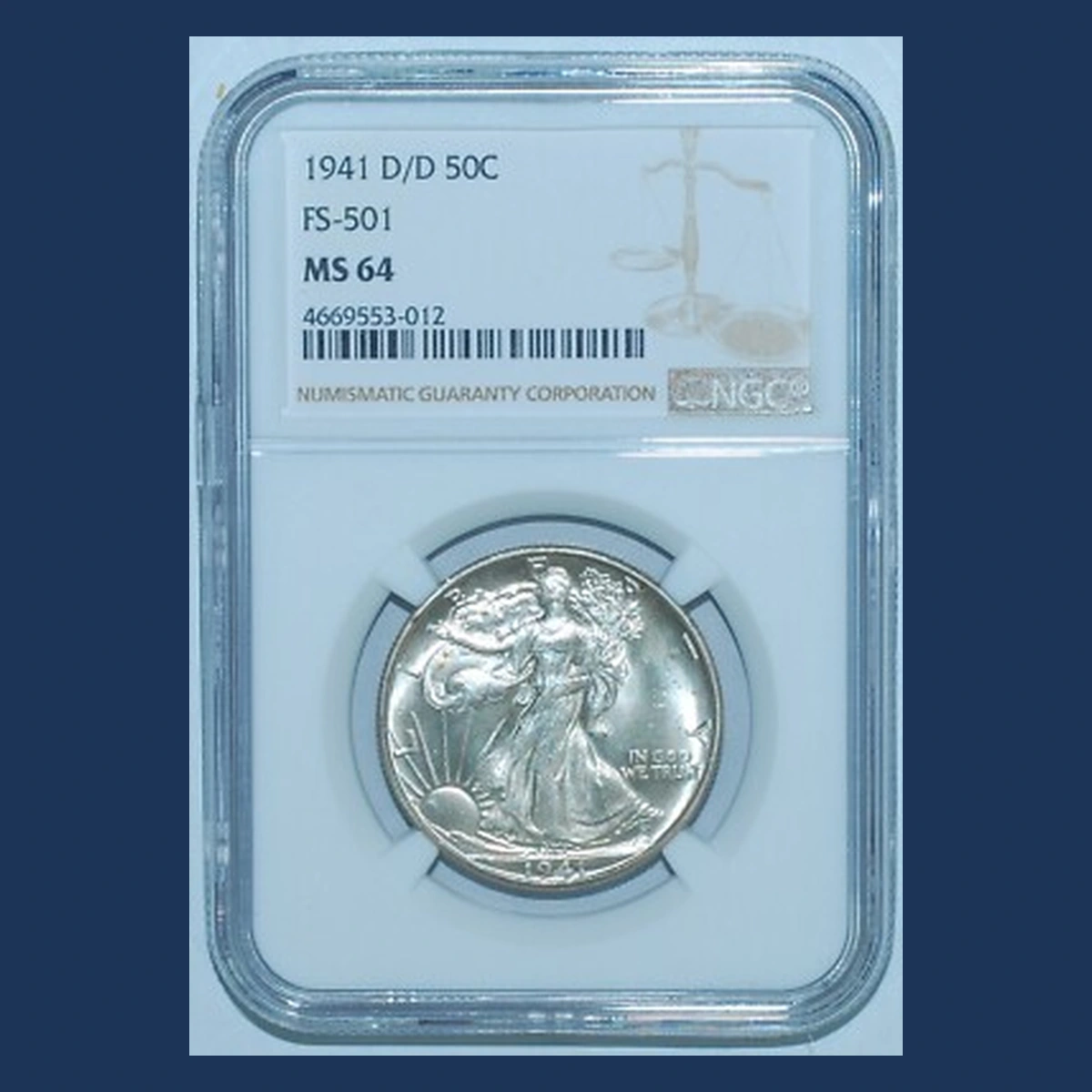
A second D or S outline can preserve an earlier mintmark punch. Workers applied the letter to the stamping tool by hand, and another attempt could leave part of the first impression visible.
NGC identifies several Denver examples. A separate year report describes an S-over-S.
One D comparison has an extra outline toward the upper left, called northwest. That direction belongs to that example and should not be applied to every D or the reported S.
A bump inside a letter or a flat shelf around it can have another cause. Look for a recognizable earlier letter shape.
Estimated Value
Confirmed examples have an estimated range of $50–$1,000, from worn coins through attractive unworn ones. Strong separated outlines generally draw more interest than weak extra edges.
A 1939 half combining repunching with front doubling sold for $1,292.50 in September 2017. PCGS graded it MS64+, an unworn coin with relatively few marks.
That is a different-year coin with two features together. Its sale shows the appeal of a stronger combination, not a direct price for 1941 repunching alone.
How to Identify
Find the mintmark at the lower left of the back and follow its curves with a magnifier. Search for part of another D or S rather than the letter’s shadow.
For the northwest D, compare the upper-left extra contour with its photograph. The reported S needs its own matching image and direction.
Inspect nearby flat areas for cuts or an added mintmark. Check the edge grooves and use a scale against 12.50 g and calipers against 30.6 mm.
Those are ordinary ninety-percent-silver half-dollar measurements. Match an extra contour shaped like the same letter first; a thick or damaged mintmark alone cannot establish repeated punching.
7. 1941 Walking Liberty Half Dollar Doubled Dies and Inherited Doubling (Estimated Up to $1,000)
Many 1941 halves share small doubled details inherited from earlier tools used to make the stamping dies. That common pattern does not automatically make a coin rare.
NGC separates this background from the very minor individual doubled-front varieties known for Denver. Their extra pattern needs its own match.
Philadelphia front doubling and back varieties are also reported. Back descriptions mention E PLURIBUS UNUM and eagle details without naming a numbered tool.
Repeated edges can have several causes. Flat shelves from movement during striking differ from extra raised design already present on the stamping tool.
Estimated Value
For an individually confirmed doubled-die variety, estimate $50–$1,000. The upper end requires desirable preservation and clear collector demand.
Common inherited doubling carries no automatic separate rarity premium. A much stronger 1939-D FS-101 sold for $2,160 in April 2025, graded NGC MS67+, a highly preserved unworn grade.
That different-year result provides context for an exceptional example. It neither establishes a four-figure sale for minor 1941 Denver varieties nor confirms the general back-doubling reports.
How to Identify
Compare several date and motto letters with an ordinary 1941 coin before naming a special variety. Use a magnifier to distinguish the shared small pattern from any additional outlines.
For a back candidate, inspect E PLURIBUS UNUM and the relevant feathers separately. Move the light to rule out reflections and distinguish rounded extra detail from flat shelves.
Keep surrounding design in the photographs rather than cropping to one thick letter. Check the edge grooves and use a scale against 12.50 g and calipers against 30.6 mm.
Begin by matching extra detail to one specific variety beyond what an ordinary comparison coin already shows.
8. 1941 Walking Liberty Half Dollar Proof No AW (Estimated Up to $1,500)
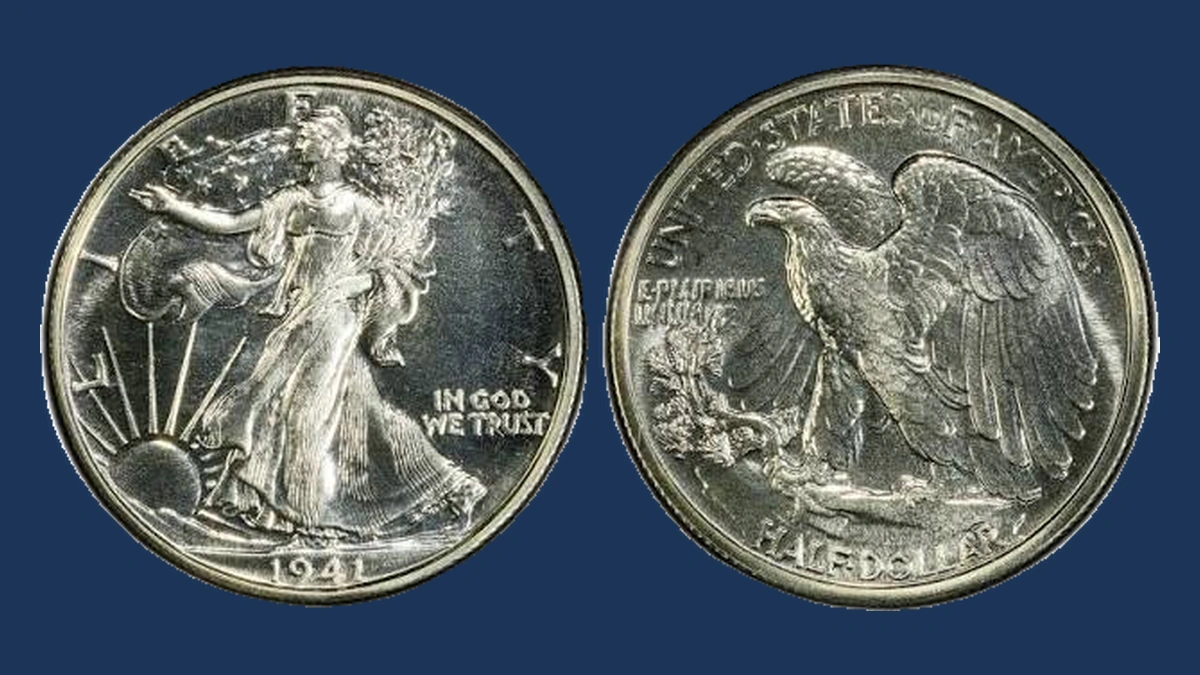
AW normally appears near the rock at the lower right of the back. The letters identify designer Adolph Weinman.
The recognized 1941 proof No AW variety lacks that small monogram. A proof is a specially made collector coin with sharp details and usually reflective flat areas.
Polishing the steel stamping tool can remove shallow initials before the coin is made. The resulting coin can retain an original surface where the letters should be.
This differs from wear erasing letters on an ordinary used half. Proof finish and untouched nearby metal are part of identifying the variety.
Estimated Value
Recent sales include $690 for an NGC PR67 in March 2025 and $780 for a PR67+ in July 2025. Those grades describe highly preserved proofs.
An estimated $400–$1,500 covers collectible examples with varying condition and appearance. The recognized No AW proof listing is the relevant variety comparison.
Scratches, cleaning, and other surface problems still affect value. Missing initials do not remove those differences or give every proof the same price.
How to Identify
Compare the coin’s sharp detail and reflective areas with a genuine Philadelphia proof first. A shiny ordinary half is not automatically a proof.
Use a magnifier at the lower-right AW position and include the nearby rock and flat area. Change the light to see whether faint letters are merely hidden by glare.
Look for rubbing or residue without cleaning the spot. A scale and calipers can check a loose coin against 12.50 g and 30.6 mm; inspect the edge grooves too.
The metal measurements alone do not identify this variety. Check first for completely absent AW surrounded by untouched proof detail, rather than a locally smoothed patch.
9. 1941 Walking Liberty Half Dollar Struck on a Quarter Planchet (Estimated Up to $25,000)
Part of the half-dollar picture extends beyond the metal on this 1941 example. The stamping tools struck a smaller silver disc intended for a quarter.
NGC graded the coin MS64, meaning unworn with some marks. Its auction description leaves the mint unresolved.
A missing mintmark cannot prove Philadelphia if that area never reached the smaller disc. The readable year and remaining design are the useful identity clues.
This coin is separate from the lightly worn quarter-blank piece in the matched pair below. It should not acquire that other coin’s measured weight or tiny transferred edge pattern.
Estimated Value
Estimate $10,000–$25,000 using nearby-year Walking Liberty comparisons. A 1942 quarter-blank example sold for $16,200 in 2018, and another graded NGC MS64 brought $18,000 in January 2022.
Those are different coins, not recorded sales of this 1941 MS64. A readable date and original surfaces support stronger interest.
Keep its mint unresolved as described. An absent letter outside the surviving design cannot justify assigning a mint or adding a mint-specific premium.
How to Identify
Use a scale to compare with a silver quarter disc’s normal 6.25 g, rather than the half dollar’s 12.50 g. Those are standards, not published measurements of this MS64 coin.
Calipers can compare its outline with the quarter’s roughly 24.3 mm and the half’s 30.6 mm. Allow for spreading under the larger stamping tools.
Both metals are ninety-percent silver, so color alone is no help. Inspect truncated letters and any edge grooves with a magnifier for natural strike formation rather than filing.
Start with near-quarter weight and original half-dollar detail ending at the smaller boundary, while leaving the mint unknown if its area is absent.
10. 1941 Walking Liberty Half Dollar Double Strike and Quarter-Planchet Mated Pair (Estimated Up to $40,000)
Two coins preserve parts of the same press accident. A finished half had not fully left when a quarter blank entered beneath the tools.
The next blow struck the half again, ninety percent off center. The smaller disc received a half-dollar picture and a tiny impression from the first coin’s grooved edge.
That small transferred edge pattern is called an edge brockage. The quarter-blank piece weighs a recorded 6.3 grams.
NGC graded both coins AU58, meaning slight wear. Their different shapes fit together because they record separate parts of one contact, rather than two unrelated mint mistakes.
Estimated Value
The two-coin Heritage lot sold for $24,675 in November 2013. An estimated $20,000–$40,000 applies to the intact matched pair.
That is one total for both coins, not an individual price or two separate sales. Their matching contact marks explain the added collector interest.
Separating the pieces loses part of that evidence. Unrelated double strikes or quarter-blank coins need their own comparisons instead of automatic shares of this pair’s price.
How to Identify
Place photographs of the contacting areas together. With a magnifier, compare the tiny impression near two-thirty on the quarter-blank coin with its companion’s edge grooves.
Then trace the half’s first picture and distant second impression. The smaller partner needs its own half-dollar design and transferred edge pattern, not a full reversed portrait.
Weigh each separately on a scale: 6.3 g belongs to the smaller piece, while 12.50 g is the normal full half’s standard. Use calipers to record both altered outlines against 30.6 mm.
Keep both coins and their edges in the photographs. First match the little edge impression to the companion’s grooves; that physical fit links the pair.
Conclusion
The 1941 estimates range from $25 to $40,000, with the highest figures applying to a matched two-coin pair. Its price should stay attached to both pieces together.
For smaller finds, distinguish ordinary small mintmarks and inherited doubling from individually confirmed varieties. Preserve original surfaces around missing initials, gaps, and embedded material.
Compare the date, finish, edge, and actual feature before using another coin’s price; a dramatic label alone cannot supply the missing evidence.