1957 Half Dollar Error List with Pictures

A 1957 half struck on a smaller quarter blank sold for $1,145.63 in January 2013. Franklin, the bell, and the full date still fit on that unusual coin.
The 1957 half dollar error list below covers estimated values of $40–$7,500. Some clues need a magnifier; others change the coin’s weight or outline.
Read on to find the right comparison for each feature. Ordinary coins and Proofs, specially made collector coins, need separate price comparisons.
1. 1957 Franklin Half Dollar Repunched D Mintmark (Estimated Up to $150)
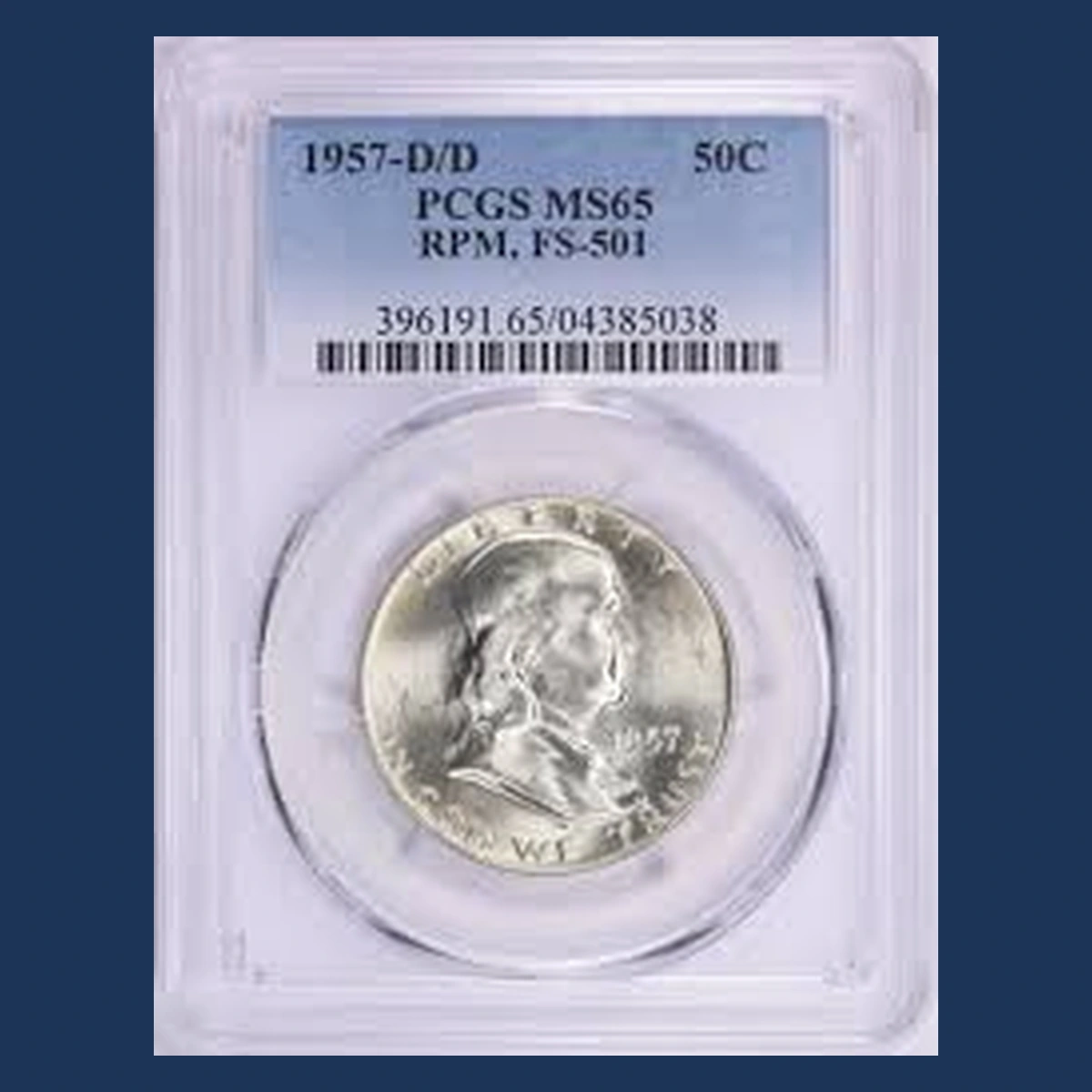
An extra outline beside the D above the bell can reveal a repunched mintmark. The D tells you the coin was made in Denver.
Workers punched that letter into a die, the steel tool that stamps the design. A shifted second punch could leave part of the earlier D beside the final one.
The year description reports a rotated extra impression. A dealer lists an example graded ICG MS62 with Full Bell Lines.
Full Bell Lines means the fine lines near the bottom of the bell are well defined. That feature is separate from the extra curve beside the D.
Estimated Value
M. Barr Coins offers the ICG MS62 Full Bell Lines example for $79.95 or best offer. That is an asking price, not a confirmed sale.
Estimate $40–$150 for clearly identified examples from circulated condition to ordinary coins without circulation wear. A sharper extra D and better surfaces can support more interest.
Full Bell Lines and unusual color may also affect the whole coin’s price. Their value should not all be credited to the mintmark.
How to Identify
Find the D directly above the Liberty Bell. With a 10× magnifier, follow its straight and curved edges before searching for an extra outline.
The reported extra impression is rotated, so compare it with a clear D/D photograph. A rough letter or flat ledge from damage is not enough.
Move the lamp to check that the extra curve stays visible as raised metal. Reflections can make a single edge appear doubled.
Normal silver halves weigh 12.50 grams and measure about 30.6 millimeters across. Check with a scale and calipers, and inspect the ridged edge.
The useful first match is part of a second D in the same position as the known example.
2. 1957 Franklin Half Dollar Reported Bugs Bunny Die Clash (Estimated Up to $200)
A raised projection at Franklin’s upper lip gives the Bugs Bunny clash its name. It can look like an extra tooth in a close-up.
The mark begins when the front and back stamping tools hit each other with no blank between them. Part of the opposite design can leave a mark on a tool.
Later coins can carry that mark at the mouth. A 1957 year guide reports the feature on Denver halves.
That report does not authenticate every tooth-like mark on a 1957-D. A nick, scratch, or stuck-on dirt can look similar, so the actual shape still needs checking.
Estimated Value
Estimate $40–$200 for a clearly matched 1957-D mouth clash in circulated to ordinary uncirculated condition. The year guide reports the feature within a modest price range.
For comparison, 1956 Bugs Bunny halves graded NGC MS64 appeared in 2026 sold listings at $48.52 and $68. Those are different-year coins.
A 1957-D still needs its own matching mouth feature. Exceptional grades or Full Bell Lines can add value beyond the range for an ordinary example.
How to Identify
Confirm 1957 on the front and D above the bell on the back. Then enlarge the upper lip while keeping enough of Franklin’s face in view to locate it.
Under a 10× magnifier, check whether the tooth-like projection is raised struck metal. Move the light to see how it joins the face.
A nick can push metal up beside a cut, and dirt can create a false tooth. Compare the shape with a suitably identified mouth-clash example.
Inspect the edge ridges and use a scale and calipers against 12.50 grams and 30.6 millimeters. The starting test is the correct raised mouth shape on a 1957-D, not the Bugs Bunny nickname.
3. 1957 Franklin Half Dollar Obverse Lamination Error (Estimated Up to $300)
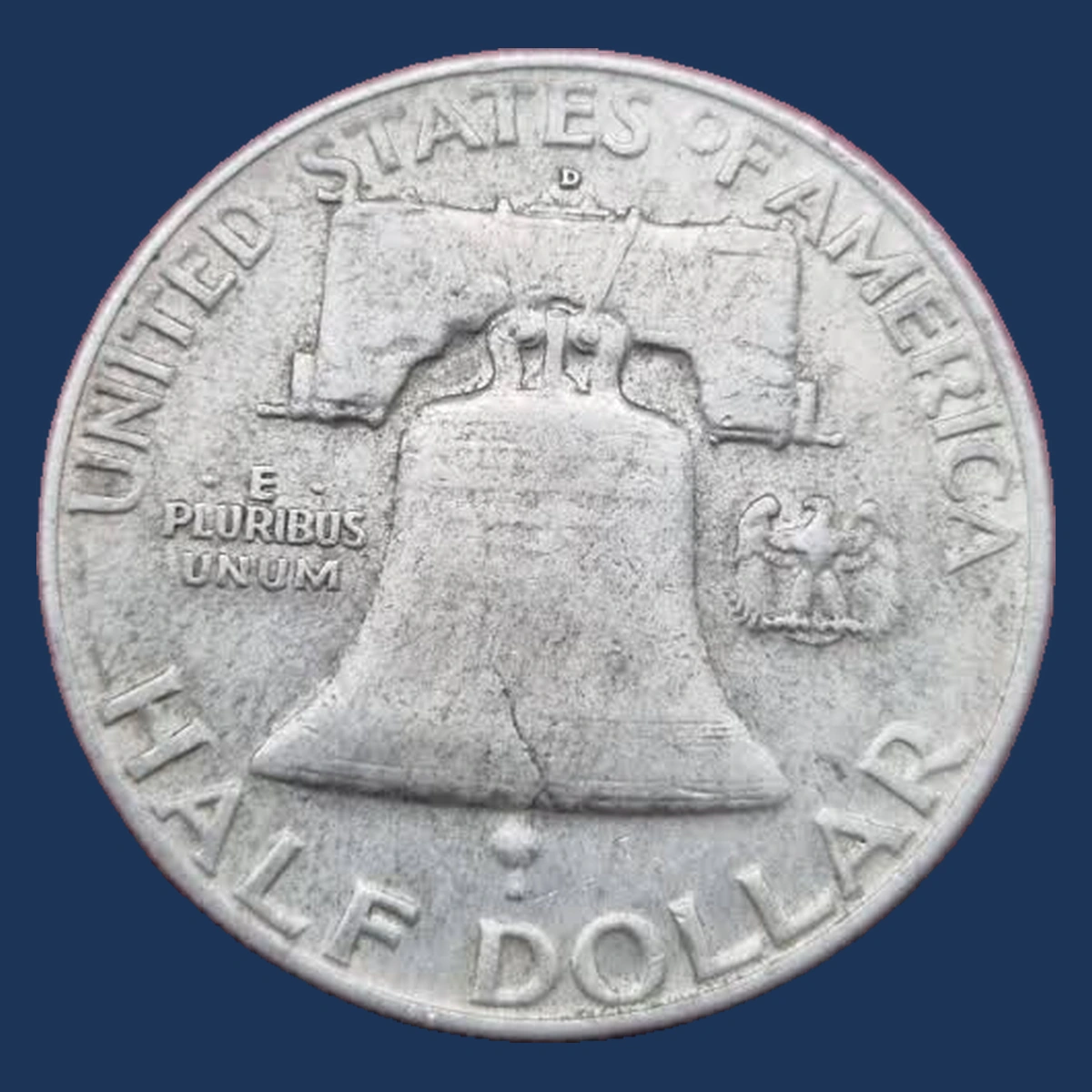
A thin layer can separate within the silver alloy of a 1957 half. This is lamination, which may leave a flap or expose metal underneath.
Two reports concern different coins. Pristine Auction recorded a Philadelphia example graded NGC MS63 with a flaw on the front.
A year guide describes a separate Denver flaw near the date. The Philadelphia listing does not place its flaw there.
Keep those locations attached to the correct coins. At either spot, look for a layer separating within the original silver alloy, rather than a shallow scrape across a finished design.
Estimated Value
The Philadelphia NGC MS63 sold for $74.49 including the buyer’s fee in January 2021. The Denver date-area example had a reported $79.99 asking price.
Estimate $50–$300 for modest laminations across circulated and attractive uncirculated examples. The two prices above are different kinds of evidence.
Look at the layer’s border and overall surface quality. A larger missing patch can harm an otherwise desirable coin’s appearance instead of automatically making it more valuable.
How to Identify
Leave any attached flap alone. Pulling it could damage the coin and destroy useful evidence.
For the Denver report, look near the date with a 10× magnifier. For the Philadelphia example, use its full front photograph to find the actual flaw.
Inspect where the intact surface meets the separated layer. A natural layer may continue beneath surviving design, while scraping cuts across details and corrosion can leave scattered pits.
Use a scale and calipers to compare the coin with 12.50 grams and 30.6 millimeters, and inspect the ridged edge. An attached flap may leave nearly all the original weight.
A thin separating layer with a natural border is the clearest first clue.
4. 1957 Franklin Half Dollar Clipped Planchet Error (Estimated Up to $400)
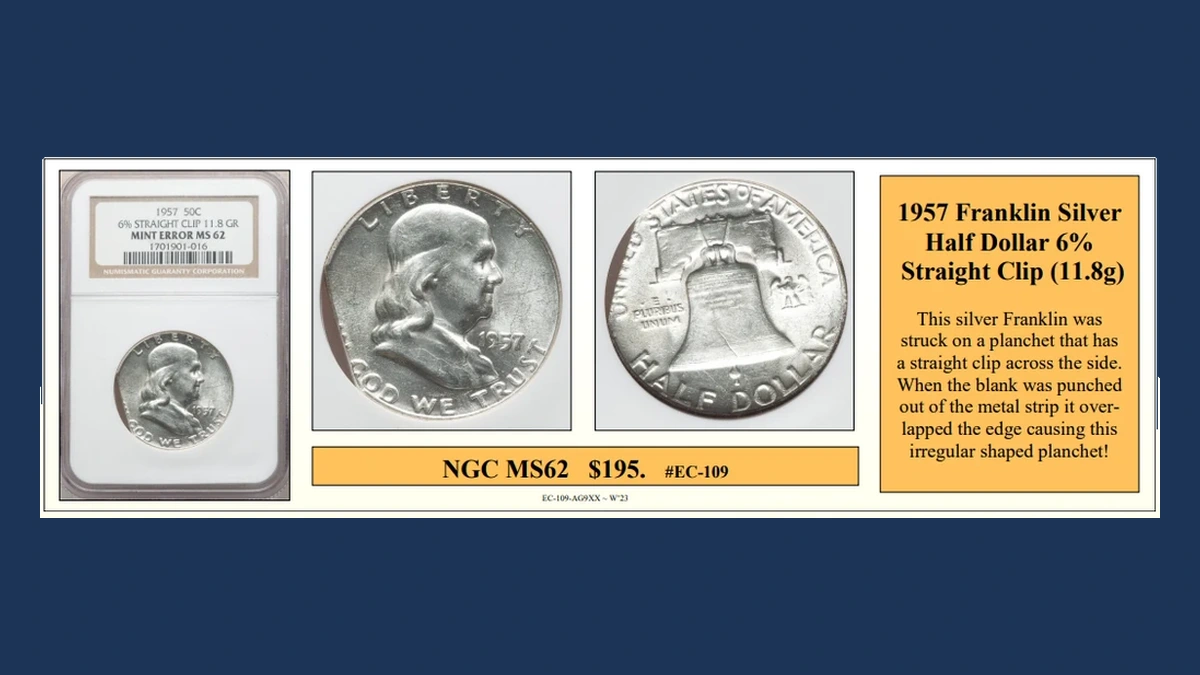
A gap near eight o’clock removes roughly ten percent of the blank on a cataloged Philadelphia 1957 half. The coin’s design was struck after that piece was already missing.
A year guide mentions a clipped example graded AU58, meaning very little wear. It does not establish that this is the same coin.
The original gap should show signs of how the rim and nearby design formed around it. A later saw cut interrupts already finished details.
The catalog gives a useful position and size for its own example. Those details do not apply to every 1957 half with a clip.
Estimated Value
Genuine clips have an estimated range of $75–$400. Small gaps on worn coins belong near the lower end, while clear gaps and better surfaces can bring more interest.
A four-percent 1962-D clip graded PCGS MS61 sold for $84 in March 2011. That is a historical, different-year comparison.
The ten-percent 1957 catalog description is not a sale price. Its larger size cannot be priced by simply multiplying what the smaller clip brought.
How to Identify
Keep the whole outline visible and find the gap near eight o’clock on the cataloged example. A different clipped coin may have its gap elsewhere.
Inspect the rim and edge ridges with a 10× magnifier where they meet the missing section. Saw marks, filing, and sharp burrs suggest a later cut.
The opposite rim may be weak because the blank was incomplete during striking. That clue varies, so it need not look identical on every clip.
A scale should show less than the normal 12.50 grams, while calipers can check the surviving width against 30.6 millimeters. The most useful test is an original struck border around the gap, rather than just a curved outline.
5. 1957 Franklin Half Dollar Strike-Through Errors (Estimated Up to $750)
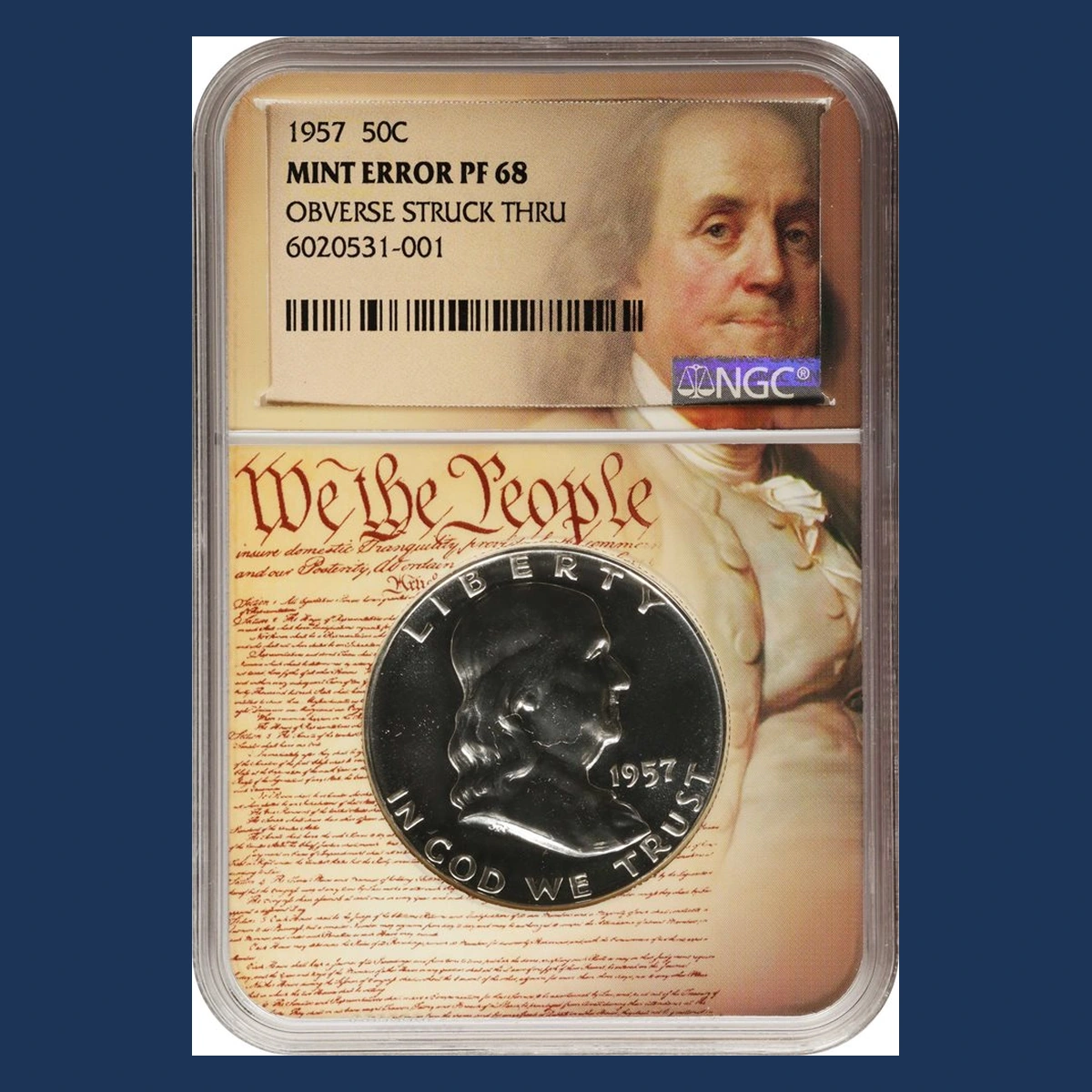
A hollow or weak patch can form when something blocks the stamping tool from touching the blank. Collectors call this a strike-through.
Three Philadelphia records describe separate 1957 coins. One is an ordinary strike with a back-side error, graded NGC MS64.
The other two are Proof collector coins: PF67 with a front-side error and PF68 with a back-side error. They are not three patches on the same coin.
The listing titles do not identify what got in the way. A wire or grease should not be named just because it could produce some kind of strike-through mark.
Estimated Value
Estimate $75–$250 for a visible strike-through on an ordinary coin without circulation wear. An attractive Proof example has an estimated range of $150–$750.
The year guide places a PF68 back-side example around $300–$550. That falls within the Proof estimate.
These are estimates, not recorded sale prices for the three listed coins. Surface quality and the size of the affected area matter, so two coins with the same grade can still bring different amounts.
How to Identify
Identify the correct face and finish first. The PF67 listing concerns the front of a Proof, not the back of the separate ordinary coin.
Use a 10× magnifier to inspect how the affected area meets the nearby design. A later scratch often cuts across details and pushes metal along its sides.
A strike-through can leave an interruption formed as the coin received its design. The shape may help explain the obstruction, but the material should not be guessed.
Check the normal 12.50 grams and 30.6 millimeters with a scale and calipers, plus the ridged edge. Begin with a naturally struck depression or weak patch on the face named in the record.
6. 1957 Franklin Half Dollar Reported Off-Center Strike (Estimated Up to $1,500)
A crescent of bare metal beside a shifted design can show an off-center strike. The half-dollar blank was partly outside the stamping tools when they came together.
Some lettering can then fall beyond the metal. The designs on both sides move against the coin’s outline.
The 1957 reports do not identify a graded example with a known mint, angle, or percentage. General discussions of small and large offsets do not fill those gaps.
A half struck on a smaller quarter blank can also lose outer letters. That is a different problem, involving the wrong blank rather than its position.
Estimated Value
Modest offsets with readable dates have an estimated range of $150–$500. Stronger, attractive examples can be estimated around $500–$1,500.
These are comparison-based estimates, with no specific 1957 auction result assigned here. A small shift on a worn coin differs from a large bare crescent on a well-preserved example.
The wrong-blank sale below is not an off-center price. Missing outer letters can appear on both types, but the causes and relevant comparisons differ.
How to Identify
Examine both sides before concentrating on one uneven rim. A genuine off-center blank should leave matching shifted designs and bare metal on both faces.
If one side is centered, a misaligned stamping tool may explain the other side. Photograph the remaining date and any mintmark.
A normal half-dollar blank begins at 12.50 grams. A scale helps separate that full blank from a much smaller blank intended for another coin, while calipers record its shape against 30.6 millimeters.
Use a 10× magnifier along the struck border to check for grinding or later removal of design. Inspect where the edge ridges formed too.
Matching incomplete designs next to untouched bare metal on both sides provide the strongest first check.
7. 1957 Franklin Half Dollar Proof Tripled Die Reverse (Estimated Up to $2,500)
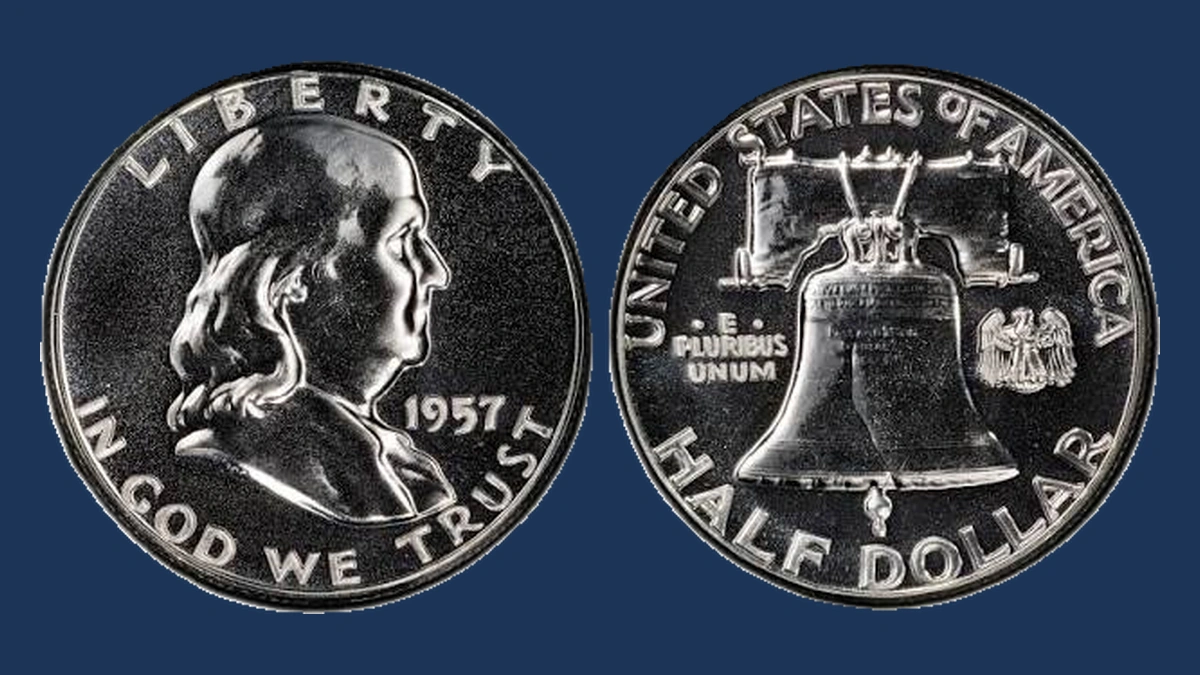
Closely spaced extra outlines appear in the lettering around the bell on the recognized 1957 tripled reverse. They came from the preparation of the stamping tool.
They do not mean the finished coin was struck three times. Later coins made with that tool could repeat the same extra lettering.
PCGS recognizes this 1957 variety, which belongs to Philadelphia Proofs. The national name and denomination are useful places to examine.
A Denver coin with thick letters does not become this variety. Shiny surfaces and strong contrast on a Proof also do not prove that the lettering has extra outlines.
Estimated Value
For standard Proofs, estimate $250–$1,100. The year guide quotes about $300 for PF65 and $995 for PF68.
Cameo and Deep Cameo mean stronger contrast between frosted designs and shiny backgrounds. Especially attractive examples can be estimated at $1,000–$2,500, with a reported PF68 Deep Cameo offer at $1,995.
These are grade-based comparisons rather than completed-sale records. The contrast and original surfaces can account for much of the price, apart from the extra lettering.
How to Identify
Use a 10× magnifier on UNITED STATES OF AMERICA and HALF DOLLAR around the bell. Compare the added outlines across neighboring letters with a known tripled-reverse photograph.
Move the light. A reflected edge in the shiny background can disappear, while a real extra outline remains part of the metal.
A flat ledge or general softness is not a third design outline. Confirm that the coin is a Philadelphia Proof with no mintmark.
The normal standards are 12.50 grams and 30.6 millimeters, which a scale and calipers can check when accessible. Inspect the ridged edge as well.
Look for the same repeated outlines across the affected lettering, not three unrelated lines found in separate places.
8. 1957 Franklin Half Dollar Wrong Planchet Errors (Estimated Up to $7,500)
Two wrong blanks produced very different 1957 half dollar errors. One was a five-gram nickel blank, and the other was a silver quarter blank.
Heritage records the nickel example as NGC MS65 Full Bell Lines. It also has a fine horizontal strike-through approaching Franklin’s eye.
The separate quarter example, graded PCGS MS63, keeps Franklin, the bell, date, eagle, and the space above the bell. That surviving space supports its Philadelphia identity.
Much outer lettering is missing. The nickel example began as an unstruck blank, not a finished Jefferson nickel, and its eye-area mark belongs to that same coin.
Estimated Value
The PCGS MS63 silver-quarter example sold for $1,145.63 at Heritage in January 2013. Estimate $1,200–$4,000 for comparable quarter-blank strikes and $3,000–$7,500 for attractive nickel-blank examples.
A 1962-D nickel-blank half graded NGC MS67 sold for $4,312.50 in January 2009. That historical result is not a 1957 sale.
The extra eye-area strike-through on the 1957 nickel example remains part of its whole-coin value. It should not receive a second wrong-blank price.
How to Identify
Weigh the coin before deciding which blank it used. The nickel example is five grams, and a normal silver quarter blank starts at 6.25 grams.
Both are far below a normal half’s 12.50 grams. Calipers should record the actual size against the standard 30.6 millimeters, allowing the smaller blank to spread during striking.
With a 10× magnifier, examine the edge for filing and compare the missing outer design with the original outline. Metal-composition testing can distinguish copper-nickel from silver alloy.
On the nickel example, record the fine line approaching the eye separately from its size. Weight, metal, and a naturally incomplete design must agree before missing letters establish a wrong blank.
Conclusion
The estimated values run from $40 to $7,500, covering small extra mintmark lines through valuable wrong-blank strikes. Start with the visible feature and keep the coin’s mint and finish in view.
A second D curve, a peeling layer, and a low weight need different checks. Proof contrast and strong bell lines can also affect price.
Compare the whole coin rather than assigning every unusual mark the same added value.