1960 Half Dollar Error List with Pictures

A Franklin half stamped on a nickel blank sold for $4,312.50 in January 2009. That was a 1962-D, a different-year price comparison for the documented 1960-D error below.
Another of the 1960 half dollar errors is a thin piece split from its blank before stamping. A certified example brought $630 including fees in June 2023.
Estimated ranges span $40–$7,500. Read on to compare thin metal, doubled designs, and objects caught during stamping.
1. 1960 Franklin Half Dollar Localized Lamination Error (Estimated Up to $200)
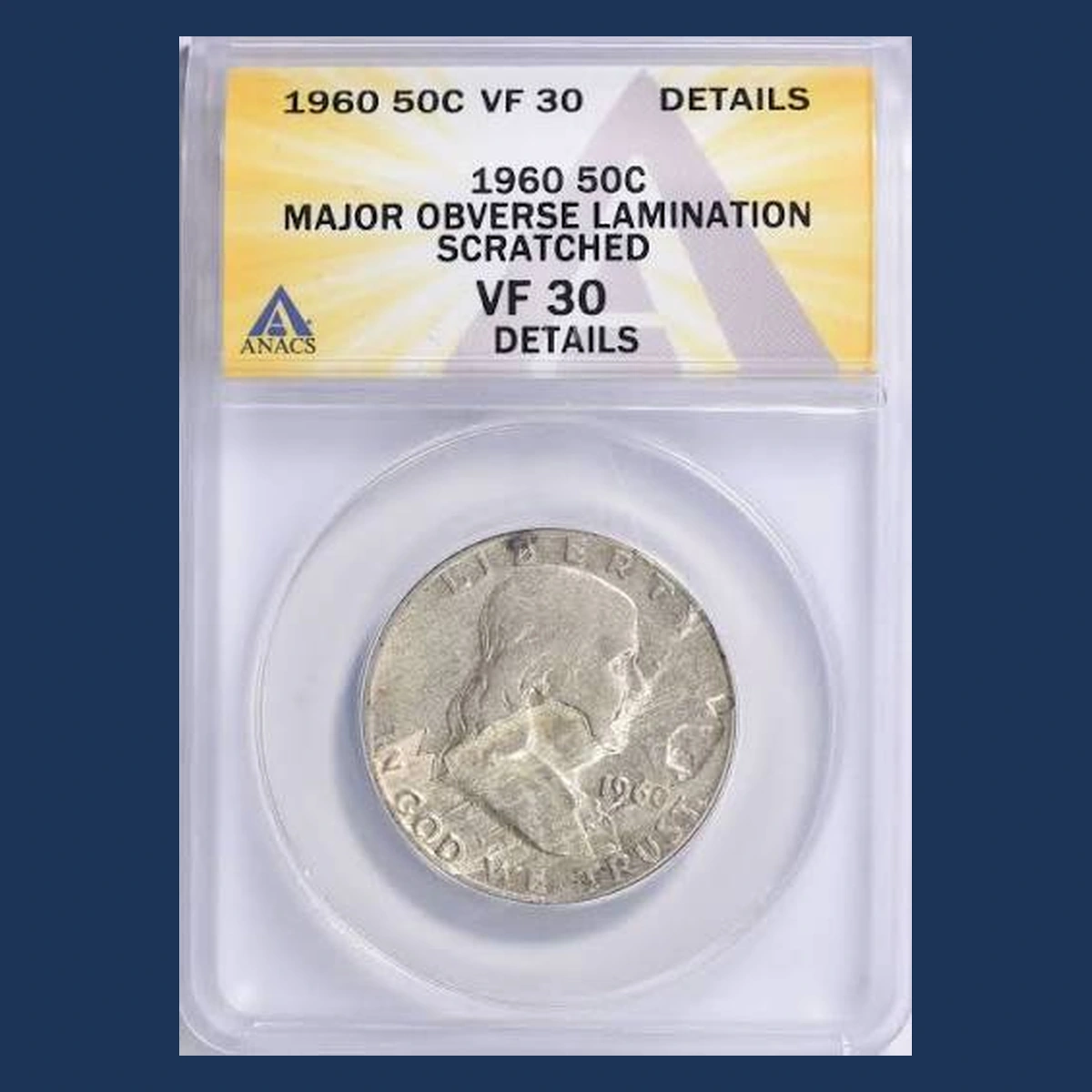
A small peeling layer leaves most of the coin intact. The metal mixture may not hold together at one spot, allowing a thin sheet to lift or fall away.
This is lamination. It differs from losing a broad layer across almost the whole blank, discussed later.
The year reference describes a Philadelphia front-side example graded ANACS VF30 Details and a Denver back-side example graded CACG MS64. They are separate coins with different wear and surface condition.
Details means a problem prevented an ordinary numerical grade. Neither report gives a precise clock position, so another coin’s location should not be assumed.
Estimated Value
Estimate $40–$75 for a modest worn Philadelphia example and $100–$200 for visible peeling on an ordinary unworn Denver coin. These estimates follow the different conditions in the year account.
Keep the ANACS Details note with its particular coin. It is not the same as a problem-free VF30.
Clean surfaces and a clearly visible original layer can help value. A larger missing patch does not necessarily make the half dollar more appealing.
How to Identify
Choose the correct side first: front for the Philadelphia report and back for the Denver one. Use a 10× magnifier and shallow light along the peeling boundary.
Look for a thin layer opening within the metal. Leave any attached flake untouched so the separation remains visible.
A digital scale and calipers can compare accessible coins with 12.50 grams and about 30.6 millimeters. Include the grooved edge in photographs, checking for cuts, corrosion, or deliberate thinning.
The useful clue is a natural layer separating from otherwise stamped metal. Low weight alone cannot show whether silver peeled before or after minting, or was removed deliberately.
2. 1960 Franklin Half Dollar Proof Doubled Die Reverse (Estimated Up to $250)
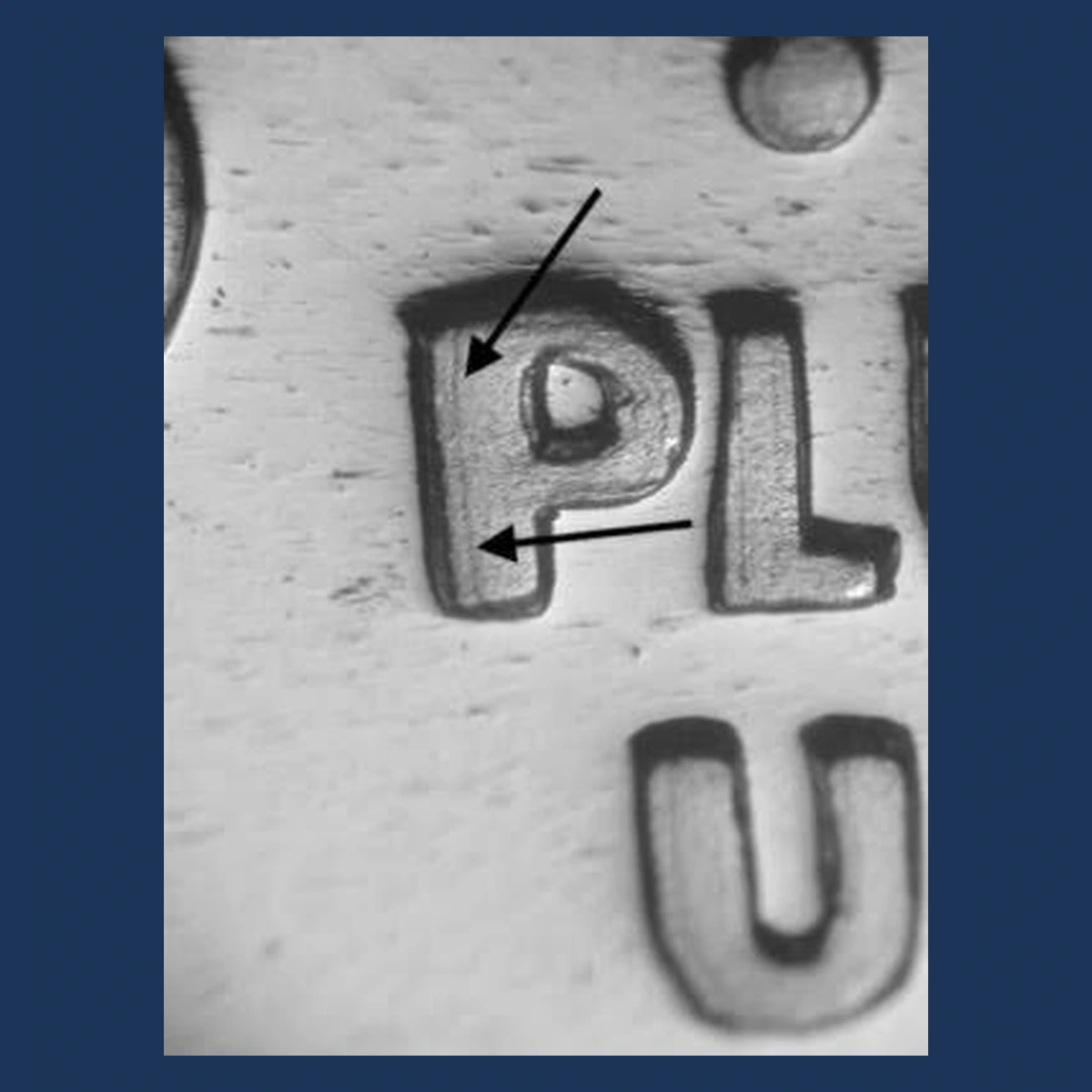
A collector Proof can have doubled back details even without the better-known doubled front. A Proof is specially made for collectors, usually with reflective backgrounds and carefully finished designs.
Specialists list several 1960 back patterns in the words and sometimes around the eagle or bell. Each pattern comes from a particular die, the steel tool that stamps coins.
Extra detail already in that tool repeats on coins made from it. The term doubled die reverse means a doubled back design.
Some appear with doubled fronts too. That pairing may help identification, but one side does not automatically establish the other.
Estimated Value
Minor identifiable back varieties have an estimated $40–$250 range on ordinary through attractive higher-grade Proofs. The year guide gives common fine-quality retail comparisons around $40–$60.
Clearer extra detail and better surfaces support more. Every added outline does not receive a fixed multiplier.
Spots, scratches, and contrast between frosted designs and mirrored backgrounds affect the underlying Proof. Prices for strongly doubled fronts should not be substituted for a modest doubled back.
How to Identify
Inspect E PLURIBUS UNUM and the outer national lettering through a 10× magnifier. Then check HALF DOLLAR and lower eagle details where the particular variety calls for them.
The CONECA photographs show one example, not a pattern to combine with unrelated dies. Keep lighting steady because reflective backgrounds can create false edges.
Confirm a Philadelphia Proof and inspect its edge grooves. Accessible coins can be checked with a digital scale and calipers against 12.50 grams and about 30.6 millimeters.
Match the full set of extra shapes to one back die. One thick letter or a flat shelf beside it cannot establish that match.
3. 1960 Franklin Half Dollar Ragged Clip Error (Estimated Up to $400)
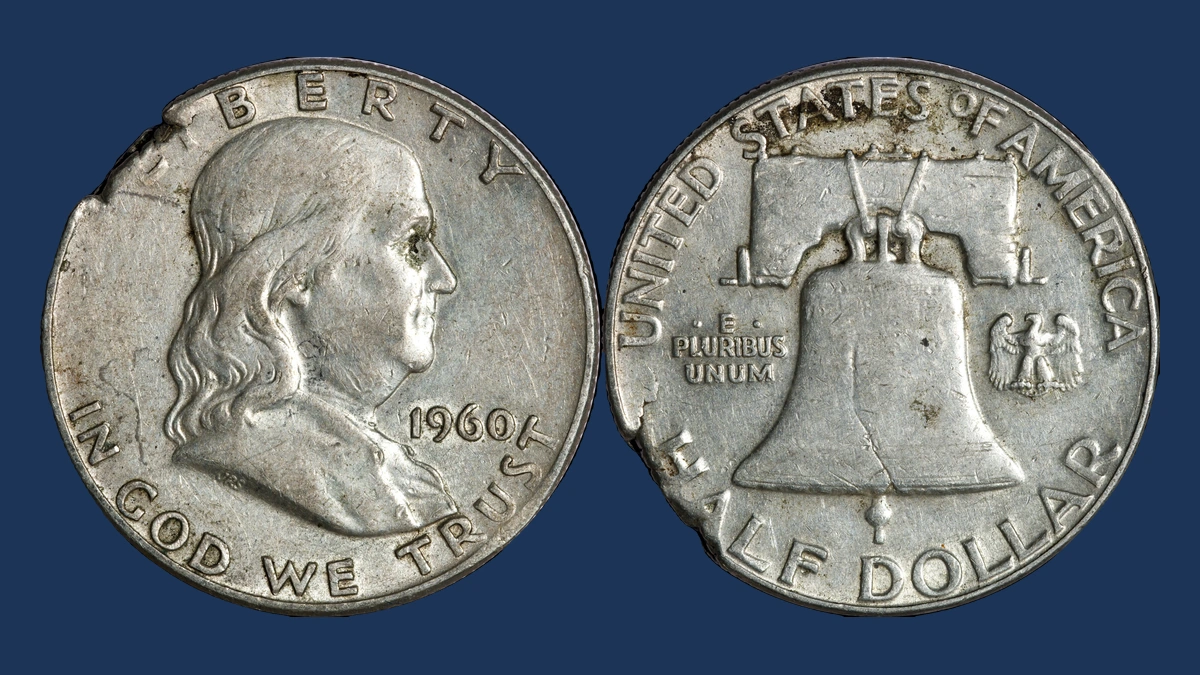
A missing piece need not leave a smooth curved gap. The Calkins collection identifies a 1960 Franklin half with a ragged clip and an uneven original boundary.
The blank, or metal disc before stamping, can include the rough end of the strip from which it was cut. The design then forms around that incomplete shape.
The collection description gives no mint, percentage, or clock position. Those details need to come from the example.
A jagged edge alone cannot establish the error. Pliers, files, or a break after minting can also leave a rough outline, but usually affect the metal differently.
Estimated Value
A genuine ragged clip has an estimated $75–$400 range from worn to ordinary unworn condition. No sale price is quoted for the Calkins coin.
A 1962-D with a 4% curved clip sold for $84 in March 2011. It was graded PCGS MS61.
That smoother, different-year clip gives a modest-error comparison. Strong original edge evidence and attractive condition can support more, while the missing piece’s roughness alone does not set the price.
How to Identify
Follow the irregular edge in the Calkins photographs and look where the rim and design approach it. A 10× magnifier can reveal file grooves, crushed metal, or a fresh break.
Photograph both sides and the surviving edge grooves. Weakness on the opposite rim may help explain an incomplete blank, but it need not be equally visible on every example.
Weigh an accessible coin with a digital scale against 12.50 grams. Calipers may still read about 30.6 millimeters across an intact section.
The design should form naturally around the rough missing edge. An uneven boundary with later cutting marks tells a different story from an original ragged blank.
4. 1960 Franklin Half Dollar Bugs Bunny and Other Die Clashes (Estimated Up to $500)
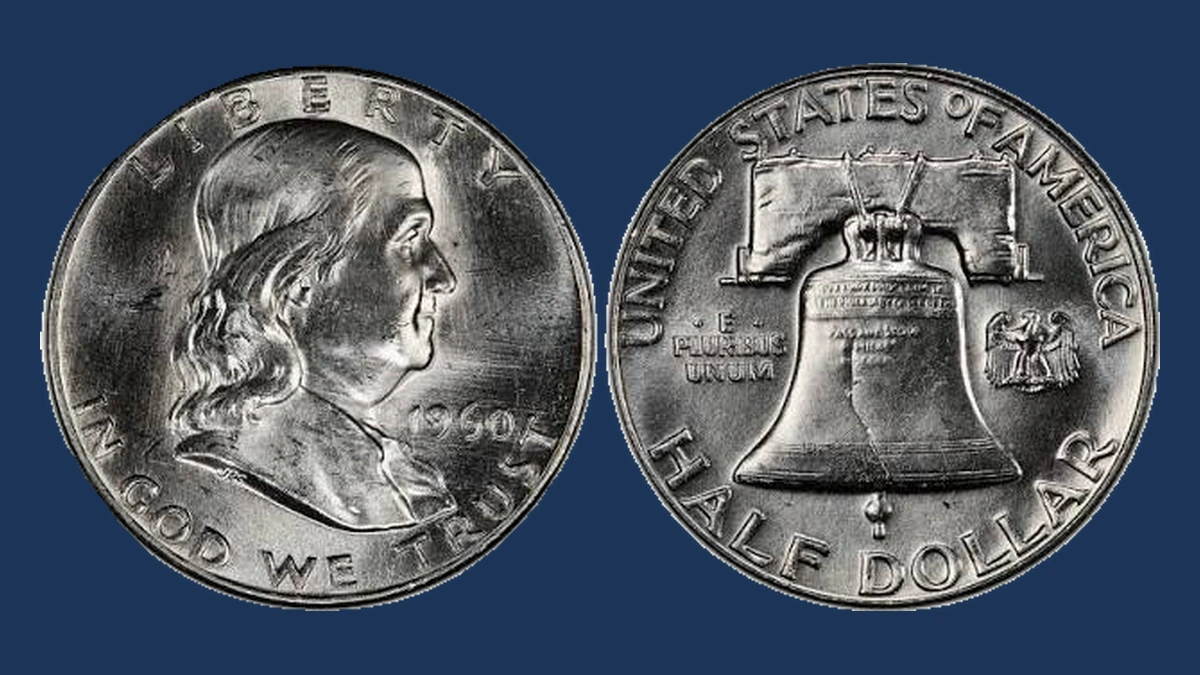
One 1960 variety gives Franklin a toothlike projection at his mouth. PCGS also lists a different front-side clash, so the two names should not be treated as one pattern.
Both can begin when the dies hit each other without a blank between them. Part of the back design marks the front die and appears on later coins.
The mouth effect is nicknamed Bugs Bunny. The other clash needs its own photographs rather than the same tooth requirement.
Sharp bell lines may accompany either. They describe how clearly the design formed, not another mistake or the cause of the extra marks.
Estimated Value
PCGS records a $350 eBay sale for an MS64 FBL front-clash example in August 2019. FBL means Full Bell Lines, with complete sharp lines at the bell’s bottom.
Estimate $50–$200 for ordinary unworn clashes and $200–$500 for stronger certified examples with relevant bell-line quality.
The recorded price belongs to that particular variety. A toothlike mark on another die does not automatically carry the same value or condition.
How to Identify
For Bugs Bunny, look at Franklin’s mouth through a 10× magnifier and compare with a known 1960 example. For the other listed clash, use its own photographs instead.
Check the Philadelphia issue without a mint letter and inspect the edge grooves. A digital scale and calipers can compare accessible coins with 12.50 grams and about 30.6 millimeters.
Follow extra shapes into the nearby flat surface and compare them with parts of the back design. A scratch or crack may lie nearby without sharing that relationship.
Find the transferred shape that matches the chosen variety. Sharp bell lines help judge the coin’s quality, but they do not establish its clash.
5. 1960 Franklin Half Dollar Proof Doubled Die Obverse (Estimated Up to $750)
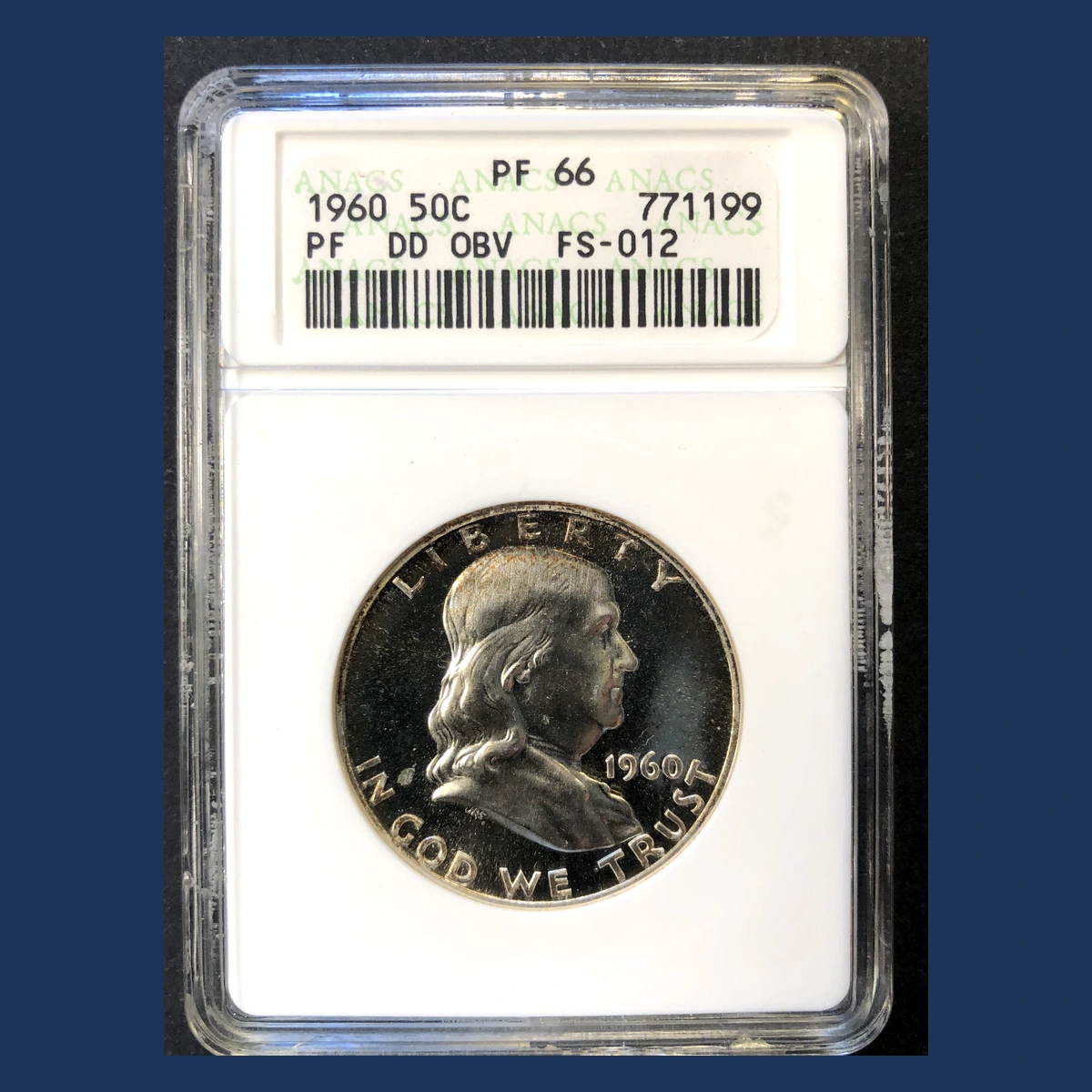
LIBERTY, the motto, and the date are the places to examine on this widely collected Proof. It is a specially made collector issue, not a regular coin that happens to shine.
Wexler describes the extra design as spread counterclockwise around a pivot near 7 o’clock. Different letters therefore need not show equally strong separation.
The extra shapes were already in the die. That differs from flat doubled-looking edges caused as a coin was struck.
A PCGS PR67 example appears in the Dogood Collection auction record. Slight thickening on an everyday-use half dollar does not automatically identify that same Proof variety.
Estimated Value
Estimate $50–$200 for ordinary identified Proofs through PR67, and $250–$750 for stronger higher-grade examples. The year guide places PR65 around $125–$150 and PR67 around $130–$175.
It lists PR68 above $525. These estimates rise with the grade; they are not a recorded sale price for the Dogood coin.
Clean reflective surfaces and clear separation matter. Strong frosted-design contrast needs its own comparison rather than a fixed additional charge for doubling.
How to Identify
Keep LIBERTY, the motto, and every date digit in a clear front photograph. Compare with a known Proof example through a 10× magnifier.
Watch how the spacing changes across the words. The extra outlines should fit a consistent turn around the described pivot, rather than point randomly in different directions.
Inspect the edge grooves and check accessible coins with a digital scale and calipers against 12.50 grams and about 30.6 millimeters. Do not wipe the reflective surface to improve the view.
Matching raised extra contours across the lettering and date identify the feature. One thick 6 or a shiny background alone does not show the doubled Proof design.
6. 1960 Franklin Half Dollar Strike-Through and Retained Fragment (Estimated Up to $1,000)
Sometimes the object that blocks a strike stays on the coin. Fred Weinberg described a small retained aluminum fragment near the bell’s lower-left base on a 1960-D graded PCGS AU55.
That grade describes a nearly unworn coin. The piece of aluminum supplies more to examine than an empty impression alone.
A separate Philadelphia report has a short mark above a T in TRUST. It does not identify the same material or the same specimen.
Both involve something between die and blank during stamping. The attached piece still needs to show that it was there then, rather than glued on later.
Estimated Value
A modest original impression on an everyday-use coin has an estimated $50–$150 range. A convincing retained fragment on an attractive nearly unworn or unworn example is estimated at $250–$1,000.
No exact realized price is assigned to Weinberg’s AU55. The larger range allows for the visible object and its interest to collectors.
Keep the reported aluminum material, attachment, and wear with that coin. Another object or an ordinary empty mark needs a different comparison.
How to Identify
Inspect the Philadelphia mark above TRUST with a 10× magnifier. Look for a depression formed with the surrounding design rather than a later scrape, without naming its material from shape alone.
On the Denver coin, examine the attached piece’s edges and nearby design. Leave it in place so that evidence is not disturbed.
The normal half weighs 12.50 grams and measures about 30.6 millimeters. A digital scale, calipers, and photographs of the edge grooves help check accessible coins.
Original metal pressed around a retained piece supports its presence during stamping. Glue, solder, or loose debris does not show the same connection, even if it sits in the reported location.
7. 1960 Franklin Half Dollar Struck on a Split Planchet (Estimated Up to $1,200)
A broad layer split from the blank before the designs were stamped. The remaining thin piece then entered the press with much less metal to fill the tools’ details.
This differs from a small local peel. A CONECA example weighs 77.3 grains, about 5.01 grams, and has the front on the smoother outer surface.
Its back design lies on the rough, lined interior exposed by splitting. Those measurements and sides belong to that particular coin.
NGC separately records a certified 1960 split-before-strike half. The information does not establish that the CONECA illustration and the auctioned coin are the same piece.
Estimated Value
NGC reports a $630 sale including fees at Heritage in June 2023 for a 1960 split-before-strike half. That is a direct dated sale for this error.
Estimate $400–$1,200 for a similar substantial split with clear identity and original surfaces. No numerical grade is supplied for that auction coin.
The separate 5.01-gram example needs its own price comparison. Its surviving design, wear, and surface condition may differ from those of the auction coin.
How to Identify
Measure thickness and width with calipers before assuming a light coin is simply worn. A much thinner body near the usual 30.6-millimeter outline is worth examining.
A digital scale can compare accessible coins with the normal 12.50 grams. Under a 10× magnifier, look at the rough separated surface for actual stamped design.
That sequence matters. If a finished coin split afterward, the newly exposed interior would not carry the same normal impression from a die.
Inspect the edge profile and remaining grooves for filing or artificial thinning. Weak but real design stamped into an original rough, lined separation surface shows that the thin fragment reached the press after splitting.
8. 1960 Franklin Half Dollar Nickel Planchet Error (Estimated Up to $7,500)
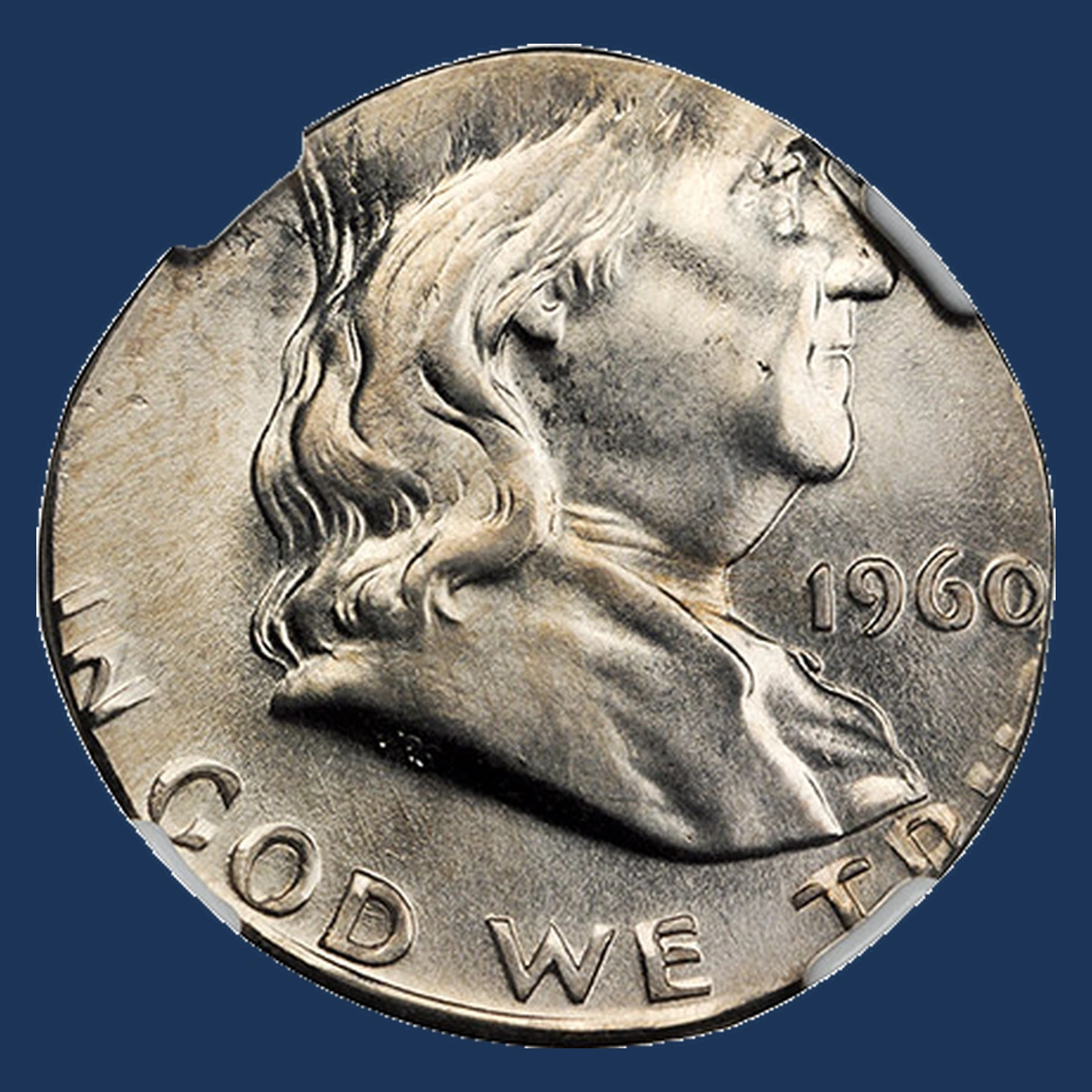
A nickel blank offered too little room for Franklin and the bell. NGC’s gallery identifies a 1960-D half dollar struck on that smaller copper-and-nickel disc, graded MS66.
The half-dollar design extends beyond the available metal. Surviving details show that the larger denomination’s tools struck the wrong blank.
The Denver identity comes from the documented example, not the metal’s color. Silver and copper-nickel can look similar in photographs.
A normal nickel blank starts near five grams. That is the usual blank weight, not a measurement taken from this particular gallery coin.
Estimated Value
Estimate $3,000–$7,500 for an authenticated 1960-D nickel-blank strike with strong surviving identity. The gallery’s MS66 has no recorded sale price in the material used here.
A 1962-D nickel-blank half graded NGC MS67 sold for $4,312.50 at Heritage in January 2009. It supplies a different-year comparison for the same kind of error.
Grade, readable date, mint, and surviving design matter together. A smaller outline or neighboring grade alone cannot set the price.
How to Identify
Weigh an accessible coin on a digital scale, comparing with a nickel’s five grams and a half dollar’s 12.50 grams. Calipers should record width and thickness.
A nickel blank starts about 21.2 millimeters wide, compared with the half’s 30.6 millimeters. Stamping can spread the smaller disc beyond its starting size.
Inspect the edge with a 10× magnifier for trimming or filed grooves. Check copper-nickel composition independently of color, and photograph the remaining date, Denver mint evidence, and cut-off design.
The correct metal and weight should agree with half-dollar details cut off naturally at the smaller edge. Together they explain a nickel blank, while small size alone cannot establish which disc was struck.
Conclusion
A small peel, a broad split, and a nickel blank can all make a half dollar lighter, but their surfaces tell different stories. Look at how the design meets the remaining metal before choosing a name.
Estimated ranges span $40–$7,500. Keep collector Proof doubling separate from ordinary-issue clashes, and leave any retained piece untouched; its attachment may preserve the clue that explains the error.