2001 Half Dollar Error List with Pictures

A 1974-D Kennedy half dollar with doubled lettering sold for $575 at Heritage in September 2005. That older sale provides a comparison for some 2001 half dollar errors, whose estimated values here range from $10 to $600.
The unusual 2001-P example has a back that bulges outward, with raised cracks around the eagle. Read on to check that shape, shifted designs, extra-wide edges, and possible doubling.
1. 2001 Kennedy Half Dollar Broadstrike Error (Estimated Up to $75)
The coin looks wider than usual, but the whole design still fits. That is the combination to look for in a broadstrike.
A metal ring normally stops the blank from spreading too far and forms the grooves around its edge. Without that restraint, the coin can spread outward.
The design does not have to sit exactly in the center of the wider shape. Broadstrikes are reported in the 2001 year guide, but that description names no particular mint, amount of widening, or coin sold at auction.
Estimated Value
Use an estimated $40–$75 for a straightforward 2001 broadstrike. The September 2025 Mint Error News price guide gives that range for regular copper-nickel Kennedy halves, including worn and unworn examples.
This is a price-guide comparison, not a recorded 2001 sale. A clearly widened coin with clean surfaces is a better fit for the upper figure than one with a slight change in shape and many distracting marks.
How to Identify
First, check that the outer lettering remains complete on both sides. Missing letters at one edge may indicate that the whole blank sat off center instead.
Take several careful measurements around the outline with calipers, using 30.61 millimeters as the normal diameter. The coin may be wider in one direction than another.
Weigh it against the regular 11.34 grams, then inspect the edge with a magnifier for missing or uneven grooves. Hammer marks and flattened details can indicate damage after minting.
The quickest useful check is a complete design inside a naturally widened border, with the unusual edge supporting the same explanation.
2. 2001 Kennedy Half Dollar Doubled Die Reverse (Estimated Up to $150)
An eagle feather or a letter may seem to have an extra edge. Look at its shape before deciding that it is doubled.
A true doubled die is a steel stamping tool made with a doubled design. Coins struck by that tool can carry the same repeated details.
The eagle’s feathers and nearby letters are useful places to examine, but no particular spot here identifies a named 2001 variety. A flat shelf beside a letter can instead come from movement during striking, which is a different effect from a doubled design in the tool.
Estimated Value
The estimated range for genuine, identified 2001 doubling on the back is $10–$150. Clear extra details and good condition support the higher end.
For a lower-priced comparison, a seller-described 2024-P VDDR-002 sold on eBay for $6 in April 2026. It was advertised as unworn and was outside a grading holder, so this was a seller’s identification of a later coin rather than certified evidence of a 2001 variety.
How to Identify
Move the light before reaching for a higher-powered photograph. Reflections beside raised letters can look like a second outline and disappear when the lighting changes.
Follow the suspected extra shape with a 10× magnifier. Rounded separation deserves attention, while a low, flat shelf may result from movement during striking.
Compare with a normal coin of the same mint and finish, and check the edge grooves. Regular coins weigh 11.34 grams; silver Proofs, specially made for collectors, weigh 12.50 grams.
Use a scale and calipers to check those weights and the usual 30.61-millimeter width.
A second raised shape that stays visible as the light changes is the quickest useful clue to investigate.
3. 2001 Kennedy Half Dollar Off-Center Strike Error (Estimated Up to $200)
A blank crescent beside Kennedy’s portrait can show that the metal missed part of the strike. The opposite edge should also be missing some of the design.
This happens when the blank enters the press too far to one side. The stamping tools can reach only the metal beneath them.
Look at both sides, because one shifted tool can make an uneven rim without moving the whole blank. A readable 2001 date is also needed before calling it a 2001 error, and no particular amount of shift is established for this reported category.
Estimated Value
Estimated value is $50–$200 for a genuine 2001 off-center strike with a readable date. This uses the regular Kennedy half-dollar comparison range in the year guide, rather than a documented sale of a specific 2001 example.
The blank crescent, missing design, and overall condition all affect appeal. A dramatic shift that removes the date cannot provide the same year identification as a smaller shift with the full date still visible.
How to Identify
Turn the coin over and compare where the design ends on each side. A wide margin on the front alone does not establish an off-center strike.
Under a magnifier, check the blank crescent and the edge for grinding or filing. A clip removes metal, while an off-center strike normally leaves metal that never received a design.
A scale should read near the regular 11.34 grams. Use calipers to compare the outline with the normal 30.61-millimeter diameter, allowing for a shape that may be uneven.
The quickest check is a readable date beside untouched blank metal, with matching design loss on the back.
4. 2001-P Kennedy Half Dollar Convex Reverse and Die Cracks (Estimated Up to $300)
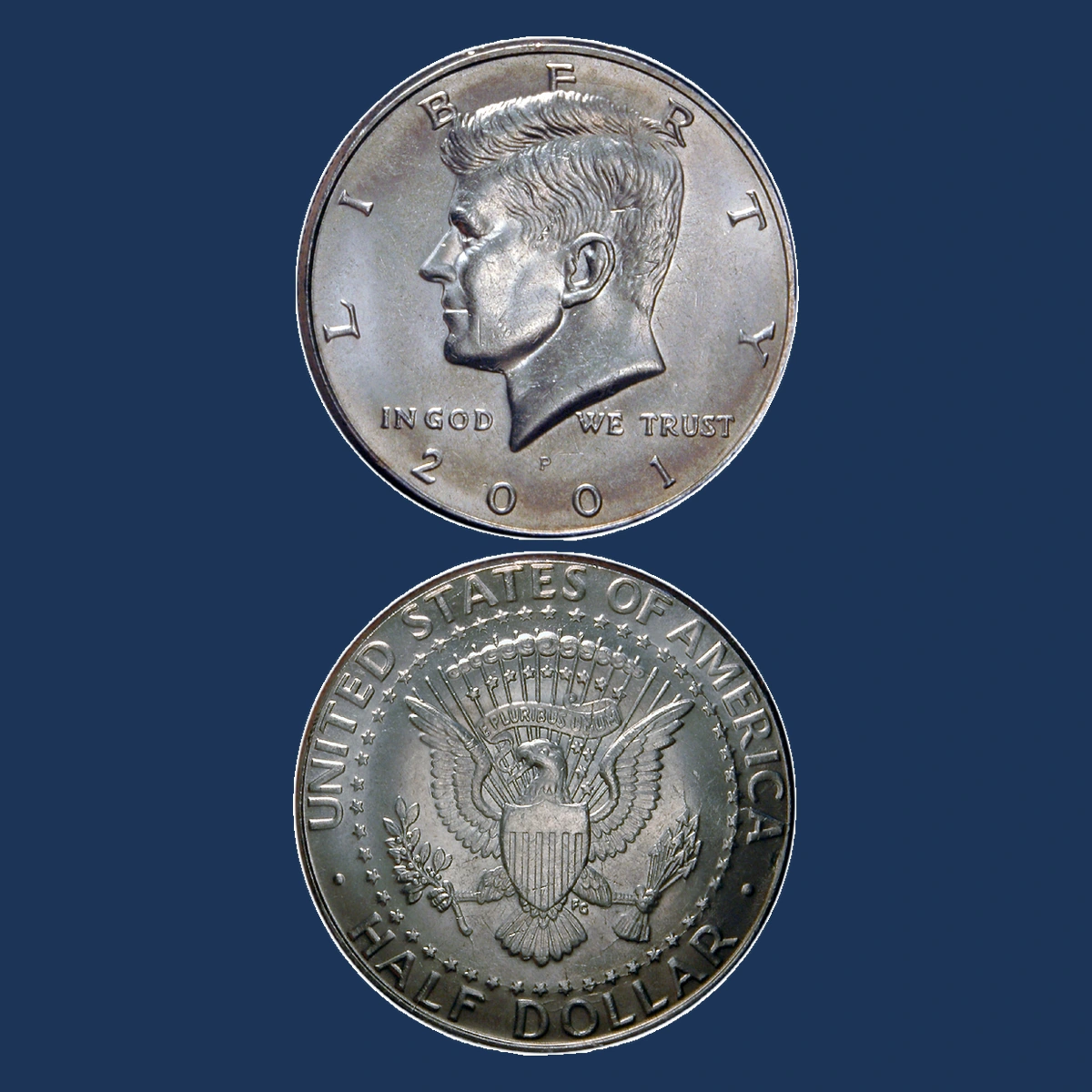
The back of this 2001-P rises toward the middle instead of sitting below the rim. Its front looks almost normal.
Pepe DeMeo found seven examples in Mint bags, according to Ken Potter’s CONECA report. Raised lines connect many of the stars around the eagle.
The report explains the shape as damage to the steel tool stamping the back, as parts of that tool began to shift and fail. The bulge and the connected lines therefore need to be checked together, rather than treating the coin as an ordinary half dollar bent after minting.
Estimated Value
The estimated value is $50–$300 for the reported bulging back with its matching cracks. An unworn 1976-D with a different break in its back stamping tool sold for $256 at Heritage in June 2026.
That coin was graded NGC MS65 and provides only a related comparison. It does not establish a sale for the 2001-P error, whose clear profile, original surfaces, and matching crack pattern support the upper end of this estimate.
How to Identify
Look along the edge under low light to see how far the back rises. Do not bend the coin or rub it against a hard surface to test its shape.
Use a magnifier to check the raised lines around the stars and through the left leg of the last A in AMERICA. Other reported lines appear among the stars and clouds above E PLURIBUS UNUM.
Check the nearly normal front and edge, then use a scale and calipers to compare 11.34 grams and 30.61 millimeters.
An outward-bulging back together with the matching raised crack pattern is the quickest way to distinguish this report from a simply bent coin.
5. 2001 Kennedy Half Dollar Doubled Die Obverse (Estimated Up to $600)
An extra-looking edge beside LIBERTY or IN GOD WE TRUST may catch your eye first. The important question is how that edge formed.
If the steel tool used to stamp the front already contained two versions of a detail, it could repeat them on many coins. This is a doubled die.
Those words are places to look, not confirmed identifying marks for a named 2001 variety. An older Kennedy example can help show what genuine doubled shapes look like, but its exact letter positions cannot simply be assigned to a coin from 2001.
Estimated Value
A 1974-D doubled die graded MS66 sold for $575 at Heritage in September 2005. MS66 means an unworn coin with relatively few marks.
That older result helps frame an estimated $50–$600 for genuine, identified doubling on a 2001 coin’s front. Clear separation and good condition matter, while an ordinary flat shelf caused by movement during striking does not receive the same extra value or establish this type of error.
How to Identify
Compare the suspected letter with the same letter on a normal 2001 coin. Use a magnifier and light from two directions so a shadow does not become your main evidence.
Look for a rounded second shape or a small split where strokes meet. A lower, flat ledge beside a thinner original stroke suggests movement during striking instead.
Inspect the edge grooves and confirm the date and mint. A scale and calipers can compare the regular 11.34 grams or silver-proof 12.50 grams, with a normal diameter of 30.61 millimeters.
A stable second design shape, rather than a changing reflection or flat shelf, is the quickest useful starting check.
Conclusion
The estimated $10–$600 range covers several different mistakes, and each needs its own check. Look at the side profile for the bulging 2001-P, the full outline for widening or a shifted strike, and the shapes of letters for doubling.
Keep the coin’s mint and metal type with its price comparison. An older auction result can help with an estimate without becoming a recorded sale for your 2001 coin.