2008 Half Dollar Error List with Pictures

A Kennedy half struck sixty-five percent off center sold for $552 in March 2023. That 1999-D coin offers a price comparison for the same error reported in 2008.
This 2008 Kennedy half dollar error list covers estimated values from $5 to $800. A graded 2008-P example also shows a front strike-through, where material blocked the design.
Read on to compare raised lines, missing metal, and shifted pictures before naming a coin’s mistake.
1. 2008 Kennedy Half Dollar Reported Die Cracks (Estimated Up to $50)
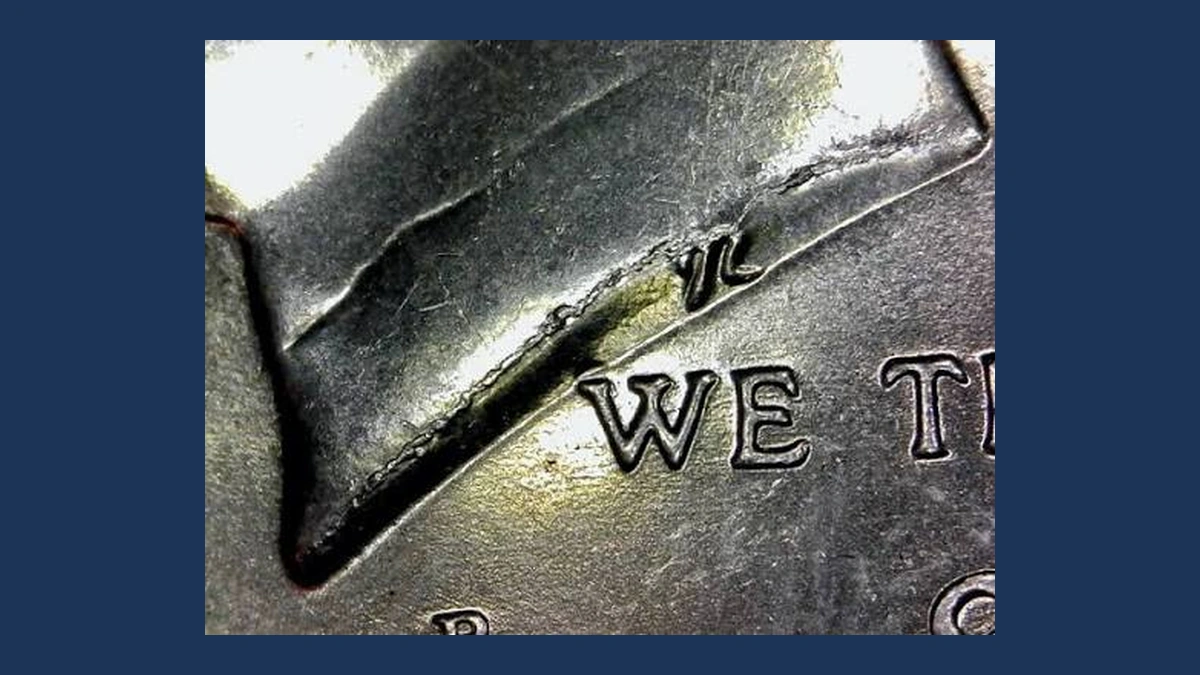
A thin raised line can come from a cracked die, the steel tool that stamps coins. Metal enters the crack during striking and forms a ridge on the finished coin.
That differs from a scratch cut into the surface. Light can make either look bright, so check the shape rather than the color.
The 2008 guide reports cracks on Philadelphia and Denver coins, mentioning lettering and hair as places to inspect. It gives no single fixed route.
A crack may grow as the tool keeps working, so related coins can show different line lengths.
Estimated Value
A confirmed thin crack on an unworn coin has an estimated value of $5–$50. A visible line crossing several details usually attracts more attention than a tiny ridge.
This estimate follows the year guide’s modest range for minor cracks. It is not a sale price for a named 2008 example.
Length alone does not set the value. The line must be original raised metal, and the rest of the coin’s condition still matters.
How to Identify
Compare the suspicious line with Kennedy’s hair on a normal coin. Some narrow raised lines belong to the intended design.
Move a desk lamp across the coin and inspect it with a 5×–10× magnifier. A crack line should stay above the surface rather than reveal a cut groove.
Do not scrape away anything that looks like dirt. Loose material sitting on top can resemble a ridge without being part of the coin.
Use a scale for the usual 11.34 g and calipers for roughly 30.6 mm on an ordinary layered-metal half. Check the grooves around the edge too.
A continuous ridge crossing an otherwise smooth area is the quickest first feature to check.
2. 2008-P Kennedy Half Dollar Reported Rim Cud (Estimated Up to $200)
A raised patch touching the rim may be a cud. This forms when a piece breaks from the edge of the steel stamping tool.
Coin metal fills the vacant space during the strike. The result is a mound where normal design detail should appear.
The reported 2008-P example has no fixed location established here. The important feature is its actual connection to the rim.
A small raised island surrounded by normal design is a different kind of break. A hammered or bent rim can also push metal upward without a stamping tool having broken.
Estimated Value
A confirmed cud on a collectible 2008-P has an estimated value of $50–$200. A broad, clear patch extending into the design can be more appealing than a narrow rim break.
The range uses the year guide’s estimate for larger breaks. No particular 2008 sale is assigned to it.
Good preservation supports the upper end. A small interior lump should not receive the same price simply because it also stands above the surface.
How to Identify
Follow the patch outward with a magnifier and see whether it joins the rim. Normal design should be missing where the raised metal takes its place.
Look at the corresponding spot on the other face for weakness. Then inspect the edge grooves for hammering or a folded rim.
Added metal may leave a seam or a different texture at its boundary. A dent usually shows where existing metal was pushed aside.
For the Philadelphia coin, check about 11.34 g with a scale and 30.6 mm with calipers. A cud does not inherently remove metal from the coin.
The first necessary check is an unbroken connection between the raised patch and the rim.
3. 2008 Kennedy Half Dollar Reported Clipped Planchet (Estimated Up to $300)
A clipped coin starts with an incomplete blank, the round metal disc used to make it. The missing section already exists when the design is stamped.
A punch overlapping an earlier hole in the metal strip can leave a curved gap. Cutting across the strip’s edge can leave a straighter missing section.
Both Philadelphia and Denver clips are reported for 2008. These possible shapes do not identify two particular confirmed coins.
The rim and design near the gap help distinguish a clip from later cutting. Reduced weight alone cannot prove when the metal disappeared.
Estimated Value
Two different-year sales show the variety of clip prices. A 1998-D ten-percent triple clip graded PCGS MS63 sold for $99 in March 2025.
A forty-five-percent curved clip graded NGC MS66 brought $240 in July 2021. Both grades describe unworn coins, with MS66 allowing fewer marks.
Using these comparisons, estimate $50–$300 for a confirmed 2008 example. The remaining date, attractive surfaces, and original rim around the gap matter alongside the amount missing.
How to Identify
Weigh the coin before examining the gap. Compare an ordinary layered-metal half with 11.34 g, and use calipers across intact sections against about 30.6 mm.
The weight loss should make sense for the missing area. A tiny gap should not explain an enormous shortage.
Use a magnifier where nearby lettering and the rim meet the opening. Filing grooves, a sharp burr, or a freshly cut wall suggest later removal.
Examine the remaining edge grooves and check the opposite rim for weakness. That weakness can help, but it does not appear equally on all genuine clips.
Follow the original rim into the gap first; a smooth strike-shaped transition is more helpful than weight alone.
4. 2008-P Kennedy Half Dollar Reported Doubled Die (Estimated Up to $350)
The same extra outline on two coins can reveal more than blurred lettering on one. A doubled die carries its repeated detail before any coin is struck.
The die is the steel tool that stamps the design. Coins made with that tool can share the same small duplicated feature.
CoinTrackers reports doubled dies for 2008-P, but gives no numbered variety or definite affected side. No particular ear, digit, or feather is established here.
Movement during one strike can instead flatten a letter’s edge. That does not necessarily create a recurring variety.
Estimated Value
A confirmed unworn example has an estimated range of $60–$350. A clearly repeated pattern with visible separation can support more interest than barely noticeable extra edges.
This estimate uses modern Kennedy comparisons, including a nearby 2007 guide starting around $60. That figure is a guide estimate, not an auction result.
No 2008-P sale is claimed here. An ordinary coin’s grade alone cannot establish extra value for a doubled design.
How to Identify
Photograph the feature beside the same area on a normal 2008-P, keeping the light similar. A 10× magnifier helps separate a rounded outline from a flat shelf or reflection.
Compare like finishes. Ordinary coins and satin mint-set coins have different-looking surfaces, although both use the same normal 11.34 g layered-metal construction.
Check that weight with a scale, measure about 30.6 mm with calipers, and inspect the edge grooves. Then look for another coin showing the same extra detail.
Random flat edges or worn-tool lines do not make a matching pattern. An identical, clearly photographed feature on another correctly identified coin gives the strongest quick starting point.
5. 2008 Kennedy Half Dollar Obverse Strike-Through and Reported Grease Errors (Estimated Up to $400)
Something interrupted the front design on a 2008-P coin graded NGC MS66. The GreatCollections listing identifies it as a strike-through without naming the material.
A strike-through happens when material lies between the coin and the stamping tool. It can leave a shaped impression or a patch of weak design.
Grease-related weakness is separately reported on Philadelphia and Denver coins, including satin mint-set pieces. Those reports do not prove that grease caused the listed coin’s mark.
MS66 describes a well-preserved unworn example. Its grade describes condition, while the error name explains the interrupted strike.
Estimated Value
The estimated range is $15–$400, covering a small weak patch through a clear impression on a well-preserved coin. More obvious shapes can attract greater collector interest.
A 1992-D struck through a fragment bearing edge grooves sold for $336 in July 2021. NGC graded it MS64, meaning unworn with some marks.
That identifiable-object error is a different-year comparison. No realized price or particular trapped material is assigned to the listed 2008-P MS66.
How to Identify
Find where sharp design gives way to the affected area. Use a magnifier and movable light to inspect the transition without touching or cleaning it.
A gouge can leave torn metal or a raised lip. Normal wear tends to flatten high points more broadly instead of creating one sharply limited interruption.
Inspect the edge grooves for separate damage and confirm the P or D mintmark. Ordinary and satin mint-set coins both normally weigh 11.34 g and measure about 30.6 mm.
Check those figures with a scale and calipers on a loose coin. The boundary between normal and interrupted detail is the first useful clue; name a material only if its imprint supports that name.
6. 2008 Kennedy Half Dollar Reported Off-Center Strike (Estimated Up to $600)
An off-center strike leaves part of the metal plain, rather than removing that metal. The disc sat partly outside the reach of the stamping tools.
The overlapping portion received the design. The rest stayed unstruck, with some outer details missing from the picture.
This error is reported for ordinary Philadelphia and Denver 2008 coins without a specific direction or percentage established here. Both faces should show a compatible shift.
If only the front has an uneven border, one tool may have been misaligned instead. A complete design on an expanded coin needs another explanation too.
Estimated Value
A 1999-D struck sixty-five percent off center brought $552 in March 2023. NGC graded it MS66, a well-preserved unworn grade.
Use an estimated $75–$600 for a confirmed 2008 example, from a modest shift to an attractive dramatic one. This is a different-year comparison, not a recorded 2008 sale.
The date needs to remain readable. An undated coin cannot be given a 2008 identity simply because its design looks similar.
How to Identify
Place the coin flat and compare photographs of both faces. Keep track of the same part of the rim so the shift can be compared correctly.
Use a magnifier to examine where each picture stops. Plain metal should look original, without grinding marks or a chemically roughened surface.
Check the readable date and surviving mintmark next. A scale should usually be near 11.34 g; calipers can compare the irregular outline with the normal 30.6 mm diameter.
Inspect the grooves around the edge and any portions that escaped the retaining ring. Matching displacement on both sides beside untouched metal gives the quickest answer before estimating a percentage.
7. 2008-P Kennedy Half Dollar Reported Missing Clad Layer (Estimated Up to $700)
Copper showing around a normal half dollar’s edge is expected. Copper appearing across a face may indicate that some outer covering is missing.
Ordinary Kennedy halves have copper-nickel layers bonded to a copper core. A remaining layer’s boundary can help show where that bond failed.
Partial and missing layers are reported for 2008-P without a fixed face, weight, or amount of loss. Those details must come from the actual coin.
A brown face can also result from normal darkening or chemicals. The year’s silver collector proofs use a different composition from the Philadelphia coins discussed here.
Estimated Value
The estimated range is $125–$700 for a confirmed unworn example. A small damaged covering and a nearly missing face need different assessments.
A 1998-P with defective front cladding sold for $149 in March 2023. NGC graded it MS63, meaning unworn with noticeable marks.
That is a related different-year comparison. Stronger loss with original struck detail can support the upper estimate, while staining or normal copper at the edge does not establish an error.
How to Identify
Look at the face and edge together with a magnifier. Find a physical boundary where surviving outer metal meets exposed copper, rather than relying only on color.
Photograph that boundary at a slant to show any difference in height. Then use a scale against the normal 11.34 g.
Substantial missing metal should lower the weight, although a tiny loss may be difficult to measure. Calipers should be compared with about 30.6 mm, and the edge normally has grooves.
Check for scraping or chemical roughness that could indicate later removal. An original layer boundary that fits both the visible loss and reduced weight is the most useful first confirmation.
8. 2008 Kennedy Half Dollar Reported Multiple Strike (Estimated Up to $800)
A second portrait edge or repeated lettering can come from another strike on the same coin. This happens when the coin remains in the press and moves before the tools strike again.
The later picture can overlap and partly flatten the first. Several surviving features should fit the same movement.
Multiple strikes are reported for ordinary Philadelphia and Denver 2008 coins. No particular number of blows, direction, or turning angle is established here.
A flat shelf beside one letter is not enough. It may come from movement during one strike rather than the coin receiving another.
Estimated Value
The year guide supports an estimated $200–$800 for a clearly confirmed multiple strike. Readable overlapping pictures and a visible date make the error easier to appreciate.
A 1998-P double strike with a broadened second impression sold for $317.20 in June 2026. CACG graded it MS64, meaning unworn with some marks.
That different-year coin provides an actual sale comparison. Its grade and sequence of strikes are not facts established for a particular 2008 example.
How to Identify
Choose two nearby features, such as a portrait edge and a letter, and compare their repeats with a 5× magnifier. They should show the same movement between impressions.
Turn the coin over for more evidence, remembering that a later strike can flatten earlier detail. A flat shelf confined to one letter is less useful than a surviving second picture.
Check about 11.34 g with a scale and compare the outline with 30.6 mm using calipers. Another strike can spread the metal without removing it.
Inspect the edge grooves and surrounding surface for changes that fit that spreading. Start with a second impression crossing several design features; it reveals another strike more clearly than isolated doubled edges.
Conclusion
These 2008 categories have estimated values from $5 to $800. A raised crack line, a missing outer layer, and an off-center picture leave different clues.
Compare the visible feature with the edge and, where needed, the weight. Keep the date, mintmark, and finish clear in your photographs.
The graded front strike-through confirms one particular example, but it does not identify the trapped material. Judge each coin by what its surfaces actually show.